IINNTTEEGGRRAATTEEDD LLOOGGIISSTTIICCSS
GGEENNEERRAALL IINNFFOO
Title : An Integrated Logistics System Based on Wireless Portable Terminals
Period : 1996
Company : ELAIS S.A.
Country : GR
Contact : http://www.netor.gr/sm/annual/elais.htm
Company description : ELAIS S.A. is the most important producer and distributor of oil and fat
based products in Greece, and one of the leading companies in the whole Food and Beverages
sector (sixth in terms of turnover and third in terms of profit).
ELAIS is now part of the UNILEVER group of companies.
The company has four main business activities:
ü Processing, packaging and distribution of olive oil;
ü Production and distribution of other oils, margarine and cooking fat;
ü Production and distribution of oils and cooking materials for professional use;
ü Import and distribution of other UNILEVER products.
ELAIS Page 2 of 10
Olive oil is the company’s most important business. ELAIS collects raw olive oil from individual
producers, co-operatives and merchants around Greece. The raw olive oil is then processed,
standardised and bottled for re-distribution and marketing under the company’s brand name.
The second business activity is the production and distribution of other oil products
such as corn oils, margarine and cooking fat. These products are marketed under specific brand
names and are addressed to the consumer market.
The third activity is the production and distribution of oils and cooking materials for professional
use in bakeries, hotels and restaurants. These products are used as raw materials in various
other food industries, pre-prepared food production, or services. The fourth and final activity is
the import and distribution of UNILEVER group products, including such brand names as Zwan,
John West, Raguletto, Calve, Linea and Lipton. The company operates a major production unit
and two distribution units in the Athens area. It has an extended distribution network consisting
of about 25 regional distribution hubs in all major Greek cities.
TTHHEE UUNNIILLEEVVEERR GGRROOUUPP
Unilever is one of the top industrial companies in the world, ranking 21st in the 1995 Fortune
500 list (ordered by net profit). Half of Unilever’s business is in food, while detergents and
toiletries are also a significant business. The group focuses on six main areas – margarine, tea,
ice cream, culinary products, frozen foods and bakery products. Due to the nature of food
products, and differences in national diets, Unilever acts as a local company in each country,
with different products, operations and so on. Thus, around half of the 585 million pounds
sterling research and development budget is spent in local company development departments.
FFIINNAANNCCIIAALL RREESSUULLTTSS
Despite the ongoing recession of the Greek market for consumer products — which for many
years has suffered from economic stagnation and inflation — the financial results of ELAIS S.A
have been more than satisfactory. In 1996, turnaround increased from 60,4 billion Drs. to 63,1
billion Drs. (4,47% increase). Net profits before taxes where 5,65 billion Drs, compared to 5,3
billion Drs. In 18995 (6,6% increase). The company operates at a 8,95% net profit margin,
which is good for the Food and Beverages sector. Further, the profit increase was not due
exclusively to growth in market share. A significant part (about 2%) came from extensive
investment over recent years in new technology and re-organisation.
ELAIS Page 3 of 10
Principal financial data (in bi Drs)
1995 1996
Turnover 60.423 63.147
Gross Profit 17.773 19.155
Net Profit 5.334 5.651
Investments 945 1.212
Labour Costs 5.335 5.585
Note that labour costs represent 41,5% of the total value added.
Industry: Consumer Goods - foodstuffs
NACE: 15 Manufacture of Food Products
Process: Process — Logistics
Domain: Data Acquisition
TTHHEE FFOOOODD AANNDD BBEEVVEERRAAGGEESS SSEECCTTOORR IINN GGRREEEECCEE
The Food and Beverages sector is the most dynamic sector of Greek industry; it has the highest
capital investment and regularly returns the best performance. A high development rate over
recent years has to some extent insulated the sector from the general trend towards
globalisation. Further, the sector has seen several significant mergers which have resulted in
the establishment of important chains. In investment terms, the gross value of installed
equipment has steadily increased over recent years by about 25% per annum.
ELAIS Page 4 of 10
MMAARRKKEETT PPOOSSIITTIIOONN
Despite the emergence of substitutes (such as soya or corn oil), olive oil remains a significant
product for all Mediterranean countries and is therefore an important market. However, over
recent years the European olive oil market has suffered from many serious problems. Poor
crops in Spain have led to short term shortages, increased producer and consumer prices, and
a significant decrease in consumption. The ELAIS strategy — which the company has been
pursuing with considerable success — is targeted at retaining the leading market position of
their branded products and maintaining or even increasing market shares without sacrificing
financial performance. The market of margarine and cooking fat has also been in recession
caused by macro-economic factors and increased competition. This increased competition
comes both the growing penetration of new brand names and from the marketing of extremely
low price products by big supermarket chains. Despite this, ELAIS has managed to retain its
leading market position, primarily by using high quality standards as a competitive advantage.
CCOOMMPPAANNYY SSTTRRAATTEEGGYY
During the last five years, the company has undertaken a major reorganisation campaign with
two main focal points:
ü heavy investment in production facility modernisation, cost reduction, quality
improvement, new product development and environmental protection; the
investment in 1996 was 1,4 billion Drs.
ü thorough re-organisation of business processes in order to achieve a streamlined
operation.
The company has gradually implemented Total Productive Manufacturing, a Total Quality
Management system, the European Foundation for Quality Management Model for Business
Excellence, and so on.
TTHHEE PPRROOJJEECCTT
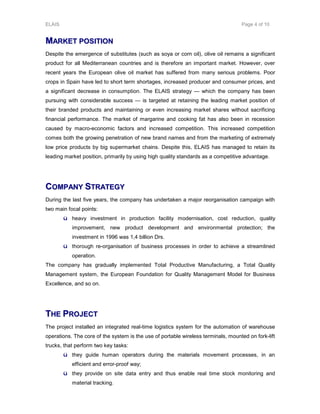
The project installed an integrated real-time logistics system for the automation of warehouse
operations. The core of the system is the use of portable wireless terminals, mounted on fork-lift
trucks, that perform two key tasks:
ü they guide human operators during the materials movement processes, in an
efficient and error-proof way;
ü they provide on site data entry and thus enable real time stock monitoring and
material tracking.
ELAIS Page 5 of 10
The results of the project have been spectacular. In addition to delivering cost savings and
considerable reductions in lead times, it has also enabled quality critical material tracking and
eliminated costly errors.
PPRROOJJEECCTT OOBBJJEECCTTIIVVEESS
The very nature of ELAIS operation entails a considerable overhead in logistics operations.
Both incoming and outgoing material flows are characterised by large quantities of a huge
variety of different product codes. Moreover, outgoing material flows include the preparation and
shipment of large numbers of customer orders in very short lead times. Each order usually
includes modest quantities of many different product codes. Thus, the company’s warehouses
are complex and fast moving, and their operation was both complicated and error prone. Prior
to the installation of the system, the operational complexity not only generated high operational
cost (as measured in labour hours and idle time) but was also highly error prone, incurring
additional costs for error correction. Furthermore, both legal obligations and quality
considerations engender two major requirements that are difficult to satisfy without effective IT
support:
ü Absolute FIFO (First-in First-out) warehouse operation, to ensure that fresh products
are distributed and eliminate the possibility of keeping a lot in the warehouse after its
expiry date;
ü The capability for absolute lot control, so that it is possible to efficiently withdraw a
defective lot.
Thus, ELAIS faced the major challenges of improving the organisation of their fast moving
warehouses and instituting continuous monitoring of their products so as to better serve their
customers and ensure high quality. The project focused on a number of specific objectives that
ensure high quality standards in the flow of products to the end customers. These include:
ELAIS Page 6 of 10
ü Better organisation of the warehouses operation, in order to reduce administrative
overhead and related costs;
ü Absolute FIFO (First-in First-out) product flow, reflecting the existence of expiry
dates and the sensitive nature of food products;
ü Conformance to legal obligations concerning lot tracking and control and the
capability for lot withdrawal;
ü Adhesion to the requirements of the ISO 9001 standard.
IITT IINNFFRRAASSTTRRUUCCTTUURREE
ELAIS operates a comprehensive and flexible IT infrastructure, used to support most of the
company’s operations. The hardware includes:
ü An AS/400 server
ü 10 RISC dedicated application servers
ü A campus wide high speed LAN
ü About 200 user PCs and Workstations
ü A high speed digital WAN network (HellasCom) connecting all 25 regional
distribution centres.
In addition to custom applications software, several other major application packages have
been installed, including:
ü SAP (sales and financial modules)
ü MFG /PRO from QAD Inc. for integrated global supply chain management.
ü MRP II (Manufacturing Resources Planning)
ü Lotus Notes based workflow and groupware applications.
ü Electronic Data Interchange Software, based on EDI-TIE EDIFACT, for
communication with major customers.
The company has a dedicated IT department, responsible for applications deployment, system
management and user support. It also has a clear strategy for the future evolution of its IT
systems. Broadly, the company is gradually moving to a three-tier architecture and is planning
to base more of its operations on Windows NT servers.
IIMMPPLLEEMMEENNTTAATTIIOONN
With the new system installed by the project, all ELAIS products are constantly monitored
throughout the entire period from leaving the production line to being loaded onto trucks and
delivered to their final distribution point. More specifically, the warehousing process starts from
the moment the products are packaged and put onto pallets at the end of the production line. As
ELAIS Page 7 of 10
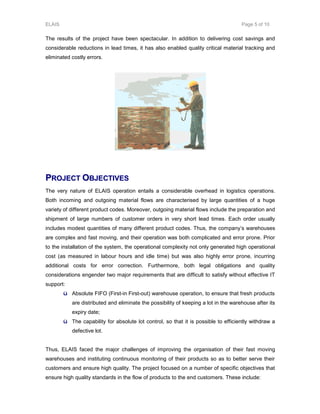
soon as the pallet is complete, it is collected by a fork-lift truck whose operator scans the bar
code that is printed on the card boxes. This bar code alone is used for product identification
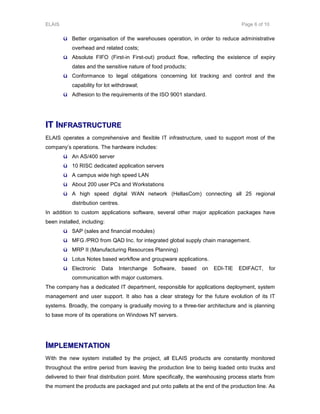
throughout the process. The IDEF0 (SADT) diagram below depicts the process structure. Within
this structure, the “define storage location” sub-process is itself quite complex. The system must
establish the pallet contents from the pallet code and determine the appropriate storage location
according to a number of factors, such as the specific product storage requirements, warehouse
space availability, the master delivery plan, and so on.
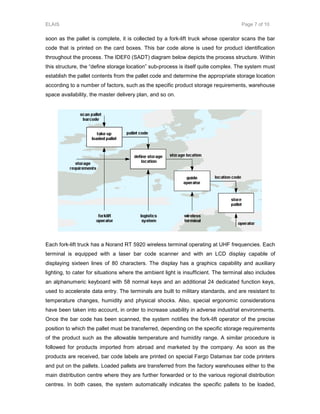
Each fork-lift truck has a Norand RT 5920 wireless terminal operating at UHF frequencies. Each
terminal is equipped with a laser bar code scanner and with an LCD display capable of
displaying sixteen lines of 80 characters. The display has a graphics capability and auxiliary
lighting, to cater for situations where the ambient light is insufficient. The terminal also includes
an alphanumeric keyboard with 58 normal keys and an additional 24 dedicated function keys,
used to accelerate data entry. The terminals are built to military standards, and are resistant to
temperature changes, humidity and physical shocks. Also, special ergonomic considerations
have been taken into account, in order to increase usability in adverse industrial environments.
Once the bar code has been scanned, the system notifies the fork-lift operator of the precise
position to which the pallet must be transferred, depending on the specific storage requirements
of the product such as the allowable temperature and humidity range. A similar procedure is
followed for products imported from abroad and marketed by the company. As soon as the
products are received, bar code labels are printed on special Fargo Datamax bar code printers
and put on the pallets. Loaded pallets are transferred from the factory warehouses either to the
main distribution centre where they are further forwarded or to the various regional distribution
centres. In both cases, the system automatically indicates the specific pallets to be loaded,
ELAIS Page 8 of 10
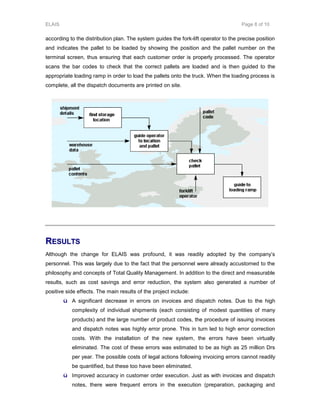
according to the distribution plan. The system guides the fork-lift operator to the precise position
and indicates the pallet to be loaded by showing the position and the pallet number on the
terminal screen, thus ensuring that each customer order is properly processed. The operator
scans the bar codes to check that the correct pallets are loaded and is then guided to the
appropriate loading ramp in order to load the pallets onto the truck. When the loading process is
complete, all the dispatch documents are printed on site.
RREESSUULLTTSS
Although the change for ELAIS was profound, it was readily adopted by the company’s
personnel. This was largely due to the fact that the personnel were already accustomed to the
philosophy and concepts of Total Quality Management. In addition to the direct and measurable
results, such as cost savings and error reduction, the system also generated a number of
positive side effects. The main results of the project include:
ü A significant decrease in errors on invoices and dispatch notes. Due to the high
complexity of individual shipments (each consisting of modest quantities of many
products) and the large number of product codes, the procedure of issuing invoices
and dispatch notes was highly error prone. This in turn led to high error correction
costs. With the installation of the new system, the errors have been virtually
eliminated. The cost of these errors was estimated to be as high as 25 million Drs
per year. The possible costs of legal actions following invoicing errors cannot readily
be quantified, but these too have been eliminated.
ü Improved accuracy in customer order execution. Just as with invoices and dispatch
notes, there were frequent errors in the execution (preparation, packaging and
ELAIS Page 9 of 10
shipment) of customer orders. This generated considerable costs (for the
replacement of mistakenly shipped items, re-shipment of omissions and so on) and
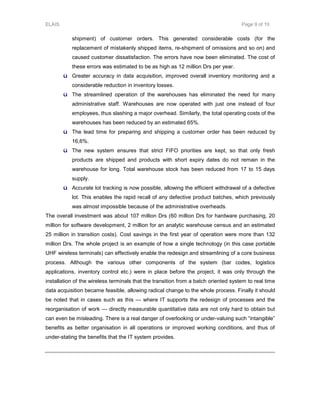
caused customer dissatisfaction. The errors have now been eliminated. The cost of
these errors was estimated to be as high as 12 million Drs per year.
ü Greater accuracy in data acquisition, improved overall inventory monitoring and a
considerable reduction in inventory losses.
ü The streamlined operation of the warehouses has eliminated the need for many
administrative staff. Warehouses are now operated with just one instead of four
employees, thus slashing a major overhead. Similarly, the total operating costs of the
warehouses has been reduced by an estimated 65%.
ü The lead time for preparing and shipping a customer order has been reduced by
16,6%.
ü The new system ensures that strict FIFO priorities are kept, so that only fresh
products are shipped and products with short expiry dates do not remain in the
warehouse for long. Total warehouse stock has been reduced from 17 to 15 days
supply.
ü Accurate lot tracking is now possible, allowing the efficient withdrawal of a defective
lot. This enables the rapid recall of any defective product batches, which previously
was almost impossible because of the administrative overheads.
The overall investment was about 107 million Drs (60 million Drs for hardware purchasing, 20
million for software development, 2 million for an analytic warehouse census and an estimated
25 million in transition costs). Cost savings in the first year of operation were more than 132
million Drs. The whole project is an example of how a single technology (in this case portable
UHF wireless terminals) can effectively enable the redesign and streamlining of a core business
process. Although the various other components of the system (bar codes, logistics
applications, inventory control etc.) were in place before the project, it was only through the
installation of the wireless terminals that the transition from a batch oriented system to real time
data acquisition became feasible, allowing radical change to the whole process. Finally it should
be noted that in cases such as this — where IT supports the redesign of processes and the
reorganisation of work — directly measurable quantitative data are not only hard to obtain but
can even be misleading. There is a real danger of overlooking or under-valuing such “intangible”
benefits as better organisation in all operations or improved working conditions, and thus of
under-stating the benefits that the IT system provides.
ELAIS Page 10 of 10
QQUUAANNTTIITTAATTIIVVEE RREESSUULLTTSS
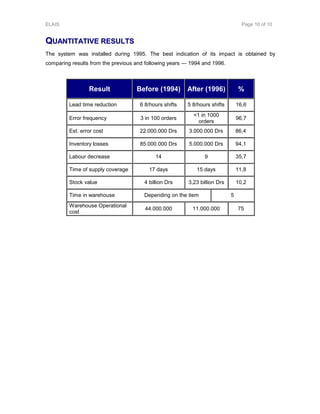
The system was installed during 1995. The best indication of its impact is obtained by
comparing results from the previous and following years — 1994 and 1996.
Result Before (1994) After (1996) %
Lead time reduction 6 8/hours shifts 5 8/hours shifts 16,6
Error frequency 3 in 100 orders
<1 in 1000
orders
96,7
Est. error cost 22.000.000 Drs 3.000.000 Drs 86,4
Inventory losses 85.000.000 Drs 5.000.000 Drs 94,1
Labour decrease 14 9 35,7
Time of supply coverage 17 days 15 days 11,8
Stock value 4 billion Drs 3,23 billion Drs 10,2
Time in warehouse Depending on the item 5
Warehouse Operational
cost
44.000.000 11.000.000 75

ELAIS Integrated Logistics_ENG

  • 1.
    IINNTTEEGGRRAATTEEDD LLOOGGIISSTTIICCSS GGEENNEERRAALL IINNFFOO Title: An Integrated Logistics System Based on Wireless Portable Terminals Period : 1996 Company : ELAIS S.A. Country : GR Contact : http://www.netor.gr/sm/annual/elais.htm Company description : ELAIS S.A. is the most important producer and distributor of oil and fat based products in Greece, and one of the leading companies in the whole Food and Beverages sector (sixth in terms of turnover and third in terms of profit). ELAIS is now part of the UNILEVER group of companies. The company has four main business activities: ü Processing, packaging and distribution of olive oil; ü Production and distribution of other oils, margarine and cooking fat; ü Production and distribution of oils and cooking materials for professional use; ü Import and distribution of other UNILEVER products.
  • 2.
    ELAIS Page 2of 10 Olive oil is the company’s most important business. ELAIS collects raw olive oil from individual producers, co-operatives and merchants around Greece. The raw olive oil is then processed, standardised and bottled for re-distribution and marketing under the company’s brand name. The second business activity is the production and distribution of other oil products such as corn oils, margarine and cooking fat. These products are marketed under specific brand names and are addressed to the consumer market. The third activity is the production and distribution of oils and cooking materials for professional use in bakeries, hotels and restaurants. These products are used as raw materials in various other food industries, pre-prepared food production, or services. The fourth and final activity is the import and distribution of UNILEVER group products, including such brand names as Zwan, John West, Raguletto, Calve, Linea and Lipton. The company operates a major production unit and two distribution units in the Athens area. It has an extended distribution network consisting of about 25 regional distribution hubs in all major Greek cities. TTHHEE UUNNIILLEEVVEERR GGRROOUUPP Unilever is one of the top industrial companies in the world, ranking 21st in the 1995 Fortune 500 list (ordered by net profit). Half of Unilever’s business is in food, while detergents and toiletries are also a significant business. The group focuses on six main areas – margarine, tea, ice cream, culinary products, frozen foods and bakery products. Due to the nature of food products, and differences in national diets, Unilever acts as a local company in each country, with different products, operations and so on. Thus, around half of the 585 million pounds sterling research and development budget is spent in local company development departments. FFIINNAANNCCIIAALL RREESSUULLTTSS Despite the ongoing recession of the Greek market for consumer products — which for many years has suffered from economic stagnation and inflation — the financial results of ELAIS S.A have been more than satisfactory. In 1996, turnaround increased from 60,4 billion Drs. to 63,1 billion Drs. (4,47% increase). Net profits before taxes where 5,65 billion Drs, compared to 5,3 billion Drs. In 18995 (6,6% increase). The company operates at a 8,95% net profit margin, which is good for the Food and Beverages sector. Further, the profit increase was not due exclusively to growth in market share. A significant part (about 2%) came from extensive investment over recent years in new technology and re-organisation.
  • 3.
    ELAIS Page 3of 10 Principal financial data (in bi Drs) 1995 1996 Turnover 60.423 63.147 Gross Profit 17.773 19.155 Net Profit 5.334 5.651 Investments 945 1.212 Labour Costs 5.335 5.585 Note that labour costs represent 41,5% of the total value added. Industry: Consumer Goods - foodstuffs NACE: 15 Manufacture of Food Products Process: Process — Logistics Domain: Data Acquisition TTHHEE FFOOOODD AANNDD BBEEVVEERRAAGGEESS SSEECCTTOORR IINN GGRREEEECCEE The Food and Beverages sector is the most dynamic sector of Greek industry; it has the highest capital investment and regularly returns the best performance. A high development rate over recent years has to some extent insulated the sector from the general trend towards globalisation. Further, the sector has seen several significant mergers which have resulted in the establishment of important chains. In investment terms, the gross value of installed equipment has steadily increased over recent years by about 25% per annum.
  • 4.
    ELAIS Page 4of 10 MMAARRKKEETT PPOOSSIITTIIOONN Despite the emergence of substitutes (such as soya or corn oil), olive oil remains a significant product for all Mediterranean countries and is therefore an important market. However, over recent years the European olive oil market has suffered from many serious problems. Poor crops in Spain have led to short term shortages, increased producer and consumer prices, and a significant decrease in consumption. The ELAIS strategy — which the company has been pursuing with considerable success — is targeted at retaining the leading market position of their branded products and maintaining or even increasing market shares without sacrificing financial performance. The market of margarine and cooking fat has also been in recession caused by macro-economic factors and increased competition. This increased competition comes both the growing penetration of new brand names and from the marketing of extremely low price products by big supermarket chains. Despite this, ELAIS has managed to retain its leading market position, primarily by using high quality standards as a competitive advantage. CCOOMMPPAANNYY SSTTRRAATTEEGGYY During the last five years, the company has undertaken a major reorganisation campaign with two main focal points: ü heavy investment in production facility modernisation, cost reduction, quality improvement, new product development and environmental protection; the investment in 1996 was 1,4 billion Drs. ü thorough re-organisation of business processes in order to achieve a streamlined operation. The company has gradually implemented Total Productive Manufacturing, a Total Quality Management system, the European Foundation for Quality Management Model for Business Excellence, and so on. TTHHEE PPRROOJJEECCTT The project installed an integrated real-time logistics system for the automation of warehouse operations. The core of the system is the use of portable wireless terminals, mounted on fork-lift trucks, that perform two key tasks: ü they guide human operators during the materials movement processes, in an efficient and error-proof way; ü they provide on site data entry and thus enable real time stock monitoring and material tracking.
  • 5.
    ELAIS Page 5of 10 The results of the project have been spectacular. In addition to delivering cost savings and considerable reductions in lead times, it has also enabled quality critical material tracking and eliminated costly errors. PPRROOJJEECCTT OOBBJJEECCTTIIVVEESS The very nature of ELAIS operation entails a considerable overhead in logistics operations. Both incoming and outgoing material flows are characterised by large quantities of a huge variety of different product codes. Moreover, outgoing material flows include the preparation and shipment of large numbers of customer orders in very short lead times. Each order usually includes modest quantities of many different product codes. Thus, the company’s warehouses are complex and fast moving, and their operation was both complicated and error prone. Prior to the installation of the system, the operational complexity not only generated high operational cost (as measured in labour hours and idle time) but was also highly error prone, incurring additional costs for error correction. Furthermore, both legal obligations and quality considerations engender two major requirements that are difficult to satisfy without effective IT support: ü Absolute FIFO (First-in First-out) warehouse operation, to ensure that fresh products are distributed and eliminate the possibility of keeping a lot in the warehouse after its expiry date; ü The capability for absolute lot control, so that it is possible to efficiently withdraw a defective lot. Thus, ELAIS faced the major challenges of improving the organisation of their fast moving warehouses and instituting continuous monitoring of their products so as to better serve their customers and ensure high quality. The project focused on a number of specific objectives that ensure high quality standards in the flow of products to the end customers. These include:
  • 6.
    ELAIS Page 6of 10 ü Better organisation of the warehouses operation, in order to reduce administrative overhead and related costs; ü Absolute FIFO (First-in First-out) product flow, reflecting the existence of expiry dates and the sensitive nature of food products; ü Conformance to legal obligations concerning lot tracking and control and the capability for lot withdrawal; ü Adhesion to the requirements of the ISO 9001 standard. IITT IINNFFRRAASSTTRRUUCCTTUURREE ELAIS operates a comprehensive and flexible IT infrastructure, used to support most of the company’s operations. The hardware includes: ü An AS/400 server ü 10 RISC dedicated application servers ü A campus wide high speed LAN ü About 200 user PCs and Workstations ü A high speed digital WAN network (HellasCom) connecting all 25 regional distribution centres. In addition to custom applications software, several other major application packages have been installed, including: ü SAP (sales and financial modules) ü MFG /PRO from QAD Inc. for integrated global supply chain management. ü MRP II (Manufacturing Resources Planning) ü Lotus Notes based workflow and groupware applications. ü Electronic Data Interchange Software, based on EDI-TIE EDIFACT, for communication with major customers. The company has a dedicated IT department, responsible for applications deployment, system management and user support. It also has a clear strategy for the future evolution of its IT systems. Broadly, the company is gradually moving to a three-tier architecture and is planning to base more of its operations on Windows NT servers. IIMMPPLLEEMMEENNTTAATTIIOONN With the new system installed by the project, all ELAIS products are constantly monitored throughout the entire period from leaving the production line to being loaded onto trucks and delivered to their final distribution point. More specifically, the warehousing process starts from the moment the products are packaged and put onto pallets at the end of the production line. As
  • 7.
    ELAIS Page 7of 10 soon as the pallet is complete, it is collected by a fork-lift truck whose operator scans the bar code that is printed on the card boxes. This bar code alone is used for product identification throughout the process. The IDEF0 (SADT) diagram below depicts the process structure. Within this structure, the “define storage location” sub-process is itself quite complex. The system must establish the pallet contents from the pallet code and determine the appropriate storage location according to a number of factors, such as the specific product storage requirements, warehouse space availability, the master delivery plan, and so on. Each fork-lift truck has a Norand RT 5920 wireless terminal operating at UHF frequencies. Each terminal is equipped with a laser bar code scanner and with an LCD display capable of displaying sixteen lines of 80 characters. The display has a graphics capability and auxiliary lighting, to cater for situations where the ambient light is insufficient. The terminal also includes an alphanumeric keyboard with 58 normal keys and an additional 24 dedicated function keys, used to accelerate data entry. The terminals are built to military standards, and are resistant to temperature changes, humidity and physical shocks. Also, special ergonomic considerations have been taken into account, in order to increase usability in adverse industrial environments. Once the bar code has been scanned, the system notifies the fork-lift operator of the precise position to which the pallet must be transferred, depending on the specific storage requirements of the product such as the allowable temperature and humidity range. A similar procedure is followed for products imported from abroad and marketed by the company. As soon as the products are received, bar code labels are printed on special Fargo Datamax bar code printers and put on the pallets. Loaded pallets are transferred from the factory warehouses either to the main distribution centre where they are further forwarded or to the various regional distribution centres. In both cases, the system automatically indicates the specific pallets to be loaded,
  • 8.
    ELAIS Page 8of 10 according to the distribution plan. The system guides the fork-lift operator to the precise position and indicates the pallet to be loaded by showing the position and the pallet number on the terminal screen, thus ensuring that each customer order is properly processed. The operator scans the bar codes to check that the correct pallets are loaded and is then guided to the appropriate loading ramp in order to load the pallets onto the truck. When the loading process is complete, all the dispatch documents are printed on site. RREESSUULLTTSS Although the change for ELAIS was profound, it was readily adopted by the company’s personnel. This was largely due to the fact that the personnel were already accustomed to the philosophy and concepts of Total Quality Management. In addition to the direct and measurable results, such as cost savings and error reduction, the system also generated a number of positive side effects. The main results of the project include: ü A significant decrease in errors on invoices and dispatch notes. Due to the high complexity of individual shipments (each consisting of modest quantities of many products) and the large number of product codes, the procedure of issuing invoices and dispatch notes was highly error prone. This in turn led to high error correction costs. With the installation of the new system, the errors have been virtually eliminated. The cost of these errors was estimated to be as high as 25 million Drs per year. The possible costs of legal actions following invoicing errors cannot readily be quantified, but these too have been eliminated. ü Improved accuracy in customer order execution. Just as with invoices and dispatch notes, there were frequent errors in the execution (preparation, packaging and
  • 9.
    ELAIS Page 9of 10 shipment) of customer orders. This generated considerable costs (for the replacement of mistakenly shipped items, re-shipment of omissions and so on) and caused customer dissatisfaction. The errors have now been eliminated. The cost of these errors was estimated to be as high as 12 million Drs per year. ü Greater accuracy in data acquisition, improved overall inventory monitoring and a considerable reduction in inventory losses. ü The streamlined operation of the warehouses has eliminated the need for many administrative staff. Warehouses are now operated with just one instead of four employees, thus slashing a major overhead. Similarly, the total operating costs of the warehouses has been reduced by an estimated 65%. ü The lead time for preparing and shipping a customer order has been reduced by 16,6%. ü The new system ensures that strict FIFO priorities are kept, so that only fresh products are shipped and products with short expiry dates do not remain in the warehouse for long. Total warehouse stock has been reduced from 17 to 15 days supply. ü Accurate lot tracking is now possible, allowing the efficient withdrawal of a defective lot. This enables the rapid recall of any defective product batches, which previously was almost impossible because of the administrative overheads. The overall investment was about 107 million Drs (60 million Drs for hardware purchasing, 20 million for software development, 2 million for an analytic warehouse census and an estimated 25 million in transition costs). Cost savings in the first year of operation were more than 132 million Drs. The whole project is an example of how a single technology (in this case portable UHF wireless terminals) can effectively enable the redesign and streamlining of a core business process. Although the various other components of the system (bar codes, logistics applications, inventory control etc.) were in place before the project, it was only through the installation of the wireless terminals that the transition from a batch oriented system to real time data acquisition became feasible, allowing radical change to the whole process. Finally it should be noted that in cases such as this — where IT supports the redesign of processes and the reorganisation of work — directly measurable quantitative data are not only hard to obtain but can even be misleading. There is a real danger of overlooking or under-valuing such “intangible” benefits as better organisation in all operations or improved working conditions, and thus of under-stating the benefits that the IT system provides.
  • 10.
    ELAIS Page 10of 10 QQUUAANNTTIITTAATTIIVVEE RREESSUULLTTSS The system was installed during 1995. The best indication of its impact is obtained by comparing results from the previous and following years — 1994 and 1996. Result Before (1994) After (1996) % Lead time reduction 6 8/hours shifts 5 8/hours shifts 16,6 Error frequency 3 in 100 orders <1 in 1000 orders 96,7 Est. error cost 22.000.000 Drs 3.000.000 Drs 86,4 Inventory losses 85.000.000 Drs 5.000.000 Drs 94,1 Labour decrease 14 9 35,7 Time of supply coverage 17 days 15 days 11,8 Stock value 4 billion Drs 3,23 billion Drs 10,2 Time in warehouse Depending on the item 5 Warehouse Operational cost 44.000.000 11.000.000 75