Electrical Installation
M a i n t e n a n c e
EXPLORATORY COURSE
Grade 7/8
Module # 1:
Prepare Electrical Supplies,
Materials and Tools
2. Enumerate the different types of
materials according to its uses and
functions;
3. Conduct an interview to one member
from the family to share the experiences
about using electrical tools and
materials that he/she usually use to
fixed, maintain and run your appliances
at home.
LEARNING
OBJECTIVES
1.Identify electrical tools and
materials according to their
functions;
Directions: Classify each electrical tools and materials. Write your answer on your
notebook.
Electrical wires Wire Stripper Switch Circuit Breaker Hammer
Fuse Screwdrivers Pliers Hacksaw lamp holder
Electrical Tools Electrical Materials
3
Electrical materials are developed and constructed for a special
purpose
such as to:
1. Control the flow of current in an electrical circuit;
2. Carry electrical current from the source to the load or
current consuming apparatus;
3. Hold and secure wires to its fixtures inside and outside
houses
and buildings; and
4. Protect the houses, buildings, appliancces’ and instruments
from any destruction and damage
ELECTRICAL SUPPLIES AND MATERIALS
a. Stranded Wire – is
made of multiple strands
joined together to make
a single wire.
1. Electrical Wires -
b. Solid Wire – is
made of a single
strand of copper or
aluminum wire.
Types of Electric Wire
Stranded Electric Wire
Solid Electric Wire
is used in electrical wiring installation.
The following are the most used electrical supplies and materials:
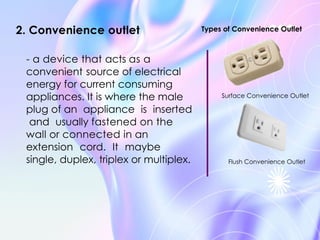
2. Convenience outlet
Surface Convenience Outlet
Types of Convenience Outlet
- a device that acts as a
convenient source of electrical
energy for current consuming
appliances. It is where the male
plug of an appliance is inserted
and usually fastened on the
wall or connected in an
extension cord. It maybe
single, duplex, triplex or multiplex. Flush Convenience Outlet
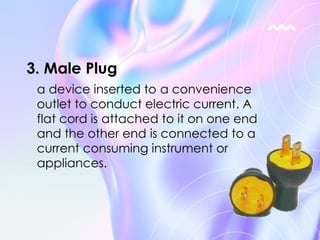
3. Male Plug
a device inserted to a convenience
outlet to conduct electric current. A
flat cord is attached to it on one end
and the other end is connected to a
current consuming instrument or
appliances.
devices that hold and protect the lamp and are also
called as ―Lamp Sockets/Receptacles.
Flush Lamp
Holder
Hanging
chain Lamp
4. Lamp holders-
Surface
Lamp Holder
Hanging
weather Lamp
a device that
connects and
disconnects the flow
of electric current in a
circuit. There are
many shapes,
designs, and types.
Hanging switch
Surface switch
Flush switch
5. Switch
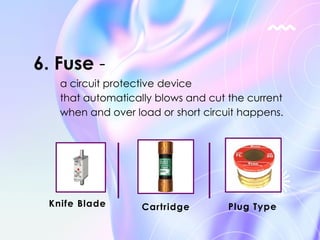
a circuit protective device
that automatically blows and cut the current
when and over load or short circuit happens.
6. Fuse -
Knife Blade Cartridge Plug Type
a protective device used to
automatically blow and
cuts the current when
trouble in the circuit such as
short circuit or overload
occurs.
7. Circuit Breaker
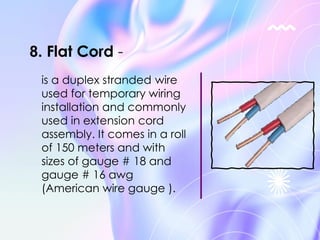
is a duplex stranded wire
used for temporary wiring
installation and commonly
used in extension cord
assembly. It comes in a roll
of 150 meters and with
sizes of gauge # 18 and
gauge # 16 awg
(American wire gauge ).
8. Flat Cord -
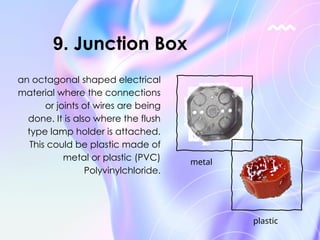
an octagonal shaped electrical
material where the connections
or joints of wires are being
done. It is also where the flush
type lamp holder is attached.
This could be plastic made of
metal or plastic (PVC)
Polyvinylchloride.
9. Junction Box
metal
plastic
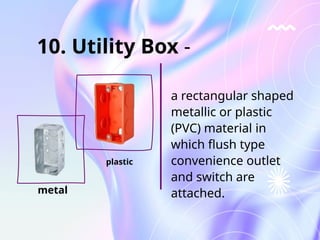
a rectangular shaped
metallic or plastic
(PVC) material in
which flush type
convenience outlet
and switch are
attached.
metal
10. Utility Box -
plastic
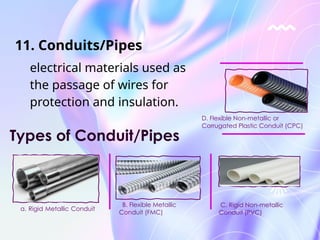
electrical materials used as
the passage of wires for
protection and insulation.
D. Flexible Non-metallic or
Corrugated Plastic Conduit (CPC)
Types of Conduit/Pipes
B. Flexible Metallic
Conduit (FMC)
C. Rigid Non-metallic
Conduit (PVC)
11. Conduits/Pipes
a. Rigid Metallic Conduit
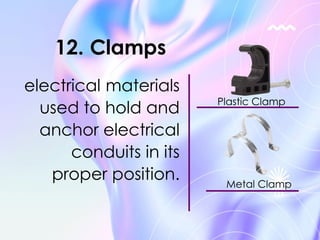
electrical materials
used to hold and
anchor electrical
conduits in its
proper position.
12. Clamps
Plastic Clamp
Metal Clamp
used to attach metallic
or non-metallic conduit
to the junction or
utility boxes.
13. Connector
Metal Connector
Flexible Non-Metallic
Connector
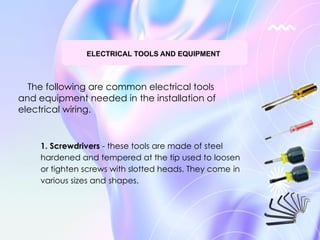
The following are common electrical tools
and equipment needed in the installation of
electrical wiring.
ELECTRICAL TOOLS AND EQUIPMENT
1. Screwdrivers - these tools are made of steel
hardened and tempered at the tip used to loosen
or tighten screws with slotted heads. They come in
various sizes and shapes.
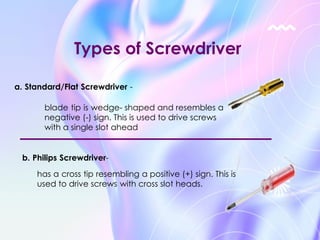
blade tip is wedge- shaped and resembles a
negative (-) sign. This is used to drive screws
with a single slot ahead
Types of Screwdriver
has a cross tip resembling a positive (+) sign. This is
used to drive screws with cross slot heads.
b. Philips Screwdriver-
a. Standard/Flat Screwdriver -
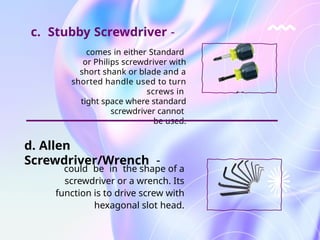
comes in either Standard
or Philips screwdriver with
short shank or blade and a
shorted handle used to turn
screws in
tight space where standard
screwdriver cannot
be used.
could be in the shape of a
screwdriver or a wrench. Its
function is to drive screw with
hexagonal slot head.
c. Stubby Screwdriver -
d. Allen
Screwdriver/Wrench -
these are tools used in driving or pounding and
pulling out nails. They are made of hard steel, wood,
plastic or rubber.
Types of Hammer
2. Hammer
a hammer with one
side of the head split
and curved, used for
extracting nails
a type of hammer, often
made of rubber or
sometimes wood, that is
smaller than a maul or
beetle, and usually has a
relatively large head.
b. Mallet(rubber head) -
a. Claw Hammer -
a hammer with a
rounded end opposite
the face, a type of
peening hammer used
in metal workings.
c. Ballpeen Hammer
-
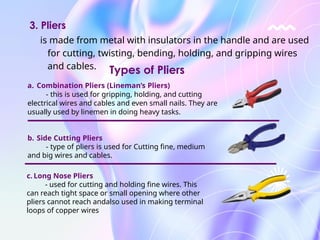
is made from metal with insulators in the handle and are used
for cutting, twisting, bending, holding, and gripping wires
and cables.
3. Pliers
a. Combination Pliers (Lineman’s Pliers)
- this is used for gripping, holding, and cutting
electrical wires and cables and even small nails. They are
usually used by linemen in doing heavy tasks.
b. Side Cutting Pliers
- type of pliers is used for Cutting fine, medium
and big wires and cables.
c. Long Nose Pliers
- used for cutting and holding fine wires. This
can reach tight space or small opening where other
pliers cannot reach andalso used in making terminal
loops of copper wires
Types of Pliers
4. Wire Stripper - A tool used for
removing insulation of medium sized
wires ranging from gauge #10 to
gauge #16.
5. Electrician’s Knife - used by
linemen to remove insulation of
wire and cables in low and high
voltage transmission lines.
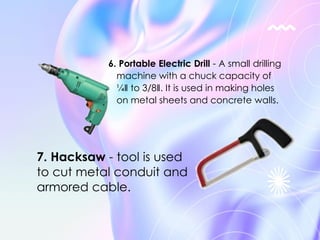
6. Portable Electric Drill - A small drilling
machine with a chuck capacity of
¼‖ to 3/8‖. It is used in making holes
on metal sheets and concrete walls.
7. Hacksaw - tool is used
to cut metal conduit and
armored cable.
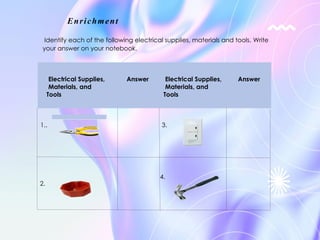
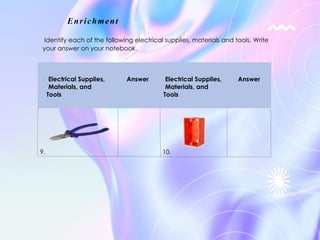
Enrichment
Identify each of the following electrical supplies, materials and tools. Write
your answer on your notebook.
Electrical Supplies,
Materials, and
Tools
Answer Electrical Supplies,
Materials, and
Tools
Answer
1..
2.
3.
4.
Enrichment
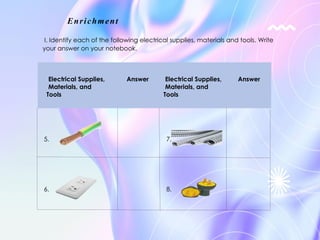
I. Identify each of the following electrical supplies, materials and tools. Write
your answer on your notebook.
Electrical Supplies,
Materials, and
Tools
Answer Electrical Supplies,
Materials, and
Tools
Answer
5. 7.
6. 8.
Enrichment
Identify each of the following electrical supplies, materials and tools. Write
your answer on your notebook.
Electrical Supplies,
Materials, and
Tools
Answer Electrical Supplies,
Materials, and
Tools
Answer
9. 10.
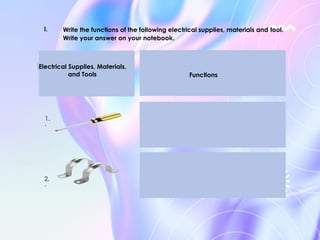
I. Write the functions of the following electrical supplies, materials and tool.
Write your answer on your notebook.
Electrical Supplies, Materials,
and Tools Functions
1.
.
2.
.
Electrical Supplies,
Materials,and Tools
Functions
3.
4.
5.
Functions
Reflection
As this new era of technology, electrical equipment are used everywhere. If
you visit somewhere, every place is decorated with electronic products. There is
no doubt about the fact that electricity is an extremely powerful source of energy
which is used for powering machinery, lighting items, tools devices and other
products used by us in our day to day lives.
11
Application
Conduct an interview to two members of your
family about their experiences in using electrical
tools and materials that they usually use in fixing,
maintaining and running your appliances at
home.
Enumerate the following electrical supplies, materials and materials in any order.
Types of Electrical Wire
Types of Switches
Types of Conduits/Pipes
Assessment:
What’s more
Paste at least 10 pictures of electrical tools and materials found in your home and
give the uses of each tools and materials. (20pts.)Do it on another sheet of paper.
Electrical Tools and Materials Uses
1
2
3
4
5
6
7
8
9
10
EIM_MODULE_1.pptx grade 7 and 8 explore.

  • 1.
    Electrical Installation M ai n t e n a n c e EXPLORATORY COURSE Grade 7/8
  • 2.
    Module # 1: PrepareElectrical Supplies, Materials and Tools
  • 3.
    2. Enumerate thedifferent types of materials according to its uses and functions; 3. Conduct an interview to one member from the family to share the experiences about using electrical tools and materials that he/she usually use to fixed, maintain and run your appliances at home. LEARNING OBJECTIVES 1.Identify electrical tools and materials according to their functions;
  • 4.
    Directions: Classify eachelectrical tools and materials. Write your answer on your notebook. Electrical wires Wire Stripper Switch Circuit Breaker Hammer Fuse Screwdrivers Pliers Hacksaw lamp holder Electrical Tools Electrical Materials 3
  • 5.
    Electrical materials aredeveloped and constructed for a special purpose such as to: 1. Control the flow of current in an electrical circuit; 2. Carry electrical current from the source to the load or current consuming apparatus; 3. Hold and secure wires to its fixtures inside and outside houses and buildings; and 4. Protect the houses, buildings, appliancces’ and instruments from any destruction and damage ELECTRICAL SUPPLIES AND MATERIALS
  • 6.
    a. Stranded Wire– is made of multiple strands joined together to make a single wire. 1. Electrical Wires - b. Solid Wire – is made of a single strand of copper or aluminum wire. Types of Electric Wire Stranded Electric Wire Solid Electric Wire is used in electrical wiring installation. The following are the most used electrical supplies and materials:
  • 7.
    2. Convenience outlet SurfaceConvenience Outlet Types of Convenience Outlet - a device that acts as a convenient source of electrical energy for current consuming appliances. It is where the male plug of an appliance is inserted and usually fastened on the wall or connected in an extension cord. It maybe single, duplex, triplex or multiplex. Flush Convenience Outlet
  • 8.
    3. Male Plug adevice inserted to a convenience outlet to conduct electric current. A flat cord is attached to it on one end and the other end is connected to a current consuming instrument or appliances.
  • 9.
    devices that holdand protect the lamp and are also called as ―Lamp Sockets/Receptacles. Flush Lamp Holder Hanging chain Lamp 4. Lamp holders- Surface Lamp Holder Hanging weather Lamp
  • 10.
    a device that connectsand disconnects the flow of electric current in a circuit. There are many shapes, designs, and types. Hanging switch Surface switch Flush switch 5. Switch
  • 11.
    a circuit protectivedevice that automatically blows and cut the current when and over load or short circuit happens. 6. Fuse - Knife Blade Cartridge Plug Type
  • 12.
    a protective deviceused to automatically blow and cuts the current when trouble in the circuit such as short circuit or overload occurs. 7. Circuit Breaker
  • 13.
    is a duplexstranded wire used for temporary wiring installation and commonly used in extension cord assembly. It comes in a roll of 150 meters and with sizes of gauge # 18 and gauge # 16 awg (American wire gauge ). 8. Flat Cord -
  • 14.
    an octagonal shapedelectrical material where the connections or joints of wires are being done. It is also where the flush type lamp holder is attached. This could be plastic made of metal or plastic (PVC) Polyvinylchloride. 9. Junction Box metal plastic
  • 15.
    a rectangular shaped metallicor plastic (PVC) material in which flush type convenience outlet and switch are attached. metal 10. Utility Box - plastic
  • 16.
    electrical materials usedas the passage of wires for protection and insulation. D. Flexible Non-metallic or Corrugated Plastic Conduit (CPC) Types of Conduit/Pipes B. Flexible Metallic Conduit (FMC) C. Rigid Non-metallic Conduit (PVC) 11. Conduits/Pipes a. Rigid Metallic Conduit
  • 17.
    electrical materials used tohold and anchor electrical conduits in its proper position. 12. Clamps Plastic Clamp Metal Clamp
  • 18.
    used to attachmetallic or non-metallic conduit to the junction or utility boxes. 13. Connector Metal Connector Flexible Non-Metallic Connector
  • 19.
    The following arecommon electrical tools and equipment needed in the installation of electrical wiring. ELECTRICAL TOOLS AND EQUIPMENT 1. Screwdrivers - these tools are made of steel hardened and tempered at the tip used to loosen or tighten screws with slotted heads. They come in various sizes and shapes.
  • 20.
    blade tip iswedge- shaped and resembles a negative (-) sign. This is used to drive screws with a single slot ahead Types of Screwdriver has a cross tip resembling a positive (+) sign. This is used to drive screws with cross slot heads. b. Philips Screwdriver- a. Standard/Flat Screwdriver -
  • 21.
    comes in eitherStandard or Philips screwdriver with short shank or blade and a shorted handle used to turn screws in tight space where standard screwdriver cannot be used. could be in the shape of a screwdriver or a wrench. Its function is to drive screw with hexagonal slot head. c. Stubby Screwdriver - d. Allen Screwdriver/Wrench -
  • 22.
    these are toolsused in driving or pounding and pulling out nails. They are made of hard steel, wood, plastic or rubber. Types of Hammer 2. Hammer a hammer with one side of the head split and curved, used for extracting nails a type of hammer, often made of rubber or sometimes wood, that is smaller than a maul or beetle, and usually has a relatively large head. b. Mallet(rubber head) - a. Claw Hammer - a hammer with a rounded end opposite the face, a type of peening hammer used in metal workings. c. Ballpeen Hammer -
  • 23.
    is made frommetal with insulators in the handle and are used for cutting, twisting, bending, holding, and gripping wires and cables. 3. Pliers a. Combination Pliers (Lineman’s Pliers) - this is used for gripping, holding, and cutting electrical wires and cables and even small nails. They are usually used by linemen in doing heavy tasks. b. Side Cutting Pliers - type of pliers is used for Cutting fine, medium and big wires and cables. c. Long Nose Pliers - used for cutting and holding fine wires. This can reach tight space or small opening where other pliers cannot reach andalso used in making terminal loops of copper wires Types of Pliers
  • 24.
    4. Wire Stripper- A tool used for removing insulation of medium sized wires ranging from gauge #10 to gauge #16. 5. Electrician’s Knife - used by linemen to remove insulation of wire and cables in low and high voltage transmission lines.
  • 25.
    6. Portable ElectricDrill - A small drilling machine with a chuck capacity of ¼‖ to 3/8‖. It is used in making holes on metal sheets and concrete walls. 7. Hacksaw - tool is used to cut metal conduit and armored cable.
  • 26.
    Enrichment Identify each ofthe following electrical supplies, materials and tools. Write your answer on your notebook. Electrical Supplies, Materials, and Tools Answer Electrical Supplies, Materials, and Tools Answer 1.. 2. 3. 4.
  • 27.
    Enrichment I. Identify eachof the following electrical supplies, materials and tools. Write your answer on your notebook. Electrical Supplies, Materials, and Tools Answer Electrical Supplies, Materials, and Tools Answer 5. 7. 6. 8.
  • 28.
    Enrichment Identify each ofthe following electrical supplies, materials and tools. Write your answer on your notebook. Electrical Supplies, Materials, and Tools Answer Electrical Supplies, Materials, and Tools Answer 9. 10.
  • 29.
    I. Write thefunctions of the following electrical supplies, materials and tool. Write your answer on your notebook. Electrical Supplies, Materials, and Tools Functions 1. . 2. .
  • 30.
  • 31.
    Reflection As this newera of technology, electrical equipment are used everywhere. If you visit somewhere, every place is decorated with electronic products. There is no doubt about the fact that electricity is an extremely powerful source of energy which is used for powering machinery, lighting items, tools devices and other products used by us in our day to day lives. 11
  • 32.
    Application Conduct an interviewto two members of your family about their experiences in using electrical tools and materials that they usually use in fixing, maintaining and running your appliances at home.
  • 33.
    Enumerate the followingelectrical supplies, materials and materials in any order. Types of Electrical Wire Types of Switches Types of Conduits/Pipes Assessment:
  • 34.
    What’s more Paste atleast 10 pictures of electrical tools and materials found in your home and give the uses of each tools and materials. (20pts.)Do it on another sheet of paper. Electrical Tools and Materials Uses 1 2 3 4 5 6 7 8 9 10