House wiring - Tools and components IN ELECTRICAL ENGINEERING
1.
1
25EEC11 – PRINCIPLESOF ELECTRICAL AND
ELECTRONICS ENGINEERING
Module 4: HOUSE WIRING AND SAFETY
Department of Electrical and Electronics
Engineering
www.skcet.ac.in
House wiring - Tools and components
2.
COURSE OUTCOMES
CO 1- Analyze electrical circuits using mesh analysis, nodal analysis and
network theorems. [A].
CO 2 - Examine the behavior of single-phase and three-phase AC circuits.
[AP].
CO 3 - Illustrate the operation and applications of various electrical
machines. [U].
CO 4 - Interpret the various wiring systems, ensuring adherence to Bureau
of Indian Standards (BIS) safety regulations. [U].
CO 5 - Investigate and design analog and digital electronic circuits. [AP].
2
3.
SYLLABUS
MODULE I DCCIRCUITS 9
Electrical circuit elements and sources - Series and Parallel circuits - Mesh and Node equations with independent
sources only. Theorems: Superposition theorem, Thevenin's theorem and Maximum power transfer theorem.
MODULE II AC CIRCUITS 9
Single Phase AC Circuits: Average, RMS and maximum values - RL, RC and RLC series circuits - Power in AC circuits,
power factor. Three Phase AC Circuits: Three phase balanced systems - Star and Delta connections.
MODULE III DC AND AC MACHINES 9
Construction, Principle of operation and applications of DC Motor - Single phase and Three phase Induction motor -
Synchronous Motor - Single phase Transformers - Special Machines: Stepper Motor - BLDC Motor.
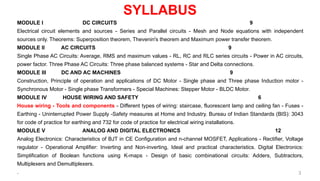
MODULE IV HOUSE WIRING AND SAFETY 6
House wiring - Tools and components - Different types of wiring: staircase, fluorescent lamp and ceiling fan - Fuses -
Earthing - Uninterrupted Power Supply -Safety measures at Home and Industry. Bureau of Indian Standards (BIS): 3043
for code of practice for earthing and 732 for code of practice for electrical wiring installations.
MODULE V ANALOG AND DIGITAL ELECTRONICS 12
Analog Electronics: Characteristics of BJT in CE Configuration and n-channel MOSFET, Applications - Rectifier, Voltage
regulator - Operational Amplifier: Inverting and Non-inverting, Ideal and practical characteristics. Digital Electronics:
Simplification of Boolean functions using K-maps - Design of basic combinational circuits: Adders, Subtractors,
Multiplexers and Demultiplexers.
. 3
4.
Text Books &Reference Books
1. Edward Hughes, John Hiley and Keith Brown, “Electrical and Electronic Technology”,
Pearson education, 2020.
2. Fitzgerald. A.E., Charles Kingsely Jr, Stephen D.Umans, ‘Electric Machinery’, Tata
McGraw Hill, 7th edition, 2020.
3. E. Hughes, “Electrical and Electronics Technology”, Pearson, 10th edition, 2023
4. Jr William H. Hayt, Jack E. Kemmerly and Jamie D. Phillips, ‘’Engineering Circuits
Analysis”, McGraw-Hill, Tenth Edition, 2024.
5. Joseph A. Edminister, Mahmmood Nahvi, ‘’Electric Circuits’’Schaum Series McGraw-Hill,
Fifth Edition, 2017.
6. Leach DP, ‘Digital Principles and Applications,’’ Tata McGraw Hill,2021
4
Wiring materials
Electrical wireis made of materials like copper, aluminium and silver.
As silver is expensive, mostly copper and aluminium are used in
wiring.
Materials are classified into three types according to their properties:
1. Conducting materials
2. Insulating materials
3. Semiconductor materials.
7.
Conducting Material
(a) Copper
Itis a good conductor of electricity. It is used in wiring materials in
cables. Its has low resistance and is used for conduction of electricity
at high, medium and low voltage. It is used in wiring and cable making.
(b) Aluminium
It is light weight and cheaper in comparison to copper. Therefore, this
type of conducting material is mostly used in electrical wiring. It is
silvery–white in colour and it has a soft texture. It is often used in
wiring and making cable.
8.
Insulating Materials
Insulating materialsare used for insulating purpose. These types of
materials are bad conductors of current. For example rubber, paper,
mica, wood, glass and cotton.
9.
Accessories
Wiring accessories areused for connecting appliances.
Switch
A switch is used to make or break an electrical circuit. It is used to switch ‘on’ or ‘off ’ the
supply of electricity to an appliance.
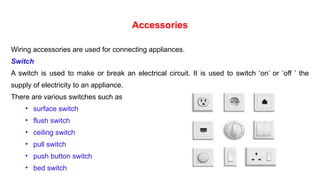
There are various switches such as
• surface switch
• flush switch
• ceiling switch
• pull switch
• push button switch
• bed switch
10.
Accessories
Wiring accessories areused for connecting appliances.
Switch
A switch is used to make or break an electrical circuit. It is used to switch ‘on’ or ‘off ’ the
supply of electricity to an appliance.
There are various switches such as
• surface switch
• flush switch
• ceiling switch
• pull switch
• push button switch
• bed switch
11.
Accessories
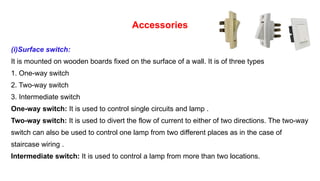
(i)Surface switch:
It ismounted on wooden boards fixed on the surface of a wall. It is of three types
1. One-way switch
2. Two-way switch
3. Intermediate switch
One-way switch: It is used to control single circuits and lamp .
Two-way switch: It is used to divert the flow of current to either of two directions. The two-way
switch can also be used to control one lamp from two different places as in the case of
staircase wiring .
Intermediate switch: It is used to control a lamp from more than two locations.
12.
Accessories
Holders
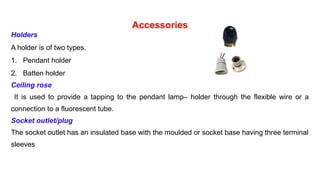
A holder isof two types.
1. Pendant holder
2. Batten holder
Ceiling rose
It is used to provide a tapping to the pendant lamp– holder through the flexible wire or a
connection to a fluorescent tube.
Socket outlet/plug
The socket outlet has an insulated base with the moulded or socket base having three terminal
sleeves
13.
Accessories
Main switch
To controlthe electrical circuit a main switch is used. Through the main switch, the power in a
building is controlled completely
PVC casing-capping wiring
PVC capping is done in order to cover the wires. It includes casing also. This casing-capping
wiring is also known as open wiring, as it is done outside the wall.
Miniature Circuit Breaker (MCB)
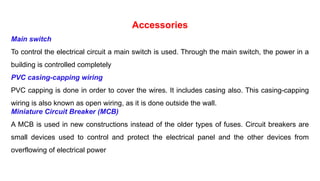
A MCB is used in new constructions instead of the older types of fuses. Circuit breakers are
small devices used to control and protect the electrical panel and the other devices from
overflowing of electrical power
14.
ELECTRICAL TOOLS
Like anyother repair or improvement project around the house,
electrical work requires tools.
There are also some specialty electrical tools that come in handy from
time to time, and these are readily available at most home centers,
hardware stores, electrical supply stores, and online retailers.
15.
Screwdrivers
These tools aremade of steel hardened and tempered at the tip
used to loosen or tighten screws with slotted heads. They come in
various sizes and shapes.
A quality set of screwdrivers can last forever. You’ll need different
types like the Phillips screwdriver for Phillips head screws, and a
set of straight blade screwdrivers.
There are a ton of options available including electronic
screwdrivers magnetic screwdrivers for better grip, mutli-tip
screwdrivers with interchangeable tips, precision screwdriver
sets, pocket clip-style screwdrivers and more.
16.
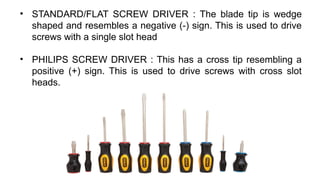
• STANDARD/FLAT SCREWDRIVER : The blade tip is wedge
shaped and resembles a negative (-) sign. This is used to drive
screws with a single slot head
• PHILIPS SCREW DRIVER : This has a cross tip resembling a
positive (+) sign. This is used to drive screws with cross slot
heads.
17.
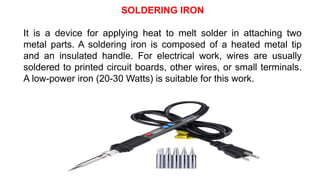
SOLDERING IRON
It isa device for applying heat to melt solder in attaching two
metal parts. A soldering iron is composed of a heated metal tip
and an insulated handle. For electrical work, wires are usually
soldered to printed circuit boards, other wires, or small terminals.
A low-power iron (20-30 Watts) is suitable for this work.
18.
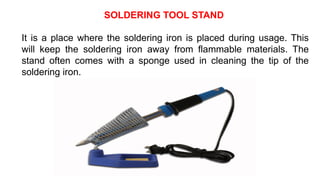
SOLDERING TOOL STAND
Itis a place where the soldering iron is placed during usage. This
will keep the soldering iron away from flammable materials. The
stand often comes with a sponge used in cleaning the tip of the
soldering iron.
19.
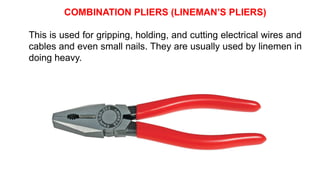
COMBINATION PLIERS (LINEMAN’SPLIERS)
This is used for gripping, holding, and cutting electrical wires and
cables and even small nails. They are usually used by linemen in
doing heavy.
20.
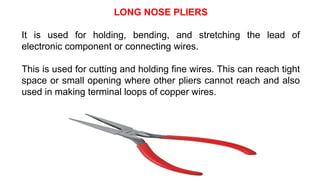
LONG NOSE PLIERS
Itis used for holding, bending, and stretching the lead of
electronic component or connecting wires.
This is used for cutting and holding fine wires. This can reach tight
space or small opening where other pliers cannot reach and also
used in making terminal loops of copper wires.
21.
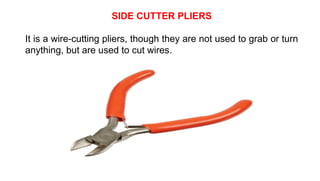
SIDE CUTTER PLIERS
Itis a wire-cutting pliers, though they are not used to grab or turn
anything, but are used to cut wires.
22.
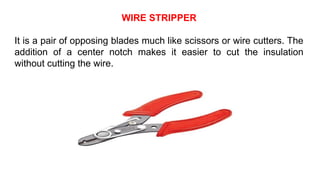
WIRE STRIPPER
It isa pair of opposing blades much like scissors or wire cutters. The
addition of a center notch makes it easier to cut the insulation
without cutting the wire.
23.
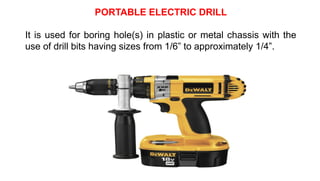
PORTABLE ELECTRIC DRILL
Itis used for boring hole(s) in plastic or metal chassis with the
use of drill bits having sizes from 1/6” to approximately 1/4”.
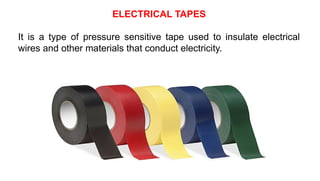
ELECTRICAL TAPES
It isa type of pressure sensitive tape used to insulate electrical
wires and other materials that conduct electricity.
27.
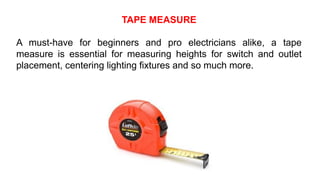
TAPE MEASURE
A must-havefor beginners and pro electricians alike, a tape
measure is essential for measuring heights for switch and outlet
placement, centering lighting fixtures and so much more.
28.
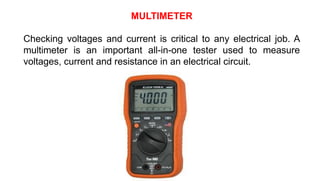
MULTIMETER
Checking voltages andcurrent is critical to any electrical job. A
multimeter is an important all-in-one tester used to measure
voltages, current and resistance in an electrical circuit.
29.
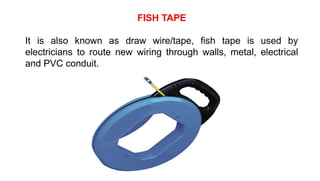
FISH TAPE
It isalso known as draw wire/tape, fish tape is used by
electricians to route new wiring through walls, metal, electrical
and PVC conduit.
30.
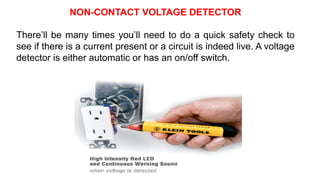
NON-CONTACT VOLTAGE DETECTOR
There’llbe many times you’ll need to do a quick safety check to
see if there is a current present or a circuit is indeed live. A voltage
detector is either automatic or has an on/off switch.
![COURSE OUTCOMES
CO 1 - Analyze electrical circuits using mesh analysis, nodal analysis and
network theorems. [A].
CO 2 - Examine the behavior of single-phase and three-phase AC circuits.
[AP].
CO 3 - Illustrate the operation and applications of various electrical
machines. [U].
CO 4 - Interpret the various wiring systems, ensuring adherence to Bureau
of Indian Standards (BIS) safety regulations. [U].
CO 5 - Investigate and design analog and digital electronic circuits. [AP].
2](https://image.slidesharecdn.com/4-251011045730-700295ae/85/House-wiring-Tools-and-components-IN-ELECTRICAL-ENGINEERING-2-320.jpg)




![Presentation1 [Autosaved] - Copy.pptx](https://cdn.slidesharecdn.com/ss_thumbnails/presentation1autosaved-copy-221107042009-21caf40e-thumbnail.jpg?width=640&height=640&fit=bounds)


