ELECTRICAL
INSTALLATIONAND
MAINTENANCE
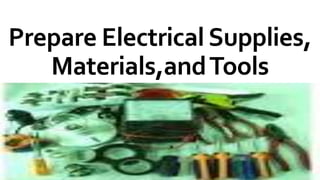
Prepare Electrical Supplies,
Materials,andTools
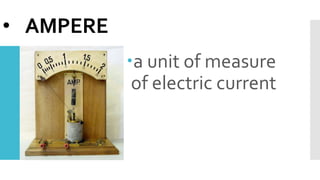
• AMPERE
a unit of measure
of electric current
• CIRCUIT
the path of electric
current from the
source to the
components and
goes back to the
source
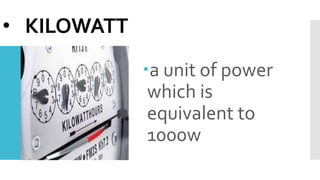
• KILOWATT
a unit of power
which is
equivalent to
1000w
• CONDUCTOR
a wire or a cord
which provides
path for current
flow
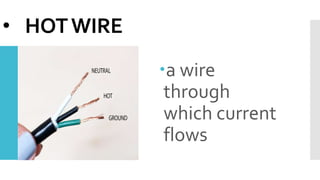
• HOTWIRE
a wire
through
which current
flows
• INSULATOR
material used
to cover
electric wires
which may be
made from
plastic, rubber,
or asbestos.
• TOOLS
are
implements
used to modify
raw materials
for human use
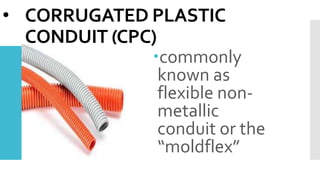
• CORRUGATED PLASTIC
CONDUIT (CPC)
commonly
known as
flexible non-
metallic
conduit or the
“moldflex”
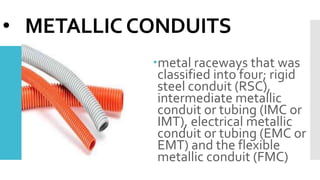
• METALLIC CONDUITS
metal raceways that was
classified into four; rigid
steel conduit (RSC),
intermediate metallic
conduit or tubing (IMC or
IMT), electrical metallic
conduit or tubing (EMC or
EMT) and the flexible
metallic conduit (FMC)
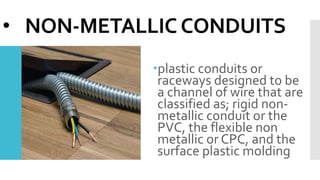
• NON-METALLIC CONDUITS
plastic conduits or
raceways designed to be
a channel of wire that are
classified as; rigid non-
metallic conduit or the
PVC, the flexible non
metallic or CPC, and the
surface plastic molding
• CONNECTORSANDADAPTERS
accessories that
are used to
connect from
boxes to conduits
or raceways to the
other boxes in the
electrical system
ELECTRICALTOOLS
AND EQUIPMENT
The following are common electrical tools and
equipment needed in the installation of electrical
wiring.
A. Standard/Flat Screw Driver
The blade tip is
wedge-shaped and
resembles a
negative (-) sign.
This is used to
drive screws with a
single slot head
B. Philips Screw Driver.
This has a cross tip
resembling a
positive (+) sign.
This is used to drive
screws with cross
slot heads.
C. Stubby Screw Driver
It comes in either
Standard or Philips
screw driver with short
shank or blade and a
shorted handle used to
turn screws in tight
space where standard
screw driver cannot be
used
D. Allen Screw Driver/Wrench
This could be in the
shape of a screw
driver or a wrench.
Its function is to
drive screw with
hexagonal slot
head.
II. HAMMERS.
These are tools used in
driving or pounding and
pulling out nails.They are
made of hard steel, wood,
plastic or rubber.The
following are types of
hammer:
A. Claw hammer
B. Mallet(rubber head)
C. Ballpeen hammer
III. PLIERS
These made from
metal with insulators
in the handle and are
used for cutting,
twisting, bending,
holding, and
gripping wires and
cables
A.Combination Pliers (Lineman’s
Pliers).
This is used for
gripping, holding,
and cutting electrical
wires and cables and
even small nails.
They are usually
used by linemen in
doing heavy tasks.
B. SideCutting Pliers.
This type of pliers is
used for cutting
fine, medium and
big wires and
cables.
C. Long Nose Pliers.
This is used for cutting
and holding fine wires.
This can reach tight
space or small opening
where other pliers
cannot reach and also
used in making
terminal loops of
copper wires.
IV. WIRE STRIPPER
A tool used for
removing
insulation of
medium sized
wires ranging from
gauge #10 to
gauge #16.
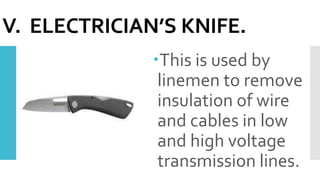
V. ELECTRICIAN’S KNIFE.
This is used by
linemen to remove
insulation of wire
and cables in low
and high voltage
transmission lines.
VI. PORTABLE ELECTRIC DRILL
A small drilling
machine with a
chuck capacity of
¼‖ to 3/8‖. It is
used in making
holes on metal
sheets and
concrete walls.
VII. HACKSAW
This tool is used
to
cut metal
conduit and
armored
cable.
ElectricalSupplies and
Materials
Electrical materials are developed and constructed for a
special purpose such as to:
1. control the flow of current in an electrical circuit;
2. carry electrical current from the source to the load or
current consuming apparatus;
3. hold and secure wires to its fixtures inside and outside
houses and buildings; and
4. protect the houses, buildings, appliances’ and
instruments from any destruction and damage.
CONVENIENCE OUTLET
 a device that acts
as a convenient
source of electrical
energy for current
consuming
appliances. .
MALE PLUG
 a device inserted to a
convenience outlet to
conduct electric current. A
flat cord is attached to it
on one end and the other
end is connected to a
current consuming
instrument or appliance.
LAMP HOLDERS
devices that hold
and protect the
lamp and are also
called as―Lamp
Sockets/
Receptacles .
SWITCH
a device that
connects and
disconnects the
flow of electric
current in a
circuit.
FUSE
a circuit
protective device
that automatically
blows and cut the
current when and
over load or short
circuit happens.
CIRCUIT BREAKER
a protective device
used to
automatically
blows and cuts the
current when
trouble in the
circuit such as short
circuit or overload
occurs.
JUNCTION BOX
an octagonal
shaped electrical
material where
the connections
or joints of wires
are being done.
UTILITY BOX
a rectangular
shaped metallic or
plastic (PVC)
material in which
flush type
convenience outlet
and switch are
attached.
ELECTRICAL
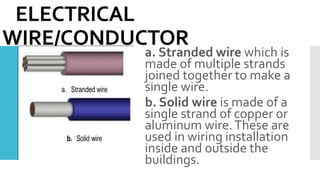
WIRE/CONDUCTOR
a. Stranded wire which is
made of multiple strands
joined together to make a
single wire.
b. Solid wire is made of a
single strand of copper or
aluminum wire.These are
used in wiring installation
inside and outside the
buildings.
CONDUITS/PIPES
electrical
materials used as
the passage of
wires for
protection and
insulation.
CLAMPS
electrical
materials used to
hold and anchor
electrical conduits
in its proper
position.
CONNECTORS
used to attach
metallic or non-
metallic conduit
to the junction
or utility boxes.
ELECTRICAL-INSTALLATION-AND-MAINTENANCE.pptx

ELECTRICAL-INSTALLATION-AND-MAINTENANCE.pptx