Environmental Impact of Internet

       Over the last two decades, the global culture has been transformed as a result
of the widespread adoption of computers in each and every arena of Human life.
This also facilitated increased dependency on data all across the globe. The key
societal and business functions have been thus brought into the digital realm, and
there had been a remarkable increase in interconnectivity and exchange of data with
the advance of the internet. The Internet is facilitating grand strides in collaboration
and communication. The technology is progressing so fast that it had entered into
nearly every sphere of civil society.


Cloud Computing.
       The world has also seen the rise of companies such as Google and Facebook
whose business models are built on the exchange and storage of vast amounts of
data, using the internet to make information available to end users worldwide. Most
recently, another technological development with likewise transformative and far
reaching impacts has occurred; namely, the paradigm of cloud computing and the
outsourcing of data storage and processing requirements by businesses,
governments, and other entities to data centres. Together, these processes have
driven the explosive growth in both networking and the data centre industry as
providers of data processing (servers), data storage (storage equipment), and
communications (network equipment), collectively referred to as ICT services over
Internet.


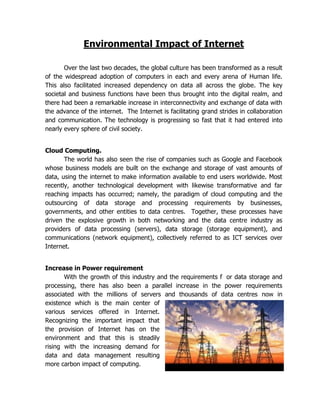
Increase in Power requirement
       With the growth of this industry and the requirements f or data storage and
processing, there has also been a parallel increase in the power requirements
associated with the millions of servers and thousands of data centres now in
existence which is the main center of
various services offered in Internet.
Recognizing the important impact that
the provision of Internet has on the
environment and that this is steadily
rising with the increasing demand for
data and data management resulting
more carbon impact of computing.
Greenhouse gases
        The rapid growth in the adoption of Internet as a main
facilit ator of the masses, the subsequent increases in
electrical requirements are also producing increases in
greenhouse gas emissions associated with electricity
generation, raising concerns in terms of the impact of the
sector in respect of its contribution to global climate change.

       On the other hand there is a rapid enhancement of technologies into more
eco-savy. Older technologies like dialup and traditional wireline connections use 3.56
kWh per GB. Newer technologies including fiber and power lines use .77 kWh/GB,
while cable uses .72 kWh/GB and DSL sips a low .17 kWh/GB. These figures don’t
include the power consumption of the end-device like a laptop or a cell phone. Also
remember the measurement is energy per gigabyte of data, and newer networks
also transmit significantly more data than older networks.     With "Moore's Law"
making CPUs exponentially faster and new tools like software virtualization allowing
one server to replace many, it was expected that a doubling of energy consumption
would result in many times more data being transferred. Various services available
in Internet also take care of the conventional environmental exploitations. For
example, purchasing music from iTunes or Amazon MP3 reduces carbon footprint to
a great extend since there are no waste materials produced like plastic cases, CDs,
or inserts for the CDs. Buying the whole album digitally is the perfect way to enjoy
the music without producing waste.


CO2 Emmission
        Several recent studies and articles have shown that a simple Google search
can result in 1-10 grams of CO2 emissions. With an average 34,000 searches per
second in Google (2 million per minute; 121 million per hour; 3 billion per day; 88
billion per month, figures rounded), we are looking at up to more than 2000 tons of
greenhouse gas emissions per day. Unfortunately the 2000 ton figure refers only to
internet searches and all other services available in Internet is accounting for extra
Carbon footprint. Most computers create 40-80 grams of greenhouse gas emissions
per hour through their use of electricity (depending on electricity source and
computer type), so the aggregated greenhouse gas emissions just from computers is
quite sizable. US statistics of 2006, states that the internet accounts for 3 percent of
US electricity consumption and 2 percent of global CO2 emissions. According to a
recent study cited on CNN.com the internet will be producing 20 percent of the
world’s greenhouse gases within a decade.
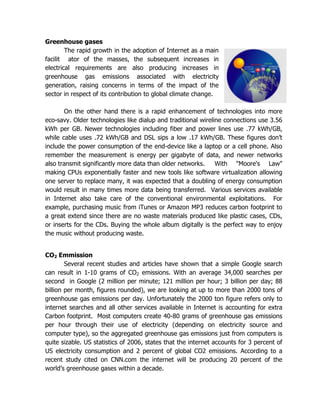
WORLD INTERNET USAGE AND POPULATION STATISTICS -2011
                                             Internet                       Penetration
                             Population                    Internet Users                  Growth
       World Regions                           Users                           (%
                            ( 2011 Est.)                    Latest Data                   2000-2011
                                           Dec. 31, 2000                    Population)
Africa                     1,037,524,058      4,514,400      118,609,620         11.4 % 2,527.4 %
Asia                       3,879,740,877    114,304,000      922,329,554         23.8 %    706.9 %
Europe                       816,426,346    105,096,093      476,213,935         58.3 %    353.1 %
Middle East                  216,258,843      3,284,800        68,553,666        31.7 % 1,987.0 %
North America                347,394,870    108,096,800      272,066,000         78.3 %    151.7 %
Latin America / Carib.       597,283,165     18,068,919      215,939,400         36.2 % 1,037.4 %
Oceania / Australia           35,426,995      7,620,480        21,293,830        60.1 %    179.4 %
WORLD TOTAL                6,930,055,154    360,985,492     2,095,006,005        30.2 %    480.4 %


         The Internet has traditionally been viewed as a low-carbon impact alternative
 to traditional activities (which use countless tons of paper and non-renewable
 energy). The Internet's supporting infrastructure of web servers, data centers and
 production materials (i.e. computers), however, is a huge waste and carbon-
 intensive area of the economy. It was roughly 700 Billion kWh in 2010 which is
 growing rapidly. Anti-virus software firm McAfee reports that the electricity needed
 just to transmit the trillions of spam emails sent annually equals the amount required
 to power over two million homes in the United States while producing the same level
 of greenhouse gas emissions as more than three million cars.


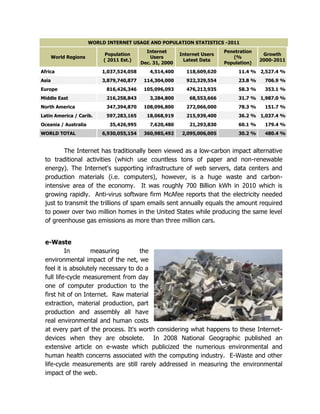
 e-Waste
          In       measuring         the
 environmental impact of the net, we
 feel it is absolutely necessary to do a
 full life-cycle measurement from day
 one of computer production to the
 first hit of on Internet. Raw material
 extraction, material production, part
 production and assembly all have
 real environmental and human costs
 at every part of the process. It's worth considering what happens to these Internet-
 devices when they are obsolete. In 2008 National Geographic published an
 extensive article on e-waste which publicized the numerious environmental and
 human health concerns associated with the computing industry. E-Waste and other
 life-cycle measurements are still rarely addressed in measuring the environmental
 impact of the web.
E-waste comprises of discarded electronic appliances viz. waste electronic
goods, such as computers, televisions and cell phones, of which computers and
mobile telephones are disproportionately abundant because of their short lifespan.
The current global production of E-waste is estimated to be 20–25 million tonnes per
year, with most E-waste being produced in Europe, the United States and
Australasia. Miniaturisation and the development of more efficient cloud computing
networks, where computing services are delivered over the internet from remote
locations, may offset the increase in E-waste production from global economic
growth and the development of pervasive new technologies. E-waste contains
potential environmental contaminants, especially Pb, Sb, Hg, Cd, Ni, polybrominated
diphenyl ethers (PBDEs), and polychlorinated biphenyls (PCBs). Burning E-waste may
generate dioxins, furans, polycyclic aromatic hydrocarbons (PAHs), polyhalogenated
aromatic hydrocarbons (PHAHs), and hydrogen chloride.


Remedial measures
       Various initiatives are now being geared up to
face this challenge. New high end processors being
launched have increased computing power, with low
energy demand. New energy efficient, Monitors with
less radiation and power consumption are available
in the market. New ways have been developed to
keep massive server farms cool. Server farms can
be located near hydroelectric facilities or other
sources of renewable energy and the can be built in
the Arctic Circle to take advantage of natural
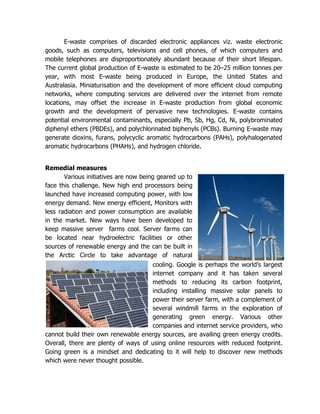
                                     cooling. Google is perhaps the world’s largest
                                     internet company and it has taken several
                                     methods to reducing its carbon footprint,
                                     including installing massive solar panels to
                                     power their server farm, with a complement of
                                     several windmill farms in the exploration of
                                     generating green energy. Various other
                                     companies and internet service providers, who
cannot build their own renewable energy sources, are availing green energy credits.
Overall, there are plenty of ways of using online resources with reduced footprint.
Going green is a mindset and dedicating to it will help to discover new methods
which were never thought possible.

Eii paper-i...group 31

  • 1.
    Environmental Impact ofInternet Over the last two decades, the global culture has been transformed as a result of the widespread adoption of computers in each and every arena of Human life. This also facilitated increased dependency on data all across the globe. The key societal and business functions have been thus brought into the digital realm, and there had been a remarkable increase in interconnectivity and exchange of data with the advance of the internet. The Internet is facilitating grand strides in collaboration and communication. The technology is progressing so fast that it had entered into nearly every sphere of civil society. Cloud Computing. The world has also seen the rise of companies such as Google and Facebook whose business models are built on the exchange and storage of vast amounts of data, using the internet to make information available to end users worldwide. Most recently, another technological development with likewise transformative and far reaching impacts has occurred; namely, the paradigm of cloud computing and the outsourcing of data storage and processing requirements by businesses, governments, and other entities to data centres. Together, these processes have driven the explosive growth in both networking and the data centre industry as providers of data processing (servers), data storage (storage equipment), and communications (network equipment), collectively referred to as ICT services over Internet. Increase in Power requirement With the growth of this industry and the requirements f or data storage and processing, there has also been a parallel increase in the power requirements associated with the millions of servers and thousands of data centres now in existence which is the main center of various services offered in Internet. Recognizing the important impact that the provision of Internet has on the environment and that this is steadily rising with the increasing demand for data and data management resulting more carbon impact of computing.
  • 2.
    Greenhouse gases The rapid growth in the adoption of Internet as a main facilit ator of the masses, the subsequent increases in electrical requirements are also producing increases in greenhouse gas emissions associated with electricity generation, raising concerns in terms of the impact of the sector in respect of its contribution to global climate change. On the other hand there is a rapid enhancement of technologies into more eco-savy. Older technologies like dialup and traditional wireline connections use 3.56 kWh per GB. Newer technologies including fiber and power lines use .77 kWh/GB, while cable uses .72 kWh/GB and DSL sips a low .17 kWh/GB. These figures don’t include the power consumption of the end-device like a laptop or a cell phone. Also remember the measurement is energy per gigabyte of data, and newer networks also transmit significantly more data than older networks. With "Moore's Law" making CPUs exponentially faster and new tools like software virtualization allowing one server to replace many, it was expected that a doubling of energy consumption would result in many times more data being transferred. Various services available in Internet also take care of the conventional environmental exploitations. For example, purchasing music from iTunes or Amazon MP3 reduces carbon footprint to a great extend since there are no waste materials produced like plastic cases, CDs, or inserts for the CDs. Buying the whole album digitally is the perfect way to enjoy the music without producing waste. CO2 Emmission Several recent studies and articles have shown that a simple Google search can result in 1-10 grams of CO2 emissions. With an average 34,000 searches per second in Google (2 million per minute; 121 million per hour; 3 billion per day; 88 billion per month, figures rounded), we are looking at up to more than 2000 tons of greenhouse gas emissions per day. Unfortunately the 2000 ton figure refers only to internet searches and all other services available in Internet is accounting for extra Carbon footprint. Most computers create 40-80 grams of greenhouse gas emissions per hour through their use of electricity (depending on electricity source and computer type), so the aggregated greenhouse gas emissions just from computers is quite sizable. US statistics of 2006, states that the internet accounts for 3 percent of US electricity consumption and 2 percent of global CO2 emissions. According to a recent study cited on CNN.com the internet will be producing 20 percent of the world’s greenhouse gases within a decade.
  • 3.
    WORLD INTERNET USAGEAND POPULATION STATISTICS -2011 Internet Penetration Population Internet Users Growth World Regions Users (% ( 2011 Est.) Latest Data 2000-2011 Dec. 31, 2000 Population) Africa 1,037,524,058 4,514,400 118,609,620 11.4 % 2,527.4 % Asia 3,879,740,877 114,304,000 922,329,554 23.8 % 706.9 % Europe 816,426,346 105,096,093 476,213,935 58.3 % 353.1 % Middle East 216,258,843 3,284,800 68,553,666 31.7 % 1,987.0 % North America 347,394,870 108,096,800 272,066,000 78.3 % 151.7 % Latin America / Carib. 597,283,165 18,068,919 215,939,400 36.2 % 1,037.4 % Oceania / Australia 35,426,995 7,620,480 21,293,830 60.1 % 179.4 % WORLD TOTAL 6,930,055,154 360,985,492 2,095,006,005 30.2 % 480.4 % The Internet has traditionally been viewed as a low-carbon impact alternative to traditional activities (which use countless tons of paper and non-renewable energy). The Internet's supporting infrastructure of web servers, data centers and production materials (i.e. computers), however, is a huge waste and carbon- intensive area of the economy. It was roughly 700 Billion kWh in 2010 which is growing rapidly. Anti-virus software firm McAfee reports that the electricity needed just to transmit the trillions of spam emails sent annually equals the amount required to power over two million homes in the United States while producing the same level of greenhouse gas emissions as more than three million cars. e-Waste In measuring the environmental impact of the net, we feel it is absolutely necessary to do a full life-cycle measurement from day one of computer production to the first hit of on Internet. Raw material extraction, material production, part production and assembly all have real environmental and human costs at every part of the process. It's worth considering what happens to these Internet- devices when they are obsolete. In 2008 National Geographic published an extensive article on e-waste which publicized the numerious environmental and human health concerns associated with the computing industry. E-Waste and other life-cycle measurements are still rarely addressed in measuring the environmental impact of the web.
  • 4.
    E-waste comprises ofdiscarded electronic appliances viz. waste electronic goods, such as computers, televisions and cell phones, of which computers and mobile telephones are disproportionately abundant because of their short lifespan. The current global production of E-waste is estimated to be 20–25 million tonnes per year, with most E-waste being produced in Europe, the United States and Australasia. Miniaturisation and the development of more efficient cloud computing networks, where computing services are delivered over the internet from remote locations, may offset the increase in E-waste production from global economic growth and the development of pervasive new technologies. E-waste contains potential environmental contaminants, especially Pb, Sb, Hg, Cd, Ni, polybrominated diphenyl ethers (PBDEs), and polychlorinated biphenyls (PCBs). Burning E-waste may generate dioxins, furans, polycyclic aromatic hydrocarbons (PAHs), polyhalogenated aromatic hydrocarbons (PHAHs), and hydrogen chloride. Remedial measures Various initiatives are now being geared up to face this challenge. New high end processors being launched have increased computing power, with low energy demand. New energy efficient, Monitors with less radiation and power consumption are available in the market. New ways have been developed to keep massive server farms cool. Server farms can be located near hydroelectric facilities or other sources of renewable energy and the can be built in the Arctic Circle to take advantage of natural cooling. Google is perhaps the world’s largest internet company and it has taken several methods to reducing its carbon footprint, including installing massive solar panels to power their server farm, with a complement of several windmill farms in the exploration of generating green energy. Various other companies and internet service providers, who cannot build their own renewable energy sources, are availing green energy credits. Overall, there are plenty of ways of using online resources with reduced footprint. Going green is a mindset and dedicating to it will help to discover new methods which were never thought possible.