David Rozas, Nigel Gilbert, Paul Hodkinson
University of Surrey
EGOS 2015 (Athens) – 04.07.2015www.p2pvalue.eu
This work was partially supported by the Framework
programme FP7-ICT-2013-10 of the European Commission through
project P2Pvalue (grant no.: 610961).
Drupal as a runaway object: conceptualisation of
peer production activities through Activity Theory
Sub-theme #17: “Activity Theory and organizations”
3
Outline
●
Introduction: Free/Libre Open Source Software, Commons-Based Peer
Production and Drupal
●
Contribution activities as unit of analysis & Activity Theory in the study of peer
production
●
Drupal as a runaway object and conceptualisation of peer production activities:
development of source code and Face-to-face events
●
Future work
●
Conclusion and questions
EGOS 2015 (Athens) – 04.07.2015www.p2pvalue.eu
@drozas
Full Name Author 4
What is Free/Libre Open Source Software (FLOSS)?
●
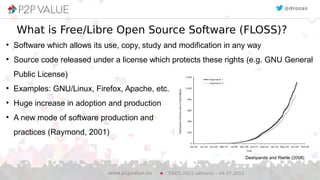
Software which allows its use, copy, study and modification in any way
●
Source code released under a license which protects these rights (e.g. GNU General
Public License)
●
Examples: GNU/Linux, Firefox, Apache, etc.
●
Huge increase in adoption and production
●
A new mode of software production and
practices (Raymond, 2001)
EGOS 2015 (Athens) – 04.07.2015www.p2pvalue.eu
@drozas
Deshpande and Riehle (2008)
5
What is Commons-Based Peer Production (CBPP)?
●
A new model of socio-economic production in which groups of loosely
connected individuals cooperate with each other to produce meaningful
products without a traditional hierarchical organisation (Benkler, 2006)
●
Spreading to diverse areas: open science, open agriculture, Peer-to-peer
urbanism, etc. (Fuster Morell et al., 2014)
EGOS 2015 (Athens) – 04.07.2015www.p2pvalue.eu
@drozas
6
What is Drupal?
● Free software content management framework
● Very modular: think of it as a “Lego”. Dozens of
core modules, +27k “contrib” modules
● Powering 2% websites worldwide (W3Techs, 2014)
● Employed in complex and high traffic websites: whitehouse.gov,
mtv.co.uk, economist.com, etc.
EGOS 2015 (Athens) – 04.07.2015www.p2pvalue.eu
@drozas
7
What is Drupal?: the Drupal community
● Started as a personal project of a student
● Code released in 2001 under a GNU General
Public License
● Currently +1M users registered at Drupal.org, +30k code contributors
(Drupal.org, 2014a)
● Hundreds of local Face-to-face events, dozens of DrupalCamps and
DrupalCons in 4 continents (Drupal.org, 2014b)
EGOS 2015 (Athens) – 04.07.2015www.p2pvalue.eu
@drozas
8
Drupal community as a CBPP community
● Drupal as a community whose mode of production (Fuster Morell, 2014) is:
● Collaborative process
● Peer-based: different levels of structure depending on the process, but not
mainly based on contractual obligations nor coercion
● Commons-process: process driven by the general interest, results in
openness of the resources
● Favouring reproducibility: via Free Software or Creative Commons licenses,
exchange of practices, etc.
EGOS 2015 (Athens) – 04.07.2015www.p2pvalue.eu
@drozas
9
Contribution activities as unit of analysis
●
Previous studies looked either at the individuals or at the whole community
(e.g.: motivations to contribute, structure of the community, etc.). Huang,
Le & Panchal (2011), Sims, J. P. (2013), Nordin (2014)
● Understand processes and dynamics: how do these communities
organise themselves?
●
My approach is to look at contribution activities as unit of analysis.
Drawing on Activity Theory (AT) and following an ethnographic approach
●
Implied to understand deeply what contribution means: stage 1
EGOS 2015 (Athens) – 04.07.2015www.p2pvalue.eu
@drozas@drozas
10
Contribution
● A blurry notion: meanings constantly evolving as part of negotiation
processes between the participants
● Critical in CBPP communities focussed on digital commons: economy of
contribution [not based on direct reciprocity]
rather than economy of gift [based on direct
reciprocity] (Wittel, 2013)
EGOS 2015 (Athens) – 04.07.2015www.p2pvalue.eu
@drozas
11
Contribution: “code-centrism”
● “Code-centrism” in FLOSS literature: typically looking at source code as
main notion of contribution; and in FLOSS communities: “Talk is silver, code
is gold”
● Relevant role of less visible contribution activities. For example, organisation
and participation in Face-to-face events (Rozas & Gilbert, in press)
● Role of “affective labour” (Hardt, 1999) to foster collaboration: avoid
barriers, increase commitment, generates and scale up the sense of
community
EGOS 2015 (Athens) – 04.07.2015www.p2pvalue.eu
@drozas
12
Activity Theory in the study of CBPP: challenges
● These communities, as being “difficult if not impossible to bound and close” and
defining their formation as being in a constant living and expanding process
(Engeström, 2007)
● CBPP requires and creates “bounded hubs of concentrated coordination efforts”
(Engeström, 2009, p. 310)
● More concrete description through the concept of benign runaway object
(Engeström, 2009):
● Intrinsic properties which transcend the utilitarian profit motive
● Object must yield useful intermediate products, yet remain an incomplete project
● Object must be visible, accessible and cumulable
● Effective feedback an exchange among the participants acting on object
EGOS 2015 (Athens) – 04.07.2015www.p2pvalue.eu
@drozas
13
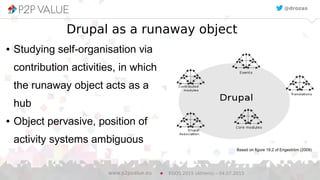
Drupal as a runaway object
● Studying self-organisation via
contribution activities, in which
the runaway object acts as a
hub
● Object pervasive, position of
activity systems ambiguous
EGOS 2015 (Athens) – 04.07.2015www.p2pvalue.eu
@drozas
Based on figure 19.2 of Engeström (2009)
14
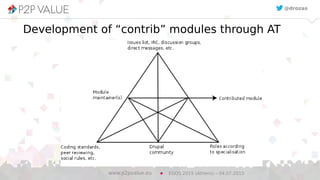
Development of “contrib” modules through AT
EGOS 2015 (Athens) – 04.07.2015www.p2pvalue.eu
@drozas
15
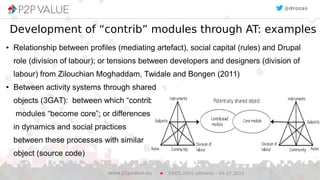
Development of “contrib” modules through AT: examples
● Relationship between profiles (mediating artefact), social capital (rules) and Drupal
role (division of labour); or tensions between developers and designers (division of
labour) from Zilouchian Moghaddam, Twidale and Bongen (2011)
● Between activity systems through shared
objects (3GAT): between which “contrib”
modules “become core”; or differences
in dynamics and social practices
between these processes with similar
object (source code)
EGOS 2015 (Athens) – 04.07.2015www.p2pvalue.eu
@drozas
17
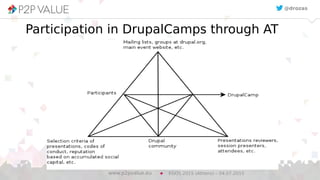
Participation in DrupalCamps through AT
EGOS 2015 (Athens) – 04.07.2015www.p2pvalue.eu
@drozas
18
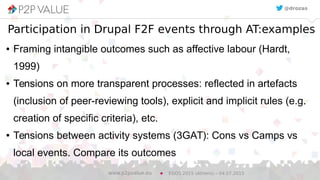
Participation in Drupal F2F events through AT:examples
● Framing intangible outcomes such as affective labour (Hardt,
1999)
● Tensions on more transparent processes: reflected in artefacts
(inclusion of peer-reviewing tools), explicit and implicit rules (e.g.
creation of specific criteria), etc.
● Tensions between activity systems (3GAT): Cons vs Camps vs
local events. Compare its outcomes
EGOS 2015 (Athens) – 04.07.2015www.p2pvalue.eu
@drozas
19
Future work
● Furthermore, emergence of
dimensions: online/offline &
formal/informal
● Allows to study according to
these dimensions, even in
diverse contribution activities:
“object-oriented” vs
“community-oriented”
EGOS 2015 (Athens) – 04.07.2015www.p2pvalue.eu
@drozas
20
Conclusion
● Lack of clear boundaries, distributed and blurred nature of CBPP
represents a challenge for AT
● Nevertheless, useful to untangle dense and multidirectional
dynamics in CBPP communities, as in this case study:
● Applying model of activity system to diverse contribution
activities
● Drawing on runaway object as a nexus of these efforts of
coordination
EGOS 2015 (Athens) – 04.07.2015www.p2pvalue.eu
@drozas
21
References
●
Deshpande, A. & Riehle, D. (2008). The total growth of open source. In Open Source Development, Communities and Quality (pp.
197–209). Springer.
●
Raymond, E. S. (2001). The Cathedral and the Bazaar: Musings on Linux and Open Source by an Accidental Revolutionary.
Sebastopol, CA, USA: O’Reilly.
● Benkler, Y. (2006). The wealth of networks: how social production transforms markets and freedom. Yale University Press.
●
Fuster Morell, M. et al. (2014). Theoretical synthesis: Final theoretical synthesis of WP1, including research reports on data collection.
Retrieved from http://p2pvalue.eu/sites/default/files/u28/D12_31July_TheoreticalFindingsA%20%281%29.pdf
●
W3Techs (2014). Usage of content management systems for websites.
http://w3techs.com/technologies/overview/content_management/all
●
Drupal.org (2014a). https://www.drupal.org/
●
Drupal.org (2014b). Drupal upcoming events. https://groups.drupal.org/events
●
Huang, Le & Panchal. (2011). Analysis of the structure and evolution of an open-source community.
●
Sims, J. P. (2013). Interactive engagement with an open source community : a study of the relationships between organizations and
an open source.
●
Nordin, D. (2014). Motivation and Collaboration in an Open Source Project: A Qualitative Study of the Drupal Community. (Master’s
thesis, Bentley University).
●
Wittel, A. (2013). Counter-commodification: The economy of contribution in the digital commons. Culture and Organization, 19 (4),
325, 327–328.
●
Rozas, D. & Gilbert, N. (in press). Talk is silver, code is gold? Contribution beyond source code in Free/Libre Open
●
Source Software communities. Abstract: Contribution beyond source code in Free/Libre Open Source Software: the role of affective
labour in the Drupal community. In BSA 2015 Annual Conference (pp. 73–74). British Sociological Association. Retrieved from
http://www.britsoc.co.uk/media/84184/Programme%20full.pdf?1427305668398
EGOS 2015 (Athens) – 04.07.2015www.p2pvalue.eu
@drozas
22
References
● Engeström, Y. (2007). From communities of practice to mycorrhizae. Communities of practice: Critical perspectives. Retrieved
from
http://www.open.ac.uk/opencetl/files/opencetl/file/ecms/web-content/Engestrom-(2007)-From-communities-of-practice-to-mycorr
hizae.pdf
● Engeström, Y. (2009). The future of activity theory: A rough draft. In Learning and expanding with activity theory (pp. 303–328).
● Zilouchian Moghaddam, R., Twidale, M. & Bongen, K. (2011). Open source interface politics: identity, acceptance, trust, and
lobbying. In CHI’11 Extended Abstracts on Human Factors in Computing Systems (pp. 1723–1728). ACM.
● Hardt, M. (1999). Affective labor. Boundary 2, 26 (2), 89–100.
● Images:
● http://www.egosnet.org/jart/prj3/egos/images/img-db/1392376003635.jpeg
● http://upload.wikimedia.org/wikipedia/commons/a/af/Tux.png
● http://upload.wikimedia.org/wikipedia/commons/5/53/Wikipedia-logo-en-big.png
● http://upload.wikimedia.org/wikipedia/commons/d/d7/Amsterdam_Fab_Lab_at_The_Waag_Society.JPG
● http://farmhack.net/sites/default/files/The%20Garlic%20Master%20001_0.JPG
● https://rafaeldemiguel.files.wordpress.com/2010/10/about_new.jpg
● http://www.garfieldtech.com/presentations/sfsf2012-drupal8/images/lego-druplicon.jpg
● http://www.siftdigital.co.uk/sites/default/files/drupal-community.png
● http://blog.101financial.com/wp-content/uploads/2014/03/Making-A-Contribution-To-Society.png
EGOS 2015 (Athens) – 04.07.2015www.p2pvalue.eu
@drozas
23
Thanks!
EGOS 2015 (Athens) – 04.07.2015www.p2pvalue.eu
Obrigado!
Grazie!
¡Gracias!
Any questions/feedback?
Ευχαριστώ!
This work is licensed under a Creative Commons
Attribution-ShareALike 4.0 Unported License
excerpt if otherwise noted.
To view a copy of this license, please visit:
https://creativecommons.org/licenses/by-sa/4.0/
@drozas
+info|contact:
●
@drozas
●
www.davidrozas.com || drozas@surrey.ac.uk
[...]

Drupal as a runaway object: conceptualisation of peer production activities through Activity Theory

  • 1.
    David Rozas, NigelGilbert, Paul Hodkinson University of Surrey EGOS 2015 (Athens) – 04.07.2015www.p2pvalue.eu This work was partially supported by the Framework programme FP7-ICT-2013-10 of the European Commission through project P2Pvalue (grant no.: 610961). Drupal as a runaway object: conceptualisation of peer production activities through Activity Theory Sub-theme #17: “Activity Theory and organizations”
  • 2.
    3 Outline ● Introduction: Free/Libre OpenSource Software, Commons-Based Peer Production and Drupal ● Contribution activities as unit of analysis & Activity Theory in the study of peer production ● Drupal as a runaway object and conceptualisation of peer production activities: development of source code and Face-to-face events ● Future work ● Conclusion and questions EGOS 2015 (Athens) – 04.07.2015www.p2pvalue.eu @drozas
  • 3.
    Full Name Author4 What is Free/Libre Open Source Software (FLOSS)? ● Software which allows its use, copy, study and modification in any way ● Source code released under a license which protects these rights (e.g. GNU General Public License) ● Examples: GNU/Linux, Firefox, Apache, etc. ● Huge increase in adoption and production ● A new mode of software production and practices (Raymond, 2001) EGOS 2015 (Athens) – 04.07.2015www.p2pvalue.eu @drozas Deshpande and Riehle (2008)
  • 4.
    5 What is Commons-BasedPeer Production (CBPP)? ● A new model of socio-economic production in which groups of loosely connected individuals cooperate with each other to produce meaningful products without a traditional hierarchical organisation (Benkler, 2006) ● Spreading to diverse areas: open science, open agriculture, Peer-to-peer urbanism, etc. (Fuster Morell et al., 2014) EGOS 2015 (Athens) – 04.07.2015www.p2pvalue.eu @drozas
  • 5.
    6 What is Drupal? ●Free software content management framework ● Very modular: think of it as a “Lego”. Dozens of core modules, +27k “contrib” modules ● Powering 2% websites worldwide (W3Techs, 2014) ● Employed in complex and high traffic websites: whitehouse.gov, mtv.co.uk, economist.com, etc. EGOS 2015 (Athens) – 04.07.2015www.p2pvalue.eu @drozas
  • 6.
    7 What is Drupal?:the Drupal community ● Started as a personal project of a student ● Code released in 2001 under a GNU General Public License ● Currently +1M users registered at Drupal.org, +30k code contributors (Drupal.org, 2014a) ● Hundreds of local Face-to-face events, dozens of DrupalCamps and DrupalCons in 4 continents (Drupal.org, 2014b) EGOS 2015 (Athens) – 04.07.2015www.p2pvalue.eu @drozas
  • 7.
    8 Drupal community asa CBPP community ● Drupal as a community whose mode of production (Fuster Morell, 2014) is: ● Collaborative process ● Peer-based: different levels of structure depending on the process, but not mainly based on contractual obligations nor coercion ● Commons-process: process driven by the general interest, results in openness of the resources ● Favouring reproducibility: via Free Software or Creative Commons licenses, exchange of practices, etc. EGOS 2015 (Athens) – 04.07.2015www.p2pvalue.eu @drozas
  • 8.
    9 Contribution activities asunit of analysis ● Previous studies looked either at the individuals or at the whole community (e.g.: motivations to contribute, structure of the community, etc.). Huang, Le & Panchal (2011), Sims, J. P. (2013), Nordin (2014) ● Understand processes and dynamics: how do these communities organise themselves? ● My approach is to look at contribution activities as unit of analysis. Drawing on Activity Theory (AT) and following an ethnographic approach ● Implied to understand deeply what contribution means: stage 1 EGOS 2015 (Athens) – 04.07.2015www.p2pvalue.eu @drozas@drozas
  • 9.
    10 Contribution ● A blurrynotion: meanings constantly evolving as part of negotiation processes between the participants ● Critical in CBPP communities focussed on digital commons: economy of contribution [not based on direct reciprocity] rather than economy of gift [based on direct reciprocity] (Wittel, 2013) EGOS 2015 (Athens) – 04.07.2015www.p2pvalue.eu @drozas
  • 10.
    11 Contribution: “code-centrism” ● “Code-centrism”in FLOSS literature: typically looking at source code as main notion of contribution; and in FLOSS communities: “Talk is silver, code is gold” ● Relevant role of less visible contribution activities. For example, organisation and participation in Face-to-face events (Rozas & Gilbert, in press) ● Role of “affective labour” (Hardt, 1999) to foster collaboration: avoid barriers, increase commitment, generates and scale up the sense of community EGOS 2015 (Athens) – 04.07.2015www.p2pvalue.eu @drozas
  • 11.
    12 Activity Theory inthe study of CBPP: challenges ● These communities, as being “difficult if not impossible to bound and close” and defining their formation as being in a constant living and expanding process (Engeström, 2007) ● CBPP requires and creates “bounded hubs of concentrated coordination efforts” (Engeström, 2009, p. 310) ● More concrete description through the concept of benign runaway object (Engeström, 2009): ● Intrinsic properties which transcend the utilitarian profit motive ● Object must yield useful intermediate products, yet remain an incomplete project ● Object must be visible, accessible and cumulable ● Effective feedback an exchange among the participants acting on object EGOS 2015 (Athens) – 04.07.2015www.p2pvalue.eu @drozas
  • 12.
    13 Drupal as arunaway object ● Studying self-organisation via contribution activities, in which the runaway object acts as a hub ● Object pervasive, position of activity systems ambiguous EGOS 2015 (Athens) – 04.07.2015www.p2pvalue.eu @drozas Based on figure 19.2 of Engeström (2009)
  • 13.
    14 Development of “contrib”modules through AT EGOS 2015 (Athens) – 04.07.2015www.p2pvalue.eu @drozas
  • 14.
    15 Development of “contrib”modules through AT: examples ● Relationship between profiles (mediating artefact), social capital (rules) and Drupal role (division of labour); or tensions between developers and designers (division of labour) from Zilouchian Moghaddam, Twidale and Bongen (2011) ● Between activity systems through shared objects (3GAT): between which “contrib” modules “become core”; or differences in dynamics and social practices between these processes with similar object (source code) EGOS 2015 (Athens) – 04.07.2015www.p2pvalue.eu @drozas
  • 15.
    17 Participation in DrupalCampsthrough AT EGOS 2015 (Athens) – 04.07.2015www.p2pvalue.eu @drozas
  • 16.
    18 Participation in DrupalF2F events through AT:examples ● Framing intangible outcomes such as affective labour (Hardt, 1999) ● Tensions on more transparent processes: reflected in artefacts (inclusion of peer-reviewing tools), explicit and implicit rules (e.g. creation of specific criteria), etc. ● Tensions between activity systems (3GAT): Cons vs Camps vs local events. Compare its outcomes EGOS 2015 (Athens) – 04.07.2015www.p2pvalue.eu @drozas
  • 17.
    19 Future work ● Furthermore,emergence of dimensions: online/offline & formal/informal ● Allows to study according to these dimensions, even in diverse contribution activities: “object-oriented” vs “community-oriented” EGOS 2015 (Athens) – 04.07.2015www.p2pvalue.eu @drozas
  • 18.
    20 Conclusion ● Lack ofclear boundaries, distributed and blurred nature of CBPP represents a challenge for AT ● Nevertheless, useful to untangle dense and multidirectional dynamics in CBPP communities, as in this case study: ● Applying model of activity system to diverse contribution activities ● Drawing on runaway object as a nexus of these efforts of coordination EGOS 2015 (Athens) – 04.07.2015www.p2pvalue.eu @drozas
  • 19.
    21 References ● Deshpande, A. &Riehle, D. (2008). The total growth of open source. In Open Source Development, Communities and Quality (pp. 197–209). Springer. ● Raymond, E. S. (2001). The Cathedral and the Bazaar: Musings on Linux and Open Source by an Accidental Revolutionary. Sebastopol, CA, USA: O’Reilly. ● Benkler, Y. (2006). The wealth of networks: how social production transforms markets and freedom. Yale University Press. ● Fuster Morell, M. et al. (2014). Theoretical synthesis: Final theoretical synthesis of WP1, including research reports on data collection. Retrieved from http://p2pvalue.eu/sites/default/files/u28/D12_31July_TheoreticalFindingsA%20%281%29.pdf ● W3Techs (2014). Usage of content management systems for websites. http://w3techs.com/technologies/overview/content_management/all ● Drupal.org (2014a). https://www.drupal.org/ ● Drupal.org (2014b). Drupal upcoming events. https://groups.drupal.org/events ● Huang, Le & Panchal. (2011). Analysis of the structure and evolution of an open-source community. ● Sims, J. P. (2013). Interactive engagement with an open source community : a study of the relationships between organizations and an open source. ● Nordin, D. (2014). Motivation and Collaboration in an Open Source Project: A Qualitative Study of the Drupal Community. (Master’s thesis, Bentley University). ● Wittel, A. (2013). Counter-commodification: The economy of contribution in the digital commons. Culture and Organization, 19 (4), 325, 327–328. ● Rozas, D. & Gilbert, N. (in press). Talk is silver, code is gold? Contribution beyond source code in Free/Libre Open ● Source Software communities. Abstract: Contribution beyond source code in Free/Libre Open Source Software: the role of affective labour in the Drupal community. In BSA 2015 Annual Conference (pp. 73–74). British Sociological Association. Retrieved from http://www.britsoc.co.uk/media/84184/Programme%20full.pdf?1427305668398 EGOS 2015 (Athens) – 04.07.2015www.p2pvalue.eu @drozas
  • 20.
    22 References ● Engeström, Y.(2007). From communities of practice to mycorrhizae. Communities of practice: Critical perspectives. Retrieved from http://www.open.ac.uk/opencetl/files/opencetl/file/ecms/web-content/Engestrom-(2007)-From-communities-of-practice-to-mycorr hizae.pdf ● Engeström, Y. (2009). The future of activity theory: A rough draft. In Learning and expanding with activity theory (pp. 303–328). ● Zilouchian Moghaddam, R., Twidale, M. & Bongen, K. (2011). Open source interface politics: identity, acceptance, trust, and lobbying. In CHI’11 Extended Abstracts on Human Factors in Computing Systems (pp. 1723–1728). ACM. ● Hardt, M. (1999). Affective labor. Boundary 2, 26 (2), 89–100. ● Images: ● http://www.egosnet.org/jart/prj3/egos/images/img-db/1392376003635.jpeg ● http://upload.wikimedia.org/wikipedia/commons/a/af/Tux.png ● http://upload.wikimedia.org/wikipedia/commons/5/53/Wikipedia-logo-en-big.png ● http://upload.wikimedia.org/wikipedia/commons/d/d7/Amsterdam_Fab_Lab_at_The_Waag_Society.JPG ● http://farmhack.net/sites/default/files/The%20Garlic%20Master%20001_0.JPG ● https://rafaeldemiguel.files.wordpress.com/2010/10/about_new.jpg ● http://www.garfieldtech.com/presentations/sfsf2012-drupal8/images/lego-druplicon.jpg ● http://www.siftdigital.co.uk/sites/default/files/drupal-community.png ● http://blog.101financial.com/wp-content/uploads/2014/03/Making-A-Contribution-To-Society.png EGOS 2015 (Athens) – 04.07.2015www.p2pvalue.eu @drozas
  • 21.
    23 Thanks! EGOS 2015 (Athens)– 04.07.2015www.p2pvalue.eu Obrigado! Grazie! ¡Gracias! Any questions/feedback? Ευχαριστώ! This work is licensed under a Creative Commons Attribution-ShareALike 4.0 Unported License excerpt if otherwise noted. To view a copy of this license, please visit: https://creativecommons.org/licenses/by-sa/4.0/ @drozas +info|contact: ● @drozas ● www.davidrozas.com || drozas@surrey.ac.uk [...]