Efficient Spring Data REST Development
2
Who I Am
3
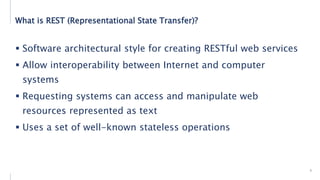
What is REST (Representational State Transfer)?
 Software architectural style for creating RESTful web services
 Allow interoperability between Internet and computer
systems
 Requesting systems can access and manipulate web
resources represented as text
 Uses a set of well-known stateless operations
4
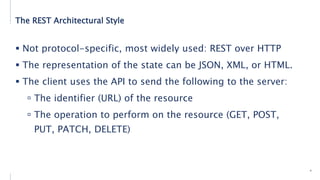
The REST Architectural Style
 Not protocol-specific, most widely used: REST over HTTP
 The representation of the state can be JSON, XML, or HTML.
 The client uses the API to send the following to the server:
 The identifier (URL) of the resource
 The operation to perform on the resource (GET, POST,
PUT, PATCH, DELETE)
5
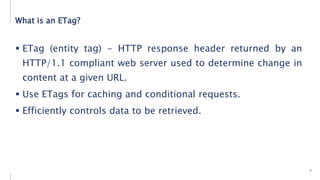
What is an ETag?
 ETag (entity tag) - HTTP response header returned by an
HTTP/1.1 compliant web server used to determine change in
content at a given URL.
 Use ETags for caching and conditional requests.
 Efficiently controls data to be retrieved.
6
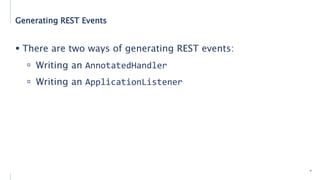
Generating REST Events
 There are two ways of generating REST events:
 Writing an AnnotatedHandler
 Writing an ApplicationListener
7
Projections and Excerpts
 Spring Data REST presents a default view of the domain
model you export.
 Sometimes you may need to alter the view of that model for
various reasons.
 Projections and excerpts serve as efficient and reduced views
of resources.
8
Reactive Access to Repositories
 Efficiently retrieve results as a stream
 ReactiveCrudRepository
 R2dbcRepository
Thank you!

Efficient Spring Data REST Development

  • 1.
    Efficient Spring DataREST Development
  • 2.
  • 3.
    3 What is REST(Representational State Transfer)?  Software architectural style for creating RESTful web services  Allow interoperability between Internet and computer systems  Requesting systems can access and manipulate web resources represented as text  Uses a set of well-known stateless operations
  • 4.
    4 The REST ArchitecturalStyle  Not protocol-specific, most widely used: REST over HTTP  The representation of the state can be JSON, XML, or HTML.  The client uses the API to send the following to the server:  The identifier (URL) of the resource  The operation to perform on the resource (GET, POST, PUT, PATCH, DELETE)
  • 5.
    5 What is anETag?  ETag (entity tag) - HTTP response header returned by an HTTP/1.1 compliant web server used to determine change in content at a given URL.  Use ETags for caching and conditional requests.  Efficiently controls data to be retrieved.
  • 6.
    6 Generating REST Events There are two ways of generating REST events:  Writing an AnnotatedHandler  Writing an ApplicationListener
  • 7.
    7 Projections and Excerpts Spring Data REST presents a default view of the domain model you export.  Sometimes you may need to alter the view of that model for various reasons.  Projections and excerpts serve as efficient and reduced views of resources.
  • 8.
    8 Reactive Access toRepositories  Efficiently retrieve results as a stream  ReactiveCrudRepository  R2dbcRepository
  • 9.