Effectively Telling Your
Story Through Content
Marketing
Cheryl Landes, Tabby Cat Communications
STC-PMC Webinar
April 12, 2017
Agenda
• What is content marketing?
• How content marketing tells your story
• Methods for telling your story
• Creating a content marketing plan
What is content marketing?
“In content marketing, content is created to provide consumers with
the information they seek.”
- Jeff Cannon, Make Your Website Work for You: How to Convert
Online Content Into Profits
Goals of content marketing
• Attract attention and generate leads
• Expand a customer base
• Generate or increase online sales
• Increase brand awareness or credibility
• Engage a user community
Content marketing isn’t new
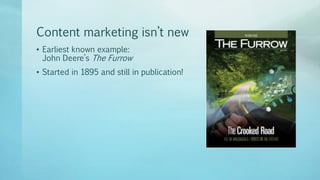
• Earliest known example:
John Deere’s The Furrow
• Started in 1895 and still in publication!
Content marketing isn’t new
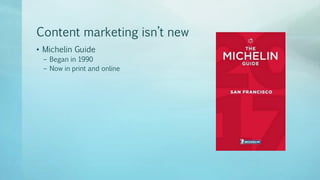
• Michelin Guide
– Began in 1990
– Now in print and online
Content marketing isn’t new
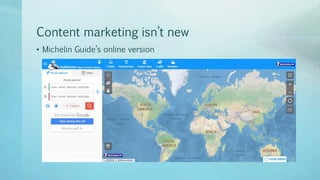
• Michelin Guide’s online version
Content marketing isn’t new
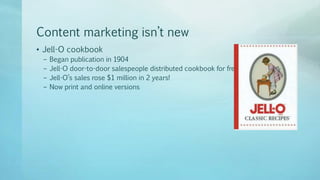
• Jell-O cookbook
– Began publication in 1904
– Jell-O door-to-door salespeople distributed cookbook for free
– Jell-O’s sales rose $1 million in 2 years!
– Now print and online versions
Content marketing isn’t new
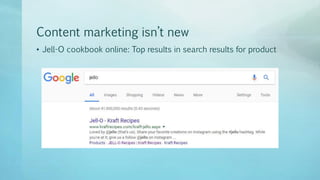
• Jell-O cookbook online: Top results in search results for product
Content marketing isn’t new
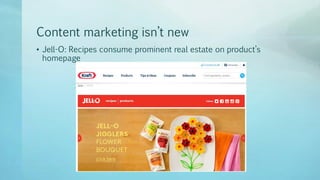
• Jell-O: Recipes consume prominent real estate on product’s
homepage
How content marketing tells your story
• Content marketing reflects your values:
– Your customers are important.
– What matters to you matters to your customers.
– Your customers want to know who you are.
Methods for telling your story
• Identify your target audience.
– What do they need?
– What do they want?
– When you know your audience, it’s easier to develop targeted content.
Methods for telling your story
• Determine the types of content to publish.
– White papers and eBooks
– How-to guides
– Webinars
– Videos
– Podcasts
– Infographics
– Quizzes
– Lists
– Q&A
– Surveys
– Interviews
– Editorials and Op-eds
– Technical documentation
Methods for telling your story
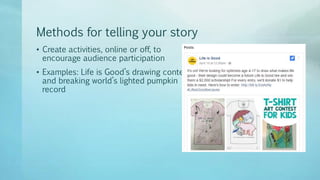
• Create activities, online or off, to
encourage audience participation
• Examples: Life is Good’s drawing contest
and breaking world’s lighted pumpkin
record
Methods for telling your story
• Set up a content management system (CMS), which helps with:
– Content creation
– Publishing content
– Tracking success of published content
– Reusing content
Content management can be simple
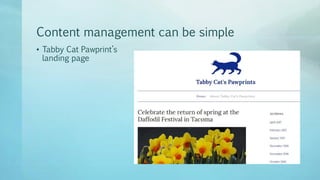
• Example from Tabby Cat’s Pawprints travel blog
– Editorial calendar – simple Word doc
– Content written in Word and published in WordPress
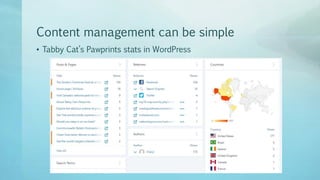
– Reader statistics tracked in WordPress
Content management can be simple
• Tabby Cat Pawprint’s
landing page
Content management can be simple
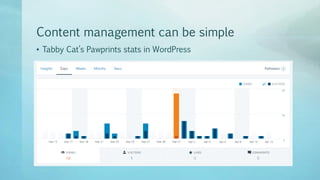
• Tabby Cat’s Pawprints stats in WordPress
Content management can be simple
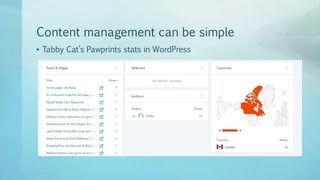
• Tabby Cat’s Pawprints stats in WordPress
Content management can be simple
• Tabby Cat’s Pawprints stats in WordPress
Content management can be simple
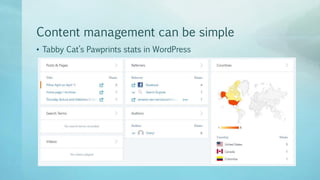
• Tabby Cat’s Pawprints stats in WordPress
Creating a content marketing plan
• Determine your goals for content marketing.
• Identify your target audience.
• Conduct a content audit to identify content you can use.
• Set up a content management system.
• Brainstorm content ideas.
• Determine the types of content you want to create.
• Publish, manage, and track your content.
Source: Hubspot
Selected resources
• Content Marketing Institute
• Content Marketing World
• Hubspot
• Unthinkable.fm/
Summary
• What content marketing is
• How content marketing tells your story
• Creating a content marketing plan
Thank you!
Cheryl Landes
Tabby Cat Communications
Personal email: clandes407@aol.com
Business website: tabbycatco.com
Travel blog: tabbycatspawprints.com

Effectively Telling Your Story through Content Marketing

  • 1.
    Effectively Telling Your StoryThrough Content Marketing Cheryl Landes, Tabby Cat Communications STC-PMC Webinar April 12, 2017
  • 2.
    Agenda • What iscontent marketing? • How content marketing tells your story • Methods for telling your story • Creating a content marketing plan
  • 3.
    What is contentmarketing? “In content marketing, content is created to provide consumers with the information they seek.” - Jeff Cannon, Make Your Website Work for You: How to Convert Online Content Into Profits
  • 4.
    Goals of contentmarketing • Attract attention and generate leads • Expand a customer base • Generate or increase online sales • Increase brand awareness or credibility • Engage a user community
  • 5.
    Content marketing isn’tnew • Earliest known example: John Deere’s The Furrow • Started in 1895 and still in publication!
  • 6.
    Content marketing isn’tnew • Michelin Guide – Began in 1990 – Now in print and online
  • 7.
    Content marketing isn’tnew • Michelin Guide’s online version
  • 8.
    Content marketing isn’tnew • Jell-O cookbook – Began publication in 1904 – Jell-O door-to-door salespeople distributed cookbook for free – Jell-O’s sales rose $1 million in 2 years! – Now print and online versions
  • 9.
    Content marketing isn’tnew • Jell-O cookbook online: Top results in search results for product
  • 10.
    Content marketing isn’tnew • Jell-O: Recipes consume prominent real estate on product’s homepage
  • 11.
    How content marketingtells your story • Content marketing reflects your values: – Your customers are important. – What matters to you matters to your customers. – Your customers want to know who you are.
  • 12.
    Methods for tellingyour story • Identify your target audience. – What do they need? – What do they want? – When you know your audience, it’s easier to develop targeted content.
  • 13.
    Methods for tellingyour story • Determine the types of content to publish. – White papers and eBooks – How-to guides – Webinars – Videos – Podcasts – Infographics – Quizzes – Lists – Q&A – Surveys – Interviews – Editorials and Op-eds – Technical documentation
  • 14.
    Methods for tellingyour story • Create activities, online or off, to encourage audience participation • Examples: Life is Good’s drawing contest and breaking world’s lighted pumpkin record
  • 15.
    Methods for tellingyour story • Set up a content management system (CMS), which helps with: – Content creation – Publishing content – Tracking success of published content – Reusing content
  • 16.
    Content management canbe simple • Example from Tabby Cat’s Pawprints travel blog – Editorial calendar – simple Word doc – Content written in Word and published in WordPress – Reader statistics tracked in WordPress
  • 17.
    Content management canbe simple • Tabby Cat Pawprint’s landing page
  • 18.
    Content management canbe simple • Tabby Cat’s Pawprints stats in WordPress
  • 19.
    Content management canbe simple • Tabby Cat’s Pawprints stats in WordPress
  • 20.
    Content management canbe simple • Tabby Cat’s Pawprints stats in WordPress
  • 21.
    Content management canbe simple • Tabby Cat’s Pawprints stats in WordPress
  • 22.
    Creating a contentmarketing plan • Determine your goals for content marketing. • Identify your target audience. • Conduct a content audit to identify content you can use. • Set up a content management system. • Brainstorm content ideas. • Determine the types of content you want to create. • Publish, manage, and track your content. Source: Hubspot
  • 23.
    Selected resources • ContentMarketing Institute • Content Marketing World • Hubspot • Unthinkable.fm/
  • 24.
    Summary • What contentmarketing is • How content marketing tells your story • Creating a content marketing plan
  • 25.
    Thank you! Cheryl Landes TabbyCat Communications Personal email: clandes407@aol.com Business website: tabbycatco.com Travel blog: tabbycatspawprints.com

Editor's Notes

  • #4 Content marketing is a form of marketing focused on creating, publishing and distributing content for a targeted audience online. Unlike other forms of online marketing, content marketing relies on anticipating and meeting an existing customer need for information, as opposed to creating demand for a new need. As James O'Brien of Contently wrote on Mashable, “The idea central to content marketing is that a brand must give something valuable to get something valuable in return. Instead of the commercial, be the show. Instead of the banner ad, be the feature story.” Firsts in content marketing: The phrase "content marketing" was used as early as 1996, when John F. Oppedahl led a roundtable for journalists at the American Society for Newspaper Editors. In 1998, Jerrell Jimerson held the title of "director of online and content marketing" at Netscape. In 2009, Joe Pulizzi founded the Content Marketing Institute after publishing his book, Get Content, Get Customers, which is still considered as the ultimate guide to content marketing. The Content Marketing Institute also hosts Content Marketing World, considered as the largest content marketing conference in the world. Last year’s attendance was 3,600 from 50 countries, and the number is expected to reach at 4,000 this year.
  • #6 In 1895, John Deere launched the magazine The Furrow, providing information to farmers on how to become more profitable. The magazine, considered the first custom publication, is still in circulation, reaching 1.5 million readers in 40 countries in 12 different languages. Well-researched, well-written articles. Examples of articles: Series on the history of country music Debate on whether Holstein or Jersey cows are the best milk producers Series about how three ranches on Maui survive Article about how Shochu, a popular Asian beverage, is made Report on the refugee farmers in Burundi
  • #7 In 1900, Michelin developed the Michelin Guide, offering drivers information on auto maintenance, accommodations, and other travel tips. 35,000 copies were distributed for free in this first edition. Online version at viamichelin.com. Can search by location or tourist site and drill down on an interactive map.
  • #9 In 1904, Jell-O salesmen went door-to-door, distributing their cookbook for free. Touting the dessert as a versatile food, the company saw its sales rise to over $1 million by 1906. When I looked up Jell-O while working on this presentation, the recipes was the top listing in the search results.
  • #10 Kraft, the owners of Jell-O, knows its audience! They’ve optimized their website so that when customers search for Jell-O, the recipes display at the top of the list. Recipes are prominent on the brand’s website.
  • #11 Kraft knows that its customers are looking for recipes, so it takes advantage of its website real estate to promote ideas.
  • #12 Examples: John Deere’s target market is farmers, but the company reflects its own values in providing information that interests its customers. The information isn’t selling their products, but customers will remember John Deer from the well-researched, high-quality, interesting content and return to read future issues of The Furrow. They’ll think of John Deere first when looking for products to make their farms more productive and efficient. Michelin knows people who buy its automotive products travel, so they’ve provided information for destinations around the world. In a sense, Michelin has turned itself into a media company with its travel publications. Kraft/Jell-O knows its customers love to cook, and cooks are always looking for recipes and new recipe ideas. Kraft attracts people by publishing a vast library of recipes for any occasion.
  • #13 The first step in creating a successful content marketing campaign is to define a target audience, commonly known as user segmentation. Successful content marketers deeply understand their customers' needs and desires, beyond just their sole interest in their products or service. For example, somebody marketing a food truck, may define their target customer as young millennials who work within a 5-minute walk of downtown San Francisco and who enjoy trying fresh, healthy foods. The more narrowly the customer can be defined, the easier it is to define content for that target audience.
  • #14 The appropriate type of content for any business will depend on the business' goals and target customer. For example, an architect provider targeting real estate developers of large residential complexes may benefit from creating a list outlining all the considerations that a real estate developer should consider before entering a deal. Conversely, a local catering service targeting busy families may benefit from a video showcasing the warmth and convenience of a home-made, freshly-cooked meal. Not every type of content on this list will be effective for everyone. This is also why it’s important to know your target audience and its needs.
  • #15 Life is Good is hosting a content for youth, ages 4-17, to create drawings on what makes life good. Top prize is a $2,000 scholarship. Winning designs could become a future T-shirt. For every entry, Life is Good donates $1 to help kids in need. Life is Good also donates 10% of its profits to help kids in need and has its own kids foundation to help those most vulnerable. They also hosted a pumpkin festival at the Boston Common in 2006 in an attempt to break the world’s record of lit pumpkins. They made it, with 29,000 lit pumpkins. Keene, New Hampshire, a city northwest of Boston, has held the record with 28,952 lighted pumpkins since 2003 and vowed to defend its title by illuminating 30,000 this year. So far, Boston’s record still stands. John Jacobs, co-founder of Life is Good.
  • #16 To get started, businesses will need to find a content management system (CMS). Though there are many CMS and they each offer a slightly different value proposition, most include functions to help with content creation, publication, and analytics to track the success of posts. Content management systems don’t have to be complicated. Reusing content—Use MadCap example.
  • #17 WordPress
  • #20 March 31: 1 visitor, 18 views on site
  • #21 April 1: 7 visitors, less views on site 5 viewed pillow fight article 1 viewed my home page 1 viewed the military lecture series article at Fort Vancouver
  • #22 Results can be surprising sometimes! Most viewed article in December 2016, on The Grotto’s Christmas Festival of Lights in Portland (130 views, with 124 referrals from Facebook)
  • #25 In content marketing, content is created to provide consumers with the information they seek. Content marketing reflects your values: Your customers are important. What matters to you matters to your customers. Your customers want to know who you are. Creating content marketing plan: Determine your goals for content marketing. Identify your target audience. Conduct a content audit to identify content you can use. Set up a content management system. Brainstorm content ideas. Determine the types of content you want to create. Publish, manage, and track your content.