Creating Effective
PowerPoints (For Teaching)
Prepared and Presented by
Dr. Dana Lynn Driscoll
CETL Faculty Fellow
Assistant Professor, Department of Writing and Rhetoric
driscoll@oakland.edu
Presentation Overview
• Teaching vs. research presentations
• Interactivity and engagement
• Learning principles for using PPT
• Basic principles of rhetoric and design
• Discussion
Introductions
Please let us know:
• Your Name
• Your Department
• Courses you typically teach
• The size of your classes
Freewrite
The title of this talk is “Creating ‘Effective’ PowerPoints.”
In a short freewrite, please consider:
• How do you intend your students to use your
PowerPoints?
• How do your students actually use your PowerPoints?
• How have you used PowerPoint in your past courses?
• Do you feel this use was effective?
Teaching Students vs. Research
Presentations
• Research PowerPoints – present results of research or
scholarship, aid for attendees, no quizzes/tests.
• Audience: high motivation/interest of attendees; attendees there of
their own free will; no long-term learning/retaining of information
necessary
• Teaching PowerPoints –Goal is to facilitate student learning of
content/knowledge/skill area. Can be used with lecture,
discussion, groupwork, etc.
• Audience: Captive audience; retaining/long-term learning necessary
• How does this change how we think about PowerPoint in the
classroom?
PowerPoints for Teaching
• Using PowerPoint a both teaching tools and study
guides changes the nature and amount of
information presented.
• Use “notes” to keep PowerPoints clean and uncluttered
• PowerPoints as teaching aids to facilitate discussion,
class time management, and groupwork
• PowerPoints have a psychological component—
students feel that PowerPoint's are important and are
more likely to take notes
Student Engagement
• One of the challenges of PowerPoint as an
instructional delivery system is that it can be a very
passive learning environment.
• What strategies have you used to make your
PowerPoints more engaging and encourage active
learning?
• How does this differ for small vs. large classes?
Student Engagement
Small Classes
• Class discussions with
questions embedded in
PowerPoint material
• Group work (even short, 5
minute discussions in pairs)
breaks up lecture portions
• The “think  pair  share”
strategy works (demonstrate a
point, have them freewrite,
have them pair, and discuss)
Large Classes
• Use of clickers, twitter feed,
or other technology can aid
in engagement
• Short discussions among
students with 3-4 groups
reporting back (or all groups
reporting to forum/twitter
feed)
• Good delivery helps (more
later on this)!
Writing and Design:
Which slide do you
prefer?
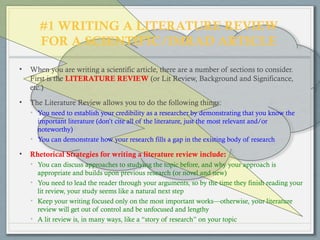
#1 WRITING A LITERATURE REVIEW
FOR A SCIENTIFIC/IMRAD ARTICLE
• When you are writing a scientific article, there are a number of sections to consider.
First is the LITERATURE REVIEW (or Lit Review, Background and Significance,
etc.)
• The Literature Review allows you to do the following things:
• You need to establish your credibility as a researcher by demonstrating that you know the
important literature (don’t cite all of the literature, just the most relevant and/or
noteworthy)
• You can demonstrate how your research fills a gap in the existing body of research
• Rhetorical Strategies for writing a literature review include:
• You can discuss approaches to studying the topic before, and why your approach is
appropriate and builds upon previous research (or novel and new)
• You need to lead the reader through your arguments, so by the time they finish reading your
lit review, your study seems like a natural next step
• Keep your writing focused only on the most important works—otherwise, your literature
review will get out of control and be unfocused and lengthy
• A lit review is, in many ways, like a “story of research” on your topic
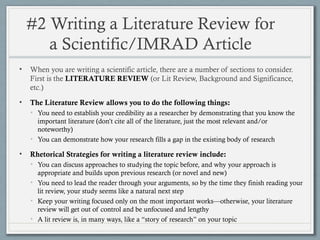
#2 Writing a Literature Review for
a Scientific/IMRAD Article
• When you are writing a scientific article, there are a number of sections to consider.
First is the LITERATURE REVIEW (or Lit Review, Background and Significance,
etc.)
• The Literature Review allows you to do the following things:
• You need to establish your credibility as a researcher by demonstrating that you know the
important literature (don’t cite all of the literature, just the most relevant and/or
noteworthy)
• You can demonstrate how your research fills a gap in the existing body of research
• Rhetorical Strategies for writing a literature review include:
• You can discuss approaches to studying the topic before, and why your approach is
appropriate and builds upon previous research (or novel and new)
• You need to lead the reader through your arguments, so by the time they finish reading your
lit review, your study seems like a natural next step
• Keep your writing focused only on the most important works—otherwise, your literature
review will get out of control and be unfocused and lengthy
• A lit review is, in many ways, like a “story of research” on your topic
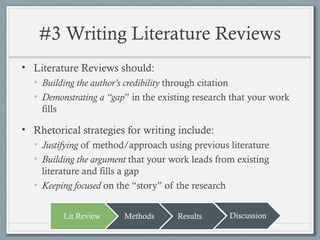
#3 Writing Literature Reviews
• Literature Reviews should:
• Building the author’s credibility through citation
• Demonstrating a “gap” in the existing research that your work
fills
• Rhetorical strategies for writing include:
• Justifying of method/approach using previous literature
• Building the argument that your work leads from existing
literature and fills a gap
• Keeping focused on the “story” of the research
Lit Review Methods Results Discussion
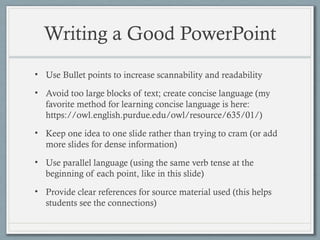
Writing a Good PowerPoint
• Use Bullet points to increase scannability and readability
• Avoid too large blocks of text; create concise language (my
favorite method for learning concise language is here:
https://owl.english.purdue.edu/owl/resource/635/01/)
• Keep one idea to one slide rather than trying to cram (or add
more slides for dense information)
• Use parallel language (using the same verb tense at the
beginning of each point, like in this slide)
• Provide clear references for source material used (this helps
students see the connections)
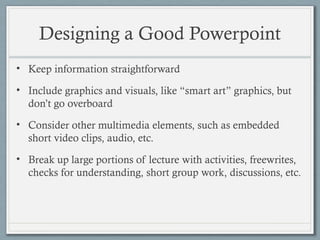
Designing a Good Powerpoint
• Keep information straightforward
• Include graphics and visuals, like “smart art” graphics, but
don’t go overboard
• Consider other multimedia elements, such as embedded
short video clips, audio, etc.
• Break up large portions of lecture with activities, freewrites,
checks for understanding, short group work, discussions, etc.
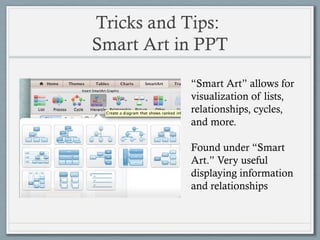
Tricks and Tips:
Smart Art in PPT
“Smart Art” allows for
visualization of lists,
relationships, cycles,
and more.
Found under “Smart
Art.” Very useful
displaying information
and relationships
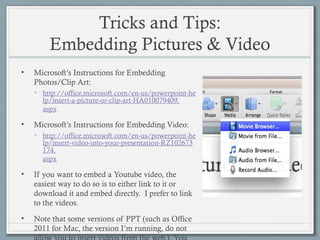
Tricks and Tips:
Embedding Pictures & Video
• Microsoft’s Instructions for Embedding
Photos/Clip Art:
• http://office.microsoft.com/en-us/powerpoint-he
lp/insert-a-picture-or-clip-art-HA010079409.
aspx
• Microsoft’s Instructions for Embedding Video:
• http://office.microsoft.com/en-us/powerpoint-he
lp/insert-video-into-your-presentation-RZ102673
174.
aspx
• If you want to embed a Youtube video, the
easiest way to do so is to either link to it or
download it and embed directly. I prefer to link
to the videos.
• Note that some versions of PPT (such as Office
2011 for Mac, the version I’m running, do not
Tricks and Tips:
Basic Design Principles
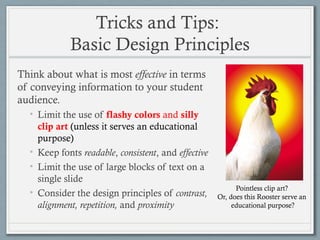
Think about what is most effective in terms
of conveying information to your student
audience.
• Limit the use of flashy colors and silly
clip art (unless it serves an educational
purpose)
• Keep fonts readable, consistent, and effective
• Limit the use of large blocks of text on a
single slide
• Consider the design principles of contrast,
alignment, repetition, and proximity
Pointless clip art?
Or, does this Rooster serve an
educational purpose?
Tricks and Tips:
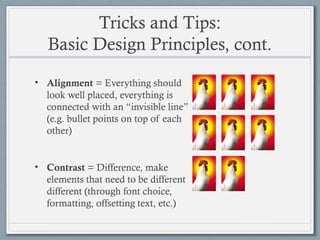
Basic Design Principles, cont.
• Alignment = Everything should
look well placed, everything is
connected with an “invisible line”
(e.g. bullet points on top of each
other)
• Contrast = Difference, make
elements that need to be different
different (through font choice,
formatting, offsetting text, etc.)
Tips and Tricks: Basic Design
Principles, cont.
• Repetition = Repetition is about unity, consistency,
and creating cohesiveness (three slides with the same
design and similar content)
• Proximity = where things are placed in relationship
to one another; where does your eye move? What is
the path it takes?
• *Information taken from Williams (2008) Non-
Designer’s Design Book
Organizing PowerPoints
• Find a partner or small group and consider the
following questions:
• How do you organize the content of Powerpoint
presentations for your courses?
• What typically comes first, second, third, etc?
• What kinds of content is included in your Powerpoint?
• How do you break up long presentations of
information/lectures?
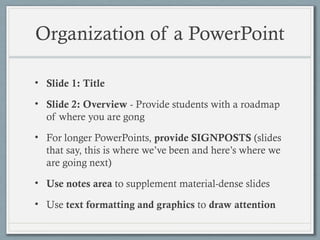
Organization of a PowerPoint
• Slide 1: Title
• Slide 2: Overview - Provide students with a roadmap
of where you are gong
• For longer PowerPoints, provide SIGNPOSTS (slides
that say, this is where we’ve been and here’s where we
are going next)
• Use notes area to supplement material-dense slides
• Use text formatting and graphics to draw attention
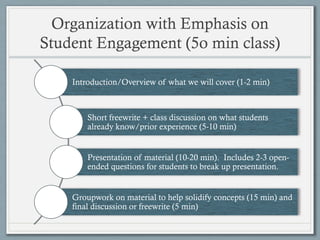
Organization with Emphasis on
Student Engagement (5o min class)
Introduction/Overview of what we will cover (1-2 min)
Short freewrite + class discussion on what students
already know/prior experience (5-10 min)
Presentation of material (10-20 min). Includes 2-3 open-
ended questions for students to break up presentation.
Groupwork on material to help solidify concepts (15 min) and
final discussion or freewrite (5 min)
Delivery of a PowerPoint
• Part of an effective PowerPoint is how its delivered/presented in a classroom
• Students prefer faculty who are engaged and interested in the material (through
enthusiasm in voice, engagement with subject, interesting stories)
• Students also want to see clear connections to future careers and real life (this is
a good activity to do with students at the beginning or end of a class session)
• I find it helpful to talk about my own experiences, successes, and struggles in
relationship to material and ask students to share theirs (if applicable)
• I also find it helpful to include humor to keep students interested and
engaged.
Question: What are your best tips for keeping things interesting in presenting a
PowerPoint presentation in a class?
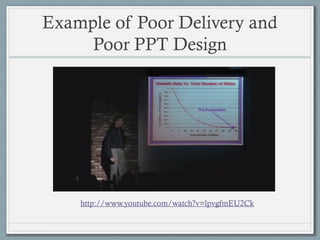
Example of Poor Delivery and
Poor PPT Design
http://www.youtube.com/watch?v=lpvgfmEU2Ck
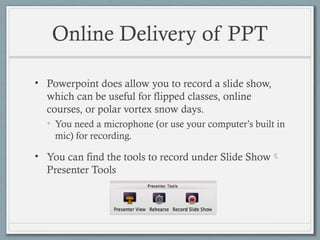
Online Delivery of PPT
• Powerpoint does allow you to record a slide show,
which can be useful for flipped classes, online
courses, or polar vortex snow days.
• You need a microphone (or use your computer’s built in
mic) for recording.
• You can find the tools to record under Slide Show
Presenter Tools
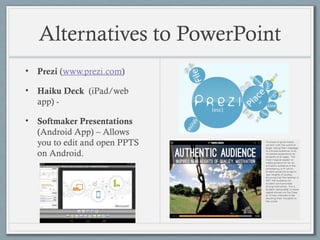
Alternatives to PowerPoint
• Prezi (www.prezi.com)
• Haiku Deck (iPad/web
app) -
• Softmaker Presentations
(Android App) – Allows
you to edit and open PPTS
on Android.
Discussion Questions
• What other ideas do you have for effective use of
PowerPoints in class?
• How do you use PowerPoint for online / flipped
classes?
• What challenges have you had with PowerPoint?
• What is PowerPoint “good at” doing in classes? What
is it “poor at” doing in classes?
• What other questions do you have?

effective_powerpoints_(for teaching)_REV.pptx

  • 1.
    Creating Effective PowerPoints (ForTeaching) Prepared and Presented by Dr. Dana Lynn Driscoll CETL Faculty Fellow Assistant Professor, Department of Writing and Rhetoric driscoll@oakland.edu
  • 2.
    Presentation Overview • Teachingvs. research presentations • Interactivity and engagement • Learning principles for using PPT • Basic principles of rhetoric and design • Discussion
  • 3.
    Introductions Please let usknow: • Your Name • Your Department • Courses you typically teach • The size of your classes
  • 4.
    Freewrite The title ofthis talk is “Creating ‘Effective’ PowerPoints.” In a short freewrite, please consider: • How do you intend your students to use your PowerPoints? • How do your students actually use your PowerPoints? • How have you used PowerPoint in your past courses? • Do you feel this use was effective?
  • 5.
    Teaching Students vs.Research Presentations • Research PowerPoints – present results of research or scholarship, aid for attendees, no quizzes/tests. • Audience: high motivation/interest of attendees; attendees there of their own free will; no long-term learning/retaining of information necessary • Teaching PowerPoints –Goal is to facilitate student learning of content/knowledge/skill area. Can be used with lecture, discussion, groupwork, etc. • Audience: Captive audience; retaining/long-term learning necessary • How does this change how we think about PowerPoint in the classroom?
  • 6.
    PowerPoints for Teaching •Using PowerPoint a both teaching tools and study guides changes the nature and amount of information presented. • Use “notes” to keep PowerPoints clean and uncluttered • PowerPoints as teaching aids to facilitate discussion, class time management, and groupwork • PowerPoints have a psychological component— students feel that PowerPoint's are important and are more likely to take notes
  • 7.
    Student Engagement • Oneof the challenges of PowerPoint as an instructional delivery system is that it can be a very passive learning environment. • What strategies have you used to make your PowerPoints more engaging and encourage active learning? • How does this differ for small vs. large classes?
  • 8.
    Student Engagement Small Classes •Class discussions with questions embedded in PowerPoint material • Group work (even short, 5 minute discussions in pairs) breaks up lecture portions • The “think  pair  share” strategy works (demonstrate a point, have them freewrite, have them pair, and discuss) Large Classes • Use of clickers, twitter feed, or other technology can aid in engagement • Short discussions among students with 3-4 groups reporting back (or all groups reporting to forum/twitter feed) • Good delivery helps (more later on this)!
  • 9.
    Writing and Design: Whichslide do you prefer?
  • 10.
    #1 WRITING ALITERATURE REVIEW FOR A SCIENTIFIC/IMRAD ARTICLE • When you are writing a scientific article, there are a number of sections to consider. First is the LITERATURE REVIEW (or Lit Review, Background and Significance, etc.) • The Literature Review allows you to do the following things: • You need to establish your credibility as a researcher by demonstrating that you know the important literature (don’t cite all of the literature, just the most relevant and/or noteworthy) • You can demonstrate how your research fills a gap in the existing body of research • Rhetorical Strategies for writing a literature review include: • You can discuss approaches to studying the topic before, and why your approach is appropriate and builds upon previous research (or novel and new) • You need to lead the reader through your arguments, so by the time they finish reading your lit review, your study seems like a natural next step • Keep your writing focused only on the most important works—otherwise, your literature review will get out of control and be unfocused and lengthy • A lit review is, in many ways, like a “story of research” on your topic
  • 11.
    #2 Writing aLiterature Review for a Scientific/IMRAD Article • When you are writing a scientific article, there are a number of sections to consider. First is the LITERATURE REVIEW (or Lit Review, Background and Significance, etc.) • The Literature Review allows you to do the following things: • You need to establish your credibility as a researcher by demonstrating that you know the important literature (don’t cite all of the literature, just the most relevant and/or noteworthy) • You can demonstrate how your research fills a gap in the existing body of research • Rhetorical Strategies for writing a literature review include: • You can discuss approaches to studying the topic before, and why your approach is appropriate and builds upon previous research (or novel and new) • You need to lead the reader through your arguments, so by the time they finish reading your lit review, your study seems like a natural next step • Keep your writing focused only on the most important works—otherwise, your literature review will get out of control and be unfocused and lengthy • A lit review is, in many ways, like a “story of research” on your topic
  • 12.
    #3 Writing LiteratureReviews • Literature Reviews should: • Building the author’s credibility through citation • Demonstrating a “gap” in the existing research that your work fills • Rhetorical strategies for writing include: • Justifying of method/approach using previous literature • Building the argument that your work leads from existing literature and fills a gap • Keeping focused on the “story” of the research Lit Review Methods Results Discussion
  • 13.
    Writing a GoodPowerPoint • Use Bullet points to increase scannability and readability • Avoid too large blocks of text; create concise language (my favorite method for learning concise language is here: https://owl.english.purdue.edu/owl/resource/635/01/) • Keep one idea to one slide rather than trying to cram (or add more slides for dense information) • Use parallel language (using the same verb tense at the beginning of each point, like in this slide) • Provide clear references for source material used (this helps students see the connections)
  • 14.
    Designing a GoodPowerpoint • Keep information straightforward • Include graphics and visuals, like “smart art” graphics, but don’t go overboard • Consider other multimedia elements, such as embedded short video clips, audio, etc. • Break up large portions of lecture with activities, freewrites, checks for understanding, short group work, discussions, etc.
  • 15.
    Tricks and Tips: SmartArt in PPT “Smart Art” allows for visualization of lists, relationships, cycles, and more. Found under “Smart Art.” Very useful displaying information and relationships
  • 16.
    Tricks and Tips: EmbeddingPictures & Video • Microsoft’s Instructions for Embedding Photos/Clip Art: • http://office.microsoft.com/en-us/powerpoint-he lp/insert-a-picture-or-clip-art-HA010079409. aspx • Microsoft’s Instructions for Embedding Video: • http://office.microsoft.com/en-us/powerpoint-he lp/insert-video-into-your-presentation-RZ102673 174. aspx • If you want to embed a Youtube video, the easiest way to do so is to either link to it or download it and embed directly. I prefer to link to the videos. • Note that some versions of PPT (such as Office 2011 for Mac, the version I’m running, do not
  • 17.
    Tricks and Tips: BasicDesign Principles Think about what is most effective in terms of conveying information to your student audience. • Limit the use of flashy colors and silly clip art (unless it serves an educational purpose) • Keep fonts readable, consistent, and effective • Limit the use of large blocks of text on a single slide • Consider the design principles of contrast, alignment, repetition, and proximity Pointless clip art? Or, does this Rooster serve an educational purpose?
  • 18.
    Tricks and Tips: BasicDesign Principles, cont. • Alignment = Everything should look well placed, everything is connected with an “invisible line” (e.g. bullet points on top of each other) • Contrast = Difference, make elements that need to be different different (through font choice, formatting, offsetting text, etc.)
  • 19.
    Tips and Tricks:Basic Design Principles, cont. • Repetition = Repetition is about unity, consistency, and creating cohesiveness (three slides with the same design and similar content) • Proximity = where things are placed in relationship to one another; where does your eye move? What is the path it takes? • *Information taken from Williams (2008) Non- Designer’s Design Book
  • 20.
    Organizing PowerPoints • Finda partner or small group and consider the following questions: • How do you organize the content of Powerpoint presentations for your courses? • What typically comes first, second, third, etc? • What kinds of content is included in your Powerpoint? • How do you break up long presentations of information/lectures?
  • 21.
    Organization of aPowerPoint • Slide 1: Title • Slide 2: Overview - Provide students with a roadmap of where you are gong • For longer PowerPoints, provide SIGNPOSTS (slides that say, this is where we’ve been and here’s where we are going next) • Use notes area to supplement material-dense slides • Use text formatting and graphics to draw attention
  • 22.
    Organization with Emphasison Student Engagement (5o min class) Introduction/Overview of what we will cover (1-2 min) Short freewrite + class discussion on what students already know/prior experience (5-10 min) Presentation of material (10-20 min). Includes 2-3 open- ended questions for students to break up presentation. Groupwork on material to help solidify concepts (15 min) and final discussion or freewrite (5 min)
  • 23.
    Delivery of aPowerPoint • Part of an effective PowerPoint is how its delivered/presented in a classroom • Students prefer faculty who are engaged and interested in the material (through enthusiasm in voice, engagement with subject, interesting stories) • Students also want to see clear connections to future careers and real life (this is a good activity to do with students at the beginning or end of a class session) • I find it helpful to talk about my own experiences, successes, and struggles in relationship to material and ask students to share theirs (if applicable) • I also find it helpful to include humor to keep students interested and engaged. Question: What are your best tips for keeping things interesting in presenting a PowerPoint presentation in a class?
  • 24.
    Example of PoorDelivery and Poor PPT Design http://www.youtube.com/watch?v=lpvgfmEU2Ck
  • 25.
    Online Delivery ofPPT • Powerpoint does allow you to record a slide show, which can be useful for flipped classes, online courses, or polar vortex snow days. • You need a microphone (or use your computer’s built in mic) for recording. • You can find the tools to record under Slide Show Presenter Tools
  • 26.
    Alternatives to PowerPoint •Prezi (www.prezi.com) • Haiku Deck (iPad/web app) - • Softmaker Presentations (Android App) – Allows you to edit and open PPTS on Android.
  • 27.
    Discussion Questions • Whatother ideas do you have for effective use of PowerPoints in class? • How do you use PowerPoint for online / flipped classes? • What challenges have you had with PowerPoint? • What is PowerPoint “good at” doing in classes? What is it “poor at” doing in classes? • What other questions do you have?

Editor's Notes

  • #6 Here is an example of the note feature in PPT. It allows for additional details without “cluttering” up slides.
  • #10 Example of a particularly bad slide.
  • #11 Example of a cluttered slide.
  • #12 Notice the use of parallel language and concise bullet points.