These slides are designed to accompany Software Engineering: A Practitioner’s Approach, 7/e
(McGraw-Hill, 2009). Slides copyright 2009 by Roger Pressman. 1
Chapter 14
 Quality Concepts
Slide Set to accompany
Software Engineering: A Practitioner’s Approach, 7/e
by Roger S. Pressman
Slides copyright © 1996, 2001, 2005, 2009 by Roger S. Pressman
For non-profit educational use only
May be reproduced ONLY for student use at the university level when used in conjunction
with Software Engineering: A Practitioner's Approach, 7/e. Any other reproduction or use is
prohibited without the express written permission of the author.
All copyright information MUST appear if these slides are posted on a website for student
use.
These slides are designed to accompany Software Engineering: A Practitioner’s Approach, 7/e
(McGraw-Hill, 2009). Slides copyright 2009 by Roger Pressman. 2
Software Quality
 In 2005, ComputerWorld [Hil05] lamented that
 “bad software plagues nearly every organization that uses
computers, causing lost work hours during computer downtime,
lost or corrupted data, missed sales opportunities, high IT support
and maintenance costs, and low customer satisfaction.
 A year later, InfoWorld [Fos06] wrote about the
 “the sorry state of software quality” reporting that the quality
problem had not gotten any better.
 Today, software quality remains an issue, but who is to blame?
 Customers blame developers, arguing that sloppy practices lead
to low-quality software.
 Developers blame customers (and other stakeholders), arguing
that irrational delivery dates and a continuing stream of changes
force them to deliver software before it has been fully validated.
These slides are designed to accompany Software Engineering: A Practitioner’s Approach, 7/e
(McGraw-Hill, 2009). Slides copyright 2009 by Roger Pressman. 3
Quality
 The American Heritage Dictionary defines
quality as
 “a characteristic or attribute of something.”
 For software, two kinds of quality may be
encountered:
 Quality of design encompasses requirements,
specifications, and the design of the system.
 Quality of conformance is an issue focused primarily
on implementation.
 User satisfaction = compliant product + good quality
+ delivery within budget and schedule
These slides are designed to accompany Software Engineering: A Practitioner’s Approach, 7/e
(McGraw-Hill, 2009). Slides copyright 2009 by Roger Pressman. 4
Quality—A Philosophical View
 Robert Persig [Per74] commented on the thing we call
quality:
 Quality . . . you know what it is, yet you don't know what it is.
But that's self-contradictory. But some things are better than
others, that is, they have more quality. But when you try to say
what the quality is, apart from the things that have it, it all goes
poof! There's nothing to talk about. But if you can't say what
Quality is, how do you know what it is, or how do you know that
it even exists? If no one knows what it is, then for all practical
purposes it doesn't exist at all. But for all practical purposes it
really does exist. What else are the grades based on? Why else
would people pay fortunes for some things and throw others in
the trash pile? Obviously some things are better than others . . .
but what's the betterness? . . . So round and round you go,
spinning mental wheels and nowhere finding anyplace to get
traction. What the hell is Quality? What is it?
These slides are designed to accompany Software Engineering: A Practitioner’s Approach, 7/e
(McGraw-Hill, 2009). Slides copyright 2009 by Roger Pressman. 5
Quality—A Pragmatic View
 The transcendental view argues (like Persig) that quality
is something that you immediately recognize, but cannot
explicitly define.
 The user view sees quality in terms of an end-user’s
specific goals. If a product meets those goals, it exhibits
quality.
 The manufacturer’s view defines quality in terms of the
original specification of the product. If the product
conforms to the spec, it exhibits quality.
 The product view suggests that quality can be tied to
inherent characteristics (e.g., functions and features) of a
product.
 Finally, the value-based view measures quality based on
how much a customer is willing to pay for a product. In
reality, quality encompasses all of these views and more.
These slides are designed to accompany Software Engineering: A Practitioner’s Approach, 7/e
(McGraw-Hill, 2009). Slides copyright 2009 by Roger Pressman. 6
Software Quality
 Software quality can be defined as:
 An effective software process applied in a manner
that creates a useful product that provides
measurable value for those who produce it and those
who use it.
 This definition has been adapted from [Bes04] and
replaces a more manufacturing-oriented view
presented in earlier editions of this book.
These slides are designed to accompany Software Engineering: A Practitioner’s Approach, 7/e
(McGraw-Hill, 2009). Slides copyright 2009 by Roger Pressman. 7
Effective Software Process
 An effective software process establishes the
infrastructure that supports any effort at building a high
quality software product.
 The management aspects of process create the checks
and balances that help avoid project chaos—a key
contributor to poor quality.
 Software engineering practices allow the developer to
analyze the problem and design a solid solution—both
critical to building high quality software.
 Finally, umbrella activities such as change management
and technical reviews have as much to do with quality as
any other part of software engineering practice.
These slides are designed to accompany Software Engineering: A Practitioner’s Approach, 7/e
(McGraw-Hill, 2009). Slides copyright 2009 by Roger Pressman. 8
Useful Product
 A useful product delivers the content, functions,
and features that the end-user desires
 But as important, it delivers these assets in a
reliable, error free way.
 A useful product always satisfies those
requirements that have been explicitly stated
by stakeholders.
 In addition, it satisfies a set of implicit
requirements (e.g., ease of use) that are
expected of all high quality software.
These slides are designed to accompany Software Engineering: A Practitioner’s Approach, 7/e
(McGraw-Hill, 2009). Slides copyright 2009 by Roger Pressman. 9
Adding Value
 By adding value for both the producer and user of a
software product, high quality software provides benefits
for the software organization and the end-user
community.
 The software organization gains added value because
high quality software requires less maintenance effort,
fewer bug fixes, and reduced customer support.
 The user community gains added value because the
application provides a useful capability in a way that
expedites some business process.
 The end result is:
 (1) greater software product revenue,
 (2) better profitability when an application supports a
business process, and/or
 (3) improved availability of information that is crucial for the
business.
These slides are designed to accompany Software Engineering: A Practitioner’s Approach, 7/e
(McGraw-Hill, 2009). Slides copyright 2009 by Roger Pressman. 10
Quality Dimensions
 David Garvin [Gar87]:
 Performance Quality. Does the software deliver all
content, functions, and features that are specified as part of
the requirements model in a way that provides value to the
end-user?
 Feature quality. Does the software provide features that
surprise and delight first-time end-users?
 Reliability. Does the software deliver all features and
capability without failure? Is it available when it is needed?
Does it deliver functionality that is error free?
 Conformance. Does the software conform to local and
external software standards that are relevant to the
application? Does it conform to de facto design and coding
conventions? For example, does the user interface
conform to accepted design rules for menu selection or
data input?
These slides are designed to accompany Software Engineering: A Practitioner’s Approach, 7/e
(McGraw-Hill, 2009). Slides copyright 2009 by Roger Pressman. 11
Quality Dimensions
 Durability. Can the software be maintained (changed) or
corrected (debugged) without the inadvertent generation of
unintended side effects? Will changes cause the error rate
or reliability to degrade with time?
 Serviceability. Can the software be maintained (changed)
or corrected (debugged) in an acceptably short time period.
Can support staff acquire all information they need to make
changes or correct defects?
 Aesthetics. Most of us would agree that an aesthetic entity has a
certain elegance, a unique flow, and an obvious “presence” that
are hard to quantify but evident nonetheless.
 Perception. In some situations, you have a set of prejudices that
will influence your perception of quality.
These slides are designed to accompany Software Engineering: A Practitioner’s Approach, 7/e
(McGraw-Hill, 2009). Slides copyright 2009 by Roger Pressman. 12
Other Views
 McCall’s Quality Factors (SEPA, Section
14.2.2)
 ISO 9126 Quality Factors (SEPA, Section
14.2.3)
 Targeted Factors (SEPA, Section 14.2.4)
These slides are designed to accompany Software Engineering: A Practitioner’s Approach, 7/e
(McGraw-Hill, 2009). Slides copyright 2009 by Roger Pressman. 13
The Software Quality Dilemma
 If you produce a software system that has terrible quality,
you lose because no one will want to buy it.
 If on the other hand you spend infinite time, extremely
large effort, and huge sums of money to build the
absolutely perfect piece of software, then it's going to
take so long to complete and it will be so expensive to
produce that you'll be out of business anyway.
 Either you missed the market window, or you simply
exhausted all your resources.
 So people in industry try to get to that magical middle
ground where the product is good enough not to be
rejected right away, such as during evaluation, but also
not the object of so much perfectionism and so much
work that it would take too long or cost too much to
complete. [Ven03]
These slides are designed to accompany Software Engineering: A Practitioner’s Approach, 7/e
(McGraw-Hill, 2009). Slides copyright 2009 by Roger Pressman. 14
“Good Enough” Software
 Good enough software delivers high quality functions and
features that end-users desire, but at the same time it delivers
other more obscure or specialized functions and features that
contain known bugs.
 Arguments against “good enough.”
 It is true that “good enough” may work in some application
domains and for a few major software companies. After all, if a
company has a large marketing budget and can convince enough
people to buy version 1.0, it has succeeded in locking them in.
 If you work for a small company be wary of this philosophy. If you
deliver a “good enough” (buggy) product, you risk permanent
damage to your company’s reputation.
 You may never get a chance to deliver version 2.0 because bad
buzz may cause your sales to plummet and your company to fold.
 If you work in certain application domains (e.g., real time
embedded software, application software that is integrated with
hardware can be negligent and open your company to expensive
litigation.
These slides are designed to accompany Software Engineering: A Practitioner’s Approach, 7/e
(McGraw-Hill, 2009). Slides copyright 2009 by Roger Pressman. 15
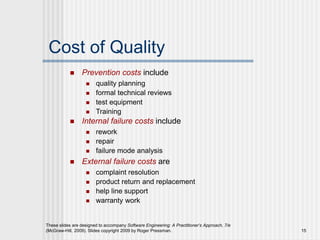
Cost of Quality
 Prevention costs include
 quality planning
 formal technical reviews
 test equipment
 Training
 Internal failure costs include
 rework
 repair
 failure mode analysis
 External failure costs are
 complaint resolution
 product return and replacement
 help line support
 warranty work
These slides are designed to accompany Software Engineering: A Practitioner’s Approach, 7/e
(McGraw-Hill, 2009). Slides copyright 2009 by Roger Pressman. 16
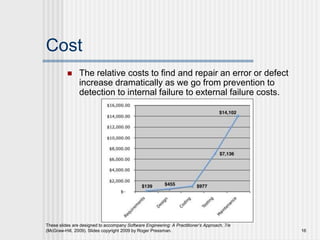
Cost
 The relative costs to find and repair an error or defect
increase dramatically as we go from prevention to
detection to internal failure to external failure costs.
These slides are designed to accompany Software Engineering: A Practitioner’s Approach, 7/e
(McGraw-Hill, 2009). Slides copyright 2009 by Roger Pressman. 17
Quality and Risk
 “People bet their jobs, their comforts, their safety, their
entertainment, their decisions, and their very lives on
computer software. It better be right.” SEPA, Chapter 1
 Example:
 Throughout the month of November, 2000 at a hospital in
Panama, 28 patients received massive overdoses of
gamma rays during treatment for a variety of cancers. In
the months that followed, five of these patients died from
radiation poisoning and 15 others developed serious
complications. What caused this tragedy? A software
package, developed by a U.S. company, was modified by
hospital technicians to compute modified doses of radiation
for each patient.
These slides are designed to accompany Software Engineering: A Practitioner’s Approach, 7/e
(McGraw-Hill, 2009). Slides copyright 2009 by Roger Pressman. 18
Negligence and Liability
 The story is all too common. A governmental or
corporate entity hires a major software developer or
consulting company to analyze requirements and then
design and construct a software-based “system” to
support some major activity.
 The system might support a major corporate function (e.g.,
pension management) or some governmental function
(e.g., healthcare administration or homeland security).
 Work begins with the best of intentions on both sides,
but by the time the system is delivered, things have gone
bad.
 The system is late, fails to deliver desired features and
functions, is error-prone, and does not meet with
customer approval.
 Litigation ensues.
These slides are designed to accompany Software Engineering: A Practitioner’s Approach, 7/e
(McGraw-Hill, 2009). Slides copyright 2009 by Roger Pressman. 19
Quality and Security
 Gary McGraw comments [Wil05]:
 “Software security relates entirely and completely to
quality. You must think about security, reliability,
availability, dependability—at the beginning, in the
design, architecture, test, and coding phases, all through
the software life cycle [process]. Even people aware of
the software security problem have focused on late life-
cycle stuff. The earlier you find the software problem, the
better. And there are two kinds of software problems.
One is bugs, which are implementation problems. The
other is software flaws—architectural problems in the
design. People pay too much attention to bugs and not
enough on flaws.”
These slides are designed to accompany Software Engineering: A Practitioner’s Approach, 7/e
(McGraw-Hill, 2009). Slides copyright 2009 by Roger Pressman. 20
Achieving Software Quality
 Critical success factors:
 Software Engineering Methods
 Project Management Techniques
 Quality Control
 Quality Assurance

Effective Software Process The Software Quality Dilemma

  • 1.
    These slides aredesigned to accompany Software Engineering: A Practitioner’s Approach, 7/e (McGraw-Hill, 2009). Slides copyright 2009 by Roger Pressman. 1 Chapter 14  Quality Concepts Slide Set to accompany Software Engineering: A Practitioner’s Approach, 7/e by Roger S. Pressman Slides copyright © 1996, 2001, 2005, 2009 by Roger S. Pressman For non-profit educational use only May be reproduced ONLY for student use at the university level when used in conjunction with Software Engineering: A Practitioner's Approach, 7/e. Any other reproduction or use is prohibited without the express written permission of the author. All copyright information MUST appear if these slides are posted on a website for student use.
  • 2.
    These slides aredesigned to accompany Software Engineering: A Practitioner’s Approach, 7/e (McGraw-Hill, 2009). Slides copyright 2009 by Roger Pressman. 2 Software Quality  In 2005, ComputerWorld [Hil05] lamented that  “bad software plagues nearly every organization that uses computers, causing lost work hours during computer downtime, lost or corrupted data, missed sales opportunities, high IT support and maintenance costs, and low customer satisfaction.  A year later, InfoWorld [Fos06] wrote about the  “the sorry state of software quality” reporting that the quality problem had not gotten any better.  Today, software quality remains an issue, but who is to blame?  Customers blame developers, arguing that sloppy practices lead to low-quality software.  Developers blame customers (and other stakeholders), arguing that irrational delivery dates and a continuing stream of changes force them to deliver software before it has been fully validated.
  • 3.
    These slides aredesigned to accompany Software Engineering: A Practitioner’s Approach, 7/e (McGraw-Hill, 2009). Slides copyright 2009 by Roger Pressman. 3 Quality  The American Heritage Dictionary defines quality as  “a characteristic or attribute of something.”  For software, two kinds of quality may be encountered:  Quality of design encompasses requirements, specifications, and the design of the system.  Quality of conformance is an issue focused primarily on implementation.  User satisfaction = compliant product + good quality + delivery within budget and schedule
  • 4.
    These slides aredesigned to accompany Software Engineering: A Practitioner’s Approach, 7/e (McGraw-Hill, 2009). Slides copyright 2009 by Roger Pressman. 4 Quality—A Philosophical View  Robert Persig [Per74] commented on the thing we call quality:  Quality . . . you know what it is, yet you don't know what it is. But that's self-contradictory. But some things are better than others, that is, they have more quality. But when you try to say what the quality is, apart from the things that have it, it all goes poof! There's nothing to talk about. But if you can't say what Quality is, how do you know what it is, or how do you know that it even exists? If no one knows what it is, then for all practical purposes it doesn't exist at all. But for all practical purposes it really does exist. What else are the grades based on? Why else would people pay fortunes for some things and throw others in the trash pile? Obviously some things are better than others . . . but what's the betterness? . . . So round and round you go, spinning mental wheels and nowhere finding anyplace to get traction. What the hell is Quality? What is it?
  • 5.
    These slides aredesigned to accompany Software Engineering: A Practitioner’s Approach, 7/e (McGraw-Hill, 2009). Slides copyright 2009 by Roger Pressman. 5 Quality—A Pragmatic View  The transcendental view argues (like Persig) that quality is something that you immediately recognize, but cannot explicitly define.  The user view sees quality in terms of an end-user’s specific goals. If a product meets those goals, it exhibits quality.  The manufacturer’s view defines quality in terms of the original specification of the product. If the product conforms to the spec, it exhibits quality.  The product view suggests that quality can be tied to inherent characteristics (e.g., functions and features) of a product.  Finally, the value-based view measures quality based on how much a customer is willing to pay for a product. In reality, quality encompasses all of these views and more.
  • 6.
    These slides aredesigned to accompany Software Engineering: A Practitioner’s Approach, 7/e (McGraw-Hill, 2009). Slides copyright 2009 by Roger Pressman. 6 Software Quality  Software quality can be defined as:  An effective software process applied in a manner that creates a useful product that provides measurable value for those who produce it and those who use it.  This definition has been adapted from [Bes04] and replaces a more manufacturing-oriented view presented in earlier editions of this book.
  • 7.
    These slides aredesigned to accompany Software Engineering: A Practitioner’s Approach, 7/e (McGraw-Hill, 2009). Slides copyright 2009 by Roger Pressman. 7 Effective Software Process  An effective software process establishes the infrastructure that supports any effort at building a high quality software product.  The management aspects of process create the checks and balances that help avoid project chaos—a key contributor to poor quality.  Software engineering practices allow the developer to analyze the problem and design a solid solution—both critical to building high quality software.  Finally, umbrella activities such as change management and technical reviews have as much to do with quality as any other part of software engineering practice.
  • 8.
    These slides aredesigned to accompany Software Engineering: A Practitioner’s Approach, 7/e (McGraw-Hill, 2009). Slides copyright 2009 by Roger Pressman. 8 Useful Product  A useful product delivers the content, functions, and features that the end-user desires  But as important, it delivers these assets in a reliable, error free way.  A useful product always satisfies those requirements that have been explicitly stated by stakeholders.  In addition, it satisfies a set of implicit requirements (e.g., ease of use) that are expected of all high quality software.
  • 9.
    These slides aredesigned to accompany Software Engineering: A Practitioner’s Approach, 7/e (McGraw-Hill, 2009). Slides copyright 2009 by Roger Pressman. 9 Adding Value  By adding value for both the producer and user of a software product, high quality software provides benefits for the software organization and the end-user community.  The software organization gains added value because high quality software requires less maintenance effort, fewer bug fixes, and reduced customer support.  The user community gains added value because the application provides a useful capability in a way that expedites some business process.  The end result is:  (1) greater software product revenue,  (2) better profitability when an application supports a business process, and/or  (3) improved availability of information that is crucial for the business.
  • 10.
    These slides aredesigned to accompany Software Engineering: A Practitioner’s Approach, 7/e (McGraw-Hill, 2009). Slides copyright 2009 by Roger Pressman. 10 Quality Dimensions  David Garvin [Gar87]:  Performance Quality. Does the software deliver all content, functions, and features that are specified as part of the requirements model in a way that provides value to the end-user?  Feature quality. Does the software provide features that surprise and delight first-time end-users?  Reliability. Does the software deliver all features and capability without failure? Is it available when it is needed? Does it deliver functionality that is error free?  Conformance. Does the software conform to local and external software standards that are relevant to the application? Does it conform to de facto design and coding conventions? For example, does the user interface conform to accepted design rules for menu selection or data input?
  • 11.
    These slides aredesigned to accompany Software Engineering: A Practitioner’s Approach, 7/e (McGraw-Hill, 2009). Slides copyright 2009 by Roger Pressman. 11 Quality Dimensions  Durability. Can the software be maintained (changed) or corrected (debugged) without the inadvertent generation of unintended side effects? Will changes cause the error rate or reliability to degrade with time?  Serviceability. Can the software be maintained (changed) or corrected (debugged) in an acceptably short time period. Can support staff acquire all information they need to make changes or correct defects?  Aesthetics. Most of us would agree that an aesthetic entity has a certain elegance, a unique flow, and an obvious “presence” that are hard to quantify but evident nonetheless.  Perception. In some situations, you have a set of prejudices that will influence your perception of quality.
  • 12.
    These slides aredesigned to accompany Software Engineering: A Practitioner’s Approach, 7/e (McGraw-Hill, 2009). Slides copyright 2009 by Roger Pressman. 12 Other Views  McCall’s Quality Factors (SEPA, Section 14.2.2)  ISO 9126 Quality Factors (SEPA, Section 14.2.3)  Targeted Factors (SEPA, Section 14.2.4)
  • 13.
    These slides aredesigned to accompany Software Engineering: A Practitioner’s Approach, 7/e (McGraw-Hill, 2009). Slides copyright 2009 by Roger Pressman. 13 The Software Quality Dilemma  If you produce a software system that has terrible quality, you lose because no one will want to buy it.  If on the other hand you spend infinite time, extremely large effort, and huge sums of money to build the absolutely perfect piece of software, then it's going to take so long to complete and it will be so expensive to produce that you'll be out of business anyway.  Either you missed the market window, or you simply exhausted all your resources.  So people in industry try to get to that magical middle ground where the product is good enough not to be rejected right away, such as during evaluation, but also not the object of so much perfectionism and so much work that it would take too long or cost too much to complete. [Ven03]
  • 14.
    These slides aredesigned to accompany Software Engineering: A Practitioner’s Approach, 7/e (McGraw-Hill, 2009). Slides copyright 2009 by Roger Pressman. 14 “Good Enough” Software  Good enough software delivers high quality functions and features that end-users desire, but at the same time it delivers other more obscure or specialized functions and features that contain known bugs.  Arguments against “good enough.”  It is true that “good enough” may work in some application domains and for a few major software companies. After all, if a company has a large marketing budget and can convince enough people to buy version 1.0, it has succeeded in locking them in.  If you work for a small company be wary of this philosophy. If you deliver a “good enough” (buggy) product, you risk permanent damage to your company’s reputation.  You may never get a chance to deliver version 2.0 because bad buzz may cause your sales to plummet and your company to fold.  If you work in certain application domains (e.g., real time embedded software, application software that is integrated with hardware can be negligent and open your company to expensive litigation.
  • 15.
    These slides aredesigned to accompany Software Engineering: A Practitioner’s Approach, 7/e (McGraw-Hill, 2009). Slides copyright 2009 by Roger Pressman. 15 Cost of Quality  Prevention costs include  quality planning  formal technical reviews  test equipment  Training  Internal failure costs include  rework  repair  failure mode analysis  External failure costs are  complaint resolution  product return and replacement  help line support  warranty work
  • 16.
    These slides aredesigned to accompany Software Engineering: A Practitioner’s Approach, 7/e (McGraw-Hill, 2009). Slides copyright 2009 by Roger Pressman. 16 Cost  The relative costs to find and repair an error or defect increase dramatically as we go from prevention to detection to internal failure to external failure costs.
  • 17.
    These slides aredesigned to accompany Software Engineering: A Practitioner’s Approach, 7/e (McGraw-Hill, 2009). Slides copyright 2009 by Roger Pressman. 17 Quality and Risk  “People bet their jobs, their comforts, their safety, their entertainment, their decisions, and their very lives on computer software. It better be right.” SEPA, Chapter 1  Example:  Throughout the month of November, 2000 at a hospital in Panama, 28 patients received massive overdoses of gamma rays during treatment for a variety of cancers. In the months that followed, five of these patients died from radiation poisoning and 15 others developed serious complications. What caused this tragedy? A software package, developed by a U.S. company, was modified by hospital technicians to compute modified doses of radiation for each patient.
  • 18.
    These slides aredesigned to accompany Software Engineering: A Practitioner’s Approach, 7/e (McGraw-Hill, 2009). Slides copyright 2009 by Roger Pressman. 18 Negligence and Liability  The story is all too common. A governmental or corporate entity hires a major software developer or consulting company to analyze requirements and then design and construct a software-based “system” to support some major activity.  The system might support a major corporate function (e.g., pension management) or some governmental function (e.g., healthcare administration or homeland security).  Work begins with the best of intentions on both sides, but by the time the system is delivered, things have gone bad.  The system is late, fails to deliver desired features and functions, is error-prone, and does not meet with customer approval.  Litigation ensues.
  • 19.
    These slides aredesigned to accompany Software Engineering: A Practitioner’s Approach, 7/e (McGraw-Hill, 2009). Slides copyright 2009 by Roger Pressman. 19 Quality and Security  Gary McGraw comments [Wil05]:  “Software security relates entirely and completely to quality. You must think about security, reliability, availability, dependability—at the beginning, in the design, architecture, test, and coding phases, all through the software life cycle [process]. Even people aware of the software security problem have focused on late life- cycle stuff. The earlier you find the software problem, the better. And there are two kinds of software problems. One is bugs, which are implementation problems. The other is software flaws—architectural problems in the design. People pay too much attention to bugs and not enough on flaws.”
  • 20.
    These slides aredesigned to accompany Software Engineering: A Practitioner’s Approach, 7/e (McGraw-Hill, 2009). Slides copyright 2009 by Roger Pressman. 20 Achieving Software Quality  Critical success factors:  Software Engineering Methods  Project Management Techniques  Quality Control  Quality Assurance