Effective Marketing
         for
Small Organisations


    Noam Kostucki
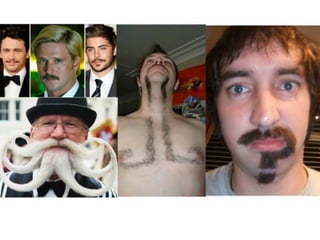
Who is the blue man?
Effective Marketing
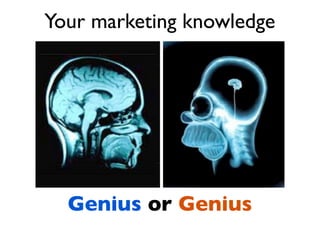
Your marketing knowledge


  Genius or Genius
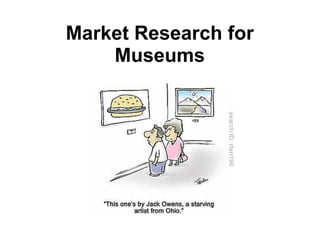
Market Research for
    Museums


                 !
Compared to last year investment
                    Trusts & Foundations (£/millions) Individuals (£/millions)         this year will:
                    Business (£/millions)             2008 total PI (£/millions)
                                                                 Increase & Same (%)      Increase (%)      Same (%)
    700
                                            Marketing                           81.4             20.3           61.0
    600
                                            CSR                                 83.3             16.7           66.7
    500
                                            Staff engagement                    78.1             15.6           62.5
    400
                                            Charitable giving                   88.9             33.3           55.6
    300
                                            Investment                        100.0                0.0         100.0

Results
    200

    100
                                    Though fewer respondents considered investment such as corporate art a
      0
                                    investing in the arts, they were less likely to decrease their investment this
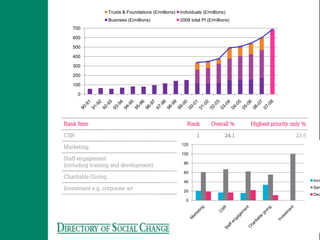
Defining  business support/sponsorship/investment for the arts by ranking according to
                                    last year.
priorities, with 1 being the highest and 5 being the lowest.
                                            Staff engagement, seems to be in the short term, the activity most likely
                                            cuts this year compared to last.
Rank Item                                            Rank      Overall %      Highest priority only %
  According to Arts & Business, the total amount of Private Investment (PI) in culture has been
CSR                                                      1          24.1                         23.5
  experiencing healthy growth since 1996. Business investment has undergone various
  fluctuations throughout the years, which are 120 many cases attributed to the unpredictable38.6
Marketing                                         in     2          24.0
  nature of Capital Projects.                     100
Staff engagement                                         3          22.7                         20.9
(including onwardsand development)
  In 2001 training A&B included individuals and trusts and foundations as key sources of
                                                   80

  private investment to be traced for the cultural sector. These three categories are therefore
                                                   60
Charitable Giving calculation of total PI in the sector. 4
  now used for the                                       This shows18.8 increasing importance of
                                                                     the                         11.8
                                                   40                                                             Incr
  individual giving as the primary source of investment for arts organisations, which is itself
Investment e.g. corporate art                            5          10.3                           3.9            Sam
  rising substantially.                            20
                                                                                                                  Dec
                                                         0


These figures identify Corporate Social Responsibility (CSR) and Marketing as the key
motivations for business investment in the arts.
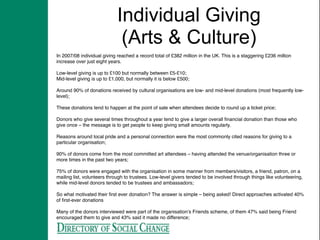
Individual Giving
                              (Arts & Culture)
In 2007/08 individual giving reached a record total of £382 million in the UK. This is a staggering £236 million
increase over just eight years.

Low-level giving is up to £100 but normally between £5-£10;
Mid-level giving is up to £1,000, but normally it is below £500;

Around 90% of donations received by cultural organisations are low- and mid-level donations (most frequently low-
level);

These donations tend to happen at the point of sale when attendees decide to round up a ticket price;

Donors who give several times throughout a year tend to give a larger overall financial donation than those who
give once – the message is to get people to keep giving small amounts regularly.

Reasons around local pride and a personal connection were the most commonly cited reasons for giving to a
particular organisation;

90% of donors come from the most committed art attendees – having attended the venue/organisation three or
more times in the past two years;

75% of donors were engaged with the organisation in some manner from members/visitors, a friend, patron, on a
mailing list, volunteers through to trustees. Low-level givers tended to be involved through things like volunteering,
while mid-level donors tended to be trustees and ambassadors;

So what motivated their first ever donation? The answer is simple – being asked! Direct approaches activated 40%
of first-ever donations

Many of the donors interviewed were part of the organisation’s Friends scheme, of them 47% said being Friend
encouraged them to give and 43% said it made no difference;
“To avoid the hassle of paperwork”
£50K+, 60-64,

“Just for cash flow reasons” £50K+, 75-79,

“Can make it an equivalent to a larger donation”
£15K-£20K, 35-39,
                                        The majority of donors (nearly 70%) were low-level donors whilst another fifth (ca.
                                        mid-level range. This means that the vast majority of donors (nearly 90%) are in th
“At that level once a year is easier, just one lump sum”
                                        level giving ranges. Only a small percentage (10%) of respondents in the sample w
£10K-£15K, 65-69,
                                        donors, which concurs with the findings of other charitable giving literature that a s
                                        large donations accounts for a large proportion of the total given.8
“I think it seemed more practical and we thought that from the organisation’s point of view it was better to have
that lump sum and to get all the interest from it over the years”
                                        Large donations are, of course,
Undisclosed, 75-79,
                                        administration; but the notion of small organisations successfully accessing what is
                                        highly sought after, pool of wealthy donors is perhaps unrealistic. In the arts econo
“I would forget if it was spread out; I’d rather just pay it. It gives you a chance to reconsider at the end of the year”
                                        majority of organisations are micro and small-sized, operating at a local level to ser
£10-£15K, 55-59,
                                        regional audiences and it could be argued that revenue from a well run small donat
                                        could meet financial needs in a proportionate yet effective way.
For those who preferred to contribute more often, convenience was also a theme, but also allowing for unplanned
giving/requests and perhaps as a (conscious) tactic to inflate the total amount contributed.
“Money raised from the trips goes to the gallery” £25K-£30K, 30-34,
                                     Low/mid-level donations, giving frequency and method
“Mainly because I was asked by [fundraiser] – [...] depending on what it is for I sometimes say yes [...] I am very
                                    The survey of donors allowed for a more detailed look at donation values and how t
encouraged by what I see [at the theatre] so I am very happy to give”
                                    giving methods and frequency. One issue in identifying individual giving patterns
Undisclosed, 75-79,
                                    is that many arts organisations have a portfolio of fundraising products. Art donors
                                    through diverse products and while these are often structured (for example, a mont
                                    they can also be spontaneous or responsive, the result of a prompt or an ad hoc req
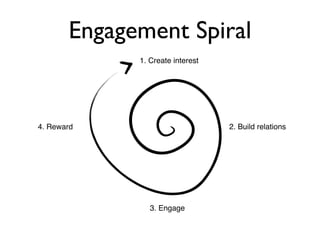
Engagement Spiral
             1. Create interest


4. Reward                         2. Build relations


                3. Engage
Do
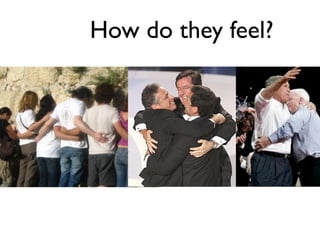
How do they feel?
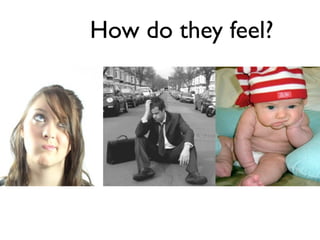
How do they feel?
How do they feel?
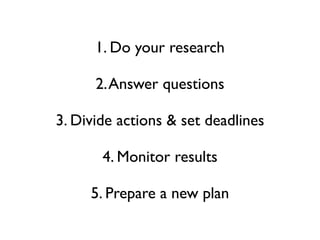
1. Do your research

      2. Answer questions

3. Divide actions & set deadlines

       4. Monitor results

     5. Prepare a new plan
Noam Kostucki

Profile & Direct Email - www.about.me/noamkos
        LinkedIn - www.bit.ly/noamkos
            Twitter - @noamkos

Effective marketing for small organisations

  • 1.
    Effective Marketing for Small Organisations Noam Kostucki
  • 2.
    Who is theblue man?
  • 3.
  • 4.
  • 5.
    Your marketing knowledge Genius or Genius
  • 8.
  • 9.
    Compared to lastyear investment Trusts & Foundations (£/millions) Individuals (£/millions) this year will: Business (£/millions) 2008 total PI (£/millions) Increase & Same (%) Increase (%) Same (%) 700 Marketing 81.4 20.3 61.0 600 CSR 83.3 16.7 66.7 500 Staff engagement 78.1 15.6 62.5 400 Charitable giving 88.9 33.3 55.6 300 Investment 100.0 0.0 100.0 Results 200 100 Though fewer respondents considered investment such as corporate art a 0 investing in the arts, they were less likely to decrease their investment this Defining business support/sponsorship/investment for the arts by ranking according to last year. priorities, with 1 being the highest and 5 being the lowest. Staff engagement, seems to be in the short term, the activity most likely cuts this year compared to last. Rank Item Rank Overall % Highest priority only % According to Arts & Business, the total amount of Private Investment (PI) in culture has been CSR 1 24.1 23.5 experiencing healthy growth since 1996. Business investment has undergone various fluctuations throughout the years, which are 120 many cases attributed to the unpredictable38.6 Marketing in 2 24.0 nature of Capital Projects. 100 Staff engagement 3 22.7 20.9 (including onwardsand development) In 2001 training A&B included individuals and trusts and foundations as key sources of 80 private investment to be traced for the cultural sector. These three categories are therefore 60 Charitable Giving calculation of total PI in the sector. 4 now used for the This shows18.8 increasing importance of the 11.8 40 Incr individual giving as the primary source of investment for arts organisations, which is itself Investment e.g. corporate art 5 10.3 3.9 Sam rising substantially. 20 Dec 0 These figures identify Corporate Social Responsibility (CSR) and Marketing as the key motivations for business investment in the arts.
  • 10.
    Individual Giving (Arts & Culture) In 2007/08 individual giving reached a record total of £382 million in the UK. This is a staggering £236 million increase over just eight years. Low-level giving is up to £100 but normally between £5-£10; Mid-level giving is up to £1,000, but normally it is below £500; Around 90% of donations received by cultural organisations are low- and mid-level donations (most frequently low- level); These donations tend to happen at the point of sale when attendees decide to round up a ticket price; Donors who give several times throughout a year tend to give a larger overall financial donation than those who give once – the message is to get people to keep giving small amounts regularly. Reasons around local pride and a personal connection were the most commonly cited reasons for giving to a particular organisation; 90% of donors come from the most committed art attendees – having attended the venue/organisation three or more times in the past two years; 75% of donors were engaged with the organisation in some manner from members/visitors, a friend, patron, on a mailing list, volunteers through to trustees. Low-level givers tended to be involved through things like volunteering, while mid-level donors tended to be trustees and ambassadors; So what motivated their first ever donation? The answer is simple – being asked! Direct approaches activated 40% of first-ever donations Many of the donors interviewed were part of the organisation’s Friends scheme, of them 47% said being Friend encouraged them to give and 43% said it made no difference;
  • 12.
    “To avoid thehassle of paperwork” £50K+, 60-64, “Just for cash flow reasons” £50K+, 75-79, “Can make it an equivalent to a larger donation” £15K-£20K, 35-39, The majority of donors (nearly 70%) were low-level donors whilst another fifth (ca. mid-level range. This means that the vast majority of donors (nearly 90%) are in th “At that level once a year is easier, just one lump sum” level giving ranges. Only a small percentage (10%) of respondents in the sample w £10K-£15K, 65-69, donors, which concurs with the findings of other charitable giving literature that a s large donations accounts for a large proportion of the total given.8 “I think it seemed more practical and we thought that from the organisation’s point of view it was better to have that lump sum and to get all the interest from it over the years” Large donations are, of course, Undisclosed, 75-79, administration; but the notion of small organisations successfully accessing what is highly sought after, pool of wealthy donors is perhaps unrealistic. In the arts econo “I would forget if it was spread out; I’d rather just pay it. It gives you a chance to reconsider at the end of the year” majority of organisations are micro and small-sized, operating at a local level to ser £10-£15K, 55-59, regional audiences and it could be argued that revenue from a well run small donat could meet financial needs in a proportionate yet effective way. For those who preferred to contribute more often, convenience was also a theme, but also allowing for unplanned giving/requests and perhaps as a (conscious) tactic to inflate the total amount contributed. “Money raised from the trips goes to the gallery” £25K-£30K, 30-34, Low/mid-level donations, giving frequency and method “Mainly because I was asked by [fundraiser] – [...] depending on what it is for I sometimes say yes [...] I am very The survey of donors allowed for a more detailed look at donation values and how t encouraged by what I see [at the theatre] so I am very happy to give” giving methods and frequency. One issue in identifying individual giving patterns Undisclosed, 75-79, is that many arts organisations have a portfolio of fundraising products. Art donors through diverse products and while these are often structured (for example, a mont they can also be spontaneous or responsive, the result of a prompt or an ad hoc req
  • 17.
    Engagement Spiral 1. Create interest 4. Reward 2. Build relations 3. Engage
  • 19.
  • 23.
  • 24.
  • 25.
  • 26.
    1. Do yourresearch 2. Answer questions 3. Divide actions & set deadlines 4. Monitor results 5. Prepare a new plan
  • 27.
    Noam Kostucki Profile &Direct Email - www.about.me/noamkos LinkedIn - www.bit.ly/noamkos Twitter - @noamkos

Editor's Notes

  • #2 \n
  • #3 \n
  • #4 Today, build an effective marketing campaign\n
  • #5 It doesn’t matter how much you know, what matters is 1) how you use what you know and 2) your ability to find out what you need to know\n
  • #6 It doesn’t matter how much you know, what matters is 1) how you use what you know and 2) your ability to find out what you need to know\n
  • #7 It doesn’t matter how much you know, what matters is 1) how you use what you know and 2) your ability to find out what you need to know\n
  • #8 Shopping list - money value + actions for people to take\n
  • #9 Who? > 3 -5 categories, then what do they do, like, etc... \n
  • #10 \n
  • #11 \n
  • #12 \n
  • #13 \n
  • #14 \n
  • #15 How\n
  • #16 Keep your eyes on the prize\n
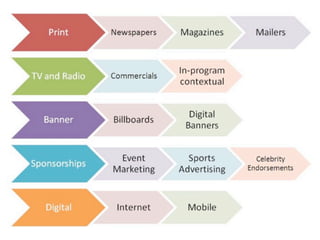
  • #17 These are just a few social media websites... what are all the communication channels you know, grouped in types?\n
  • #18 Now start matching process > marketing is very much like getting married: don’t go in pub and propose... first get to know and aim for kiss, then spend time together and eventually, get married. So what does the model look like for marketing? > Engagement spiral\n
  • #19 \n
  • #20 create interest = 3 types > 1. makes you think 2. creates conversation 3. creates an emotional reaction\n
  • #21 create interest = 3 types > 1. makes you think 2. creates conversation 3. creates an emotional reaction\n
  • #22 create interest = 3 types > 1. makes you think 2. creates conversation 3. creates an emotional reaction\n
  • #23 Build relations > what is their motivation? > what’s in it for them?\n
  • #24 engage > how do you get people to do these kind of things? journey > step by step, low commitment... why come back?\n
  • #25 Reward\n
  • #26 Reward\n
  • #27 Reward\n
  • #28 \n
  • #29 \n
  • #30 \n