Agenda
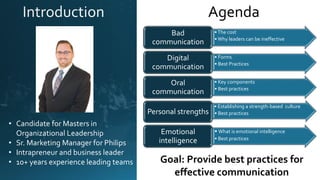
•The cost
• Why leaders can be ineffective
Bad
communication
• Forms
• Best Practices
Digital
communication
• Key components
• Best practices
Oral
communication
• Establishing a strength-based culture
• Best practices
Personal strengths
• What is emotional intelligence
• Best practices
Emotional
intelligence
• Candidate for Masters in
Organizational Leadership
• Sr. Marketing Manager for Philips
• Intrapreneur and business leader
• 10+ years experience leading teams Goal: Provide best practices for
effective communication
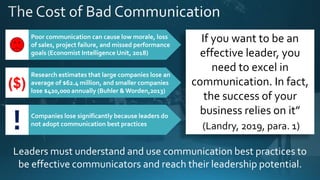
If you want to be an
effective leader, you
need to excel in
communication. In fact,
the success of your
business relies on it”
(Landry, 2019, para. 1)
Leaders must understand and use communication best practices to
be effective communicators and reach their leadership potential.
Research estimates that large companies lose an
average of $62.4 million, and smaller companies
lose $420,000 annually (Buhler & Worden,2013)
($)
Poor communication can cause low morale, loss
of sales, project failure, and missed performance
goals (Economist Intelligence Unit, 2018)
Companies lose significantly because leaders do
not adopt communication best practices
!
Virtual
Meetings
Use good
equipment
Turn on
camera
Use good
body
language
End 5-15
minutes
early
Don’t use
distracting
background
E-Mail
Be concise
Be aware of
tone
Use proper
grammar
Consider the
audience
Proofread
Chat
Start with
the reason
for reaching
out
Don’t be a
distraction
Remain
professional
Be concise
Use
empathetic
tone
Social Media
Have a
target
audience
Use proper
grammar
Be
professional
and polite
Follow social
media
policies
Do not
overuse
hashtags
Telephone
Use
professional
language
Use
empathetic
tone
Speak clearly
Vary vocal
pitch
Announce
when on
speaker
Best practices of common forms of digital communication
Digital
communication is
using electronic
technology to
transmit information
Leaders should use
positive messaging as it
has been shown to build
resilience and
engagement in teams
(Schimschal & Lomas, 2019)
Best Practice
• Newsletters
• Flyers
• Bulletins
• E-Mail
• Memos
• Chat
• Telephone
• Audio recordings
• Teleconferences
• Virtual Meetings
• Video Media
• Conversations
• Meetings
Face-to-Face
Video
Audio
Written,
Addressed
Unaddressed
Documents
Media
Richness
Least Effective
Most Effective
Choose
best
channels
for
Dispersion
Graphic derived from Guffey & Loewy
(2015)
Expert
recommendations:
Strategically select and use a
variety of media for
communication (Wiles,2017)
Select the right repetition of
key messaging through
strategic channels for most
effective communication
(Conner, 2018)
Avoid using the same media
and channels too often to
avoid message fatigue (Jiyeon
et al., 2017)
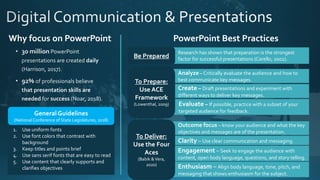
Enthusiasm – Align body language, tone, pitch, and
messaging that shows enthusiasm for the subject.
Engagement – Seek to engage the audience with
content, open body language, questions, and story telling.
Clarity – Use clear communication and messaging.
Evaluate – If possible, practice with a subset of your
targeted audience for feedback.
Create – Draft presentations and experiment with
different ways to deliver key messages.
PowerPoint Best Practices
Research has shown that preparation is the strongest
factor for successful presentations (Carello, 2002).
Be Prepared
Outcome focus – know your audience and what the key
objectives and messages are of the presentation.
To Deliver:
Use the Four
Aces
(Babik &Vera,
2020)
1. Use uniform fonts
2. Use font colors that contrast with
background
3. Keep titles and points brief
4. Use sans serif fonts that are easy to read
5. Use content that clearly supports and
clarifies objectives
General Guidelines
(National Conference of State Legislatures, 2018)
Why focus on PowerPoint
Analyze – Critically evaluate the audience and how to
best communicate key messages.
To Prepare:
Use ACE
Framework
(Lowenthal, 2009)
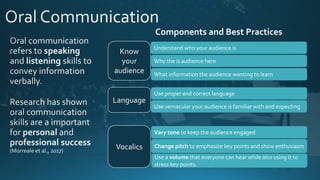
Components and Best Practices
Vocalics
Language
Know
your
audience
Understand who your audience is
Why the is audience here
What information the audience wanting to learn
Use proper and correct language
Use vernacular your audience is familiar with and expecting
Vary tone to keep the audience engaged
Change pitch to emphasize key points and show enthusiasm
Use a volume that everyone can hear while also using it to
stress key points.
Engaging body language Be confident Interact with the Audience
Figure 1. Illustrates the difference between open
body language (top) versus closed body language
(bottom).Original image.
Figure 2. Illustrates the
confident body language
(CitiRecruitment, 2021)
Figure 3. Shows audience interaction by asking to pull out
money (TedxZapopan, 2021)
• Use open and active body language
• Use the stage
• Move towards the audience
• Never turn your back
• Dress professionally
• Use confident tone
• Use good posture
• Be enthusiastic
• Ask questions
• Poll the audience
• Use props
• Use various forms of media
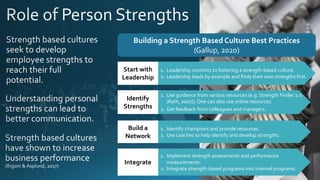
1. Use guidance from various resources (e.g. Strength Finder 2.0
(Rath, 2007)). One can also use online resources.
2. Get feedback from colleagues and managers.
Identify
Strengths
1. Leadership commits to fostering a strength-based culture.
2. Leadership leads by example and finds their own strengths first.
Start with
Leadership
1. Identify champions and provide resources.
2. Use coaches to help identify and develop strengths.
Build a
Network
1. Implement strength assessments and performance
measurements.
2. Integrate strength-based programs into internal programs.
Integrate
Building a Strength Based Culture Best Practices
(Gallup, 2020)
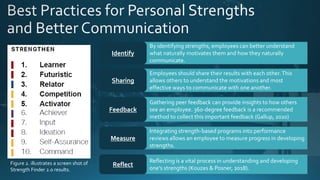
Figure 2. illustrates a screen shot of
Strength Finder 2.0 results.
By identifying strengths, employees can better understand
what naturally motivates them and how they naturally
communicate.
Identify
Employees should share their results with each other.This
allows others to understand the motivations and most
effective ways to communicate with one another.
Sharing
Gathering peer feedback can provide insights to how others
see an employee. 360-degree feedback is a recommended
method to collect this important feedback (Gallup, 2020)
Feedback
Integrating strength-based programs into performance
reviews allows an employee to measure progress in developing
strengths.
Measure
Reflecting is a vital process in understanding and developing
one’s strengths (Kouzes & Posner, 2018).
Reflect
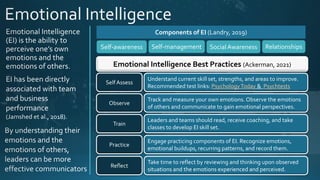
Components of EI (Landry, 2019)
Self-awareness Self-management SocialAwareness Relationships
Emotional Intelligence Best Practices (Ackerman, 2021)
Observe
Train
Reflect
Practice
Understand current skill set, strengths, and areas to improve.
Recommended test links: PsychologyToday & Psychtests
SelfAssess
Track and measure your own emotions. Observe the emotions
of others and communicate to gain emotional perspectives.
Leaders and teams should read, receive coaching, and take
classes to develop EI skill set.
Engage practicing components of EI. Recognize emotions,
emotional buildups, recurring patterns, and record them.
Take time to reflect by reviewing and thinking upon observed
situations and the emotions experienced and perceived.
Conclusions
The cost of bad communication can cost
organizations millions
Call to Action
Use these best practices to develop effective communication skills
and reach one’s potential as a leader.
Leaders must adopt best practices in
digital and oral communication to be
more effective
Leaders should develop their strengths
and their emotional intelligence to be
more effective communicators
Ackerman, C. (2021, February 2). What is Emotional Intelligence? +18 ways to improve it. Retrieved from www.positivepsychology.com:
https://positivepsychology.com/emotional-intelligence-eq/
Babik, J., & Vera, L. (2020). Creating and presenting an effective lecture. Journal of Continuing Education in the Health Professions, 40(1), 36-
41. doi: 10.1097/CEH.0000000000000281.
Buhler, P., & Worden, J. (2013). The cost of poor communications. Retrieved from www.shrm.org: https://www.shrm.org/resourcesandtools/hr-t
opics/behavioral-competencies/communication/pages/the-cost-of-poor-communications.aspx
Carello, C. (2002). Hi-tech presentations: Are they powerful or pointless? Teaching with Technology Today, 9.
CitiRecruitment. (2021). Business. Retrieved from www.creativecommons.org: https://creativecommons.org/licenses/by/2.0/
Conner, S. (2018, May 16). Say it 7 times: The art of overcommunication. Retrieved from www.medium.com: https://medium.com/unexpected-
leadership/say-it-7-times-the-art-of-overcommunication-5d019b2c33d4
Gallup. (2020, May 20). How to create a strengths-based company culture. Retrieved from www.gallup.com:
https://www.gallup.com/cliftonstrengths/en/290903/how-to-create-strengths-based-company-culture.aspx
Guffey, & Loewy. (2015). Business Communication 8th Edition. United States of America: Cengage Learning.
Harrison, A. (2017, July 11th). 19 powerful presentation stats to transform talks in 2019. Retrieved from www.duarte.com:
https://www.duarte.com/presentation-skills-resources/19-powerful-presentation-
stats/#:~:text=Experts%20estimate%20that%2030%20million%20PowerPoint%20presentations%20are%20created%20every%20day.
Jamshed, S., Bakar, R., & Nazri, M. (2018). Emotionally Intelligent Teams: Can Emotional Intelligence Enhance Performance. Arabian Journal of
Business Management Review, 7(1), 23-33. DOI: 10.12816/0043947.
Jiyeon, S., Kim, S., & Cohen, H. (2017). Message fatigue: Conceptual definition, operationalization, and correlates. Communication Monographs,
84(1), 5-29. https://www.academia.edu/download/49670035/So__Kim____Cohen_message_fatigue_final.pdf.
Kouzes, J. M., & Posner, B. Z. (2017). The Leadership Challenge. Hoboken: John Wiley & Sons, Inc.
Landry, L. (2019, April 3). Why emotional intelligence is important in leadership. Retrieved from www.hbs.edu:
https://online.hbs.edu/blog/post/emotional-intelligence-in-leadership
Landry, L. (2019, April 3). Why emotional intelligence is important in leadership. Retrieved from www.hbs.edu:
https://online.hbs.edu/blog/post/emotional-intelligence-in-leadership
Lowenthal, P. (2009). Improving the design of PowerPoint presentations. In U. o. Denver, The CU Online Handbook (pp. 59-63.). Denver:
University of Colorado Denver.
Morreale, S., Valenzano, J., & Bauer, J. (2017). Why communication education is important: a third study on the centrality of the discipline’s
content and pedagogy. Communication Education, 66(4), 402-422. http://dx.doi.org/10.1080/03634523.2016.1265136.
National Conference of State Legislatures. (2017, August 8). Tips for making effective PowerPoint presentations. Retrieved from www.NCSL.org:
https://www.ncsl.org/legislators-staff/legislative-staff/legislative-staff-coordinating-committee/tips-for-making-effective-powerpoint-
presentations.aspx
Noar, A. (2018, May 22). New survey results on presentations … #2 will shock you! Retrieved from www.presentationpanda.com:
https://presentationpanda.com/blog/new-presentation-statistics/
Psychology Today. (2020, September). Emotional Intelligence Test. Retrieved from www.psychologytoday.com:
https://www.psychologytoday.com/us/test/3203
Psychtests. (2014, October 22). Emotional Intelligence Test. Retrieved from www.testyourself.psychtests.com:
https://testyourself.psychtests.com/testid/3979
Rath, T. (2007). Strengths Finder. New York: Gallup Press.
Rigoni, B., & Asplund, J. (2017, January 3). Strengths-based cultures attract top talent. Retrieved from www.gallup.com:
https://www.gallup.com/workplace/236270/strengths-based-cultures-attract-top-talent.aspx
Schimschal, S., & Lomas, T. (2019). Gritty leaders: The impact of grit on positive leadership capacity. Psychological Reports, 122(4),
1449-1470. DOI: 10.1177/0033294118785547.
TEDxZapopan. (2021). Audience Interaction at TEDxZapopan. Retrieved from www.creativecommons.com:
https://creativecommons.org/licenses/by-nc-nd/2.0/
The Economist Intelligence Unit. (2018). Communication barriers in the modern workplace. The Economist, 1-20. https://www.clomedia.com/wp-
content/uploads/sites/3/2018/05/FINAL_EIU_Lucidchart_March2018.pdf.
Wiles, J. (2017, July 1). Internal communications teams must opt for the channel that best serves their given purpose and audience. Retrieved
from www.gartner.com: https://www.gartner.com/smarterwithgartner/corporate-communications-four-steps-to-choosing-the-right-
communication-channel/

Effective Communication Practices for Leaders

  • 2.
    Agenda •The cost • Whyleaders can be ineffective Bad communication • Forms • Best Practices Digital communication • Key components • Best practices Oral communication • Establishing a strength-based culture • Best practices Personal strengths • What is emotional intelligence • Best practices Emotional intelligence • Candidate for Masters in Organizational Leadership • Sr. Marketing Manager for Philips • Intrapreneur and business leader • 10+ years experience leading teams Goal: Provide best practices for effective communication
  • 3.
    If you wantto be an effective leader, you need to excel in communication. In fact, the success of your business relies on it” (Landry, 2019, para. 1) Leaders must understand and use communication best practices to be effective communicators and reach their leadership potential. Research estimates that large companies lose an average of $62.4 million, and smaller companies lose $420,000 annually (Buhler & Worden,2013) ($) Poor communication can cause low morale, loss of sales, project failure, and missed performance goals (Economist Intelligence Unit, 2018) Companies lose significantly because leaders do not adopt communication best practices !
  • 4.
    Virtual Meetings Use good equipment Turn on camera Usegood body language End 5-15 minutes early Don’t use distracting background E-Mail Be concise Be aware of tone Use proper grammar Consider the audience Proofread Chat Start with the reason for reaching out Don’t be a distraction Remain professional Be concise Use empathetic tone Social Media Have a target audience Use proper grammar Be professional and polite Follow social media policies Do not overuse hashtags Telephone Use professional language Use empathetic tone Speak clearly Vary vocal pitch Announce when on speaker Best practices of common forms of digital communication Digital communication is using electronic technology to transmit information Leaders should use positive messaging as it has been shown to build resilience and engagement in teams (Schimschal & Lomas, 2019) Best Practice
  • 5.
    • Newsletters • Flyers •Bulletins • E-Mail • Memos • Chat • Telephone • Audio recordings • Teleconferences • Virtual Meetings • Video Media • Conversations • Meetings Face-to-Face Video Audio Written, Addressed Unaddressed Documents Media Richness Least Effective Most Effective Choose best channels for Dispersion Graphic derived from Guffey & Loewy (2015) Expert recommendations: Strategically select and use a variety of media for communication (Wiles,2017) Select the right repetition of key messaging through strategic channels for most effective communication (Conner, 2018) Avoid using the same media and channels too often to avoid message fatigue (Jiyeon et al., 2017)
  • 6.
    Enthusiasm – Alignbody language, tone, pitch, and messaging that shows enthusiasm for the subject. Engagement – Seek to engage the audience with content, open body language, questions, and story telling. Clarity – Use clear communication and messaging. Evaluate – If possible, practice with a subset of your targeted audience for feedback. Create – Draft presentations and experiment with different ways to deliver key messages. PowerPoint Best Practices Research has shown that preparation is the strongest factor for successful presentations (Carello, 2002). Be Prepared Outcome focus – know your audience and what the key objectives and messages are of the presentation. To Deliver: Use the Four Aces (Babik &Vera, 2020) 1. Use uniform fonts 2. Use font colors that contrast with background 3. Keep titles and points brief 4. Use sans serif fonts that are easy to read 5. Use content that clearly supports and clarifies objectives General Guidelines (National Conference of State Legislatures, 2018) Why focus on PowerPoint Analyze – Critically evaluate the audience and how to best communicate key messages. To Prepare: Use ACE Framework (Lowenthal, 2009)
  • 7.
    Components and BestPractices Vocalics Language Know your audience Understand who your audience is Why the is audience here What information the audience wanting to learn Use proper and correct language Use vernacular your audience is familiar with and expecting Vary tone to keep the audience engaged Change pitch to emphasize key points and show enthusiasm Use a volume that everyone can hear while also using it to stress key points.
  • 8.
    Engaging body languageBe confident Interact with the Audience Figure 1. Illustrates the difference between open body language (top) versus closed body language (bottom).Original image. Figure 2. Illustrates the confident body language (CitiRecruitment, 2021) Figure 3. Shows audience interaction by asking to pull out money (TedxZapopan, 2021) • Use open and active body language • Use the stage • Move towards the audience • Never turn your back • Dress professionally • Use confident tone • Use good posture • Be enthusiastic • Ask questions • Poll the audience • Use props • Use various forms of media
  • 9.
    1. Use guidancefrom various resources (e.g. Strength Finder 2.0 (Rath, 2007)). One can also use online resources. 2. Get feedback from colleagues and managers. Identify Strengths 1. Leadership commits to fostering a strength-based culture. 2. Leadership leads by example and finds their own strengths first. Start with Leadership 1. Identify champions and provide resources. 2. Use coaches to help identify and develop strengths. Build a Network 1. Implement strength assessments and performance measurements. 2. Integrate strength-based programs into internal programs. Integrate Building a Strength Based Culture Best Practices (Gallup, 2020)
  • 10.
    Figure 2. illustratesa screen shot of Strength Finder 2.0 results. By identifying strengths, employees can better understand what naturally motivates them and how they naturally communicate. Identify Employees should share their results with each other.This allows others to understand the motivations and most effective ways to communicate with one another. Sharing Gathering peer feedback can provide insights to how others see an employee. 360-degree feedback is a recommended method to collect this important feedback (Gallup, 2020) Feedback Integrating strength-based programs into performance reviews allows an employee to measure progress in developing strengths. Measure Reflecting is a vital process in understanding and developing one’s strengths (Kouzes & Posner, 2018). Reflect
  • 11.
    Components of EI(Landry, 2019) Self-awareness Self-management SocialAwareness Relationships Emotional Intelligence Best Practices (Ackerman, 2021) Observe Train Reflect Practice Understand current skill set, strengths, and areas to improve. Recommended test links: PsychologyToday & Psychtests SelfAssess Track and measure your own emotions. Observe the emotions of others and communicate to gain emotional perspectives. Leaders and teams should read, receive coaching, and take classes to develop EI skill set. Engage practicing components of EI. Recognize emotions, emotional buildups, recurring patterns, and record them. Take time to reflect by reviewing and thinking upon observed situations and the emotions experienced and perceived.
  • 12.
    Conclusions The cost ofbad communication can cost organizations millions Call to Action Use these best practices to develop effective communication skills and reach one’s potential as a leader. Leaders must adopt best practices in digital and oral communication to be more effective Leaders should develop their strengths and their emotional intelligence to be more effective communicators
  • 13.
    Ackerman, C. (2021,February 2). What is Emotional Intelligence? +18 ways to improve it. Retrieved from www.positivepsychology.com: https://positivepsychology.com/emotional-intelligence-eq/ Babik, J., & Vera, L. (2020). Creating and presenting an effective lecture. Journal of Continuing Education in the Health Professions, 40(1), 36- 41. doi: 10.1097/CEH.0000000000000281. Buhler, P., & Worden, J. (2013). The cost of poor communications. Retrieved from www.shrm.org: https://www.shrm.org/resourcesandtools/hr-t opics/behavioral-competencies/communication/pages/the-cost-of-poor-communications.aspx Carello, C. (2002). Hi-tech presentations: Are they powerful or pointless? Teaching with Technology Today, 9. CitiRecruitment. (2021). Business. Retrieved from www.creativecommons.org: https://creativecommons.org/licenses/by/2.0/ Conner, S. (2018, May 16). Say it 7 times: The art of overcommunication. Retrieved from www.medium.com: https://medium.com/unexpected- leadership/say-it-7-times-the-art-of-overcommunication-5d019b2c33d4 Gallup. (2020, May 20). How to create a strengths-based company culture. Retrieved from www.gallup.com: https://www.gallup.com/cliftonstrengths/en/290903/how-to-create-strengths-based-company-culture.aspx
  • 14.
    Guffey, & Loewy.(2015). Business Communication 8th Edition. United States of America: Cengage Learning. Harrison, A. (2017, July 11th). 19 powerful presentation stats to transform talks in 2019. Retrieved from www.duarte.com: https://www.duarte.com/presentation-skills-resources/19-powerful-presentation- stats/#:~:text=Experts%20estimate%20that%2030%20million%20PowerPoint%20presentations%20are%20created%20every%20day. Jamshed, S., Bakar, R., & Nazri, M. (2018). Emotionally Intelligent Teams: Can Emotional Intelligence Enhance Performance. Arabian Journal of Business Management Review, 7(1), 23-33. DOI: 10.12816/0043947. Jiyeon, S., Kim, S., & Cohen, H. (2017). Message fatigue: Conceptual definition, operationalization, and correlates. Communication Monographs, 84(1), 5-29. https://www.academia.edu/download/49670035/So__Kim____Cohen_message_fatigue_final.pdf. Kouzes, J. M., & Posner, B. Z. (2017). The Leadership Challenge. Hoboken: John Wiley & Sons, Inc. Landry, L. (2019, April 3). Why emotional intelligence is important in leadership. Retrieved from www.hbs.edu: https://online.hbs.edu/blog/post/emotional-intelligence-in-leadership Landry, L. (2019, April 3). Why emotional intelligence is important in leadership. Retrieved from www.hbs.edu: https://online.hbs.edu/blog/post/emotional-intelligence-in-leadership
  • 15.
    Lowenthal, P. (2009).Improving the design of PowerPoint presentations. In U. o. Denver, The CU Online Handbook (pp. 59-63.). Denver: University of Colorado Denver. Morreale, S., Valenzano, J., & Bauer, J. (2017). Why communication education is important: a third study on the centrality of the discipline’s content and pedagogy. Communication Education, 66(4), 402-422. http://dx.doi.org/10.1080/03634523.2016.1265136. National Conference of State Legislatures. (2017, August 8). Tips for making effective PowerPoint presentations. Retrieved from www.NCSL.org: https://www.ncsl.org/legislators-staff/legislative-staff/legislative-staff-coordinating-committee/tips-for-making-effective-powerpoint- presentations.aspx Noar, A. (2018, May 22). New survey results on presentations … #2 will shock you! Retrieved from www.presentationpanda.com: https://presentationpanda.com/blog/new-presentation-statistics/ Psychology Today. (2020, September). Emotional Intelligence Test. Retrieved from www.psychologytoday.com: https://www.psychologytoday.com/us/test/3203 Psychtests. (2014, October 22). Emotional Intelligence Test. Retrieved from www.testyourself.psychtests.com: https://testyourself.psychtests.com/testid/3979
  • 16.
    Rath, T. (2007).Strengths Finder. New York: Gallup Press. Rigoni, B., & Asplund, J. (2017, January 3). Strengths-based cultures attract top talent. Retrieved from www.gallup.com: https://www.gallup.com/workplace/236270/strengths-based-cultures-attract-top-talent.aspx Schimschal, S., & Lomas, T. (2019). Gritty leaders: The impact of grit on positive leadership capacity. Psychological Reports, 122(4), 1449-1470. DOI: 10.1177/0033294118785547. TEDxZapopan. (2021). Audience Interaction at TEDxZapopan. Retrieved from www.creativecommons.com: https://creativecommons.org/licenses/by-nc-nd/2.0/ The Economist Intelligence Unit. (2018). Communication barriers in the modern workplace. The Economist, 1-20. https://www.clomedia.com/wp- content/uploads/sites/3/2018/05/FINAL_EIU_Lucidchart_March2018.pdf. Wiles, J. (2017, July 1). Internal communications teams must opt for the channel that best serves their given purpose and audience. Retrieved from www.gartner.com: https://www.gartner.com/smarterwithgartner/corporate-communications-four-steps-to-choosing-the-right- communication-channel/