Analyzing Effect ofFriction Between Two
Masses
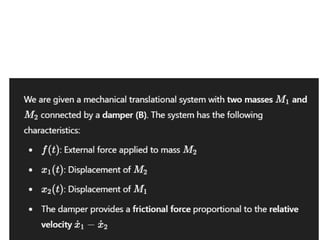
• We analyze a system with two masses (M1,
M2) connected by a damper (B).
• Goal: Derive the transfer function X1(s)/F(s)
including friction effects.
9.
System Diagram andVariables
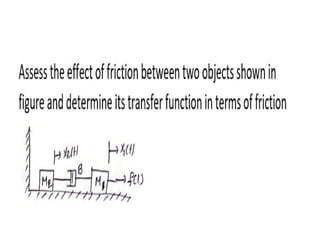
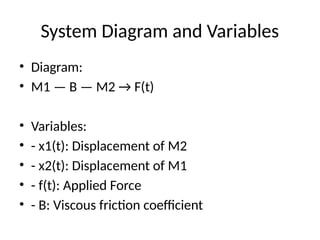
• Diagram:
• M1 — B — M2 → F(t)
• Variables:
• - x1(t): Displacement of M2
• - x2(t): Displacement of M1
• - f(t): Applied Force
• - B: Viscous friction coefficient
10.
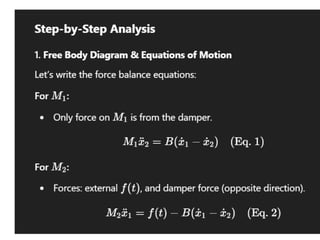
Equations of Motion
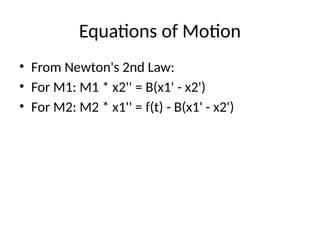
•From Newton's 2nd Law:
• For M1: M1 * x2'' = B(x1' - x2')
• For M2: M2 * x1'' = f(t) - B(x1' - x2')
11.
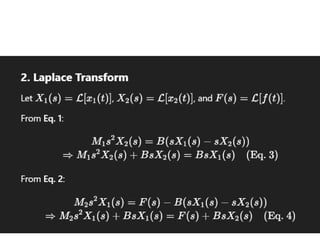
Laplace Transform
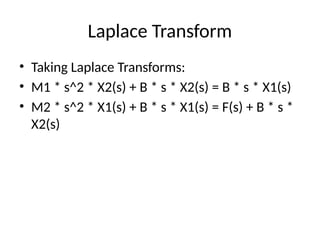
• TakingLaplace Transforms:
• M1 * s^2 * X2(s) + B * s * X2(s) = B * s * X1(s)
• M2 * s^2 * X1(s) + B * s * X1(s) = F(s) + B * s *
X2(s)
12.
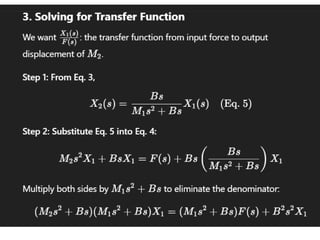
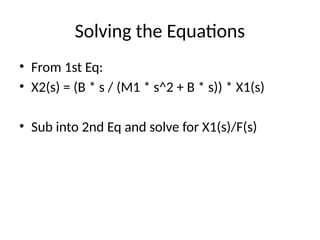
Solving the Equations
•From 1st Eq:
• X2(s) = (B * s / (M1 * s^2 + B * s)) * X1(s)
• Sub into 2nd Eq and solve for X1(s)/F(s)
13.
Final Transfer Function
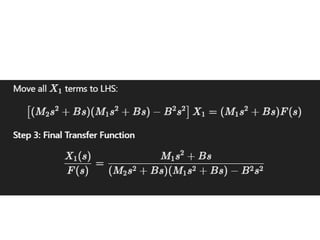
•T(s) = X1(s)/F(s) = (M1 * s^2 + B * s) / [ (M2 *
s^2 + B * s)(M1 * s^2 + B * s) - B^2 * s^2 ]
14.
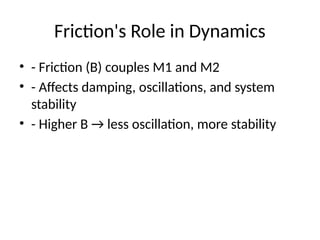
Friction's Role inDynamics
• - Friction (B) couples M1 and M2
• - Affects damping, oscillations, and system
stability
• - Higher B → less oscillation, more stability
15.
Conclusion
• We modeleda coupled-mass system with
viscous friction
• Derived transfer function reveals friction's
effect
• Useful in mechanical and control system
design


![Final Transfer Function
• T(s) = X1(s)/F(s) = (M1 * s^2 + B * s) / [ (M2 *
s^2 + B * s)(M1 * s^2 + B * s) - B^2 * s^2 ]](https://image.slidesharecdn.com/effectoffrictiontransferfunction-250608045522-d7d386f4/85/Effect_of_Friction_Transfer_Function-pptx-13-320.jpg)