EEG/MEG/ERP
Electroencephalography (EEG)
• An imaging technique to record electric
potentials due to neuronal activities using
electrodes over the scalp.
• Spontaneous activity
– Goes on continuously (~ 100 µV )
• Evoked Potentials
– Response to stimulus (electric, auditory, visual, etc.)
– Very low Signal-Noise ratio
• Normally in the order of micro volts
• Bandwidth of less than 50 Hz
Apparatus
• Electrodes
– Ag-AgCl electrodes with gel to reduce
impedaance
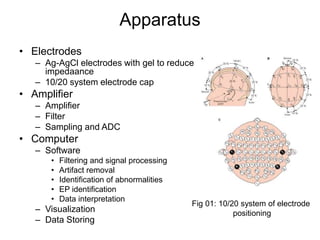
– 10/20 system electrode cap
• Amplifier
– Amplifier
– Filter
– Sampling and ADC
• Computer
– Software
• Filtering and signal processing
• Artifact removal
• Identification of abnormalities
• EP identification
• Data interpretation
– Visualization
– Data Storing
Fig 01: 10/20 system of electrode
positioning
Signal interpretation
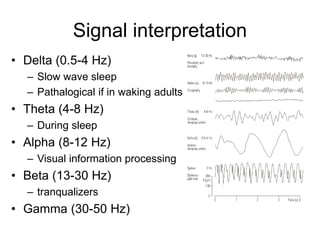
• Delta (0.5-4 Hz)
– Slow wave sleep
– Pathalogical if in waking adults
• Theta (4-8 Hz)
– During sleep
• Alpha (8-12 Hz)
– Visual information processing
• Beta (13-30 Hz)
– tranqualizers
• Gamma (30-50 Hz)
Applications/
Advantages/Disadvantages
• Applications
– Diagnosis of epilepsy, sleep disorders, strokes, head trauma,
encephalopathies
– Study cognitive processes (perception, memory, attention,
language, emotion,etc.
• Advantages
– High temporal resoluton
– Noninvasive
– Inexpensive
– Fast and easy electrode placing
– Minimal patient discomfort
– Highly available
• Disadvantages
– Low spatial resolution
– Possible corruption of data due to artifacts and interferences
– Inverse problem almost impossible

eeg_presentation.ppt

  • 1.
  • 2.
    Electroencephalography (EEG) • Animaging technique to record electric potentials due to neuronal activities using electrodes over the scalp. • Spontaneous activity – Goes on continuously (~ 100 µV ) • Evoked Potentials – Response to stimulus (electric, auditory, visual, etc.) – Very low Signal-Noise ratio • Normally in the order of micro volts • Bandwidth of less than 50 Hz
  • 3.
    Apparatus • Electrodes – Ag-AgClelectrodes with gel to reduce impedaance – 10/20 system electrode cap • Amplifier – Amplifier – Filter – Sampling and ADC • Computer – Software • Filtering and signal processing • Artifact removal • Identification of abnormalities • EP identification • Data interpretation – Visualization – Data Storing Fig 01: 10/20 system of electrode positioning
  • 4.
    Signal interpretation • Delta(0.5-4 Hz) – Slow wave sleep – Pathalogical if in waking adults • Theta (4-8 Hz) – During sleep • Alpha (8-12 Hz) – Visual information processing • Beta (13-30 Hz) – tranqualizers • Gamma (30-50 Hz)
  • 5.
    Applications/ Advantages/Disadvantages • Applications – Diagnosisof epilepsy, sleep disorders, strokes, head trauma, encephalopathies – Study cognitive processes (perception, memory, attention, language, emotion,etc. • Advantages – High temporal resoluton – Noninvasive – Inexpensive – Fast and easy electrode placing – Minimal patient discomfort – Highly available • Disadvantages – Low spatial resolution – Possible corruption of data due to artifacts and interferences – Inverse problem almost impossible