Syllabus
Bill of quantities (BOQ):
• This is defined as a list of brief descriptions and estimated
quantities. This lists in a tabular form all the items of work involved
in connection with estimate for a project with the description,
corresponding quantity, unit rate and amounts column.
• The columns indicating unit rate and amounts are kept blank. BOQ
is provided in a tender form for item rate tenders. Contractors’ put
up their own competitive rates and calculate the totals to offer their
estimate amount to complete the whole work.
• The BOQ is also required to calculate the quantities of different
materials required for the project.
Syllabus
Principles of Measurements
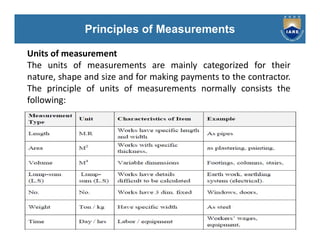
Units of measurement
The units of measurements are mainly categorized for their
nature, shape and size and for making payments to the contractor.
The principle of units of measurements normally consists the
following:
Syllabus
Rules for measurement
The rules for measurement of each item are invariably described in
IS- 1200. However some of the general rules are listed below.
• Measurement shall be made for finished item of work and
description of each item shall include materials, transport, labor,
fabrication tools and plant and all types of overheads for finishing the
work in required shape, size and specification.
• In booking, the order shall be in sequence of length, breadth and
height or thickness.
• Same type of work under different conditions and nature shall be
measured separately under separate items.
•All works shall be measured subject to the following tolerances.
• Linear measurement shall be measured to the nearest 0.01m.
• Areas shall be measured to the nearest 0.01 sq.m
•Cubic contents shall be worked-out to the nearest 0.01 cum
Syllabus
• In concreting works any opening more than 0.1 m2 (for items
measured by area) or 0.1 m3 (for items measured by volume) are
deducted in the quantity calculation.
• The bill of quantities shall fully describe the materials,
proportions, workmanships and accurately represent the work to
be executed.
• In case of masonry (stone or brick) or structural concrete, the
categories shall be measured separately and the heights shall be
describe.
Syllabus
Quantity Surveyor
Quantity surveyor is a person who is responsible on estimating the
quantities from the design drawings, and measurement of the
quantities in the site during the project implementation, and
preparing the current and final payments
Duties of quantity surveyor:
•Preparing bill of quantities (Taking off, squaring, Abstracting and
billing)
•Preparing bills for part payments at intervals during the execution
of work.
• Preparing bill of adjustment in the case of variations ordered
during the execution of work
•Giving legal advice in case of court proceedings
Syllabus
Essential qualities of a good surveyor
•The quality surveyor must be well versed with the drawings of
work.
•He should be able to read the drawing correctly and bill the
quantities accurately.
•He should have a thorough knowledge of the construction
procedure to be adopted, the various items of works involved in the
execution: and the different materials to be used in the work.
•He should be able to prepare schedule to be priced by tenderor.
Syllabus
Types of Estimation
There are five types of estimate:
a. Approximate Estimate
b. Detailed Estimate
c. Quantity Estimate
d. Revised Estimate
e. Supplementary Estimate
Syllabus
a. Approximate Estimate: This is also known as preliminary/rough
estimate. This estimate is prepared to work-out an approximate
cost of the project in a short period without going into details.
This estimate is done for preliminary financial evaluation of
different alternatives and for administrative sanctions.
b. Detailed Estimate: This estimate is prepared by working out the
quantities of different items of work and then working out the cost
by multiplying the quantities by their respective rates. In detailed
estimate provisions for any other expenses like contingencies, T&P,
work-charged establishment etc. are added to the above cost to
calculate the total amount required for project completion.
Syllabus
c. Quantity Estimate: Quantity Estimate/Quantity Survey is a part of
detailed estimate which list the quantities of all the items required to
complete the project. These quantities are worked out from the
drawings. The purpose of Quantity Estimation is to prepare bill of
quantities.
d. Revised Estimate: It is a detailed estimate for the revised
quantities or revised rates of items of work originally provided in the
estimate without any deviation in original design and specifications
approved for the project. It is required when the material cost or the
material quantities deviates significantly (> 5%) from sanctioned
value.
Syllabus
e. Supplementary Estimate: This estimate is worked out during
progress of work due to any changes or addition of works to
originally approved.
• A supplementary estimate is different from the revised estimate in
the aspect that, the former is worked out for the works which are
not present in the original design whereas the latter is worked out
when there is a deviation of materials from original proposal.
f. Abstract Estimate: This is the third and final stage in a detailed
estimate. The quantities and rates of each item of work, arrived in
the first two stages, are now entered in an abstract form. The total
cost of each item of work is now calculated by multiplying the
quantities and respective rates.
Syllabus
Approximate Estimate
Approximate Estimate is made to find out an approximate cost in a
short time and thus enable the administrative authorities to
evaluate the financial aspects of various schemes and subsequently
allows them to sanction them.
Importance
• Approximate estimate is prepared with preliminary investigation
and survey. It does not require detailed surveying design, drawing
etc. It is basically done to evaluate feasibility of a project.
• If it is observed from approximate estimate that the cost of the
project is very high then the project may be abandoned without
preparing a detailed estimate.
• Thus the cost required for detailed surveying design or drawing
required for preparation of detailed estimate is saved.
Syllabus
Purpose of approximate estimate
Approximate estimate provides an idea about the cost of the
project, which enables the authority to check the feasibility of the
projects considering the funds available for the project.
• Approximate estimate does not require any detail investigation,
design or drawing and hence saves both time and money.
• If several alternatives are available for the original works, a
comparison is done from approximate estimate and the decision is
made to select the project according to this comparison.
• Approximate estimate is required for getting the administrative
approval for conducting detailed investigation, design and
estimation.
•Approximate estimate for a property or project is required for
insurances and tax scheduling.
Syllabus
Purpose of approximate estimate
• Approximate estimate provides an idea about the cost of the
project, which enables the authority to check the feasibility of the
projects considering the funds available for the project.
• Approximate estimate does not require any detail investigation,
design or drawing and hence saves both time and money.
• If several alternatives are available for the original works, a
comparison is done from approximate estimate and the decision is
made to select the project according to this comparison.
• Approximate estimate is required for getting the administrative
approval for conducting detailed investigation, design and
estimation.
• Approximate estimate for a property or project is required for
insurances and tax scheduling.
Purpose of approximate estimate

EEEC pdf.pdf

  • 1.
    Syllabus Bill of quantities(BOQ): • This is defined as a list of brief descriptions and estimated quantities. This lists in a tabular form all the items of work involved in connection with estimate for a project with the description, corresponding quantity, unit rate and amounts column. • The columns indicating unit rate and amounts are kept blank. BOQ is provided in a tender form for item rate tenders. Contractors’ put up their own competitive rates and calculate the totals to offer their estimate amount to complete the whole work. • The BOQ is also required to calculate the quantities of different materials required for the project.
  • 2.
    Syllabus Principles of Measurements Unitsof measurement The units of measurements are mainly categorized for their nature, shape and size and for making payments to the contractor. The principle of units of measurements normally consists the following:
  • 3.
    Syllabus Rules for measurement Therules for measurement of each item are invariably described in IS- 1200. However some of the general rules are listed below. • Measurement shall be made for finished item of work and description of each item shall include materials, transport, labor, fabrication tools and plant and all types of overheads for finishing the work in required shape, size and specification. • In booking, the order shall be in sequence of length, breadth and height or thickness. • Same type of work under different conditions and nature shall be measured separately under separate items. •All works shall be measured subject to the following tolerances. • Linear measurement shall be measured to the nearest 0.01m. • Areas shall be measured to the nearest 0.01 sq.m •Cubic contents shall be worked-out to the nearest 0.01 cum
  • 4.
    Syllabus • In concretingworks any opening more than 0.1 m2 (for items measured by area) or 0.1 m3 (for items measured by volume) are deducted in the quantity calculation. • The bill of quantities shall fully describe the materials, proportions, workmanships and accurately represent the work to be executed. • In case of masonry (stone or brick) or structural concrete, the categories shall be measured separately and the heights shall be describe.
  • 5.
    Syllabus Quantity Surveyor Quantity surveyoris a person who is responsible on estimating the quantities from the design drawings, and measurement of the quantities in the site during the project implementation, and preparing the current and final payments Duties of quantity surveyor: •Preparing bill of quantities (Taking off, squaring, Abstracting and billing) •Preparing bills for part payments at intervals during the execution of work. • Preparing bill of adjustment in the case of variations ordered during the execution of work •Giving legal advice in case of court proceedings
  • 6.
    Syllabus Essential qualities ofa good surveyor •The quality surveyor must be well versed with the drawings of work. •He should be able to read the drawing correctly and bill the quantities accurately. •He should have a thorough knowledge of the construction procedure to be adopted, the various items of works involved in the execution: and the different materials to be used in the work. •He should be able to prepare schedule to be priced by tenderor.
  • 7.
    Syllabus Types of Estimation Thereare five types of estimate: a. Approximate Estimate b. Detailed Estimate c. Quantity Estimate d. Revised Estimate e. Supplementary Estimate
  • 8.
    Syllabus a. Approximate Estimate:This is also known as preliminary/rough estimate. This estimate is prepared to work-out an approximate cost of the project in a short period without going into details. This estimate is done for preliminary financial evaluation of different alternatives and for administrative sanctions. b. Detailed Estimate: This estimate is prepared by working out the quantities of different items of work and then working out the cost by multiplying the quantities by their respective rates. In detailed estimate provisions for any other expenses like contingencies, T&P, work-charged establishment etc. are added to the above cost to calculate the total amount required for project completion.
  • 9.
    Syllabus c. Quantity Estimate:Quantity Estimate/Quantity Survey is a part of detailed estimate which list the quantities of all the items required to complete the project. These quantities are worked out from the drawings. The purpose of Quantity Estimation is to prepare bill of quantities. d. Revised Estimate: It is a detailed estimate for the revised quantities or revised rates of items of work originally provided in the estimate without any deviation in original design and specifications approved for the project. It is required when the material cost or the material quantities deviates significantly (> 5%) from sanctioned value.
  • 10.
    Syllabus e. Supplementary Estimate:This estimate is worked out during progress of work due to any changes or addition of works to originally approved. • A supplementary estimate is different from the revised estimate in the aspect that, the former is worked out for the works which are not present in the original design whereas the latter is worked out when there is a deviation of materials from original proposal. f. Abstract Estimate: This is the third and final stage in a detailed estimate. The quantities and rates of each item of work, arrived in the first two stages, are now entered in an abstract form. The total cost of each item of work is now calculated by multiplying the quantities and respective rates.
  • 11.
    Syllabus Approximate Estimate Approximate Estimateis made to find out an approximate cost in a short time and thus enable the administrative authorities to evaluate the financial aspects of various schemes and subsequently allows them to sanction them. Importance • Approximate estimate is prepared with preliminary investigation and survey. It does not require detailed surveying design, drawing etc. It is basically done to evaluate feasibility of a project. • If it is observed from approximate estimate that the cost of the project is very high then the project may be abandoned without preparing a detailed estimate. • Thus the cost required for detailed surveying design or drawing required for preparation of detailed estimate is saved.
  • 12.
    Syllabus Purpose of approximateestimate Approximate estimate provides an idea about the cost of the project, which enables the authority to check the feasibility of the projects considering the funds available for the project. • Approximate estimate does not require any detail investigation, design or drawing and hence saves both time and money. • If several alternatives are available for the original works, a comparison is done from approximate estimate and the decision is made to select the project according to this comparison. • Approximate estimate is required for getting the administrative approval for conducting detailed investigation, design and estimation. •Approximate estimate for a property or project is required for insurances and tax scheduling.
  • 13.
    Syllabus Purpose of approximateestimate • Approximate estimate provides an idea about the cost of the project, which enables the authority to check the feasibility of the projects considering the funds available for the project. • Approximate estimate does not require any detail investigation, design or drawing and hence saves both time and money. • If several alternatives are available for the original works, a comparison is done from approximate estimate and the decision is made to select the project according to this comparison. • Approximate estimate is required for getting the administrative approval for conducting detailed investigation, design and estimation. • Approximate estimate for a property or project is required for insurances and tax scheduling. Purpose of approximate estimate