WELCOME BRAC Education for Ethnic Children (EEC)
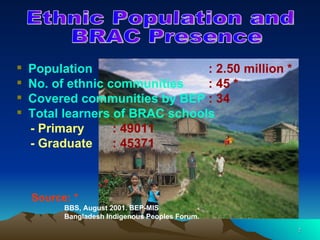
Population  : 2.50 million * No. of ethnic communities : 45 * Covered communities by BEP : 34 Total learners of BRAC schools   - Primary   : 49011 - Graduate   : 45371 Source: *   BBS, August 2001. BEP-MIS   Bangladesh Indigenous Peoples Forum. Ethnic Population and BRAC Presence
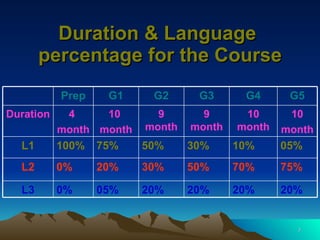
Duration & Language  percentage for the Course 20% 20% 20% 20% 05% 0% L3 75% 70% 50% 30% 20% 0% L2 05% 10% 30% 50% 75% 100% L1 10 month 10 month 9 month 9 month 10  month 4  month Duration G5 G4 G3 G2 G1 Prep
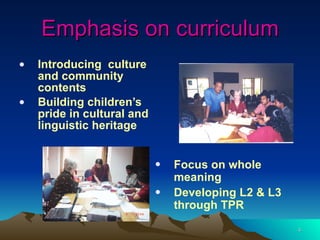
Emphasis on curriculum Introducing  culture and community contents Building children’s pride in cultural and linguistic heritage Focus on whole meaning Developing L2 & L3 through TPR
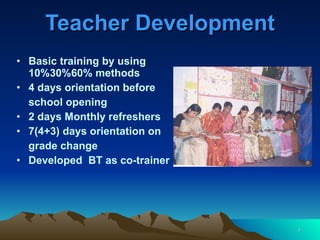
Teacher Development Basic training by using 10%30%60% methods  4 days orientation before school opening 2 days Monthly refreshers  7(4+3) days orientation on  grade change Developed  BT as co-trainer
Training for Staff Foundation training include ethnic issues  OMC  PMC 1 and PMC 2 Training on EEC supplementary materials MT training Special orientation and workshop
Training for Area Sector Specialist (ASS) Language development workshop by SIL (Institute of Summer Linguistics) Training on supplementary materials Supervision and staff development Communication skill development
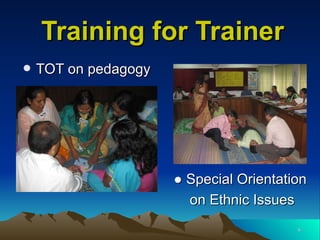
Training for Trainer TOT on pedagogy ●  Special Orientation on Ethnic Issues
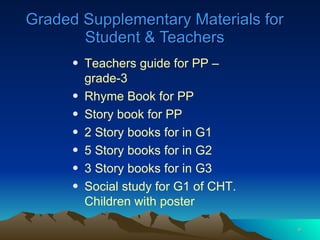
Graded Supplementary Materials for Student & Teachers Teachers guide for PP – grade-3 Rhyme Book for PP Story book for PP 2 Story books for in G1 5 Story books for in G2 3 Story books for in G3 Social study for G1 of CHT. Children with poster
Graded Supplementary Materials for Student & Teachers Teachers guide on Bangla for grade-4 English book for G-2 with teacher’s guide
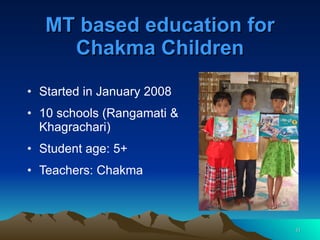
MT based education for Chakma Children Started in January 2008 10 schools (Rangamati & Khagrachari) Student age: 5+ Teachers: Chakma
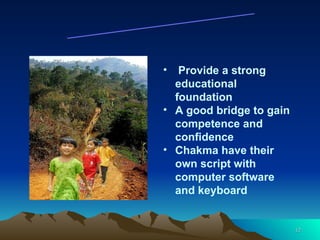
Provide a strong educational foundation A good bridge to gain competence and confidence Chakma have their own script with computer software and keyboard Rationale
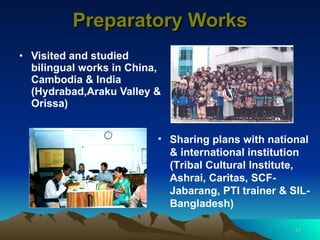
Preparatory Works Visited and studied bilingual works in China, Cambodia & India (Hydrabad,Araku Valley & Orissa) Sharing plans with national & international institution (Tribal Cultural Institute, Ashrai, Caritas, SCF-Jabarang, PTI trainer & SIL-Bangladesh)
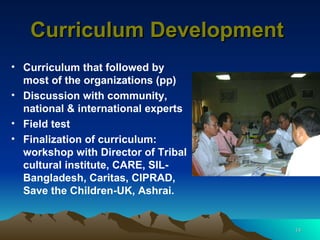
Curriculum Development  Curriculum that followed by most of the organizations (pp) Discussion with community, national & international experts  Field test  Finalization of curriculum: workshop with Director of Tribal cultural institute, CARE, SIL-Bangladesh, Caritas, CIPRAD, Save the Children-UK, Ashrai.
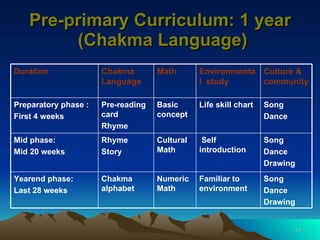
Pre-primary Curriculum: 1 year  (Chakma Language) Song Dance Drawing Familiar to environment Numeric Math Chakma alphabet Yearend phase: Last 28 weeks Song Dance Drawing Self introduction  Cultural Math Rhyme Story Mid phase:  Mid 20 weeks Song Dance Life skill chart Basic concept Pre-reading card  Rhyme Preparatory phase : First 4 weeks Culture & community Environmental  study Math Chakma Language Duration
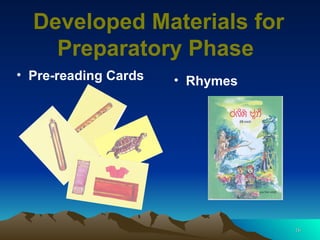
Pre-reading Cards Rhymes Developed Materials for Preparatory Phase
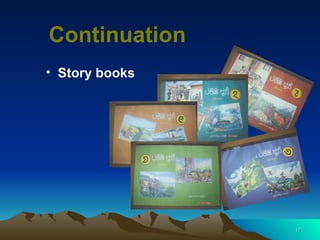
Continuation Story books
Math work books - Cultural Primer with Chart Teacher’s Guide Life skill message :Flip Chart Continuation -  Numeric Environmental Study work book
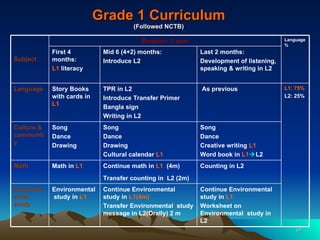
Grade 1 Curriculum (Followed NCTB) Song Dance Creative writing  L1 Word book in  L1  L2 Song  Dance Drawing Cultural calendar  L1 Song Dance  Drawing Culture & community Last 2 months: Development of listening, speaking & writing in L2 Mid 6 (4+2) months: Introduce L2 First 4 months: L1  literacy Counting in L2 Continue Environmental  study in  L1 Worksheet on Environmental  study in L2 Continue Environmental  study in  L1(4m) Transfer Environmental  study message in L2(Orally) 2 m Environmental  study in  L1 Environmental  study Continue math in  L1   (4m) Transfer counting in  L2 (2m) Math in  L1 Math L1: 75% L2: 25% As previous TPR in L2 Introduce Transfer Primer Bangla sign Writing in L2 Story Books with cards in  L1 Language Language % Duration -1 year Subject
Developed materials for  Grade - 1 3 Story Books  Math workbook Social study workbook with poster Transfer Primer in Bangla with chart Word book L1->L2->L3
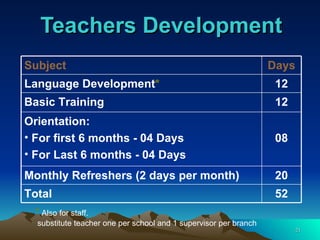
Teachers Development *  Also for staff.  substitute teacher one per school and 1 supervisor per branch 20 Monthly Refreshers (2 days per month) 52 Total  08 Orientation: For first 6 months - 04 Days For Last 6 months - 04 Days 12 Basic Training 12 Language Development * Days Subject
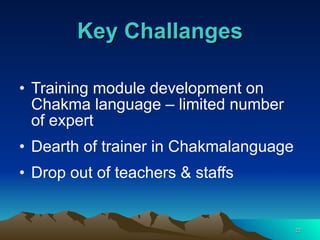
Key Challanges Training module development on Chakma language – limited number of expert Dearth of trainer in Chakmalanguage Drop out of teachers & staffs
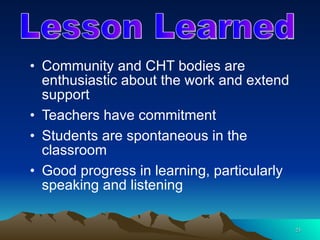
Community and CHT bodies are enthusiastic about the work and extend support Teachers have commitment Students are spontaneous in the classroom Good progress in learning, particularly speaking and listening Lesson Learned
Thank You Shuvolong, Rangamati

EEC

  • 1.
    WELCOME BRAC Educationfor Ethnic Children (EEC)
  • 2.
    Population :2.50 million * No. of ethnic communities : 45 * Covered communities by BEP : 34 Total learners of BRAC schools - Primary : 49011 - Graduate : 45371 Source: * BBS, August 2001. BEP-MIS Bangladesh Indigenous Peoples Forum. Ethnic Population and BRAC Presence
  • 3.
    Duration & Language percentage for the Course 20% 20% 20% 20% 05% 0% L3 75% 70% 50% 30% 20% 0% L2 05% 10% 30% 50% 75% 100% L1 10 month 10 month 9 month 9 month 10 month 4 month Duration G5 G4 G3 G2 G1 Prep
  • 4.
    Emphasis on curriculumIntroducing culture and community contents Building children’s pride in cultural and linguistic heritage Focus on whole meaning Developing L2 & L3 through TPR
  • 5.
    Teacher Development Basictraining by using 10%30%60% methods 4 days orientation before school opening 2 days Monthly refreshers 7(4+3) days orientation on grade change Developed BT as co-trainer
  • 6.
    Training for StaffFoundation training include ethnic issues OMC PMC 1 and PMC 2 Training on EEC supplementary materials MT training Special orientation and workshop
  • 7.
    Training for AreaSector Specialist (ASS) Language development workshop by SIL (Institute of Summer Linguistics) Training on supplementary materials Supervision and staff development Communication skill development
  • 8.
    Training for TrainerTOT on pedagogy ● Special Orientation on Ethnic Issues
  • 9.
    Graded Supplementary Materialsfor Student & Teachers Teachers guide for PP – grade-3 Rhyme Book for PP Story book for PP 2 Story books for in G1 5 Story books for in G2 3 Story books for in G3 Social study for G1 of CHT. Children with poster
  • 10.
    Graded Supplementary Materialsfor Student & Teachers Teachers guide on Bangla for grade-4 English book for G-2 with teacher’s guide
  • 11.
    MT based educationfor Chakma Children Started in January 2008 10 schools (Rangamati & Khagrachari) Student age: 5+ Teachers: Chakma
  • 12.
    Provide a strongeducational foundation A good bridge to gain competence and confidence Chakma have their own script with computer software and keyboard Rationale
  • 13.
    Preparatory Works Visitedand studied bilingual works in China, Cambodia & India (Hydrabad,Araku Valley & Orissa) Sharing plans with national & international institution (Tribal Cultural Institute, Ashrai, Caritas, SCF-Jabarang, PTI trainer & SIL-Bangladesh)
  • 14.
    Curriculum Development Curriculum that followed by most of the organizations (pp) Discussion with community, national & international experts Field test Finalization of curriculum: workshop with Director of Tribal cultural institute, CARE, SIL-Bangladesh, Caritas, CIPRAD, Save the Children-UK, Ashrai.
  • 15.
    Pre-primary Curriculum: 1year (Chakma Language) Song Dance Drawing Familiar to environment Numeric Math Chakma alphabet Yearend phase: Last 28 weeks Song Dance Drawing Self introduction Cultural Math Rhyme Story Mid phase: Mid 20 weeks Song Dance Life skill chart Basic concept Pre-reading card Rhyme Preparatory phase : First 4 weeks Culture & community Environmental study Math Chakma Language Duration
  • 16.
    Pre-reading Cards RhymesDeveloped Materials for Preparatory Phase
  • 17.
  • 18.
    Math work books- Cultural Primer with Chart Teacher’s Guide Life skill message :Flip Chart Continuation - Numeric Environmental Study work book
  • 19.
    Grade 1 Curriculum(Followed NCTB) Song Dance Creative writing L1 Word book in L1  L2 Song Dance Drawing Cultural calendar L1 Song Dance Drawing Culture & community Last 2 months: Development of listening, speaking & writing in L2 Mid 6 (4+2) months: Introduce L2 First 4 months: L1 literacy Counting in L2 Continue Environmental study in L1 Worksheet on Environmental study in L2 Continue Environmental study in L1(4m) Transfer Environmental study message in L2(Orally) 2 m Environmental study in L1 Environmental study Continue math in L1 (4m) Transfer counting in L2 (2m) Math in L1 Math L1: 75% L2: 25% As previous TPR in L2 Introduce Transfer Primer Bangla sign Writing in L2 Story Books with cards in L1 Language Language % Duration -1 year Subject
  • 20.
    Developed materials for Grade - 1 3 Story Books Math workbook Social study workbook with poster Transfer Primer in Bangla with chart Word book L1->L2->L3
  • 21.
    Teachers Development * Also for staff. substitute teacher one per school and 1 supervisor per branch 20 Monthly Refreshers (2 days per month) 52 Total 08 Orientation: For first 6 months - 04 Days For Last 6 months - 04 Days 12 Basic Training 12 Language Development * Days Subject
  • 22.
    Key Challanges Trainingmodule development on Chakma language – limited number of expert Dearth of trainer in Chakmalanguage Drop out of teachers & staffs
  • 23.
    Community and CHTbodies are enthusiastic about the work and extend support Teachers have commitment Students are spontaneous in the classroom Good progress in learning, particularly speaking and listening Lesson Learned
  • 24.

Editor's Notes

  • #2 This slide shows the statistics of ethnic community at a glance as well as the community covered by BRAC education program. 3 Research studies have been done by Research Development collective, run by Prof. Mesbah Kamal et. Al., Findings from first Research study was –to open adequate schools where medium of instruction may by mother tongue. 2 nd was students of mother tongue user(L1) showed high level Good performance while student of Bangla user(L2) achieved low level Average performance . 3 rd research indicated that community showed interest in having their own script with computer software and keyboard.
  • #3 Pre-primary curriculum focus on students thinking, speaking & listening of language. Concept on traditional measurement is taught through Cultural math and safe life by Environmental study. A team from BRAC visited different Bilingual and Multilingual education program of different countries to gather knowledge before launch of the pilot prog. In addition materials of the visited programs are also collected for ideas.
  • #12 Piloting shows the children are spontaneous jin the classroom. Teachers are from Chakma community and are enthusiastic.
  • #13 Plan International ECD (Early Childhood Development) group, Action Aid, BUIED BEP of BRAC have developed the curriculum on the basis of global concept. Followed by different steps the materials have been developed by the coordination of community resource person, field staff of community resource person, field staff of BEP and core group in H/O. Developed Materials have been displayed. Feedback is being received continuously. At first materials developed as a prototype & illustration done by Chakma resource personnel These have been edited by Chakma resource personnel. Language development training is needed to reinforce how to read & write Chakma script. By the Experience of pilot, language training is needed for spare teacher and staff as a precaution of dropout.
  • #20 A team from BRAC visited different Multilingual Education program of different countries to gather knowledge before launch of the pilot program . In addition materials of the visited programs are also collected for ideas.
  • #23 Difficult to find person who knows script. PTI trainers are also not available. It was difficult to act consensus on spelling during material development because there is not a standard form.
  • #24 Initial experience helkps to take precaution that is train spare teachers & Staff. Lack of coordination with govt. does not help to know each other’s work.
  • #25 Thank you very much for listening me patiently. If you have any quary please fell free to ask. We will give you answer.