MODULE 7
GREEN BUILDING CONCEPT
Introduction: Need for sustainability in
building sector
 As per a study done by the International Energy Agency,
buildings consume nearly 30% of the total energy
consumed by various major sectors in India.
 Sharma (2011) states the construction industry in India is
growing at a rate of 10% as compared to the world average
of 5.2 %. Hence energy efficiency in the building sector
assumes tremendous importance.
 Sharma Isha, Architecture: Time Space & People, April 2011,Vol.
11, Issue 4, Green Building Technologies for a future Green Urban
India.
Growing importance of energy modeling
 In the developed countries the growth rate of energy
consumption is only marginally higher compared to the
growth rate of population. For example, in USA, energy
consumption is projected to grow at 1.3% while the
population growth rate is projected to grow at 0.8%.
 In contrast, in developing countries like India population
growth rate is expected to grow at 1.3% while the energy
consumption rate is expected to grow at 4.3%. This trend
would strain the energy sector to a large extent.
GREEN BUILDINGS
 A green building depletes the natural resources to a minimum during
its construction and operation. The aim of a green building design is
to minimize the demand on non-renewable resources, maximize the
utilization efficiency of these resources when in use, and maximize
the reuse, recycling, and utilization of renewable resources.
 Green buildings often include measures to reduce energy
consumption – both the embodied energy required to extract,
process, transport and install building materials and operating energy
to provide services such as heating and power for equipment.
Energy-efficient buildings use less operating energy. Embodied
energy make up as much as 30% of the overall life cycle energy
consumption.
Energy Efficient Building.
 To reduce operating energy use, designers use details that
reduce air leakage through the building envelope (the barrier
between conditioned and unconditioned space).
 They also specify high-performance windows and extra
insulation in walls, ceilings, and floors.
 Another strategy, passive solar building design, is often
implemented in low-energy homes.
 In addition, effective window placement (day-lighting) can
provide more natural light and lessen the need for electric
lighting during the day.
 Solar water heating further reduces energy costs.
GREEN BUILDINGS
 It maximizes the use of efficient building materials and
construction practices;
 it optimizes the use of on-site sources and sinks by bioclimatic
architectural practices;
 uses minimum energy to power itself; uses efficient
equipment to meet its lighting, air conditioning, and other
needs;
 maximizes the use of renewable sources of energy;
 uses efficient waste and water management practices;
 provides comfortable and hygienic indoor working conditions.
Low environmental footprint….
 It is evolved through a design process that requires input
from all concerned – the architect; landscape designer; and
the air conditioning, electrical, plumbing, and energy
consultants – to work as a team to address all aspects of
building and system planning, designing, construction, and
operation.
 They critically evaluate the impacts of each design decision
and arrive at viable design solutions to minimize the negative
impacts and enhance the positive impacts on the
environment.
What are the prevailing systems in India…

LEED India rating system
a. Indian Green Building Council
b. Indigenized
c. Refers local standards / norms
d. Global outreach
GRIHA (Green Rating for Integrated Habitat Assessment)
 National Rating System of India.
 Conceived by TERI and developed jointly with The Ministry of New and
Renewable Energy, Government of India.
 Energy Conservation Building Code (ECBC) 2007
• Developed by India’s Bureau of Energy Efficiency,
• Guidance from United States Agency for International Development (USAID)
• Significant inputs from various other stakeholders such as practicing architects,
consultants, educational institutions and other government organizations.
Main Two Green Building Rating systems in
India
 The two primary Green building Ratings that exist in
India are IGBC LEED and GRIHA.
 LEED (Leadership in Energy & Environmental Design)
is one of the world’s most popular rating systems that
first originated in US in March 2000 . It has now been
adopted by many countries, with the necessary
modifications to suit the country’s climate.
SALIENT POINTS COVERED BY IGBC LEED
LEED-INDIA
 LEED-INDIA promotes a whole-building approach to
sustainability by recognizing performance in the following seven
key areas:

 Sustainable Sites
 Water Efficiency
 Energy & Atmosphere
 Materials & Resources
 Indoor Environmental Quality
 Innovation in Design
 Regional Priority
GRIHA……………
Green Building Rating systems in India
 The GRIHA rating applies to new building stock –
commercial, institutional, and residential, of varied functions,
endorsed by the Ministry of New and Renewable
Energy( MNRE), Government of India.
 GRIHA emphasises on passive solar techniques for
optimizing indoor visual and thermal comfort.
 GRIHA encourages optimization of building design to
reduce conventional energy demand.
 A building is assessed on its predicted performance over its
entire life cycle. GRIHA ratings are more relevant to Indian
conditions.
GRIHA India rating system
 GRIHA India rating system encompasses the following broad
aspects:
 Site Selection and Site Planning
 Conservation and efficient utilization of resource
 Health and well being during construction
 Building Planning and Construction Stage
 Water
 Energy: end use
 Energy: embodied and construction
 Energy: renewable
 Waste management
 Health and well-being during post-construction occupation
 Building Operation and Maintenance
 Innovation
Energy Conservation Building Code (ECBC)
 How building is designed, constructed and used in response
to the climate of a particular place is of utmost importance
in reducing the energy demands of that particular
building.
 It is in this context that the Energy Conservation Act,
which defines norms and standards for the energy
performance of buildings and their components based
on the climatic zone in which they are located.
ENERGY CONSERVATION BUILDING CODE…
 The ECBC provides design norms for:
 Building envelope, including thermal performance
requirements for walls, roofs, and windows;
 Lighting system, including day lighting, and lamps and
luminaire performance requirements;
 HVAC system, including energy performance of chillers and
air distribution systems;
 Electrical system; and
 Water heating and pumping systems, including requirements
for solar hot-water systems.
Need for a simplified set of mandatory rules
to be applicable to all buildings.
 Generalised version of the existing GRIHA and IGBC
LEED ratings can be adopted for implementation for all
building stock which is going to be newly constructed
in the future.
 These generalised requirements thus formulated would
be based on very basic principles of building science
and energy conservation techniques.
BREAK-UP OF ENERGY CONSUMPTION
Domain for comparative analysis:
 In the analysis that has been carried out, the following aspects
have been considered:
 Relevance with Indian climatic conditions
 Attributes impacting the environment covered by the
system
 Indoor environmental quality
 Cost effectiveness
 Incentives for widespread appeal among the
construction industry
 Scope for innovations
 Miscellaneous merits and demerits of any given system.
Comparative Analysis:
Conclusions
 Salient points observed for GRIHA:
 Endorsed by the Ministry of Renewable Energy.
 Incentives to the buildings for complying.
 Easy to understand, concise.
 More weight age given to elimination of air-conditioning
requirements, therefore, more suitable for the public sector, where
traditional techniques are more appreciated and welcome. Also in Indian
tropical conditions it is more relevant as wanton air-conditioning has
become rampant.
 Specific building materials like use of Fly-ash in the building construction
emphasized. Comparatively less stress on use of innovative materials.
 Generalized keeping in mind even the small city construction works.
Again relevant for Indian conditions.
Salient points observed for IGBC LEED:
 More popular internationally.
 More exposure to International systems and research, as it is an
Indian version of USGBC.
 More lucrative option for the corporate sector with
International funding.
 Essentially a big city phenomenon because it has many points
reserved for reusing the pre-existing building, if any.
A uniform system which should be mandatorily enforced for all
future new constructions should include the following aspects:
 Proper orientation of the building for least heat gain in summer and
good overall site planning and location on site.
 Reduce water use in landscaping, reduce building water use and
water-use during construction, and introduce compulsory rain
water harvesting and partial water recycling.
 Introduce ways of natural ventilation in buildings through wind
towers, passive down draft evaporative cooling and thereby
minimize as far as possible conditioned spaces. Optimize building
design for more thermal comfort inside.
 Generate onsite renewable energy and use it.
 Utilization of fly-ash bricks, compressed mud blocks and other
low embodied energy materials for construction.
 Proper Construction waste management, efficient waste
segregation and proper storage and disposal of waste.
Benefits of green building
 A green building has lower resource consumption as
compared to conventional buildings. The following is
the percentage reduction of various resources in a building and
their respective reasons.
 Green buildings consume 40% to 60% (depending on the
range of measures adopted) lesser electricity as
compared to conventional buildings. This is primarily because
they rely on passive architectural interventions in the building
design, and high efficiency materials and technologies in the
engineering design of the building.
Benefits of green building
 Green buildings restrict the use of high ODP (ozone
depleting potential) substances in their systems as well as in
finishes.
 Green buildings offer higher image and marketability.
 All of these can be achieved at a minimal incremental cost
with an estimated payback period of about 3–5 years
(excepting renewable energy for power generation).
Benefits of green buildings…
 Green buildings generate lesser pollution both during
construction as well as while in use.
 Through best-practices such as proper storage of
construction materials, barricading of the site to prevent air and
noise pollution during construction, proper storage and disposal
of waste during construction and operation, and so on, ensures
reduced impact on the surrounding environment.
 Green buildings ensure proper safety, health and sanitation
facilities for the labourers (during construction) and the
occupants (while in use).
 Green Buildings also attempt to work towards on-site energy
generation through renewable Energy utilization to cater to its
energy needs. For instance, solar thermal systems can help
generate hot-water and replace the conventional electrical geyser in
buildings. Solar PV panels can help generate electricity which can
reduce the buildings dependence on grid power.
 Green buildings consume 40% to 80% (depending on the range of
measures adopted) lesser water as compared to conventional
buildings. By utilizing ultra low-flow fixtures, waste-water
recycling systems and rain-water harvesting, green buildings
not only reduce their demand for water use but also look at on-site
supply options to cater to its internal and external (landscape)
water demands.
Green buildings generate lesser waste by employing
waste management strategies on site. They may
also employ waste to energy or waste to resource
(like manure, or compost) strategies on site, to
minimize their burden on municipal waste
management facilities and landfills.
• Suzlon One Earth is Suzlon group global
headquarter based at Pune, India.
• The project has received Five Star Rating
under GRIHA green building rating
system & LEED PLATINUM RATING.
• Suzlon One Earth is a minimal ecological
foot print project keeping with the spirit
of company's mission – 'Powering a
Green Tomorrow'.
• The Suzlon campus consists of an office
space and Global Learning Academy.
• It is spread across the site area of 42,500
sq.mts.
• The total built up area is 75,825 sq.mts.
• There are various salient features which
enable it to become an iconic green
building.
PASSIVE DESIGN STRATEGIES
• Passive design strategies
help in ensuring there is
visual and thermal comfort.
• The orientation of blocks is
such that it enables
adequate day lighting and
glare control.
• Concept: Central gathering
space or Brahmas than, with
sky as its ceiling. Visual
access to large central
gardens from everywhere.
TECHNIQUES…
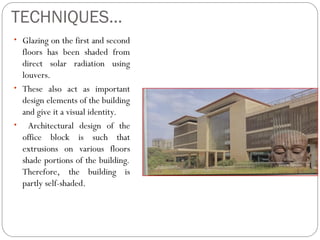
• Glazing on the first and second
floors has been shaded from
direct solar radiation using
louvers.
• These also act as important
design elements of the building
and give it a visual identity.
• Architectural design of the
office block is such that
extrusions on various floors
shade portions of the building.
Therefore, the building is
partly self-shaded.
PLANNING STYLES…
 In order to cater to functional interior
office atmosphere, break out spaces have
been created in the form of terraces and
pavilions which have been interspersed
within building profile.
 Waterfront cafeteria in the basement
arching under work places of the campus.
salient features
• There are various salient
features which enable it to
become an iconic green
building.
• Reflective pools not only
connect the campus but also
create a microenvironment
in the campus.
• Glass cylinder connecting
the earth and the sky at
various entry levels.
SUSTAINABLE DESIGN….
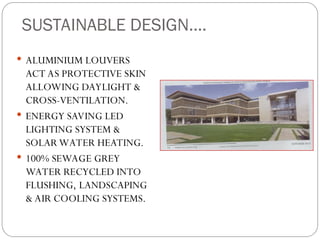
 ALUMINIUM LOUVERS
ACT AS PROTECTIVE SKIN
ALLOWING DAYLIGHT &
CROSS-VENTILATION.
 ENERGY SAVING LED
LIGHTING SYSTEM &
SOLAR WATER HEATING.
 100% SEWAGE GREY
WATER RECYCLED INTO
FLUSHING, LANDSCAPING
& AIR COOLING SYSTEMS.
SALIENT FEATURES…
 DERIVES INSPIRATION
FROM LARGE INDIAN
HISTORICAL CAMPUSES
LIKE FATEHPUR SIKRI.
Daylighting…
 Library & Reading Rooms
overlooking into the
atrium In the Learning
Centre.
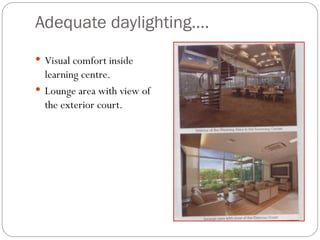
Adequate daylighting….
 Visual comfort inside
learning centre.
 Lounge area with view of
the exterior court.
Solar photovoltaic panels
 Solar photovoltaic panels
form the roof of the atrium
of the learning centre,
generating green power.
 8% of its annual energy
generated on-site thru
photovoltaic panels and
wind mills with a total
incremental cost of about
11%.
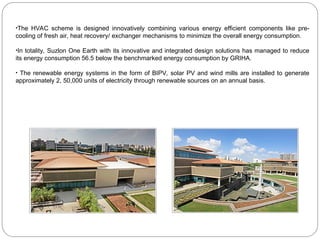
•The HVAC scheme is designed innovatively combining various energy efficient components like pre-
cooling of fresh air, heat recovery/ exchanger mechanisms to minimize the overall energy consumption.
•In totality, Suzlon One Earth with its innovative and integrated design solutions has managed to reduce
its energy consumption 56.5 below the benchmarked energy consumption by GRIHA.
• The renewable energy systems in the form of BIPV, solar PV and wind mills are installed to generate
approximately 2, 50,000 units of electricity through renewable sources on an annual basis.
•Apart from this, the project has incorporated smart solutions in order to reduce its water
consumption with the help of low-flow fixtures, sensor based urinals and pressure
reducing devices throughout the campus which ensures that the building requires
50.34% less potable water than the conventional building requirements.
• In addition, water efficient landscape design that uses higher ratio of native and
naturalized trees, shrubs and ground covers along with high efficiency sprinkler and drip
irrigation systems, reduces the landscape water requirement by about 50%.
• About 60% of the water in the building is recycled and reused within the campus.
•The intent of making a green building is also reflected in various materials used in the
structural systems and in the interiors.
•Majority of the materials used for the interiors application have high recycled content
and are low embodied energy materials.
•Overall, Suzlon One Earth has set very high standards for energy and water
management which is reflected in their projected energy and water savings.
•With defined functional need and clear design intent supported with adequate architectural
vocabulary, the interior integrates the user needs and enhanced productivity with optimized day light
harvesting.
•The design takes complete care of the ergonomics, visual connect to outdoors and optimal usage of
space with assigned tasks, shared and break out zones.
•Landscape is an integral part of the design, complementing the architecture and functional aspects of
the place.
• The landscape incorporates the principles of Xeriscape with efficient water management systems,
use of higher ration of native and naturalized plant species to sustain and enhance local ecology.
•High efficiency mechanical systems integrated with the efficient building envelope ensure that the
energy consumption of the building is significantly reduced.
•All the work stations are equipped with task lighting which is governed by motion sensors turning them
on when occupied.
•In addition, all the common areas like parking, washrooms, closed offices; meeting rooms also employ
the same system. This reduces the lighting load to 0.8 watt/sq.ft.
List of references
 Rao Pratap.M., Architecture: Time Space & People, October 2010,
Vol. 10 Issue 10, Green Buildings: Myth and Reality.
 Sharma Isha, Architecture: Time Space & People, April 2011, Vol. 11,
Issue 4, Green Building Technologies for a future Green Urban India.
 LEED_RS_V2-1
 LEED INDIA CS GUIDE
 LEED INDIA NC- REFERENCE GUIDE (Version 1.0) January 2007
 GRIHA Manual Volume I, TERI
 Energy Conservation Building Code (2006), Bureau of Energy
Efficiency.
 Dissertation report (2011) by Ms.Mitul Kumari, Eighth semester,
B.Arch.
THANKS…
THAT’S ALL…..

eebpresentation m-7_LATEST..................

  • 1.
  • 2.
    Introduction: Need forsustainability in building sector  As per a study done by the International Energy Agency, buildings consume nearly 30% of the total energy consumed by various major sectors in India.  Sharma (2011) states the construction industry in India is growing at a rate of 10% as compared to the world average of 5.2 %. Hence energy efficiency in the building sector assumes tremendous importance.  Sharma Isha, Architecture: Time Space & People, April 2011,Vol. 11, Issue 4, Green Building Technologies for a future Green Urban India.
  • 3.
    Growing importance ofenergy modeling  In the developed countries the growth rate of energy consumption is only marginally higher compared to the growth rate of population. For example, in USA, energy consumption is projected to grow at 1.3% while the population growth rate is projected to grow at 0.8%.  In contrast, in developing countries like India population growth rate is expected to grow at 1.3% while the energy consumption rate is expected to grow at 4.3%. This trend would strain the energy sector to a large extent.
  • 4.
    GREEN BUILDINGS  Agreen building depletes the natural resources to a minimum during its construction and operation. The aim of a green building design is to minimize the demand on non-renewable resources, maximize the utilization efficiency of these resources when in use, and maximize the reuse, recycling, and utilization of renewable resources.  Green buildings often include measures to reduce energy consumption – both the embodied energy required to extract, process, transport and install building materials and operating energy to provide services such as heating and power for equipment. Energy-efficient buildings use less operating energy. Embodied energy make up as much as 30% of the overall life cycle energy consumption.
  • 5.
    Energy Efficient Building. To reduce operating energy use, designers use details that reduce air leakage through the building envelope (the barrier between conditioned and unconditioned space).  They also specify high-performance windows and extra insulation in walls, ceilings, and floors.  Another strategy, passive solar building design, is often implemented in low-energy homes.  In addition, effective window placement (day-lighting) can provide more natural light and lessen the need for electric lighting during the day.  Solar water heating further reduces energy costs.
  • 6.
    GREEN BUILDINGS  Itmaximizes the use of efficient building materials and construction practices;  it optimizes the use of on-site sources and sinks by bioclimatic architectural practices;  uses minimum energy to power itself; uses efficient equipment to meet its lighting, air conditioning, and other needs;  maximizes the use of renewable sources of energy;  uses efficient waste and water management practices;  provides comfortable and hygienic indoor working conditions.
  • 7.
    Low environmental footprint…. It is evolved through a design process that requires input from all concerned – the architect; landscape designer; and the air conditioning, electrical, plumbing, and energy consultants – to work as a team to address all aspects of building and system planning, designing, construction, and operation.  They critically evaluate the impacts of each design decision and arrive at viable design solutions to minimize the negative impacts and enhance the positive impacts on the environment.
  • 8.
    What are theprevailing systems in India…  LEED India rating system a. Indian Green Building Council b. Indigenized c. Refers local standards / norms d. Global outreach GRIHA (Green Rating for Integrated Habitat Assessment)  National Rating System of India.  Conceived by TERI and developed jointly with The Ministry of New and Renewable Energy, Government of India.  Energy Conservation Building Code (ECBC) 2007 • Developed by India’s Bureau of Energy Efficiency, • Guidance from United States Agency for International Development (USAID) • Significant inputs from various other stakeholders such as practicing architects, consultants, educational institutions and other government organizations.
  • 9.
    Main Two GreenBuilding Rating systems in India  The two primary Green building Ratings that exist in India are IGBC LEED and GRIHA.  LEED (Leadership in Energy & Environmental Design) is one of the world’s most popular rating systems that first originated in US in March 2000 . It has now been adopted by many countries, with the necessary modifications to suit the country’s climate.
  • 10.
  • 11.
    LEED-INDIA  LEED-INDIA promotesa whole-building approach to sustainability by recognizing performance in the following seven key areas:   Sustainable Sites  Water Efficiency  Energy & Atmosphere  Materials & Resources  Indoor Environmental Quality  Innovation in Design  Regional Priority
  • 12.
  • 16.
    Green Building Ratingsystems in India  The GRIHA rating applies to new building stock – commercial, institutional, and residential, of varied functions, endorsed by the Ministry of New and Renewable Energy( MNRE), Government of India.  GRIHA emphasises on passive solar techniques for optimizing indoor visual and thermal comfort.  GRIHA encourages optimization of building design to reduce conventional energy demand.  A building is assessed on its predicted performance over its entire life cycle. GRIHA ratings are more relevant to Indian conditions.
  • 17.
    GRIHA India ratingsystem  GRIHA India rating system encompasses the following broad aspects:  Site Selection and Site Planning  Conservation and efficient utilization of resource  Health and well being during construction  Building Planning and Construction Stage  Water  Energy: end use  Energy: embodied and construction  Energy: renewable  Waste management  Health and well-being during post-construction occupation  Building Operation and Maintenance  Innovation
  • 18.
    Energy Conservation BuildingCode (ECBC)  How building is designed, constructed and used in response to the climate of a particular place is of utmost importance in reducing the energy demands of that particular building.  It is in this context that the Energy Conservation Act, which defines norms and standards for the energy performance of buildings and their components based on the climatic zone in which they are located.
  • 19.
    ENERGY CONSERVATION BUILDINGCODE…  The ECBC provides design norms for:  Building envelope, including thermal performance requirements for walls, roofs, and windows;  Lighting system, including day lighting, and lamps and luminaire performance requirements;  HVAC system, including energy performance of chillers and air distribution systems;  Electrical system; and  Water heating and pumping systems, including requirements for solar hot-water systems.
  • 20.
    Need for asimplified set of mandatory rules to be applicable to all buildings.  Generalised version of the existing GRIHA and IGBC LEED ratings can be adopted for implementation for all building stock which is going to be newly constructed in the future.  These generalised requirements thus formulated would be based on very basic principles of building science and energy conservation techniques.
  • 21.
    BREAK-UP OF ENERGYCONSUMPTION
  • 22.
    Domain for comparativeanalysis:  In the analysis that has been carried out, the following aspects have been considered:  Relevance with Indian climatic conditions  Attributes impacting the environment covered by the system  Indoor environmental quality  Cost effectiveness  Incentives for widespread appeal among the construction industry  Scope for innovations  Miscellaneous merits and demerits of any given system.
  • 23.
  • 27.
    Conclusions  Salient pointsobserved for GRIHA:  Endorsed by the Ministry of Renewable Energy.  Incentives to the buildings for complying.  Easy to understand, concise.  More weight age given to elimination of air-conditioning requirements, therefore, more suitable for the public sector, where traditional techniques are more appreciated and welcome. Also in Indian tropical conditions it is more relevant as wanton air-conditioning has become rampant.  Specific building materials like use of Fly-ash in the building construction emphasized. Comparatively less stress on use of innovative materials.  Generalized keeping in mind even the small city construction works. Again relevant for Indian conditions.
  • 28.
    Salient points observedfor IGBC LEED:  More popular internationally.  More exposure to International systems and research, as it is an Indian version of USGBC.  More lucrative option for the corporate sector with International funding.  Essentially a big city phenomenon because it has many points reserved for reusing the pre-existing building, if any.
  • 29.
    A uniform systemwhich should be mandatorily enforced for all future new constructions should include the following aspects:  Proper orientation of the building for least heat gain in summer and good overall site planning and location on site.  Reduce water use in landscaping, reduce building water use and water-use during construction, and introduce compulsory rain water harvesting and partial water recycling.  Introduce ways of natural ventilation in buildings through wind towers, passive down draft evaporative cooling and thereby minimize as far as possible conditioned spaces. Optimize building design for more thermal comfort inside.  Generate onsite renewable energy and use it.  Utilization of fly-ash bricks, compressed mud blocks and other low embodied energy materials for construction.  Proper Construction waste management, efficient waste segregation and proper storage and disposal of waste.
  • 30.
    Benefits of greenbuilding  A green building has lower resource consumption as compared to conventional buildings. The following is the percentage reduction of various resources in a building and their respective reasons.  Green buildings consume 40% to 60% (depending on the range of measures adopted) lesser electricity as compared to conventional buildings. This is primarily because they rely on passive architectural interventions in the building design, and high efficiency materials and technologies in the engineering design of the building.
  • 31.
    Benefits of greenbuilding  Green buildings restrict the use of high ODP (ozone depleting potential) substances in their systems as well as in finishes.  Green buildings offer higher image and marketability.  All of these can be achieved at a minimal incremental cost with an estimated payback period of about 3–5 years (excepting renewable energy for power generation).
  • 32.
    Benefits of greenbuildings…  Green buildings generate lesser pollution both during construction as well as while in use.  Through best-practices such as proper storage of construction materials, barricading of the site to prevent air and noise pollution during construction, proper storage and disposal of waste during construction and operation, and so on, ensures reduced impact on the surrounding environment.  Green buildings ensure proper safety, health and sanitation facilities for the labourers (during construction) and the occupants (while in use).
  • 33.
     Green Buildingsalso attempt to work towards on-site energy generation through renewable Energy utilization to cater to its energy needs. For instance, solar thermal systems can help generate hot-water and replace the conventional electrical geyser in buildings. Solar PV panels can help generate electricity which can reduce the buildings dependence on grid power.  Green buildings consume 40% to 80% (depending on the range of measures adopted) lesser water as compared to conventional buildings. By utilizing ultra low-flow fixtures, waste-water recycling systems and rain-water harvesting, green buildings not only reduce their demand for water use but also look at on-site supply options to cater to its internal and external (landscape) water demands.
  • 34.
    Green buildings generatelesser waste by employing waste management strategies on site. They may also employ waste to energy or waste to resource (like manure, or compost) strategies on site, to minimize their burden on municipal waste management facilities and landfills.
  • 35.
    • Suzlon OneEarth is Suzlon group global headquarter based at Pune, India. • The project has received Five Star Rating under GRIHA green building rating system & LEED PLATINUM RATING. • Suzlon One Earth is a minimal ecological foot print project keeping with the spirit of company's mission – 'Powering a Green Tomorrow'. • The Suzlon campus consists of an office space and Global Learning Academy. • It is spread across the site area of 42,500 sq.mts. • The total built up area is 75,825 sq.mts. • There are various salient features which enable it to become an iconic green building.
  • 36.
    PASSIVE DESIGN STRATEGIES •Passive design strategies help in ensuring there is visual and thermal comfort. • The orientation of blocks is such that it enables adequate day lighting and glare control. • Concept: Central gathering space or Brahmas than, with sky as its ceiling. Visual access to large central gardens from everywhere.
  • 37.
    TECHNIQUES… • Glazing onthe first and second floors has been shaded from direct solar radiation using louvers. • These also act as important design elements of the building and give it a visual identity. • Architectural design of the office block is such that extrusions on various floors shade portions of the building. Therefore, the building is partly self-shaded.
  • 38.
    PLANNING STYLES…  Inorder to cater to functional interior office atmosphere, break out spaces have been created in the form of terraces and pavilions which have been interspersed within building profile.  Waterfront cafeteria in the basement arching under work places of the campus.
  • 39.
    salient features • Thereare various salient features which enable it to become an iconic green building. • Reflective pools not only connect the campus but also create a microenvironment in the campus. • Glass cylinder connecting the earth and the sky at various entry levels.
  • 40.
    SUSTAINABLE DESIGN….  ALUMINIUMLOUVERS ACT AS PROTECTIVE SKIN ALLOWING DAYLIGHT & CROSS-VENTILATION.  ENERGY SAVING LED LIGHTING SYSTEM & SOLAR WATER HEATING.  100% SEWAGE GREY WATER RECYCLED INTO FLUSHING, LANDSCAPING & AIR COOLING SYSTEMS.
  • 41.
    SALIENT FEATURES…  DERIVESINSPIRATION FROM LARGE INDIAN HISTORICAL CAMPUSES LIKE FATEHPUR SIKRI.
  • 42.
    Daylighting…  Library &Reading Rooms overlooking into the atrium In the Learning Centre.
  • 43.
    Adequate daylighting….  Visualcomfort inside learning centre.  Lounge area with view of the exterior court.
  • 44.
    Solar photovoltaic panels Solar photovoltaic panels form the roof of the atrium of the learning centre, generating green power.  8% of its annual energy generated on-site thru photovoltaic panels and wind mills with a total incremental cost of about 11%.
  • 45.
    •The HVAC schemeis designed innovatively combining various energy efficient components like pre- cooling of fresh air, heat recovery/ exchanger mechanisms to minimize the overall energy consumption. •In totality, Suzlon One Earth with its innovative and integrated design solutions has managed to reduce its energy consumption 56.5 below the benchmarked energy consumption by GRIHA. • The renewable energy systems in the form of BIPV, solar PV and wind mills are installed to generate approximately 2, 50,000 units of electricity through renewable sources on an annual basis.
  • 46.
    •Apart from this,the project has incorporated smart solutions in order to reduce its water consumption with the help of low-flow fixtures, sensor based urinals and pressure reducing devices throughout the campus which ensures that the building requires 50.34% less potable water than the conventional building requirements. • In addition, water efficient landscape design that uses higher ratio of native and naturalized trees, shrubs and ground covers along with high efficiency sprinkler and drip irrigation systems, reduces the landscape water requirement by about 50%. • About 60% of the water in the building is recycled and reused within the campus. •The intent of making a green building is also reflected in various materials used in the structural systems and in the interiors. •Majority of the materials used for the interiors application have high recycled content and are low embodied energy materials. •Overall, Suzlon One Earth has set very high standards for energy and water management which is reflected in their projected energy and water savings.
  • 47.
    •With defined functionalneed and clear design intent supported with adequate architectural vocabulary, the interior integrates the user needs and enhanced productivity with optimized day light harvesting. •The design takes complete care of the ergonomics, visual connect to outdoors and optimal usage of space with assigned tasks, shared and break out zones. •Landscape is an integral part of the design, complementing the architecture and functional aspects of the place. • The landscape incorporates the principles of Xeriscape with efficient water management systems, use of higher ration of native and naturalized plant species to sustain and enhance local ecology. •High efficiency mechanical systems integrated with the efficient building envelope ensure that the energy consumption of the building is significantly reduced. •All the work stations are equipped with task lighting which is governed by motion sensors turning them on when occupied. •In addition, all the common areas like parking, washrooms, closed offices; meeting rooms also employ the same system. This reduces the lighting load to 0.8 watt/sq.ft.
  • 48.
    List of references Rao Pratap.M., Architecture: Time Space & People, October 2010, Vol. 10 Issue 10, Green Buildings: Myth and Reality.  Sharma Isha, Architecture: Time Space & People, April 2011, Vol. 11, Issue 4, Green Building Technologies for a future Green Urban India.  LEED_RS_V2-1  LEED INDIA CS GUIDE  LEED INDIA NC- REFERENCE GUIDE (Version 1.0) January 2007  GRIHA Manual Volume I, TERI  Energy Conservation Building Code (2006), Bureau of Energy Efficiency.  Dissertation report (2011) by Ms.Mitul Kumari, Eighth semester, B.Arch.
  • 49.