Creating Survivors:
A Century of Treatment Advances in
Colorectal Cancer

                  Edward Greeno, MD
   Associate Professor of Medicine, University of Minnesota
           Medical Director, Masonic Cancer Clinic
   Executive Medical Director, UMPhysicians Cancer Care
1900’s to 1960’s
 Surgery


                   2
1965 to 1995
 One Chemotherapy drug: 5-Fluorouracil
 Screening


                                    3
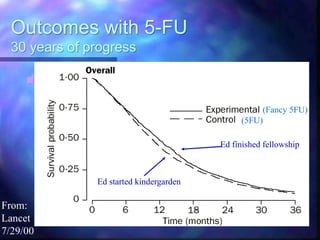
Outcomes with 5-FU
  30 years of progress

     Survival     6-12 months
           Probable   1-2 mo improvement in survival
                                                           (Fancy 5FU)
                                                      (5FU)

                                                 Ed finished fellowship


                       Ed started kindergarden

From:
Lancet
7/29/00
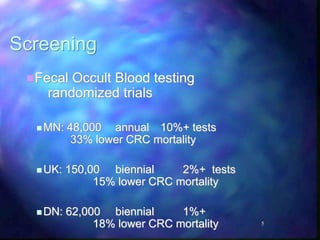
Screening
 Fecal Occult Blood testing
    randomized trials

   MN:   48,000 annual 10%+ tests
           33% lower CRC mortality

   UK:   150,00 biennial     2%+ tests
               15% lower CRC mortality

   DN:   62,000 biennial     1%+
               18% lower CRC mortality    5
1995 to Present
 Prevention
 Adjuvant  Therapy
 Multiple new chemotherapies
 Personalized Medicine


                                6
Prevention
 Diet
   Populations  with low fat, high fiber diets rich in
    fruits and vegetables = lower risk
   Patients after resection of colon cancer who
    follow good diet => lower risk of recurrence
 Exercise
   Patientsafter resection of colon cancer who
   exercise regularly => lower risk of recurrence

                                                 7
Prevention in high risk
populations
  Identification   of high risk patients
    Geneticscreening
    Inflammatory bowel disease

    Frequent polyps

  Regular colonscopy with resection of
   polyps => 50% risk reduction
  Resection of the colon => 90% reduction


                                            8
Adjuvant Therapy
 Definition:Treatment added to primary
  curative therapy to improve cure rates

 Frequent    recurrences after surgery
   10-80%   depending on stage


 Due   to occult (tiny & not visible) spread

                                          9
Adjuvant Therapy
 Chemotherapy   can cure microscopic
  metastatic disease

 Studies in early 90’s show 20-30% risk
  reduction with 5FU

 Additionof Oxaliplatin improved reduction
  to 40-50%
                                        10
NeoAdjuvant Therapy
 Using   regimens prior to surgery

 Dramatic  response rates allow curative-
  intent resection of previously inoperable
  patients.


                                        11
New Drugs
 Oral agents allow easier adminstration
 New cytoxic agents improve control of
  metastatic disease
 Better understanding of cancer biology
  allows better identification of targets


                                       12
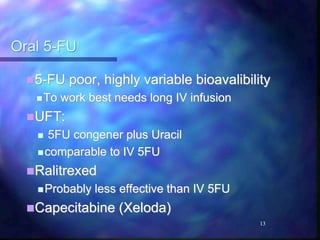
Oral 5-FU

  5-FU    poor, highly variable bioavalibility
    To   work best needs long IV infusion
  UFT:
     5FU congener plus Uracil
    comparable to IV 5FU

  Ralitrexed
    Probably   less effective than IV 5FU
  Capecitabine     (Xeloda)
                                             13
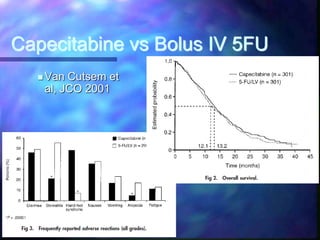
Capecitabine vs Bolus IV 5FU
   Van Cutsem et
   al, JCO 2001
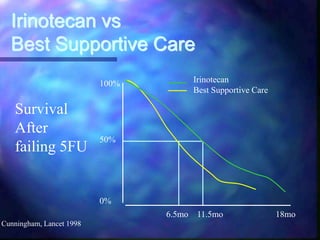
Irinotecan vs
  Best Supportive Care
                          100%           Irinotecan
                                         Best Supportive Care

   Survival
   After
                          50%
   failing 5FU


                          0%
                                 6.5mo   11.5mo                 18mo
Cunningham, Lancet 1998
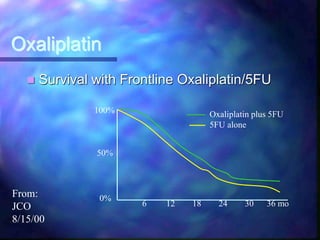
Oxaliplatin
      Survival with Frontline Oxaliplatin/5FU

                100%                  Oxaliplatin plus 5FU
                                      5FU alone


                50%


From:            0%
JCO                     6   12   18     24     30    36 mo
8/15/00
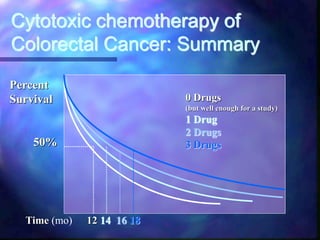
Cytotoxic chemotherapy of
Colorectal Cancer: Summary
Percent
Survival                    0 Drugs
                            (but well enough for a study)
                            1 Drug
                            2 Drugs
    50%                     3 Drugs


  Time (mo)   12 14 16 18
New targeted agents
 Angiogenesis inhibitors
 EGFR Inhibitors
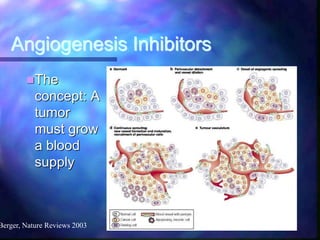
Angiogenesis Inhibitors
        The
           concept: A
           tumor
           must grow
           a blood
           supply


Berger, Nature Reviews 2003
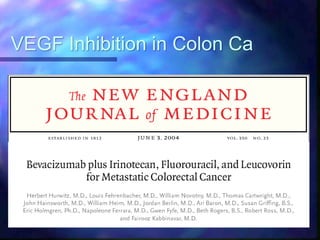
VEGF Inhibition in Colon Ca
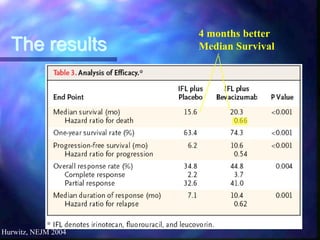
4 months better
  The results        Median Survival


Hurwitz, NEJM 2004
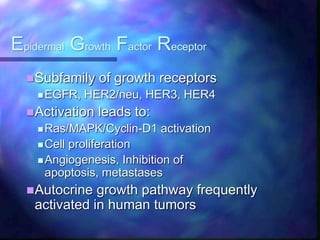
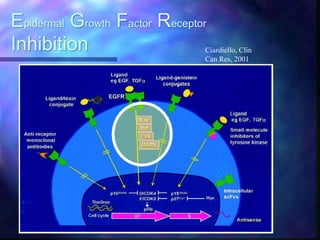
Epidermal Growth Factor Receptor
  Subfamily    of growth receptors
     EGFR,   HER2/neu, HER3, HER4
  Activation   leads to:
     Ras/MAPK/Cyclin-D1    activation
     Cellproliferation
     Angiogenesis, Inhibition of
      apoptosis, metastases
  Autocrine  growth pathway frequently
   activated in human tumors
Epidermal Growth Factor Receptor
Inhibition                     Ciardiello, Clin
                               Can Res, 2001
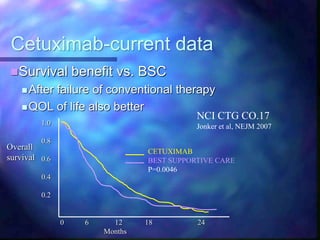
Cetuximab-current data
Survival          benefit vs. BSC
     After
          failure of conventional therapy
     QOL of life also better
                                             NCI CTG CO.17
         1.0                                 Jonker et al, NEJM 2007
         0.8
Overall                           CETUXIMAB
survival 0.6                      BEST SUPPORTIVE CARE
                                  P=0.0046
         0.4

         0.2


               0     6     12     18         24
                         Months
Epidermal Growth Factor Receptor
Inhibition                     Ciardiello, Clin
                               Can Res, 2001
Regorafenib
 Randomized     study in colon cancer
  patients failing all other therapies
   Survival   improved 2 months


                                                 26
    www.thelancet.com Vol 381 January 26, 2013
Aflibercept
 Complex molecule to block multiple
  pathways--1 month survival benefit


                                       27
        J Clin Oncol 30:3499-3506.
Drug Therapy of Advanced
Colorectal Cancer:
Impact of new agents

Percent                     0 Drugs    4 Drugs
Survival                    1 Drug     5 Drugs
                            2 Drugs    6 Drugs
                            3 Drugs    7 Drugs

    50%


  Time (mo)   12 14 16 18
                             >30 months median
Personalized Medicine
 New  tools create much more detailed
  information about individual patient tumors

 Allow   more precise selection of therapy

 Most  of the promise just beginning to be
  realized

                                        29
Selecting patients for adjuvant
therapy
  Microsatellite   instability (MSI)
    Genetic alteration in some tumors
    Predicts lower recurrence risk

    Predicts less effect of chemotherapy

  Avoid chemotherapy in low risk patients
   with MSI
  Molecular predictors being developed for
   multiple cancers
                                            30
Cetuximab-importance of KRAS
If KRAS is mutated:
Cetuximab never works


                         NCI    CTG CO.17
                             Karepetis et al, NEJM 2008
                                                   31
New Therapies for Colon Cancer
 For   60 years all we had was surgery

 Inthe next 30 we learned to do screening
  and developed one chemotherapy drug

 Inthe past 15 we dramatically improved
  outcomes

 The   next 5 years will eclipse all of that
                                            32
Advances In the Pipeline
 Genetically      Engineered Salmonella
    Infects
           tumor cells
    Induces immune destruction

 Minnelide—Plant         derived drug
       downregulates protective mechanisms in
       cancer cells
 Genetically      engineered Adenovirus
    Infect   and destroy tumor cells
                                             33
Salmonella-pIL2
Colorectal liver
metastases reduced in
mice orally administered
Salmonella-IL2 vs.
saline (control) or
Salmonella-no-IL2.


Developed By Dan
Saltzman
First in human Phase I
study nearly complete
with no significant t
toxicity
Minnelide vs. Pancreas Cancer


  Science Translational Medicine, 17 October 2012 Vol 4 Issue 156

  Effective in mice even with                     Developed by Ashok
   fresh patient xenograft rather                  Saluja
   than cell line
  Effective even when tumor
                                                   First in human trial
   allowed to grow to massive
                                                   to begin in June
   volume
Adenovirus
Developed by Masato Yamamoto               Controls


Effective in
mouse xenograft
model
                                           Modified
                                            virus


 First in human trial awaiting toxicity
   studies and funding

Edward Greeno, M.D.

  • 1.
    Creating Survivors: A Centuryof Treatment Advances in Colorectal Cancer Edward Greeno, MD Associate Professor of Medicine, University of Minnesota Medical Director, Masonic Cancer Clinic Executive Medical Director, UMPhysicians Cancer Care
  • 2.
  • 3.
    1965 to 1995 One Chemotherapy drug: 5-Fluorouracil Screening 3
  • 4.
    Outcomes with 5-FU 30 years of progress Survival 6-12 months  Probable 1-2 mo improvement in survival (Fancy 5FU) (5FU) Ed finished fellowship Ed started kindergarden From: Lancet 7/29/00
  • 5.
    Screening Fecal OccultBlood testing randomized trials  MN: 48,000 annual 10%+ tests 33% lower CRC mortality  UK: 150,00 biennial 2%+ tests 15% lower CRC mortality  DN: 62,000 biennial 1%+ 18% lower CRC mortality 5
  • 6.
    1995 to Present Prevention Adjuvant Therapy Multiple new chemotherapies Personalized Medicine 6
  • 7.
    Prevention Diet  Populations with low fat, high fiber diets rich in fruits and vegetables = lower risk  Patients after resection of colon cancer who follow good diet => lower risk of recurrence Exercise  Patientsafter resection of colon cancer who exercise regularly => lower risk of recurrence 7
  • 8.
    Prevention in highrisk populations Identification of high risk patients  Geneticscreening  Inflammatory bowel disease  Frequent polyps Regular colonscopy with resection of polyps => 50% risk reduction Resection of the colon => 90% reduction 8
  • 9.
    Adjuvant Therapy Definition:Treatmentadded to primary curative therapy to improve cure rates Frequent recurrences after surgery  10-80% depending on stage Due to occult (tiny & not visible) spread 9
  • 10.
    Adjuvant Therapy Chemotherapy can cure microscopic metastatic disease Studies in early 90’s show 20-30% risk reduction with 5FU Additionof Oxaliplatin improved reduction to 40-50% 10
  • 11.
    NeoAdjuvant Therapy Using regimens prior to surgery Dramatic response rates allow curative- intent resection of previously inoperable patients. 11
  • 12.
    New Drugs Oralagents allow easier adminstration New cytoxic agents improve control of metastatic disease Better understanding of cancer biology allows better identification of targets 12
  • 13.
    Oral 5-FU 5-FU poor, highly variable bioavalibility  To work best needs long IV infusion UFT:  5FU congener plus Uracil  comparable to IV 5FU Ralitrexed  Probably less effective than IV 5FU Capecitabine (Xeloda) 13
  • 14.
    Capecitabine vs BolusIV 5FU  Van Cutsem et al, JCO 2001
  • 15.
    Irinotecan vs Best Supportive Care 100% Irinotecan Best Supportive Care Survival After 50% failing 5FU 0% 6.5mo 11.5mo 18mo Cunningham, Lancet 1998
  • 16.
    Oxaliplatin  Survival with Frontline Oxaliplatin/5FU 100% Oxaliplatin plus 5FU 5FU alone 50% From: 0% JCO 6 12 18 24 30 36 mo 8/15/00
  • 17.
    Cytotoxic chemotherapy of ColorectalCancer: Summary Percent Survival 0 Drugs (but well enough for a study) 1 Drug 2 Drugs 50% 3 Drugs Time (mo) 12 14 16 18
  • 18.
    New targeted agents Angiogenesis inhibitors EGFR Inhibitors
  • 19.
    Angiogenesis Inhibitors The concept: A tumor must grow a blood supply Berger, Nature Reviews 2003
  • 20.
  • 21.
    4 months better The results Median Survival Hurwitz, NEJM 2004
  • 22.
    Epidermal Growth FactorReceptor Subfamily of growth receptors  EGFR, HER2/neu, HER3, HER4 Activation leads to:  Ras/MAPK/Cyclin-D1 activation  Cellproliferation  Angiogenesis, Inhibition of apoptosis, metastases Autocrine growth pathway frequently activated in human tumors
  • 23.
    Epidermal Growth FactorReceptor Inhibition Ciardiello, Clin Can Res, 2001
  • 24.
    Cetuximab-current data Survival benefit vs. BSC  After failure of conventional therapy  QOL of life also better NCI CTG CO.17 1.0 Jonker et al, NEJM 2007 0.8 Overall CETUXIMAB survival 0.6 BEST SUPPORTIVE CARE P=0.0046 0.4 0.2 0 6 12 18 24 Months
  • 25.
    Epidermal Growth FactorReceptor Inhibition Ciardiello, Clin Can Res, 2001
  • 26.
    Regorafenib Randomized study in colon cancer patients failing all other therapies  Survival improved 2 months 26 www.thelancet.com Vol 381 January 26, 2013
  • 27.
    Aflibercept Complex moleculeto block multiple pathways--1 month survival benefit 27 J Clin Oncol 30:3499-3506.
  • 28.
    Drug Therapy ofAdvanced Colorectal Cancer: Impact of new agents Percent 0 Drugs 4 Drugs Survival 1 Drug 5 Drugs 2 Drugs 6 Drugs 3 Drugs 7 Drugs 50% Time (mo) 12 14 16 18 >30 months median
  • 29.
    Personalized Medicine New tools create much more detailed information about individual patient tumors Allow more precise selection of therapy Most of the promise just beginning to be realized 29
  • 30.
    Selecting patients foradjuvant therapy Microsatellite instability (MSI)  Genetic alteration in some tumors  Predicts lower recurrence risk  Predicts less effect of chemotherapy Avoid chemotherapy in low risk patients with MSI Molecular predictors being developed for multiple cancers 30
  • 31.
    Cetuximab-importance of KRAS IfKRAS is mutated: Cetuximab never works  NCI CTG CO.17  Karepetis et al, NEJM 2008 31
  • 32.
    New Therapies forColon Cancer For 60 years all we had was surgery Inthe next 30 we learned to do screening and developed one chemotherapy drug Inthe past 15 we dramatically improved outcomes The next 5 years will eclipse all of that 32
  • 33.
    Advances In thePipeline Genetically Engineered Salmonella  Infects tumor cells  Induces immune destruction Minnelide—Plant derived drug  downregulates protective mechanisms in cancer cells Genetically engineered Adenovirus  Infect and destroy tumor cells 33
  • 34.
    Salmonella-pIL2 Colorectal liver metastases reducedin mice orally administered Salmonella-IL2 vs. saline (control) or Salmonella-no-IL2. Developed By Dan Saltzman First in human Phase I study nearly complete with no significant t toxicity
  • 35.
    Minnelide vs. PancreasCancer Science Translational Medicine, 17 October 2012 Vol 4 Issue 156  Effective in mice even with Developed by Ashok fresh patient xenograft rather Saluja than cell line  Effective even when tumor First in human trial allowed to grow to massive to begin in June volume
  • 36.
    Adenovirus Developed by MasatoYamamoto Controls Effective in mouse xenograft model Modified virus First in human trial awaiting toxicity studies and funding