Civil service pension schemes
Options for reform
World Bank
Core Course on Pensions
Washington, DC, April, 2013
Agenda
 Institutional arrangements for public-sector workers’
pensions
 Demographic pressures
 Fiscal pressures
 Flexibility and portability of civil-service pensions
Origins
 Civil-service pension schemes usually set up before
national programmes
 independence of civil servants
 make working for the public sector attractive
 shift the cost of remunerating civil servants into the future
 Separate schemes then often persisted after national
schemes established: ‘dualism’
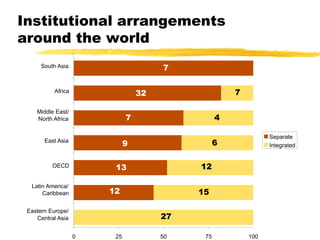
Institutional arrangements
around the world
0 25 50 75 100
Eastern Europe/
Central Asia
Latin America/
Caribbean
OECD
East Asia
Middle East/
North Africa
Africa
South Asia
Separate
Integrated
7
32 7
12 15
27
13 12
9 6
7 4
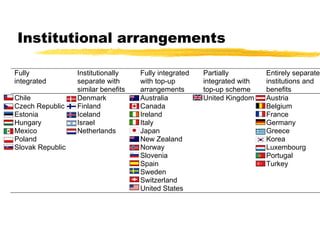
Institutional arrangements
Fully
integrated
Institutionally
separate with
similar benefits
Fully integrated
with top-up
arrangements
Partially
integrated with
top-up scheme
Entirely separate
institutions and
benefits
Chile
Czech Republic
Estonia
Hungary
Mexico
Poland
Slovak Republic
Denmark
Finland
Iceland
Israel
Netherlands
Australia
Canada
Ireland
Italy
Japan
New Zealand
Norway
Slovenia
Spain
Sweden
Switzerland
United States
United Kingdom Austria
Belgium
France
Germany
Greece
Korea
Luxembourg
Portugal
Turkey
Dualism
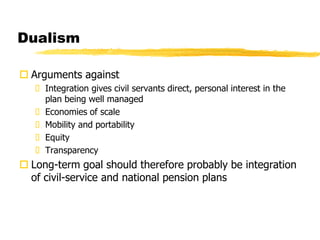
 Arguments against
 Integration gives civil servants direct, personal interest in the
plan being well managed
 Economies of scale
 Mobility and portability
 Equity
 Transparency
 Long-term goal should therefore probably be integration
of civil-service and national pension plans
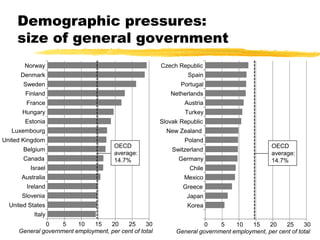
Demographic pressures:
size of general government
0 5 10 15 20 25 30
Italy
United States
Slovenia
Ireland
Australia
Israel
Canada
Belgium
United Kingdom
Luxembourg
Estonia
Hungary
France
Finland
Sweden
Denmark
Norway
General government employment, per cent of total
OECD
average:
14.7%
0 5 10 15 20 25 30
Korea
Japan
Greece
Mexico
Chile
Germany
Switzerland
Poland
New Zealand
Slovak Republic
Turkey
Austria
Netherlands
Portugal
Spain
Czech Republic
General government employment, per cent of total
OECD
average:
14.7%
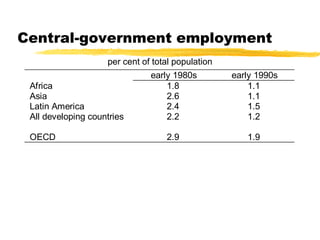
Central-government employment
per cent of total population
early 1980s early 1990s
Africa 1.8 1.1
Asia 2.6 1.1
Latin America 2.4 1.5
All developing countries 2.2 1.2
OECD 2.9 1.9
10
20
30
40
50
1995 2000 2005 2009
Australia
Estonia
Korea
Iceland
United States
Canada
Israel
Finland
New Zealand
Austria
Portugal
United Kingdom
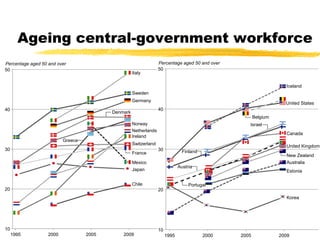
Percentage aged 50 and over
Belgium
10
20
30
40
50
1995 2000 2005 2009
Chile
Japan
Switzerland
Ireland
Netherlands
Italy
Germany
Denmark
Sweden
Norway
Greece
France
Percentage aged 50 and over
Mexico
Ageing central-government workforce
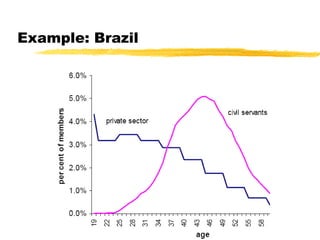
Example: Brazil
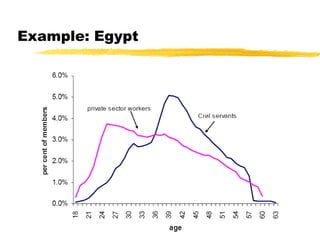
Example: Egypt
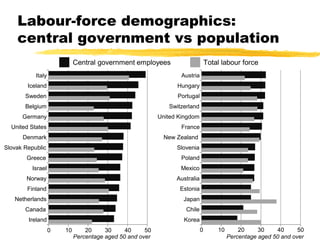
Labour-force demographics:
central government vs population
Central government employees Total labour force
0 10 20 30 40 50
Ireland
Canada
Netherlands
Finland
Norway
Israel
Greece
Slovak Republic
Denmark
United States
Germany
Belgium
Sweden
Iceland
Italy
Percentage aged 50 and over
0 10 20 30 40 50
Korea
Chile
Japan
Estonia
Australia
Mexico
Poland
Slovenia
New Zealand
France
United Kingdom
Switzerland
Portugal
Hungary
Austria
Percentage aged 50 and over
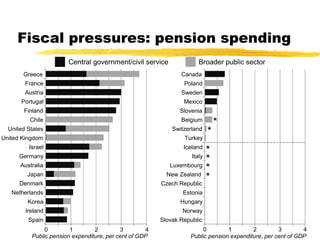
Fiscal pressures: pension spending
Central government/civil service Broader public sector
0 1 2 3 4
Spain
Ireland
Korea
Netherlands
Denmark
Japan
Australia
Germany
Israel
United Kingdom
United States
Chile
Finland
Portugal
Austria
France
Greece
Public pension expenditure, per cent of GDP
*
*
*
*
*
*
0 1 2 3 4
Slovak Republic
Norway
Hungary
Estonia
Czech Republic
New Zealand
Luxembourg
Italy
Iceland
Turkey
Switzerland
Belgium
Slovenia
Mexico
Sweden
Poland
Canada
Public pension expenditure, per cent of GDP
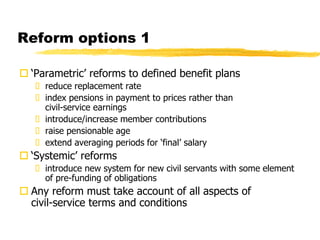
Reform options 1
 ‘Parametric’ reforms to defined benefit plans
 reduce replacement rate
 index pensions in payment to prices rather than
civil-service earnings
 introduce/increase member contributions
 raise pensionable age
 extend averaging periods for ‘final’ salary
 ‘Systemic’ reforms
 introduce new system for new civil servants with some element
of pre-funding of obligations
 Any reform must take account of all aspects of
civil-service terms and conditions
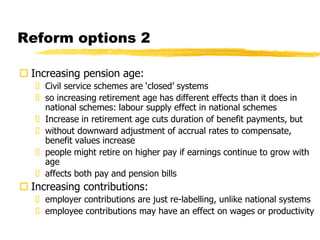
Reform options 2
 Increasing pension age:
 Civil service schemes are ‘closed’ systems
 so increasing retirement age has different effects than it does in
national schemes: labour supply effect in national schemes
 Increase in retirement age cuts duration of benefit payments, but
 without downward adjustment of accrual rates to compensate,
benefit values increase
 people might retire on higher pay if earnings continue to grow with
age
 affects both pay and pension bills
 Increasing contributions:
 employer contributions are just re-labelling, unlike national systems
 employee contributions may have an effect on wages or productivity
Flexibility and portability
 Civil service schemes are inflexible: ill designed to deal
with people without full careers
 But flexible schemes are increasingly important
 ‘revolving doors’: cross-fertilisation between public and private
sectors
 transfer of employees due to privatisation or contracting out
Penalties to moving jobs
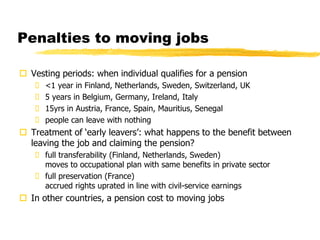
 Vesting periods: when individual qualifies for a pension
 <1 year in Finland, Netherlands, Sweden, Switzerland, UK
 5 years in Belgium, Germany, Ireland, Italy
 15yrs in Austria, France, Spain, Mauritius, Senegal
 people can leave with nothing
 Treatment of ‘early leavers’: what happens to the benefit between
leaving the job and claiming the pension?
 full transferability (Finland, Netherlands, Sweden)
moves to occupational plan with same benefits in private sector
 full preservation (France)
accrued rights uprated in line with civil-service earnings
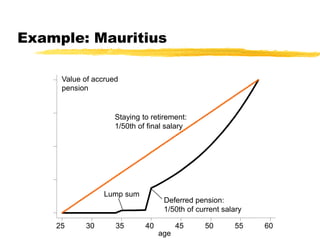
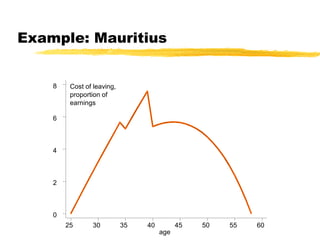
 In other countries, a pension cost to moving jobs
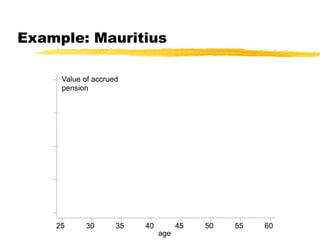
Example: Mauritius
age
25 30 35 40 45 50 55 60
Value of accrued
pension
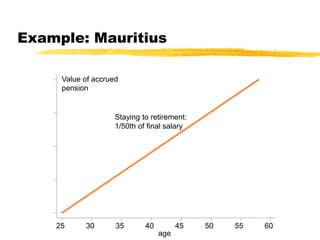
Example: Mauritius
age
25 30 35 40 45 50 55 60
Value of accrued
pension
Staying to retirement:
1/50th of final salary
Example: Mauritius
age
25 30 35 40 45 50 55 60
Value of accrued
pension
Lump sum
Deferred pension:
1/50th of current salary
Staying to retirement:
1/50th of final salary
Example: Mauritius
age
25 30 35 40 45 50 55 60
0
2
4
6
8 Cost of leaving,
proportion of
earnings
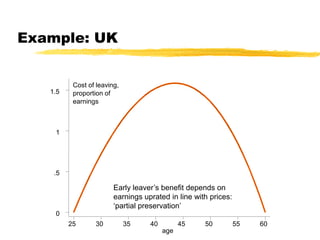
Example: UK
age
25 30 35 40 45 50 55 60
0
.5
1
1.5
Cost of leaving,
proportion of
earnings
Early leaver’s benefit depends on
earnings uprated in line with prices:
‘partial preservation’
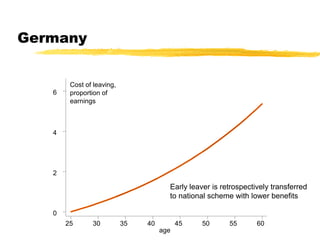
Germany
age
25 30 35 40 45 50 55 60
0
2
4
6
Cost of leaving,
proportion of
earnings
Early leaver is retrospectively transferred
to national scheme with lower benefits
Reforms to improve portability
 Shorten vesting periods
 Preserve pension rights of early leavers
 Extend averaging period for ‘final salary’
 career average uprating eliminates the mobility problem
 also deals with problems of incentives for abuse
 but requires improvements in record-keeping
 Introduce a defined contribution scheme
 fully portable
 examples include Australia, UK, US
Conclusions
 Reform of civil-service pension schemes is important in
low- and middle-income countries
 often, larger expenditure than national schemes
 crowds out important social programmes
 Many options to put civil-service pension schemes on a
sustainable footing
 Structural issues as important as fiscal ones
 single national scheme would be more administratively efficient,
equitable and increase labour-market flexibility
 equity and efficiency also improved by longer averaging periods
for earnings, shorter vesting periods, preservation for early
leavers, DC option

Pensions Core Course 2013: Civil Service Pension Schemes

  • 1.
    Civil service pensionschemes Options for reform World Bank Core Course on Pensions Washington, DC, April, 2013
  • 2.
    Agenda  Institutional arrangementsfor public-sector workers’ pensions  Demographic pressures  Fiscal pressures  Flexibility and portability of civil-service pensions
  • 3.
    Origins  Civil-service pensionschemes usually set up before national programmes  independence of civil servants  make working for the public sector attractive  shift the cost of remunerating civil servants into the future  Separate schemes then often persisted after national schemes established: ‘dualism’
  • 4.
    Institutional arrangements around theworld 0 25 50 75 100 Eastern Europe/ Central Asia Latin America/ Caribbean OECD East Asia Middle East/ North Africa Africa South Asia Separate Integrated 7 32 7 12 15 27 13 12 9 6 7 4
  • 5.
    Institutional arrangements Fully integrated Institutionally separate with similarbenefits Fully integrated with top-up arrangements Partially integrated with top-up scheme Entirely separate institutions and benefits Chile Czech Republic Estonia Hungary Mexico Poland Slovak Republic Denmark Finland Iceland Israel Netherlands Australia Canada Ireland Italy Japan New Zealand Norway Slovenia Spain Sweden Switzerland United States United Kingdom Austria Belgium France Germany Greece Korea Luxembourg Portugal Turkey
  • 6.
    Dualism  Arguments against Integration gives civil servants direct, personal interest in the plan being well managed  Economies of scale  Mobility and portability  Equity  Transparency  Long-term goal should therefore probably be integration of civil-service and national pension plans
  • 7.
    Demographic pressures: size ofgeneral government 0 5 10 15 20 25 30 Italy United States Slovenia Ireland Australia Israel Canada Belgium United Kingdom Luxembourg Estonia Hungary France Finland Sweden Denmark Norway General government employment, per cent of total OECD average: 14.7% 0 5 10 15 20 25 30 Korea Japan Greece Mexico Chile Germany Switzerland Poland New Zealand Slovak Republic Turkey Austria Netherlands Portugal Spain Czech Republic General government employment, per cent of total OECD average: 14.7%
  • 8.
    Central-government employment per centof total population early 1980s early 1990s Africa 1.8 1.1 Asia 2.6 1.1 Latin America 2.4 1.5 All developing countries 2.2 1.2 OECD 2.9 1.9
  • 9.
    10 20 30 40 50 1995 2000 20052009 Australia Estonia Korea Iceland United States Canada Israel Finland New Zealand Austria Portugal United Kingdom Percentage aged 50 and over Belgium 10 20 30 40 50 1995 2000 2005 2009 Chile Japan Switzerland Ireland Netherlands Italy Germany Denmark Sweden Norway Greece France Percentage aged 50 and over Mexico Ageing central-government workforce
  • 10.
  • 11.
  • 12.
    Labour-force demographics: central governmentvs population Central government employees Total labour force 0 10 20 30 40 50 Ireland Canada Netherlands Finland Norway Israel Greece Slovak Republic Denmark United States Germany Belgium Sweden Iceland Italy Percentage aged 50 and over 0 10 20 30 40 50 Korea Chile Japan Estonia Australia Mexico Poland Slovenia New Zealand France United Kingdom Switzerland Portugal Hungary Austria Percentage aged 50 and over
  • 13.
    Fiscal pressures: pensionspending Central government/civil service Broader public sector 0 1 2 3 4 Spain Ireland Korea Netherlands Denmark Japan Australia Germany Israel United Kingdom United States Chile Finland Portugal Austria France Greece Public pension expenditure, per cent of GDP * * * * * * 0 1 2 3 4 Slovak Republic Norway Hungary Estonia Czech Republic New Zealand Luxembourg Italy Iceland Turkey Switzerland Belgium Slovenia Mexico Sweden Poland Canada Public pension expenditure, per cent of GDP
  • 14.
    Reform options 1 ‘Parametric’ reforms to defined benefit plans  reduce replacement rate  index pensions in payment to prices rather than civil-service earnings  introduce/increase member contributions  raise pensionable age  extend averaging periods for ‘final’ salary  ‘Systemic’ reforms  introduce new system for new civil servants with some element of pre-funding of obligations  Any reform must take account of all aspects of civil-service terms and conditions
  • 15.
    Reform options 2 Increasing pension age:  Civil service schemes are ‘closed’ systems  so increasing retirement age has different effects than it does in national schemes: labour supply effect in national schemes  Increase in retirement age cuts duration of benefit payments, but  without downward adjustment of accrual rates to compensate, benefit values increase  people might retire on higher pay if earnings continue to grow with age  affects both pay and pension bills  Increasing contributions:  employer contributions are just re-labelling, unlike national systems  employee contributions may have an effect on wages or productivity
  • 16.
    Flexibility and portability Civil service schemes are inflexible: ill designed to deal with people without full careers  But flexible schemes are increasingly important  ‘revolving doors’: cross-fertilisation between public and private sectors  transfer of employees due to privatisation or contracting out
  • 17.
    Penalties to movingjobs  Vesting periods: when individual qualifies for a pension  <1 year in Finland, Netherlands, Sweden, Switzerland, UK  5 years in Belgium, Germany, Ireland, Italy  15yrs in Austria, France, Spain, Mauritius, Senegal  people can leave with nothing  Treatment of ‘early leavers’: what happens to the benefit between leaving the job and claiming the pension?  full transferability (Finland, Netherlands, Sweden) moves to occupational plan with same benefits in private sector  full preservation (France) accrued rights uprated in line with civil-service earnings  In other countries, a pension cost to moving jobs
  • 18.
    Example: Mauritius age 25 3035 40 45 50 55 60 Value of accrued pension
  • 19.
    Example: Mauritius age 25 3035 40 45 50 55 60 Value of accrued pension Staying to retirement: 1/50th of final salary
  • 20.
    Example: Mauritius age 25 3035 40 45 50 55 60 Value of accrued pension Lump sum Deferred pension: 1/50th of current salary Staying to retirement: 1/50th of final salary
  • 21.
    Example: Mauritius age 25 3035 40 45 50 55 60 0 2 4 6 8 Cost of leaving, proportion of earnings
  • 22.
    Example: UK age 25 3035 40 45 50 55 60 0 .5 1 1.5 Cost of leaving, proportion of earnings Early leaver’s benefit depends on earnings uprated in line with prices: ‘partial preservation’
  • 23.
    Germany age 25 30 3540 45 50 55 60 0 2 4 6 Cost of leaving, proportion of earnings Early leaver is retrospectively transferred to national scheme with lower benefits
  • 24.
    Reforms to improveportability  Shorten vesting periods  Preserve pension rights of early leavers  Extend averaging period for ‘final salary’  career average uprating eliminates the mobility problem  also deals with problems of incentives for abuse  but requires improvements in record-keeping  Introduce a defined contribution scheme  fully portable  examples include Australia, UK, US
  • 25.
    Conclusions  Reform ofcivil-service pension schemes is important in low- and middle-income countries  often, larger expenditure than national schemes  crowds out important social programmes  Many options to put civil-service pension schemes on a sustainable footing  Structural issues as important as fiscal ones  single national scheme would be more administratively efficient, equitable and increase labour-market flexibility  equity and efficiency also improved by longer averaging periods for earnings, shorter vesting periods, preservation for early leavers, DC option