Educational paradigms
implemented in the
learning process
performer: Kenesova Asemgul Nurlankyzy
Law, 1 course
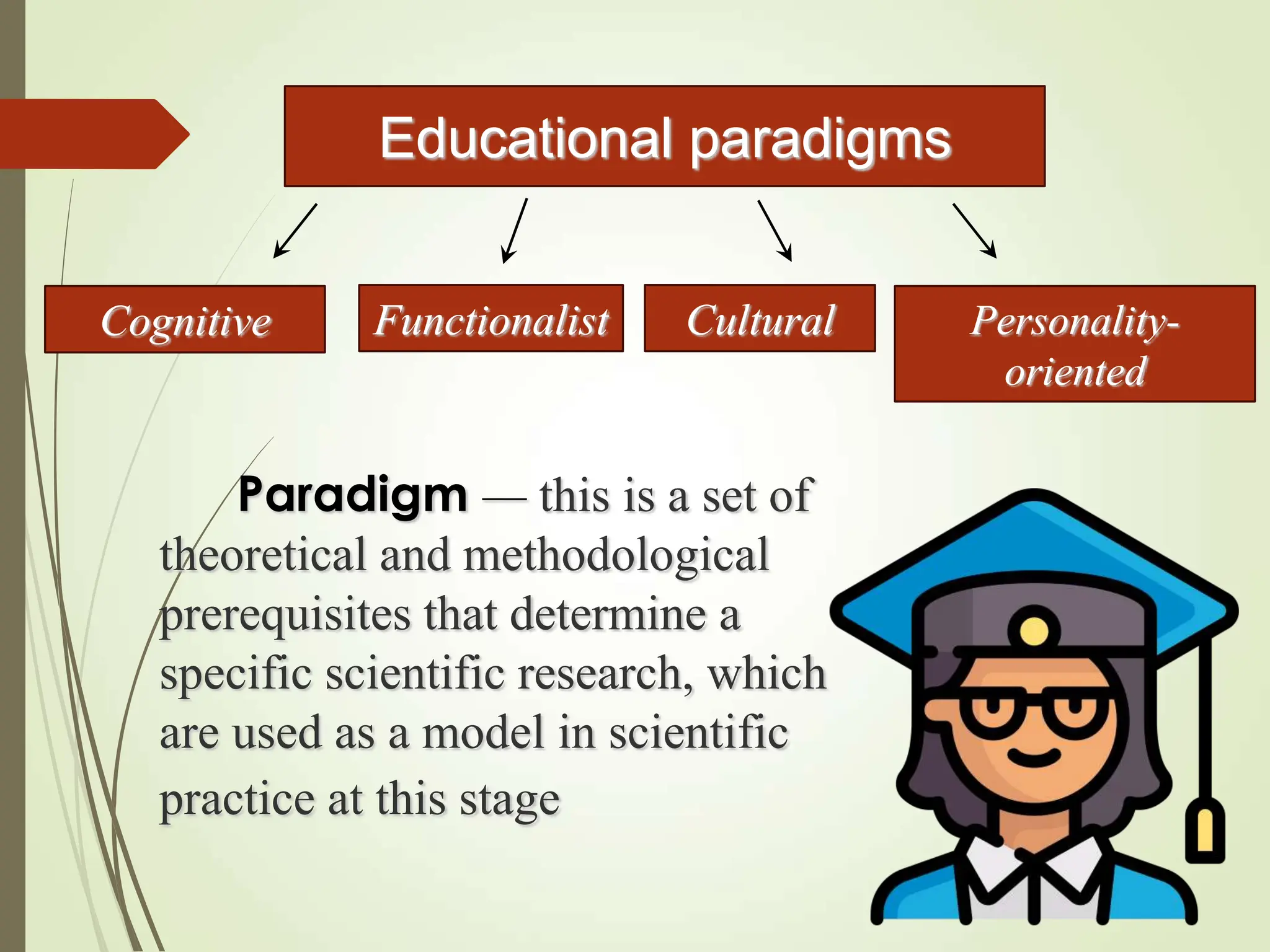
Educational paradigms
Cognitive Personality-
oriented
Functionalist Cultural
Paradigm — this is a set of
theoretical and methodological
prerequisites that determine a
specific scientific research, which
are used as a model in scientific
practice at this stage
Cognitive paradigm
3
Cognitive (latin cognitio - “knowledge”)— pertaining to cognition
only on the basis of thinking
•Knowledge, abilities, skills
The purpose of
training
•Teacher, teacher
Source of knowledge
•an object
Trainable
•"projection" of science
Academic subject
•Scientific knowledge
Educational material
Personal aspects of learning come down to the formation of cognitive
motivation and cognitive abilities.
Person-centered paradigm
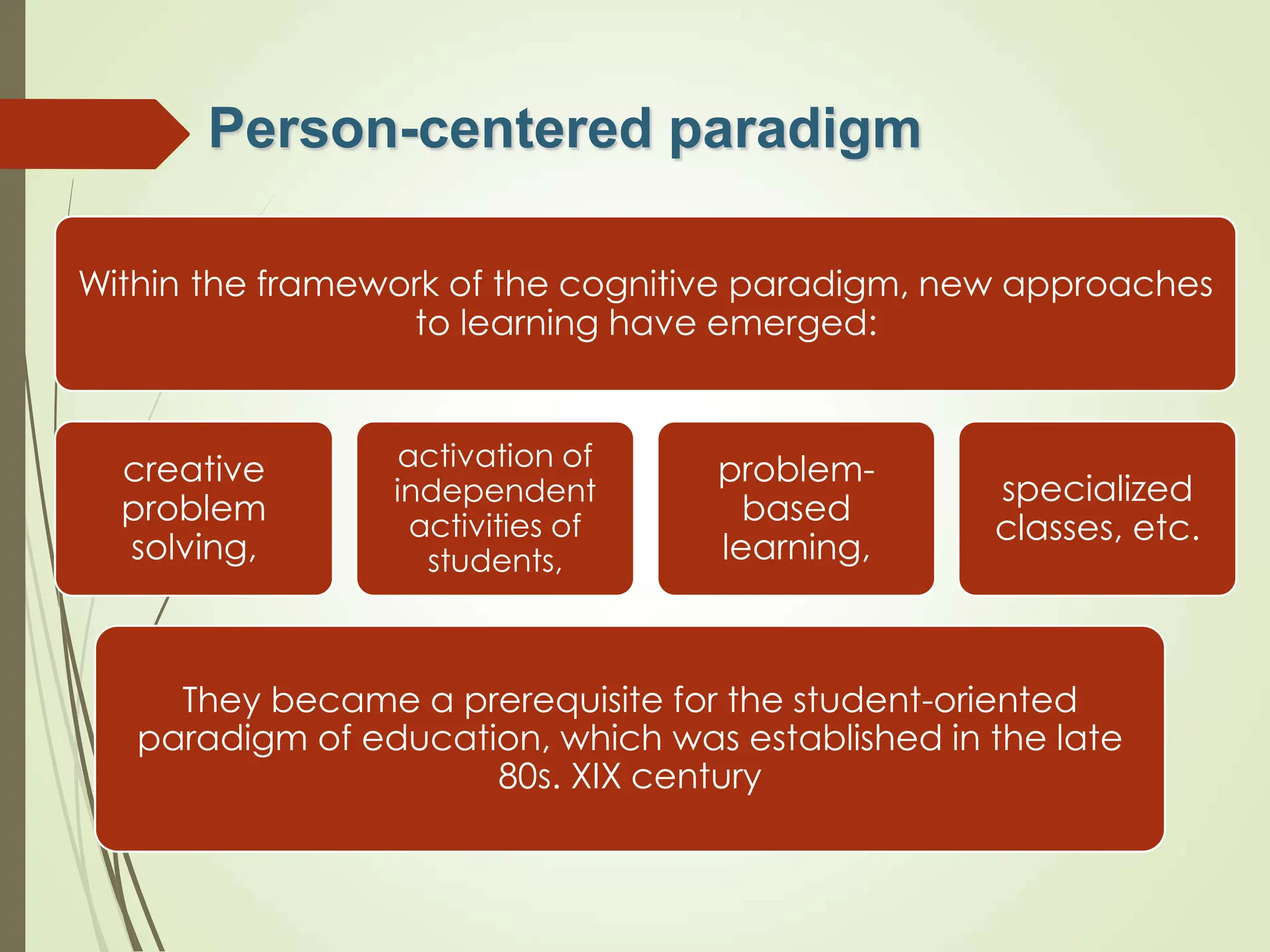
Within the framework of the cognitive paradigm, new approaches
to learning have emerged:
creative
problem
solving,
activation of
independent
activities of
students,
problem-
based
learning,
specialized
classes, etc.
They became a prerequisite for the student-oriented
paradigm of education, which was established in the late
80s. XIX century
Innovative teachers played an important role in the
development of a student-centered education paradigm
V.F. Shatalov, Sh.A. Amonashvili, E.N. Ilyin, S.N. Lysenkova,
I.P. Volkov and others.
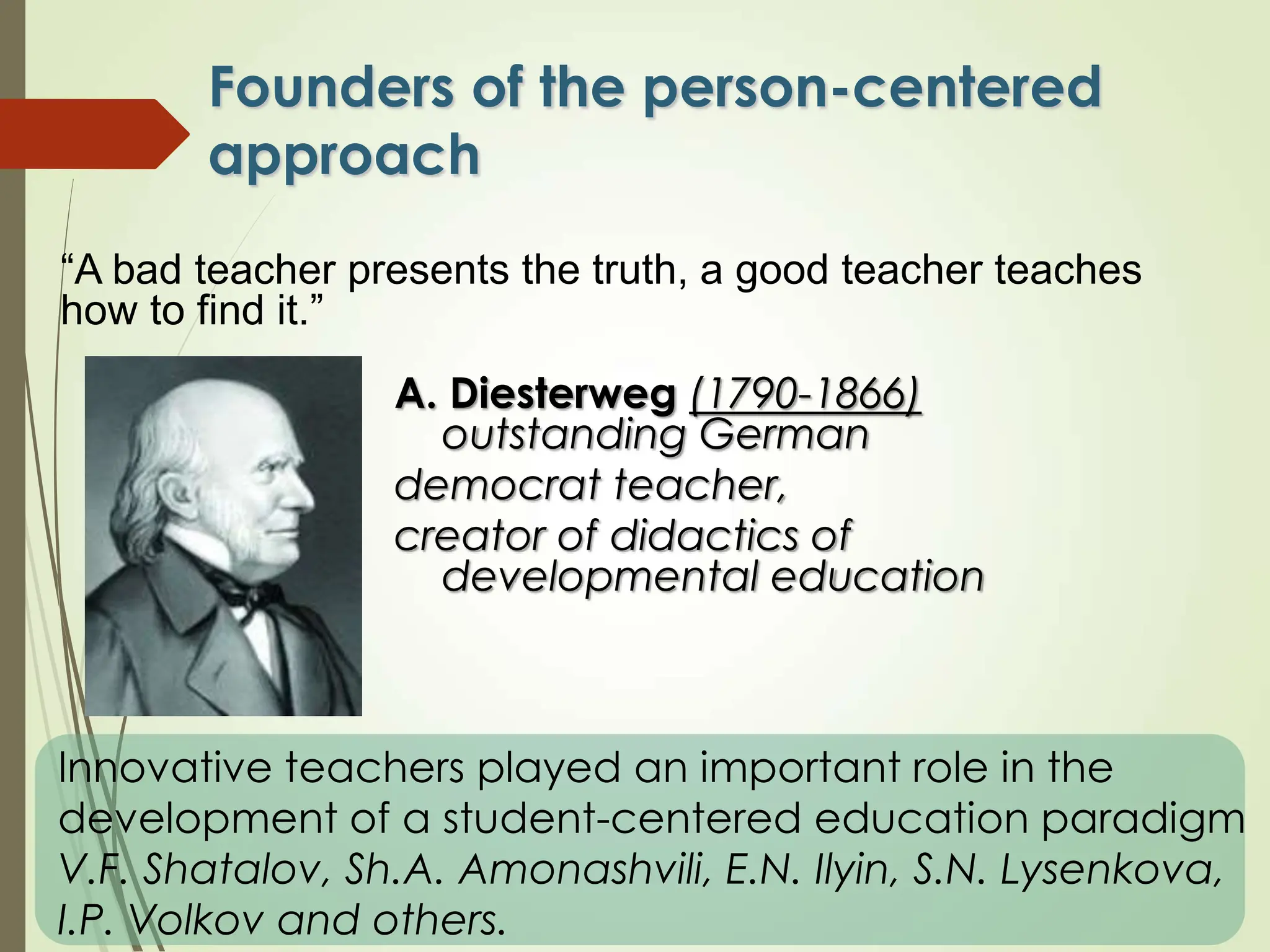
“A bad teacher presents the truth, a good teacher teaches
how to find it.”
A. Diesterweg (1790-1866)
outstanding German
democrat teacher,
creator of didactics of
developmental education
Founders of the person-centered
approach
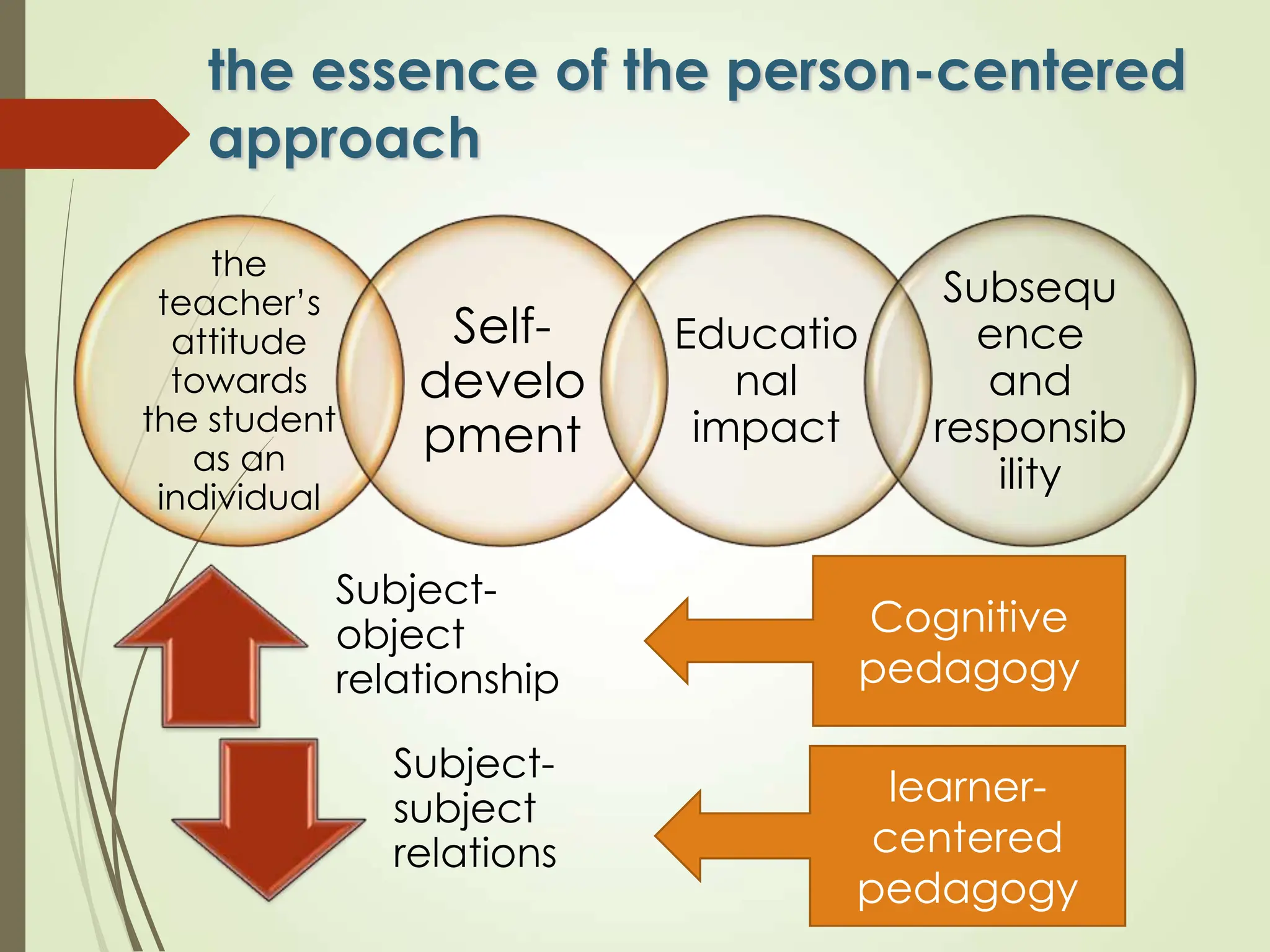
the essence of the person-centered
approach
the
teacher’s
attitude
towards
the student
as an
individual
Self-
develo
pment
Educatio
nal
impact
Subsequ
ence
and
responsib
ility
Subject-
object
relationship
Subject-
subject
relations
Cognitive
pedagogy
learner-
centered
pedagogy
The relationship between teacher and
student in student-centered pedagogy
Teacher
(subject)
Content,
forms, methods,
facilities
Student (object)
Cognitive
(traditional)
pedagogy
Teacher
(subject)
Student
(subject)
Forms, methods,
means
Contents (object)
Personal-
oriented
pedagogy
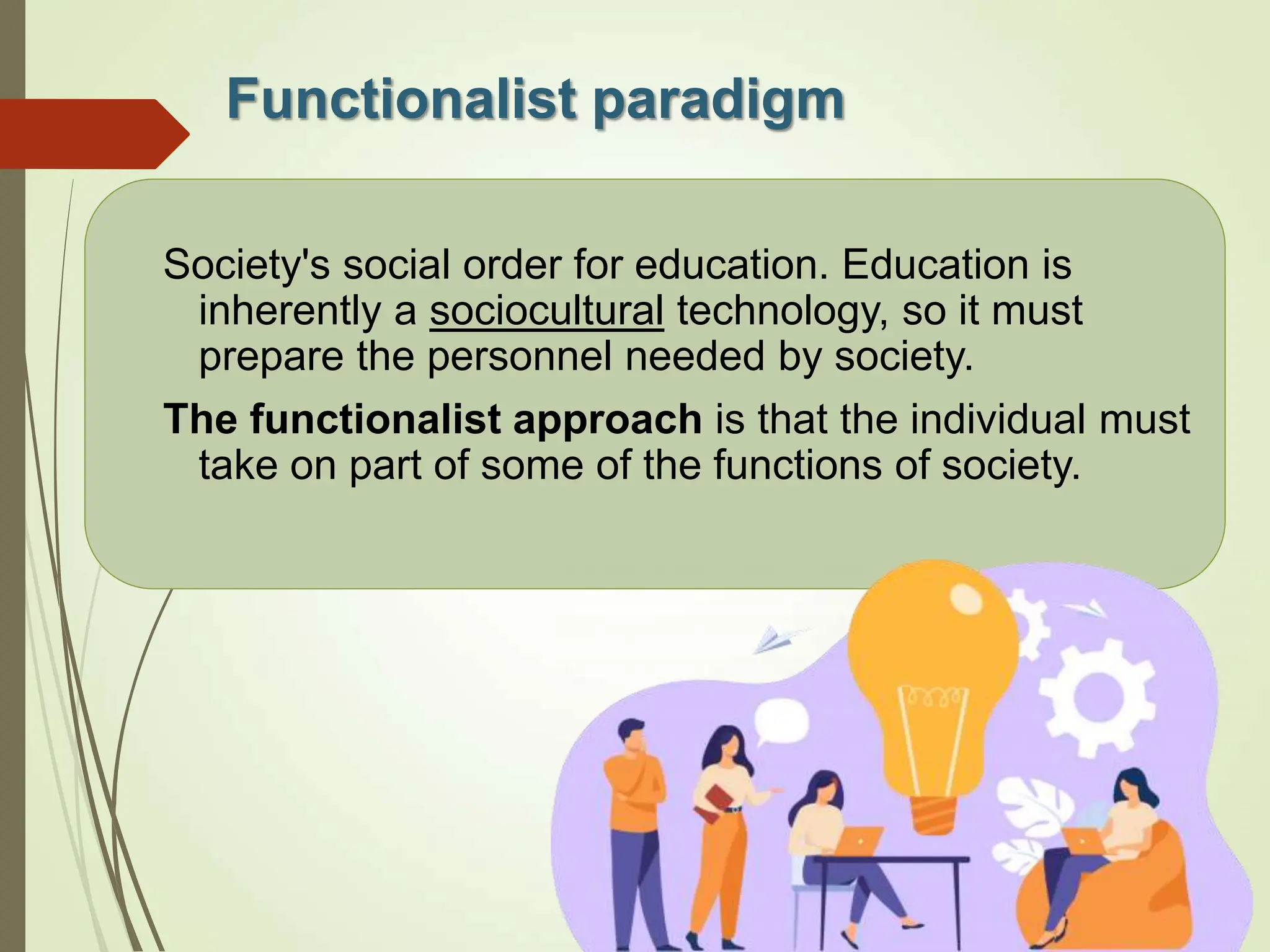
Functionalist paradigm
Society's social order for education. Education is
inherently a sociocultural technology, so it must
prepare the personnel needed by society.
The functionalist approach is that the individual must
take on part of some of the functions of society.
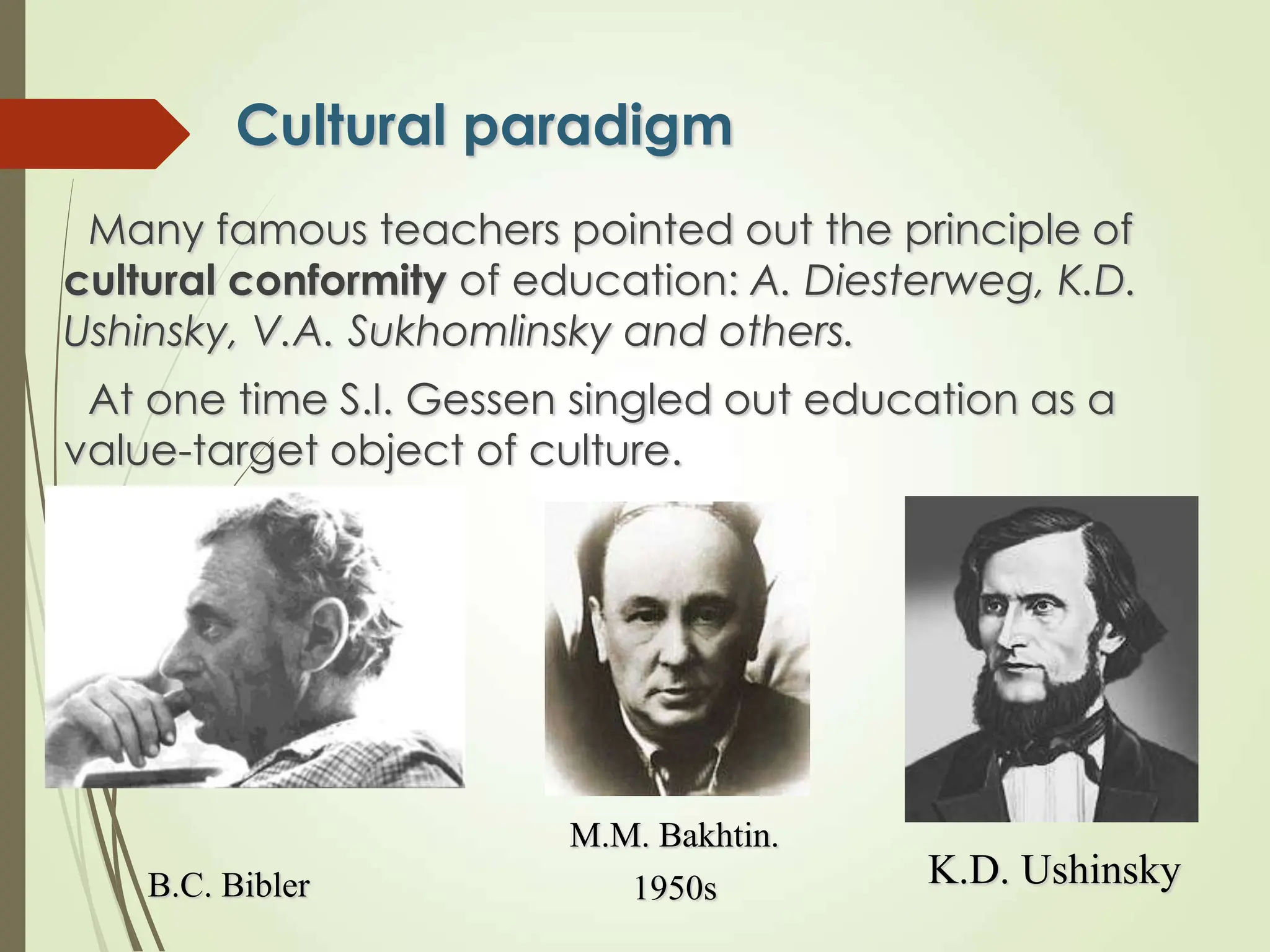
Cultural paradigm
Many famous teachers pointed out the principle of
cultural conformity of education: A. Diesterweg, K.D.
Ushinsky, V.A. Sukhomlinsky and others.
At one time S.I. Gessen singled out education as a
value-target object of culture.
K.D. Ushinsky
M.M. Bakhtin.
1950s
B.C. Bibler
Core values of culturally responsive
education:
Values
man as a subject of culture, his own life
and individual development;
education as a culturally developing
environment;
creativity and dialogue as ways of human existence
and self-development in the cultural and
educational space.
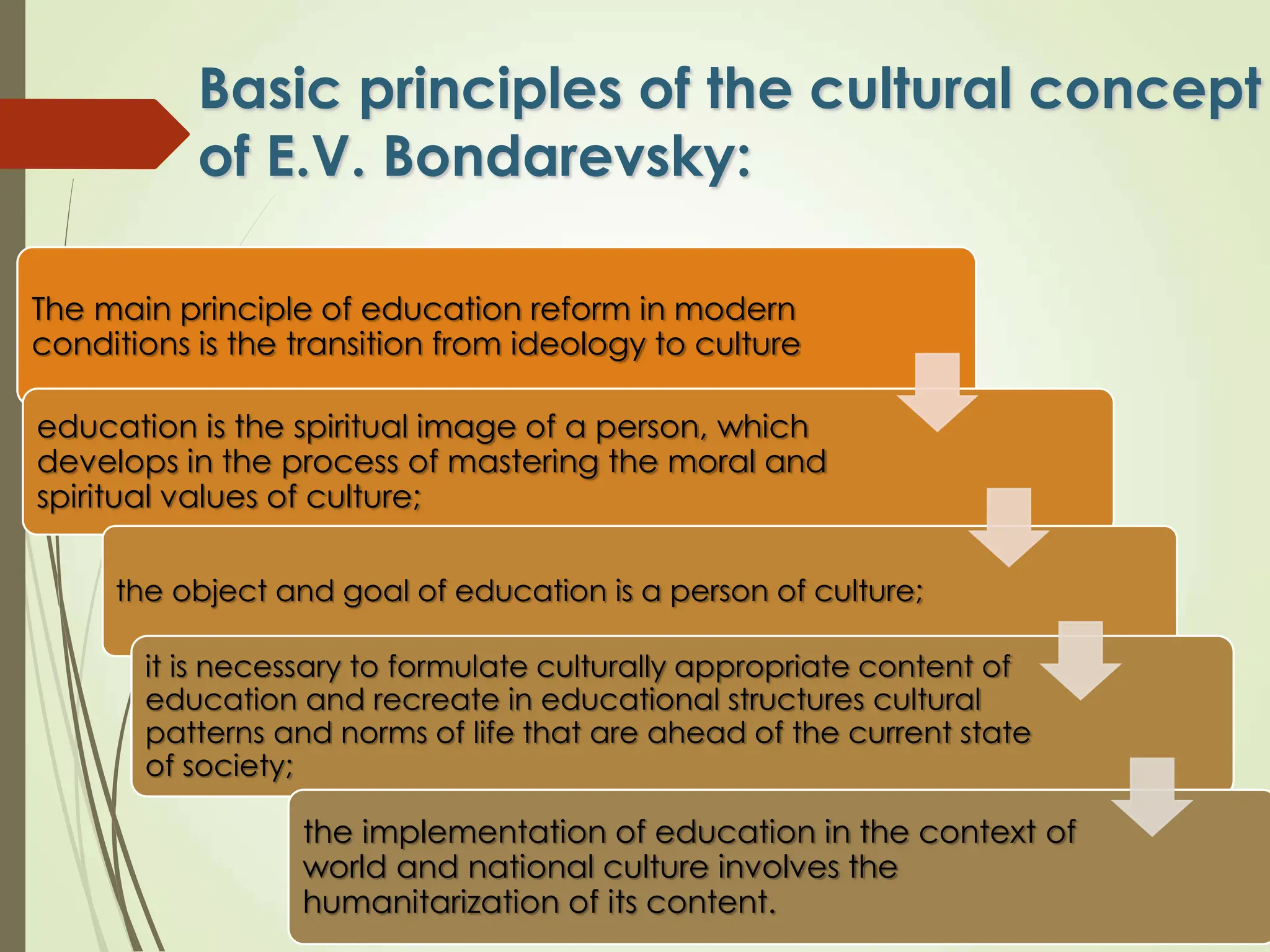
Basic principles of the cultural concept
of E.V. Bondarevsky:
The main principle of education reform in modern
conditions is the transition from ideology to culture
education is the spiritual image of a person, which
develops in the process of mastering the moral and
spiritual values of culture;
the object and goal of education is a person of culture;
it is necessary to formulate culturally appropriate content of
education and recreate in educational structures cultural
patterns and norms of life that are ahead of the current state
of society;
the implementation of education in the context of
world and national culture involves the
humanitarization of its content.
Cultural functions of education:
humanitarian (preservation and restoration of human
ecology, his physical and mental health, personal
freedom, individuality, spirituality, morality);
culturally creative (preservation, transmission,
reproduction and development of culture through
education);
sociologizing (assimilation and reproduction of social
experience).
Conclusions: the relationship between
culture and education
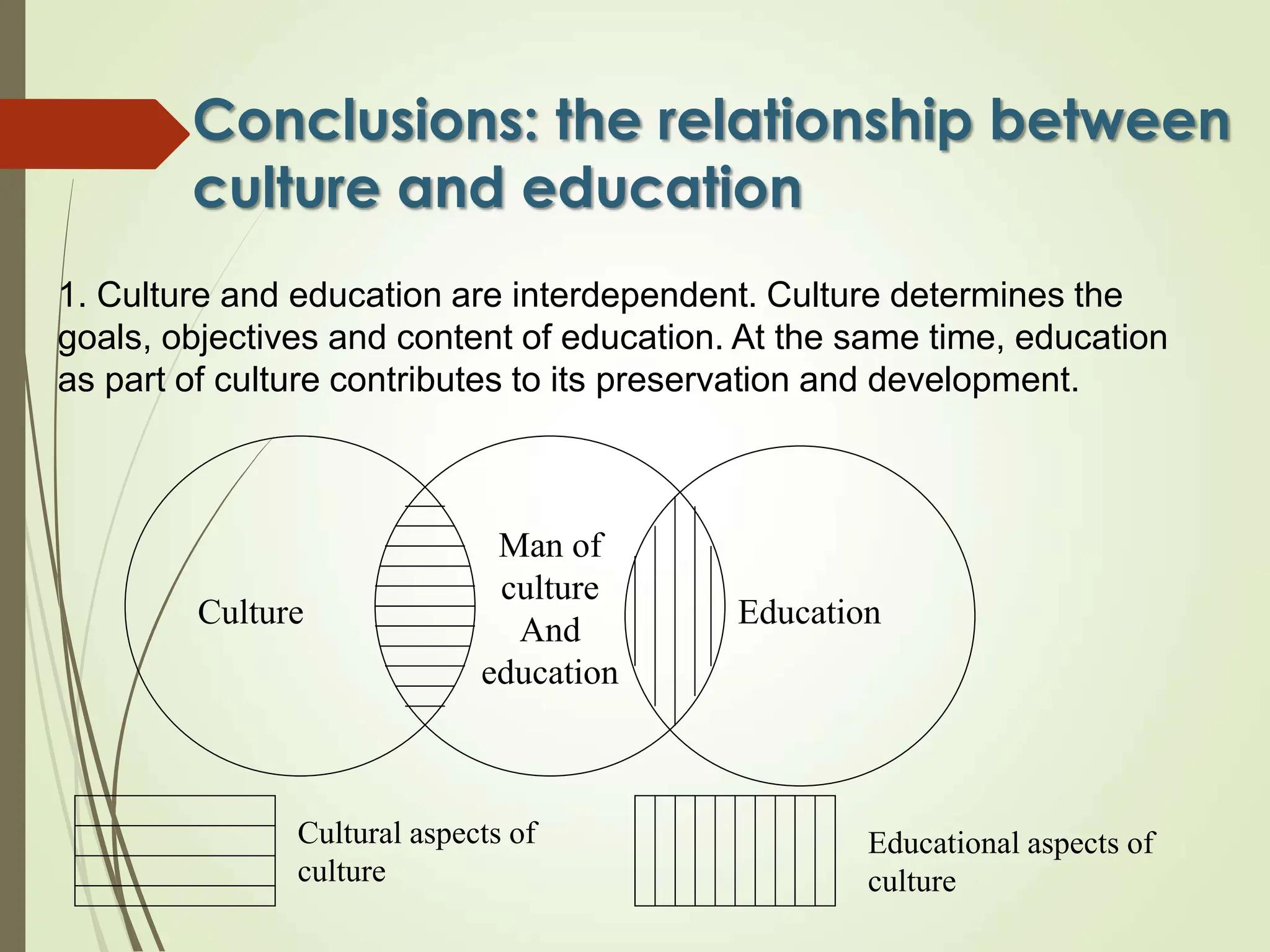
Culture Education
Man of
culture
And
education
Cultural aspects of
culture
Educational aspects of
culture
1. Culture and education are interdependent. Culture determines the
goals, objectives and content of education. At the same time, education
as part of culture contributes to its preservation and development.
Conclusions: the relationship between
culture and education
1.Culture and education are interconnected:
- common object
- universal human values
-the creative nature of cultural and educational activities.
-general functions
2. The cultural paradigm is more focused not on knowledge, but on the
assimilation of cultural elements.
3. The teacher must be a bearer of advanced culture; he himself is a value and
produces new values - students.
4. Pedagogical activity is, first of all, a dialogue between cultures, the exchange
of cultural values, and not just the transfer of knowledge, skills and abilities.
5. Every history is the history of culture and education.
Theory or concept– this is a set of generalized
provisions or a system of views on
understanding the essence of the learning
process.
The theory or concept is necessary because...
their purpose is to explain or predict how the
learning process will take place
Developmental education
Developmental learning is understood as a new,
active-activity method (type) of learning, replacing
the explanatory-illustrative method (type).
Developmental education takes into account
and uses developmental patterns and adapts to
the level and characteristics of the individual.
Developmental learning occurs in the zone of
proximal development.
Developmental education is the orientation of
the educational process towards human potential
and their implementation.
Developmental education
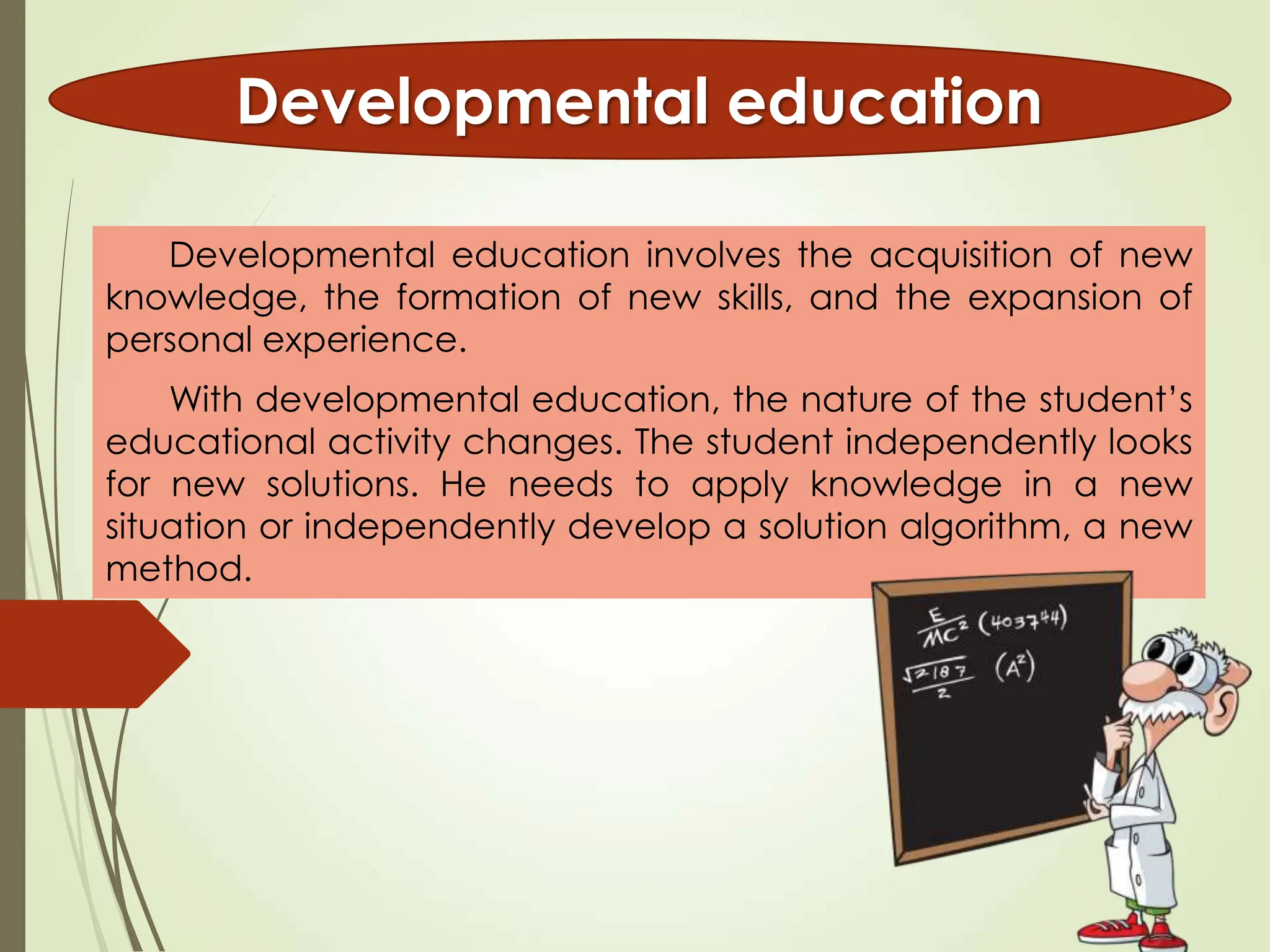
Developmental education involves the acquisition of new
knowledge, the formation of new skills, and the expansion of
personal experience.
With developmental education, the nature of the student’s
educational activity changes. The student independently looks
for new solutions. He needs to apply knowledge in a new
situation or independently develop a solution algorithm, a new
method.
Developmental education
The main goal of the concept of developmental
education is to prepare students for independent
acquisition of knowledge and search for truth.
The basis of such learning is the productive activity of
students, carried out in the “zone of proximal
development.”
The zone of proximal development of students causes
the emergence of personal new formations both in the
content side of the psyche and in the sphere of
methods of activity and the nature of behavior.
Developmental education
The basis of the developmental education
system according to L.V. Zankov consists of the
following interrelated principles:
principle of
learning at a
high level of
difficulty
principle of
the leading
role of
theoretical
knowledge
the principle
of students'
awareness of
the learning
process
the principle
of working on
the
development
of all students
the principle of
advancing the
study of
material at a
fast pace
Developmental education
An important condition for developmental
education is the organization of joint activities
between the teacher and students, because
theoretical knowledge is better absorbed when the
teacher’s help is manifested in the form of his
participation in a collective discussion to identify a
theoretical conclusion from a discussion of various
options for analyzing a life situation, objective facts
of the manifestation of the psyche.
This means that the main methods for
developmental learning are interactive learning
methods, which can include elements of other
active methods - problem-based and programmed
learning.
Developmental education
One of the most important features of
developmental education is its focus on the final
result - on the formation of the main psychological
new formations, primarily the mental development
of students, the ability to creatively approach
scientific and practical problems.
Training that focuses on the final product in the
form of the main psychological new formations is
developmental learning, and the methods of its
implementation are called innovative (innovations
are new formations).
Developmental education
In the process of developmental education,
along with the development of intellectual or
mental qualities of the individual, facts of the
development of moral qualities in students are
also observed, i.e. those qualities that are, it
would seem, a “privilege” not of training, but of
upbringing. These facts are not accidental, but
natural and indicate the educational role of
developmental education.
Developmental education
 So, the development of personality does not occur
spontaneously, not in a “natural” way, independent of
the subjective activity of people, but under the
influence of teaching - good or bad, organized or
spontaneous. But good teaching is properly organized
training, and it gives a greater developmental effect.
Therefore, the scientific organization of education on
the basis of the psychological theory of developmental
education is the main task of the methodology for
teaching any science at a university.
Thank you for
attention!

educational paradigms implemented in the learning process.ppt

  • 1.
    Educational paradigms implemented inthe learning process performer: Kenesova Asemgul Nurlankyzy Law, 1 course
  • 2.
    Educational paradigms Cognitive Personality- oriented FunctionalistCultural Paradigm — this is a set of theoretical and methodological prerequisites that determine a specific scientific research, which are used as a model in scientific practice at this stage
  • 3.
    Cognitive paradigm 3 Cognitive (latincognitio - “knowledge”)— pertaining to cognition only on the basis of thinking •Knowledge, abilities, skills The purpose of training •Teacher, teacher Source of knowledge •an object Trainable •"projection" of science Academic subject •Scientific knowledge Educational material Personal aspects of learning come down to the formation of cognitive motivation and cognitive abilities.
  • 4.
    Person-centered paradigm Within theframework of the cognitive paradigm, new approaches to learning have emerged: creative problem solving, activation of independent activities of students, problem- based learning, specialized classes, etc. They became a prerequisite for the student-oriented paradigm of education, which was established in the late 80s. XIX century
  • 5.
    Innovative teachers playedan important role in the development of a student-centered education paradigm V.F. Shatalov, Sh.A. Amonashvili, E.N. Ilyin, S.N. Lysenkova, I.P. Volkov and others. “A bad teacher presents the truth, a good teacher teaches how to find it.” A. Diesterweg (1790-1866) outstanding German democrat teacher, creator of didactics of developmental education Founders of the person-centered approach
  • 6.
    the essence ofthe person-centered approach the teacher’s attitude towards the student as an individual Self- develo pment Educatio nal impact Subsequ ence and responsib ility Subject- object relationship Subject- subject relations Cognitive pedagogy learner- centered pedagogy
  • 7.
    The relationship betweenteacher and student in student-centered pedagogy Teacher (subject) Content, forms, methods, facilities Student (object) Cognitive (traditional) pedagogy Teacher (subject) Student (subject) Forms, methods, means Contents (object) Personal- oriented pedagogy
  • 8.
    Functionalist paradigm Society's socialorder for education. Education is inherently a sociocultural technology, so it must prepare the personnel needed by society. The functionalist approach is that the individual must take on part of some of the functions of society.
  • 9.
    Cultural paradigm Many famousteachers pointed out the principle of cultural conformity of education: A. Diesterweg, K.D. Ushinsky, V.A. Sukhomlinsky and others. At one time S.I. Gessen singled out education as a value-target object of culture. K.D. Ushinsky M.M. Bakhtin. 1950s B.C. Bibler
  • 10.
    Core values ofculturally responsive education: Values man as a subject of culture, his own life and individual development; education as a culturally developing environment; creativity and dialogue as ways of human existence and self-development in the cultural and educational space.
  • 11.
    Basic principles ofthe cultural concept of E.V. Bondarevsky: The main principle of education reform in modern conditions is the transition from ideology to culture education is the spiritual image of a person, which develops in the process of mastering the moral and spiritual values of culture; the object and goal of education is a person of culture; it is necessary to formulate culturally appropriate content of education and recreate in educational structures cultural patterns and norms of life that are ahead of the current state of society; the implementation of education in the context of world and national culture involves the humanitarization of its content.
  • 12.
    Cultural functions ofeducation: humanitarian (preservation and restoration of human ecology, his physical and mental health, personal freedom, individuality, spirituality, morality); culturally creative (preservation, transmission, reproduction and development of culture through education); sociologizing (assimilation and reproduction of social experience).
  • 13.
    Conclusions: the relationshipbetween culture and education Culture Education Man of culture And education Cultural aspects of culture Educational aspects of culture 1. Culture and education are interdependent. Culture determines the goals, objectives and content of education. At the same time, education as part of culture contributes to its preservation and development.
  • 14.
    Conclusions: the relationshipbetween culture and education 1.Culture and education are interconnected: - common object - universal human values -the creative nature of cultural and educational activities. -general functions 2. The cultural paradigm is more focused not on knowledge, but on the assimilation of cultural elements. 3. The teacher must be a bearer of advanced culture; he himself is a value and produces new values - students. 4. Pedagogical activity is, first of all, a dialogue between cultures, the exchange of cultural values, and not just the transfer of knowledge, skills and abilities. 5. Every history is the history of culture and education.
  • 15.
    Theory or concept–this is a set of generalized provisions or a system of views on understanding the essence of the learning process. The theory or concept is necessary because... their purpose is to explain or predict how the learning process will take place
  • 16.
    Developmental education Developmental learningis understood as a new, active-activity method (type) of learning, replacing the explanatory-illustrative method (type). Developmental education takes into account and uses developmental patterns and adapts to the level and characteristics of the individual. Developmental learning occurs in the zone of proximal development. Developmental education is the orientation of the educational process towards human potential and their implementation.
  • 17.
    Developmental education Developmental educationinvolves the acquisition of new knowledge, the formation of new skills, and the expansion of personal experience. With developmental education, the nature of the student’s educational activity changes. The student independently looks for new solutions. He needs to apply knowledge in a new situation or independently develop a solution algorithm, a new method.
  • 18.
    Developmental education The maingoal of the concept of developmental education is to prepare students for independent acquisition of knowledge and search for truth. The basis of such learning is the productive activity of students, carried out in the “zone of proximal development.” The zone of proximal development of students causes the emergence of personal new formations both in the content side of the psyche and in the sphere of methods of activity and the nature of behavior.
  • 19.
    Developmental education The basisof the developmental education system according to L.V. Zankov consists of the following interrelated principles: principle of learning at a high level of difficulty principle of the leading role of theoretical knowledge the principle of students' awareness of the learning process the principle of working on the development of all students the principle of advancing the study of material at a fast pace
  • 20.
    Developmental education An importantcondition for developmental education is the organization of joint activities between the teacher and students, because theoretical knowledge is better absorbed when the teacher’s help is manifested in the form of his participation in a collective discussion to identify a theoretical conclusion from a discussion of various options for analyzing a life situation, objective facts of the manifestation of the psyche. This means that the main methods for developmental learning are interactive learning methods, which can include elements of other active methods - problem-based and programmed learning.
  • 21.
    Developmental education One ofthe most important features of developmental education is its focus on the final result - on the formation of the main psychological new formations, primarily the mental development of students, the ability to creatively approach scientific and practical problems. Training that focuses on the final product in the form of the main psychological new formations is developmental learning, and the methods of its implementation are called innovative (innovations are new formations).
  • 22.
    Developmental education In theprocess of developmental education, along with the development of intellectual or mental qualities of the individual, facts of the development of moral qualities in students are also observed, i.e. those qualities that are, it would seem, a “privilege” not of training, but of upbringing. These facts are not accidental, but natural and indicate the educational role of developmental education.
  • 23.
    Developmental education  So,the development of personality does not occur spontaneously, not in a “natural” way, independent of the subjective activity of people, but under the influence of teaching - good or bad, organized or spontaneous. But good teaching is properly organized training, and it gives a greater developmental effect. Therefore, the scientific organization of education on the basis of the psychological theory of developmental education is the main task of the methodology for teaching any science at a university.
  • 24.