I Am A Teacher
Emerging world of Education
 School Curriculum – need for a
paradigm shift .
 Concerns & issues for quality
improvement.
 linkages & Interface.
WHAT IS A CURRICULUM : Systematic and intended packaging of
competencies (knowledge, skills,
attitudes, values).
 Learners must acquire through organized
learning experiences.
 Formal and informal settings.
PARADIGM SHIFT:-

WHAT
AND

WHY?
WHAT:Fundamental change in
approach.
 Move from one model of
thinking to a completely
different way of thinking.
WHY:Education has attempted to solve needs
and problems of 21st Century by using 20th
Century concepts of

“Lesson Based” approach to curriculum and
instruction.
THIS IS THE CHALLENGE !!!
IN THE LAST DECADE:Layers of new ideas/ dimensions
have been piled onto the already
existing complex lessons.
 Academic Excellence.
 Multiple Intelligences.
 Values and Attitudes.
 Formative Assessment.
 Character and Values.
 Thematic Projects.
 Cooperative Learning, Team Work and
Social Skills.
 Technology Skills.
 Global citizenship
 Inclusive Education/ RTE (Diverse Students
Population).
 ASL
 CCE
 OTBA
 Inter disciplinary activities.
 PSA
 Vocational education
 ..
 ..
 ..
 Thus, in the 21st Century, a number of these
“Pile On” factors are converging to make the
teachers job difficult and challenging because
the paradigm shift in school curriculum and
its transaction has not happened.
 Educated people lack basic “employments
skills” like problem solving, teamwork, time
management, quality conscious….
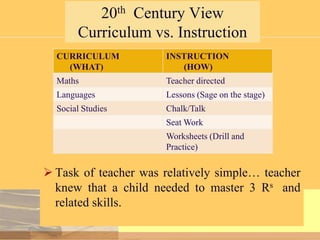
20th Century View
Curriculum vs. Instruction
CURRICULUM
(WHAT)

INSTRUCTION
(HOW)

Maths

Teacher directed

Languages

Lessons (Sage on the stage)

Social Studies

Chalk/Talk
Seat Work
Worksheets (Drill and
Practice)

 Task of teacher was relatively simple… teacher
knew that a child needed to master 3 Rs and
related skills.
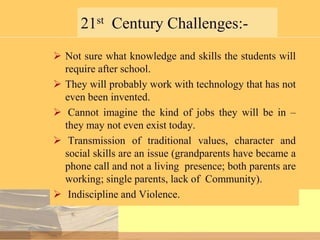
21st Century Challenges: Not sure what knowledge and skills the students will
require after school.
 They will probably work with technology that has not
even been invented.
 Cannot imagine the kind of jobs they will be in –
they may not even exist today.
 Transmission of traditional values, character and
social skills are an issue (grandparents have became a
phone call and not a living presence; both parents are
working; single parents, lack of Community).
 Indiscipline and Violence.
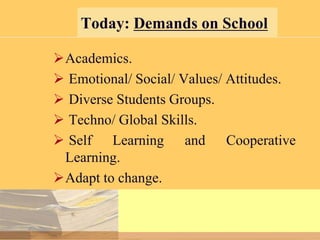
Today: Demands on School
Academics.
 Emotional/ Social/ Values/ Attitudes.
 Diverse Students Groups.
 Techno/ Global Skills.
 Self Learning and Cooperative
Learning.
Adapt to change.
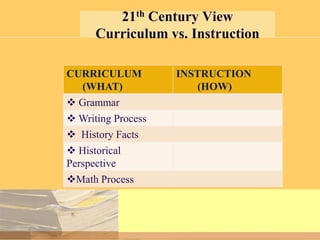
21th Century View
Curriculum vs. Instruction
CURRICULUM
(WHAT)

 Grammar
 Writing Process
 History Facts
 Historical
Perspective
Math Process

INSTRUCTION
(HOW)
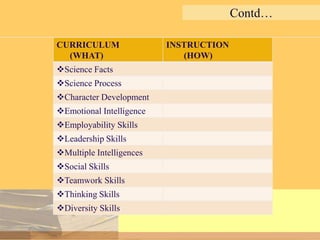
Contd…
CURRICULUM
(WHAT)
Science Facts
Science Process
Character Development
Emotional Intelligence
Employability Skills
Leadership Skills
Multiple Intelligences
Social Skills
Teamwork Skills
Thinking Skills
Diversity Skills

INSTRUCTION
(HOW)
Today – where are we with respect to the
Demands/ Needs of the 21st Century
Learner?

A Paradigm Shift in Curriculum Planning
and Design is happening but not in its
instruction and evaluation
There isn’t time in the school day or school
year to teach all the lessons
and
deliver “ The Complex and Differentiated
Curriculum” using instructional strategies…
That will prepare the learner today for an
unknown/unpredictable tomorrow.
 How can the teacher design and teach lessons on
traditional maths, language, social studies, and
science, then create lessons on process skills in
each of those academic content areas, and then, on
top of that, design and deliver additional lessons to
engage and develop the students multiple
intelligences, respond to their various learning
styles, and teach brain – based differentiated
lessons to develop social skills, character virtues,
emotional intelligence, leadership skills, teamwork
skills, and higher level thinking skills?
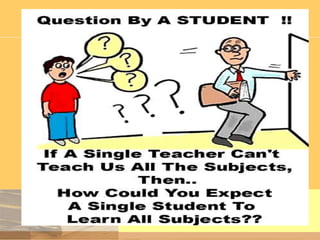
 And … how can a child learn all this?
Is there a way forward ?

If YES, What OR How ?
There is a need for a paradigm
shift in our approach to
Teaching_Learning.
We need to shift our Paradigm
from…..
A Lesson – based Approach
To
A Structure based Approach.
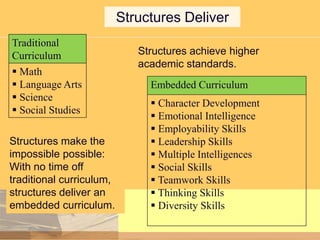
Structures Deliver
Traditional
Curriculum
 Math
 Language Arts
 Science
 Social Studies
Structures make the
impossible possible:
With no time off
traditional curriculum,
structures deliver an
embedded curriculum.

Structures achieve higher
academic standards.
Embedded Curriculum
 Character Development
 Emotional Intelligence
 Employability Skills
 Leadership Skills
 Multiple Intelligences
 Social Skills
 Teamwork Skills
 Thinking Skills
 Diversity Skills
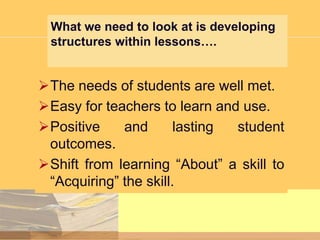
What we need to look at is developing
structures within lessons….

The needs of students are well met.
Easy for teachers to learn and use.
Positive
and
lasting
student
outcomes.
Shift from learning “About” a skill to
“Acquiring” the skill.
So….. let us get into a
“Leapfrogging” mode of mindset….
Based on
Rapid, Proactive Response to future
realties.
This Implies:
To rethink what students should learn and
how.
To look at new approaches to teaching and
learning.
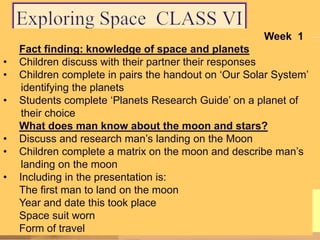
Week 1
•
•
•
•
•

•

Fact finding: knowledge of space and planets
Children discuss with their partner their responses
Children complete in pairs the handout on „Our Solar System‟
identifying the planets
Students complete „Planets Research Guide‟ on a planet of
their choice
What does man know about the moon and stars?
Discuss and research man‟s landing on the Moon
Children complete a matrix on the moon and describe man‟s
landing on the moon
Including in the presentation is:
The first man to land on the moon
Year and date this took place
Space suit worn
Form of travel
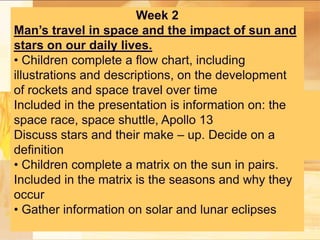
Week 2
Man’s travel in space and the impact of sun and
stars on our daily lives.
• Children complete a flow chart, including
illustrations and descriptions, on the development
of rockets and space travel over time
Included in the presentation is information on: the
space race, space shuttle, Apollo 13
Discuss stars and their make – up. Decide on a
definition
• Children complete a matrix on the sun in pairs.
Included in the matrix is the seasons and why they
occur
• Gather information on solar and lunar eclipses
Week 3
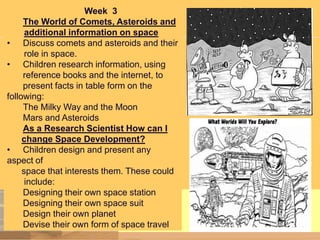
The World of Comets, Asteroids and
additional information on space
• Discuss comets and asteroids and their
role in space.
• Children research information, using
reference books and the internet, to
present facts in table form on the
following:
The Milky Way and the Moon
Mars and Asteroids
As a Research Scientist How can I
change Space Development?
• Children design and present any
aspect of
space that interests them. These could
include:
Designing their own space station
Designing their own space suit
Design their own planet
Devise their own form of space travel
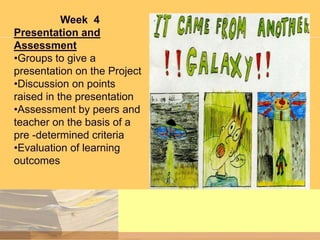
Week 4
Presentation and
Assessment
•Groups to give a
presentation on the Project
•Discussion on points
raised in the presentation
•Assessment by peers and
teacher on the basis of a
pre -determined criteria
•Evaluation of learning
outcomes
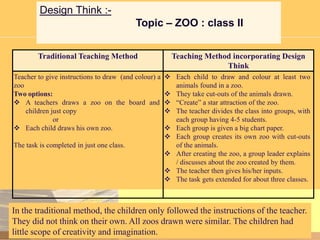
Design Think :Topic – ZOO : class II
Traditional Teaching Method

Teaching Method incorporating Design
Think

Teacher to give instructions to draw (and colour) a
zoo
Two options:
 A teachers draws a zoo on the board and
children just copy
or
 Each child draws his own zoo.

 Each child to draw and colour at least two
animals found in a zoo.
 They take cut-outs of the animals drawn.
 “Create” a star attraction of the zoo.
 The teacher divides the class into groups, with
each group having 4-5 students.
 Each group is given a big chart paper.
 Each group creates its own zoo with cut-outs
of the animals.
 After creating the zoo, a group leader explains
/ discusses about the zoo created by them.
 The teacher then gives his/her inputs.
 The task gets extended for about three classes.

The task is completed in just one class.

In the traditional method, the children only followed the instructions of the teacher.
They did not think on their own. All zoos drawn were similar. The children had
little scope of creativity and imagination.
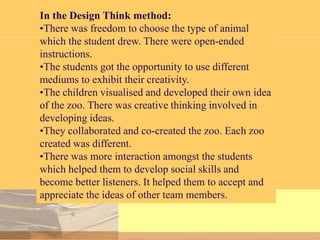
In the Design Think method:
•There was freedom to choose the type of animal
which the student drew. There were open-ended
instructions.
•The students got the opportunity to use different
mediums to exhibit their creativity.
•The children visualised and developed their own idea
of the zoo. There was creative thinking involved in
developing ideas.
•They collaborated and co-created the zoo. Each zoo
created was different.
•There was more interaction amongst the students
which helped them to develop social skills and
become better listeners. It helped them to accept and
appreciate the ideas of other team members.
Extended Activity post/prior to the Design Think
lesson on zoo:
Visit to an actual zoo to observe real animals with
the following observations/learning:
•Observe the kind of food the animals in the zoo eat.
•Observe how some animals are much bigger or
smaller in size.
•Learn dos and don’ts regarding good behaviour in
zoos and public places.
•Discuss amongst each other how their food is
different from the food consumed by animals.
•Have an open discussion about whether animals
should be caged in zoos and why.
•Have a fun trip where students and teachers bond
with each other outside the classroom.
The following skills are developed when
a lesson is taught using Design Think:
•Research/Discovery
•Interpretation
•Ideation (creating ideas)
•Co-creation (collaboration)
•Evolution (refining ideas further)
•Critical thinking and analysis (out-ofthe-box thinking)
•Communicating
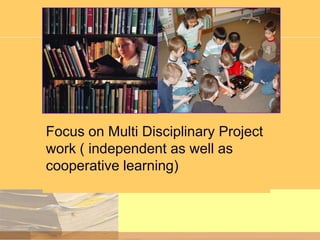
Focus on Multi Disciplinary Project
work ( independent as well as
cooperative learning)
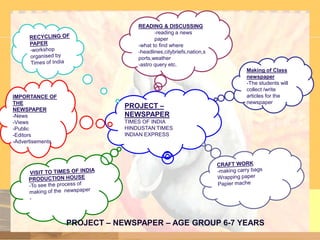
READING & DISCUSSING
-reading a news
paper
-what to find where
-headlines,citybriefs,nation,s
ports,weather
-astro query etc.

IMPORTANCE OF
THE
NEWSPAPER
-News
-Views
-Public
-Editors
-Advertisements

PROJECT –
NEWSPAPER

Making of Class
newspaper
-The students will
collect /write
articles for the
newspaper

TIMES OF INDIA
HINDUSTAN TIMES
INDIAN EXPRESS

PROJECT – NEWSPAPER – AGE GROUP 6-7 YEARS
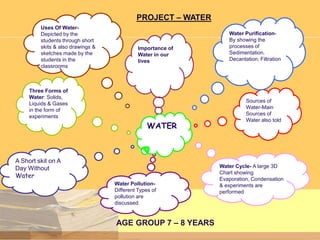
PROJECT – WATER
Uses Of WaterDepicted by the
students through short
skits & also drawings &
sketches made by the
students in the
classrooms

Importance of
Water in our
lives

Three Forms of
Water: Solids,
Liquids & Gases
in the form of
experiments

WATER

A Short skit on A
Day Without
Water
Water PollutionDifferent Types of
pollution are
discussed

AGE GROUP 7 – 8 YEARS

Water PurificationBy showing the
processes of
Sedimentation.
Decantation, Filtration

Sources of
Water-Main
Sources of
Water also told

Water Cycle- A large 3D
Chart showing
Evaporation, Condensation
& experiments are
performed
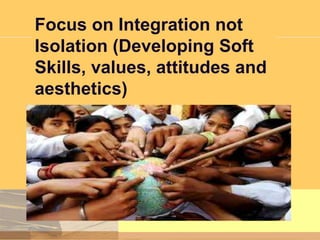
Focus on Integration not
Isolation (Developing Soft
Skills, values, attitudes and
aesthetics)
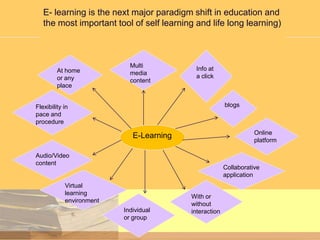
E- learning is the next major paradigm shift in education and
the most important tool of self learning and life long learning)

At home
or any
place

Multi
media
content

Info at
a click

blogs

Flexibility in
pace and
procedure

Online
platform

E-Learning
Audio/Video
content

Collaborative
application

Virtual
learning
environment
Individual
or group

With or
without
interaction
So what next?..
When presented with examples of
innovative practices, people react as
follows:
 These are inspiring.
 These sound great, but would never
work in my school/town/ country.
 Lets not a experiment with education
we are doing a great job already!
Education systems have been resistant to
change because education is so important
– too important, some would argue, to
experiment with.
There is another way to look at this:
In a rapidly changing world, education is
too important to be left behind.
Be a Step Ahead…..
Think outside the classroom box…..
Shift from students sitting in rooms
facing the teacher – Design
classrooms beyond the four walls.
Why restrict lessons to 35-40
minutes slots - why not have a
session of 1½-2hrs for a subject.
Be a Step Ahead…..
Think outside the classroom box…..
A school conducts science experiments
in half day blocks to allow children to
be fully involved in experimenting and
discovering.
Schools have even crossed barriers of
the so-called “academic year” and
focused on skill development and
learning outcomes.
Khan academy- online content in maths
and science at home enables in depth
discussion in class.
Be a Step Ahead…..
Think outside the classroom box…

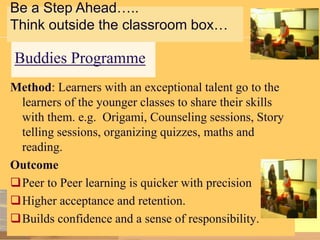
Buddies Programme
Method: Learners with an exceptional talent go to the
learners of the younger classes to share their skills
with them. e.g. Origami, Counseling sessions, Story
telling sessions, organizing quizzes, maths and
reading.
Outcome
Peer to Peer learning is quicker with precision
Higher acceptance and retention.
Builds confidence and a sense of responsibility.
Be a Step Ahead…..
Think outside the classroom box…..

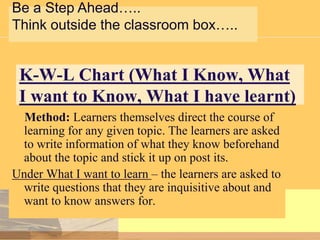
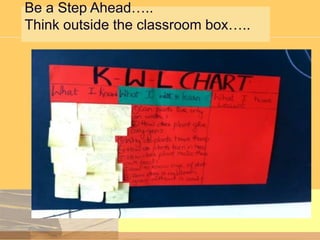
K-W-L Chart (What I Know, What
I want to Know, What I have learnt)
Method: Learners themselves direct the course of
learning for any given topic. The learners are asked
to write information of what they know beforehand
about the topic and stick it up on post its.
Under What I want to learn – the learners are asked to
write questions that they are inquisitive about and
want to know answers for.
Be a Step Ahead…..
Think outside the classroom box…..
Be a Step Ahead…..
Think outside the classroom box…..

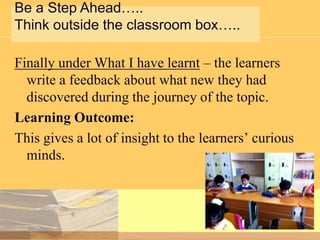
Finally under What I have learnt – the learners
write a feedback about what new they had
discovered during the journey of the topic.
Learning Outcome:
This gives a lot of insight to the learners’ curious
minds.
Be a Step Ahead…..
Think outside the classroom box…..

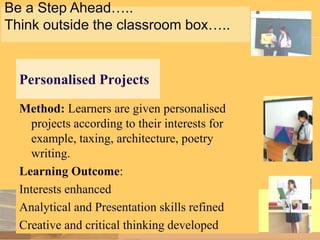
Personalised Projects
Method: Learners are given personalised
projects according to their interests for
example, taxing, architecture, poetry
writing.
Learning Outcome:
Interests enhanced
Analytical and Presentation skills refined
Creative and critical thinking developed
Be a Step Ahead…..
Think outside the classroom box…..

Comparative Study
Comparative Studies related to current topics and predicting an outcome after 30 years

Method: The learners compare the texts of two different authors or poets and
analyze the similarities and differences in the two while dealing with the
same subject.
 The learners while studying “How I Taught My Grandmother to Read” by
Sudha Murty did the comparative study with Khushwant Singh’s “Portrait of
a Lady” and studied the similarities and differences between the two keeping
in mind the writing style and the characters involved and their responses on
different occasions.
Learning Outcome:
 Develops critical thinking
 Analysing and appreciating different characters, writing style and
the plot.
Be a Step Ahead…..
Think outside the classroom box…..

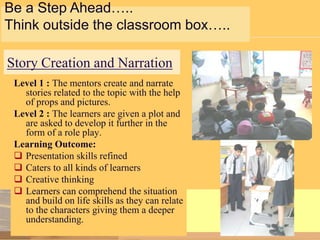
Story Creation and Narration
Level 1 : The mentors create and narrate
stories related to the topic with the help
of props and pictures.
Level 2 : The learners are given a plot and
are asked to develop it further in the
form of a role play.
Learning Outcome:
 Presentation skills refined
 Caters to all kinds of learners
 Creative thinking
 Learners can comprehend the situation
and build on life skills as they can relate
to the characters giving them a deeper
understanding.
Be a Step Ahead…..
Think outside the classroom box…..

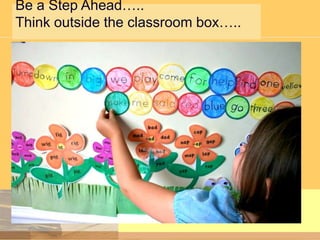
Presenting vocabulary
Vocabulary Wall
Method 1: Unfamiliar words are constantly put up in places where the learners
can easily see and use them for practice every day. The list continues to
grow with time.
Method 2: After every lesson, words and phrases are given to the learners to
be used in their presentation.
Learning Outcome:
 Builds vocabulary.
 Improves spellings.
 Usage in their daily dialect.
Be a Step Ahead…..
Think outside the classroom box…..
Be a Step Ahead…..
Think outside the classroom box…..

Treasure Hunt
Method: The learners play the game with flash cards holding different
information on the topic. All the learners are given a set of questions
for which they have to locate the matching flashcard and then edit
the information to be able answer the question in one line. This
activity is enjoyed by the learners a lot. And at the same time it gave
them the understanding of picking up relevant information.
Learning Outcome:
 Inculcates the ability to explore, match and be able to pick up
concise information from any given document.
 Reinforcement of the topic
So.. Start experimenting: try at some new
ideas… some will succeed, some will
fail…
But
You and your students will learn from all
of them.
Those who think “Sky is the limit”
have limited imagination
In today’s world, with every passing year,
when we are becoming better equipped
to accomplish the things;
then sky is not the limit,
IT IS THE BEGINNING,
we should aspire to go beyond the skies
I Am A Teacher
Education PPT
Education PPT

Education PPT

  • 2.
    I Am ATeacher
  • 4.
    Emerging world ofEducation  School Curriculum – need for a paradigm shift .  Concerns & issues for quality improvement.  linkages & Interface.
  • 6.
    WHAT IS ACURRICULUM : Systematic and intended packaging of competencies (knowledge, skills, attitudes, values).  Learners must acquire through organized learning experiences.  Formal and informal settings.
  • 7.
  • 8.
    WHAT:Fundamental change in approach. Move from one model of thinking to a completely different way of thinking.
  • 9.
    WHY:Education has attemptedto solve needs and problems of 21st Century by using 20th Century concepts of “Lesson Based” approach to curriculum and instruction. THIS IS THE CHALLENGE !!!
  • 12.
    IN THE LASTDECADE:Layers of new ideas/ dimensions have been piled onto the already existing complex lessons.
  • 13.
     Academic Excellence. Multiple Intelligences.  Values and Attitudes.  Formative Assessment.  Character and Values.  Thematic Projects.  Cooperative Learning, Team Work and Social Skills.  Technology Skills.  Global citizenship  Inclusive Education/ RTE (Diverse Students Population).
  • 14.
     ASL  CCE OTBA  Inter disciplinary activities.  PSA  Vocational education  ..  ..  ..
  • 15.
     Thus, inthe 21st Century, a number of these “Pile On” factors are converging to make the teachers job difficult and challenging because the paradigm shift in school curriculum and its transaction has not happened.  Educated people lack basic “employments skills” like problem solving, teamwork, time management, quality conscious….
  • 16.
    20th Century View Curriculumvs. Instruction CURRICULUM (WHAT) INSTRUCTION (HOW) Maths Teacher directed Languages Lessons (Sage on the stage) Social Studies Chalk/Talk Seat Work Worksheets (Drill and Practice)  Task of teacher was relatively simple… teacher knew that a child needed to master 3 Rs and related skills.
  • 18.
    21st Century Challenges:Not sure what knowledge and skills the students will require after school.  They will probably work with technology that has not even been invented.  Cannot imagine the kind of jobs they will be in – they may not even exist today.  Transmission of traditional values, character and social skills are an issue (grandparents have became a phone call and not a living presence; both parents are working; single parents, lack of Community).  Indiscipline and Violence.
  • 19.
    Today: Demands onSchool Academics.  Emotional/ Social/ Values/ Attitudes.  Diverse Students Groups.  Techno/ Global Skills.  Self Learning and Cooperative Learning. Adapt to change.
  • 20.
    21th Century View Curriculumvs. Instruction CURRICULUM (WHAT)  Grammar  Writing Process  History Facts  Historical Perspective Math Process INSTRUCTION (HOW)
  • 21.
    Contd… CURRICULUM (WHAT) Science Facts Science Process CharacterDevelopment Emotional Intelligence Employability Skills Leadership Skills Multiple Intelligences Social Skills Teamwork Skills Thinking Skills Diversity Skills INSTRUCTION (HOW)
  • 22.
    Today – whereare we with respect to the Demands/ Needs of the 21st Century Learner? A Paradigm Shift in Curriculum Planning and Design is happening but not in its instruction and evaluation
  • 24.
    There isn’t timein the school day or school year to teach all the lessons and deliver “ The Complex and Differentiated Curriculum” using instructional strategies… That will prepare the learner today for an unknown/unpredictable tomorrow.
  • 25.
     How canthe teacher design and teach lessons on traditional maths, language, social studies, and science, then create lessons on process skills in each of those academic content areas, and then, on top of that, design and deliver additional lessons to engage and develop the students multiple intelligences, respond to their various learning styles, and teach brain – based differentiated lessons to develop social skills, character virtues, emotional intelligence, leadership skills, teamwork skills, and higher level thinking skills?  And … how can a child learn all this?
  • 27.
    Is there away forward ? If YES, What OR How ?
  • 28.
    There is aneed for a paradigm shift in our approach to Teaching_Learning.
  • 29.
    We need toshift our Paradigm from….. A Lesson – based Approach To A Structure based Approach.
  • 30.
    Structures Deliver Traditional Curriculum  Math Language Arts  Science  Social Studies Structures make the impossible possible: With no time off traditional curriculum, structures deliver an embedded curriculum. Structures achieve higher academic standards. Embedded Curriculum  Character Development  Emotional Intelligence  Employability Skills  Leadership Skills  Multiple Intelligences  Social Skills  Teamwork Skills  Thinking Skills  Diversity Skills
  • 31.
    What we needto look at is developing structures within lessons…. The needs of students are well met. Easy for teachers to learn and use. Positive and lasting student outcomes. Shift from learning “About” a skill to “Acquiring” the skill.
  • 32.
    So….. let usget into a “Leapfrogging” mode of mindset…. Based on Rapid, Proactive Response to future realties. This Implies: To rethink what students should learn and how. To look at new approaches to teaching and learning.
  • 35.
    Week 1 • • • • • • Fact finding:knowledge of space and planets Children discuss with their partner their responses Children complete in pairs the handout on „Our Solar System‟ identifying the planets Students complete „Planets Research Guide‟ on a planet of their choice What does man know about the moon and stars? Discuss and research man‟s landing on the Moon Children complete a matrix on the moon and describe man‟s landing on the moon Including in the presentation is: The first man to land on the moon Year and date this took place Space suit worn Form of travel
  • 36.
    Week 2 Man’s travelin space and the impact of sun and stars on our daily lives. • Children complete a flow chart, including illustrations and descriptions, on the development of rockets and space travel over time Included in the presentation is information on: the space race, space shuttle, Apollo 13 Discuss stars and their make – up. Decide on a definition • Children complete a matrix on the sun in pairs. Included in the matrix is the seasons and why they occur • Gather information on solar and lunar eclipses
  • 37.
    Week 3 The Worldof Comets, Asteroids and additional information on space • Discuss comets and asteroids and their role in space. • Children research information, using reference books and the internet, to present facts in table form on the following: The Milky Way and the Moon Mars and Asteroids As a Research Scientist How can I change Space Development? • Children design and present any aspect of space that interests them. These could include: Designing their own space station Designing their own space suit Design their own planet Devise their own form of space travel
  • 38.
    Week 4 Presentation and Assessment •Groupsto give a presentation on the Project •Discussion on points raised in the presentation •Assessment by peers and teacher on the basis of a pre -determined criteria •Evaluation of learning outcomes
  • 40.
    Design Think :Topic– ZOO : class II Traditional Teaching Method Teaching Method incorporating Design Think Teacher to give instructions to draw (and colour) a zoo Two options:  A teachers draws a zoo on the board and children just copy or  Each child draws his own zoo.  Each child to draw and colour at least two animals found in a zoo.  They take cut-outs of the animals drawn.  “Create” a star attraction of the zoo.  The teacher divides the class into groups, with each group having 4-5 students.  Each group is given a big chart paper.  Each group creates its own zoo with cut-outs of the animals.  After creating the zoo, a group leader explains / discusses about the zoo created by them.  The teacher then gives his/her inputs.  The task gets extended for about three classes. The task is completed in just one class. In the traditional method, the children only followed the instructions of the teacher. They did not think on their own. All zoos drawn were similar. The children had little scope of creativity and imagination.
  • 41.
    In the DesignThink method: •There was freedom to choose the type of animal which the student drew. There were open-ended instructions. •The students got the opportunity to use different mediums to exhibit their creativity. •The children visualised and developed their own idea of the zoo. There was creative thinking involved in developing ideas. •They collaborated and co-created the zoo. Each zoo created was different. •There was more interaction amongst the students which helped them to develop social skills and become better listeners. It helped them to accept and appreciate the ideas of other team members.
  • 42.
    Extended Activity post/priorto the Design Think lesson on zoo: Visit to an actual zoo to observe real animals with the following observations/learning: •Observe the kind of food the animals in the zoo eat. •Observe how some animals are much bigger or smaller in size. •Learn dos and don’ts regarding good behaviour in zoos and public places. •Discuss amongst each other how their food is different from the food consumed by animals. •Have an open discussion about whether animals should be caged in zoos and why. •Have a fun trip where students and teachers bond with each other outside the classroom.
  • 43.
    The following skillsare developed when a lesson is taught using Design Think: •Research/Discovery •Interpretation •Ideation (creating ideas) •Co-creation (collaboration) •Evolution (refining ideas further) •Critical thinking and analysis (out-ofthe-box thinking) •Communicating
  • 44.
    Focus on MultiDisciplinary Project work ( independent as well as cooperative learning)
  • 45.
    READING & DISCUSSING -readinga news paper -what to find where -headlines,citybriefs,nation,s ports,weather -astro query etc. IMPORTANCE OF THE NEWSPAPER -News -Views -Public -Editors -Advertisements PROJECT – NEWSPAPER Making of Class newspaper -The students will collect /write articles for the newspaper TIMES OF INDIA HINDUSTAN TIMES INDIAN EXPRESS PROJECT – NEWSPAPER – AGE GROUP 6-7 YEARS
  • 46.
    PROJECT – WATER UsesOf WaterDepicted by the students through short skits & also drawings & sketches made by the students in the classrooms Importance of Water in our lives Three Forms of Water: Solids, Liquids & Gases in the form of experiments WATER A Short skit on A Day Without Water Water PollutionDifferent Types of pollution are discussed AGE GROUP 7 – 8 YEARS Water PurificationBy showing the processes of Sedimentation. Decantation, Filtration Sources of Water-Main Sources of Water also told Water Cycle- A large 3D Chart showing Evaporation, Condensation & experiments are performed
  • 47.
    Focus on Integrationnot Isolation (Developing Soft Skills, values, attitudes and aesthetics)
  • 55.
    E- learning isthe next major paradigm shift in education and the most important tool of self learning and life long learning) At home or any place Multi media content Info at a click blogs Flexibility in pace and procedure Online platform E-Learning Audio/Video content Collaborative application Virtual learning environment Individual or group With or without interaction
  • 56.
    So what next?.. Whenpresented with examples of innovative practices, people react as follows:  These are inspiring.  These sound great, but would never work in my school/town/ country.  Lets not a experiment with education we are doing a great job already!
  • 57.
    Education systems havebeen resistant to change because education is so important – too important, some would argue, to experiment with. There is another way to look at this: In a rapidly changing world, education is too important to be left behind.
  • 59.
    Be a StepAhead….. Think outside the classroom box….. Shift from students sitting in rooms facing the teacher – Design classrooms beyond the four walls. Why restrict lessons to 35-40 minutes slots - why not have a session of 1½-2hrs for a subject.
  • 60.
    Be a StepAhead….. Think outside the classroom box….. A school conducts science experiments in half day blocks to allow children to be fully involved in experimenting and discovering. Schools have even crossed barriers of the so-called “academic year” and focused on skill development and learning outcomes. Khan academy- online content in maths and science at home enables in depth discussion in class.
  • 61.
    Be a StepAhead….. Think outside the classroom box… Buddies Programme Method: Learners with an exceptional talent go to the learners of the younger classes to share their skills with them. e.g. Origami, Counseling sessions, Story telling sessions, organizing quizzes, maths and reading. Outcome Peer to Peer learning is quicker with precision Higher acceptance and retention. Builds confidence and a sense of responsibility.
  • 62.
    Be a StepAhead….. Think outside the classroom box….. K-W-L Chart (What I Know, What I want to Know, What I have learnt) Method: Learners themselves direct the course of learning for any given topic. The learners are asked to write information of what they know beforehand about the topic and stick it up on post its. Under What I want to learn – the learners are asked to write questions that they are inquisitive about and want to know answers for.
  • 63.
    Be a StepAhead….. Think outside the classroom box…..
  • 64.
    Be a StepAhead….. Think outside the classroom box….. Finally under What I have learnt – the learners write a feedback about what new they had discovered during the journey of the topic. Learning Outcome: This gives a lot of insight to the learners’ curious minds.
  • 65.
    Be a StepAhead….. Think outside the classroom box….. Personalised Projects Method: Learners are given personalised projects according to their interests for example, taxing, architecture, poetry writing. Learning Outcome: Interests enhanced Analytical and Presentation skills refined Creative and critical thinking developed
  • 66.
    Be a StepAhead….. Think outside the classroom box….. Comparative Study Comparative Studies related to current topics and predicting an outcome after 30 years Method: The learners compare the texts of two different authors or poets and analyze the similarities and differences in the two while dealing with the same subject.  The learners while studying “How I Taught My Grandmother to Read” by Sudha Murty did the comparative study with Khushwant Singh’s “Portrait of a Lady” and studied the similarities and differences between the two keeping in mind the writing style and the characters involved and their responses on different occasions. Learning Outcome:  Develops critical thinking  Analysing and appreciating different characters, writing style and the plot.
  • 67.
    Be a StepAhead….. Think outside the classroom box….. Story Creation and Narration Level 1 : The mentors create and narrate stories related to the topic with the help of props and pictures. Level 2 : The learners are given a plot and are asked to develop it further in the form of a role play. Learning Outcome:  Presentation skills refined  Caters to all kinds of learners  Creative thinking  Learners can comprehend the situation and build on life skills as they can relate to the characters giving them a deeper understanding.
  • 68.
    Be a StepAhead….. Think outside the classroom box….. Presenting vocabulary Vocabulary Wall Method 1: Unfamiliar words are constantly put up in places where the learners can easily see and use them for practice every day. The list continues to grow with time. Method 2: After every lesson, words and phrases are given to the learners to be used in their presentation. Learning Outcome:  Builds vocabulary.  Improves spellings.  Usage in their daily dialect.
  • 69.
    Be a StepAhead….. Think outside the classroom box…..
  • 70.
    Be a StepAhead….. Think outside the classroom box….. Treasure Hunt Method: The learners play the game with flash cards holding different information on the topic. All the learners are given a set of questions for which they have to locate the matching flashcard and then edit the information to be able answer the question in one line. This activity is enjoyed by the learners a lot. And at the same time it gave them the understanding of picking up relevant information. Learning Outcome:  Inculcates the ability to explore, match and be able to pick up concise information from any given document.  Reinforcement of the topic
  • 71.
    So.. Start experimenting:try at some new ideas… some will succeed, some will fail… But You and your students will learn from all of them.
  • 72.
    Those who think“Sky is the limit” have limited imagination In today’s world, with every passing year, when we are becoming better equipped to accomplish the things; then sky is not the limit, IT IS THE BEGINNING, we should aspire to go beyond the skies
  • 73.
    I Am ATeacher