
DIVINA GRACIA D. DIZON
UAE


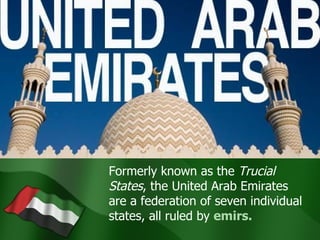
 Formerly known as the Trucial
 States, the United Arab Emirates
 are a federation of seven individual
 states, all ruled by emirs.
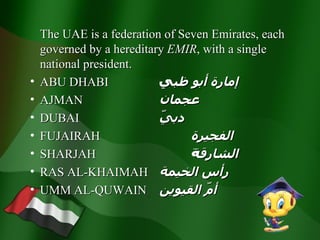
The UAE is a federation of Seven Emirates, each
    governed by a hereditary EMIR, with a single
    national president.
•   ABU DHABI              ‫إمارة أبو ظبي‬
                           ‫ي‬
•   AJMAN                  ‫عجمان‬
•   DUBAI                  ‫ي‬
                           ّ ‫دب‬
•   FUJAIRAH                     ‫الفجيرة‬
•   SHARJAH                      ‫الشارقة‬
                                 ‫ة‬
•   RAS AL-KHAIMAH ‫رأس الخيمة‬
•   UMM AL-QUWAIN ‫أ ّ القيوين‬      ‫م‬
Brie f H is tory


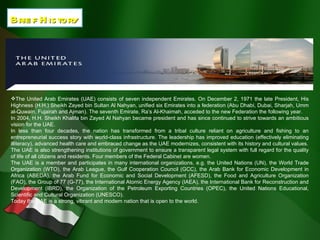
The United Arab Emirates (UAE) consists of seven independent Emirates. On December 2, 1971 the late President, His
Highness (H.H.) Sheikh Zayed bin Sultan Al Nahyan, unified six Emirates into a federation (Abu Dhabi, Dubai, Sharjah, Umm
al-Quwain, Fujairah and Ajman). The seventh Emirate, Ra’s Al-Khaimah, acceded to the new Federation the following year.
In 2004, H.H. Sheikh Khalifa bin Zayed Al Nahyan became president and has since continued to strive towards an ambitious
vision for the UAE.
In less than four decades, the nation has transformed from a tribal culture reliant on agriculture and fishing to an
entrepreneurial success story with world-class infrastructure. The leadership has improved education (effectively eliminating
illiteracy), advanced health care and embraced change as the UAE modernizes, consistent with its history and cultural values.
The UAE is also strengthening institutions of government to ensure a transparent legal system with full regard for the quality
of life of all citizens and residents. Four members of the Federal Cabinet are women.
The UAE is a member and participates in many international organizations, e.g. the United Nations (UN), the World Trade
Organization (WTO), the Arab League, the Gulf Cooperation Council (GCC), the Arab Bank for Economic Development in
Africa (ABEDA), the Arab Fund for Economic and Social Development (AFESD), the Food and Agriculture Organization
(FAO), the Group of 77 (G-77), the International Atomic Energy Agency (IAEA), the International Bank for Reconstruction and
Development (IBRD), the Organization of the Petroleum Exporting Countries (OPEC), the United Nations Educational,
Scientific and Cultural Organization (UNESCO).
Today the UAE is a strong, vibrant and modern nation that is open to the world.
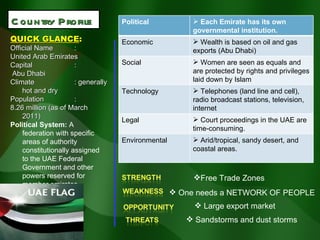
C ou ntry P rofile                  Political             Each Emirate has its own
                                                         governmental institution.
QUICK GLANCE:                       Economic              Wealth is based on oil and gas
Official Name         :                                  exports (Abu Dhabi)
United Arab Emirates
Capital               :             Social                Women are seen as equals and
Abu Dhabi                                                are protected by rights and privileges
Climate               : generally                        laid down by Islam
    hot and dry                     Technology            Telephones (land line and cell),
Population            :                                  radio broadcast stations, television,
8.26 million (as of March                                internet
    2011)                                                 Court proceedings in the UAE are
                                    Legal
Political System: A
                                                         time-consuming.
    federation with specific
    areas of authority              Environmental         Arid/tropical, sandy desert, and
    constitutionally assigned                            coastal areas.
    to the UAE Federal
    Government and other
    powers reserved for                                  Free Trade Zones
    member emirates
                                                     One needs a NETWORK OF PEOPLE
                                                          Large export market
                                                        Sandstorms and dust storms
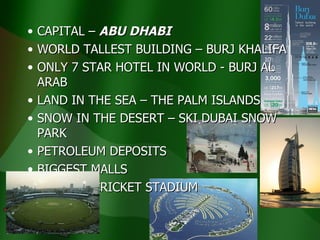
•   CAPITAL – ABU DHABI
•   WORLD TALLEST BUILDING – BURJ KHALIFA
•   ONLY 7 STAR HOTEL IN WORLD - BURJ AL
    ARAB
•   LAND IN THE SEA – THE PALM ISLANDS
•   SNOW IN THE DESERT – SKI DUBAI SNOW
    PARK
•   PETROLEUM DEPOSITS
•   BIGGEST MALLS
•   SHARJAH CRICKET STADIUM
GEOGRAPH
 Y
• The total area of the UAE is approximately
  83,600 square kilometers.
• Maximum temperatures reach above
  40 °C (104.0 °F) on the coastal plain during July
  and Aug.
• Minimum temperatures in January and February
  are between 10 and 14 °C (50 and 57.2 °F).
ECONOMY
• Highest per capita incomes in the world ($49,499).
• More than 85% of the economy is based on the exports of
  natural resources.
• $350 billion worth of active construction projects.
• $360 billion in overseas investments & an estimated $900
  billion in assets.
INFRASTRUCTUR
          E
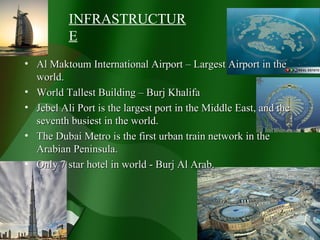
• Al Maktoum International Airport – Largest Airport in the
  world.
• World Tallest Building – Burj Khalifa
• Jebel Ali Port is the largest port in the Middle East, and the
  seventh busiest in the world.
• The Dubai Metro is the first urban train network in the
  Arabian Peninsula.
• Only 7 star hotel in world - Burj Al Arab.
TOURISM

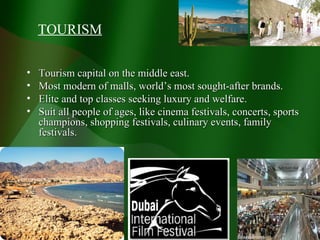
•   Tourism capital on the middle east.
•   Most modern of malls, world’s most sought-after brands.
•   Elite and top classes seeking luxury and welfare.
•   Suit all people of ages, like cinema festivals, concerts, sports
    champions, shopping festivals, culinary events, family
    festivals.
HEALTH
• The UAE Ministry of Health (MoH) provides special medical
  centers for school children, and health units in every school.
• There are world-class hospitals and clinics in Dubai, Abu
  Dhabi, Sharjah and other major cities of the UAE.
• Life expectancy at birth in the UAE, at 78.3 years, has reached
  levels similar to those in Europe and North America.
EDUCATION

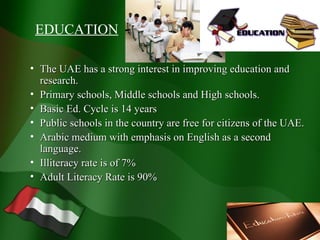
• The UAE has a strong interest in improving education and
  research.
• Primary schools, Middle schools and High schools.
• Basic Ed. Cycle is 14 years
• Public schools in the country are free for citizens of the UAE.
• Arabic medium with emphasis on English as a second
  language.
• Illiteracy rate is of 7%
• Adult Literacy Rate is 90%
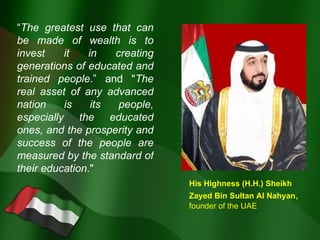
“The greatest use that can
be made of wealth is to
invest    it   in   creating
generations of educated and
trained people.” and "The
real asset of any advanced
nation    is    its  people,
especially the educated
ones, and the prosperity and
success of the people are
measured by the standard of
their education."
                               His Highness (H.H.) Sheikh
                               Zayed Bin Sultan Al Nahyan,
                               founder of the UAE
Outline of Presentation
III. The Evolution of Education in UAE


Education in the UAE started with the first civilizations that cultivated this
region. In those early days, education was a personal experience was people
learned by experimentation and imitation as well as interaction with the
immediate environment. Eventually, education developed to a teaching process
on the hands of well versed scholars with knowledge in natural science.
Accordingly, Education in the UAE developed from traditional simple style to
systematic education based on well studied curricula and subjects. Moreover,
education went through four types of developments that characterized the UAE
throughout its long and rich history.
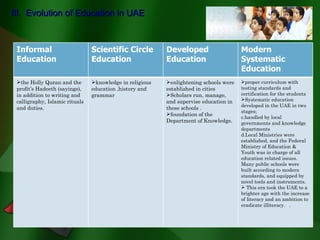
III. Evolution of Education in UAE


 Informal                       Scientific Circle         Developed                    Modern
 Education                      Education                 Education                    Systematic
                                                                                       Education
 the Holly Quran and the       knowledge in religious   enlightening schools were   proper curriculum with
 profit’s Hadeeth (sayings),    education ,history and    established in cities        testing standards and
 in addition to writing and     grammar                   Scholars run, manage,       certification for the students
 calligraphy, Islamic rituals                             and supervise education in   Systematic education
                                                                                       developed in the UAE in two
 and duties.                                              these schools .
                                                                                       stages;
                                                          foundation of the
                                                                                       c.handled by local
                                                          Department of Knowledge.     governments and knowledge
                                                                                       departments
                                                                                       d.Local Ministries were
                                                                                       established, and the Federal
                                                                                       Ministry of Education &
                                                                                       Youth was in charge of all
                                                                                       education related issues.
                                                                                       Many public schools were
                                                                                       built according to modern
                                                                                       standards, and equipped by
                                                                                       novel tools and instruments.
                                                                                        This era took the UAE to a
                                                                                       brighter age with the increase
                                                                                       of literacy and an ambition to
                                                                                       eradicate illiteracy.   .
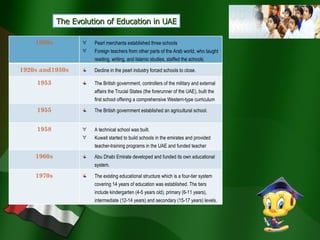
The Evolution of Education in UAE

    1900s          ∀   Pearl merchants established three schools
                   ∀   Foreign teachers from other parts of the Arab world, who taught
                       reading, writing, and Islamic studies, staffed the schools.

1920s and1930s         Decline in the pearl industry forced schools to close.

    1953               The British government, controllers of the military and external
                       affairs the Trucial States (the forerunner of the UAE), built the
                       first school offering a comprehensive Western-type curriculum

    1955               The British government established an agricultural school.


    1958           ∀   A technical school was built.
                   ∀   Kuwait started to build schools in the emirates and provided
                       teacher-training programs in the UAE and funded teacher

    1960s              Abu Dhabi Emirate developed and funded its own educational
                       system.

    1970s              The existing educational structure which is a four-tier system
                       covering 14 years of education was established. The tiers
                       include kindergarten (4-5 years old), primary (6-11 years),
                       intermediate (12-14 years) and secondary (15-17 years) levels.
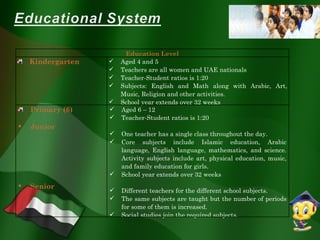
Education Level
    Kindergarten      Aged 4 and 5
                      Teachers are all women and UAE nationals
                      Teacher-Student ratios is 1:20
                      Subjects: English and Math along with Arabic, Art,
                       Music, Religion and other activities.
                      School year extends over 32 weeks
    Primary (6)       Aged 6 – 12
                      Teacher-Student ratios is 1:20
   Junior
                      One teacher has a single class throughout the day.
                      Core subjects include Islamic education, Arabic
                       language, English language, mathematics, and science.
                       Activity subjects include art, physical education, music,
                       and family education for girls.
                      School year extends over 32 weeks
   Senior
                      Different teachers for the different school subjects.
                      The same subjects are taught but the number of periods
                       for some of them is increased.
                      Social studies join the required subjects.
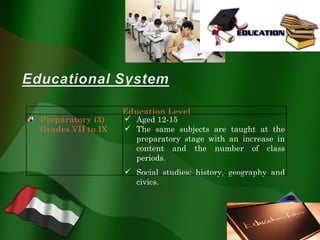
Education Level
    Preparatory (3)     Aged 12-15
-   Grades VII to IX    The same subjects are taught at the
                         preparatory stage with an increase in
                         content and the number of class
                         periods.
                        Social studies: history, geography and
                         civics.
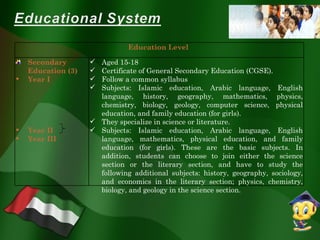
Education Level

    Secondary        Aged 15-18
    Education (3)    Certificate of General Secondary Education (CGSE).
   Year I           Follow a common syllabus
                     Subjects: Islamic education, Arabic language, English
                      language, history, geography, mathematics, physics,
                      chemistry, biology, geology, computer science, physical
                      education, and family education (for girls).
                     They specialize in science or literature.
   Year II          Subjects: Islamic education, Arabic language, English
   Year III          language, mathematics, physical education, and family
                      education (for girls). These are the basic subjects. In
                      addition, students can choose to join either the science
                      section or the literary section, and have to study the
                      following additional subjects: history, geography, sociology,
                      and economics in the literary section; physics, chemistry,
                      biology, and geology in the science section.
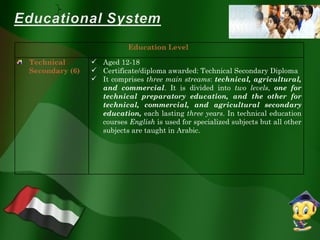
Education Level

Technical        Aged 12-18
Secondary (6)    Certificate/diploma awarded: Technical Secondary Diploma
                 It comprises three main streams: technical, agricultural,
                  and commercial. It is divided into two levels, one for
                  technical preparatory education, and the other for
                  technical, commercial, and agricultural secondary
                  education, each lasting three years. In technical education
                  courses English is used for specialized subjects but all other
                  subjects are taught in Arabic.
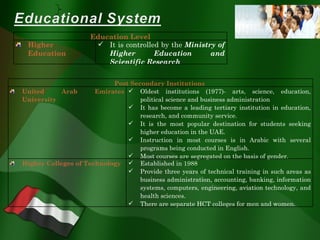
Education Level
 Higher                It is controlled by the Ministry of
 Education               Higher        Education       and
                         Scientific Research


                           Post Secondary Institutions
United      Arab      Emirates  Oldest institutions (1977)- arts, science, education,
University                         political science and business administration
                                It has become a leading tertiary institution in education,
                                   research, and community service.
                                It is the most popular destination for students seeking
                                   higher education in the UAE.
                                Instruction in most courses is in Arabic with several
                                   programs being conducted in English.
                                Most courses are segregated on the basis of gender.
Higher Colleges of Technology  Established in 1988
                                Provide three years of technical training in such areas as
                                   business administration, accounting, banking, information
                                   systems, computers, engineering, aviation technology, and
                                   health sciences.
                                There are separate HCT colleges for men and women.
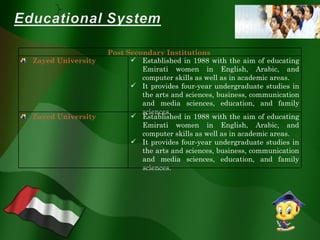
Post Secondary Institutions
Zayed University          Established in 1988 with the aim of educating
                            Emirati women in English, Arabic, and
                            computer skills as well as in academic areas.
                          It provides four-year undergraduate studies in
                            the arts and sciences, business, communication
                            and media sciences, education, and family
                            sciences.
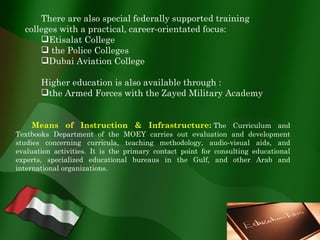
There are also special federally supported training
  colleges with a practical, career-orientated focus:
      Etisalat College
       the Police Colleges
      Dubai Aviation College

       Higher education is also available through :
       the Armed Forces with the Zayed Military Academy


    Means of Instruction & Infrastructure: The Curriculum and
Textbooks Department of the MOEY carries out evaluation and development
studies concerning curricula, teaching methodology, audio-visual aids, and
evaluation activities. It is the primary contact point for consulting educational
experts, specialized educational bureaus in the Gulf, and other Arab and
international organizations.
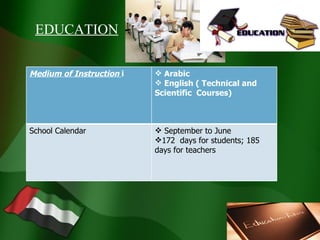
EDUCATION

Medium of Instruction i    Arabic
                           English ( Technical and
                          Scientific Courses)


School Calendar            September to June
                          172 days for students; 185
                          days for teachers
Term                  Primary School

Autumn       September 8th to December 12th

Spring             January 5th to March 27th

Summer               April 7th to June 26th


      Term                   Secondary School
 Autumn/Spring         September 12th to January 15th
Mid-Term Holiday        January 16th to February 2nd
 Spring/Summer            February 3rd to June 13th
Summer Holidays         June 14th to September 10th
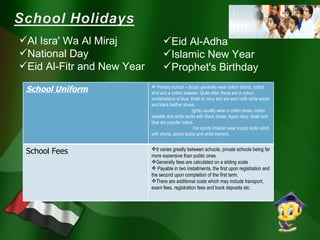
Al Isra' Wa Al Miraj             Eid Al-Adha
National Day                     Islamic New Year
Eid Al-Fitr and New Year         Prophet's Birthday

 School Uniform              Primary school – (boys) generally wear cotton shorts, cotton
                            shirt and a cotton sweater. Quite often these are in colour
                            combinations of blue, khaki or navy and are worn with white socks
                            and black leather shoes.
                                                   (girls) usually wear a cotton dress, cotton
                            sweater and white socks with black shoes. Again navy, khaki and
                            blue are popular colors.
                                                    For sports children wear a polo style t-shirt
                            with shorts, sports socks and white trainers.


 School Fees                It varies greatly between schools, private schools being far
                            more expensive than public ones.
                            Generally fees are calculated on a sliding scale
                             Payable in two installments, the first upon registration and
                            the second upon completion of the first term.
                            There are additional costs which may include transport,
                            exam fees, registration fees and book deposits etc.
Teaching Profession

   •The average salary of a UAE national teacher in the federal system was reportedly
about US$1400 per month in 2000
   • Teachers with a master's degree receive an additional allowance of US$170 per
month, while teachers with a Ph.D. receive an additional US$340.
   •Teachers working in distant areas receive a remote area increment in accordance with
the Civil Service Law. In addition to their salaries, teachers receive allowances for
accommodation, transport and cost of living, plus an annual supplement based on
qualifications.
   •A special scale for teachers' salaries has been in force since 1976 and that awarding a
special allowance amounting to 30 percent of the basic salary to UAE national teachers as
an incentive to continue their work as teachers or remain in the profession.
   •Any teacher with an "excellent" grade in his/her annual performance is eligible for
promotion to an administrative or technical job.
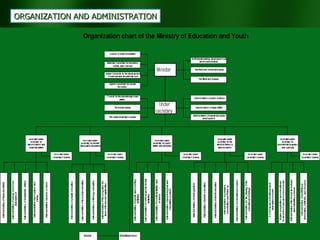
ORGANIZATION AND ADMINISTRATION
Administration, Finance, & Educational Research
     Budgeting and financial procedures are under the control of the various
central government councils composed of the leaders or designates of each
emirate. Budgets are routinely drawn up by ministry officials with the aid of
consultants and reviewed at different levels.
     At the ministerial level, educational issues are the domain of a High
Committee including the ministers of education, planning, finance and
industry, labor and social welfare, the chancellor of the UAE University, the
undersecretary of education, and two MOEY appointees. It coordinates and
develops national policies and implementation efforts. A MOEY committee on
Regulations and Development drafts policy, budgets and implementation
procedures for the High Committee and is composed of the minister and his
top five assistants.
PRIVATE
EDUCATION
       Private schools follow the curricula of their homeland but they operate under
  the licensing and supervision of the Ministry of Education and Youth (MOEY).
        The MOEY supplies textbooks to private schools that follow the national
  syllabus.

NON- FORMAL EDUCATION
 Focusing on UAE women who are making their presence felt in society as civil
 servants, university professors, teachers, lawyers, engineers, doctors, business
 women, administrators, and as members of the police force and the army.
Unlike many countries, a lack of financial resources has not been a barrier to
the development of the educational system. Lacking teachers in the UAE, the
government has been able to recruit teachers from other countries to fill staffing
needs.
     Research has shown that teaching methods on the whole are traditional and
based on rote memorization.
     Innovation on the part of teachers is often viewed as very difficult because of
the demands of complying with a centralized curriculum and evaluation system
enforced by administrators and school inspectors.
     The high turnover in expatriate staff prevents UAE schools from developing
a cadre of experienced teachers upon which quality programs depend.
The UAE University is seeking to establish an internationally
prominent information technology college. The curriculum will
encompass a total of nine degree programs, including software
engineering, information systems, telecommunications, educational
technology, e-commerce, and information security.
    The ministry seeks to accomplish high quality teacher training
for both pre- and in-service, in addition to improvements in salary
scales and job descriptions for teachers.
    Having a teaching force that is 90 percent Emirati by 2020
The UAE Government gives special attention to the future generations. Hence, it will develop
teaching systems, methods and staff to ensure the reduction of student drop-out rates, and
contribute to the development of student skills. The Government will also develop student’s
knowledge, instill learning and work values in them, and prepare them for college life. It will also
work to improve the quality of higher education to ensure that it yields graduates who are equipped
with the skills required to fuel the growth of the country.

The UAE Government’s strategic directions to achieve a first-rate education system are
summarized as follows:
• Develop students’ skills, knowledge, and readiness for higher education by implementing proper
governance in the education system, improving preschool education, school curriculum and
assessment, enhancing the productivity and efficiency of administrative and academic staff,
improving the learning experience, pursuing the accreditation of private and public schools, and
applying standard international examinations
• Promote student retention, educational attainment, and values by reducing student drop-out
rates, promoting community and parental involvement in student education, encouraging extra-
curricular activities, improving educational guidance and counselling in schools, promoting a
culture of self-education, work values and educational values, and encouraging sport culture and
competitions in schools and universities
• Improve the quality of higher education and ensure accessibility by defining and coordinating the
roles of public universities, enhancing higher education curricula and teaching methods focused on
empirical research, accrediting and monitoring public and private universities to global standards,
encouraging university outreach programs, diversifying sources of funding for public higher
education institutions, and enhancing the effectiveness of Emirati student scholarship programs
Very similar to American education system. Primary schools,
middle schools, and secondary schools.
Public schools paid for by government, but there is also private
schools.
Higher education is dictated by Ministry of Higher Education.
The UAE has a strong interest in improving education and
research.
 Today, the UAE offers a comprehensive education to all male and
female students from kindergarten to university.
‫شكرا‬