Participating in indoor recreational activities is important for
a child’s development and can lay a foundation for a healthy life.
Play is a good mental and physical activity for children. It develops
their physical body, movement, and coordination;encourages self-
esteem; fosters social interaction skills; improves thinking skills; and
develops emotional skills. Moreover, family relationships can be
enhanced when the family has something worthwhile to do
altogether.
This module encompasses the basic principles and ideas
about one of the indoor recreational activities, i.e., chess. It will lead
you to understand the nature/background of the game chess and
the benefits derived from playing it. This will help you to become
better player or to love chess while learning the basic skills in
playing it.
 Pre-Assessment
You will be given set of activities to assess and activate your
prior knowledge about chess.
In this activity your prior knowledge in the game chess will
be assessed.
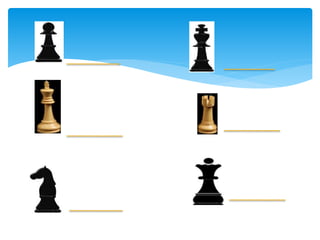
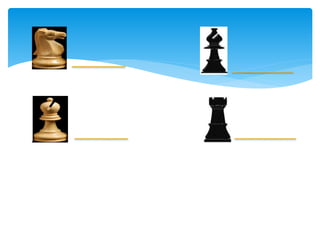
In your activity notebook, copy the table as shown. Look
at the drawing of chess pieces and equipment of the game.
Identify each of the pieces.
Activity I: Name Me
Chess pieces and equipment So, you are…..
Write your answer on the appropriate boxes.
Are you ready? Let’s check it out!
 The above simple recall and identification
have surely activated your prior knowledge in
chess. In the next activity, you will be directed
to identify your own personal learning goals
and objectives of the course. At this point,
you will write your expectations for this
module.
 GOOD JOB LEARNER!
LEARNING GOALS and TARGETS
Define your own personal learning goals and targets about our
lesson chess.
 Example: Learn the moves of each chess piece.
1.___________________________________________________
2.___________________________________________________
3.___________________________________________________
4.___________________________________________________
5.___________________________________________________
The succeeding activities are classified into four phases of
learning. Knowing, processing, reflecting and understanding, and
transferring of understanding.
In this phase, you will be given activities to assess your prior knowledge;
communicate your expectations: what you want to know, understand,
produce or perform. You will be taught what you need to learn about
chess. You will also be informed of the assessment techniques which
will be used to rate your output and performance at the end of the
lesson.
 Brief History of Chess
 Do you know where chess originated? Chess is a game that has been
played for centuries and was thought to have originated in India in the 15th
century. Long ago, it was considered a game reserved only for kings and
members of the upper classes. Nowadays, chess is played by common
people even at an early age.
 The modern design of chess pieces bears the name Staunton, who was an
English master in the mid-18OO's. These are the type of pieces that are now
used in all tournaments worldwide.
 The first international chess tournament was the London Tourney played
in 1851. A German named AdolfAnderssen won the game. He became the
unofficial best chess player of the world because he did not receive any
award or title.
PART I: WHAT TO
KNOW
 The first great American-born chess player is Paul Morphy. Paul
traveled to Europe in the 185O's, where he beat all challengers,
including Adolf Anderssen. However, the English champion of
the time (Staunton) refused to play with him, so Morphy never
became a world chess champ.
 The first official championship chess tournament was played in
1866 in London, with sand clocks to restrict the length of a
game. A Bohemian (Czechoslovakian) Jew named Steinitz won
the game. He became the world's first official chess champion,
holding this title until 1894.
 Have you wondered who rules in the world of chess today?
Recently, Russia dominates the game of chess. This results from
the establishment of government schools for talented chess
players after the communist revolution of 1917. Since 1927, many
of the top chess players have been citizens of the former USSR,
and include: Tal, Alekhine, Petrosian, Spassky, Smyslov,
AnatoliKarpov, and Gary Kasparov.
 Benefits Derived from Playing Chess.
 Chess is an indoor recreational activity which is now being introduced as a
major part of secondary level curriculum because of the benefits it gives to
the students.
 You probably know some of the benefits derived from playing chess. Here are
some of the benefits which can be derived from playing chess.
 Chess increases the mathematical and scientific skills of the students. It also
enhances the problem solving skills, concentration ability, as well as logical
thinking ability of the students.
 It develops a sense of confidence and self-worth of a student.
 It also increases communication skills of a student.
 It gives a lesson of hard work and commitment.
 Aside from intellectual exercise, chess provides entertainment and relaxation.
This game is free and can provide entertainment even for the observers.
 Chess also has health benefits. It is considered as a form of recreational
therapy. Chess keeps the mind healthy and a healthy mind results in healthy
body. It is used by therapists to help people suffering from cognitive
functioning such as anxiety and depression.
 Chess a form of indoor recreational activity can be used to strengthen family
bond. The members of the family can play with each other while at home. In
a way, the chess pieces can represent the family members. Each member of
the family has a role to play. In chess, the pieces also have specific function to
perform to win the game.
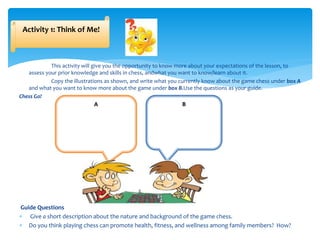
This activity will give you the opportunity to know more about your expectations of the lesson, to
assess your prior knowledge and skills in chess, andwhat you want to know/learn about it.
Copy the illustrations as shown, and write what you currently know about the game chess under box A
and what you want to know more about the game under box B.Use the questions as your guide.
Chess Go!
Guide Questions
 Give a short description about the nature and background of the game chess.
 Do you think playing chess can promote health, fitness, and wellness among family members? How?
Activity 1: Think of Me!
A B
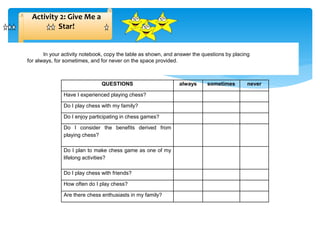
Activity 2: Give Me a
Star!
QUESTIONS always sometimes never
Have I experienced playing chess?
Do I play chess with my family?
Do I enjoy participating in chess games?
Do I consider the benefits derived from
playing chess?
Do I plan to make chess game as one of my
lifelong activities?
Do I play chess with friends?
How often do I play chess?
Are there chess enthusiasts in my family?
At this point,questions are provided for you to gauge how you value chess as a game.In your activity notebook, copy the table as shown, and answer the questions by placing
for always, for sometimes, and for never on the space provided.
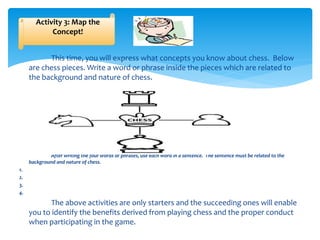
This time, you will express what concepts you know about chess. Below
are chess pieces. Write a word or phrase inside the pieces which are related to
the background and nature of chess.
After writing the four words or phrases, use each word in a sentence. The sentence must be related to the
background and nature of chess.
1.
2.
3.
4.
The above activities are only starters and the succeeding ones will enable
you to identify the benefits derived from playing chess and the proper conduct
when participating in the game.
Activity 3: Map the
Concept!
 The above activities are only starters and the succeeding
ones will enable you to identify the benefits derived from
playing chess and the proper conduct when participating in
the game.
Activity 4: Chess Out! All On Board!
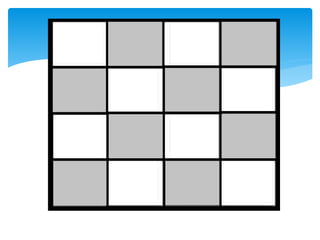
 Below is a chess board containing rumbled details regarding benefits
derived from chess and the proper behavior when participating in this
game. Copy the chess board in your activity notebook.
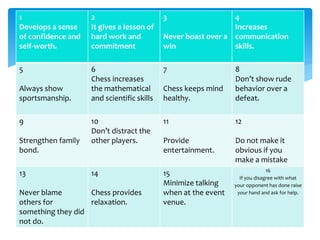
 From the numbered details below, identify which are the benefits
derived from chess and the proper behavior when participating in the
game. Write the number on the shaded box below corresponding to
benefits derived from chess and the number on the white box for the
proper behavior when participating in chess game.
1
Develops a sense
of confidence and
self-worth.
2
It gives a lesson of
hard work and
commitment
3
Never boast over a
win
4
Increases
communication
skills.
5
Always show
sportsmanship.
6
Chess increases
the mathematical
and scientific skills
7
Chess keeps mind
healthy.
8
Don’t show rude
behavior over a
defeat.
9
Strengthen family
bond.
10
Don’t distract the
other players.
11
Provide
entertainment.
12
Do not make it
obvious if you
make a mistake
13
Never blame
others for
something they did
not do.
14
Chess provides
relaxation.
15
Minimize talking
when at the event
venue.
16
If you disagree with what
your opponent has done raise
your hand and ask for help.
 You have made a lot of progress by learning the overview of
the game chess. Now, you will learn the basic skills in
playing chess. You will be acquainted with the rules and
regulations of the game.
Activity 5: Watch Me!
This module comes with a video presentation on how to play the game
which you can download at
https://www.youtube.com/watch?v=unB3BoEtLDo&feature=channel&lis
t=UL
 After the video presentation answer the following questions:
 How does a chess piece move?
 What are the special features of the chess piece?
 How can you do castling?
 When does check or checkmate occur?
In Part I of the module, activities are designed to
gauge the knowledge and interests you already
possess as well as the evidence of your learning from
this module. In the second phase, activities will focus
on how you process the information you gained in the
first phase.
In this phase, you will be provided with various
learning resources and learning experiences to enable
you to understand and perform better in the game
chess as an indoor recreational activity.
This activity will test your ability to use your hands and eyes together to
perform a task requiring you to synchronize vision, touch, movement,
and cognition.
Paper juggling is a fun way to help you develop and maintain your eye-
hand coordination that is essential in playing chess.
 Make your own paper juggling ball by crumpling 2 sheets of paper.
 Start the activity by juggling the paper ball alternately with right and left
hand.
 Count how many times you hit the paper ball.
 If you fail to hit the paper ball, stop counting.
 Do it three times.
 Your final score will be the highest in three trials.
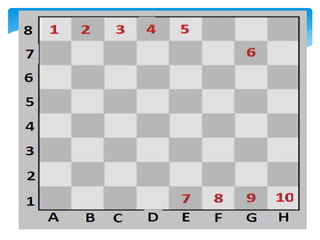
 You are now on the exciting part of the module. In this
activity, you will be acquainted with the proper positioning
of the chess pieces on the chess board.
 Try to visualize a chess board with chess pieces placed in
their proper initial positions. In your activity notebook, copy
the illustration as shown and locate the following pieces in
their initial positions on the chessboard by writing the
number in the space provided.
Through the aforementioned activities,
you were warmed up by playing paper
juggling and identifying the initial
positions of the chess pieces. In the
proceeding activity, you will perform
the moves of each chess piece.
 In this next activity, you will be given the opportunity to
practice the basic moves of each chess piece. You need
to remember each specific move to win a game. Pieces
can be moved to capture an opponent's piece. This is
done by landing onthe square of the opponent’s piece
and then replacing it.
 Pieces can also be moved to defend other pieces in
case of capture, or to control important squares in the
game.
 Follow the moves of the chess pieces as illustrated
below.
Activity 3: Its play time
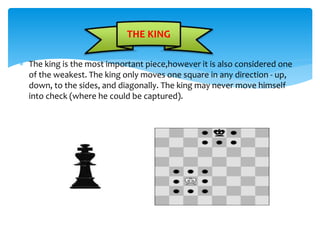
 The king is the most important piece,however it is also considered one
of the weakest. The king only moves one square in any direction - up,
down, to the sides, and diagonally. The king may never move himself
into check (where he could be captured).
THE KING
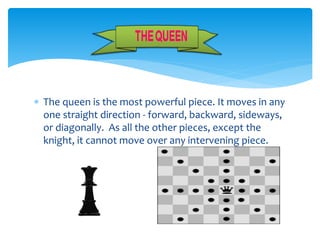
 The queen is the most powerful piece. It moves in any
one straight direction - forward, backward, sideways,
or diagonally. As all the other pieces, except the
knight, it cannot move over any intervening piece.
 The rook may move to any square as far as it wants,
but only forward, backward, and to the sides. The
rooks are particularly powerful pieces when they are
protecting each other and working together!
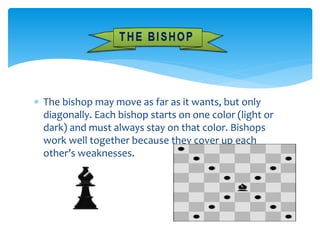
 The bishop may move as far as it wants, but only
diagonally. Each bishop starts on one color (light or
dark) and must always stay on that color. Bishops
work well together because they cover up each
other’s weaknesses.
 Knights moves by going two squares in one direction,
and then one more move just like an “L” shape.
Knights are the only pieces that can move over other
pieces.
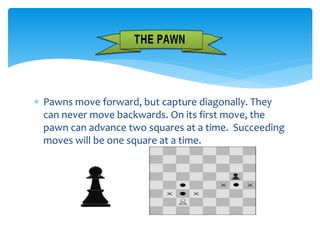
 Pawns move forward, but capture diagonally. They
can never move backwards. On its first move, the
pawn can advance two squares at a time. Succeeding
moves will be one square at a time.
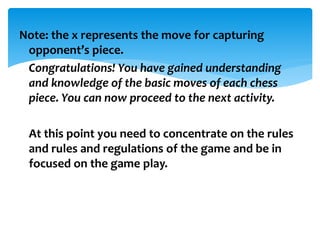
Note: the x represents the move for capturing
opponent’s piece.
Congratulations! You have gained understanding
and knowledge of the basic moves of each chess
piece. You can now proceed to the next activity.
At this point you need to concentrate on the rules
and rules and regulations of the game and be in
focused on the game play.
After learning each chess moves, let us review
your knowledge on the rules and regulations in
playing chess.
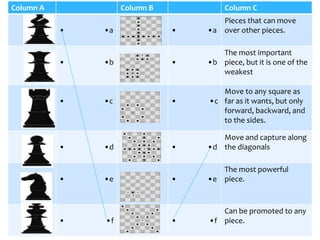
Welcome to your next activity!In your activity
notebook, copy the figures and other entries as
shown. You have to identify the move of each
illustrated chess piece. With the use of a straight line,
connect column A to column B then, column B to
column C. The first one is done for you.
Column A Column B Column C
• •a • •a
Pieces that can move
over other pieces.
• •b • •b
The most important
piece, but it is one of the
weakest
• •c • •c
Move to any square as
far as it wants, but only
forward, backward, and
to the sides.
• •d • •d
Move and capture along
the diagonals
• •e • •e
The most powerful
piece.
• •f • •f
Can be promoted to any
piece.
Way to go!Play chess online. You will have the computer as your
opponent.
Play chess with your computer at
http://www.learn4good.com/games/board/play-chess-against-the-
computer.htm.
In Part II, you were given sets of activities to facilitate
betterunderstanding of the game chess. Aside from just knowing the
basic required skills in playing the game, a deeper understanding of
its importance is necessary. In the next phase, activities are designed
to convey the deeper value of chess.
In this phase you haveother learning resources and experiences to enrich
your understanding of chess.
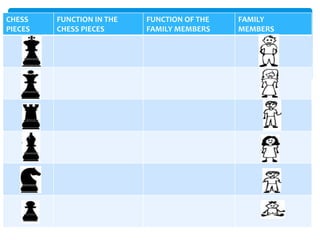
Below are pictures of chess pieces and members of a typical family. In
your notebook, copy the table as shown. Write the function of each
chess pieces and the function of the family members on the space
provided for. After which, relate the functions of each chess piece to the
members of the family or to the family as a whole. Present your work to
your teacher.
CHESS
PIECES
FUNCTION IN THE
CHESS PIECES
FUNCTION OF THE
FAMILY MEMBERS
FAMILY
MEMBERS
Here is a question for you to ponder. This will
give you a deeper understanding on the value of playing
chess.
Do you think playing chess can promote health, fitness
and wellness among family members? How?
Copy the illustrations in your notebook, and write your
answer on the space provided.
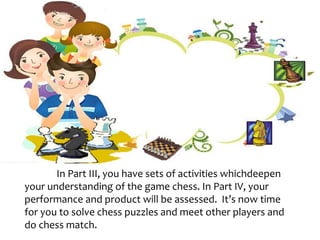
In Part III, you have sets of activities whichdeepen
your understanding of the game chess. In Part IV, your
performance and product will be assessed. It’s now time
for you to solve chess puzzles and meet other players and
do chess match.
WOW! Finally, you made it to this part!
This is now your chance to show
everyone that you can play chess with
your classmate. In the next activities,
you need to have a chess set. Your
performance and product will be graded
based on a set of criteria.
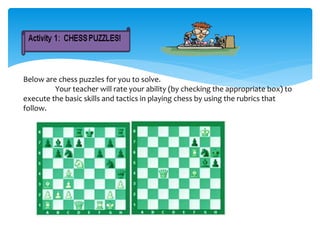
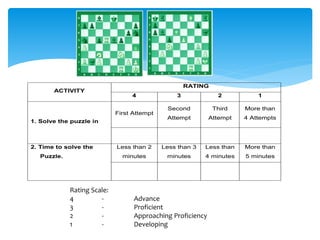
Below are chess puzzles for you to solve.
Your teacher will rate your ability (by checking the appropriate box) to
execute the basic skills and tactics in playing chess by using the rubrics that
follow.
ACTIVITY
RATING
4 3 2 1
1. Solve the puzzle in
First Attempt
Second
Attempt
Third
Attempt
More than
4 Attempts
2. Time to solve the
Puzzle.
Less than 2
minutes
Less than 3
minutes
Less than
4 minutes
More than
5 minutes
Rating Scale:
4 - Advance
3 - Proficient
2 - Approaching Proficiency
1 - Developing
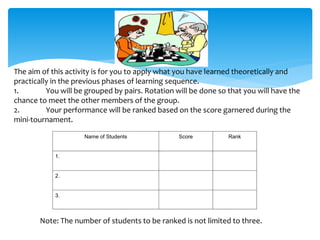
The aim of this activity is for you to apply what you have learned theoretically and
practically in the previous phases of learning sequence.
1. You will be grouped by pairs. Rotation will be done so that you will have the
chance to meet the other members of the group.
2. Your performance will be ranked based on the score garnered during the
mini-tournament.
Name of Students Score Rank
1.
2.
3.
Note: The number of students to be ranked is not limited to three.
BSED III-C (MAPEH)

instructional tools in edtech2

  • 2.
    Participating in indoorrecreational activities is important for a child’s development and can lay a foundation for a healthy life. Play is a good mental and physical activity for children. It develops their physical body, movement, and coordination;encourages self- esteem; fosters social interaction skills; improves thinking skills; and develops emotional skills. Moreover, family relationships can be enhanced when the family has something worthwhile to do altogether. This module encompasses the basic principles and ideas about one of the indoor recreational activities, i.e., chess. It will lead you to understand the nature/background of the game chess and the benefits derived from playing it. This will help you to become better player or to love chess while learning the basic skills in playing it.
  • 3.
     Pre-Assessment You willbe given set of activities to assess and activate your prior knowledge about chess. In this activity your prior knowledge in the game chess will be assessed. In your activity notebook, copy the table as shown. Look at the drawing of chess pieces and equipment of the game. Identify each of the pieces. Activity I: Name Me
  • 4.
    Chess pieces andequipment So, you are….. Write your answer on the appropriate boxes. Are you ready? Let’s check it out!
  • 5.
     The abovesimple recall and identification have surely activated your prior knowledge in chess. In the next activity, you will be directed to identify your own personal learning goals and objectives of the course. At this point, you will write your expectations for this module.  GOOD JOB LEARNER!
  • 6.
    LEARNING GOALS andTARGETS Define your own personal learning goals and targets about our lesson chess.  Example: Learn the moves of each chess piece. 1.___________________________________________________ 2.___________________________________________________ 3.___________________________________________________ 4.___________________________________________________ 5.___________________________________________________ The succeeding activities are classified into four phases of learning. Knowing, processing, reflecting and understanding, and transferring of understanding.
  • 7.
    In this phase,you will be given activities to assess your prior knowledge; communicate your expectations: what you want to know, understand, produce or perform. You will be taught what you need to learn about chess. You will also be informed of the assessment techniques which will be used to rate your output and performance at the end of the lesson.  Brief History of Chess  Do you know where chess originated? Chess is a game that has been played for centuries and was thought to have originated in India in the 15th century. Long ago, it was considered a game reserved only for kings and members of the upper classes. Nowadays, chess is played by common people even at an early age.  The modern design of chess pieces bears the name Staunton, who was an English master in the mid-18OO's. These are the type of pieces that are now used in all tournaments worldwide.  The first international chess tournament was the London Tourney played in 1851. A German named AdolfAnderssen won the game. He became the unofficial best chess player of the world because he did not receive any award or title. PART I: WHAT TO KNOW
  • 8.
     The firstgreat American-born chess player is Paul Morphy. Paul traveled to Europe in the 185O's, where he beat all challengers, including Adolf Anderssen. However, the English champion of the time (Staunton) refused to play with him, so Morphy never became a world chess champ.  The first official championship chess tournament was played in 1866 in London, with sand clocks to restrict the length of a game. A Bohemian (Czechoslovakian) Jew named Steinitz won the game. He became the world's first official chess champion, holding this title until 1894.  Have you wondered who rules in the world of chess today? Recently, Russia dominates the game of chess. This results from the establishment of government schools for talented chess players after the communist revolution of 1917. Since 1927, many of the top chess players have been citizens of the former USSR, and include: Tal, Alekhine, Petrosian, Spassky, Smyslov, AnatoliKarpov, and Gary Kasparov.
  • 9.
     Benefits Derivedfrom Playing Chess.  Chess is an indoor recreational activity which is now being introduced as a major part of secondary level curriculum because of the benefits it gives to the students.  You probably know some of the benefits derived from playing chess. Here are some of the benefits which can be derived from playing chess.  Chess increases the mathematical and scientific skills of the students. It also enhances the problem solving skills, concentration ability, as well as logical thinking ability of the students.  It develops a sense of confidence and self-worth of a student.  It also increases communication skills of a student.  It gives a lesson of hard work and commitment.  Aside from intellectual exercise, chess provides entertainment and relaxation. This game is free and can provide entertainment even for the observers.  Chess also has health benefits. It is considered as a form of recreational therapy. Chess keeps the mind healthy and a healthy mind results in healthy body. It is used by therapists to help people suffering from cognitive functioning such as anxiety and depression.  Chess a form of indoor recreational activity can be used to strengthen family bond. The members of the family can play with each other while at home. In a way, the chess pieces can represent the family members. Each member of the family has a role to play. In chess, the pieces also have specific function to perform to win the game.
  • 10.
    This activity willgive you the opportunity to know more about your expectations of the lesson, to assess your prior knowledge and skills in chess, andwhat you want to know/learn about it. Copy the illustrations as shown, and write what you currently know about the game chess under box A and what you want to know more about the game under box B.Use the questions as your guide. Chess Go! Guide Questions  Give a short description about the nature and background of the game chess.  Do you think playing chess can promote health, fitness, and wellness among family members? How? Activity 1: Think of Me! A B
  • 11.
    Activity 2: GiveMe a Star! QUESTIONS always sometimes never Have I experienced playing chess? Do I play chess with my family? Do I enjoy participating in chess games? Do I consider the benefits derived from playing chess? Do I plan to make chess game as one of my lifelong activities? Do I play chess with friends? How often do I play chess? Are there chess enthusiasts in my family? At this point,questions are provided for you to gauge how you value chess as a game.In your activity notebook, copy the table as shown, and answer the questions by placing for always, for sometimes, and for never on the space provided.
  • 12.
    This time, youwill express what concepts you know about chess. Below are chess pieces. Write a word or phrase inside the pieces which are related to the background and nature of chess. After writing the four words or phrases, use each word in a sentence. The sentence must be related to the background and nature of chess. 1. 2. 3. 4. The above activities are only starters and the succeeding ones will enable you to identify the benefits derived from playing chess and the proper conduct when participating in the game. Activity 3: Map the Concept!
  • 13.
     The aboveactivities are only starters and the succeeding ones will enable you to identify the benefits derived from playing chess and the proper conduct when participating in the game. Activity 4: Chess Out! All On Board!  Below is a chess board containing rumbled details regarding benefits derived from chess and the proper behavior when participating in this game. Copy the chess board in your activity notebook.  From the numbered details below, identify which are the benefits derived from chess and the proper behavior when participating in the game. Write the number on the shaded box below corresponding to benefits derived from chess and the number on the white box for the proper behavior when participating in chess game.
  • 14.
    1 Develops a sense ofconfidence and self-worth. 2 It gives a lesson of hard work and commitment 3 Never boast over a win 4 Increases communication skills. 5 Always show sportsmanship. 6 Chess increases the mathematical and scientific skills 7 Chess keeps mind healthy. 8 Don’t show rude behavior over a defeat. 9 Strengthen family bond. 10 Don’t distract the other players. 11 Provide entertainment. 12 Do not make it obvious if you make a mistake 13 Never blame others for something they did not do. 14 Chess provides relaxation. 15 Minimize talking when at the event venue. 16 If you disagree with what your opponent has done raise your hand and ask for help.
  • 16.
     You havemade a lot of progress by learning the overview of the game chess. Now, you will learn the basic skills in playing chess. You will be acquainted with the rules and regulations of the game. Activity 5: Watch Me! This module comes with a video presentation on how to play the game which you can download at https://www.youtube.com/watch?v=unB3BoEtLDo&feature=channel&lis t=UL  After the video presentation answer the following questions:  How does a chess piece move?  What are the special features of the chess piece?  How can you do castling?  When does check or checkmate occur?
  • 17.
    In Part Iof the module, activities are designed to gauge the knowledge and interests you already possess as well as the evidence of your learning from this module. In the second phase, activities will focus on how you process the information you gained in the first phase. In this phase, you will be provided with various learning resources and learning experiences to enable you to understand and perform better in the game chess as an indoor recreational activity.
  • 18.
    This activity willtest your ability to use your hands and eyes together to perform a task requiring you to synchronize vision, touch, movement, and cognition. Paper juggling is a fun way to help you develop and maintain your eye- hand coordination that is essential in playing chess.  Make your own paper juggling ball by crumpling 2 sheets of paper.  Start the activity by juggling the paper ball alternately with right and left hand.  Count how many times you hit the paper ball.  If you fail to hit the paper ball, stop counting.  Do it three times.  Your final score will be the highest in three trials.
  • 19.
     You arenow on the exciting part of the module. In this activity, you will be acquainted with the proper positioning of the chess pieces on the chess board.  Try to visualize a chess board with chess pieces placed in their proper initial positions. In your activity notebook, copy the illustration as shown and locate the following pieces in their initial positions on the chessboard by writing the number in the space provided.
  • 23.
    Through the aforementionedactivities, you were warmed up by playing paper juggling and identifying the initial positions of the chess pieces. In the proceeding activity, you will perform the moves of each chess piece.
  • 24.
     In thisnext activity, you will be given the opportunity to practice the basic moves of each chess piece. You need to remember each specific move to win a game. Pieces can be moved to capture an opponent's piece. This is done by landing onthe square of the opponent’s piece and then replacing it.  Pieces can also be moved to defend other pieces in case of capture, or to control important squares in the game.  Follow the moves of the chess pieces as illustrated below. Activity 3: Its play time
  • 25.
     The kingis the most important piece,however it is also considered one of the weakest. The king only moves one square in any direction - up, down, to the sides, and diagonally. The king may never move himself into check (where he could be captured). THE KING
  • 26.
     The queenis the most powerful piece. It moves in any one straight direction - forward, backward, sideways, or diagonally. As all the other pieces, except the knight, it cannot move over any intervening piece.
  • 27.
     The rookmay move to any square as far as it wants, but only forward, backward, and to the sides. The rooks are particularly powerful pieces when they are protecting each other and working together!
  • 28.
     The bishopmay move as far as it wants, but only diagonally. Each bishop starts on one color (light or dark) and must always stay on that color. Bishops work well together because they cover up each other’s weaknesses.
  • 29.
     Knights movesby going two squares in one direction, and then one more move just like an “L” shape. Knights are the only pieces that can move over other pieces.
  • 30.
     Pawns moveforward, but capture diagonally. They can never move backwards. On its first move, the pawn can advance two squares at a time. Succeeding moves will be one square at a time.
  • 31.
    Note: the xrepresents the move for capturing opponent’s piece. Congratulations! You have gained understanding and knowledge of the basic moves of each chess piece. You can now proceed to the next activity. At this point you need to concentrate on the rules and rules and regulations of the game and be in focused on the game play.
  • 32.
    After learning eachchess moves, let us review your knowledge on the rules and regulations in playing chess. Welcome to your next activity!In your activity notebook, copy the figures and other entries as shown. You have to identify the move of each illustrated chess piece. With the use of a straight line, connect column A to column B then, column B to column C. The first one is done for you.
  • 33.
    Column A ColumnB Column C • •a • •a Pieces that can move over other pieces. • •b • •b The most important piece, but it is one of the weakest • •c • •c Move to any square as far as it wants, but only forward, backward, and to the sides. • •d • •d Move and capture along the diagonals • •e • •e The most powerful piece. • •f • •f Can be promoted to any piece.
  • 34.
    Way to go!Playchess online. You will have the computer as your opponent. Play chess with your computer at http://www.learn4good.com/games/board/play-chess-against-the- computer.htm. In Part II, you were given sets of activities to facilitate betterunderstanding of the game chess. Aside from just knowing the basic required skills in playing the game, a deeper understanding of its importance is necessary. In the next phase, activities are designed to convey the deeper value of chess.
  • 35.
    In this phaseyou haveother learning resources and experiences to enrich your understanding of chess. Below are pictures of chess pieces and members of a typical family. In your notebook, copy the table as shown. Write the function of each chess pieces and the function of the family members on the space provided for. After which, relate the functions of each chess piece to the members of the family or to the family as a whole. Present your work to your teacher.
  • 36.
    CHESS PIECES FUNCTION IN THE CHESSPIECES FUNCTION OF THE FAMILY MEMBERS FAMILY MEMBERS
  • 37.
    Here is aquestion for you to ponder. This will give you a deeper understanding on the value of playing chess. Do you think playing chess can promote health, fitness and wellness among family members? How? Copy the illustrations in your notebook, and write your answer on the space provided.
  • 38.
    In Part III,you have sets of activities whichdeepen your understanding of the game chess. In Part IV, your performance and product will be assessed. It’s now time for you to solve chess puzzles and meet other players and do chess match.
  • 39.
    WOW! Finally, youmade it to this part! This is now your chance to show everyone that you can play chess with your classmate. In the next activities, you need to have a chess set. Your performance and product will be graded based on a set of criteria.
  • 40.
    Below are chesspuzzles for you to solve. Your teacher will rate your ability (by checking the appropriate box) to execute the basic skills and tactics in playing chess by using the rubrics that follow.
  • 41.
    ACTIVITY RATING 4 3 21 1. Solve the puzzle in First Attempt Second Attempt Third Attempt More than 4 Attempts 2. Time to solve the Puzzle. Less than 2 minutes Less than 3 minutes Less than 4 minutes More than 5 minutes Rating Scale: 4 - Advance 3 - Proficient 2 - Approaching Proficiency 1 - Developing
  • 42.
    The aim ofthis activity is for you to apply what you have learned theoretically and practically in the previous phases of learning sequence. 1. You will be grouped by pairs. Rotation will be done so that you will have the chance to meet the other members of the group. 2. Your performance will be ranked based on the score garnered during the mini-tournament. Name of Students Score Rank 1. 2. 3. Note: The number of students to be ranked is not limited to three.
  • 44.