18th European Advanced Process Control
and Manufacturing (apc|m) Conference
Dresden, Germany
Alan Weber – Cimetrix Incorporated
EDA* Applications and Benefits
for Smart Manufacturing
* EDA = SEMI’s Equipment Data Acquisition standards suite
 Key messages
 Keeping score with ROI
 The standardization paradox
 Data collection strategy
 EDA factory applications
 Example use case
 Factory implementation alternatives
Outline
 It’s important to keep score… while agreeing on the
rules of the game
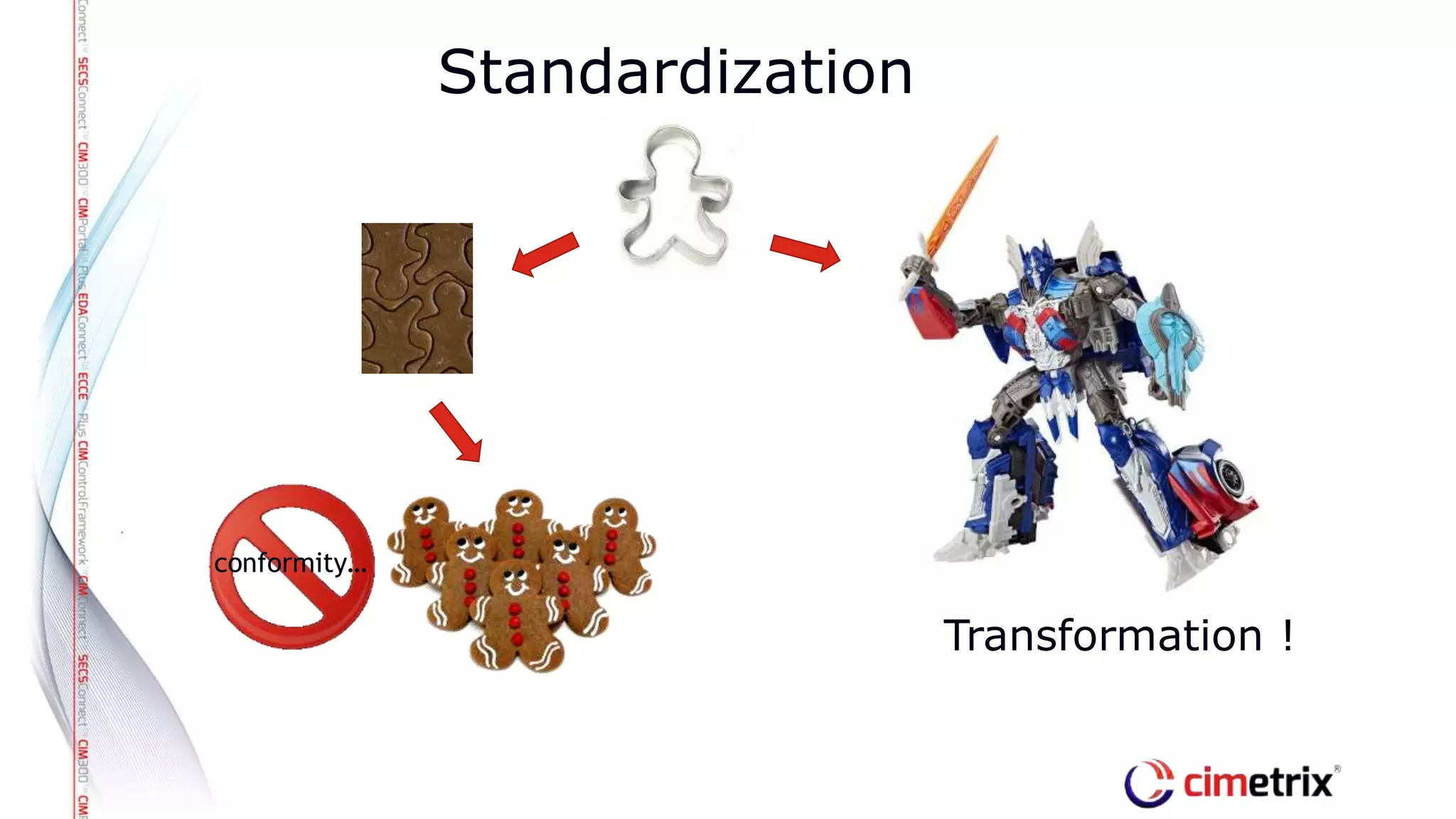
 Standardization does not lead to conformity, but
actually enables genuine transformation
 Data collection should be viewed as a spectrum of
alternatives, not an all-or-nothing proposition
 Fabs collect data to solve specific problems… not to
make life difficult for their equipment suppliers
 The latest generations of SEMI standards offer many
opportunities for engineering cost savings
Key messages
The importance of keeping score
It’s an integral part of everyday life
 Sports
 Business
 Politics
 Science
 Health
 Finances
 Relationships
 …
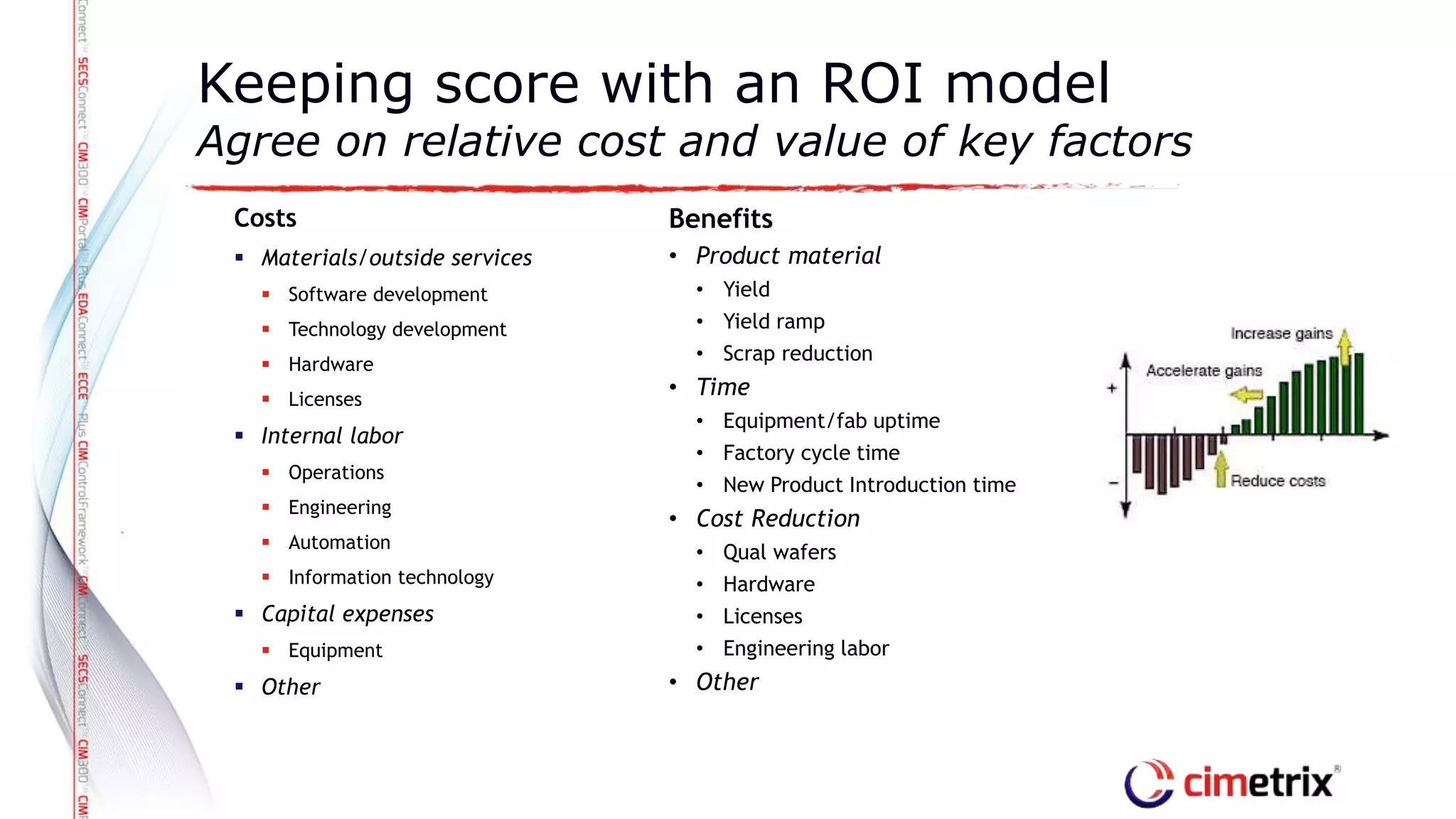
Keeping score with an ROI model
Agree on relative cost and value of key factors
Costs
 Materials/outside services
 Software development
 Technology development
 Hardware
 Licenses
 Internal labor
 Operations
 Engineering
 Automation
 Information technology
 Capital expenses
 Equipment
 Other
Benefits
• Product material
• Yield
• Yield ramp
• Scrap reduction
• Time
• Equipment/fab uptime
• Factory cycle time
• New Product Introduction time
• Cost Reduction
• Qual wafers
• Hardware
• Licenses
• Engineering labor
• Other
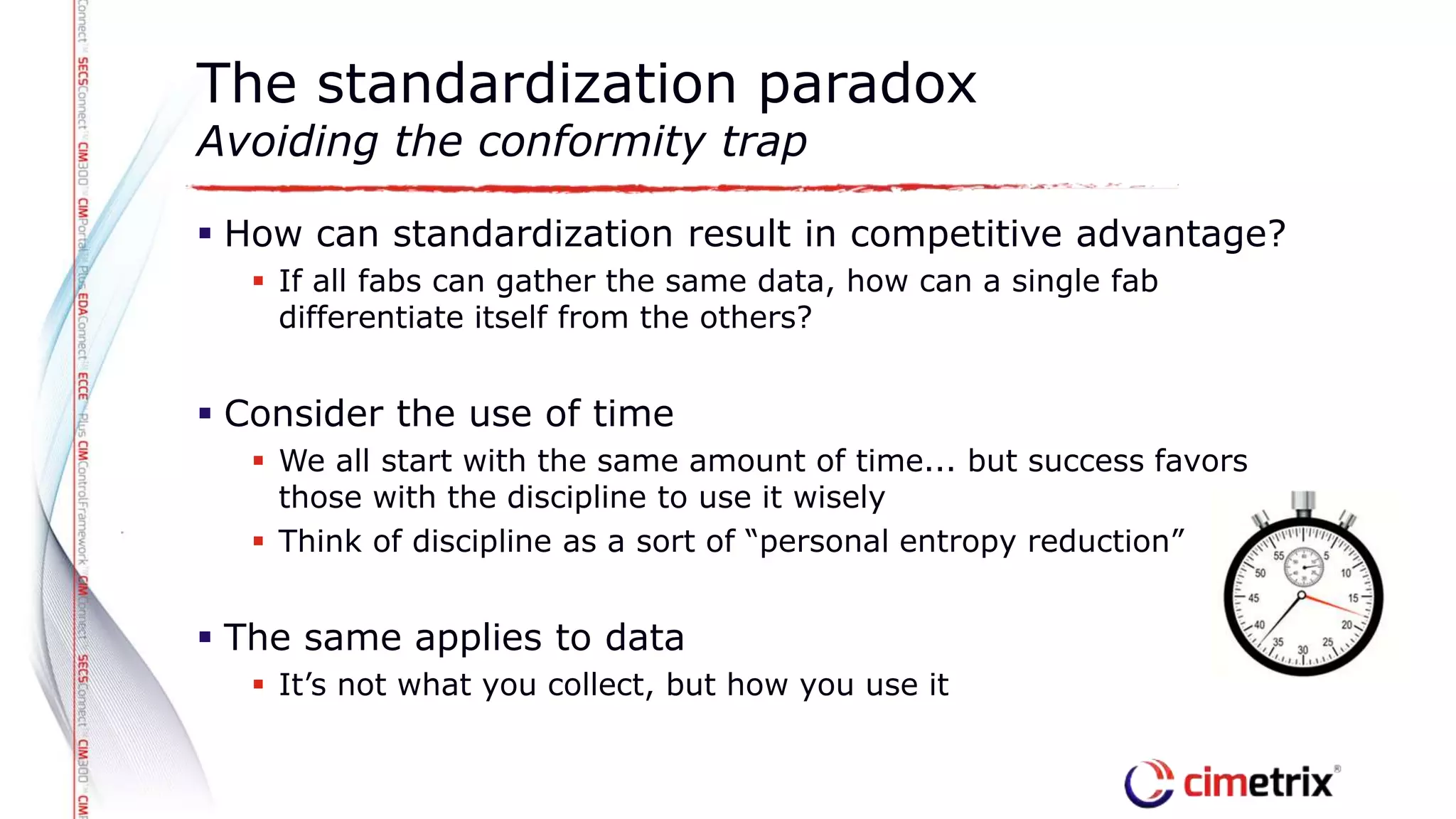
 How can standardization result in competitive advantage?
 If all fabs can gather the same data, how can a single fab
differentiate itself from the others?
 Consider the use of time
 We all start with the same amount of time... but success favors
those with the discipline to use it wisely
 Think of discipline as a sort of “personal entropy reduction”
 The same applies to data
 It’s not what you collect, but how you use it
The standardization paradox
Avoiding the conformity trap
Standardization
conformity…
Transformation !
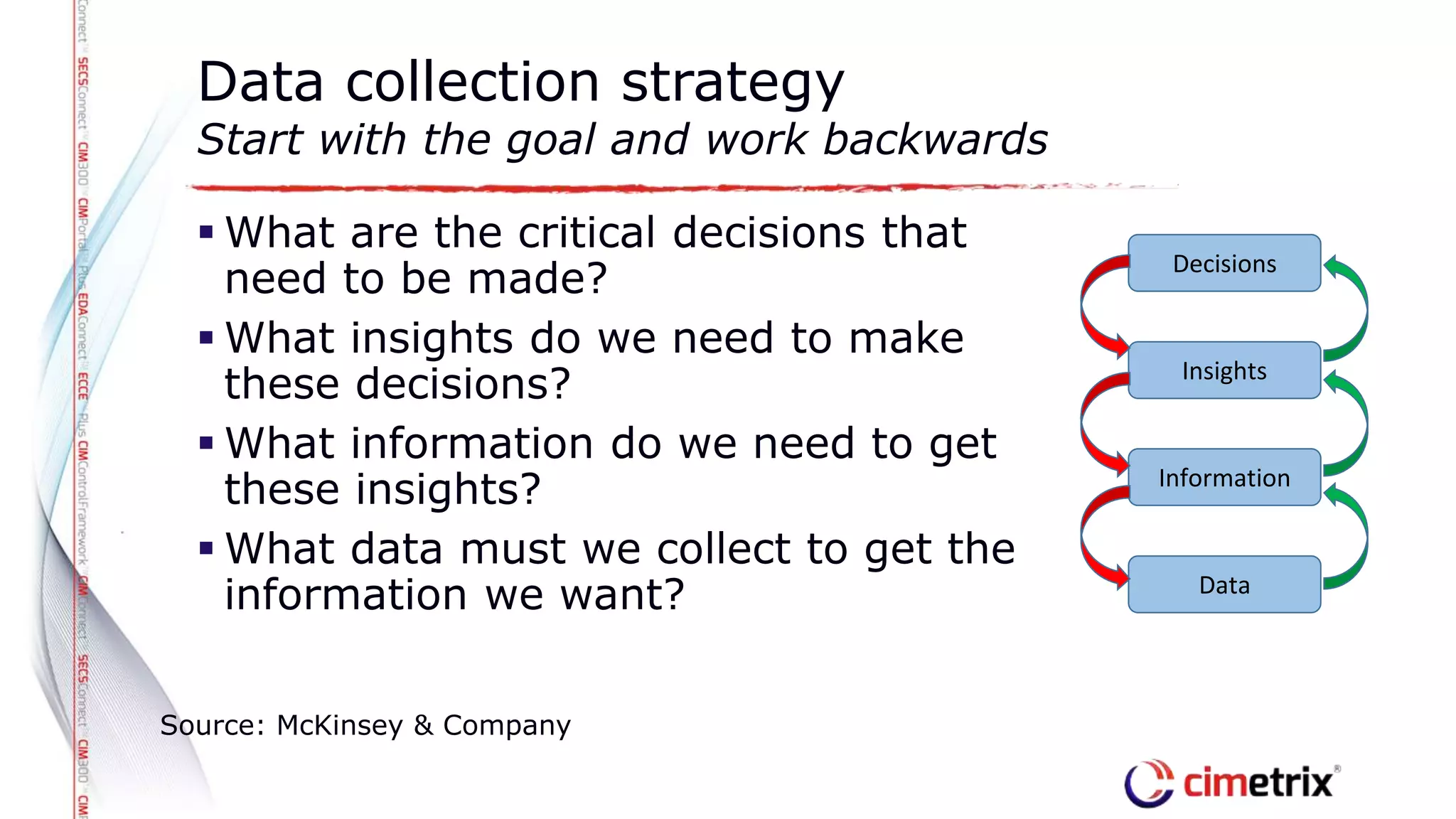
 What are the critical decisions that
need to be made?
 What insights do we need to make
these decisions?
 What information do we need to get
these insights?
 What data must we collect to get the
information we want?
Data collection strategy
Start with the goal and work backwards
Source: McKinsey & Company
Insights
Information
Data
Decisions
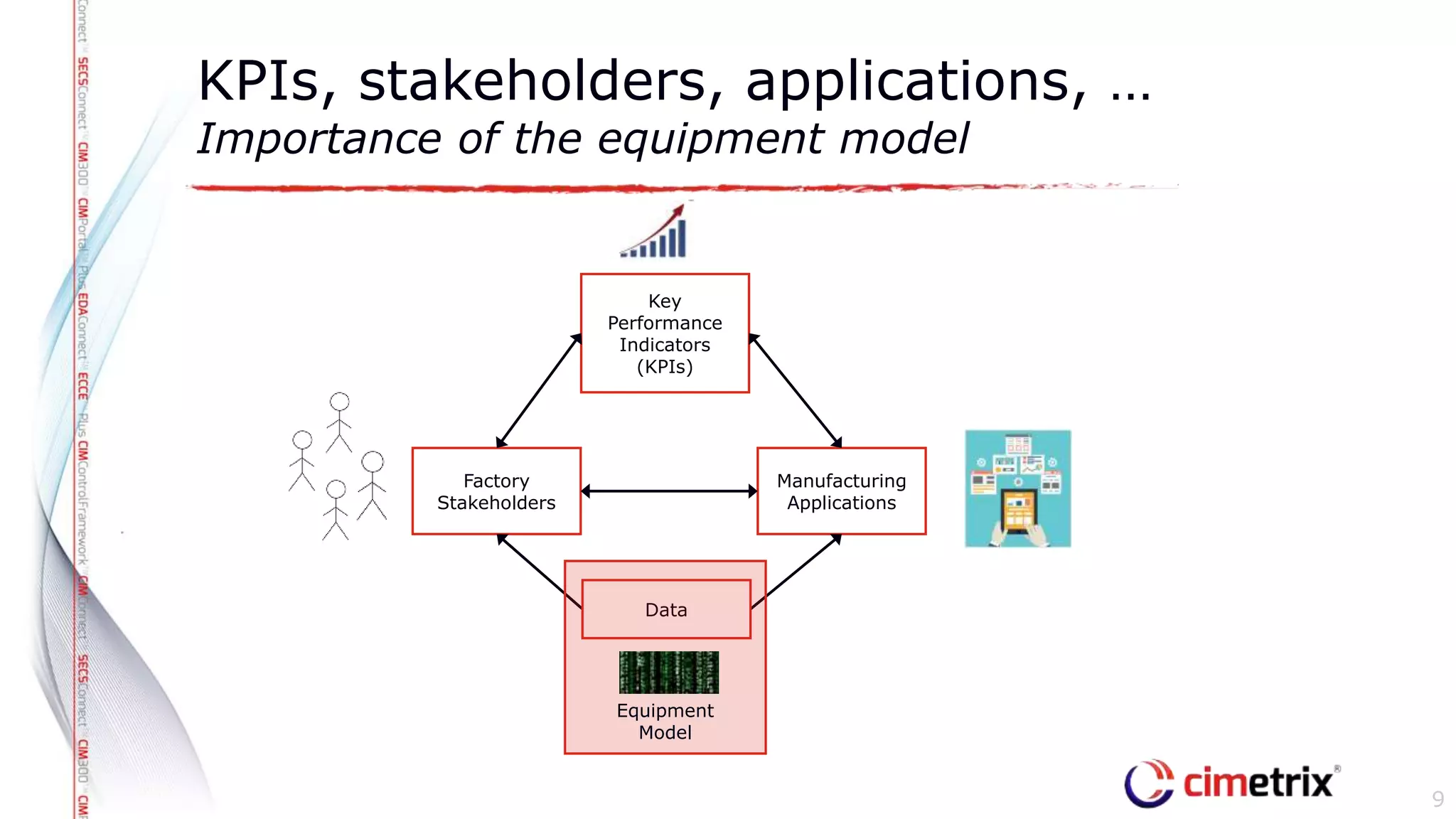
KPIs, stakeholders, applications, …
Importance of the equipment model
9
Key
Performance
Indicators
(KPIs)
Factory
Stakeholders
Manufacturing
Applications
Data
Equipment
Model
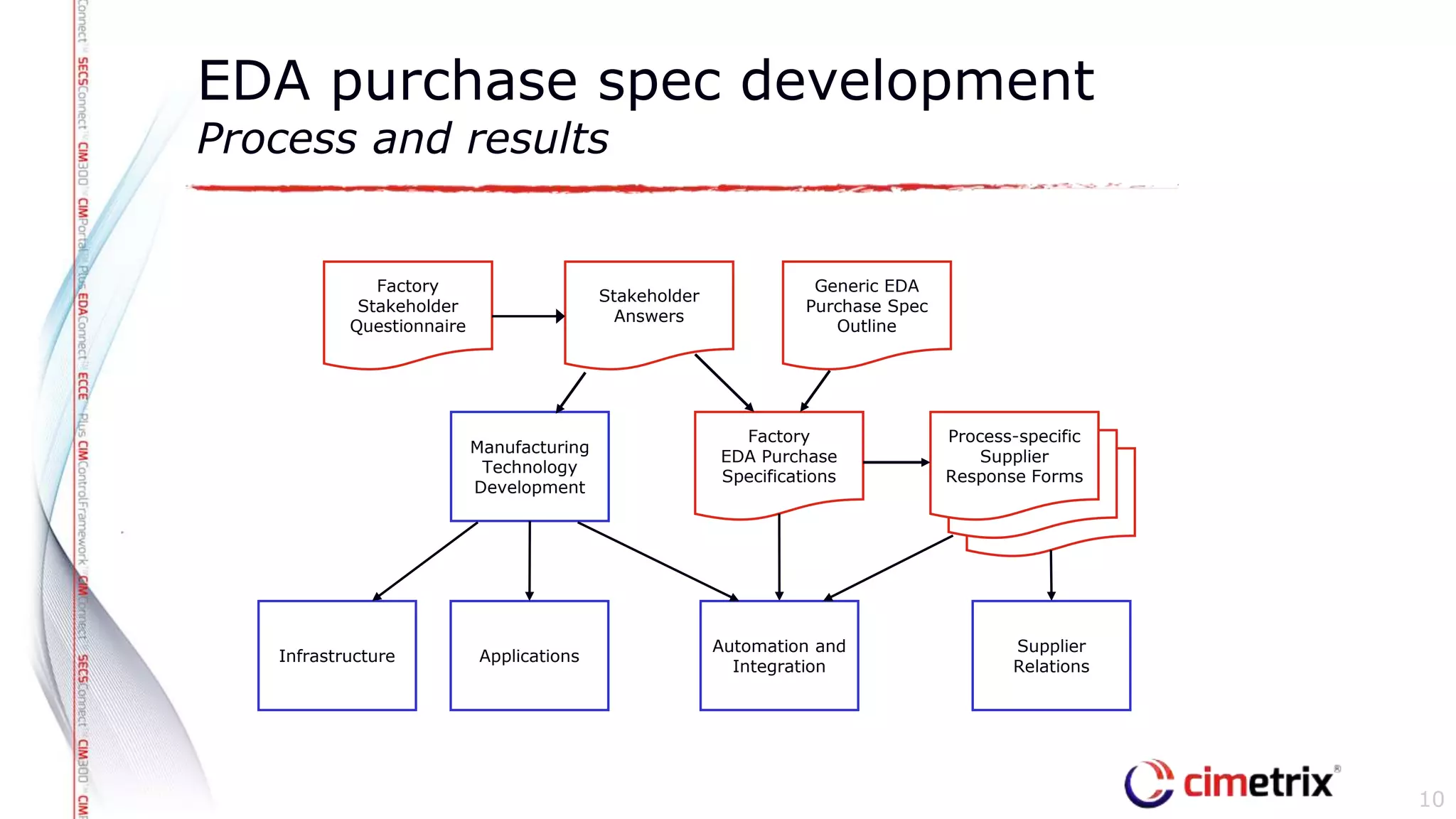
EDA purchase spec development
Process and results
10
Factory
Stakeholder
Questionnaire
Generic EDA
Purchase Spec
Outline
Stakeholder
Answers
Factory
EDA Purchase
Specifications
Manufacturing
Technology
Development
Process-specific
Supplier
Response Forms
Automation and
Integration
Supplier
Relations
ApplicationsInfrastructure
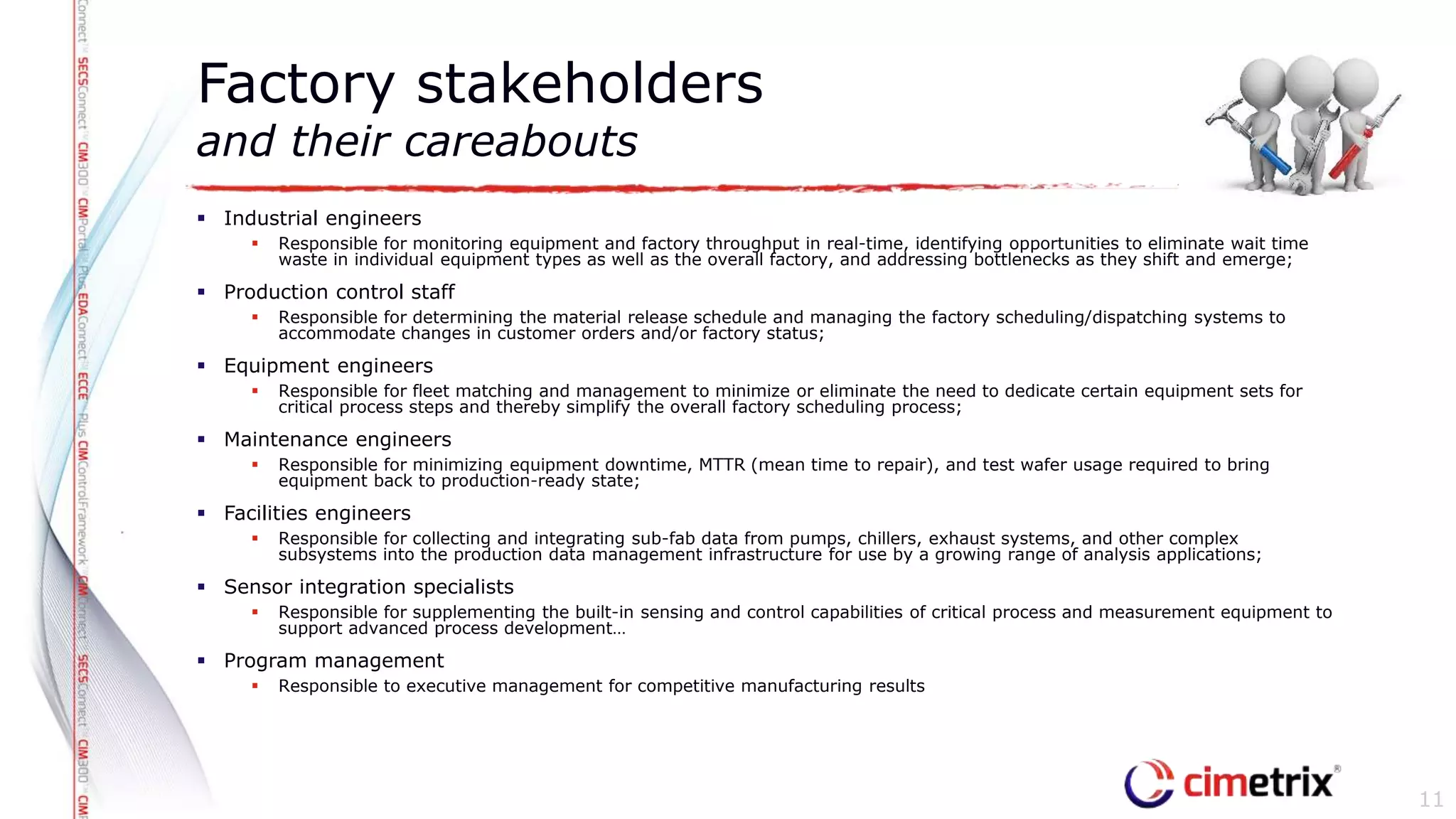
 Industrial engineers
 Responsible for monitoring equipment and factory throughput in real-time, identifying opportunities to eliminate wait time
waste in individual equipment types as well as the overall factory, and addressing bottlenecks as they shift and emerge;
 Production control staff
 Responsible for determining the material release schedule and managing the factory scheduling/dispatching systems to
accommodate changes in customer orders and/or factory status;
 Equipment engineers
 Responsible for fleet matching and management to minimize or eliminate the need to dedicate certain equipment sets for
critical process steps and thereby simplify the overall factory scheduling process;
 Maintenance engineers
 Responsible for minimizing equipment downtime, MTTR (mean time to repair), and test wafer usage required to bring
equipment back to production-ready state;
 Facilities engineers
 Responsible for collecting and integrating sub-fab data from pumps, chillers, exhaust systems, and other complex
subsystems into the production data management infrastructure for use by a growing range of analysis applications;
 Sensor integration specialists
 Responsible for supplementing the built-in sensing and control capabilities of critical process and measurement equipment to
support advanced process development…
 Program management
 Responsible to executive management for competitive manufacturing results
Factory stakeholders
and their careabouts
11
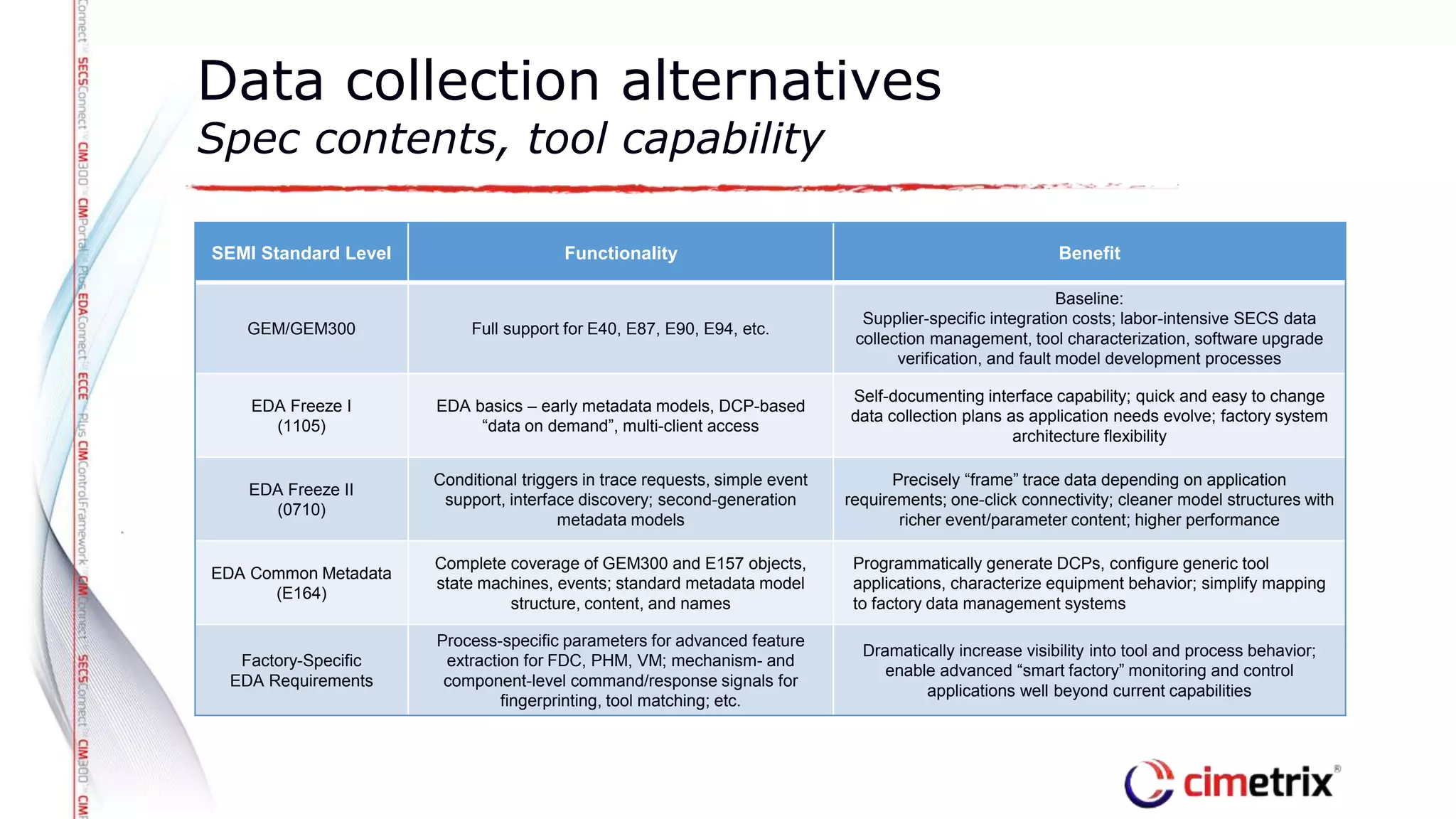
Data collection alternatives
Spec contents, tool capability
SEMI Standard Level Functionality Benefit
GEM/GEM300 Full support for E40, E87, E90, E94, etc.
Baseline:
Supplier-specific integration costs; labor-intensive SECS data
collection management, tool characterization, software upgrade
verification, and fault model development processes
EDA Freeze I
(1105)
EDA basics – early metadata models, DCP-based
“data on demand”, multi-client access
Self-documenting interface capability; quick and easy to change
data collection plans as application needs evolve; factory system
architecture flexibility
EDA Freeze II
(0710)
Conditional triggers in trace requests, simple event
support, interface discovery; second-generation
metadata models
Precisely “frame” trace data depending on application
requirements; one-click connectivity; cleaner model structures with
richer event/parameter content; higher performance
EDA Common Metadata
(E164)
Complete coverage of GEM300 and E157 objects,
state machines, events; standard metadata model
structure, content, and names
Programmatically generate DCPs, configure generic tool
applications, characterize equipment behavior; simplify mapping
to factory data management systems
Factory-Specific
EDA Requirements
Process-specific parameters for advanced feature
extraction for FDC, PHM, VM; mechanism- and
component-level command/response signals for
fingerprinting, tool matching; etc.
Dramatically increase visibility into tool and process behavior;
enable advanced “smart factory” monitoring and control
applications well beyond current capabilities
 E120/E125 Common Equipment Model usage/content
 Nodes and parameters must have meaningful descriptions
 Equipment element attributes for all E120 nodes must have meaningful
values
 All definitions (exceptions, SMs, parameter types, units, SEMI object
types) must be referenced
 Strict event name enforcement
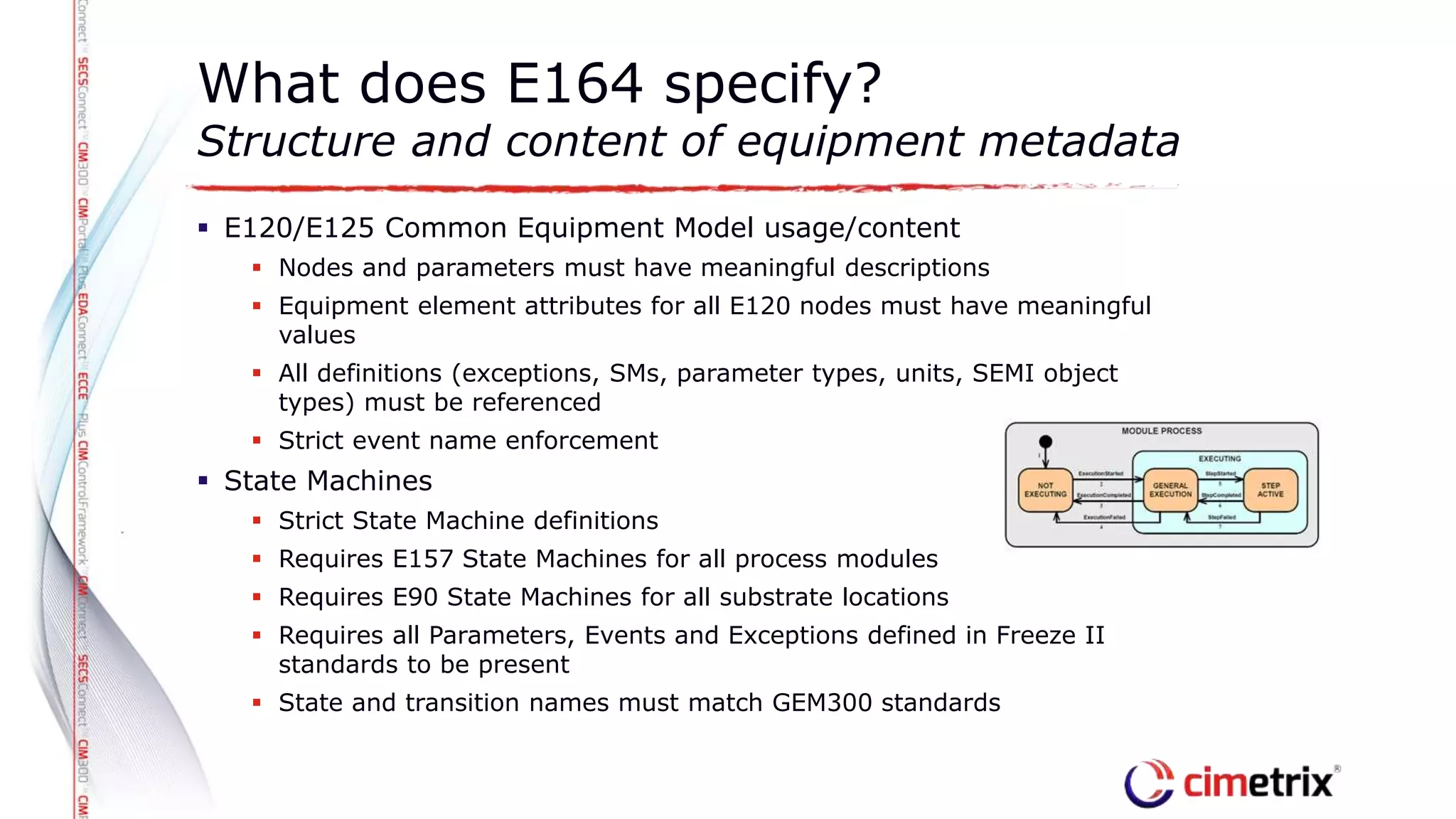
 State Machines
 Strict State Machine definitions
 Requires E157 State Machines for all process modules
 Requires E90 State Machines for all substrate locations
 Requires all Parameters, Events and Exceptions defined in Freeze II
standards to be present
 State and transition names must match GEM300 standards
What does E164 specify?
Structure and content of equipment metadata
 Model structure exactly reflects tool
hardware organization
 Complete description of all potentially
useful information in the tool
 Always accurate, always available – no
additional documentation required
 Common point of reference among tool,
process, and factory stakeholders
 Source of unambiguous identifiers/tags
for database [auto] configuration
 Enables “plug and play” applications
Standard metadata model benefits
First specified by SEMI E164
Process Module #1
Gate Valve Data
Substrate Location
Utilization
More Data,
Events, Alarms
Process Tracking
Other
Components
 Key messages
 Keeping score with ROI
 The standardization paradox
 Data collection strategy
 EDA factory applications
 Example use case
 Factory implementation alternatives
Outline
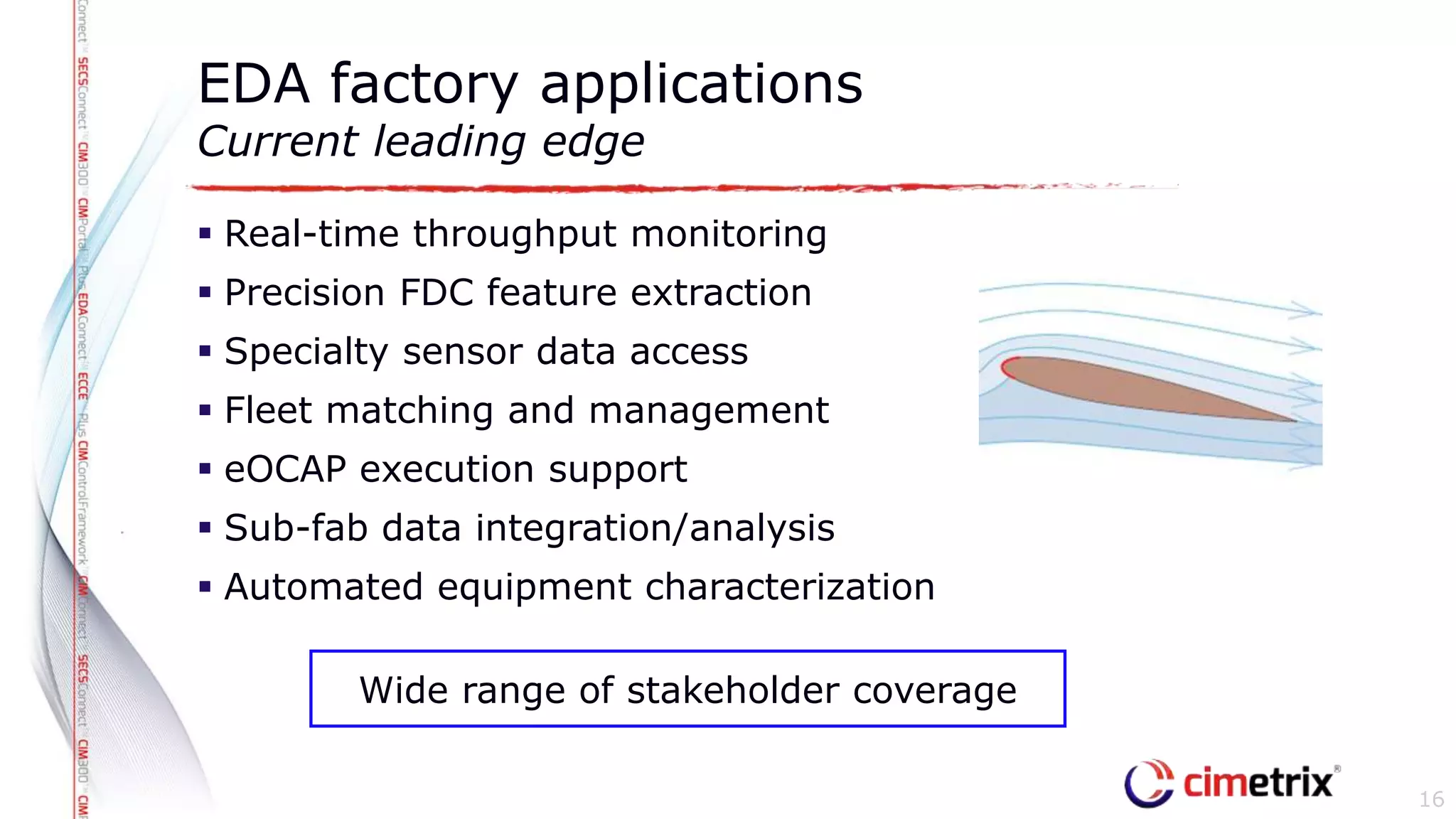
 Real-time throughput monitoring
 Precision FDC feature extraction
 Specialty sensor data access
 Fleet matching and management
 eOCAP execution support
 Sub-fab data integration/analysis
 Automated equipment characterization
EDA factory applications
Current leading edge
16
Wide range of stakeholder coverage
 Description
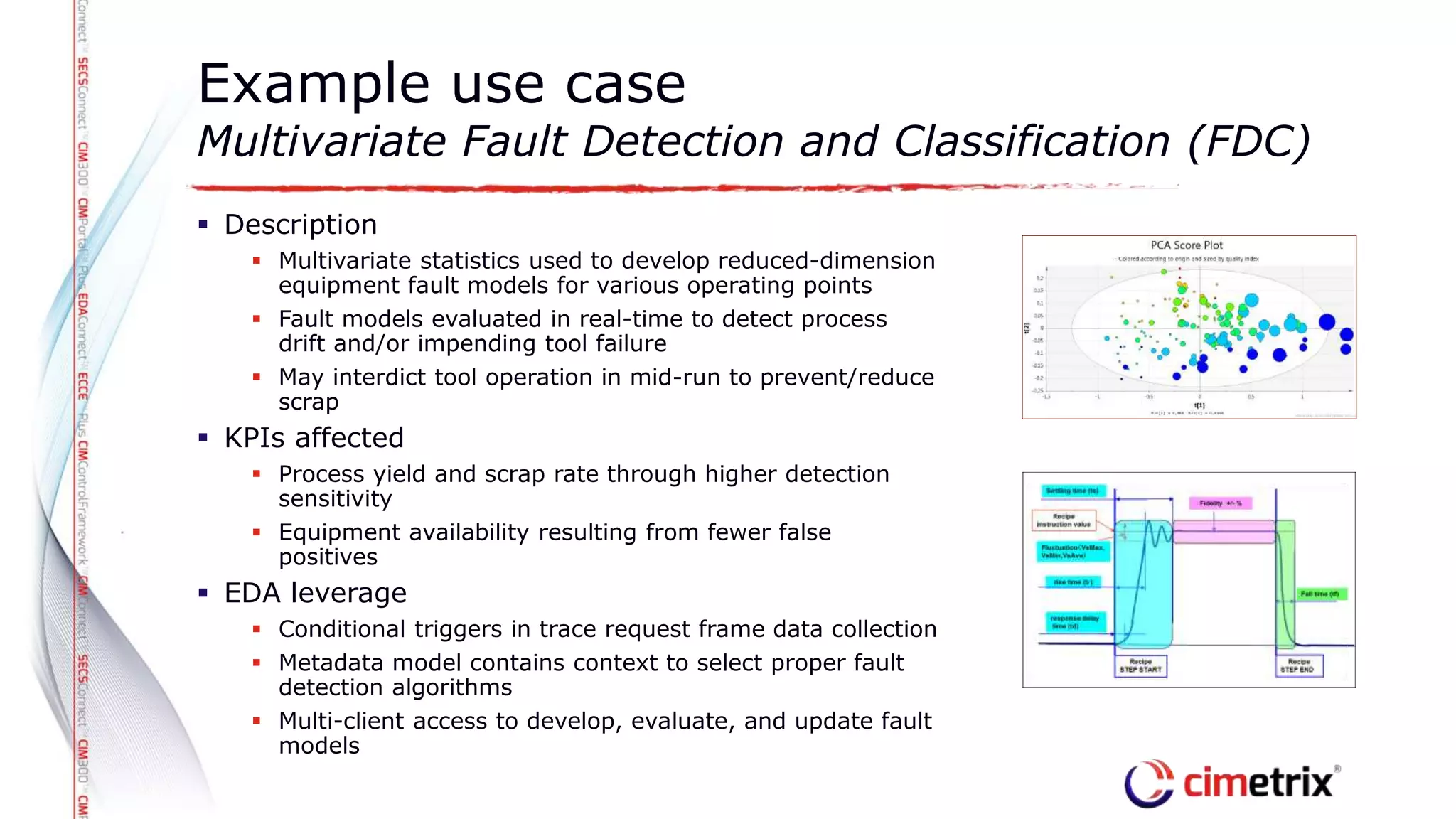
 Multivariate statistics used to develop reduced-dimension
equipment fault models for various operating points
 Fault models evaluated in real-time to detect process
drift and/or impending tool failure
 May interdict tool operation in mid-run to prevent/reduce
scrap
 KPIs affected
 Process yield and scrap rate through higher detection
sensitivity
 Equipment availability resulting from fewer false
positives
 EDA leverage
 Conditional triggers in trace request frame data collection
 Metadata model contains context to select proper fault
detection algorithms
 Multi-client access to develop, evaluate, and update fault
models
Example use case
Multivariate Fault Detection and Classification (FDC)
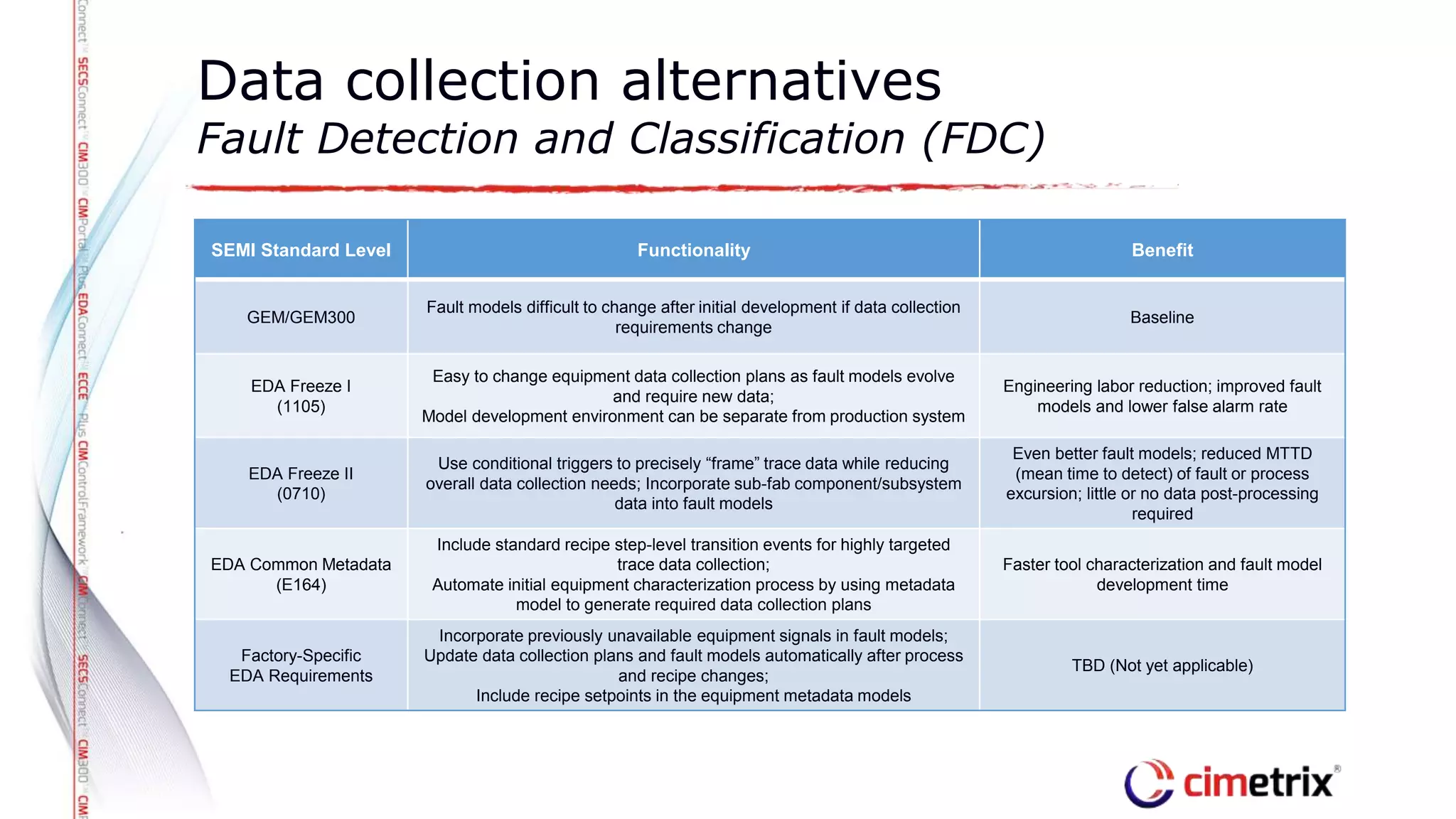
Data collection alternatives
Fault Detection and Classification (FDC)
SEMI Standard Level Functionality Benefit
GEM/GEM300
Fault models difficult to change after initial development if data collection
requirements change
Baseline
EDA Freeze I
(1105)
Easy to change equipment data collection plans as fault models evolve
and require new data;
Model development environment can be separate from production system
Engineering labor reduction; improved fault
models and lower false alarm rate
EDA Freeze II
(0710)
Use conditional triggers to precisely “frame” trace data while reducing
overall data collection needs; Incorporate sub-fab component/subsystem
data into fault models
Even better fault models; reduced MTTD
(mean time to detect) of fault or process
excursion; little or no data post-processing
required
EDA Common Metadata
(E164)
Include standard recipe step-level transition events for highly targeted
trace data collection;
Automate initial equipment characterization process by using metadata
model to generate required data collection plans
Faster tool characterization and fault model
development time
Factory-Specific
EDA Requirements
Incorporate previously unavailable equipment signals in fault models;
Update data collection plans and fault models automatically after process
and recipe changes;
Include recipe setpoints in the equipment metadata models
TBD (Not yet applicable)
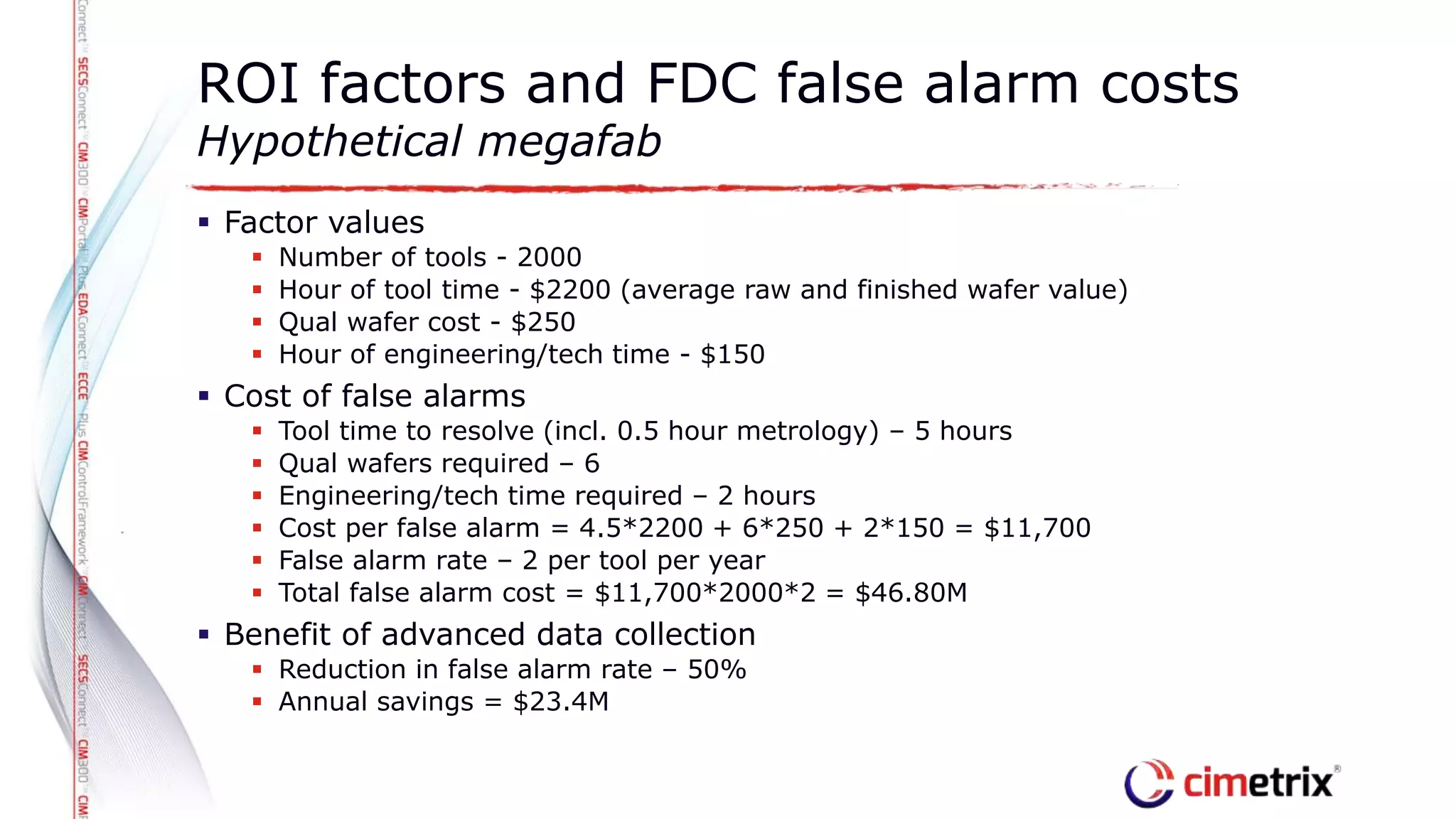
 Factor values
 Number of tools - 2000
 Hour of tool time - $2200 (average raw and finished wafer value)
 Qual wafer cost - $250
 Hour of engineering/tech time - $150
 Cost of false alarms
 Tool time to resolve (incl. 0.5 hour metrology) – 5 hours
 Qual wafers required – 6
 Engineering/tech time required – 2 hours
 Cost per false alarm = 4.5*2200 + 6*250 + 2*150 = $11,700
 False alarm rate – 2 per tool per year
 Total false alarm cost = $11,700*2000*2 = $46.80M
 Benefit of advanced data collection
 Reduction in false alarm rate – 50%
 Annual savings = $23.4M
ROI factors and FDC false alarm costs
Hypothetical megafab
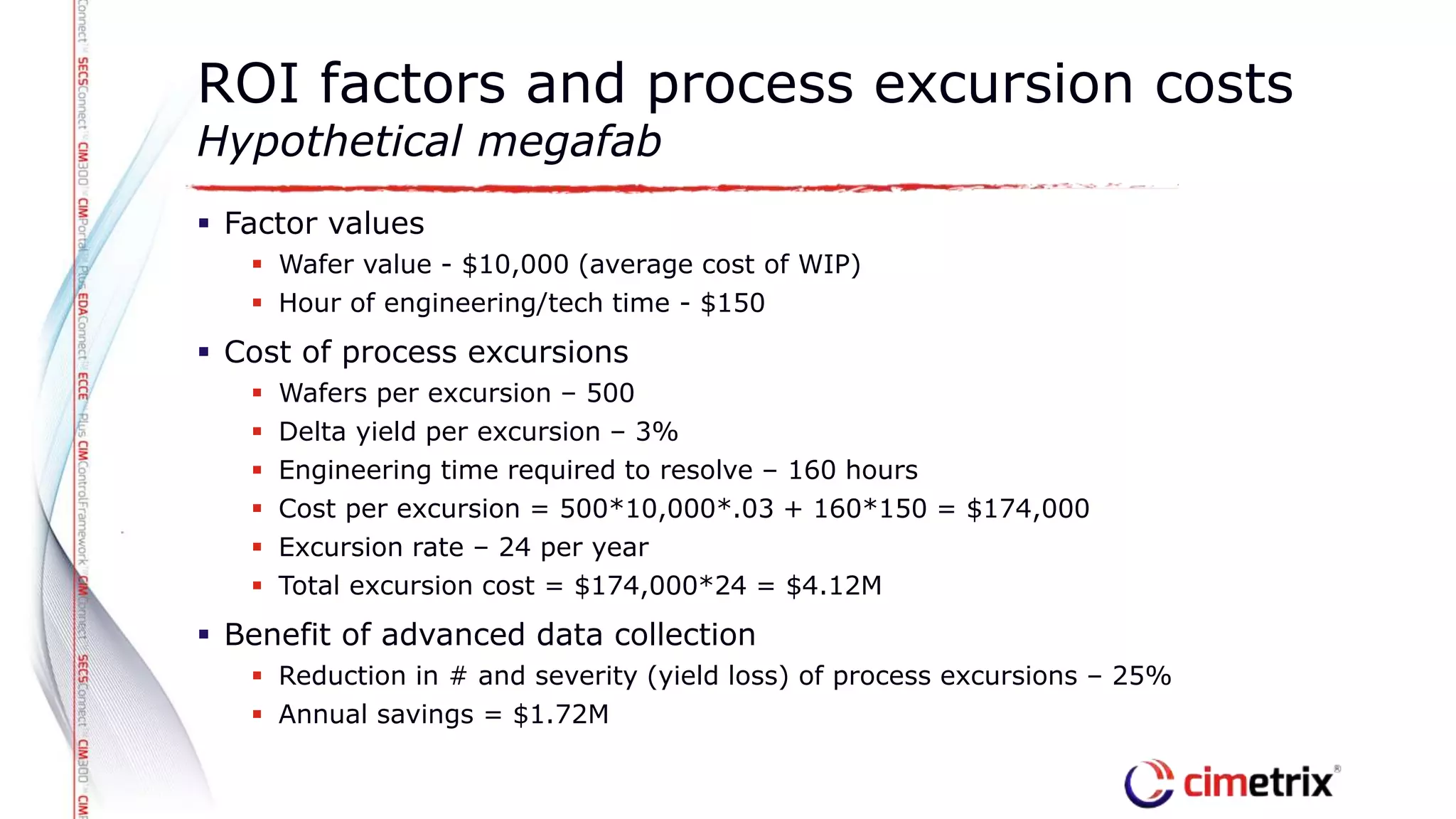
 Factor values
 Wafer value - $10,000 (average cost of WIP)
 Hour of engineering/tech time - $150
 Cost of process excursions
 Wafers per excursion – 500
 Delta yield per excursion – 3%
 Engineering time required to resolve – 160 hours
 Cost per excursion = 500*10,000*.03 + 160*150 = $174,000
 Excursion rate – 24 per year
 Total excursion cost = $174,000*24 = $4.12M
 Benefit of advanced data collection
 Reduction in # and severity (yield loss) of process excursions – 25%
 Annual savings = $1.72M
ROI factors and process excursion costs
Hypothetical megafab
 Key messages
 Keeping score with ROI
 The standardization paradox
 Data collection strategy
 EDA factory applications
 Example use case
 Factory implementation alternatives
Outline
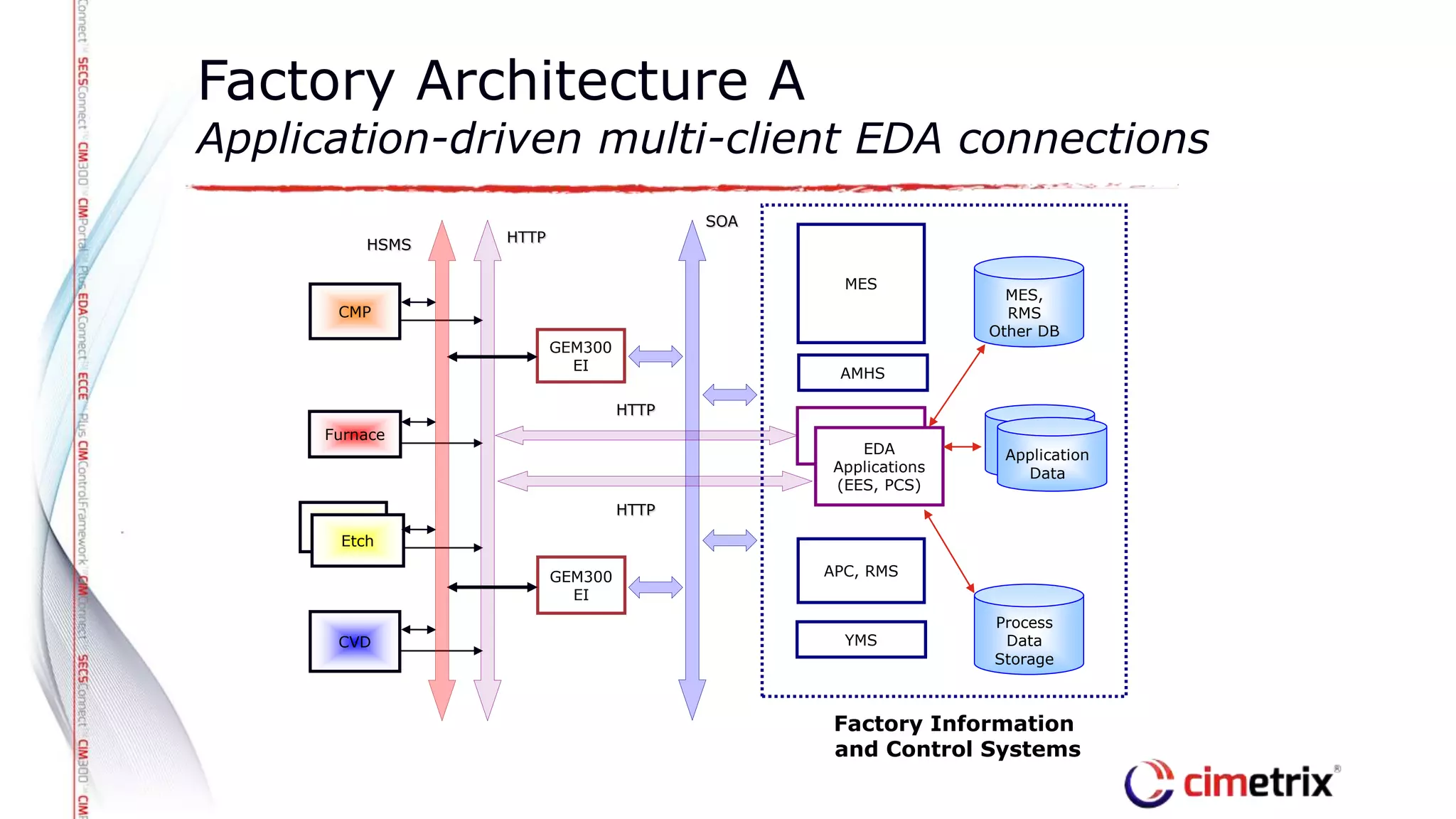
Factory Architecture A
Application-driven multi-client EDA connections
CVD
Furnace
CMP
GEM300
EI
GEM300
EI
Tool
Etch
MES
YMS
APC, RMS
HTTP
Factory Information
and Control Systems
Process
Data
Storage
HSMS
AMHS
SOA
MES,
RMS
Other DB
EDA
Applications
(EES, PCS)
Application
Data
HTTP
HTTP
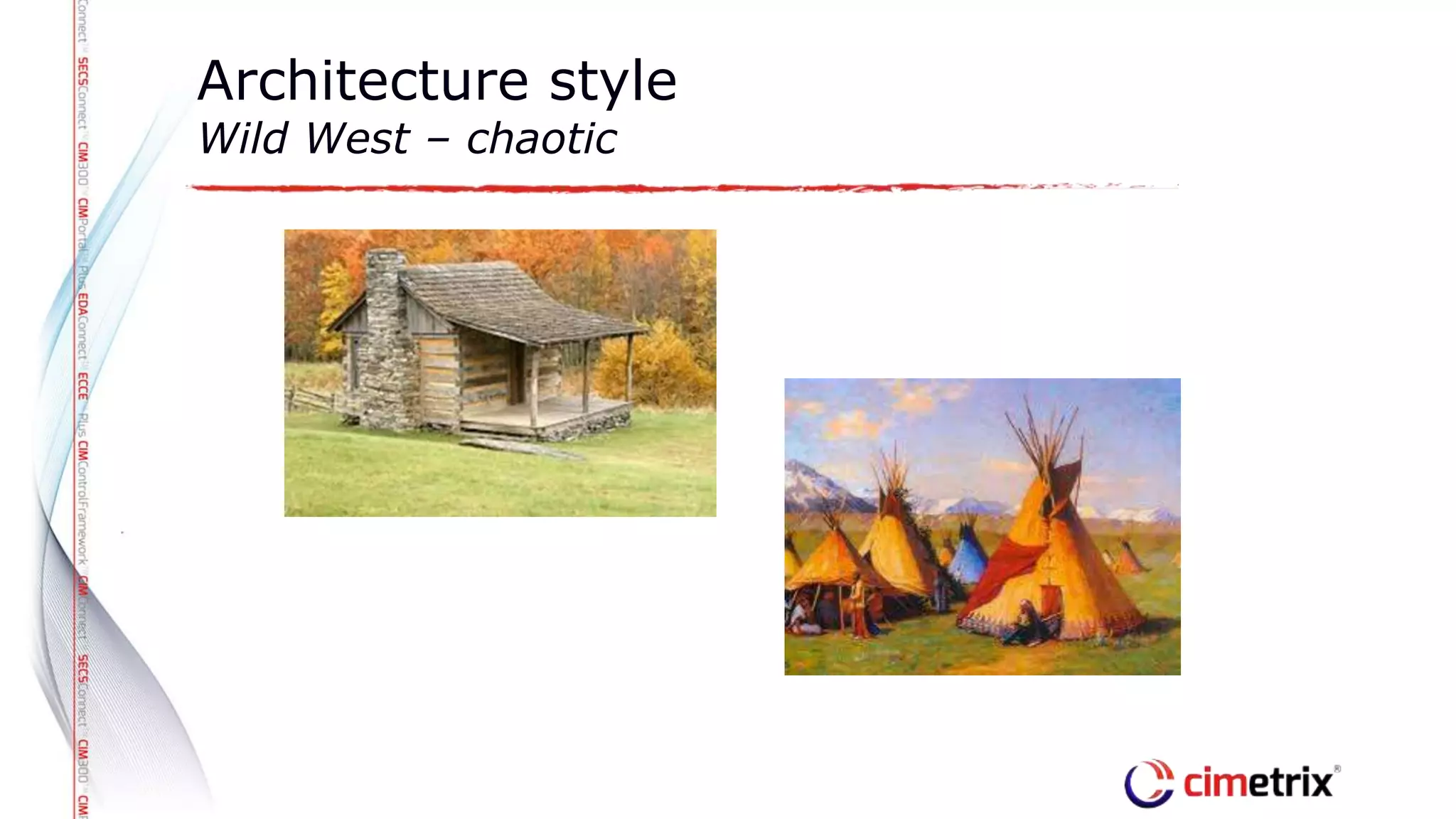
Architecture style
Wild West – chaotic
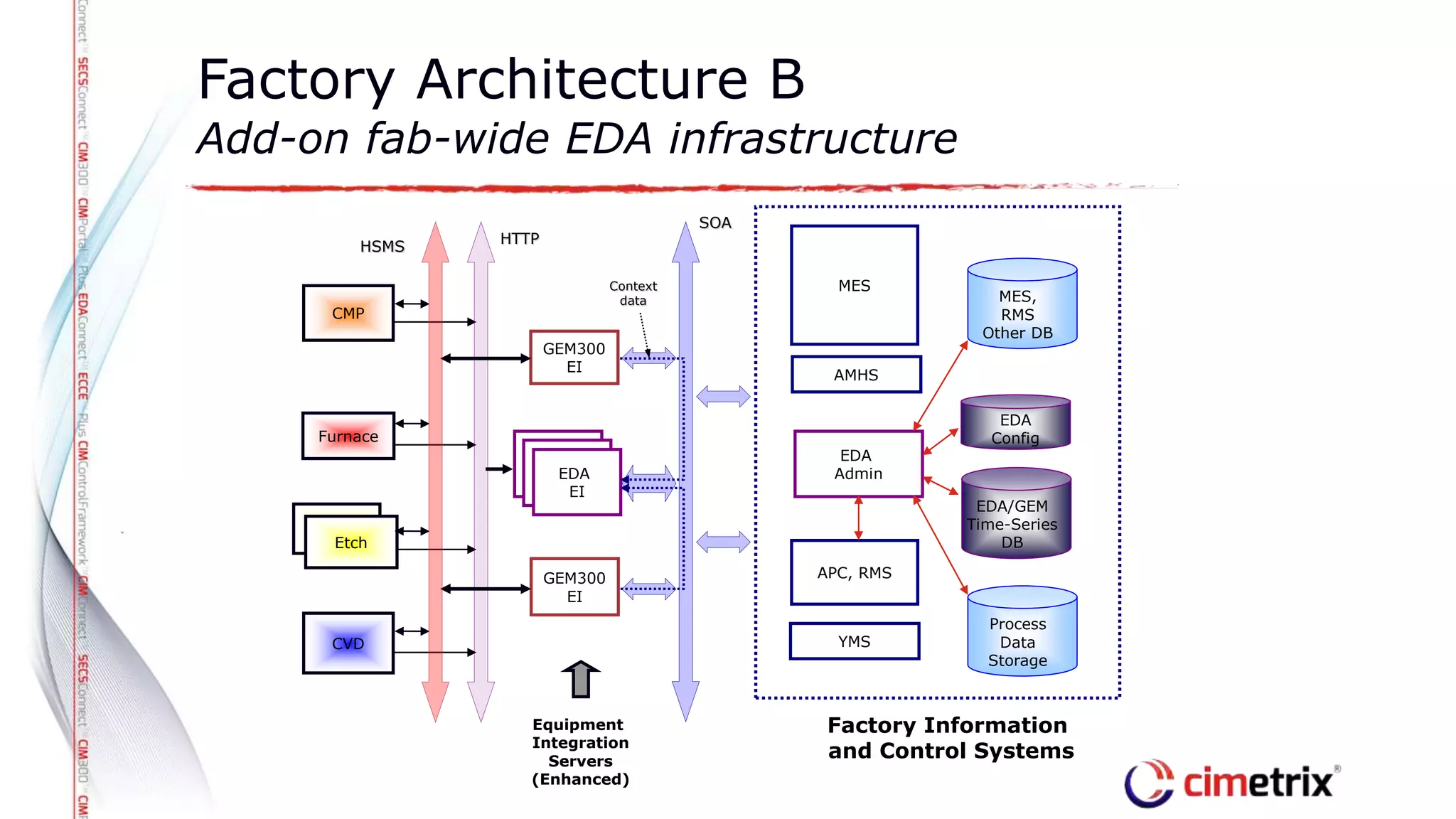
Factory Architecture B
Add-on fab-wide EDA infrastructure
CVD
Furnace
CMP
EDA
EI
GEM300
EI
GEM300
EI
Tool
Etch
MES
YMS
APC, RMS
HTTP
Factory Information
and Control Systems
Equipment
Integration
Servers
(Enhanced)
Process
Data
Storage
HSMS
AMHS
EDA/GEM
Time-Series
DB
SOA
EDA
Admin
EDA
Config
Context
data MES,
RMS
Other DB
Architecture style
Evolutionary
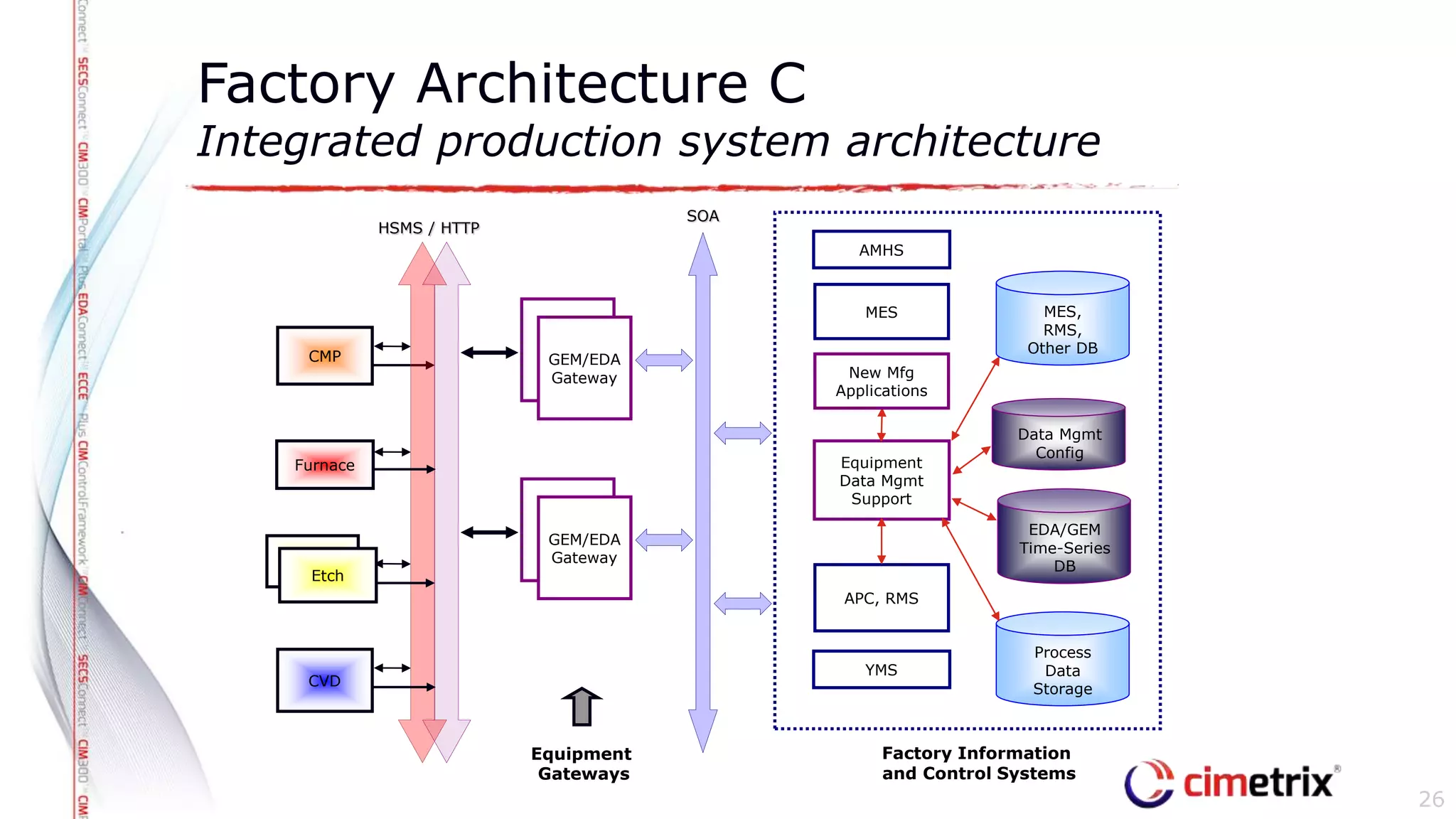
Factory Architecture C
Integrated production system architecture
26
GEM/EDA
Gateway
HSMS / HTTP
Equipment
Gateways
GEM/EDA
Gateway
SOA
MES
YMS
APC, RMS
Factory Information
and Control Systems
Process
Data
Storage
AMHS
EDA/GEM
Time-Series
DB
Equipment
Data Mgmt
Support
Data Mgmt
Config
MES,
RMS,
Other DB
CMP
Furnace
Tool
Etch
CVD
New Mfg
Applications
Architecture style
Classical
 감사합니다
 唔該
 Merci
 Danke
 多謝
 ありがとうございます
 Gracias
Acknowledgements and Thanks
 Mark Reath, Member, Technical Staff, GLOBALFOUNDRIES
 Decades of apc|m Conference organizers and participants!

EDA Applications and Benefits for Smart Manufacturing

  • 1.
    18th European AdvancedProcess Control and Manufacturing (apc|m) Conference Dresden, Germany Alan Weber – Cimetrix Incorporated EDA* Applications and Benefits for Smart Manufacturing * EDA = SEMI’s Equipment Data Acquisition standards suite
  • 2.
     Key messages Keeping score with ROI  The standardization paradox  Data collection strategy  EDA factory applications  Example use case  Factory implementation alternatives Outline
  • 3.
     It’s importantto keep score… while agreeing on the rules of the game  Standardization does not lead to conformity, but actually enables genuine transformation  Data collection should be viewed as a spectrum of alternatives, not an all-or-nothing proposition  Fabs collect data to solve specific problems… not to make life difficult for their equipment suppliers  The latest generations of SEMI standards offer many opportunities for engineering cost savings Key messages
  • 4.
    The importance ofkeeping score It’s an integral part of everyday life  Sports  Business  Politics  Science  Health  Finances  Relationships  …
  • 5.
    Keeping score withan ROI model Agree on relative cost and value of key factors Costs  Materials/outside services  Software development  Technology development  Hardware  Licenses  Internal labor  Operations  Engineering  Automation  Information technology  Capital expenses  Equipment  Other Benefits • Product material • Yield • Yield ramp • Scrap reduction • Time • Equipment/fab uptime • Factory cycle time • New Product Introduction time • Cost Reduction • Qual wafers • Hardware • Licenses • Engineering labor • Other
  • 6.
     How canstandardization result in competitive advantage?  If all fabs can gather the same data, how can a single fab differentiate itself from the others?  Consider the use of time  We all start with the same amount of time... but success favors those with the discipline to use it wisely  Think of discipline as a sort of “personal entropy reduction”  The same applies to data  It’s not what you collect, but how you use it The standardization paradox Avoiding the conformity trap
  • 7.
  • 8.
     What arethe critical decisions that need to be made?  What insights do we need to make these decisions?  What information do we need to get these insights?  What data must we collect to get the information we want? Data collection strategy Start with the goal and work backwards Source: McKinsey & Company Insights Information Data Decisions
  • 9.
    KPIs, stakeholders, applications,… Importance of the equipment model 9 Key Performance Indicators (KPIs) Factory Stakeholders Manufacturing Applications Data Equipment Model
  • 10.
    EDA purchase specdevelopment Process and results 10 Factory Stakeholder Questionnaire Generic EDA Purchase Spec Outline Stakeholder Answers Factory EDA Purchase Specifications Manufacturing Technology Development Process-specific Supplier Response Forms Automation and Integration Supplier Relations ApplicationsInfrastructure
  • 11.
     Industrial engineers Responsible for monitoring equipment and factory throughput in real-time, identifying opportunities to eliminate wait time waste in individual equipment types as well as the overall factory, and addressing bottlenecks as they shift and emerge;  Production control staff  Responsible for determining the material release schedule and managing the factory scheduling/dispatching systems to accommodate changes in customer orders and/or factory status;  Equipment engineers  Responsible for fleet matching and management to minimize or eliminate the need to dedicate certain equipment sets for critical process steps and thereby simplify the overall factory scheduling process;  Maintenance engineers  Responsible for minimizing equipment downtime, MTTR (mean time to repair), and test wafer usage required to bring equipment back to production-ready state;  Facilities engineers  Responsible for collecting and integrating sub-fab data from pumps, chillers, exhaust systems, and other complex subsystems into the production data management infrastructure for use by a growing range of analysis applications;  Sensor integration specialists  Responsible for supplementing the built-in sensing and control capabilities of critical process and measurement equipment to support advanced process development…  Program management  Responsible to executive management for competitive manufacturing results Factory stakeholders and their careabouts 11
  • 12.
    Data collection alternatives Speccontents, tool capability SEMI Standard Level Functionality Benefit GEM/GEM300 Full support for E40, E87, E90, E94, etc. Baseline: Supplier-specific integration costs; labor-intensive SECS data collection management, tool characterization, software upgrade verification, and fault model development processes EDA Freeze I (1105) EDA basics – early metadata models, DCP-based “data on demand”, multi-client access Self-documenting interface capability; quick and easy to change data collection plans as application needs evolve; factory system architecture flexibility EDA Freeze II (0710) Conditional triggers in trace requests, simple event support, interface discovery; second-generation metadata models Precisely “frame” trace data depending on application requirements; one-click connectivity; cleaner model structures with richer event/parameter content; higher performance EDA Common Metadata (E164) Complete coverage of GEM300 and E157 objects, state machines, events; standard metadata model structure, content, and names Programmatically generate DCPs, configure generic tool applications, characterize equipment behavior; simplify mapping to factory data management systems Factory-Specific EDA Requirements Process-specific parameters for advanced feature extraction for FDC, PHM, VM; mechanism- and component-level command/response signals for fingerprinting, tool matching; etc. Dramatically increase visibility into tool and process behavior; enable advanced “smart factory” monitoring and control applications well beyond current capabilities
  • 13.
     E120/E125 CommonEquipment Model usage/content  Nodes and parameters must have meaningful descriptions  Equipment element attributes for all E120 nodes must have meaningful values  All definitions (exceptions, SMs, parameter types, units, SEMI object types) must be referenced  Strict event name enforcement  State Machines  Strict State Machine definitions  Requires E157 State Machines for all process modules  Requires E90 State Machines for all substrate locations  Requires all Parameters, Events and Exceptions defined in Freeze II standards to be present  State and transition names must match GEM300 standards What does E164 specify? Structure and content of equipment metadata
  • 14.
     Model structureexactly reflects tool hardware organization  Complete description of all potentially useful information in the tool  Always accurate, always available – no additional documentation required  Common point of reference among tool, process, and factory stakeholders  Source of unambiguous identifiers/tags for database [auto] configuration  Enables “plug and play” applications Standard metadata model benefits First specified by SEMI E164 Process Module #1 Gate Valve Data Substrate Location Utilization More Data, Events, Alarms Process Tracking Other Components
  • 15.
     Key messages Keeping score with ROI  The standardization paradox  Data collection strategy  EDA factory applications  Example use case  Factory implementation alternatives Outline
  • 16.
     Real-time throughputmonitoring  Precision FDC feature extraction  Specialty sensor data access  Fleet matching and management  eOCAP execution support  Sub-fab data integration/analysis  Automated equipment characterization EDA factory applications Current leading edge 16 Wide range of stakeholder coverage
  • 17.
     Description  Multivariatestatistics used to develop reduced-dimension equipment fault models for various operating points  Fault models evaluated in real-time to detect process drift and/or impending tool failure  May interdict tool operation in mid-run to prevent/reduce scrap  KPIs affected  Process yield and scrap rate through higher detection sensitivity  Equipment availability resulting from fewer false positives  EDA leverage  Conditional triggers in trace request frame data collection  Metadata model contains context to select proper fault detection algorithms  Multi-client access to develop, evaluate, and update fault models Example use case Multivariate Fault Detection and Classification (FDC)
  • 18.
    Data collection alternatives FaultDetection and Classification (FDC) SEMI Standard Level Functionality Benefit GEM/GEM300 Fault models difficult to change after initial development if data collection requirements change Baseline EDA Freeze I (1105) Easy to change equipment data collection plans as fault models evolve and require new data; Model development environment can be separate from production system Engineering labor reduction; improved fault models and lower false alarm rate EDA Freeze II (0710) Use conditional triggers to precisely “frame” trace data while reducing overall data collection needs; Incorporate sub-fab component/subsystem data into fault models Even better fault models; reduced MTTD (mean time to detect) of fault or process excursion; little or no data post-processing required EDA Common Metadata (E164) Include standard recipe step-level transition events for highly targeted trace data collection; Automate initial equipment characterization process by using metadata model to generate required data collection plans Faster tool characterization and fault model development time Factory-Specific EDA Requirements Incorporate previously unavailable equipment signals in fault models; Update data collection plans and fault models automatically after process and recipe changes; Include recipe setpoints in the equipment metadata models TBD (Not yet applicable)
  • 19.
     Factor values Number of tools - 2000  Hour of tool time - $2200 (average raw and finished wafer value)  Qual wafer cost - $250  Hour of engineering/tech time - $150  Cost of false alarms  Tool time to resolve (incl. 0.5 hour metrology) – 5 hours  Qual wafers required – 6  Engineering/tech time required – 2 hours  Cost per false alarm = 4.5*2200 + 6*250 + 2*150 = $11,700  False alarm rate – 2 per tool per year  Total false alarm cost = $11,700*2000*2 = $46.80M  Benefit of advanced data collection  Reduction in false alarm rate – 50%  Annual savings = $23.4M ROI factors and FDC false alarm costs Hypothetical megafab
  • 20.
     Factor values Wafer value - $10,000 (average cost of WIP)  Hour of engineering/tech time - $150  Cost of process excursions  Wafers per excursion – 500  Delta yield per excursion – 3%  Engineering time required to resolve – 160 hours  Cost per excursion = 500*10,000*.03 + 160*150 = $174,000  Excursion rate – 24 per year  Total excursion cost = $174,000*24 = $4.12M  Benefit of advanced data collection  Reduction in # and severity (yield loss) of process excursions – 25%  Annual savings = $1.72M ROI factors and process excursion costs Hypothetical megafab
  • 21.
     Key messages Keeping score with ROI  The standardization paradox  Data collection strategy  EDA factory applications  Example use case  Factory implementation alternatives Outline
  • 22.
    Factory Architecture A Application-drivenmulti-client EDA connections CVD Furnace CMP GEM300 EI GEM300 EI Tool Etch MES YMS APC, RMS HTTP Factory Information and Control Systems Process Data Storage HSMS AMHS SOA MES, RMS Other DB EDA Applications (EES, PCS) Application Data HTTP HTTP
  • 23.
  • 24.
    Factory Architecture B Add-onfab-wide EDA infrastructure CVD Furnace CMP EDA EI GEM300 EI GEM300 EI Tool Etch MES YMS APC, RMS HTTP Factory Information and Control Systems Equipment Integration Servers (Enhanced) Process Data Storage HSMS AMHS EDA/GEM Time-Series DB SOA EDA Admin EDA Config Context data MES, RMS Other DB
  • 25.
  • 26.
    Factory Architecture C Integratedproduction system architecture 26 GEM/EDA Gateway HSMS / HTTP Equipment Gateways GEM/EDA Gateway SOA MES YMS APC, RMS Factory Information and Control Systems Process Data Storage AMHS EDA/GEM Time-Series DB Equipment Data Mgmt Support Data Mgmt Config MES, RMS, Other DB CMP Furnace Tool Etch CVD New Mfg Applications
  • 27.
  • 28.
     감사합니다  唔該 Merci  Danke  多謝  ありがとうございます  Gracias Acknowledgements and Thanks  Mark Reath, Member, Technical Staff, GLOBALFOUNDRIES  Decades of apc|m Conference organizers and participants!