Technology The learning return on our  educational investment Presented by Heidi Benson
Investments will promote . . . Academic achievement Critical-thinking skills Individual learning needs Positive attitudes  Preparation for future Educational return
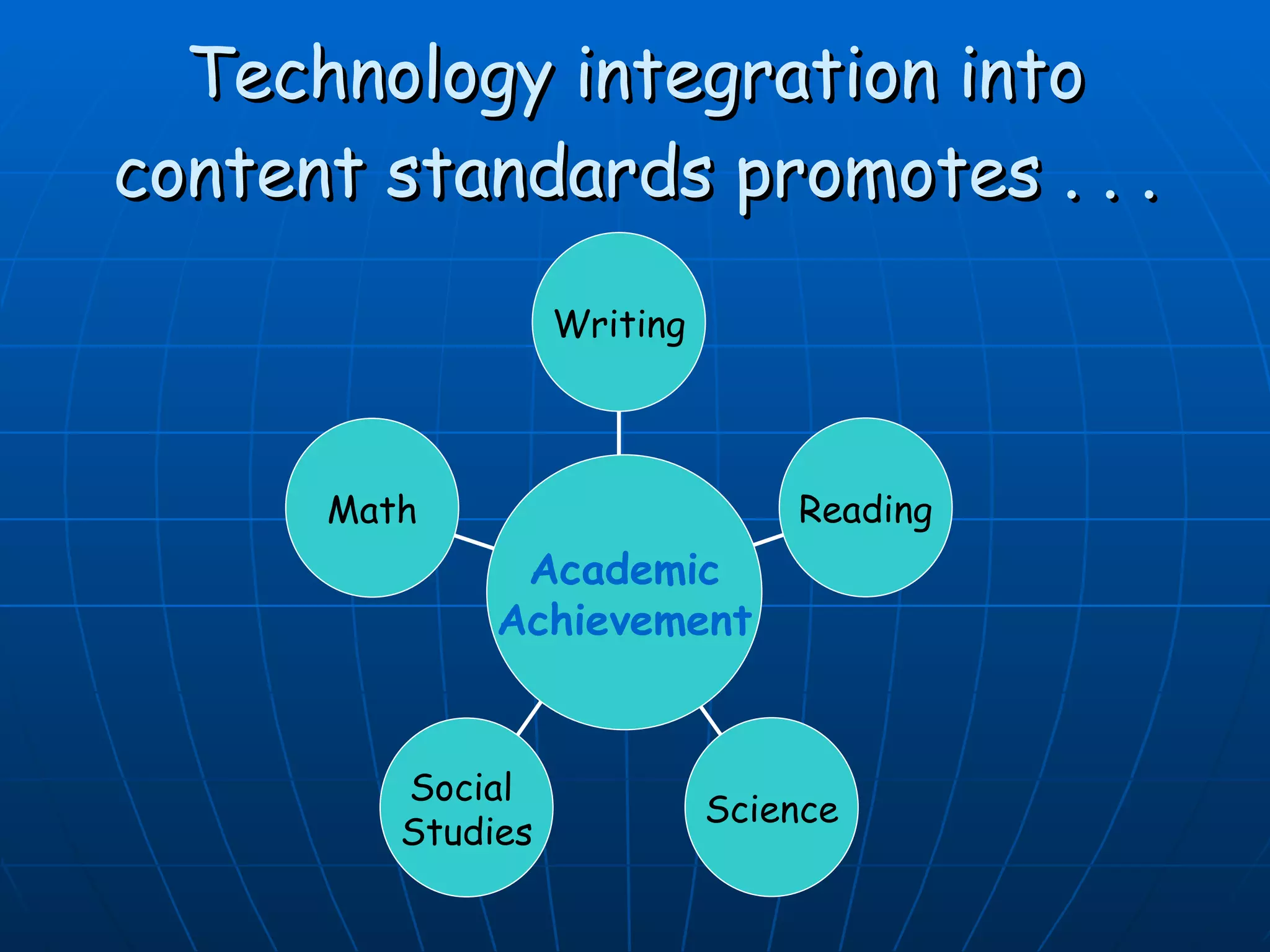
Technology integration into content standards promotes . . . Math Social  Studies Science Reading Writing Academic Achievement
Research says . . . Students who, starting in first grade, used computers as tutors to enhance content standards . . .  -showed higher gains on statewide tests -had higher grades in high school -took more advanced  placement courses  -were more likely to graduate   West Virginia Basic Skills Study - (Barnett, 2003) Students who had computers in their elementary classrooms and used software aligned with their state’s content standards . . . -received higher scores on standardized tests in both low  and high achieving schools -had higher GPAs in high school -enrolled in more advanced math courses in middle school   Project Child – (Ringstaff & Kelley, 2002)
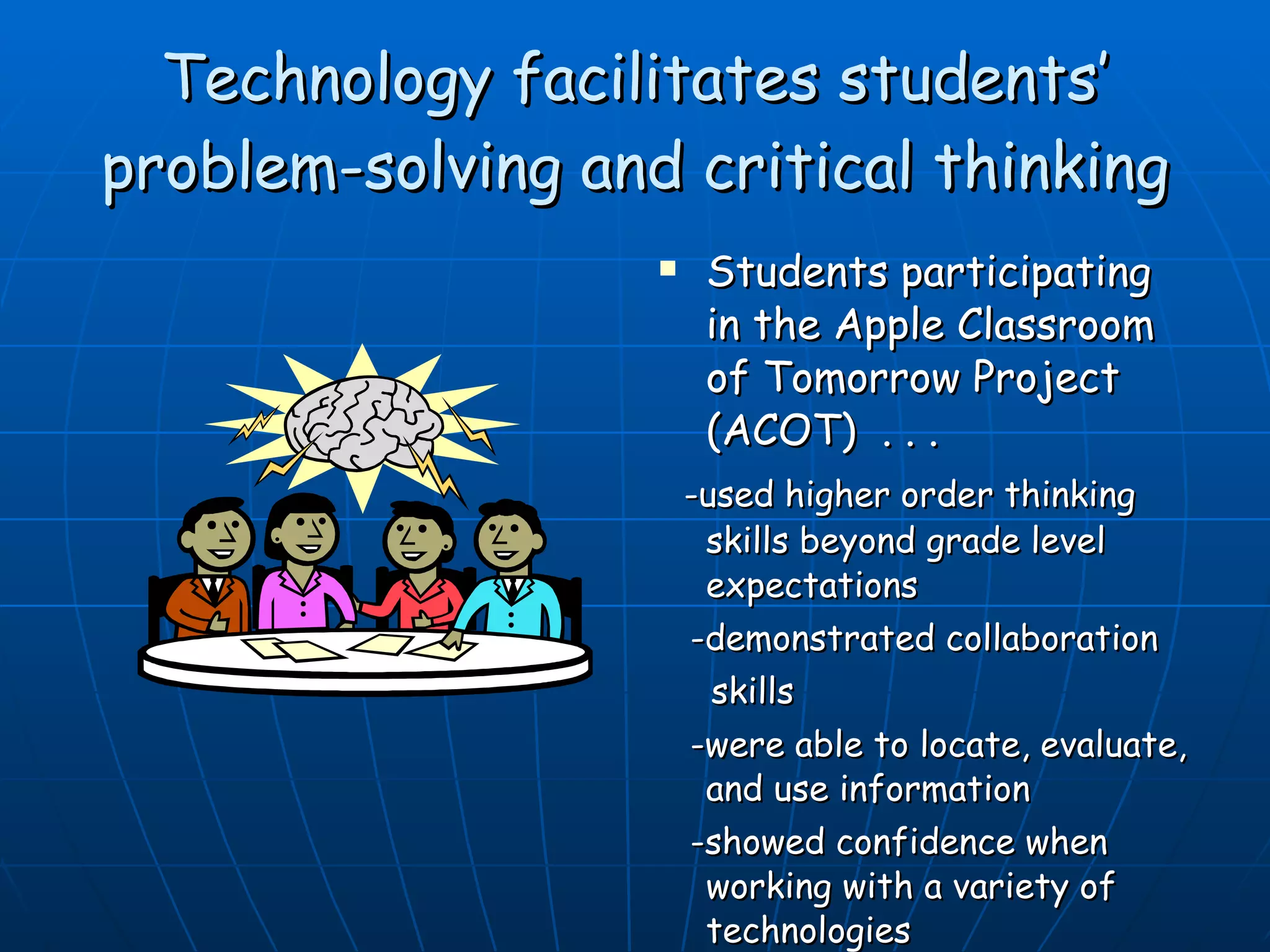
Technology facilitates students’ problem-solving and critical thinking Students participating in the Apple Classroom of Tomorrow Project (ACOT)  . . . -used higher order thinking skills beyond grade level expectations -demonstrated collaboration skills -were able to locate, evaluate, and use information -showed confidence when working with a variety of technologies ACOT – (Barnett, 2003)
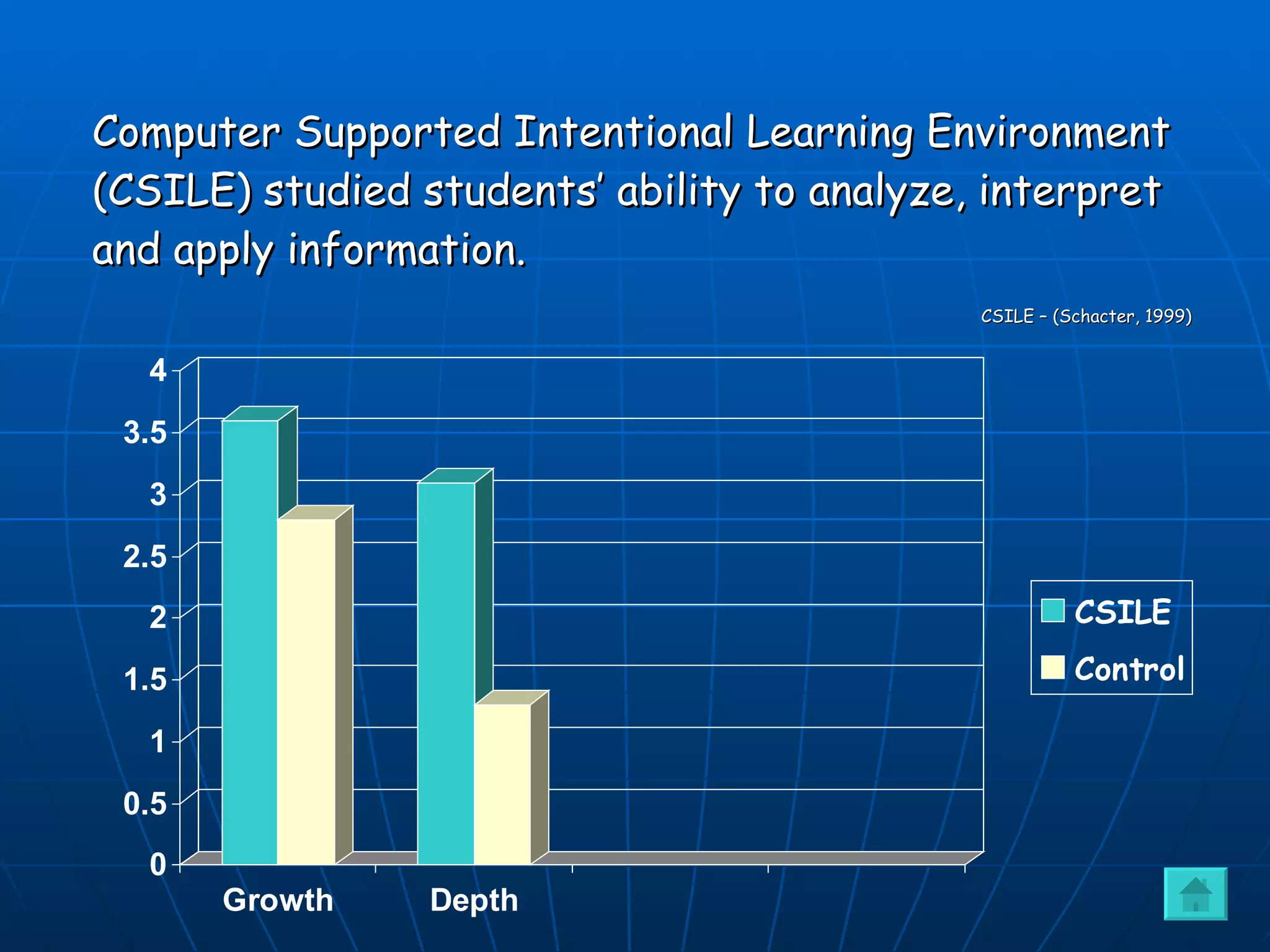
Computer Supported Intentional Learning Environment (CSILE) studied students’ ability to analyze, interpret and apply information.  CSILE – (Schacter, 1999)
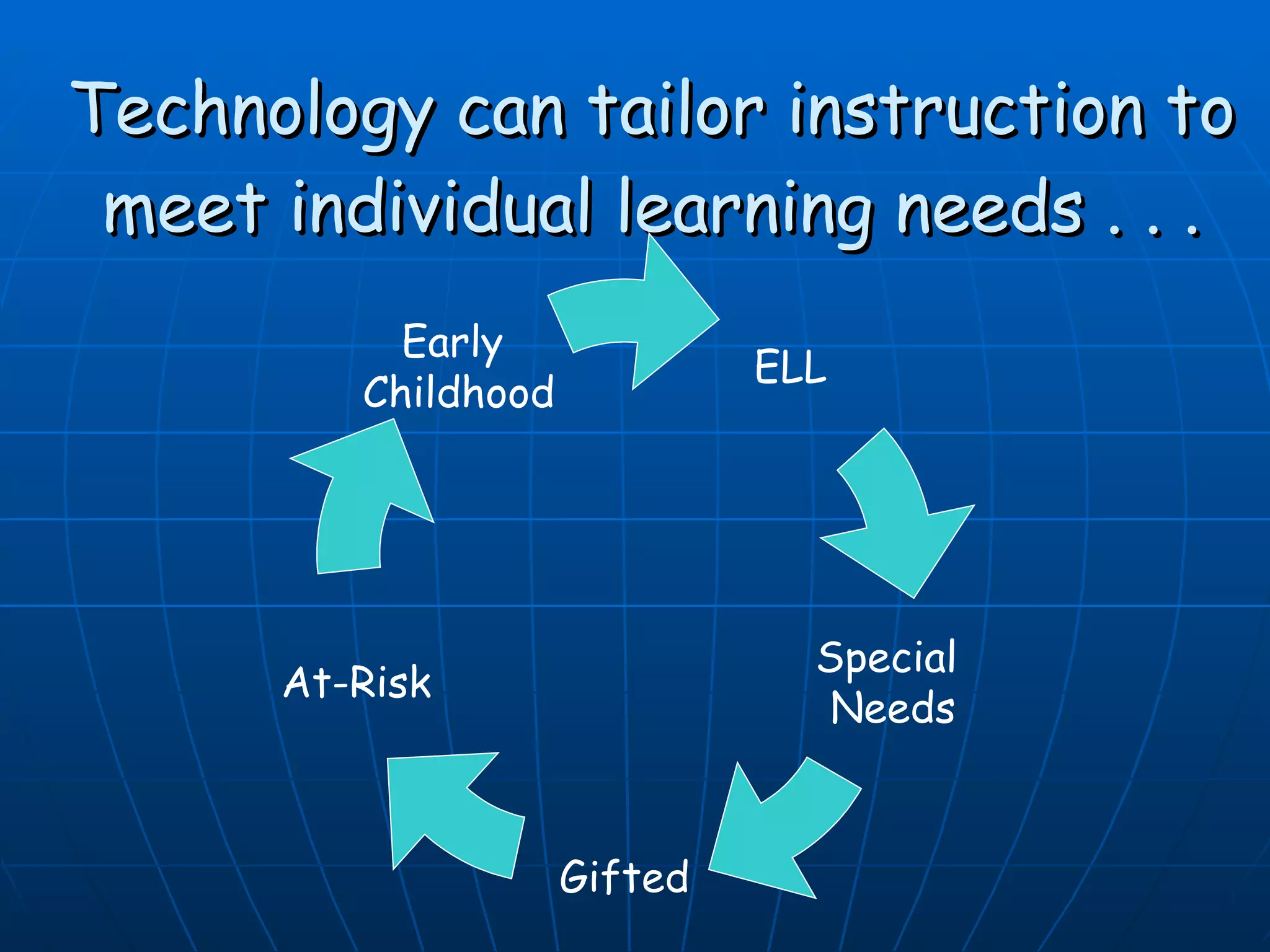
Technology can tailor instruction to meet individual learning needs . . . ELL At-Risk Early  Childhood Special  Needs Gifted
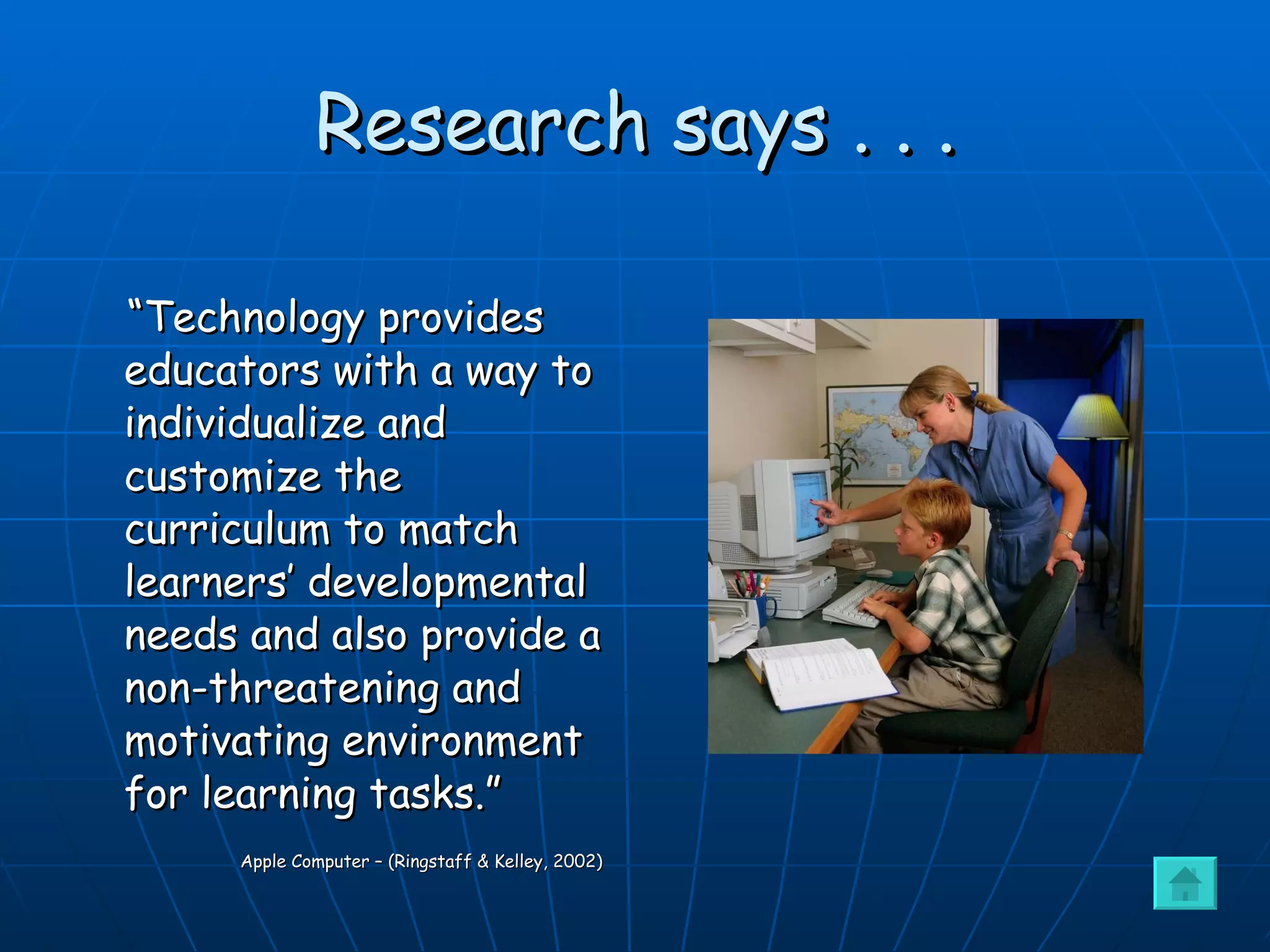
Research says . . . “ Technology provides educators with a way to individualize and customize the curriculum to match learners’ developmental needs and also provide a non-threatening and motivating environment for learning tasks.”   Apple Computer – (Ringstaff & Kelley, 2002)
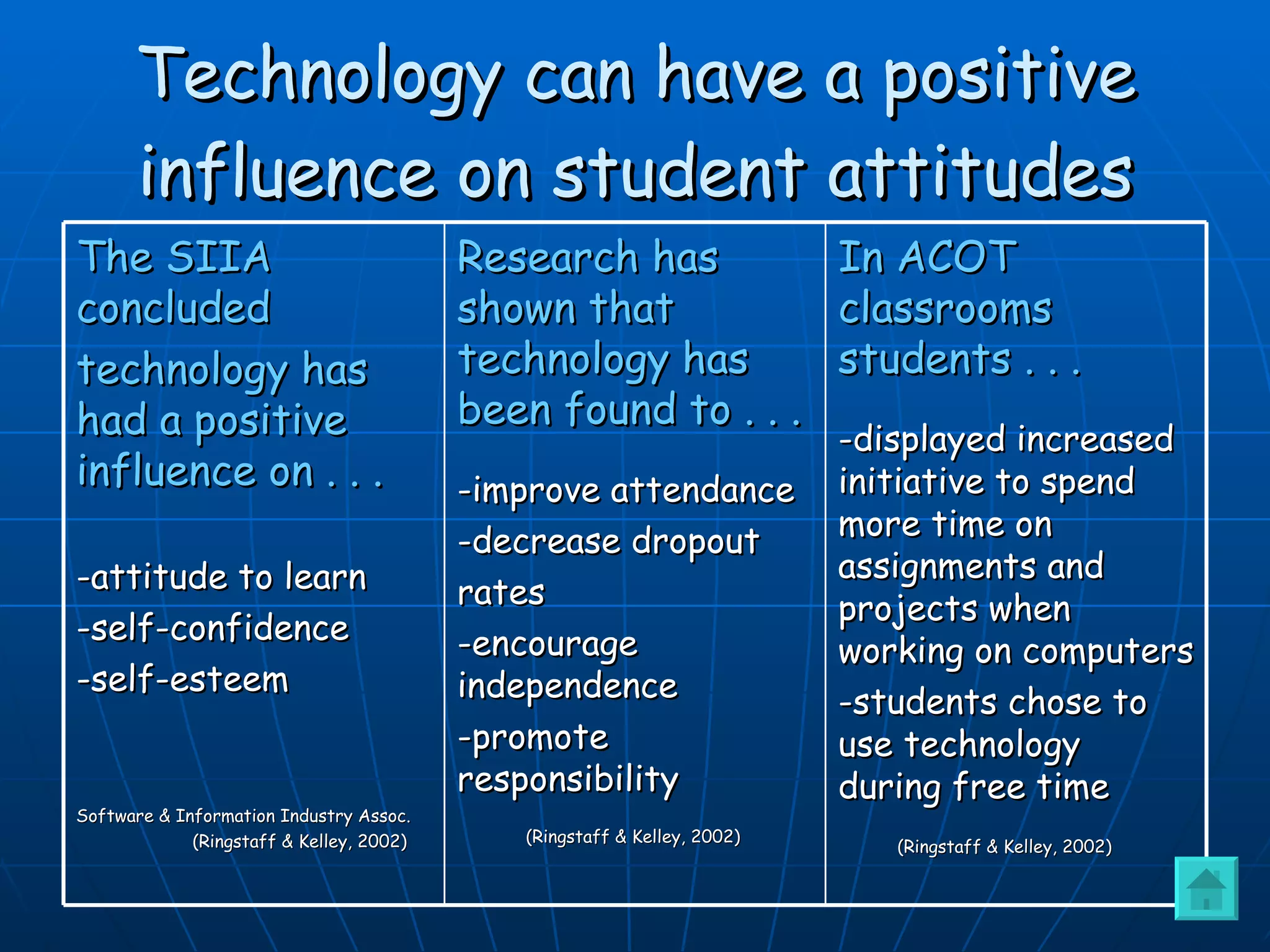
Technology can have a positive influence on student attitudes The SIIA concluded  technology has had a positive influence on . . . -attitude to learn -self-confidence -self-esteem Software & Information Industry Assoc. (Ringstaff & Kelley, 2002) Research has shown that technology has been found to . . . -improve attendance -decrease dropout rates -encourage  independence -promote responsibility (Ringstaff & Kelley, 2002) In ACOT classrooms students . . . -displayed increased initiative to spend more time on assignments and projects when working on computers -students chose to use technology during free time (Ringstaff & Kelley, 2002)
Technology provides opportunities for students to prepare for the future The use of technology can enhance “important skills that will be valued in the workplace, such as locating and accessing information, organizing and displaying data, working collaboratively, and creating persuasive arguments”   (Ringstaff & Kelley, 2002)
“ When content and problem-solving strategies meet accepted educational standards, technology increases mastery of vocational and workforce skills and helps prepare students for work”  (Cradler, 2002)
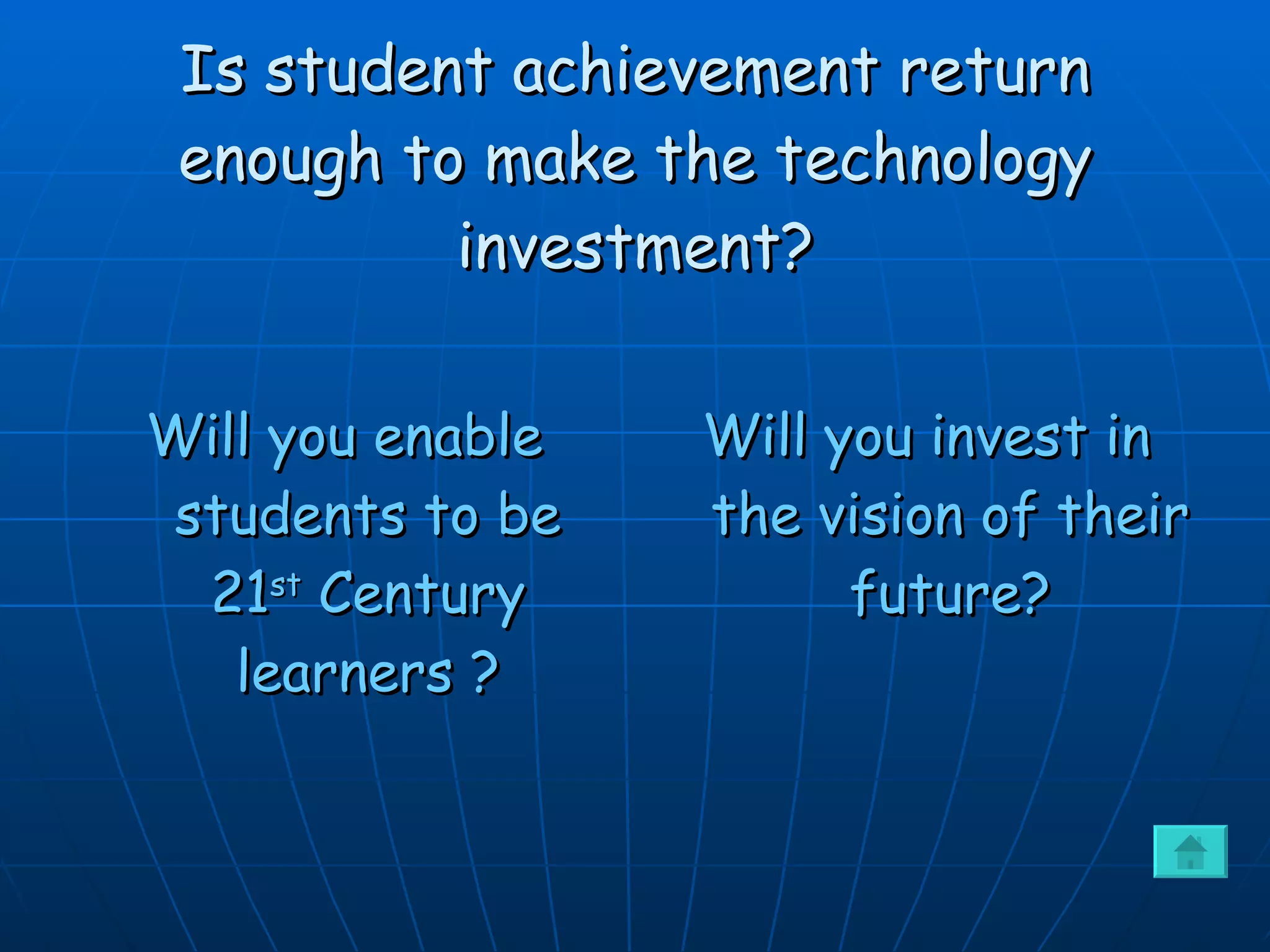
Is student achievement return enough to make the technology investment? Will you enable students to be 21 st  Century learners ? Will you invest in the vision of their future?

Ed 633 powerpoint final

  • 1.
    Technology The learningreturn on our educational investment Presented by Heidi Benson
  • 2.
    Investments will promote. . . Academic achievement Critical-thinking skills Individual learning needs Positive attitudes Preparation for future Educational return
  • 3.
    Technology integration intocontent standards promotes . . . Math Social Studies Science Reading Writing Academic Achievement
  • 4.
    Research says .. . Students who, starting in first grade, used computers as tutors to enhance content standards . . . -showed higher gains on statewide tests -had higher grades in high school -took more advanced placement courses -were more likely to graduate West Virginia Basic Skills Study - (Barnett, 2003) Students who had computers in their elementary classrooms and used software aligned with their state’s content standards . . . -received higher scores on standardized tests in both low and high achieving schools -had higher GPAs in high school -enrolled in more advanced math courses in middle school Project Child – (Ringstaff & Kelley, 2002)
  • 5.
    Technology facilitates students’problem-solving and critical thinking Students participating in the Apple Classroom of Tomorrow Project (ACOT) . . . -used higher order thinking skills beyond grade level expectations -demonstrated collaboration skills -were able to locate, evaluate, and use information -showed confidence when working with a variety of technologies ACOT – (Barnett, 2003)
  • 6.
    Computer Supported IntentionalLearning Environment (CSILE) studied students’ ability to analyze, interpret and apply information. CSILE – (Schacter, 1999)
  • 7.
    Technology can tailorinstruction to meet individual learning needs . . . ELL At-Risk Early Childhood Special Needs Gifted
  • 8.
    Research says .. . “ Technology provides educators with a way to individualize and customize the curriculum to match learners’ developmental needs and also provide a non-threatening and motivating environment for learning tasks.” Apple Computer – (Ringstaff & Kelley, 2002)
  • 9.
    Technology can havea positive influence on student attitudes The SIIA concluded technology has had a positive influence on . . . -attitude to learn -self-confidence -self-esteem Software & Information Industry Assoc. (Ringstaff & Kelley, 2002) Research has shown that technology has been found to . . . -improve attendance -decrease dropout rates -encourage independence -promote responsibility (Ringstaff & Kelley, 2002) In ACOT classrooms students . . . -displayed increased initiative to spend more time on assignments and projects when working on computers -students chose to use technology during free time (Ringstaff & Kelley, 2002)
  • 10.
    Technology provides opportunitiesfor students to prepare for the future The use of technology can enhance “important skills that will be valued in the workplace, such as locating and accessing information, organizing and displaying data, working collaboratively, and creating persuasive arguments” (Ringstaff & Kelley, 2002)
  • 11.
    “ When contentand problem-solving strategies meet accepted educational standards, technology increases mastery of vocational and workforce skills and helps prepare students for work” (Cradler, 2002)
  • 12.
    Is student achievementreturn enough to make the technology investment? Will you enable students to be 21 st Century learners ? Will you invest in the vision of their future?

Editor's Notes

  • #2 I am here to present evidence that shows how instructional technologies have impacted student learning positively in our nation. As I present my findings, please consider technology as an educational investment that will result in a valuable return for our students. In today’s world, computer-based technology is an important part of any modern K-12 curriculum. Students depend on educators to teach them the skills they will need throughout the 21 st century. Students and educators are counting on you to help them become 21 st century learners.
  • #3 My focus for this presentation will be on five major reasons technology investments should be promoted. I will talk in detail about each of them on the following slides. If viewing this presentation at a later time, you can use this outline to navigate through the slides to review the five main points.
  • #4 When technology is integrated into the curriculum and embedded into the content standards students will experience positive effects on achievement in all major subject areas. (Ringstaff & Kelley, 2002) Writing – Students working through the writing process use word processors to outperform their peers in content, organization, language, voice, style, and mechanics. Apple Computer (Ringstaff & Kelley, 2002) Reading – Software tutorials with animated objects and words increased readers’ verbal recall of stories, with improved comprehension. Students who used computers to assist with reading performed significantly better on tests of word identification and passage comprehension in a study done from 1990-1997 that assessed effects of technology on learning and achievement of all age learners. Sivin-Kachala Review (Schacter, 1999) Science – Science software and web-based programs that ask students to interact with content, graph and interpret data, draw conclusions, or demonstrate the use of the scientific process have resulted in “significantly higher achievement in content knowledge and in science process skills” than for students who haven’t had access to such learning tools. Siven-Kachala Review (Schacter, 1999) Social Studies – The depth and range of Internet research available on the Internet lead to increased student achievement in this content area. Students can access virtual field trips, email peers around the globe, access museums, archives, web quests, simulations, and current events. (Ringstaff & Kelley, 2002) Math – Technology has the ability to present abstract math concepts in a concrete way, providing students with a visual way to comprehend difficult math concepts. Instructional software or web-based access to interactive math lessons also promote student achievement. (Ringstaff & Kelley, 2002)
  • #5 Research tells us that in order for educators to use technology effectively, they must understand how it fits into the larger curriculum and instructional framework. Instead of “teaching technology”, such as keyboarding or word processing, teachers should “use technology as a tool to teach the curriculum”. (Ringstaff & Kelley, 2002) The West Virginia Skills Study and Project Child also promoted on-going teacher training and computers available for use in classrooms, not just in lab environments. (Barnett, 2003)
  • #6 The Apple Classrooms of Tomorrow project was a ten year study that provided teachers and students in five different schools around the country, with continual access to technology equipment, training and support. An evaluation on student learning found that, “when compared to their not-ACOT peers, ACOT students routinely employed inquiry, collaborative, technological, and problem-solving skills uncommon to graduates of traditional high school programs” (Ringstaff & Kelley, 2002) Technology-enriched environments result in new experiences for students that require higher-level reasoning and problem solving, which, in turn, have a positive effect on student achievement. (Ringstaff & Kelley, 2002) Students are more likely to discover and understand practical implications and gain knowledge that can be applied beyond the classroom when exposed to technology tools. (Cradler, McNabb, Freeman, & Burchett, 2002)
  • #7 The Computer Supported Intentional Learning Environment is the most widely studied collaborative computer application in schools today. It asks entire classrooms of students to come up with ideas, respond to, and reframe what is said and written over time on computers. CSILE promotes student reflection and encourages progressive thought applying multiple perspectives, and independent thinking. (Schacter, 1999) Students from the study surpassed those of the control in knowledge growth and depth of understanding. The academic growth was shown in standardized reading, language, and vocabulary tests. The depth of understanding measured inferential and interpretive comprehension. (Schacter, 1999)
  • #8 The impact of technology on specific populations of students has uncovered a variety of methods for individualizing instruction. Teacher integration of technology can be flexible enough to allow specific learner needs to be addressed. (Ringstaff & Kelley, 2002) Early Childhood – Technology integration with young children show they achieve higher growth in memory and visual perception skills, word identification, and comprehension than their non-computer using peers. Math software and interactive math activities have been shown to improve patterning, classification, sequencing, and graphing skills. As students begin to write, use of speech synthesizers, word processors, printers, and smart boards allow children to see and hear their own words in print. Silvin-Kachala Review – (Schacter, 1999) English Language Learners – Writing skills are improved using word processing software, which results in higher quality writing. Read-aloud features of computers allows the ELL student to process language in both visual and auditory modalities. Silvin-Kachala Review – (Schacter, 1999) Special Needs – Video and interactive technologies give learning disabled students an advantage in vocabulary development and reading comprehension achievement compared to those who were not exposed. Computers often provide the opportunity to make inclusion possible and more effective. Silvin-Kachala Review – (Schacter, 1999) Gifted – Learning can be based on students’ interests and done at their own pace with technology supplying a wide range of materials and resources. (Ringstaff & Kelley, 2002) At-Risk – Integration of technology is associated with better attendance, more time on task, fewer drop out rates, and fewer disciplinary problems. Basic skills are mastered more effectively when students have the opportunity to practice those skills using technology. Apple Computer - (Ringstaff & Kelley, 2002)
  • #9 One of the most powerful uses of technology is to design instruction to students’ individual learning needs and to accommodate students’ different learning styles. (Ringstaff & Kelley, 2002) For technology to have the impact research says it can, many teachers will have to learn more than just new technology skills; they will need to learn new instructional strategies and new roles. Districts will need to ensure that teachers have the opportunity and support to make these changes happen. (Barnett, 2003)
  • #10 Research shows that integration of technology into students’ daily school lives has a significant positive influence on their attitudes and motivation to learn. This hold true across any population of student, age, or subject area. Apple Computer – (Ringstaff & Kelley, 2002) Motivation - Students look forward to assignments that integrate technology. Attitude – Meaningful and authentic uses of technology as a tool inspire students to learn more effectively. Students have less anxiety and are apt to view education as important Social skills – Working with others on projects using technology requires skill in getting along with others. Students learn how to collaborate to solve problems Confidence – Learning with technology helps students to be successful. Students are then more likely to feel confident attempting new challenges and take more pride in their work Self-directed learning – Students who become proficient using technology tools tend to make meaningful decisions. Meta-cognitive awareness is enhanced, which, in turn, increases academic achievement Silvin-Kachala Review – (Schacter, 1999) Apple Computer – (Ringstaff & Kelley, 2002)
  • #11 Research shows that when students learn to use applications found in the world of work, such as word processors, spreadsheets, Web-site developmental programs, and the Internet, they acquire some prerequisite workplace skills. Integration of technology with thematic and interdisciplinary projects can also enhance career preparation. A study of four health career programs in California demonstrated the effectiveness of work-based learning models such as Tech Prep and career academics. Students’ work experiences were integrated with academic subjects like math, English, science, and social studies. These programs allowed high school students to gain valuable knowledge about how to conduct themselves in actual workplace environments. In a report on the state of technology integration in Minnesota, schools have seen the benefits of using information technologies, such as new basics or new basics plus , to bring the world of work into the classroom. (Cradler, McNabb, Freeman & Burchett, 2002)
  • #12 Technology plays a pivotal role in helping school communities reach their educational goals. (Cradler, McNabb, Freeman, & Burchett, 2002) The vision of our school is that students, faculty, and staff will be enabled by technology to solve problems, improve their productivity, and gain the skills necessary to become life-long learners and contributing members of society. (Fertile-Beltrami Technology Plan) Our school board, superintendent, and principal must have a vision of how technology will support student learning and teacher productivity in our school. Leadership is the single most important factor affecting the successful integration of technology in education. (Barnett, 2003)
  • #13 Will you enable students to be 21 st century learners? Research has proven that your technology investments will help our students to succeed in the 21 st century. The investments will . . . -promote academic achievement -create critical thinkers and problem solvers -accommodate students’ individual learning needs -promote positive attitudes and motivation to learn -prepare our students for a productive future Will you invest in the vision of their future?