European Conference in Technology and Society
June 27-28, 2013
International University of Sarajevo

Impact of Global Financial Crisis on The
Financial Stability of Bosnia and Herzegovina:
Can The Islamic Financial Model Help?
Nerma Saračević
dr.sc. Ivica Katavić
mr.sc. Dragan Kopecki
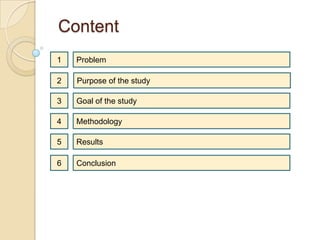
Content
1

Problem

2

Purpose of the study

3

Goal of the study

4

Methodology

5

Results

6

Conclusion
1

Problem

• The recent global financial crisis presents a
significant risk to the financial stability of Bosnia
& Herzegovina (B&H)
2

Purpose of the study

• The purpose of this study is to explore the
impact of the global financial crisis on the
financial stability of Bosnia and Herzegovina
(B&H) and propose a new financial system
based on Islamic bank's principles that would
take over the function of coordinating and
guiding financial institutions in B&H
3

Goal of the study

• The goal of this study is to achieve a deeper understanding about
the global financial crisis and how Islamic bank principles may
contribute to financial stability of B&H.
• In order to achieve this goal, the specific research questions were
developed to guide this study.

RQ1. What is the historical background of the financial crises?
RQ2. What is the impact of the global ongoing financial crisis
on the financial stability of B&H?
RQ3. What are the main financial stability challenges and
opportunities in B&H?
RQ4. How can Islamic banking system be used to create a new
financial system that contributes to the financial stability
of B&H?
RQ5. How will new financial system contribute to the financial
stability in B&H?
4

Metodology

• Research design: Qualitative study
• Data collection:
a) Semi-structured interviews
• Target population (N ≈ 100): executive managers
in the banking sector in B & H
• Sample (N ≈ 8) executive managers in the banking
sector in B & H responsible for developing and
implementing strategies for reducing the negative
impact of global financial crisis
b) Content analysis of secondary data was uses to
appraise global financial crisis, Islamic financial
system, and financial stability in B&H.
5

Results

RQ1. What is the historical background of the financial crises?
Major financial crisis

Causes

South Sea Bubble crisis (1720)

The stock exchange crashed

Great Depression (1929 1933). USA.

Increased money supply in
circulation by the Central Bank of
America (FED) and a relaxation of
credit policy and interest rate
reduction

Economic imbalances (supply /
demand), reduction of productivity,
decreased rate of profit, lower rates
of turnover and securities, …

Big stagflation (1970)

Increase of oil price

Rising inflation and falling economic
growth and gross domestic product

International financial
Southeast Asia (1990)

crisis The housing and credit booms ,
subprime bad loans

The crisis mortgage market
2007 (USA)

The housing and credit booms ,
subprime bad loans

Consequences

Devastating effects in the economy
on whole region
Decrease in gross domestic product
(GDP), the reduction of industrial
production, the reduction in exports,
an increase in unemployment

The results of the interviews are similar to the results of the secondary
sources.
5

Results

RQ2. What is the impact of the ongoing global financial crisis on
the financial stability of B&H?
The impact of the ongoing
global financial crisis on the
financial stability of B&H
The reduction of capital by major The dominance of foreign banking financial groups with
banks from abroad
95%of assets and 82% of the equity share capital
represents a significant risk to the financial stability of B&H

The rising unemployment

From 23,41% in 2008 to 28% in 2012

The decreased export

7,53% in 2012 compared to 2011

Becoming indebtedness of the The loans from abroad who approved for public
country without investing in consumption (budgets) are not in themselves in the function
production
development than in the function of consumption
The stricter credit standards of
the economy and the population

BASEL III, increase of capital adequacy ratio

The results of the interviews are similar to the results of the secondary
sources.
5

Results

RQ3. What are the main financial stability challenges and
opportunities in B&H?
Challenges

Opportunities

Financial stability and Islamic
principles

A key problem is the active
conduct of monetary policy
because it is practically in the
hands of banks that have other
priorities of the development.

One of the opportunities offered by
the crisis, i.e. the new system is to
educate the market and the
participants in the economy.

the risk-sharing according to
investment participants in the project
co-financing;

Politics, cross-party and ethnic
relations are at the forefront of
all relevant factors. We can
hardly speak of favorable
conditions in this regard.

Take advantage of ethnic and
religious diversity in attracting
investors from the East and the West

Islamic financial institutions are
business partners with their clients;

The introduction of Islamic banking is
one of the options for further
development of the banking system.

provide the link between financial
transactions and real economy

The results of the interviews are similar to the
results of the secondary sources.

prevent over debt financing, creating
a permanent equality between the
capital and the value of debts
protects deposits and prevents
overgrowth of loans
5

Results

RQ4. How can Islamic banking system be used to create a new
financial system that contributes to the financial stability of B&H?
Participant´s outcome
Islamic banking system in B&H does not exist as a separate system because the application of Islamic model
of operations of financial institutions is limited the banking legislation which treats only the commercial
banking (based on interest)
Islamic banking system as part of a new financial system in B&H is certainly welcome, if only as a means of
increasing competitiveness and capabilities greater freedom of choice by the parties as part of that system.
It can contribute to the stability of the financial system because it is based on the real economy. This country
needs a moral and ethical banking for the fair conduct of business and real recovery of trade and financial
flows.
Due to the above is the only bank that wants to do business according to Islamic
principles - BBI dd Sarajevo is framed in conventional-usurious banking.

The results of the interviews are similar to the results of the secondary
sources.
5

Results

RQ5. How will new financial system contribute to the financial
stability in B&H?

In order to successfully measure the impact of the Islamic financial system on the
financial stability in B&H, it is necessary to promote, educate all stakeholders in the
banking sector, and incorporate some Islamic banking principles into the banking
system of B&H.
Integrating the four main Islamic financial techniques (i.e., Mudaraba [Trust
Financing]; Musharaka [Joint Venture or Profit and Loss Sharing "PLS”]; Ijara
[Leasing]; and Murabaha [Mark-up financing or Cost-plus financing]) into the new
national financial system, may contribute to the financial stability in B&H.
6

Conclusion

Based on the empirical research employed in this study, the results
indicated that the proposed new financial system, which is based on
Islamic banking principles, can reduce the negative effects of the
global finanancial crisis and help the financial stability of B&H.
A new financial system should emphasize on productivity, equitqble
contracts, and profit and loss sharing.
Applying some of the Shari´ah principles into conventional banking
may produce better efficiency and stability, reduce moral hazard, and
create environment in which economic and social aspects are
balanced.
The precondition for this balance is to develop a new financial
regulatory framework to prevent the negative impact of cyclical
financial crises on the national economy.
To test how application of Islamic financial principles contributesto
financial stability of B&H, future research should be performed using
multiple methods of data collection, processes, and analysis.
Thank you for
your attention

Ects 2013 presentation

  • 1.
    European Conference inTechnology and Society June 27-28, 2013 International University of Sarajevo Impact of Global Financial Crisis on The Financial Stability of Bosnia and Herzegovina: Can The Islamic Financial Model Help? Nerma Saračević dr.sc. Ivica Katavić mr.sc. Dragan Kopecki
  • 2.
    Content 1 Problem 2 Purpose of thestudy 3 Goal of the study 4 Methodology 5 Results 6 Conclusion
  • 3.
    1 Problem • The recentglobal financial crisis presents a significant risk to the financial stability of Bosnia & Herzegovina (B&H)
  • 4.
    2 Purpose of thestudy • The purpose of this study is to explore the impact of the global financial crisis on the financial stability of Bosnia and Herzegovina (B&H) and propose a new financial system based on Islamic bank's principles that would take over the function of coordinating and guiding financial institutions in B&H
  • 5.
    3 Goal of thestudy • The goal of this study is to achieve a deeper understanding about the global financial crisis and how Islamic bank principles may contribute to financial stability of B&H. • In order to achieve this goal, the specific research questions were developed to guide this study. RQ1. What is the historical background of the financial crises? RQ2. What is the impact of the global ongoing financial crisis on the financial stability of B&H? RQ3. What are the main financial stability challenges and opportunities in B&H? RQ4. How can Islamic banking system be used to create a new financial system that contributes to the financial stability of B&H? RQ5. How will new financial system contribute to the financial stability in B&H?
  • 6.
    4 Metodology • Research design:Qualitative study • Data collection: a) Semi-structured interviews • Target population (N ≈ 100): executive managers in the banking sector in B & H • Sample (N ≈ 8) executive managers in the banking sector in B & H responsible for developing and implementing strategies for reducing the negative impact of global financial crisis b) Content analysis of secondary data was uses to appraise global financial crisis, Islamic financial system, and financial stability in B&H.
  • 7.
    5 Results RQ1. What isthe historical background of the financial crises? Major financial crisis Causes South Sea Bubble crisis (1720) The stock exchange crashed Great Depression (1929 1933). USA. Increased money supply in circulation by the Central Bank of America (FED) and a relaxation of credit policy and interest rate reduction Economic imbalances (supply / demand), reduction of productivity, decreased rate of profit, lower rates of turnover and securities, … Big stagflation (1970) Increase of oil price Rising inflation and falling economic growth and gross domestic product International financial Southeast Asia (1990) crisis The housing and credit booms , subprime bad loans The crisis mortgage market 2007 (USA) The housing and credit booms , subprime bad loans Consequences Devastating effects in the economy on whole region Decrease in gross domestic product (GDP), the reduction of industrial production, the reduction in exports, an increase in unemployment The results of the interviews are similar to the results of the secondary sources.
  • 8.
    5 Results RQ2. What isthe impact of the ongoing global financial crisis on the financial stability of B&H? The impact of the ongoing global financial crisis on the financial stability of B&H The reduction of capital by major The dominance of foreign banking financial groups with banks from abroad 95%of assets and 82% of the equity share capital represents a significant risk to the financial stability of B&H The rising unemployment From 23,41% in 2008 to 28% in 2012 The decreased export 7,53% in 2012 compared to 2011 Becoming indebtedness of the The loans from abroad who approved for public country without investing in consumption (budgets) are not in themselves in the function production development than in the function of consumption The stricter credit standards of the economy and the population BASEL III, increase of capital adequacy ratio The results of the interviews are similar to the results of the secondary sources.
  • 9.
    5 Results RQ3. What arethe main financial stability challenges and opportunities in B&H? Challenges Opportunities Financial stability and Islamic principles A key problem is the active conduct of monetary policy because it is practically in the hands of banks that have other priorities of the development. One of the opportunities offered by the crisis, i.e. the new system is to educate the market and the participants in the economy. the risk-sharing according to investment participants in the project co-financing; Politics, cross-party and ethnic relations are at the forefront of all relevant factors. We can hardly speak of favorable conditions in this regard. Take advantage of ethnic and religious diversity in attracting investors from the East and the West Islamic financial institutions are business partners with their clients; The introduction of Islamic banking is one of the options for further development of the banking system. provide the link between financial transactions and real economy The results of the interviews are similar to the results of the secondary sources. prevent over debt financing, creating a permanent equality between the capital and the value of debts protects deposits and prevents overgrowth of loans
  • 10.
    5 Results RQ4. How canIslamic banking system be used to create a new financial system that contributes to the financial stability of B&H? Participant´s outcome Islamic banking system in B&H does not exist as a separate system because the application of Islamic model of operations of financial institutions is limited the banking legislation which treats only the commercial banking (based on interest) Islamic banking system as part of a new financial system in B&H is certainly welcome, if only as a means of increasing competitiveness and capabilities greater freedom of choice by the parties as part of that system. It can contribute to the stability of the financial system because it is based on the real economy. This country needs a moral and ethical banking for the fair conduct of business and real recovery of trade and financial flows. Due to the above is the only bank that wants to do business according to Islamic principles - BBI dd Sarajevo is framed in conventional-usurious banking. The results of the interviews are similar to the results of the secondary sources.
  • 11.
    5 Results RQ5. How willnew financial system contribute to the financial stability in B&H? In order to successfully measure the impact of the Islamic financial system on the financial stability in B&H, it is necessary to promote, educate all stakeholders in the banking sector, and incorporate some Islamic banking principles into the banking system of B&H. Integrating the four main Islamic financial techniques (i.e., Mudaraba [Trust Financing]; Musharaka [Joint Venture or Profit and Loss Sharing "PLS”]; Ijara [Leasing]; and Murabaha [Mark-up financing or Cost-plus financing]) into the new national financial system, may contribute to the financial stability in B&H.
  • 12.
    6 Conclusion Based on theempirical research employed in this study, the results indicated that the proposed new financial system, which is based on Islamic banking principles, can reduce the negative effects of the global finanancial crisis and help the financial stability of B&H. A new financial system should emphasize on productivity, equitqble contracts, and profit and loss sharing. Applying some of the Shari´ah principles into conventional banking may produce better efficiency and stability, reduce moral hazard, and create environment in which economic and social aspects are balanced. The precondition for this balance is to develop a new financial regulatory framework to prevent the negative impact of cyclical financial crises on the national economy. To test how application of Islamic financial principles contributesto financial stability of B&H, future research should be performed using multiple methods of data collection, processes, and analysis.
  • 13.