Financial Stability Report (2014)
Presented By:
Dinesh Adhikari
Kiran Chaulagain
Nabin Mahatha
Saroj Shrestha
Suresh Karki
Introduction
• Based on the provisional data of
BFIs and other FIs as of mid July
2014
• Covers the development and risks
during the year to mind July 2014.
• Published by NRB, Central Office,
Banks and Financial Institutions
Regulation Department, Financial
Stability Unit.
• Aims to share information and
ensure in the functioning of the
financial system.
3/27/2016 2
Macroeconomic Development
• Global Growth is projected to rebound and the strongest
rebound in growth is expected in the United States
• Inflation will remain central bank targets and advanced
economies.
• Inflation is projected to increase gradually as the recovery
strengthens and output gaps slowly decrease in the euro
area.
• Crude oil prices started to drop form 111.8 dollar a barrel
from June 2014 to reach 87.43 in August.
3/27/2016 3
Domestic Macro economic
development.
Real GDP at basic price grew by 5.2 percent in 2013/14 compared to a
growth of 3.5 percent in the previous year.
The growth rate of the agriculture and the non agriculture sectors were
4.7 percent and 5.3 percent, respectively in 2013/14.
The annual average CPI increased by 9.1 percent in 2013/14 compared to
an increase of 9.9 percent in the previous year.
BOP has surplus of Rs. 127.1 billion.
Nepalese currency remained fairly stable during the later months of the
fiscal year.
Excess liquidity in BFIs was mopped up through OMOs in the review
period.
3/27/2016 4
Financial System Performance and
Stability
oReport depicts that the global banking system is now better capitalised
oNRB regulates commercial banks, development banks, finance
companies, micro finance financial institutions, FINGOs and
cooperatives carrying limited banking activities.
oRecently, banking system of Nepal is experiencing an encouraging
restructuring and consolidation, particularly through the merger and
acquisition
oA high level committee to enhance financial stability through improved
coordination between regulators, comprising NRB, SEBON, Insurance
Board, Department of Cooperatives, office of the Company Registrar has
been recently established.
3/27/2016 5
Number of BFIs and other
institutions.
3/27/2016 6
Financial Highlights
3/27/2016 7
Asset structure of Banks
21.6
19.7
10.5
8
7.7
4.3
Loans & advances in %
Wholeseller & retailer
Manufacturing
Constructon
Real estate
Consumption
Agriculture & Forestry
3/27/2016 8
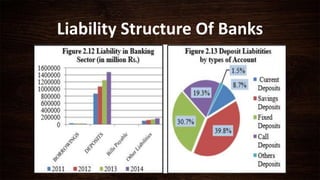
Liability Structure Of Banks
3/27/2016 9
NPL and LLP ratio
3/27/2016 10
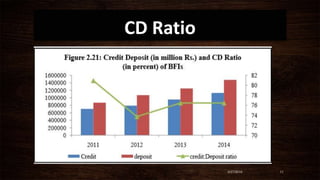
CD Ratio
3/27/2016 11
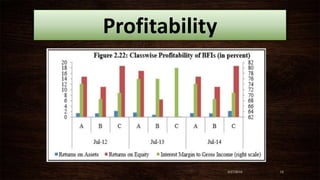
Profitability
3/27/2016 12
• Financial soundness indicators show that the banking system
performing well during the year 2013/14.
• Capital fund of BFIs increased by Rs. 14.1 billion.
• Deposits in BIFs grew by 18.2 percent.
• The overall profitability of banking sector increased by 13.0
percent.
• The overall CAR of BFIs in mid-July 2014 was 12.7 percent which
was 13.2 percent in previous year.
3/27/2016 13
Performance of Commercial
Banks
3/27/2016 14
Stress testing
Credit shock
Stress test results
shows that there is
growing risk in credit
among commercial
banks.
Liquidity shock
Results from stress tests
under liquidity shock shows
that encouraging
improvements in liquidity
resilience among
commercial banks.
3/27/2016 15
Co- Operatives
Cooperatives are supposed to be a helping hand in expanding and
deepening financial access in rural areas of the country.
Nepal Rastra Bank had licensed some cooperatives to carryout
limited banking function in 1990s.
As of mid-Jul 2014, 15 cooperatives are carrying out limited-
banking activities.
Co-operatives have emerged as one of the major pillar of the
economic as well as financial sector of the country.
Cooperatives have been mobilizing huge amount of deposits and
credits that equals to around 10.0 percent of total deposits and
credits.
3/27/2016 16
3/27/2016 17
Financial Markets
Global Financial and Money Market Perspective
•In order to stabilize financial crisis, Federal
Reserve took extraordinary actions
–Reducing short term interest rate almost to zero
–Reducing long term interest rate
–Purchased large number of treasury securities
3/27/2016 18
Domestic Financial Market
Money Market
• Short term interest rate remained low with weighted average 91-day
Treasury bill rate stood at 0.02%
• Weighted average inter bank rate among commercial banks declined to
0.16% from 0.86%
• Inter bank rate among other financial institution declined to 2.40% from
5.03%
• As per the modified method of spread rate calculation, the weighted
average interest rate spread of commercial banks stood at 5.2 percent
• The average base rate of commercial banks remained at 8.4 percent in
mid-July 2014 compared to 9.8 percent a year ago.
3/27/2016 19
Securities Market
• After second Constituent Assembly Election, there is improvement
in securities market
• NEPSE index increased by 99.9% to 1035.1 points & sensitive index
at 222…….5 points as against 130.3 points
• Market capitalization increased by 105.5 points with contribution
of 30.4 % in GDP
• Total piad up capital of listed comapanies stood at 146.5 billion
with annual growth of 16.2 %
• Commercial bank’s bond of RS 2.3 billion was also listed at NEPSE
3/27/2016 20
Foreign Exchange
• Gross FOREX reserves increased by 24.8%
• NRB’s reserve increased by 26.4%
• Convertible FOREX reserves increased by 22.9%
• Inconvertible FOREX reserves increased by 23.4%
• The existing level of reserves is sufficient for financing
merchandise imports of 11.5 months & merchandise
and service imports of 10 months
3/27/2016 21
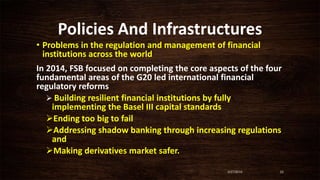
Policies And Infrastructures
• Problems in the regulation and management of financial
institutions across the world
In 2014, FSB focused on completing the core aspects of the four
fundamental areas of the G20 led international financial
regulatory reforms
 Building resilient financial institutions by fully
implementing the Basel III capital standards
Ending too big to fail
Addressing shadow banking through increasing regulations
and
Making derivatives market safer.
3/27/2016 22
Continue…
• Basel I and II only concentrated to the capital not with liquidity.
• NRB has developed its own liquidity monitoring framework for the
short-term liquidity monitoring of the banks
• Nepalese commercial banks will be fully compliant with the Basel III
regulations by 2019 starting early 2015.
• BFIs has to maintain CRR and SLC within NRB.
• Developed "Problem Bank Resolution Framework (PBRF)“
• Auction-based repo, reverse repo, outright sale, outright purchase,
deposit collection and NRB bonds is used as instruments for regular,
fine tuning and structural OMOs.
3/27/2016 23
• Risk based supervision
• Special inspection of financial institution
• Diagnostic review
• Merger & Acquisition Bylaws
• Financial Literacy
• Payment and Settlement Reforms
•Monetary policy
3/27/2016 24
Summary and Recommendation
• Nepalesefinancialsystemhasbeenregulatedbydifferentindependent
regulators
• Aimstoshareinformationandensuretransparencyinthefunctioningofthe
financialsystem.
• Thecentralbankistakingthenecessarymeasurestoensurethe
implementationofBaselIIIprovisionsforfinancialstability.
• Developed"ProblemBankResolutionFramework"whichspellsoutthe
detailpoliciesandproceduresforidentificationofproblembankandfinancial
institutions.
• Thebankingsectorneedstoconsolidatetoimproveitsfinancialstability,its
intermediationfunction,andaccesstofinance.
3/27/2016 25
Continue…
• NRB should be careful in order to implement the policies
adopted by globally, because Nepalese market is not as par
with developed countries.
• NRB should focus on research and development to implement
better policy for BFIs.
• BFIs has to be more transparent in terms of financial
highlights.
• Transparency and disclosure of data and good governance is
major factor for financial stability of Nepal.
3/27/2016 26
3/27/2016 27

Financial stability final

  • 1.
    Financial Stability Report(2014) Presented By: Dinesh Adhikari Kiran Chaulagain Nabin Mahatha Saroj Shrestha Suresh Karki
  • 2.
    Introduction • Based onthe provisional data of BFIs and other FIs as of mid July 2014 • Covers the development and risks during the year to mind July 2014. • Published by NRB, Central Office, Banks and Financial Institutions Regulation Department, Financial Stability Unit. • Aims to share information and ensure in the functioning of the financial system. 3/27/2016 2
  • 3.
    Macroeconomic Development • GlobalGrowth is projected to rebound and the strongest rebound in growth is expected in the United States • Inflation will remain central bank targets and advanced economies. • Inflation is projected to increase gradually as the recovery strengthens and output gaps slowly decrease in the euro area. • Crude oil prices started to drop form 111.8 dollar a barrel from June 2014 to reach 87.43 in August. 3/27/2016 3
  • 4.
    Domestic Macro economic development. RealGDP at basic price grew by 5.2 percent in 2013/14 compared to a growth of 3.5 percent in the previous year. The growth rate of the agriculture and the non agriculture sectors were 4.7 percent and 5.3 percent, respectively in 2013/14. The annual average CPI increased by 9.1 percent in 2013/14 compared to an increase of 9.9 percent in the previous year. BOP has surplus of Rs. 127.1 billion. Nepalese currency remained fairly stable during the later months of the fiscal year. Excess liquidity in BFIs was mopped up through OMOs in the review period. 3/27/2016 4
  • 5.
    Financial System Performanceand Stability oReport depicts that the global banking system is now better capitalised oNRB regulates commercial banks, development banks, finance companies, micro finance financial institutions, FINGOs and cooperatives carrying limited banking activities. oRecently, banking system of Nepal is experiencing an encouraging restructuring and consolidation, particularly through the merger and acquisition oA high level committee to enhance financial stability through improved coordination between regulators, comprising NRB, SEBON, Insurance Board, Department of Cooperatives, office of the Company Registrar has been recently established. 3/27/2016 5
  • 6.
    Number of BFIsand other institutions. 3/27/2016 6
  • 7.
  • 8.
    Asset structure ofBanks 21.6 19.7 10.5 8 7.7 4.3 Loans & advances in % Wholeseller & retailer Manufacturing Constructon Real estate Consumption Agriculture & Forestry 3/27/2016 8
  • 9.
    Liability Structure OfBanks 3/27/2016 9
  • 10.
    NPL and LLPratio 3/27/2016 10
  • 11.
  • 12.
  • 13.
    • Financial soundnessindicators show that the banking system performing well during the year 2013/14. • Capital fund of BFIs increased by Rs. 14.1 billion. • Deposits in BIFs grew by 18.2 percent. • The overall profitability of banking sector increased by 13.0 percent. • The overall CAR of BFIs in mid-July 2014 was 12.7 percent which was 13.2 percent in previous year. 3/27/2016 13
  • 14.
  • 15.
    Stress testing Credit shock Stresstest results shows that there is growing risk in credit among commercial banks. Liquidity shock Results from stress tests under liquidity shock shows that encouraging improvements in liquidity resilience among commercial banks. 3/27/2016 15
  • 16.
    Co- Operatives Cooperatives aresupposed to be a helping hand in expanding and deepening financial access in rural areas of the country. Nepal Rastra Bank had licensed some cooperatives to carryout limited banking function in 1990s. As of mid-Jul 2014, 15 cooperatives are carrying out limited- banking activities. Co-operatives have emerged as one of the major pillar of the economic as well as financial sector of the country. Cooperatives have been mobilizing huge amount of deposits and credits that equals to around 10.0 percent of total deposits and credits. 3/27/2016 16
  • 17.
  • 18.
    Financial Markets Global Financialand Money Market Perspective •In order to stabilize financial crisis, Federal Reserve took extraordinary actions –Reducing short term interest rate almost to zero –Reducing long term interest rate –Purchased large number of treasury securities 3/27/2016 18
  • 19.
    Domestic Financial Market MoneyMarket • Short term interest rate remained low with weighted average 91-day Treasury bill rate stood at 0.02% • Weighted average inter bank rate among commercial banks declined to 0.16% from 0.86% • Inter bank rate among other financial institution declined to 2.40% from 5.03% • As per the modified method of spread rate calculation, the weighted average interest rate spread of commercial banks stood at 5.2 percent • The average base rate of commercial banks remained at 8.4 percent in mid-July 2014 compared to 9.8 percent a year ago. 3/27/2016 19
  • 20.
    Securities Market • Aftersecond Constituent Assembly Election, there is improvement in securities market • NEPSE index increased by 99.9% to 1035.1 points & sensitive index at 222…….5 points as against 130.3 points • Market capitalization increased by 105.5 points with contribution of 30.4 % in GDP • Total piad up capital of listed comapanies stood at 146.5 billion with annual growth of 16.2 % • Commercial bank’s bond of RS 2.3 billion was also listed at NEPSE 3/27/2016 20
  • 21.
    Foreign Exchange • GrossFOREX reserves increased by 24.8% • NRB’s reserve increased by 26.4% • Convertible FOREX reserves increased by 22.9% • Inconvertible FOREX reserves increased by 23.4% • The existing level of reserves is sufficient for financing merchandise imports of 11.5 months & merchandise and service imports of 10 months 3/27/2016 21
  • 22.
    Policies And Infrastructures •Problems in the regulation and management of financial institutions across the world In 2014, FSB focused on completing the core aspects of the four fundamental areas of the G20 led international financial regulatory reforms  Building resilient financial institutions by fully implementing the Basel III capital standards Ending too big to fail Addressing shadow banking through increasing regulations and Making derivatives market safer. 3/27/2016 22
  • 23.
    Continue… • Basel Iand II only concentrated to the capital not with liquidity. • NRB has developed its own liquidity monitoring framework for the short-term liquidity monitoring of the banks • Nepalese commercial banks will be fully compliant with the Basel III regulations by 2019 starting early 2015. • BFIs has to maintain CRR and SLC within NRB. • Developed "Problem Bank Resolution Framework (PBRF)“ • Auction-based repo, reverse repo, outright sale, outright purchase, deposit collection and NRB bonds is used as instruments for regular, fine tuning and structural OMOs. 3/27/2016 23
  • 24.
    • Risk basedsupervision • Special inspection of financial institution • Diagnostic review • Merger & Acquisition Bylaws • Financial Literacy • Payment and Settlement Reforms •Monetary policy 3/27/2016 24
  • 25.
    Summary and Recommendation •Nepalesefinancialsystemhasbeenregulatedbydifferentindependent regulators • Aimstoshareinformationandensuretransparencyinthefunctioningofthe financialsystem. • Thecentralbankistakingthenecessarymeasurestoensurethe implementationofBaselIIIprovisionsforfinancialstability. • Developed"ProblemBankResolutionFramework"whichspellsoutthe detailpoliciesandproceduresforidentificationofproblembankandfinancial institutions. • Thebankingsectorneedstoconsolidatetoimproveitsfinancialstability,its intermediationfunction,andaccesstofinance. 3/27/2016 25
  • 26.
    Continue… • NRB shouldbe careful in order to implement the policies adopted by globally, because Nepalese market is not as par with developed countries. • NRB should focus on research and development to implement better policy for BFIs. • BFIs has to be more transparent in terms of financial highlights. • Transparency and disclosure of data and good governance is major factor for financial stability of Nepal. 3/27/2016 26
  • 27.

Editor's Notes