e-Consultation Platforms: Generating
or just Recycling Ideas?
Efthimios Tambouris, Anastasia Migotzidou and Konstantinos Tarabanis
University of Macedonia, Thessaloniki, Greece
tambouris@uom.gr
EGOV2015 and ePart2015
Thessaloniki, Greece
© Ε. Tambouris http://egov.it.uom.gr/wiki
Contents
• Rationale and Study objective
• Method of work
• Study scope and Mapping framework
• Data selection and Results
• Conclusion and future work
EGOV2015 and ePart2015
Thessaloniki, Greece
© Ε. Tambouris http://egov.it.uom.gr/wiki
Background
• The literature includes ample work on the use of Web-based platforms to
support online deliberation on policy material such as draft laws and
regulations, which is provided by relevant agencies.
• These platforms enable users to discuss (argue in favour or against) the
proposed draft legislation as well as to propose new ideas for the relevant
policy topics.
• This area is sometimes termed open consultation, while in the USA it is
closely associated with e-rulemaking
• eConsultation platforms in this paper are restricted to platforms enabling
structured discussions around draft laws (relevant to e-rulemaking
platforms in USA)
• These are often implemented using eforums having threads of discussions
where users can provide posts with their view and suggestions
3
EGOV2015 and ePart2015
Thessaloniki, Greece
© Ε. Tambouris http://egov.it.uom.gr/wiki
Background
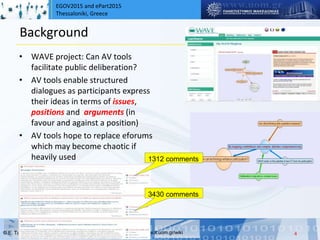
• WAVE project: Can AV tools
facilitate public deliberation?
• AV tools enable structured
dialogues as participants express
their ideas in terms of issues,
positions and arguments (in
favour and against a position)
• AV tools hope to replace eforums
which may become chaotic if
heavily used
4
1312 comments
3430 comments
EGOV2015 and ePart2015
Thessaloniki, Greece
© Ε. Tambouris http://egov.it.uom.gr/wiki
Rationale
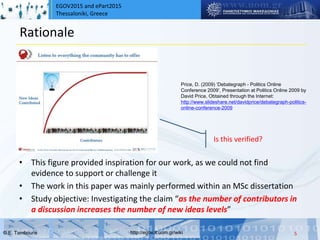
• This figure provided inspiration for our work, as we could not find
evidence to support or challenge it
• The work in this paper was mainly performed within an MSc dissertation
• Study objective: Investigating the claim “as the number of contributors in
a discussion increases the number of new ideas levels”
5
Price, D. (2009) ‘Debategraph - Politics Online
Conference 2009’, Presentation at Politics Online 2009 by
David Price, Obtained through the Internet:
http://www.slideshare.net/davidprice/debategraph-politics-
online-conference-2009
Is this verified?
EGOV2015 and ePart2015
Thessaloniki, Greece
© Ε. Tambouris http://egov.it.uom.gr/wiki
Contents
• Rationale and Study objective
• Method of work
• Study scope and Mapping framework
• Data selection and Results
• Conclusion and future work
EGOV2015 and ePart2015
Thessaloniki, Greece
© Ε. Tambouris http://egov.it.uom.gr/wiki
Method of work
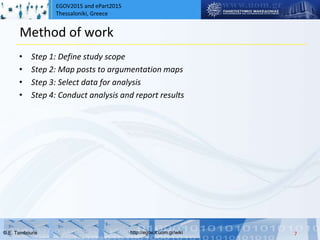
• Step 1: Define study scope
• Step 2: Map posts to argumentation maps
• Step 3: Select data for analysis
• Step 4: Conduct analysis and report results
7
EGOV2015 and ePart2015
Thessaloniki, Greece
© Ε. Tambouris http://egov.it.uom.gr/wiki
Contents
• Rationale and Study objective
• Method of work
• Study scope and Mapping framework
• Data selection and Results
• Conclusion and future work
EGOV2015 and ePart2015
Thessaloniki, Greece
© Ε. Tambouris http://egov.it.uom.gr/wiki
Study scope
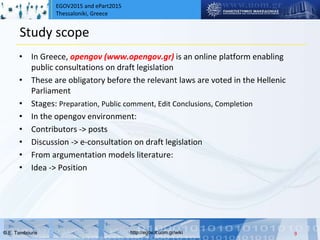
• In Greece, opengov (www.opengov.gr) is an online platform enabling
public consultations on draft legislation
• These are obligatory before the relevant laws are voted in the Hellenic
Parliament
• Stages: Preparation, Public comment, Edit Conclusions, Completion
• In the opengov environment:
• Contributors -> posts
• Discussion -> e-consultation on draft legislation
• From argumentation models literature:
• Idea -> Position
9
EGOV2015 and ePart2015
Thessaloniki, Greece
© Ε. Tambouris http://egov.it.uom.gr/wiki
Study objective operationalisation
• Concluding, our study objective is now operationalised as follows:
investigate the relationship between the number of posts and the number
of citizens’ new positions in an official e-consultation on draft legislation.
10
“as the number of
contributors
in a
discussion
increases the number of new
ideas
levels”
“as the number of
posts
in an
e-consultation on draft legislation
increases the number of new
positions
levels”
EGOV2015 and ePart2015
Thessaloniki, Greece
© Ε. Tambouris http://egov.it.uom.gr/wiki
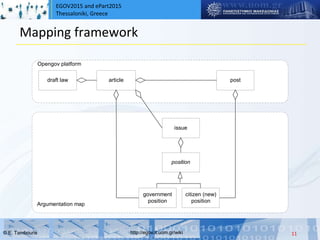
Mapping framework
11
draft law article
issue
position
post
government
position
citizen (new)
position
Opengov platform
Argumentation map
EGOV2015 and ePart2015
Thessaloniki, Greece
© Ε. Tambouris http://egov.it.uom.gr/wiki
Contents
• Rationale and Study objective
• Method of work
• Study scope and Mapping framework
• Data selection and Results
• Conclusion and future work
EGOV2015 and ePart2015
Thessaloniki, Greece
© Ε. Tambouris http://egov.it.uom.gr/wiki
Data selection
• The total number of articles presented in all ministries’ consultations is
1,132 while the total number of posts is 42,263 (2011 data).
• The average number of posts published per article is 30.
• The maximum number of posts in one article was 2,546.
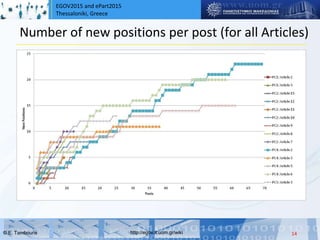
• Due to the extremely large number of posts that some articles had, we
decided to restrict our research to articles having less than 70 posts.
• These represent 91,43% of the total number of posts in all articles.
13
EGOV2015 and ePart2015
Thessaloniki, Greece
© Ε. Tambouris http://egov.it.uom.gr/wiki
Number of new positions per post (for all Articles)
14
EGOV2015 and ePart2015
Thessaloniki, Greece
© Ε. Tambouris http://egov.it.uom.gr/wiki
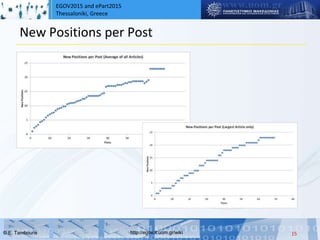
New Positions per Post
15
EGOV2015 and ePart2015
Thessaloniki, Greece
© Ε. Tambouris http://egov.it.uom.gr/wiki
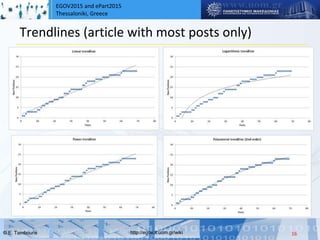
Trendlines (article with most posts only)
16
EGOV2015 and ePart2015
Thessaloniki, Greece
© Ε. Tambouris http://egov.it.uom.gr/wiki
Impact
• Increased participation in open consultations has an impact in terms of new
ideas generated.
• Thus by mobilising more citizens we can anticipate more different ideas.
• Here, we did not evaluate the quality of those ideas (but we excluded spam,
personal attacks etc)
• This finding might be also interesting to the developers of tools for massive
participation in e-rulemaking, online deliberation or idea generation in
general.
• This is particularly related to challenge posed to those designing user
interfaces for such applications.
• Evidence suggests we cannot assume that the number of ideas will
eventually level, hence there is a challenge on how to fit ideas in the screen
when having massive participation.
• As a result, new ways of accommodating the volume of positions are
needed.
17
EGOV2015 and ePart2015
Thessaloniki, Greece
© Ε. Tambouris http://egov.it.uom.gr/wiki
Contents
• Rationale and Study objective
• Method of work
• Study scope and Mapping framework
• Data selection and Results
• Conclusion and future work
EGOV2015 and ePart2015
Thessaloniki, Greece
© Ε. Tambouris http://egov.it.uom.gr/wiki
Conclusions and future work
• Under the study limitations, we could not obtain evidence of a
logarithmic relationship between posts (participants) and new positions
(ideas)
• Limitations:
– we examined only one platform
– we measured the number of posts instead of contributors i.e. actual persons
– we equated new ideas with citizens positions (as defined in argumentation
models)
– the extraction of new positions from posts was performed manually by one
only author
– we only examined e-consultations having up to 69 posts. Although these
represent 91.43% of the total number of opengov e-consultations, there were
still consultations with significantly more posts (up to 2,546 posts).
• All these limitations indicate possible routes for future research.
19

e-Consultation Platforms: Generating or just Recycling Ideas?

  • 1.
    e-Consultation Platforms: Generating orjust Recycling Ideas? Efthimios Tambouris, Anastasia Migotzidou and Konstantinos Tarabanis University of Macedonia, Thessaloniki, Greece tambouris@uom.gr
  • 2.
    EGOV2015 and ePart2015 Thessaloniki,Greece © Ε. Tambouris http://egov.it.uom.gr/wiki Contents • Rationale and Study objective • Method of work • Study scope and Mapping framework • Data selection and Results • Conclusion and future work
  • 3.
    EGOV2015 and ePart2015 Thessaloniki,Greece © Ε. Tambouris http://egov.it.uom.gr/wiki Background • The literature includes ample work on the use of Web-based platforms to support online deliberation on policy material such as draft laws and regulations, which is provided by relevant agencies. • These platforms enable users to discuss (argue in favour or against) the proposed draft legislation as well as to propose new ideas for the relevant policy topics. • This area is sometimes termed open consultation, while in the USA it is closely associated with e-rulemaking • eConsultation platforms in this paper are restricted to platforms enabling structured discussions around draft laws (relevant to e-rulemaking platforms in USA) • These are often implemented using eforums having threads of discussions where users can provide posts with their view and suggestions 3
  • 4.
    EGOV2015 and ePart2015 Thessaloniki,Greece © Ε. Tambouris http://egov.it.uom.gr/wiki Background • WAVE project: Can AV tools facilitate public deliberation? • AV tools enable structured dialogues as participants express their ideas in terms of issues, positions and arguments (in favour and against a position) • AV tools hope to replace eforums which may become chaotic if heavily used 4 1312 comments 3430 comments
  • 5.
    EGOV2015 and ePart2015 Thessaloniki,Greece © Ε. Tambouris http://egov.it.uom.gr/wiki Rationale • This figure provided inspiration for our work, as we could not find evidence to support or challenge it • The work in this paper was mainly performed within an MSc dissertation • Study objective: Investigating the claim “as the number of contributors in a discussion increases the number of new ideas levels” 5 Price, D. (2009) ‘Debategraph - Politics Online Conference 2009’, Presentation at Politics Online 2009 by David Price, Obtained through the Internet: http://www.slideshare.net/davidprice/debategraph-politics- online-conference-2009 Is this verified?
  • 6.
    EGOV2015 and ePart2015 Thessaloniki,Greece © Ε. Tambouris http://egov.it.uom.gr/wiki Contents • Rationale and Study objective • Method of work • Study scope and Mapping framework • Data selection and Results • Conclusion and future work
  • 7.
    EGOV2015 and ePart2015 Thessaloniki,Greece © Ε. Tambouris http://egov.it.uom.gr/wiki Method of work • Step 1: Define study scope • Step 2: Map posts to argumentation maps • Step 3: Select data for analysis • Step 4: Conduct analysis and report results 7
  • 8.
    EGOV2015 and ePart2015 Thessaloniki,Greece © Ε. Tambouris http://egov.it.uom.gr/wiki Contents • Rationale and Study objective • Method of work • Study scope and Mapping framework • Data selection and Results • Conclusion and future work
  • 9.
    EGOV2015 and ePart2015 Thessaloniki,Greece © Ε. Tambouris http://egov.it.uom.gr/wiki Study scope • In Greece, opengov (www.opengov.gr) is an online platform enabling public consultations on draft legislation • These are obligatory before the relevant laws are voted in the Hellenic Parliament • Stages: Preparation, Public comment, Edit Conclusions, Completion • In the opengov environment: • Contributors -> posts • Discussion -> e-consultation on draft legislation • From argumentation models literature: • Idea -> Position 9
  • 10.
    EGOV2015 and ePart2015 Thessaloniki,Greece © Ε. Tambouris http://egov.it.uom.gr/wiki Study objective operationalisation • Concluding, our study objective is now operationalised as follows: investigate the relationship between the number of posts and the number of citizens’ new positions in an official e-consultation on draft legislation. 10 “as the number of contributors in a discussion increases the number of new ideas levels” “as the number of posts in an e-consultation on draft legislation increases the number of new positions levels”
  • 11.
    EGOV2015 and ePart2015 Thessaloniki,Greece © Ε. Tambouris http://egov.it.uom.gr/wiki Mapping framework 11 draft law article issue position post government position citizen (new) position Opengov platform Argumentation map
  • 12.
    EGOV2015 and ePart2015 Thessaloniki,Greece © Ε. Tambouris http://egov.it.uom.gr/wiki Contents • Rationale and Study objective • Method of work • Study scope and Mapping framework • Data selection and Results • Conclusion and future work
  • 13.
    EGOV2015 and ePart2015 Thessaloniki,Greece © Ε. Tambouris http://egov.it.uom.gr/wiki Data selection • The total number of articles presented in all ministries’ consultations is 1,132 while the total number of posts is 42,263 (2011 data). • The average number of posts published per article is 30. • The maximum number of posts in one article was 2,546. • Due to the extremely large number of posts that some articles had, we decided to restrict our research to articles having less than 70 posts. • These represent 91,43% of the total number of posts in all articles. 13
  • 14.
    EGOV2015 and ePart2015 Thessaloniki,Greece © Ε. Tambouris http://egov.it.uom.gr/wiki Number of new positions per post (for all Articles) 14
  • 15.
    EGOV2015 and ePart2015 Thessaloniki,Greece © Ε. Tambouris http://egov.it.uom.gr/wiki New Positions per Post 15
  • 16.
    EGOV2015 and ePart2015 Thessaloniki,Greece © Ε. Tambouris http://egov.it.uom.gr/wiki Trendlines (article with most posts only) 16
  • 17.
    EGOV2015 and ePart2015 Thessaloniki,Greece © Ε. Tambouris http://egov.it.uom.gr/wiki Impact • Increased participation in open consultations has an impact in terms of new ideas generated. • Thus by mobilising more citizens we can anticipate more different ideas. • Here, we did not evaluate the quality of those ideas (but we excluded spam, personal attacks etc) • This finding might be also interesting to the developers of tools for massive participation in e-rulemaking, online deliberation or idea generation in general. • This is particularly related to challenge posed to those designing user interfaces for such applications. • Evidence suggests we cannot assume that the number of ideas will eventually level, hence there is a challenge on how to fit ideas in the screen when having massive participation. • As a result, new ways of accommodating the volume of positions are needed. 17
  • 18.
    EGOV2015 and ePart2015 Thessaloniki,Greece © Ε. Tambouris http://egov.it.uom.gr/wiki Contents • Rationale and Study objective • Method of work • Study scope and Mapping framework • Data selection and Results • Conclusion and future work
  • 19.
    EGOV2015 and ePart2015 Thessaloniki,Greece © Ε. Tambouris http://egov.it.uom.gr/wiki Conclusions and future work • Under the study limitations, we could not obtain evidence of a logarithmic relationship between posts (participants) and new positions (ideas) • Limitations: – we examined only one platform – we measured the number of posts instead of contributors i.e. actual persons – we equated new ideas with citizens positions (as defined in argumentation models) – the extraction of new positions from posts was performed manually by one only author – we only examined e-consultations having up to 69 posts. Although these represent 91.43% of the total number of opengov e-consultations, there were still consultations with significantly more posts (up to 2,546 posts). • All these limitations indicate possible routes for future research. 19