• Economics is the study of the method of
allocating scarce physical and human means
(resources) among unlimited wants or
competing ends.
• In other words economics is the study of
scarcity, which results when people want more
than can be produced.
• Economics has become fundamentally the
science of decision making.
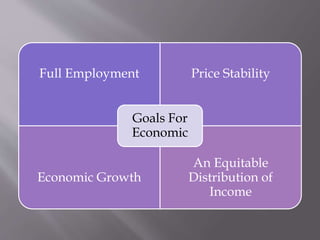
Full Employment Price Stability
Economic Growth
An Equitable
Distribution of
Income
Goals For
Economic
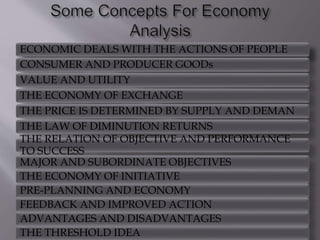
PHYSICAL AND ECONOMIC LAWSECONOMIC DEALS WITH THE ACTIONS OF PEOPLE
CONSUMER AND PRODUCER GOODs
VALUE AND UTILITY
THE ECONOMY OF EXCHANGE
THE PRICE IS DETERMINED BY SUPPLY AND DEMAN
THE LAW OF DIMINUTION RETURNS
THE RELATION OF OBJECTIVE AND PERFORMANCE
TO SUCCESS
MAJOR AND SUBORDINATE OBJECTIVES
THE ECONOMY OF INITIATIVE
PRE-PLANNING AND ECONOMY
FEEDBACK AND IMPROVED ACTION
ADVANTAGES AND DISADVANTAGES
THE THRESHOLD IDEA
 With the physical environment the engineer has a
body of physical laws upon which to base his
reasoning.
 Boyle’s laws,
 Ohm’s law
 Newton’s law of motion
 They are supplemented by many formulas and
known facts, all of which enable the engineer to
come to conclusions about the physical
environment that match the facts within narrow
limits.
 Economic laws, therefore can no more exact
than the description of the behavior of people
acting singly and collectively.
 But the engineering process is concerned with
the economic as well as the physical
environment.
 Economics deals with the behavior of people
individually and collectively, particularly as
their behavior relates to the satisfaction of their
wants.
 The wants of people are motivated largely by
emotional drives and tensions and to a lesser
extent by logical reasoning processes.
 A part of human wants can be satisfied by physical
goods and services such as
↘ Food
↘ Clothing
↘ Shelter
↘ Transportation Communication
↘ Entertainment
↘ Medical Care
↘ Educational
↘ Opportunities
↘ Personal Services
but man is rarely satisfied by physical things
alone.
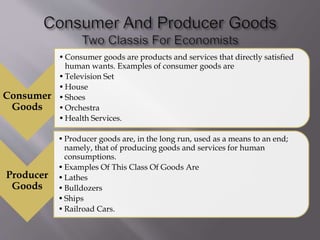
Consumer
Goods
•Consumer goods are products and services that directly satisfied
human wants. Examples of consumer goods are
•Television Set
•House
•Shoes
•Orchestra
•Health Services.
Producer
Goods
•Producer goods are, in the long run, used as a means to an end;
namely, that of producing goods and services for human
consumptions.
•Examples Of This Class Of Goods Are
•Lathes
•Bulldozers
•Ships
•Railroad Cars.
 The term value, like most other widely used terms,
has a variety of meanings.
 In economics, value designates the worth that a
person attaches to an object or a service.
 The value of an object is not inherent in the object
but in inherent in regard that a person or people
have for it.
 The general economic meaning of the term
utility is the power to satisfy human wants.
 The utility that an object has for an individual
is determined by him, thus the utility of an
object, like its value, is not inherent has for it.
 Economy of exchange occurs when utilities are
exchanged by two or more people.
 In this connection, a utility means anything
that a person may receive in an exchange that
has any value what–so ever to him; for
example, lather, a dozen pencils a meal, music,
or a friendly gesture.
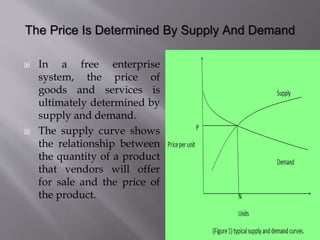
 In a free enterprise
system, the price of
goods and services is
ultimately determined by
supply and demand.
 The supply curve shows
the relationship between
the quantity of a product
that vendors will offer
for sale and the price of
the product.
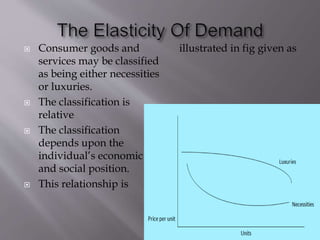
 Consumer goods and
services may be classified
as being either necessities
or luxuries.
 The classification is
relative
 The classification
depends upon the
individual’s economic
and social position.
 This relationship is
illustrated in fig given as
 The term law of diminishing return was
originally used to designate the relation of
input of fertilizers to land and the output of
crops.
 “The amount of product obtained in a productive
process varies with the agents of production are
combined. Of only one agent is varied, the product per
unit of this agent may increase to a maximum amount,
after which the product per unit may be expected to
diminish but not necessarily proportionately.”
 Attention may be focused on doing very worth-while
things or on doing things well.
 Economic success depends to an extent on each and
therefore an optimum balance should be sought.
 All too often the effort of each is not given
consideration separately in contemplating
understandings.
 Pre-planning is the formulation, prior to
beginning an undertaking, of more or less
detailed plans for carrying it out.
 One important economy of this practice is that
it permits specialization.
 Feedback for the purpose of improving future
is an essential of the decision-making process.
 A great deal of time and energy is spent.
 A great deal of time and energy is spent in
acquiring information about an understanding
that has been completed.
 Any contemplated action has its advantages and
disadvantages.
 The sponsor of a proposal should school himself to
consider advantages and disadvantages as
impersonally as possible, because the economic
advantage of a proposal depends upon its advantages
and disadvantages in comparison with those of other
alternatives.
 There are degrees of action in a great many fields below
which the effect of the action Is insignificant.
 The threshold of success varies greatly for different
activities.
 The threshold idea should be taken into consideration in
evaluation engineering alternatives.
 What exactly is substitution?
 The most obvious and simple example of substitution
is the direct replacement of a material for another in a
given application or process.
 An example that everyone would have noticed would
be the use of plastic instead of glass for drinks bottles.
 In the chemical industry, growing evidence of the
toxicity of certain solvents e.g. benzene has driven a
move to the use of more benign solvents e.g. toluene.
 The raw materials are the basic materials from which
goods and products are made. Usually, raw materials
are natural resources – for example oil, iron and wood
are all common raw materials used in the production
of goods and products.
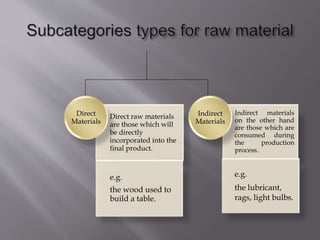
Direct raw materials
are those which will
be directly
incorporated into the
final product.
e.g.
the wood used to
build a table.
Direct
Materials
Indirect materials
on the other hand
are those which are
consumed during
the production
process.
e.g.
the lubricant,
rags, light bulbs.
Indirect
Materials
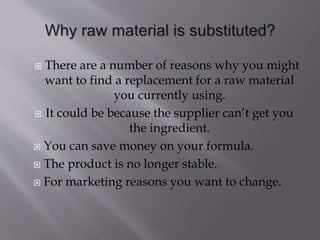
 There are a number of reasons why you might
want to find a replacement for a raw material
you currently using.
 It could be because the supplier can’t get you
the ingredient.
 You can save money on your formula.
 The product is no longer stable.
 For marketing reasons you want to change.
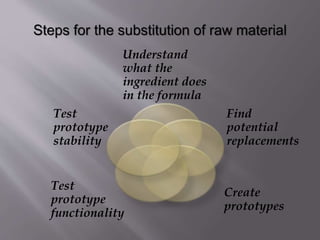
Understand
what the
ingredient does
in the formula
Find
potential
replacements
Create
prototypes
Test
prototype
functionality
Test
prototype
stability
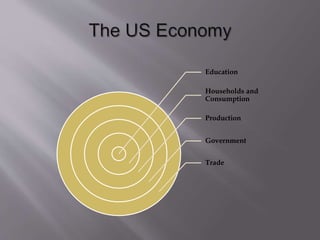
Education
Households and
Consumption
Production
Government
Trade
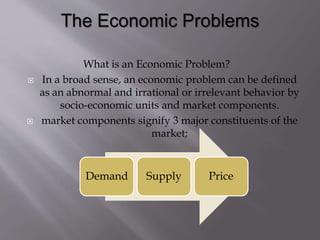
What is an Economic Problem?
 In a broad sense, an economic problem can be defined
as an abnormal and irrational or irrelevant behavior by
socio-economic units and market components.
 market components signify 3 major constituents of the
market;
Demand Supply Price
 Meaning
 Scarcity
 Inflation
 Economic Bubble
 Recession
 List of Economic Challenges
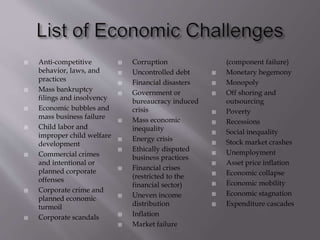
 Anti-competitive
behavior, laws, and
practices
 Mass bankruptcy
filings and insolvency
 Economic bubbles and
mass business failure
 Child labor and
improper child welfare
development
 Commercial crimes
and intentional or
planned corporate
offenses
 Corporate crime and
planned economic
turmoil
 Corporate scandals
 Corruption
 Uncontrolled debt
 Financial disasters
 Government or
bureaucracy induced
crisis
 Mass economic
inequality
 Energy crisis
 Ethically disputed
business practices
 Financial crises
(restricted to the
financial sector)
 Uneven income
distribution
 Inflation
 Market failure
(component failure)
 Monetary hegemony
 Monopoly
 Off shoring and
outsourcing
 Poverty
 Recessions
 Social inequality
 Stock market crashes
 Unemployment
 Asset price inflation
 Economic collapse
 Economic mobility
 Economic stagnation
 Expenditure cascades
Done

Economy presentation

  • 2.
    • Economics isthe study of the method of allocating scarce physical and human means (resources) among unlimited wants or competing ends. • In other words economics is the study of scarcity, which results when people want more than can be produced. • Economics has become fundamentally the science of decision making.
  • 4.
    Full Employment PriceStability Economic Growth An Equitable Distribution of Income Goals For Economic
  • 5.
    PHYSICAL AND ECONOMICLAWSECONOMIC DEALS WITH THE ACTIONS OF PEOPLE CONSUMER AND PRODUCER GOODs VALUE AND UTILITY THE ECONOMY OF EXCHANGE THE PRICE IS DETERMINED BY SUPPLY AND DEMAN THE LAW OF DIMINUTION RETURNS THE RELATION OF OBJECTIVE AND PERFORMANCE TO SUCCESS MAJOR AND SUBORDINATE OBJECTIVES THE ECONOMY OF INITIATIVE PRE-PLANNING AND ECONOMY FEEDBACK AND IMPROVED ACTION ADVANTAGES AND DISADVANTAGES THE THRESHOLD IDEA
  • 6.
     With thephysical environment the engineer has a body of physical laws upon which to base his reasoning.  Boyle’s laws,  Ohm’s law  Newton’s law of motion  They are supplemented by many formulas and known facts, all of which enable the engineer to come to conclusions about the physical environment that match the facts within narrow limits.
  • 7.
     Economic laws,therefore can no more exact than the description of the behavior of people acting singly and collectively.  But the engineering process is concerned with the economic as well as the physical environment.
  • 8.
     Economics dealswith the behavior of people individually and collectively, particularly as their behavior relates to the satisfaction of their wants.  The wants of people are motivated largely by emotional drives and tensions and to a lesser extent by logical reasoning processes.
  • 9.
     A partof human wants can be satisfied by physical goods and services such as ↘ Food ↘ Clothing ↘ Shelter ↘ Transportation Communication ↘ Entertainment ↘ Medical Care ↘ Educational ↘ Opportunities ↘ Personal Services but man is rarely satisfied by physical things alone.
  • 10.
    Consumer Goods •Consumer goods areproducts and services that directly satisfied human wants. Examples of consumer goods are •Television Set •House •Shoes •Orchestra •Health Services. Producer Goods •Producer goods are, in the long run, used as a means to an end; namely, that of producing goods and services for human consumptions. •Examples Of This Class Of Goods Are •Lathes •Bulldozers •Ships •Railroad Cars.
  • 11.
     The termvalue, like most other widely used terms, has a variety of meanings.  In economics, value designates the worth that a person attaches to an object or a service.  The value of an object is not inherent in the object but in inherent in regard that a person or people have for it.
  • 12.
     The generaleconomic meaning of the term utility is the power to satisfy human wants.  The utility that an object has for an individual is determined by him, thus the utility of an object, like its value, is not inherent has for it.
  • 13.
     Economy ofexchange occurs when utilities are exchanged by two or more people.  In this connection, a utility means anything that a person may receive in an exchange that has any value what–so ever to him; for example, lather, a dozen pencils a meal, music, or a friendly gesture.
  • 14.
     In afree enterprise system, the price of goods and services is ultimately determined by supply and demand.  The supply curve shows the relationship between the quantity of a product that vendors will offer for sale and the price of the product.
  • 15.
     Consumer goodsand services may be classified as being either necessities or luxuries.  The classification is relative  The classification depends upon the individual’s economic and social position.  This relationship is illustrated in fig given as
  • 16.
     The termlaw of diminishing return was originally used to designate the relation of input of fertilizers to land and the output of crops.  “The amount of product obtained in a productive process varies with the agents of production are combined. Of only one agent is varied, the product per unit of this agent may increase to a maximum amount, after which the product per unit may be expected to diminish but not necessarily proportionately.”
  • 17.
     Attention maybe focused on doing very worth-while things or on doing things well.  Economic success depends to an extent on each and therefore an optimum balance should be sought.  All too often the effort of each is not given consideration separately in contemplating understandings.
  • 18.
     Pre-planning isthe formulation, prior to beginning an undertaking, of more or less detailed plans for carrying it out.  One important economy of this practice is that it permits specialization.
  • 19.
     Feedback forthe purpose of improving future is an essential of the decision-making process.  A great deal of time and energy is spent.  A great deal of time and energy is spent in acquiring information about an understanding that has been completed.
  • 20.
     Any contemplatedaction has its advantages and disadvantages.  The sponsor of a proposal should school himself to consider advantages and disadvantages as impersonally as possible, because the economic advantage of a proposal depends upon its advantages and disadvantages in comparison with those of other alternatives.
  • 21.
     There aredegrees of action in a great many fields below which the effect of the action Is insignificant.  The threshold of success varies greatly for different activities.  The threshold idea should be taken into consideration in evaluation engineering alternatives.
  • 22.
     What exactlyis substitution?  The most obvious and simple example of substitution is the direct replacement of a material for another in a given application or process.
  • 23.
     An examplethat everyone would have noticed would be the use of plastic instead of glass for drinks bottles.  In the chemical industry, growing evidence of the toxicity of certain solvents e.g. benzene has driven a move to the use of more benign solvents e.g. toluene.
  • 24.
     The rawmaterials are the basic materials from which goods and products are made. Usually, raw materials are natural resources – for example oil, iron and wood are all common raw materials used in the production of goods and products.
  • 25.
    Direct raw materials arethose which will be directly incorporated into the final product. e.g. the wood used to build a table. Direct Materials Indirect materials on the other hand are those which are consumed during the production process. e.g. the lubricant, rags, light bulbs. Indirect Materials
  • 26.
     There area number of reasons why you might want to find a replacement for a raw material you currently using.  It could be because the supplier can’t get you the ingredient.  You can save money on your formula.  The product is no longer stable.  For marketing reasons you want to change.
  • 27.
    Understand what the ingredient does inthe formula Find potential replacements Create prototypes Test prototype functionality Test prototype stability
  • 28.
  • 29.
    What is anEconomic Problem?  In a broad sense, an economic problem can be defined as an abnormal and irrational or irrelevant behavior by socio-economic units and market components.  market components signify 3 major constituents of the market; Demand Supply Price
  • 30.
     Meaning  Scarcity Inflation  Economic Bubble  Recession  List of Economic Challenges
  • 31.
     Anti-competitive behavior, laws,and practices  Mass bankruptcy filings and insolvency  Economic bubbles and mass business failure  Child labor and improper child welfare development  Commercial crimes and intentional or planned corporate offenses  Corporate crime and planned economic turmoil  Corporate scandals  Corruption  Uncontrolled debt  Financial disasters  Government or bureaucracy induced crisis  Mass economic inequality  Energy crisis  Ethically disputed business practices  Financial crises (restricted to the financial sector)  Uneven income distribution  Inflation  Market failure (component failure)  Monetary hegemony  Monopoly  Off shoring and outsourcing  Poverty  Recessions  Social inequality  Stock market crashes  Unemployment  Asset price inflation  Economic collapse  Economic mobility  Economic stagnation  Expenditure cascades
  • 32.