-40
-35
-30
-25
-20
-15
-10
-5
0
5
10
Jan-19
Mar-19
May-19
Jul-19
Sep-19
Nov-19
Jan-20
Mar-20
May-20
Jul-20
Sep-20
Nov-20
Jan-21
0
2000
4000
6000
8000
Q4
2015
Q1
2016
Q2
2016
Q3
2016
Q4
2016
Q1
2017
Q2
2017
Q3
2017
Q4
2017
Q1
2018
Q2
2018
Q3
2018
Q4
2018
Q1
2019
Q2
2019
Q3
2019
Q4
2019
Q1
2020
Q2
2020
Q3
2020
Q4
2020
+109.9%
year-on-year
Foreclosures
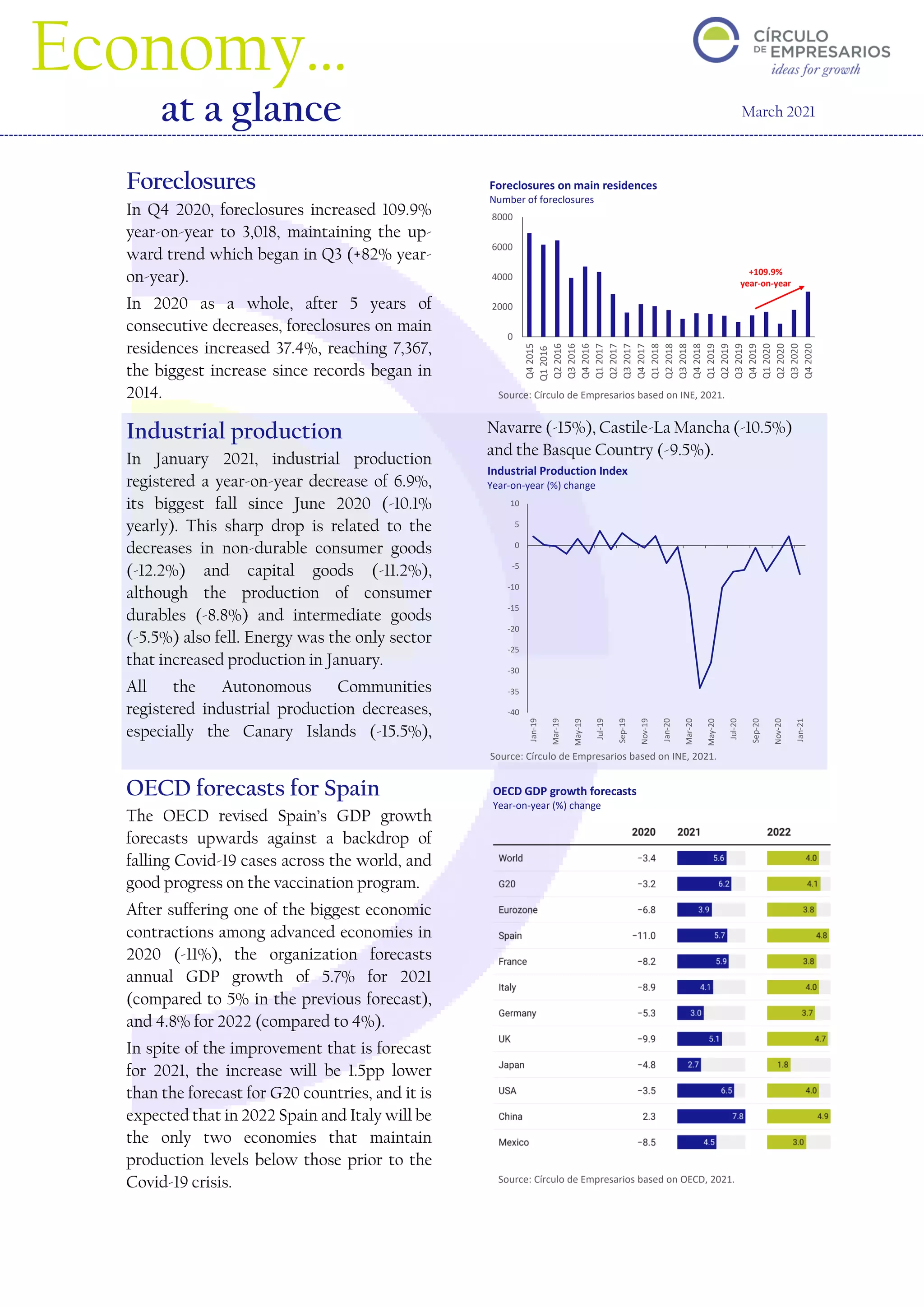
In Q4 2020, foreclosures increased 109.9%
year-on-year to 3,018, maintaining the up-
ward trend which began in Q3 (+82% year-
on-year).
In 2020 as a whole, after 5 years of
consecutive decreases, foreclosures on main
residences increased 37.4%, reaching 7,367,
the biggest increase since records began in
2014.
Industrial production
In January 2021, industrial production
registered a year-on-year decrease of 6.9%,
its biggest fall since June 2020 (-10.1%
yearly). This sharp drop is related to the
decreases in non-durable consumer goods
(-12.2%) and capital goods (-11.2%),
although the production of consumer
durables (-8.8%) and intermediate goods
(-5.5%) also fell. Energy was the only sector
that increased production in January.
All the Autonomous Communities
registered industrial production decreases,
especially the Canary Islands (-15.5%),
Navarre (-15%), Castile-La Mancha (-10.5%)
and the Basque Country (-9.5%).
OECD forecasts for Spain
The OECD revised Spain’s GDP growth
forecasts upwards against a backdrop of
falling Covid-19 cases across the world, and
good progress on the vaccination program.
After suffering one of the biggest economic
contractions among advanced economies in
2020 (-11%), the organization forecasts
annual GDP growth of 5.7% for 2021
(compared to 5% in the previous forecast),
and 4.8% for 2022 (compared to 4%).
In spite of the improvement that is forecast
for 2021, the increase will be 1.5pp lower
than the forecast for G20 countries, and it is
expected that in 2022 Spain and Italy will be
the only two economies that maintain
production levels below those prior to the
Covid-19 crisis.
March 2021
Source: Círculo de Empresarios based on INE, 2021.
Industrial Production Index
Year-on-year (%) change
Source: Círculo de Empresarios based on OECD, 2021.
OECD GDP growth forecasts
Year-on-year (%) change
Foreclosures on main residences
Number of foreclosures
Economy…
at a glance
‘Economy at a glance’, a publication of the Círculo de Empresarios produced by its Department of the Economy, contains information and opinion from reliable sources. However, the
Círculo de Empresarios does not guarantee its accuracy and does not take responsibility for any errors or omissions. This document is merely informative. As a result, the Círculo de
Empresarios is not responsible for any uses that may be made of the publication. The opinions and estimates of the Department can be modified without prior warning.
www.circulodeempresarios.org
-35
-30
-25
-20
-15
-10
-5
0
5
Jan-20
Feb-20
Mar-20
Apr-20
May-20
Jun-20
Jul-20
Aug-20
Sep-20
Oct-20
Nov-20
Dec-20
Jan-21
Imports Exports
-6
-3
0
3
6
9
Jan-16
May-16
Sep-16
Jan-17
May-17
Sep-17
Jan-18
May-18
Sep-18
Jan-19
May-19
Sep-19
Jan-20
May-20
Sep-20
Jan-21
PPI CPI
Trade balance, Germany
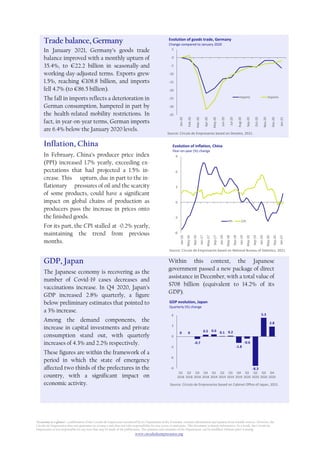
In January 2021, Germany’s goods trade
balance improved with a monthly upturn of
35.4%, to €22.2 billion in seasonally-and
working-day-adjusted terms. Exports grew
1.5%, reaching €108.8 billion, and imports
fell 4.7% (to €86.5 billion).
The fall in imports reflects a deterioration in
German consumption, hampered in part by
the health-related mobility restrictions. In
fact, in year-on-year terms, German imports
are 6.4% below the January 2020 levels.
Inflation, China
In February, China’s producer price index
(PPI) increased 1.7% yearly, exceeding ex-
pectations that had projected a 1.5% in-
crease. This upturn, due in part to the in-
flationary pressures of oil and the scarcity
of some products, could have a significant
impact on global chains of production as
producers pass the increase in prices onto
the finished goods.
For its part, the CPI stalled at -0.2% yearly,
maintaining the trend from previous
months.
GDP, Japan
The Japanese economy is recovering as the
number of Covid-19 cases decreases and
vaccinations increase. In Q4 2020, Japan’s
GDP increased 2.8% quarterly, a figure
below preliminary estimates that pointed to
a 3% increase.
Among the demand components, the
increase in capital investments and private
consumption stand out, with quarterly
increases of 4.3% and 2.2% respectively.
These figures are within the framework of a
period in which the state of emergency
affected two thirds of the prefectures in the
country, with a significant impact on
economic activity.
Within this context, the Japanese
government passed a new package of direct
assistance in December, with a total value of
$708 billion (equivalent to 14.2% of its
GDP).
0 0
-0.7
0.5 0.6 0.1 0.2
-1.8
-0.6
-8.3
5.3
2.8
-9
-6
-3
0
3
6
Q1
2018
Q2
2018
Q3
2018
Q4
2018
Q1
2019
Q2
2019
Q3
2019
Q4
2019
Q1
2020
Q2
2020
Q3
2020
Q4
2020
Source: Círculo de Empresarios based on Destatis, 2021.
Source: Círculo de Empresarios based on Cabinet Office of Japan, 2021.
Source: Círculo de Empresarios based on National Bureau of Statistics, 2021.
Evolution of goods trade, Germany
Change compared to January 2020
Evolution of inflation, China
Year-on-year (%) change
GDP evolution, Japan
Quarterly (%) change

Economy... at a glance March 2021

  • 1.
    -40 -35 -30 -25 -20 -15 -10 -5 0 5 10 Jan-19 Mar-19 May-19 Jul-19 Sep-19 Nov-19 Jan-20 Mar-20 May-20 Jul-20 Sep-20 Nov-20 Jan-21 0 2000 4000 6000 8000 Q4 2015 Q1 2016 Q2 2016 Q3 2016 Q4 2016 Q1 2017 Q2 2017 Q3 2017 Q4 2017 Q1 2018 Q2 2018 Q3 2018 Q4 2018 Q1 2019 Q2 2019 Q3 2019 Q4 2019 Q1 2020 Q2 2020 Q3 2020 Q4 2020 +109.9% year-on-year Foreclosures In Q4 2020,foreclosures increased 109.9% year-on-year to 3,018, maintaining the up- ward trend which began in Q3 (+82% year- on-year). In 2020 as a whole, after 5 years of consecutive decreases, foreclosures on main residences increased 37.4%, reaching 7,367, the biggest increase since records began in 2014. Industrial production In January 2021, industrial production registered a year-on-year decrease of 6.9%, its biggest fall since June 2020 (-10.1% yearly). This sharp drop is related to the decreases in non-durable consumer goods (-12.2%) and capital goods (-11.2%), although the production of consumer durables (-8.8%) and intermediate goods (-5.5%) also fell. Energy was the only sector that increased production in January. All the Autonomous Communities registered industrial production decreases, especially the Canary Islands (-15.5%), Navarre (-15%), Castile-La Mancha (-10.5%) and the Basque Country (-9.5%). OECD forecasts for Spain The OECD revised Spain’s GDP growth forecasts upwards against a backdrop of falling Covid-19 cases across the world, and good progress on the vaccination program. After suffering one of the biggest economic contractions among advanced economies in 2020 (-11%), the organization forecasts annual GDP growth of 5.7% for 2021 (compared to 5% in the previous forecast), and 4.8% for 2022 (compared to 4%). In spite of the improvement that is forecast for 2021, the increase will be 1.5pp lower than the forecast for G20 countries, and it is expected that in 2022 Spain and Italy will be the only two economies that maintain production levels below those prior to the Covid-19 crisis. March 2021 Source: Círculo de Empresarios based on INE, 2021. Source: Círculo de Empresarios based on INE, 2021. Industrial Production Index Year-on-year (%) change Source: Círculo de Empresarios based on OECD, 2021. OECD GDP growth forecasts Year-on-year (%) change Foreclosures on main residences Number of foreclosures Economy… at a glance
  • 2.
    ‘Economy at aglance’, a publication of the Círculo de Empresarios produced by its Department of the Economy, contains information and opinion from reliable sources. However, the Círculo de Empresarios does not guarantee its accuracy and does not take responsibility for any errors or omissions. This document is merely informative. As a result, the Círculo de Empresarios is not responsible for any uses that may be made of the publication. The opinions and estimates of the Department can be modified without prior warning. www.circulodeempresarios.org -35 -30 -25 -20 -15 -10 -5 0 5 Jan-20 Feb-20 Mar-20 Apr-20 May-20 Jun-20 Jul-20 Aug-20 Sep-20 Oct-20 Nov-20 Dec-20 Jan-21 Imports Exports -6 -3 0 3 6 9 Jan-16 May-16 Sep-16 Jan-17 May-17 Sep-17 Jan-18 May-18 Sep-18 Jan-19 May-19 Sep-19 Jan-20 May-20 Sep-20 Jan-21 PPI CPI Trade balance, Germany In January 2021, Germany’s goods trade balance improved with a monthly upturn of 35.4%, to €22.2 billion in seasonally-and working-day-adjusted terms. Exports grew 1.5%, reaching €108.8 billion, and imports fell 4.7% (to €86.5 billion). The fall in imports reflects a deterioration in German consumption, hampered in part by the health-related mobility restrictions. In fact, in year-on-year terms, German imports are 6.4% below the January 2020 levels. Inflation, China In February, China’s producer price index (PPI) increased 1.7% yearly, exceeding ex- pectations that had projected a 1.5% in- crease. This upturn, due in part to the in- flationary pressures of oil and the scarcity of some products, could have a significant impact on global chains of production as producers pass the increase in prices onto the finished goods. For its part, the CPI stalled at -0.2% yearly, maintaining the trend from previous months. GDP, Japan The Japanese economy is recovering as the number of Covid-19 cases decreases and vaccinations increase. In Q4 2020, Japan’s GDP increased 2.8% quarterly, a figure below preliminary estimates that pointed to a 3% increase. Among the demand components, the increase in capital investments and private consumption stand out, with quarterly increases of 4.3% and 2.2% respectively. These figures are within the framework of a period in which the state of emergency affected two thirds of the prefectures in the country, with a significant impact on economic activity. Within this context, the Japanese government passed a new package of direct assistance in December, with a total value of $708 billion (equivalent to 14.2% of its GDP). 0 0 -0.7 0.5 0.6 0.1 0.2 -1.8 -0.6 -8.3 5.3 2.8 -9 -6 -3 0 3 6 Q1 2018 Q2 2018 Q3 2018 Q4 2018 Q1 2019 Q2 2019 Q3 2019 Q4 2019 Q1 2020 Q2 2020 Q3 2020 Q4 2020 Source: Círculo de Empresarios based on Destatis, 2021. Source: Círculo de Empresarios based on Cabinet Office of Japan, 2021. Source: Círculo de Empresarios based on National Bureau of Statistics, 2021. Evolution of goods trade, Germany Change compared to January 2020 Evolution of inflation, China Year-on-year (%) change GDP evolution, Japan Quarterly (%) change