ECONOMIC GROWTH OF
GERMANY
21T112- MITHUN
KANNA
21T201- ABINAV
21T202- ARJUN
MAHENDRA
21T204- BARATH
HISTORY OF GERMANY
• Germany before 1800 was heavily rural, with some urban trade
centres.
• In 19th century it began the stage of rapid economic growth and
modernization, led by heavy industries.
• By 1900 it became the largest economy of Europe.
• West Germany became an “economic miracle” in the 1950s and
1960s with the help of Marshall’s plan.
• In Germany the industrial revolution began 100 years ahead of
Britain.
INTRODUCTION TO GERMANY’S
ECONOMY
• Germany is the largest economy in Europe.
• It is the forth largest economy in the world by nominal GDP and the fifth largest by GDP(PPP).
• The country is a founding member of the European union and the Eurozone.
• The socio-economic policy of Germany is based on the concept social market economy.
• German economy is the third most complex economy according to economic complexity index.
NORMAL FACTS
1. As of January 2022 the unemployment rate was 5.3%.
2. As of October 2022 the inflation rate was 10.4%.
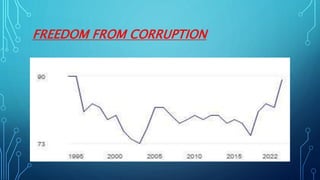
3. Freedom from corruption is 89% and increasing.
4. Nominal GDP is $4.03 Trillion.
5. GDP(PPP) is $5.32 Trillion.
6. GDP growth rate is 1.2%.
7. Average gross salary is €4168 monthly in 2021.
BASIC ASPECTS OF GERMAN
ECONOMY
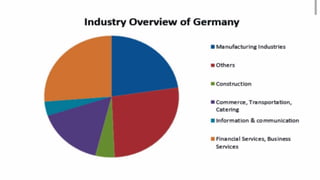
INDUSTRIES
• Of the world’s 500 largest stock-market-listed companies measured by
revenue in 2022, the Fortune Global 500, 17 are headquartered in
Germany. Well-known global brands are SAP , Mercedes-benz ,
BMW.
• Germany excels in production of automobiles, machinery, chemicals
and electrical equipments. With the production of 3.3 million
automobiles in 2021, Germany was the sixth largest producer of
automobiles.
SERVICE SECTOR
• In 2017 services constituted 68.6% of gross domestic product (GDP).
• The subcomponents of services are financial, renting, and business
activities (30.5%); trade, hotels and restaurants, and transport (16.4%);
and other service activities (21.7%).
• Germans were the first to bring insurance policies.
EXPORT AND IMPORT OF GERMANY
• Germany is the third largest export and import economy in the world
.
• Germany is the largest exporter of automobiles in the world.
• It is the largest capital exporter in the world.
• In 2021 Germany exported €1.37T and imported €1.20T , resulting
in positive trade balance of €173.3B.
• The top exports of Germany are Machinery including
computers($268.6B), Vehicle ($246B), Electrical
machinery($176.4B), Pharmaceuticals ($118B) and Medical apparatus
($83.2B).
EDUCATION
• Germany has one of the highest levels of upper secondary attainment.
• 86% of the country’s 25-64 year-olds have obtained at least an upper
secondary qualification.
• Germany is one of the top most preferred higher education
destination in the world.
INFRASTRUCTURE
• Germany boasts a highly developed infrastructure with dynamic growth.
• The railroad network is approx. 41,000 kilometres long, and there are 230,000 kilometres of roads.
• The country has one of the world’s most modern telephone and communications networks.
• Germany is the fifth largest consumer of energy in the world. It is the highest consumer of electricity in
Europe, 512.9 terawatts-hour.
• With its central position in Europe, Germany is an important transportation hub.
FINANCIAL CRISIS
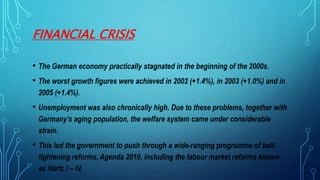
• The German economy practically stagnated in the beginning of the 2000s.
• The worst growth figures were achieved in 2002 (+1.4%), in 2003 (+1.0%) and in
2005 (+1.4%).
• Unemployment was also chronically high. Due to these problems, together with
Germany’s aging population, the welfare system came under considerable
strain.
• This led the government to push through a wide-ranging programme of belt-
tightening reforms, Agenda 2010, including the labour market reforms known
as Hartz I – IV.
INDIA VS GERMANY
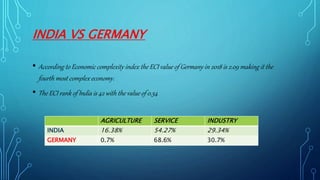
• According to Economic complexity index the ECI value of Germany in 2018 is 2.09 making it the
fourth most complex economy.
• The ECI rank of India is 42 with the value of 0.54
AGRICULTURE SERVICE INDUSTRY
INDIA 16.38% 54.27% 29.34%
GERMANY 0.7% 68.6% 30.7%
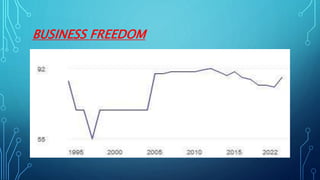
BUSINESS FREEDOM
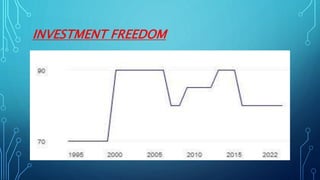
INVESTMENT FREEDOM
FREEDOM FROM CORRUPTION
OVERVIE
W
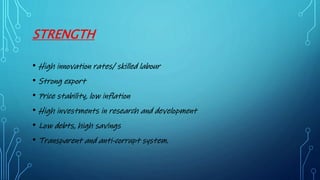
STRENGTH
• High innovation rates/ skilled labour
• Strong export
• Price stability, low inflation
• High investments in research and development
• Low debts, high savings
• Transparent and anti-corrupt system.
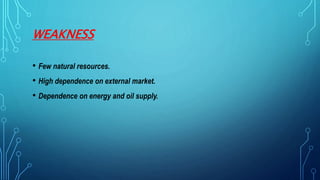
WEAKNESS
• Few natural resources.
• High dependence on external market.
• Dependence on energy and oil supply.
economics presentation-1.pptx

economics presentation-1.pptx

  • 1.
    ECONOMIC GROWTH OF GERMANY 21T112-MITHUN KANNA 21T201- ABINAV 21T202- ARJUN MAHENDRA 21T204- BARATH
  • 2.
    HISTORY OF GERMANY •Germany before 1800 was heavily rural, with some urban trade centres. • In 19th century it began the stage of rapid economic growth and modernization, led by heavy industries. • By 1900 it became the largest economy of Europe. • West Germany became an “economic miracle” in the 1950s and 1960s with the help of Marshall’s plan. • In Germany the industrial revolution began 100 years ahead of Britain.
  • 3.
    INTRODUCTION TO GERMANY’S ECONOMY •Germany is the largest economy in Europe. • It is the forth largest economy in the world by nominal GDP and the fifth largest by GDP(PPP). • The country is a founding member of the European union and the Eurozone. • The socio-economic policy of Germany is based on the concept social market economy. • German economy is the third most complex economy according to economic complexity index.
  • 4.
    NORMAL FACTS 1. Asof January 2022 the unemployment rate was 5.3%. 2. As of October 2022 the inflation rate was 10.4%. 3. Freedom from corruption is 89% and increasing. 4. Nominal GDP is $4.03 Trillion. 5. GDP(PPP) is $5.32 Trillion. 6. GDP growth rate is 1.2%. 7. Average gross salary is €4168 monthly in 2021.
  • 5.
    BASIC ASPECTS OFGERMAN ECONOMY
  • 6.
    INDUSTRIES • Of theworld’s 500 largest stock-market-listed companies measured by revenue in 2022, the Fortune Global 500, 17 are headquartered in Germany. Well-known global brands are SAP , Mercedes-benz , BMW. • Germany excels in production of automobiles, machinery, chemicals and electrical equipments. With the production of 3.3 million automobiles in 2021, Germany was the sixth largest producer of automobiles.
  • 8.
    SERVICE SECTOR • In2017 services constituted 68.6% of gross domestic product (GDP). • The subcomponents of services are financial, renting, and business activities (30.5%); trade, hotels and restaurants, and transport (16.4%); and other service activities (21.7%). • Germans were the first to bring insurance policies.
  • 9.
    EXPORT AND IMPORTOF GERMANY • Germany is the third largest export and import economy in the world . • Germany is the largest exporter of automobiles in the world. • It is the largest capital exporter in the world. • In 2021 Germany exported €1.37T and imported €1.20T , resulting in positive trade balance of €173.3B. • The top exports of Germany are Machinery including computers($268.6B), Vehicle ($246B), Electrical machinery($176.4B), Pharmaceuticals ($118B) and Medical apparatus ($83.2B).
  • 10.
    EDUCATION • Germany hasone of the highest levels of upper secondary attainment. • 86% of the country’s 25-64 year-olds have obtained at least an upper secondary qualification. • Germany is one of the top most preferred higher education destination in the world.
  • 11.
    INFRASTRUCTURE • Germany boastsa highly developed infrastructure with dynamic growth. • The railroad network is approx. 41,000 kilometres long, and there are 230,000 kilometres of roads. • The country has one of the world’s most modern telephone and communications networks. • Germany is the fifth largest consumer of energy in the world. It is the highest consumer of electricity in Europe, 512.9 terawatts-hour. • With its central position in Europe, Germany is an important transportation hub.
  • 12.
    FINANCIAL CRISIS • TheGerman economy practically stagnated in the beginning of the 2000s. • The worst growth figures were achieved in 2002 (+1.4%), in 2003 (+1.0%) and in 2005 (+1.4%). • Unemployment was also chronically high. Due to these problems, together with Germany’s aging population, the welfare system came under considerable strain. • This led the government to push through a wide-ranging programme of belt- tightening reforms, Agenda 2010, including the labour market reforms known as Hartz I – IV.
  • 13.
    INDIA VS GERMANY •According to Economic complexity index the ECI value of Germany in 2018 is 2.09 making it the fourth most complex economy. • The ECI rank of India is 42 with the value of 0.54 AGRICULTURE SERVICE INDUSTRY INDIA 16.38% 54.27% 29.34% GERMANY 0.7% 68.6% 30.7%
  • 14.
  • 15.
  • 16.
  • 17.
  • 18.
    STRENGTH • High innovationrates/ skilled labour • Strong export • Price stability, low inflation • High investments in research and development • Low debts, high savings • Transparent and anti-corrupt system.
  • 19.
    WEAKNESS • Few naturalresources. • High dependence on external market. • Dependence on energy and oil supply.