Title
Date
Lifetime Learning… Building Success… Towards Globalization
Economics -Chapter 1
The Nature of Economics
Lifetime Learning… Building Success… Towards Globalization
Economics - Definition
• Economics is the;
• science which studies human behavior;
• as a relationship;
• between ends and scarce means;
• which have alternative uses
– Lord Robbins.
EIBFS/Economics
Definition Explained
a. Economics is a social science in that it uses scientific methods
to study human behaviour.
b. Human needs are unlimited whereas resources are in limited
supply, hence the problem of scarcity.
c. The resources can be put to alternative uses in order to meet
certain ends. (needs)
 Note: Choices have to be made to utilize scarce resources
EIBFS/Economics
Scarcity and choice
• Wants unlimited
• Means (resources) limited
• Choice between alternatives
• Opportunity cost.
EIBFS/Economics
4
Reading Graph
EIBFS/Economics
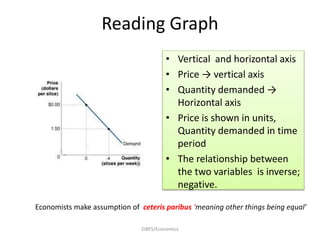
• Vertical and horizontal axis
• Price → vertical axis
• Quantity demanded →
Horizontal axis
• Price is shown in units,
Quantity demanded in time
period
• The relationship between
the two variables is inverse;
negative.
Economists make assumption of ceteris paribus ‘meaning other things being equal’
The Nature of Economic Problem
• Economics studies the;
– allocation
– distribution
– utilization of resources
– to meet human needs.
EIBFS/Economics
Economic Problem cont…
• Main economic problem can be summarized as:
• Allocation of Resources: What gets produced.
• Distribution of Resources between different groups
in the society. (who gets what is produced)
• Utilization of resources: All the available resources
are used effectively.
• Since the resources are limited in supply (scarce) and
the wants are unlimited choice has to be made.
EIBFS/Economics
The Nature of Economic Problem Cont…..
• The resources an economy has at its disposal to
satisfy the unlimited wants are termed by
economists as inputs or factors of production and
divided into the following categories:
a. Land; Natural resources
b. Labour: Human resources:
c. Capital: Physical resources
EIBFS/Economics
Opportunity Cost
Production Possibilities Frontier (PPF)
• Opportunity cost of producing more of one good is less of the
other.
• Opportunity cost can be defined as the best alternative
forgone or sacrificed.
• A production possibilities frontier (PPF) represents the
combinations of the two products that the country can
produce if it fully utilizes all of its resources.
EIBFS/Economics
Production Possibilities Frontier (PPF)
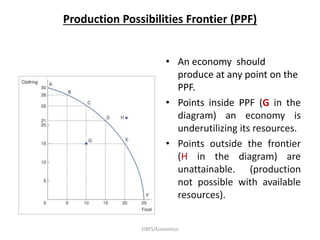
• An economy should
produce at any point on the
PPF.
• Points inside PPF (G in the
diagram) an economy is
underutilizing its resources.
• Points outside the frontier
(H in the diagram) are
unattainable. (production
not possible with available
resources).
EIBFS/Economics
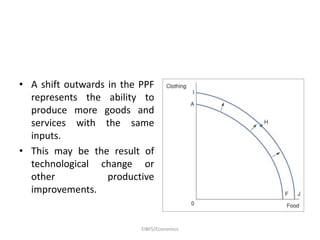
• A shift outwards in the PPF
represents the ability to
produce more goods and
services with the same
inputs.
• This may be the result of
technological change or
other productive
improvements.
EIBFS/Economics
PPF and Opportunity Cost
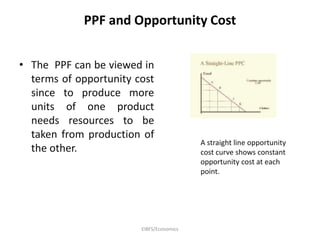
• The PPF can be viewed in
terms of opportunity cost
since to produce more
units of one product
needs resources to be
taken from production of
the other.
EIBFS/Economics
A straight line opportunity
cost curve shows constant
opportunity cost at each
point.
Economic Systems
• Economic system refers to the approach taken when
dealing with the economic problem of;
– allocating,
– distributing‘, and;
– utilizing recourses.
EIBFS/Economics
• Three main types of economic systems are:
• A Market Economy:
• A Planned Economy
• A Mixed Economy
EIBFS/Economics
Market economy
• What is a market economy?
• A market economy allocates resources through the price
mechanism; and prices are determined by demand and
supply.
EIBFS/Economics
Advantages of the
• Resources are allocated without government
intervention.
• The consumer dictates to the producers, what is
produced.
• Producers produce those goods and services which
gives most profit.
EIBFS/Economics
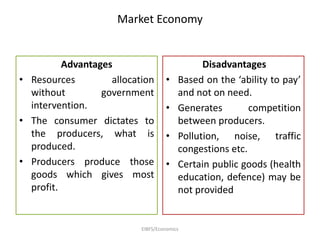
Market Economy
Advantages
• Resources allocation
without government
intervention.
• The consumer dictates to
the producers, what is
produced.
• Producers produce those
goods which gives most
profit.
Disadvantages
• Based on the ‘ability to pay’
and not on need.
• Generates competition
between producers.
• Pollution, noise, traffic
congestions etc.
• Certain public goods (health
education, defence) may be
not provided
EIBFS/Economics
The Planned Economy
• In a planned economy the government decides;
– what to produce;
– how to allocate the resources and;
– distribute the goods and services
EIBFS/Economics
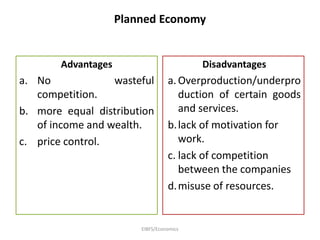
Planned Economy
Advantages
a. No wasteful
competition.
b. more equal distribution
of income and wealth.
c. price control.
Disadvantages
a.Overproduction/underpro
duction of certain goods
and services.
b.lack of motivation for
work.
c. lack of competition
between the companies
d.misuse of resources.
EIBFS/Economics
The Mixed Economy
• A mixed economic system combines merits of both the
market and planned economies.
• The mixed economy aims to allow the market to operate, with
government intervening in the economy only where the
market fails.
• Providing those goods and services such as;
– law and order, education and health services which would have been
under-provided if left to the market.
– Most economies throughout the world are mixed economies
EIBFS/Economics
Why Mixed Economy?
• The free market economy can cause:
a.Up and down in the economic activity.
b.Monopoly power
c.Inequalities
d.Environment problem
 So government intervention and control is required
EIBFS/Economics
Positive and Normative Economics
• Positive economics deal with what is or what will be—
statements that can be empirically tested.
– Example: If the government increase the income tax it will
lead to a fall in the level of consumer expenditure.
• Normative economics deals with should or ought —
statements that cannot be tested empirically.
– Example: Income should be distributed more equally.
EIBFS/Economics
Micro and Macroeconomics
• Microeconomics deals with the decision making of
individuals and firms and how particular market
works.
• Macroeconomics studies the operation of the
economy as a whole covering such areas as;
unemployment, inflation and aggregate demand.
EIBFS/Economics

الدرس الأول اقتصاد

  • 1.
    Title Date Lifetime Learning… BuildingSuccess… Towards Globalization Economics -Chapter 1 The Nature of Economics Lifetime Learning… Building Success… Towards Globalization
  • 2.
    Economics - Definition •Economics is the; • science which studies human behavior; • as a relationship; • between ends and scarce means; • which have alternative uses – Lord Robbins. EIBFS/Economics
  • 3.
    Definition Explained a. Economicsis a social science in that it uses scientific methods to study human behaviour. b. Human needs are unlimited whereas resources are in limited supply, hence the problem of scarcity. c. The resources can be put to alternative uses in order to meet certain ends. (needs)  Note: Choices have to be made to utilize scarce resources EIBFS/Economics
  • 4.
    Scarcity and choice •Wants unlimited • Means (resources) limited • Choice between alternatives • Opportunity cost. EIBFS/Economics 4
  • 5.
    Reading Graph EIBFS/Economics • Verticaland horizontal axis • Price → vertical axis • Quantity demanded → Horizontal axis • Price is shown in units, Quantity demanded in time period • The relationship between the two variables is inverse; negative. Economists make assumption of ceteris paribus ‘meaning other things being equal’
  • 6.
    The Nature ofEconomic Problem • Economics studies the; – allocation – distribution – utilization of resources – to meet human needs. EIBFS/Economics
  • 7.
    Economic Problem cont… •Main economic problem can be summarized as: • Allocation of Resources: What gets produced. • Distribution of Resources between different groups in the society. (who gets what is produced) • Utilization of resources: All the available resources are used effectively. • Since the resources are limited in supply (scarce) and the wants are unlimited choice has to be made. EIBFS/Economics
  • 8.
    The Nature ofEconomic Problem Cont….. • The resources an economy has at its disposal to satisfy the unlimited wants are termed by economists as inputs or factors of production and divided into the following categories: a. Land; Natural resources b. Labour: Human resources: c. Capital: Physical resources EIBFS/Economics
  • 9.
    Opportunity Cost Production PossibilitiesFrontier (PPF) • Opportunity cost of producing more of one good is less of the other. • Opportunity cost can be defined as the best alternative forgone or sacrificed. • A production possibilities frontier (PPF) represents the combinations of the two products that the country can produce if it fully utilizes all of its resources. EIBFS/Economics
  • 10.
    Production Possibilities Frontier(PPF) • An economy should produce at any point on the PPF. • Points inside PPF (G in the diagram) an economy is underutilizing its resources. • Points outside the frontier (H in the diagram) are unattainable. (production not possible with available resources). EIBFS/Economics
  • 11.
    • A shiftoutwards in the PPF represents the ability to produce more goods and services with the same inputs. • This may be the result of technological change or other productive improvements. EIBFS/Economics
  • 12.
    PPF and OpportunityCost • The PPF can be viewed in terms of opportunity cost since to produce more units of one product needs resources to be taken from production of the other. EIBFS/Economics A straight line opportunity cost curve shows constant opportunity cost at each point.
  • 13.
    Economic Systems • Economicsystem refers to the approach taken when dealing with the economic problem of; – allocating, – distributing‘, and; – utilizing recourses. EIBFS/Economics
  • 14.
    • Three maintypes of economic systems are: • A Market Economy: • A Planned Economy • A Mixed Economy EIBFS/Economics
  • 15.
    Market economy • Whatis a market economy? • A market economy allocates resources through the price mechanism; and prices are determined by demand and supply. EIBFS/Economics
  • 16.
    Advantages of the •Resources are allocated without government intervention. • The consumer dictates to the producers, what is produced. • Producers produce those goods and services which gives most profit. EIBFS/Economics
  • 17.
    Market Economy Advantages • Resourcesallocation without government intervention. • The consumer dictates to the producers, what is produced. • Producers produce those goods which gives most profit. Disadvantages • Based on the ‘ability to pay’ and not on need. • Generates competition between producers. • Pollution, noise, traffic congestions etc. • Certain public goods (health education, defence) may be not provided EIBFS/Economics
  • 18.
    The Planned Economy •In a planned economy the government decides; – what to produce; – how to allocate the resources and; – distribute the goods and services EIBFS/Economics
  • 19.
    Planned Economy Advantages a. Nowasteful competition. b. more equal distribution of income and wealth. c. price control. Disadvantages a.Overproduction/underpro duction of certain goods and services. b.lack of motivation for work. c. lack of competition between the companies d.misuse of resources. EIBFS/Economics
  • 20.
    The Mixed Economy •A mixed economic system combines merits of both the market and planned economies. • The mixed economy aims to allow the market to operate, with government intervening in the economy only where the market fails. • Providing those goods and services such as; – law and order, education and health services which would have been under-provided if left to the market. – Most economies throughout the world are mixed economies EIBFS/Economics
  • 21.
    Why Mixed Economy? •The free market economy can cause: a.Up and down in the economic activity. b.Monopoly power c.Inequalities d.Environment problem  So government intervention and control is required EIBFS/Economics
  • 22.
    Positive and NormativeEconomics • Positive economics deal with what is or what will be— statements that can be empirically tested. – Example: If the government increase the income tax it will lead to a fall in the level of consumer expenditure. • Normative economics deals with should or ought — statements that cannot be tested empirically. – Example: Income should be distributed more equally. EIBFS/Economics
  • 23.
    Micro and Macroeconomics •Microeconomics deals with the decision making of individuals and firms and how particular market works. • Macroeconomics studies the operation of the economy as a whole covering such areas as; unemployment, inflation and aggregate demand. EIBFS/Economics