The Economic System
University of Sargodha Sub Campus Bhakkar
Creation
 Man is not only social in fact he is also an
economic being.
 The economy may be treated as a system or
sub-system.
 Within economy we could take more solid
structures such as bank or corporation and
analyse it in terms of basic necessities of
social system.
 According to concise Oxford Dictionary:-
 Expenditure of energy, striving
application of effort to some purpose.
 The famous anthropologist Raymond Firth
define work as:-
 An income producing activity or
purposeful activity and expenditure of
energy at some sacrifice of pleasure.
 In fact occupation is essentially a kind of
work.
 But the word occupation is used mostly to
refer to specialized and established kind of
work.
 In this , individual becomes completely
engaged.
 It denotes habitual employment, profession
or any kind of business.
 In modern definition occupation means an
instrument of livelihood.
 Peter Berger has gave this classification in
three ways.
 1st way:- Some occupations provide self-
identification and satisfaction . Like,
Teaching or business.
 2nd way:- Direct threat to person’s identity.
Like Poorly paid occupations of labours
works in industries.
 3rd way:- Neutral occupations Neither very
hateful nor pleasurable . Like Bankers.
 Material Needs Of Man:- Production of Food
, machines , vehicles , newsprints or many
other needs of daily life.
 Not just for money but good working
conditions , opportunity for promotion ,
mental satisfaction , status etc.
 Mental Health.
 Lessens Unemployment.
 Country moves towards progressive way.
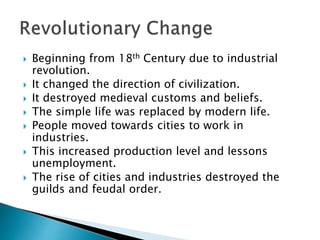
 Beginning from 18th Century due to industrial
revolution.
 It changed the direction of civilization.
 It destroyed medieval customs and beliefs.
 The simple life was replaced by modern life.
 People moved towards cities to work in
industries.
 This increased production level and lessons
unemployment.
 The rise of cities and industries destroyed the
guilds and feudal order.
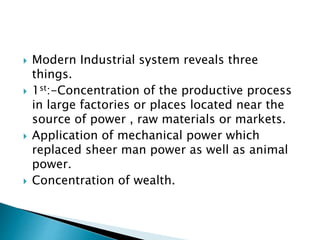
 Modern Industrial system reveals three
things.
 1st:-Concentration of the productive process
in large factories or places located near the
source of power , raw materials or markets.
 Application of mechanical power which
replaced sheer man power as well as animal
power.
 Concentration of wealth.
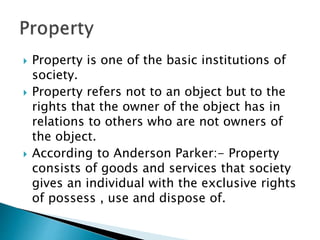
 Property is one of the basic institutions of
society.
 Property refers not to an object but to the
rights that the owner of the object has in
relations to others who are not owners of
the object.
 According to Anderson Parker:- Property
consists of goods and services that society
gives an individual with the exclusive rights
of possess , use and dispose of.
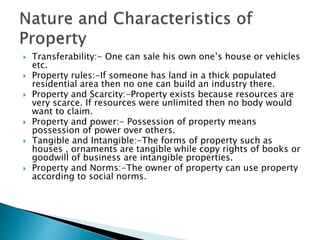
 Transferability:- One can sale his own one’s house or vehicles
etc.
 Property rules:-If someone has land in a thick populated
residential area then no one can build an industry there.
 Property and Scarcity:-Property exists because resources are
very scarce. If resources were unlimited then no body would
want to claim.
 Property and power:- Possession of property means
possession of power over others.
 Tangible and Intangible:-The forms of property such as
houses , ornaments are tangible while copy rights of books or
goodwill of business are intangible properties.
 Property and Norms:-The owner of property can use property
according to social norms.
 Capitalism is an economy in which the means of
producing are largely in private hands and the main
incentive for economic activity in the accumulation of
profits.
 Two qualities:-
 1st:-Personal Profits:-Seeking self-interest or profit is
considered here as normal, morally acceptable, and
socially desirable.
 2nd:-Free Competition:-Competition is necessary if
capitalist system is to work effectively.
 Adam Smith said in 1776 that under these two
conditions the forces of supply and demand will ensure
the production of the best products at lower possible
prices.
 Capitalism overemphasizes profits and neglects
social functions.
 Capitalism leads to labour exploitation.
 Ownership becomes anonymous here.
 It provides no guarantee that profits will
correspond to service and that economic
activities will further the interests of the
community.
 Capitalism produces labour unions which often
fights against management and disturb the
relationship between labours and management.
 It is the type of economy in which the means of
production and distribution in a society are
collectively rather than privately owned.
 Merits of Socialism:
 Socialist economies are more efficient
economically.
 Because there is less scope for waste, like
unemployment, over production, etc.
 Socialist economies don’t have unions so there is
no clash between labours and managements.
 These economies are more democratic than
capitalist societies because decisions about
humans taken collectively.
 Here economic activities planned by state.
 We can say that socialist economy is
democratic but to some extent because some
major decisions are taken by ruling communist
party and not by the people or public in
general.
 In socialist society, inequality is determined not
by the market but by the party and its
bureaucratic system which enjoys autocratic
power.
 Socialist societies also proved to be imperialist
. Because in order to satisfy the requirements
of industries they forced workers.
 A multinational corporation is simply one which
owns or manages businesses in two or more
countries. Like Shell, Unilever, Nestle, Coca Cola
etc.
 Criticism Level Against Multinational
Companies:-
 Political Interference:- Multinational companies
have drawn criticism during recent years. So to
safeguard their interest they started interference in
internal political affairs . Like It is reported that
America intelligence agency CIA had made use of
multinational companies to create political anarchy
in nations such as Namibia, Nigeria etc.
 Economic development is very much
influenced by various social factors.
 The Role of People’s Ability, Experience and
Knowledge:-
 Economic development of any country
depends on the efficient employment of
factors of production.
 The people must have the required ability,
experience, and knowledge to make the
best use of facilities that are available.
 Adoption of Technology:-Technology can
results only when appropriate social
conditions are present.
 All types of technology are not suitable to
all types of societies.
 Labour-saving machines are more ideally
suited to more advanced societies. But they
may be dysfunctional for societies where
large number of unemployed and unskilled
workers are ready to work.
 Innovative Personality:-Economic
development requires innovative
personality. In some societies a child taught
to solve problems independently and
encouraged to be creative. But on the other
hand more importance is given to
conformity. Here children are encouraged to
follow old traditions . In such societies
innovative personalities don’t grow easily so
economic development would be very slow.
 Time gap between the introduction of Technology
and Cultural Support for Technology:-
 For its fast growth technology requires a favourable
cultural support. The Western societies have
developed over decades the cultural traits and
social conditions appropriate to technology. As a
result they could get the cultural support when
they started technological inventions.
 In underdeveloped countries the media of
communication carry advertisements of products
produced by the Western industries. Due to these
advertisements people may develop intentions
towards these products.
 Explosive Growth of Population:-The biggest
social problem for economic growth is the
explosive growth of population that we see in
countries such as India, Bangladesh, Pakistan,
China etc.
 Professor Gill says:- Population growth is not
a stimulant to development, but a depressant
. Because of the lack of industrial capital the
growing labour force can’t find jobs in the
city and therefore adds itself to the already
congested rural area.
Economic System

Economic System

  • 1.
  • 2.
    University of SargodhaSub Campus Bhakkar Creation
  • 3.
     Man isnot only social in fact he is also an economic being.  The economy may be treated as a system or sub-system.  Within economy we could take more solid structures such as bank or corporation and analyse it in terms of basic necessities of social system.
  • 4.
     According toconcise Oxford Dictionary:-  Expenditure of energy, striving application of effort to some purpose.  The famous anthropologist Raymond Firth define work as:-  An income producing activity or purposeful activity and expenditure of energy at some sacrifice of pleasure.
  • 5.
     In factoccupation is essentially a kind of work.  But the word occupation is used mostly to refer to specialized and established kind of work.  In this , individual becomes completely engaged.  It denotes habitual employment, profession or any kind of business.  In modern definition occupation means an instrument of livelihood.
  • 6.
     Peter Bergerhas gave this classification in three ways.  1st way:- Some occupations provide self- identification and satisfaction . Like, Teaching or business.  2nd way:- Direct threat to person’s identity. Like Poorly paid occupations of labours works in industries.  3rd way:- Neutral occupations Neither very hateful nor pleasurable . Like Bankers.
  • 7.
     Material NeedsOf Man:- Production of Food , machines , vehicles , newsprints or many other needs of daily life.  Not just for money but good working conditions , opportunity for promotion , mental satisfaction , status etc.  Mental Health.  Lessens Unemployment.  Country moves towards progressive way.
  • 8.
     Beginning from18th Century due to industrial revolution.  It changed the direction of civilization.  It destroyed medieval customs and beliefs.  The simple life was replaced by modern life.  People moved towards cities to work in industries.  This increased production level and lessons unemployment.  The rise of cities and industries destroyed the guilds and feudal order.
  • 9.
     Modern Industrialsystem reveals three things.  1st:-Concentration of the productive process in large factories or places located near the source of power , raw materials or markets.  Application of mechanical power which replaced sheer man power as well as animal power.  Concentration of wealth.
  • 10.
     Property isone of the basic institutions of society.  Property refers not to an object but to the rights that the owner of the object has in relations to others who are not owners of the object.  According to Anderson Parker:- Property consists of goods and services that society gives an individual with the exclusive rights of possess , use and dispose of.
  • 11.
     Transferability:- Onecan sale his own one’s house or vehicles etc.  Property rules:-If someone has land in a thick populated residential area then no one can build an industry there.  Property and Scarcity:-Property exists because resources are very scarce. If resources were unlimited then no body would want to claim.  Property and power:- Possession of property means possession of power over others.  Tangible and Intangible:-The forms of property such as houses , ornaments are tangible while copy rights of books or goodwill of business are intangible properties.  Property and Norms:-The owner of property can use property according to social norms.
  • 12.
     Capitalism isan economy in which the means of producing are largely in private hands and the main incentive for economic activity in the accumulation of profits.  Two qualities:-  1st:-Personal Profits:-Seeking self-interest or profit is considered here as normal, morally acceptable, and socially desirable.  2nd:-Free Competition:-Competition is necessary if capitalist system is to work effectively.  Adam Smith said in 1776 that under these two conditions the forces of supply and demand will ensure the production of the best products at lower possible prices.
  • 13.
     Capitalism overemphasizesprofits and neglects social functions.  Capitalism leads to labour exploitation.  Ownership becomes anonymous here.  It provides no guarantee that profits will correspond to service and that economic activities will further the interests of the community.  Capitalism produces labour unions which often fights against management and disturb the relationship between labours and management.
  • 14.
     It isthe type of economy in which the means of production and distribution in a society are collectively rather than privately owned.  Merits of Socialism:  Socialist economies are more efficient economically.  Because there is less scope for waste, like unemployment, over production, etc.  Socialist economies don’t have unions so there is no clash between labours and managements.  These economies are more democratic than capitalist societies because decisions about humans taken collectively.  Here economic activities planned by state.
  • 15.
     We cansay that socialist economy is democratic but to some extent because some major decisions are taken by ruling communist party and not by the people or public in general.  In socialist society, inequality is determined not by the market but by the party and its bureaucratic system which enjoys autocratic power.  Socialist societies also proved to be imperialist . Because in order to satisfy the requirements of industries they forced workers.
  • 16.
     A multinationalcorporation is simply one which owns or manages businesses in two or more countries. Like Shell, Unilever, Nestle, Coca Cola etc.  Criticism Level Against Multinational Companies:-  Political Interference:- Multinational companies have drawn criticism during recent years. So to safeguard their interest they started interference in internal political affairs . Like It is reported that America intelligence agency CIA had made use of multinational companies to create political anarchy in nations such as Namibia, Nigeria etc.
  • 17.
     Economic developmentis very much influenced by various social factors.  The Role of People’s Ability, Experience and Knowledge:-  Economic development of any country depends on the efficient employment of factors of production.  The people must have the required ability, experience, and knowledge to make the best use of facilities that are available.
  • 18.
     Adoption ofTechnology:-Technology can results only when appropriate social conditions are present.  All types of technology are not suitable to all types of societies.  Labour-saving machines are more ideally suited to more advanced societies. But they may be dysfunctional for societies where large number of unemployed and unskilled workers are ready to work.
  • 19.
     Innovative Personality:-Economic developmentrequires innovative personality. In some societies a child taught to solve problems independently and encouraged to be creative. But on the other hand more importance is given to conformity. Here children are encouraged to follow old traditions . In such societies innovative personalities don’t grow easily so economic development would be very slow.
  • 20.
     Time gapbetween the introduction of Technology and Cultural Support for Technology:-  For its fast growth technology requires a favourable cultural support. The Western societies have developed over decades the cultural traits and social conditions appropriate to technology. As a result they could get the cultural support when they started technological inventions.  In underdeveloped countries the media of communication carry advertisements of products produced by the Western industries. Due to these advertisements people may develop intentions towards these products.
  • 21.
     Explosive Growthof Population:-The biggest social problem for economic growth is the explosive growth of population that we see in countries such as India, Bangladesh, Pakistan, China etc.  Professor Gill says:- Population growth is not a stimulant to development, but a depressant . Because of the lack of industrial capital the growing labour force can’t find jobs in the city and therefore adds itself to the already congested rural area.