
Economic Reforms & Trends In
National Income
Presented By
Prof M.M.Joshi
Reforms… Reforming……? ?
Reforms
Poor India
Economic Reforms &
Trends in National Income
A challenge or an
opportunity ?
IMPORTANCE
Economic reforms have had a deep impact on income
propagation on the Indian Economy.The study is relevant in
studying the changes in income in various sectors of the
Indian Economy. The scenario of the Indian Economy
changed after the new economic reforms were implemented
in this country in the year 1991. This study tries to analyze
the pre reform and post reform impact on the Indian Economy.
OBJECTIVES
• To analyze pre and post reforms
impact on the growth of GDP at
factor cost .
• To analyze intersectoral growth
rate .
Review of the literature
* Mahesh Joshi (2003) states that economic
reforms
shall be a failure if agriculture and rural
development is neglected.
* V.D. Vidyarthi and Asha Rani (2003) correlate
economic reforms with greater productivity in
agriculture .
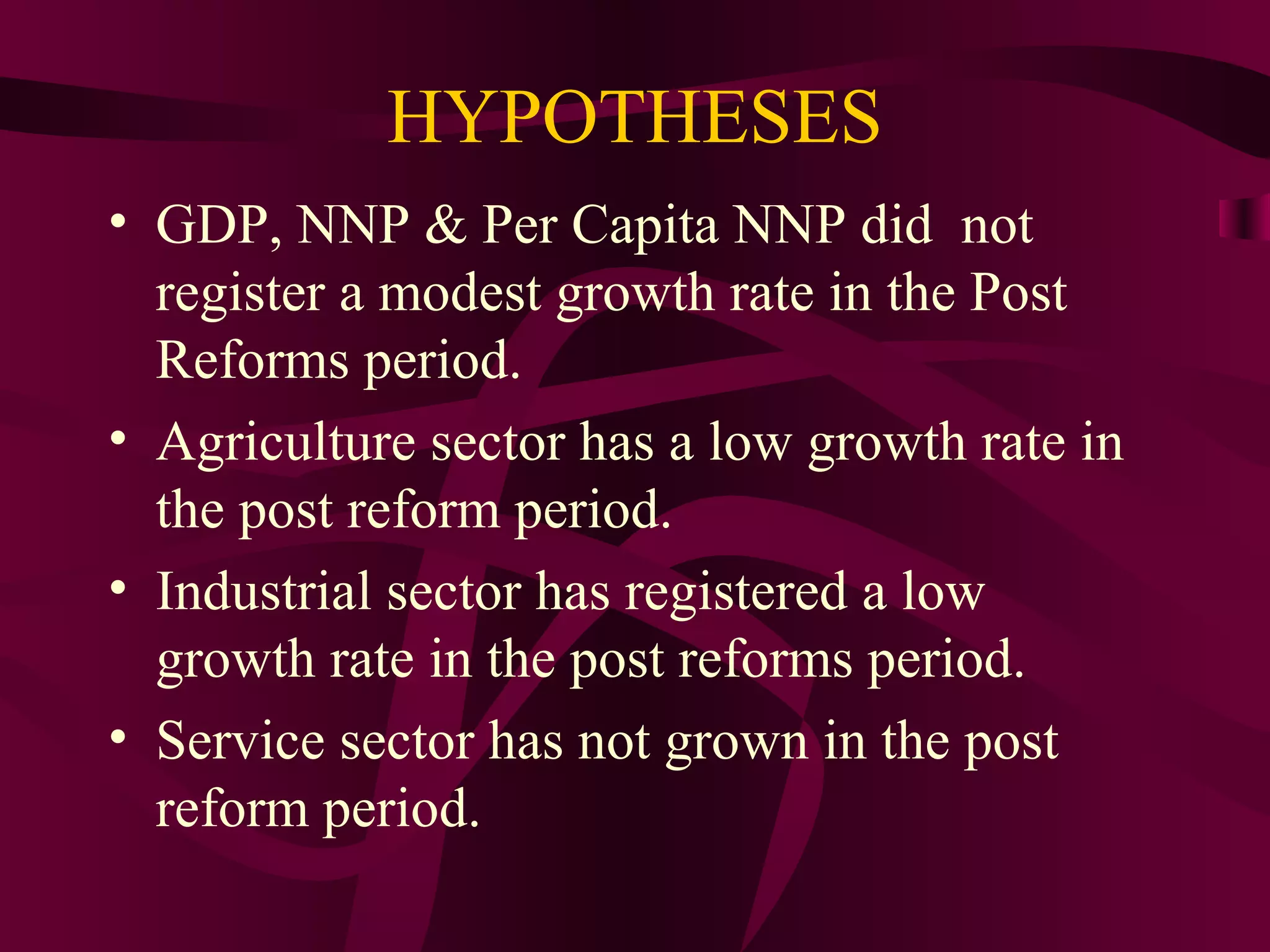
HYPOTHESES
• GDP, NNP & Per Capita NNP did not
register a modest growth rate in the Post
Reforms period.
• Agriculture sector has a low growth rate in
the post reform period.
• Industrial sector has registered a low
growth rate in the post reforms period.
• Service sector has not grown in the post
reform period.
METHODOLOGY
• Basic econometric models like linear growth
models,elasticity have been used .
• Secondary data from various sources like
CSO,RBI Bulletin has been used for empirical
calculations.
Empirical Findings
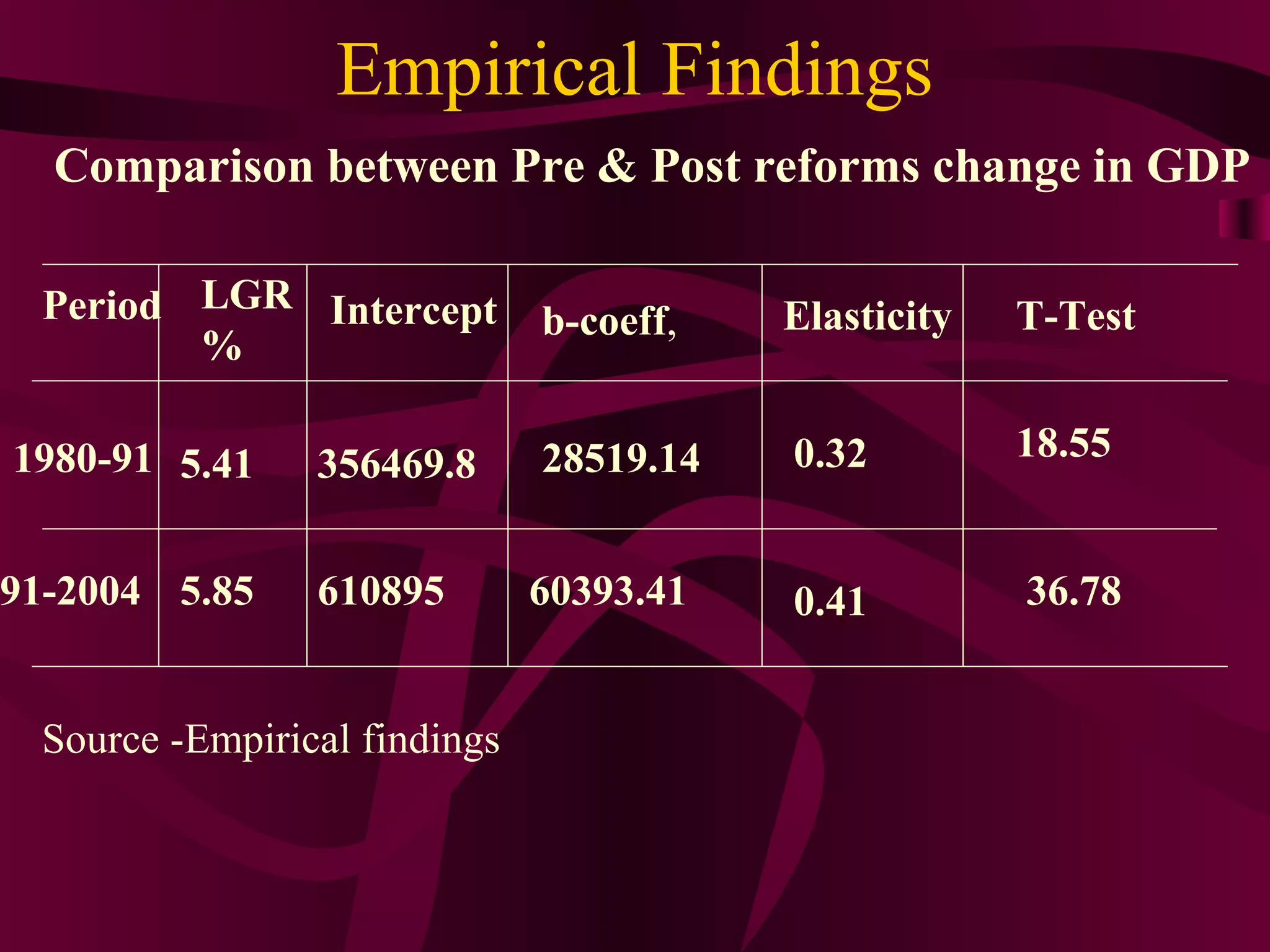
Comparison between Pre & Post reforms change in GDP
Period LGR
%
Intercept b-coeff, Elasticity T-Test
1980-91
91-2004
5.41
5.85
356469.8
610895
28519.14
60393.41
0.32
0.41
18.55
36.78
Source -Empirical findings
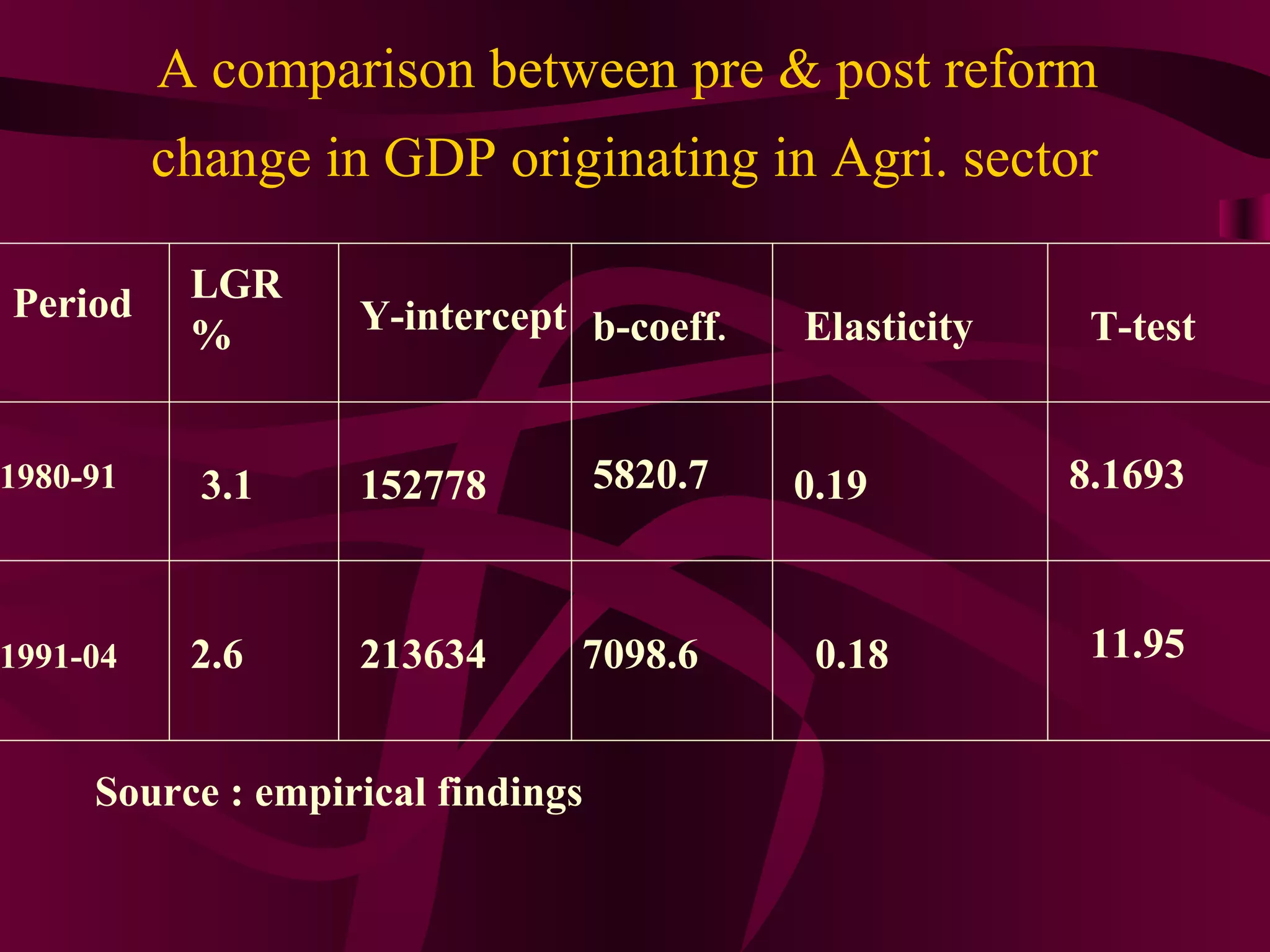
A comparison between pre & post reform
change in GDP originating in Agri. sector
Period LGR
% Y-intercept b-coeff. Elasticity T-test
1980-91
1991-04
3.1
2.6
152778
213634
5820.7
7098.6
0.19
0.18
8.1693
11.95
Source : empirical findings
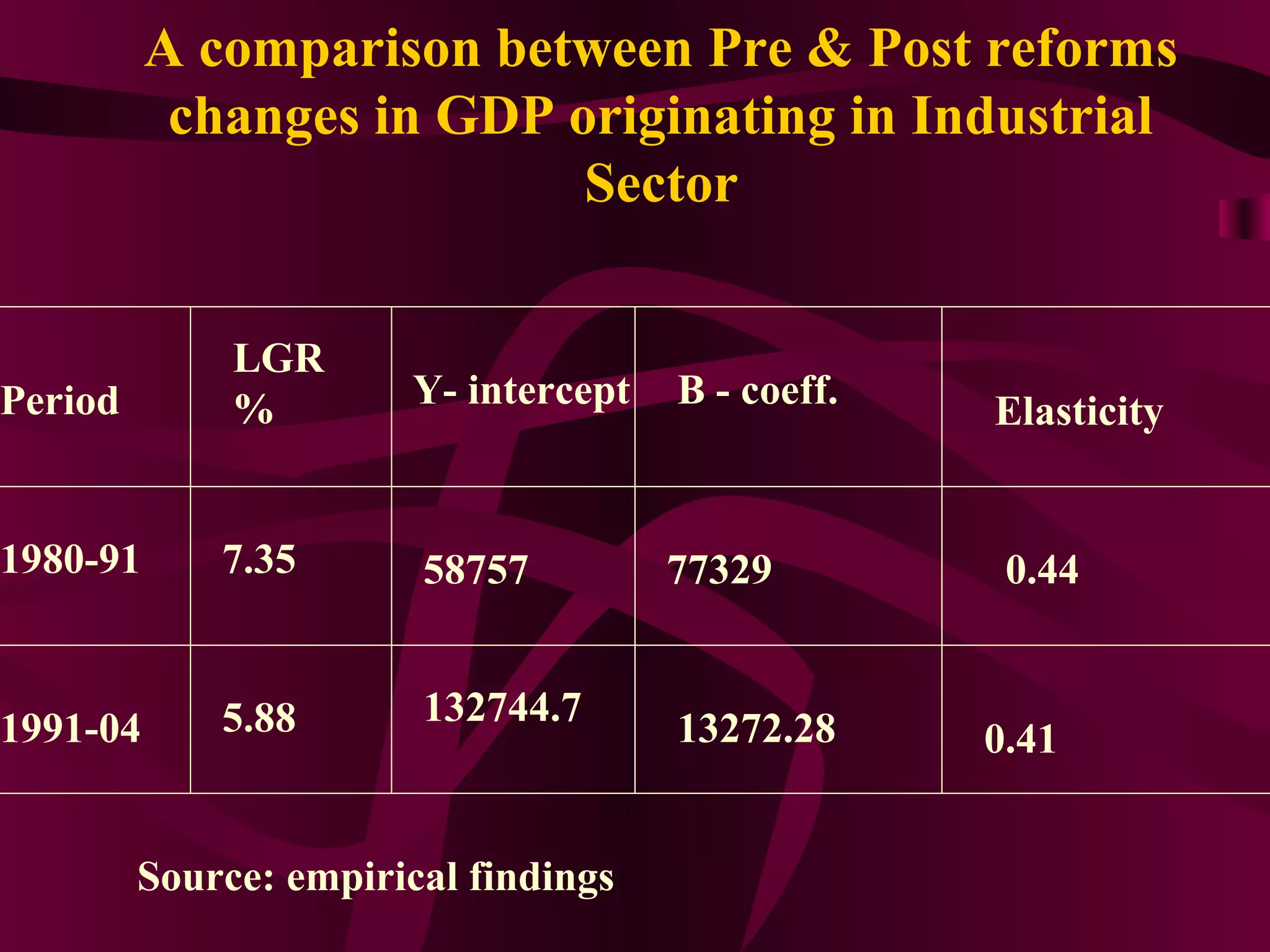
A comparison between Pre & Post reforms
changes in GDP originating in Industrial
Sector
Period
LGR
% Y- intercept B - coeff.
Elasticity
1980-91
1991-04
7.35
5.88
58757
132744.7
77329
13272.28
0.44
0.41
Source: empirical findings
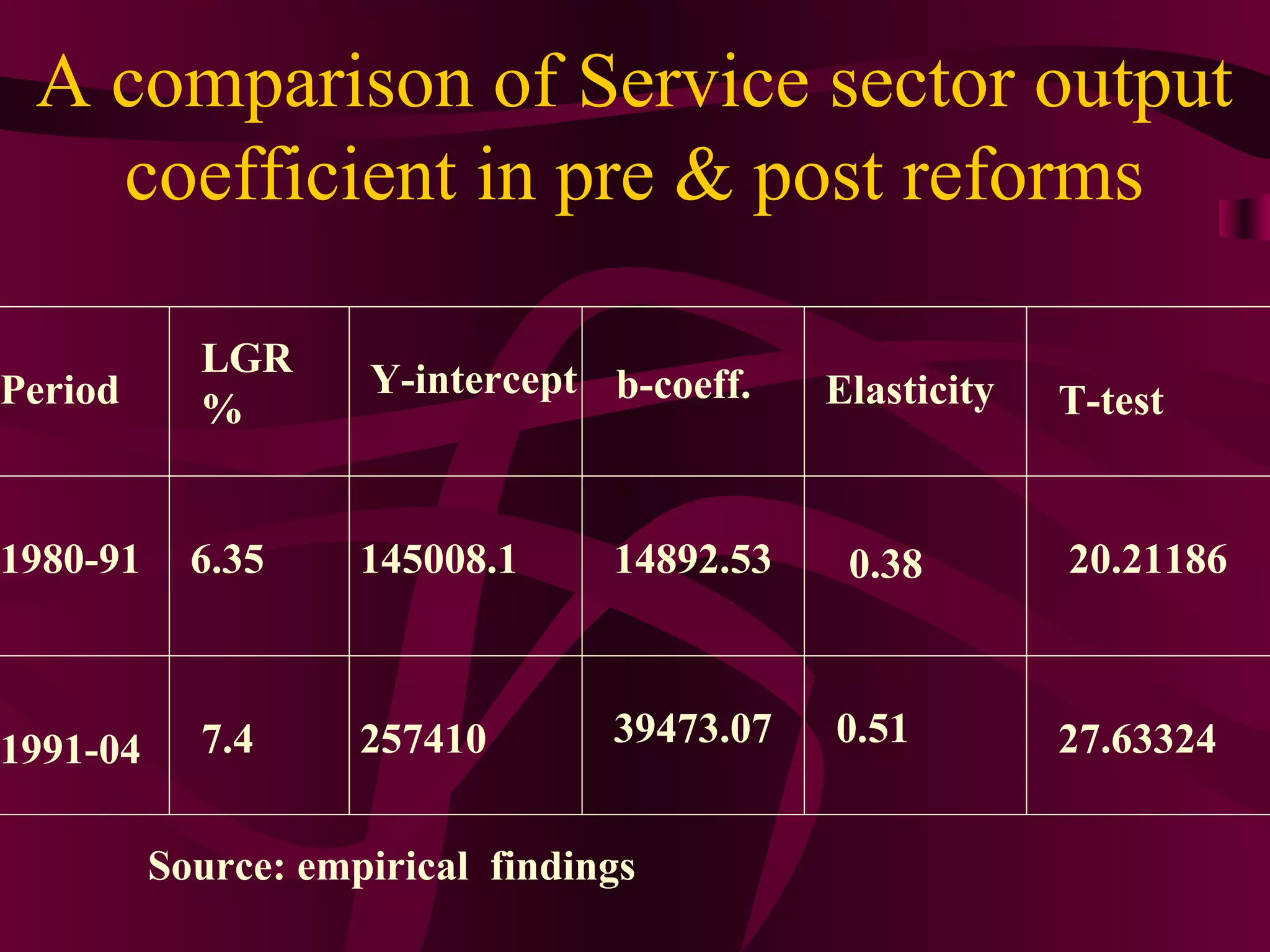
A comparison of Service sector output
coefficient in pre & post reforms
Period
LGR
%
Y-intercept b-coeff. Elasticity T-test
1980-91
1991-04
6.35
7.4
145008.1
257410
14892.53
39473.07
0.38
0.51
20.21186
27.63324
Source: empirical findings
CONCLUSIONS
* Agriculture has recorded a low growth of output
during reforms periods.
* Verifications also support the case of fall in industrial
output, and a rise in output in service sector .
* The claim that NNP & per capita NNP has grown
during the reforms period stands accepted .
Hence the euphoria of economic reforms appears
to be elusive barring a few exceptions.
THANK YOU

Economic reforms and trends

  • 1.
    Economic Reforms &Trends In National Income Presented By Prof M.M.Joshi
  • 2.
  • 3.
    Economic Reforms & Trendsin National Income A challenge or an opportunity ?
  • 4.
    IMPORTANCE Economic reforms havehad a deep impact on income propagation on the Indian Economy.The study is relevant in studying the changes in income in various sectors of the Indian Economy. The scenario of the Indian Economy changed after the new economic reforms were implemented in this country in the year 1991. This study tries to analyze the pre reform and post reform impact on the Indian Economy.
  • 5.
    OBJECTIVES • To analyzepre and post reforms impact on the growth of GDP at factor cost . • To analyze intersectoral growth rate .
  • 6.
    Review of theliterature * Mahesh Joshi (2003) states that economic reforms shall be a failure if agriculture and rural development is neglected. * V.D. Vidyarthi and Asha Rani (2003) correlate economic reforms with greater productivity in agriculture .
  • 7.
    HYPOTHESES • GDP, NNP& Per Capita NNP did not register a modest growth rate in the Post Reforms period. • Agriculture sector has a low growth rate in the post reform period. • Industrial sector has registered a low growth rate in the post reforms period. • Service sector has not grown in the post reform period.
  • 8.
    METHODOLOGY • Basic econometricmodels like linear growth models,elasticity have been used . • Secondary data from various sources like CSO,RBI Bulletin has been used for empirical calculations.
  • 9.
    Empirical Findings Comparison betweenPre & Post reforms change in GDP Period LGR % Intercept b-coeff, Elasticity T-Test 1980-91 91-2004 5.41 5.85 356469.8 610895 28519.14 60393.41 0.32 0.41 18.55 36.78 Source -Empirical findings
  • 10.
    A comparison betweenpre & post reform change in GDP originating in Agri. sector Period LGR % Y-intercept b-coeff. Elasticity T-test 1980-91 1991-04 3.1 2.6 152778 213634 5820.7 7098.6 0.19 0.18 8.1693 11.95 Source : empirical findings
  • 11.
    A comparison betweenPre & Post reforms changes in GDP originating in Industrial Sector Period LGR % Y- intercept B - coeff. Elasticity 1980-91 1991-04 7.35 5.88 58757 132744.7 77329 13272.28 0.44 0.41 Source: empirical findings
  • 12.
    A comparison ofService sector output coefficient in pre & post reforms Period LGR % Y-intercept b-coeff. Elasticity T-test 1980-91 1991-04 6.35 7.4 145008.1 257410 14892.53 39473.07 0.38 0.51 20.21186 27.63324 Source: empirical findings
  • 13.
    CONCLUSIONS * Agriculture hasrecorded a low growth of output during reforms periods. * Verifications also support the case of fall in industrial output, and a rise in output in service sector . * The claim that NNP & per capita NNP has grown during the reforms period stands accepted . Hence the euphoria of economic reforms appears to be elusive barring a few exceptions.
  • 14.