North Western Universities Purchasing Consortium Ltd
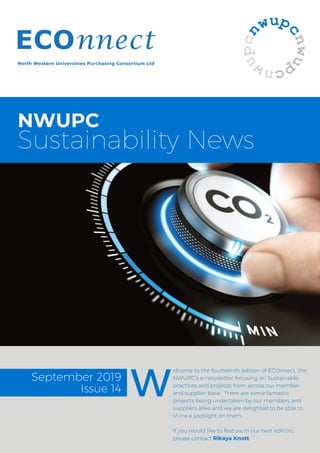
NWUPC
Sustainability News
elcome to the fourteenth edition of ECOnnect, the
NWUPC’s e-newsletter focusing on Sustainable
practices and projects from across our member
and supplier base. There are some fantastic
projects being undertaken by our members and
suppliers alike and we are delighted to be able to
shine a spotlight on them.
If you would like to feature in our next edition,
please contact Rikaya Knott.
WSeptember 2019
Issue 14
People & Planet
University League
As part of the research, People & Planet analyse
carbon emissions data collected by the Higher
Education Statistics Agency for all publically funded
UK Universities and publish their results toward the
sector wide target of 43% cuts on 2005 emissions
by 2020.
Manchester Metropolitan University has once again
been named as one of the UK’s greenest
universities, ranked second in this year’s University
League Table. Manchester Metropolitan has now
maintained a top three position for the past six
league tables and have demonstrated improved
performance by increasing their score since the last
table was released in 2017. Some of the key
initiatives undertaken include the university
becoming a member of Electronics Watch who are
a collaborative public sector organisation working
to create an ethical IT supply chain.
University of Worcester were ranked in 5th place.
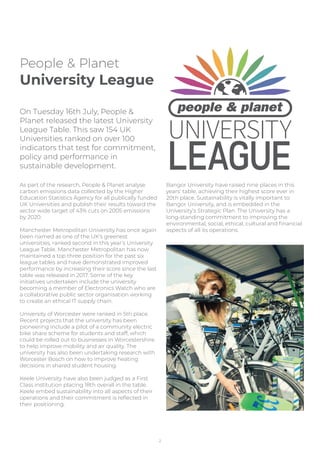
Recent projects that the university has been
pioneering include a pilot of a community electric
bike share scheme for students and staff, which
could be rolled out to businesses in Worcestershire
to help improve mobility and air quality. The
university has also been undertaking research with
Worcester Bosch on how to improve heating
decisions in shared student housing.
Keele University have also been judged as a First
Class institution placing 18th overall in the table.
Keele embed sustainability into all aspects of their
operations and their commitment is reflected in
their positioning.
2
On Tuesday 16th July, People &
Planet released the latest University
League Table. This saw 154 UK
Universities ranked on over 100
indicators that test for commitment,
policy and performance in
sustainable development.
Bangor University have raised nine places in this
years’ table, achieving their highest score ever in
20th place. Sustainability is vitally important to
Bangor University, and is embedded in the
University’s Strategic Plan. The University has a
long-standing commitment to improving the
environmental, social, ethical, cultural and financial
aspects of all its operations.
3
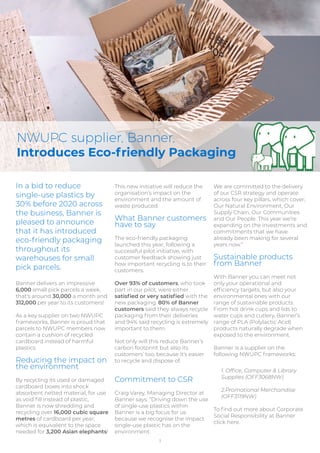
In a bid to reduce
single-use plastics by
30% before 2020 across
the business, Banner is
pleased to announce
that it has introduced
eco-friendly packaging
throughout its
warehouses for small
pick parcels.
Banner delivers an impressive
6,000 small pick parcels a week,
that's around 30,000 a month and
312,000 per year to its customers!
As a key supplier on two NWUPC
frameworks, Banner is proud that
parcels to NWUPC members now
contain a cushion of recycled
cardboard instead of harmful
plastics.
Reducing the impact on
the environment
By recycling its used or damaged
cardboard boxes into shock
absorbent netted material, for use
as void fill instead of plastic,
Banner is now shredding and
recycling over 16,000 cubic square
metres of cardboard per year;
which is equivalent to the space
needed for 3,200 Asian elephants!
NWUPC supplier, Banner,
Introduces Eco-friendly Packaging
This new initiative will reduce the
organisation’s impact on the
environment and the amount of
waste produced.
What Banner customers
have to say
The eco-friendly packaging
launched this year, following a
successful pilot initiative, with
customer feedback showing just
how important recycling is to their
customers.
Over 93% of customers, who took
part in our pilot, were either
satisfied or very satisfied with the
new packaging. 80% of Banner
customers said they always recycle
packaging from their deliveries
and 94% said recycling is extremely
important to them.
Not only will this reduce Banner’s
carbon footprint but also its
customers’ too, because it’s easier
to recycle and dispose of.
Commitment to CSR
Craig Varey, Managing Director at
Banner says: “Driving down the use
of single-use plastics within
Banner is a big focus for us
because we recognise the impact
single-use plastic has on the
environment.
We are committed to the delivery
of our CSR strategy and operate
across four key pillars, which cover;
Our Natural Environment, Our
Supply Chain, Our Communities
and Our People. This year we’re
expanding on the investments and
commitments that we have
already been making for several
years now.”
Sustainable products
from Banner
With Banner you can meet not
only your operational and
efficiency targets, but also your
environmental ones with our
range of sustainable products.
From hot drink cups and lids to
water cups and cutlery, Banner’s
range of PLA (Polylactic Acid)
products naturally degrade when
exposed to the environment.
Banner is a supplier on the
following NWUPC frameworks:
1. Office, Computer & Library
Supplies (OFF3068NW)
2.Promotional Merchandise
(OFF3119NW)
To find out more about Corporate
Social Responsibility at Banner
click here.
University of Bolton’s
Fight Against Global Air Pollution
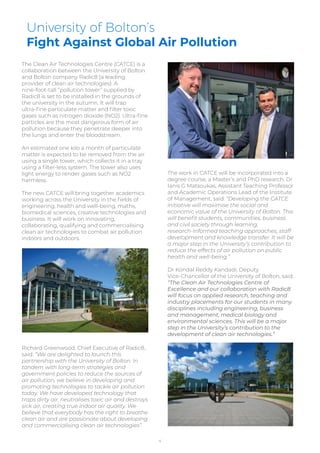
The Clean Air Technologies Centre (CATCE) is a
collaboration between the University of Bolton
and Bolton company Radic8 (a leading
provider of clean air technologies). A
nine-foot-tall “pollution tower” supplied by
Radic8 is set to be installed in the grounds of
the university in the autumn. It will trap
ultra-fine particulate matter and filter toxic
gases such as nitrogen dioxide (NO2). Ultra-fine
particles are the most dangerous form of air
pollution because they penetrate deeper into
the lungs and enter the bloodstream.
An estimated one kilo a month of particulate
matter is expected to be removed from the air
using a single tower, which collects it in a tray
using a filter-less system. The tower also uses
light energy to render gases such as NO2
harmless.
The new CATCE will bring together academics
working across the University in the fields of
engineering, health and well-being, maths,
biomedical sciences, creative technologies and
business. It will work on innovating,
collaborating, qualifying and commercialising
clean air technologies to combat air pollution
indoors and outdoors.
Richard Greenwood, Chief Executive of Radic8,
said: “We are delighted to launch this
partnership with the University of Bolton. In
tandem with long-term strategies and
government policies to reduce the sources of
air pollution, we believe in developing and
promoting technologies to tackle air pollution
today. We have developed technology that
traps dirty air, neutralises toxic air and destroys
sick air, creating true indoor air quality. We
believe that everybody has the right to breathe
clean air and are passionate about developing
and commercialising clean air technologies”.
The work in CATCE will be incorporated into a
degree course, a Master’s and PhD research. Dr
Ianis G Matsoukas, Assistant Teaching Professor
and Academic Operations Lead of the Institute
of Management, said: “Developing the CATCE
initiative will maximise the social and
economic value of the University of Bolton. This
will benefit students, communities, business
and civil society through learning,
research-informed teaching approaches, staff
development and knowledge transfer. It will be
a major step in the University’s contribution to
reduce the effects of air pollution on public
health and well-being.”
Dr Kondal Reddy Kandadi, Deputy
Vice-Chancellor of the University of Bolton, said:
“The Clean Air Technologies Centre of
Excellence and our collaboration with Radic8
will focus on applied research, teaching and
industry placements for our students in many
disciplines including engineering, business
and management, medical biology and
environmental sciences. This will be a major
step in the University’s contribution to the
development of clean air technologies.”
4
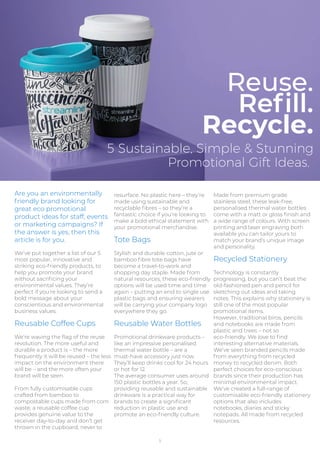
Are you an environmentally
friendly brand looking for
great eco promotional
product ideas for staff, events
or marketing campaigns? If
the answer is yes, then this
article is for you.
We’ve put together a list of our 5
most popular, innovative and
striking eco-friendly products, to
help you promote your brand
without sacrificing your
environmental values. They’re
perfect if you’re looking to send a
bold message about your
conscientious and environmental
business values.
Reusable Coffee Cups
We’re waving the flag of the reuse
revolution. The more useful and
durable a product is – the more
frequently it will be reused – the less
impact on the environment there
will be – and the more often your
brand will be seen.
From fully customisable cups
crafted from bamboo to
compostable cups made from corn
waste, a reusable coffee cup
provides genuine value to the
receiver day-to-day and don’t get
thrown in the cupboard, never to
5
resurface. No plastic here – they’re
made using sustainable and
recyclable fibres – so they’re a
fantastic choice if you’re looking to
make a bold ethical statement with
your promotional merchandise.
Tote Bags
Stylish and durable cotton, jute or
bamboo fibre tote bags have
become a travel-to-work and
shopping day staple. Made from
natural resources, these eco-friendly
options will be used time and time
again – putting an end to single use
plastic bags and ensuring wearers
will be carrying your company logo
everywhere they go.
Reusable Water Bottles
Promotional drinkware products –
like an impressive personalised
thermal water bottle – are a
must-have accessory just now.
They’ll keep drinks cool for 24 hours
or hot for 12.
The average consumer uses around
150 plastic bottles a year. So,
providing reusable and sustainable
drinkware is a practical way for
brands to create a significant
reduction in plastic use and
promote an eco-friendly culture.
Made from premium grade
stainless steel, these leak-free,
personalised thermal water bottles
come with a matt or gloss finish and
a wide range of colours. With screen
printing and laser engraving both
available you can tailor yours to
match your brand’s unique image
and personality.
Recycled Stationery
Technology is constantly
progressing, but you can’t beat the
old-fashioned pen and pencil for
sketching out ideas and taking
notes. This explains why stationery is
still one of the most popular
promotional items.
However, traditional biros, pencils
and notebooks are made from
plastic and trees – not so
eco-friendly. We love to find
interesting alternative materials.
We’ve seen branded pencils made
from everything from recycled
money to recycled denim. Both
perfect choices for eco-conscious
brands since their production has
minimal environmental impact.
We‘ve created a full-range of
customisable eco-friendly stationery
options that also includes
notebooks, diaries and sticky
notepads. All made from recycled
resources.
Reuse.
Refill.
Recycle.
5 Sustainable, Simple & Stunning
Promotional Gift Ideas.
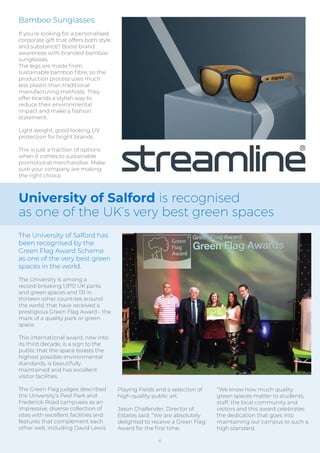
Bamboo Sunglasses
If you’re looking for a personalised
corporate gift that offers both style
and substance? Boost brand
awareness with branded bamboo
sunglasses.
The legs are made from
sustainable bamboo fibre, so the
production process uses much
less plastic than traditional
manufacturing methods. They
offer brands a stylish way to
reduce their environmental
impact and make a fashion
statement.
Light weight, good looking UV
protection for bright brands.
This is just a fraction of options
when it comes to sustainable
promotional merchandise. Make
sure your company are making
the right choice.
University of Salford is recognised
as one of the UK’s very best green spaces
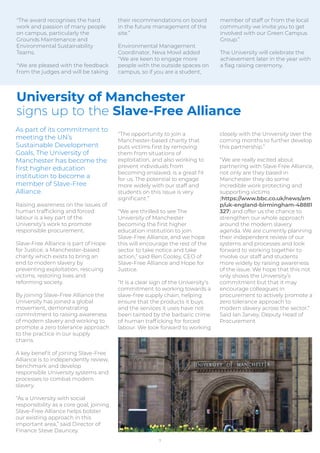
The University of Salford has
been recognised by the
Green Flag Award Scheme
as one of the very best green
spaces in the world.
The University is among a
record-breaking 1,970 UK parks
and green spaces and 131 in
thirteen other countries around
the world, that have received a
prestigious Green Flag Award - the
mark of a quality park or green
space.
This international award, now into
its third decade, is a sign to the
public that the space boasts the
highest possible environmental
standards, is beautifully
maintained and has excellent
visitor facilities.
The Green Flag judges described
the University’s Peel Park and
Frederick Road campuses as an
impressive, diverse collection of
sites with excellent facilities and
features that complement each
other well, including David Lewis
Playing Fields and a selection of
high-quality public art.
Jason Challender, Director of
Estates said: “We are absolutely
delighted to receive a Green Flag
Award for the first time.
“We know how much quality
green spaces matter to students,
staff, the local community and
visitors and this award celebrates
the dedication that goes into
maintaining our campus to such a
high standard.
6
As part of its commitment to
meeting the UN’s
Sustainable Development
Goals, The University of
Manchester has become the
first higher education
institution to become a
member of Slave-Free
Alliance.
Raising awareness on the issues of
human trafficking and forced
labour is a key part of the
University’s work to promote
responsible procurement.
Slave-Free Alliance is part of Hope
for Justice, a Manchester-based
charity which exists to bring an
end to modern slavery by
preventing exploitation, rescuing
victims, restoring lives and
reforming society.
By joining Slave-Free Alliance the
University has joined a global
movement, demonstrating
commitment to raising awareness
of modern slavery and working to
promote a zero tolerance approach
to the practice in our supply
chains.
A key benefit of joining Slave-Free
Alliance is to independently review,
benchmark and develop
responsible University systems and
processes to combat modern
slavery.
“As a University with social
responsibility as a core goal, joining
Slave-Free Alliance helps bolster
our existing approach in this
important area,” said Director of
Finance Steve Dauncey.
“The opportunity to join a
Manchester-based charity that
puts victims first by removing
them from situations of
exploitation, and also working to
prevent individuals from
becoming enslaved, is a great fit
for us. The potential to engage
more widely with our staff and
students on this issue is very
significant.”
“We are thrilled to see The
University of Manchester
becoming the first higher
education institution to join
Slave-Free Alliance, and we hope
this will encourage the rest of the
sector to take notice and take
action,” said Ben Cooley, CEO of
Slave-Free Alliance and Hope for
Justice.
“It is a clear sign of the University’s
commitment to working towards a
slave-free supply chain, helping
ensure that the products it buys
and the services it uses have not
been tainted by the barbaric crime
of human trafficking for forced
labour. We look forward to working
closely with the University over the
coming months to further develop
this partnership.”
“We are really excited about
partnering with Slave Free Alliance,
not only are they based in
Manchester they do some
incredible work protecting and
supporting victims
(https://www.bbc.co.uk/news/am
p/uk-england-birmingham-48881
327) and offer us the chance to
strengthen our whole approach
around the modern slavery
agenda. We are currently planning
their independent review of our
systems and processes and look
forward to working together to
involve our staff and students
more widely by raising awareness
of the issue. We hope that this not
only shows the University’s
commitment but that it may
encourage colleagues in
procurement to actively promote a
zero tolerance approach to
modern slavery across the sector.”
Said Ian Jarvey, Deputy Head of
Procurement.
"The award recognises the hard
work and passion of many people
on campus, particularly the
Grounds Maintenance and
Environmental Sustainability
Teams.
"We are pleased with the feedback
from the judges and will be taking
their recommendations on board
in the future management of the
site.”
Environmental Management
Coordinator, Neva Mowl added
“We are keen to engage more
people with the outside spaces on
campus, so if you are a student,
member of staff or from the local
community we invite you to get
involved with our Green Campus
Group.”
The University will celebrate the
achievement later in the year with
a flag raising ceremony.
7
University of Manchester
signs up to the Slave-Free Alliance
8
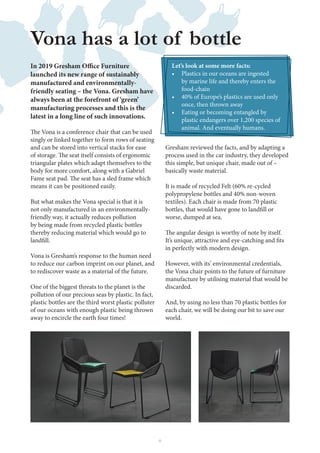
launched its new range of sustainably
manufactured and environmentally-
friendly seating – the Vona. Gresham have
always been at the forefront of ‘green’
manufacturing processes and this is the
latest in a long line of such innovations.
singly or linked together to form rows of seating
and can be stored into vertical stacks for ease
triangular plates which adapt themselves to the
body for more comfort, along with a Gabriel
means it can be positioned easily.
But what makes the Vona special is that it is
not only manufactured in an environmentally-
friendly way, it actually reduces pollution
by being made from recycled plastic bottles
thereby reducing material which would go to
Vona is Gresham’s response to the human need
to reduce our carbon imprint on our planet, and
to rediscover waste as a material of the future.
One of the biggest threats to the planet is the
pollution of our precious seas by plastic. In fact,
plastic bottles are the third worst plastic polluter
of our oceans with enough plastic being thrown
away to encircle the earth four times!
Vona has a lot of bottle
Gresham reviewed the facts, and by adapting a
process used in the car industry, they developed
this simple, but unique chair, made out of –
basically waste material.
It is made of recycled Felt (60% re-cycled
polypropylene bottles and 40% non-woven
textiles). Each chair is made from 70 plastic
worse, dumped at sea.
in perfectly with modern design.
However, with its’ environmental credentials,
the Vona chair points to the future of furniture
manufacture by utilising material that would be
discarded.
And, by using no less than 70 plastic bottles for
each chair, we will be doing our bit to save our
world.
Let’s look at some more facts:
• Plastics in our oceans are ingested
by marine life and thereby enters the
food-chain
• 40% of Europe’s plastics are used only
once, then thrown away
• Eating or becoming entangled by
plastic endangers over 1,200 species of
animal. And eventually humans.
9
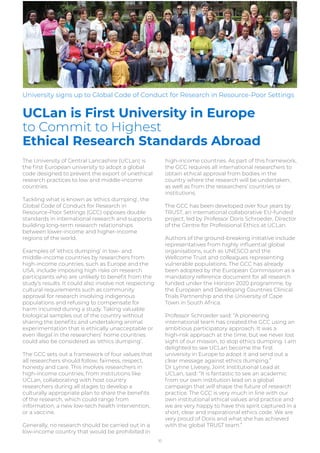
The University of Central Lancashire (UCLan) is
the first European university to adopt a global
code designed to prevent the export of unethical
research practices to low and middle-income
countries.
Tackling what is known as ‘ethics dumping’, the
Global Code of Conduct for Research in
Resource-Poor Settings (GCC) opposes double
standards in international research and supports
building long-term research relationships
between lower-income and higher-income
regions of the world.
Examples of ‘ethics dumping’ in low- and
middle-income countries by researchers from
high-income countries, such as Europe and the
USA, include imposing high risks on research
participants who are unlikely to benefit from the
study’s results. It could also involve not respecting
cultural requirements such as community
approval for research involving indigenous
populations and refusing to compensate for
harm incurred during a study. Taking valuable
biological samples out of the country without
sharing the benefits and undertaking animal
experimentation that is ethically unacceptable or
even illegal in the researchers’ home countries
could also be considered as ‘ethics dumping’.
The GCC sets out a framework of four values that
all researchers should follow; fairness, respect,
honesty and care. This involves researchers in
high-income countries, from institutions like
UCLan, collaborating with host country
researchers during all stages to develop a
culturally appropriate plan to share the benefits
of the research, which could range from
information, a new low-tech health intervention,
or a vaccine.
Generally, no research should be carried out in a
low-income country that would be prohibited in
high-income countries. As part of this framework,
the GCC requires all international researchers to
obtain ethical approval from bodies in the
country where the research will be undertaken,
as well as from the researchers’ countries or
institutions.
The GCC has been developed over four years by
TRUST, an international collaborative EU-funded
project, led by Professor Doris Schroeder, Director
of the Centre for Professional Ethics at UCLan.
Authors of the ground-breaking initiative include
representatives from highly influential global
organisations, such as UNESCO and the
Wellcome Trust and colleagues representing
vulnerable populations. The GCC has already
been adopted by the European Commission as a
mandatory reference document for all research
funded under the Horizon 2020 programme, by
the European and Developing Countries Clinical
Trials Partnership and the University of Cape
Town in South Africa.
Professor Schroeder said: “A pioneering
international team has created the GCC using an
ambitious participatory approach. It was a
high-risk approach at the time, but we never lost
sight of our mission, to stop ethics dumping. I am
delighted to see UCLan become the first
university in Europe to adopt it and send out a
clear message against ethics dumping.”
Dr Lynne Livesey, Joint Institutional Lead at
UCLan, said: “It is fantastic to see an academic
from our own institution lead on a global
campaign that will shape the future of research
practice. The GCC is very much in line with our
own institutional ethical values and practice and
we are very happy to have this spirit captured in a
short, clear and inspirational ethics code. We are
very proud of Doris and what she has achieved
with the global TRUST team.”
10
UCLan is First University in Europe
to Commit to Highest
Ethical Research Standards Abroad
University signs up to Global Code of Conduct for Research in Resource-Poor Settings
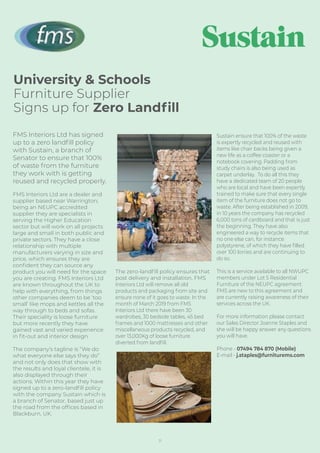
University & Schools
Furniture Supplier
Signs up for Zero Landfill
FMS Interiors Ltd has signed
up to a zero landfill policy
with Sustain, a branch of
Senator to ensure that 100%
of waste from the furniture
they work with is getting
reused and recycled properly.
FMS Interiors Ltd are a dealer and
supplier based near Warrington;
being an NEUPC accredited
supplier they are specialists in
serving the Higher Education
sector but will work on all projects
large and small in both public and
private sectors. They have a close
relationship with multiple
manufacturers varying in size and
price, which ensures they are
confident they can source any
product you will need for the space
you are creating. FMS Interiors Ltd
are known throughout the UK to
help with everything, from things
other companies deem to be ‘too
small’ like mops and kettles all the
way through to beds and sofas.
Their speciality is loose furniture
but more recently they have
gained vast and varied experience
in fit-out and interior design.
The company’s tagline is “We do
what everyone else says they do”
and not only does that show with
the results and loyal clientele, it is
also displayed through their
actions. Within this year they have
signed up to a zero-landfill policy
with the company Sustain which is
a branch of Senator, based just up
the road from the offices based in
Blackburn, UK.
The zero-landfill policy ensures that
post delivery and installation, FMS
Interiors Ltd will remove all old
products and packaging from site and
ensure none of it goes to waste. In the
month of March 2019 from FMS
Interiors Ltd there have been 30
wardrobes, 30 bedside tables, 45 bed
frames and 1000 mattresses and other
miscellaneous products recycled, and
over 13,000Kg of loose furniture
diverted from landfill.
Sustain ensure that 100% of the waste
is expertly recycled and reused with
items like chair backs being given a
new life as a coffee coaster or a
notebook covering. Padding from
study chairs is also being used as
carpet underlay. To do all this they
have a dedicated team of 20 people
who are local and have been expertly
trained to make sure that every single
item of the furniture does not go to
waste. After being established in 2009,
in 10 years the company has recycled
6,000 tons of cardboard and that is just
the beginning. They have also
engineered a way to recycle items that
no one else can, for instance
polystyrene, of which they have filled
over 100 lorries and are continuing to
do so.
This is a service available to all NWUPC
members under Lot 5 Residential
Furniture of the NEUPC agreement.
FMS are new to this agreement and
are currently raising awareness of their
services across the UK.
For more information please contact
our Sales Director Joanne Staples and
she will be happy answer any questions
you will have.
Phone - 07494 784 870 (Mobile)
E-mail - j.staples@furniturems.com
11
12
EnvoPAP:
Sustainable Tree-Free Paper
for a Circular Economy
The circular economy is a concept that aims to
minimise waste by reusing materials and regenerating
natural systems thus avoiding landfill waste. The
old-fashioned linear consumption has led to our
plastic-filled oceans and rampant deforestation. The
crucial part the rainforests play as the ‘lungs of the
planet’ is at odds with the corporate interests and
illegal logging in the Amazon and other unprotected
forests across the globe.
The EnvoPAP Story
Kaushal Shah thought of a plan to combat this
problem whilst studying at the University of
Southampton. He saw the potential of turning
agricultural waste in his home country of India into
usable products.
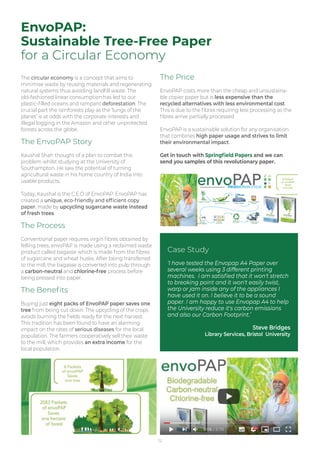
Today, Kaushal is the C.E.O of EnvoPAP. EnvoPAP has
created a unique, eco-friendly and efficient copy
paper, made by upcycling sugarcane waste instead
of fresh trees.
The Process
Conventional paper requires virgin fibres obtained by
felling trees, envoPAP is made using a reclaimed waste
product called bagasse which is made from the fibres
of sugarcane and wheat husks. After being transferred
to the mill, the bagasse is converted into pulp through
a carbon-neutral and chlorine-free process before
being pressed into paper.
The Benefits
Buying just eight packs of EnvoPAP paper saves one
tree from being cut down. The upcycling of the crops
avoids burning the fields ready for the next harvest.
This tradition has been found to have an alarming
impact on the rates of serious diseases for the local
population. The farmers cooperatively sell their waste
to the mill, which provides an extra income for the
local population.
The Price
EnvoPAP costs more than the cheap and unsustaina-
ble copier paper but is less expensive than the
recycled alternatives with less environmental cost.
This is due to the fibres requiring less processing as the
fibres arrive partially processed.
EnvoPAP is a sustainable solution for any organisation
that combines high paper usage and strives to limit
their environmental impact.
Get in touch with Springfield Papers and we can
send you samples of this revolutionary paper.
Case Study
‘I have tested the Envopap A4 Paper over
several weeks using 3 different printing
machines. I am satisfied that it won't stretch
to breaking point and it won't easily twist,
warp or jam inside any of the appliances I
have used it on. I believe it to be a sound
paper. I am happy to use Envopap A4 to help
the University reduce it's carbon emissions
and also our Carbon Footprint.’
Steve Bridges
Library Services, Bristol University

Econnect issue14

  • 1.
    North Western UniversitiesPurchasing Consortium Ltd NWUPC Sustainability News elcome to the fourteenth edition of ECOnnect, the NWUPC’s e-newsletter focusing on Sustainable practices and projects from across our member and supplier base. There are some fantastic projects being undertaken by our members and suppliers alike and we are delighted to be able to shine a spotlight on them. If you would like to feature in our next edition, please contact Rikaya Knott. WSeptember 2019 Issue 14
  • 2.
    People & Planet UniversityLeague As part of the research, People & Planet analyse carbon emissions data collected by the Higher Education Statistics Agency for all publically funded UK Universities and publish their results toward the sector wide target of 43% cuts on 2005 emissions by 2020. Manchester Metropolitan University has once again been named as one of the UK’s greenest universities, ranked second in this year’s University League Table. Manchester Metropolitan has now maintained a top three position for the past six league tables and have demonstrated improved performance by increasing their score since the last table was released in 2017. Some of the key initiatives undertaken include the university becoming a member of Electronics Watch who are a collaborative public sector organisation working to create an ethical IT supply chain. University of Worcester were ranked in 5th place. Recent projects that the university has been pioneering include a pilot of a community electric bike share scheme for students and staff, which could be rolled out to businesses in Worcestershire to help improve mobility and air quality. The university has also been undertaking research with Worcester Bosch on how to improve heating decisions in shared student housing. Keele University have also been judged as a First Class institution placing 18th overall in the table. Keele embed sustainability into all aspects of their operations and their commitment is reflected in their positioning. 2 On Tuesday 16th July, People & Planet released the latest University League Table. This saw 154 UK Universities ranked on over 100 indicators that test for commitment, policy and performance in sustainable development. Bangor University have raised nine places in this years’ table, achieving their highest score ever in 20th place. Sustainability is vitally important to Bangor University, and is embedded in the University’s Strategic Plan. The University has a long-standing commitment to improving the environmental, social, ethical, cultural and financial aspects of all its operations.
  • 3.
    3 In a bidto reduce single-use plastics by 30% before 2020 across the business, Banner is pleased to announce that it has introduced eco-friendly packaging throughout its warehouses for small pick parcels. Banner delivers an impressive 6,000 small pick parcels a week, that's around 30,000 a month and 312,000 per year to its customers! As a key supplier on two NWUPC frameworks, Banner is proud that parcels to NWUPC members now contain a cushion of recycled cardboard instead of harmful plastics. Reducing the impact on the environment By recycling its used or damaged cardboard boxes into shock absorbent netted material, for use as void fill instead of plastic, Banner is now shredding and recycling over 16,000 cubic square metres of cardboard per year; which is equivalent to the space needed for 3,200 Asian elephants! NWUPC supplier, Banner, Introduces Eco-friendly Packaging This new initiative will reduce the organisation’s impact on the environment and the amount of waste produced. What Banner customers have to say The eco-friendly packaging launched this year, following a successful pilot initiative, with customer feedback showing just how important recycling is to their customers. Over 93% of customers, who took part in our pilot, were either satisfied or very satisfied with the new packaging. 80% of Banner customers said they always recycle packaging from their deliveries and 94% said recycling is extremely important to them. Not only will this reduce Banner’s carbon footprint but also its customers’ too, because it’s easier to recycle and dispose of. Commitment to CSR Craig Varey, Managing Director at Banner says: “Driving down the use of single-use plastics within Banner is a big focus for us because we recognise the impact single-use plastic has on the environment. We are committed to the delivery of our CSR strategy and operate across four key pillars, which cover; Our Natural Environment, Our Supply Chain, Our Communities and Our People. This year we’re expanding on the investments and commitments that we have already been making for several years now.” Sustainable products from Banner With Banner you can meet not only your operational and efficiency targets, but also your environmental ones with our range of sustainable products. From hot drink cups and lids to water cups and cutlery, Banner’s range of PLA (Polylactic Acid) products naturally degrade when exposed to the environment. Banner is a supplier on the following NWUPC frameworks: 1. Office, Computer & Library Supplies (OFF3068NW) 2.Promotional Merchandise (OFF3119NW) To find out more about Corporate Social Responsibility at Banner click here.
  • 4.
    University of Bolton’s FightAgainst Global Air Pollution The Clean Air Technologies Centre (CATCE) is a collaboration between the University of Bolton and Bolton company Radic8 (a leading provider of clean air technologies). A nine-foot-tall “pollution tower” supplied by Radic8 is set to be installed in the grounds of the university in the autumn. It will trap ultra-fine particulate matter and filter toxic gases such as nitrogen dioxide (NO2). Ultra-fine particles are the most dangerous form of air pollution because they penetrate deeper into the lungs and enter the bloodstream. An estimated one kilo a month of particulate matter is expected to be removed from the air using a single tower, which collects it in a tray using a filter-less system. The tower also uses light energy to render gases such as NO2 harmless. The new CATCE will bring together academics working across the University in the fields of engineering, health and well-being, maths, biomedical sciences, creative technologies and business. It will work on innovating, collaborating, qualifying and commercialising clean air technologies to combat air pollution indoors and outdoors. Richard Greenwood, Chief Executive of Radic8, said: “We are delighted to launch this partnership with the University of Bolton. In tandem with long-term strategies and government policies to reduce the sources of air pollution, we believe in developing and promoting technologies to tackle air pollution today. We have developed technology that traps dirty air, neutralises toxic air and destroys sick air, creating true indoor air quality. We believe that everybody has the right to breathe clean air and are passionate about developing and commercialising clean air technologies”. The work in CATCE will be incorporated into a degree course, a Master’s and PhD research. Dr Ianis G Matsoukas, Assistant Teaching Professor and Academic Operations Lead of the Institute of Management, said: “Developing the CATCE initiative will maximise the social and economic value of the University of Bolton. This will benefit students, communities, business and civil society through learning, research-informed teaching approaches, staff development and knowledge transfer. It will be a major step in the University’s contribution to reduce the effects of air pollution on public health and well-being.” Dr Kondal Reddy Kandadi, Deputy Vice-Chancellor of the University of Bolton, said: “The Clean Air Technologies Centre of Excellence and our collaboration with Radic8 will focus on applied research, teaching and industry placements for our students in many disciplines including engineering, business and management, medical biology and environmental sciences. This will be a major step in the University’s contribution to the development of clean air technologies.” 4
  • 5.
    Are you anenvironmentally friendly brand looking for great eco promotional product ideas for staff, events or marketing campaigns? If the answer is yes, then this article is for you. We’ve put together a list of our 5 most popular, innovative and striking eco-friendly products, to help you promote your brand without sacrificing your environmental values. They’re perfect if you’re looking to send a bold message about your conscientious and environmental business values. Reusable Coffee Cups We’re waving the flag of the reuse revolution. The more useful and durable a product is – the more frequently it will be reused – the less impact on the environment there will be – and the more often your brand will be seen. From fully customisable cups crafted from bamboo to compostable cups made from corn waste, a reusable coffee cup provides genuine value to the receiver day-to-day and don’t get thrown in the cupboard, never to 5 resurface. No plastic here – they’re made using sustainable and recyclable fibres – so they’re a fantastic choice if you’re looking to make a bold ethical statement with your promotional merchandise. Tote Bags Stylish and durable cotton, jute or bamboo fibre tote bags have become a travel-to-work and shopping day staple. Made from natural resources, these eco-friendly options will be used time and time again – putting an end to single use plastic bags and ensuring wearers will be carrying your company logo everywhere they go. Reusable Water Bottles Promotional drinkware products – like an impressive personalised thermal water bottle – are a must-have accessory just now. They’ll keep drinks cool for 24 hours or hot for 12. The average consumer uses around 150 plastic bottles a year. So, providing reusable and sustainable drinkware is a practical way for brands to create a significant reduction in plastic use and promote an eco-friendly culture. Made from premium grade stainless steel, these leak-free, personalised thermal water bottles come with a matt or gloss finish and a wide range of colours. With screen printing and laser engraving both available you can tailor yours to match your brand’s unique image and personality. Recycled Stationery Technology is constantly progressing, but you can’t beat the old-fashioned pen and pencil for sketching out ideas and taking notes. This explains why stationery is still one of the most popular promotional items. However, traditional biros, pencils and notebooks are made from plastic and trees – not so eco-friendly. We love to find interesting alternative materials. We’ve seen branded pencils made from everything from recycled money to recycled denim. Both perfect choices for eco-conscious brands since their production has minimal environmental impact. We‘ve created a full-range of customisable eco-friendly stationery options that also includes notebooks, diaries and sticky notepads. All made from recycled resources. Reuse. Refill. Recycle. 5 Sustainable, Simple & Stunning Promotional Gift Ideas.
  • 6.
    Bamboo Sunglasses If you’relooking for a personalised corporate gift that offers both style and substance? Boost brand awareness with branded bamboo sunglasses. The legs are made from sustainable bamboo fibre, so the production process uses much less plastic than traditional manufacturing methods. They offer brands a stylish way to reduce their environmental impact and make a fashion statement. Light weight, good looking UV protection for bright brands. This is just a fraction of options when it comes to sustainable promotional merchandise. Make sure your company are making the right choice. University of Salford is recognised as one of the UK’s very best green spaces The University of Salford has been recognised by the Green Flag Award Scheme as one of the very best green spaces in the world. The University is among a record-breaking 1,970 UK parks and green spaces and 131 in thirteen other countries around the world, that have received a prestigious Green Flag Award - the mark of a quality park or green space. This international award, now into its third decade, is a sign to the public that the space boasts the highest possible environmental standards, is beautifully maintained and has excellent visitor facilities. The Green Flag judges described the University’s Peel Park and Frederick Road campuses as an impressive, diverse collection of sites with excellent facilities and features that complement each other well, including David Lewis Playing Fields and a selection of high-quality public art. Jason Challender, Director of Estates said: “We are absolutely delighted to receive a Green Flag Award for the first time. “We know how much quality green spaces matter to students, staff, the local community and visitors and this award celebrates the dedication that goes into maintaining our campus to such a high standard. 6
  • 7.
    As part ofits commitment to meeting the UN’s Sustainable Development Goals, The University of Manchester has become the first higher education institution to become a member of Slave-Free Alliance. Raising awareness on the issues of human trafficking and forced labour is a key part of the University’s work to promote responsible procurement. Slave-Free Alliance is part of Hope for Justice, a Manchester-based charity which exists to bring an end to modern slavery by preventing exploitation, rescuing victims, restoring lives and reforming society. By joining Slave-Free Alliance the University has joined a global movement, demonstrating commitment to raising awareness of modern slavery and working to promote a zero tolerance approach to the practice in our supply chains. A key benefit of joining Slave-Free Alliance is to independently review, benchmark and develop responsible University systems and processes to combat modern slavery. “As a University with social responsibility as a core goal, joining Slave-Free Alliance helps bolster our existing approach in this important area,” said Director of Finance Steve Dauncey. “The opportunity to join a Manchester-based charity that puts victims first by removing them from situations of exploitation, and also working to prevent individuals from becoming enslaved, is a great fit for us. The potential to engage more widely with our staff and students on this issue is very significant.” “We are thrilled to see The University of Manchester becoming the first higher education institution to join Slave-Free Alliance, and we hope this will encourage the rest of the sector to take notice and take action,” said Ben Cooley, CEO of Slave-Free Alliance and Hope for Justice. “It is a clear sign of the University’s commitment to working towards a slave-free supply chain, helping ensure that the products it buys and the services it uses have not been tainted by the barbaric crime of human trafficking for forced labour. We look forward to working closely with the University over the coming months to further develop this partnership.” “We are really excited about partnering with Slave Free Alliance, not only are they based in Manchester they do some incredible work protecting and supporting victims (https://www.bbc.co.uk/news/am p/uk-england-birmingham-48881 327) and offer us the chance to strengthen our whole approach around the modern slavery agenda. We are currently planning their independent review of our systems and processes and look forward to working together to involve our staff and students more widely by raising awareness of the issue. We hope that this not only shows the University’s commitment but that it may encourage colleagues in procurement to actively promote a zero tolerance approach to modern slavery across the sector.” Said Ian Jarvey, Deputy Head of Procurement. "The award recognises the hard work and passion of many people on campus, particularly the Grounds Maintenance and Environmental Sustainability Teams. "We are pleased with the feedback from the judges and will be taking their recommendations on board in the future management of the site.” Environmental Management Coordinator, Neva Mowl added “We are keen to engage more people with the outside spaces on campus, so if you are a student, member of staff or from the local community we invite you to get involved with our Green Campus Group.” The University will celebrate the achievement later in the year with a flag raising ceremony. 7 University of Manchester signs up to the Slave-Free Alliance
  • 8.
    8 launched its newrange of sustainably manufactured and environmentally- friendly seating – the Vona. Gresham have always been at the forefront of ‘green’ manufacturing processes and this is the latest in a long line of such innovations. singly or linked together to form rows of seating and can be stored into vertical stacks for ease triangular plates which adapt themselves to the body for more comfort, along with a Gabriel means it can be positioned easily. But what makes the Vona special is that it is not only manufactured in an environmentally- friendly way, it actually reduces pollution by being made from recycled plastic bottles thereby reducing material which would go to Vona is Gresham’s response to the human need to reduce our carbon imprint on our planet, and to rediscover waste as a material of the future. One of the biggest threats to the planet is the pollution of our precious seas by plastic. In fact, plastic bottles are the third worst plastic polluter of our oceans with enough plastic being thrown away to encircle the earth four times! Vona has a lot of bottle Gresham reviewed the facts, and by adapting a process used in the car industry, they developed this simple, but unique chair, made out of – basically waste material. It is made of recycled Felt (60% re-cycled polypropylene bottles and 40% non-woven textiles). Each chair is made from 70 plastic worse, dumped at sea. in perfectly with modern design. However, with its’ environmental credentials, the Vona chair points to the future of furniture manufacture by utilising material that would be discarded. And, by using no less than 70 plastic bottles for each chair, we will be doing our bit to save our world. Let’s look at some more facts: • Plastics in our oceans are ingested by marine life and thereby enters the food-chain • 40% of Europe’s plastics are used only once, then thrown away • Eating or becoming entangled by plastic endangers over 1,200 species of animal. And eventually humans.
  • 9.
  • 10.
    The University ofCentral Lancashire (UCLan) is the first European university to adopt a global code designed to prevent the export of unethical research practices to low and middle-income countries. Tackling what is known as ‘ethics dumping’, the Global Code of Conduct for Research in Resource-Poor Settings (GCC) opposes double standards in international research and supports building long-term research relationships between lower-income and higher-income regions of the world. Examples of ‘ethics dumping’ in low- and middle-income countries by researchers from high-income countries, such as Europe and the USA, include imposing high risks on research participants who are unlikely to benefit from the study’s results. It could also involve not respecting cultural requirements such as community approval for research involving indigenous populations and refusing to compensate for harm incurred during a study. Taking valuable biological samples out of the country without sharing the benefits and undertaking animal experimentation that is ethically unacceptable or even illegal in the researchers’ home countries could also be considered as ‘ethics dumping’. The GCC sets out a framework of four values that all researchers should follow; fairness, respect, honesty and care. This involves researchers in high-income countries, from institutions like UCLan, collaborating with host country researchers during all stages to develop a culturally appropriate plan to share the benefits of the research, which could range from information, a new low-tech health intervention, or a vaccine. Generally, no research should be carried out in a low-income country that would be prohibited in high-income countries. As part of this framework, the GCC requires all international researchers to obtain ethical approval from bodies in the country where the research will be undertaken, as well as from the researchers’ countries or institutions. The GCC has been developed over four years by TRUST, an international collaborative EU-funded project, led by Professor Doris Schroeder, Director of the Centre for Professional Ethics at UCLan. Authors of the ground-breaking initiative include representatives from highly influential global organisations, such as UNESCO and the Wellcome Trust and colleagues representing vulnerable populations. The GCC has already been adopted by the European Commission as a mandatory reference document for all research funded under the Horizon 2020 programme, by the European and Developing Countries Clinical Trials Partnership and the University of Cape Town in South Africa. Professor Schroeder said: “A pioneering international team has created the GCC using an ambitious participatory approach. It was a high-risk approach at the time, but we never lost sight of our mission, to stop ethics dumping. I am delighted to see UCLan become the first university in Europe to adopt it and send out a clear message against ethics dumping.” Dr Lynne Livesey, Joint Institutional Lead at UCLan, said: “It is fantastic to see an academic from our own institution lead on a global campaign that will shape the future of research practice. The GCC is very much in line with our own institutional ethical values and practice and we are very happy to have this spirit captured in a short, clear and inspirational ethics code. We are very proud of Doris and what she has achieved with the global TRUST team.” 10 UCLan is First University in Europe to Commit to Highest Ethical Research Standards Abroad University signs up to Global Code of Conduct for Research in Resource-Poor Settings
  • 11.
    University & Schools FurnitureSupplier Signs up for Zero Landfill FMS Interiors Ltd has signed up to a zero landfill policy with Sustain, a branch of Senator to ensure that 100% of waste from the furniture they work with is getting reused and recycled properly. FMS Interiors Ltd are a dealer and supplier based near Warrington; being an NEUPC accredited supplier they are specialists in serving the Higher Education sector but will work on all projects large and small in both public and private sectors. They have a close relationship with multiple manufacturers varying in size and price, which ensures they are confident they can source any product you will need for the space you are creating. FMS Interiors Ltd are known throughout the UK to help with everything, from things other companies deem to be ‘too small’ like mops and kettles all the way through to beds and sofas. Their speciality is loose furniture but more recently they have gained vast and varied experience in fit-out and interior design. The company’s tagline is “We do what everyone else says they do” and not only does that show with the results and loyal clientele, it is also displayed through their actions. Within this year they have signed up to a zero-landfill policy with the company Sustain which is a branch of Senator, based just up the road from the offices based in Blackburn, UK. The zero-landfill policy ensures that post delivery and installation, FMS Interiors Ltd will remove all old products and packaging from site and ensure none of it goes to waste. In the month of March 2019 from FMS Interiors Ltd there have been 30 wardrobes, 30 bedside tables, 45 bed frames and 1000 mattresses and other miscellaneous products recycled, and over 13,000Kg of loose furniture diverted from landfill. Sustain ensure that 100% of the waste is expertly recycled and reused with items like chair backs being given a new life as a coffee coaster or a notebook covering. Padding from study chairs is also being used as carpet underlay. To do all this they have a dedicated team of 20 people who are local and have been expertly trained to make sure that every single item of the furniture does not go to waste. After being established in 2009, in 10 years the company has recycled 6,000 tons of cardboard and that is just the beginning. They have also engineered a way to recycle items that no one else can, for instance polystyrene, of which they have filled over 100 lorries and are continuing to do so. This is a service available to all NWUPC members under Lot 5 Residential Furniture of the NEUPC agreement. FMS are new to this agreement and are currently raising awareness of their services across the UK. For more information please contact our Sales Director Joanne Staples and she will be happy answer any questions you will have. Phone - 07494 784 870 (Mobile) E-mail - j.staples@furniturems.com 11
  • 12.
    12 EnvoPAP: Sustainable Tree-Free Paper fora Circular Economy The circular economy is a concept that aims to minimise waste by reusing materials and regenerating natural systems thus avoiding landfill waste. The old-fashioned linear consumption has led to our plastic-filled oceans and rampant deforestation. The crucial part the rainforests play as the ‘lungs of the planet’ is at odds with the corporate interests and illegal logging in the Amazon and other unprotected forests across the globe. The EnvoPAP Story Kaushal Shah thought of a plan to combat this problem whilst studying at the University of Southampton. He saw the potential of turning agricultural waste in his home country of India into usable products. Today, Kaushal is the C.E.O of EnvoPAP. EnvoPAP has created a unique, eco-friendly and efficient copy paper, made by upcycling sugarcane waste instead of fresh trees. The Process Conventional paper requires virgin fibres obtained by felling trees, envoPAP is made using a reclaimed waste product called bagasse which is made from the fibres of sugarcane and wheat husks. After being transferred to the mill, the bagasse is converted into pulp through a carbon-neutral and chlorine-free process before being pressed into paper. The Benefits Buying just eight packs of EnvoPAP paper saves one tree from being cut down. The upcycling of the crops avoids burning the fields ready for the next harvest. This tradition has been found to have an alarming impact on the rates of serious diseases for the local population. The farmers cooperatively sell their waste to the mill, which provides an extra income for the local population. The Price EnvoPAP costs more than the cheap and unsustaina- ble copier paper but is less expensive than the recycled alternatives with less environmental cost. This is due to the fibres requiring less processing as the fibres arrive partially processed. EnvoPAP is a sustainable solution for any organisation that combines high paper usage and strives to limit their environmental impact. Get in touch with Springfield Papers and we can send you samples of this revolutionary paper. Case Study ‘I have tested the Envopap A4 Paper over several weeks using 3 different printing machines. I am satisfied that it won't stretch to breaking point and it won't easily twist, warp or jam inside any of the appliances I have used it on. I believe it to be a sound paper. I am happy to use Envopap A4 to help the University reduce it's carbon emissions and also our Carbon Footprint.’ Steve Bridges Library Services, Bristol University