Trans Pacific Partnership
Merit and Demerit in the US and in Japan
Minami Okamoto
Contents
•What isTPP
•History
•TPP Negotiations
•Merit and Demerit in Japan and the US
•reference
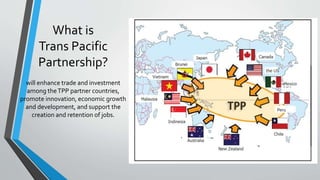
What is
Trans Pacific
Partnership?
will enhance trade and investment
among theTPP partner countries,
promote innovation, economic growth
and development, and support the
creation and retention of jobs.
What isTPP ?
• Comprehensive market access
• Fully regional agreement
• Cross-cutting trade issues
① Regulatory coherence
②Competitiveness and Business Facilitation
③ Small- and Medium-Sized Enterprises
④Development
• New trade challenges
• Living agreement
FIVE KEY FEATURES
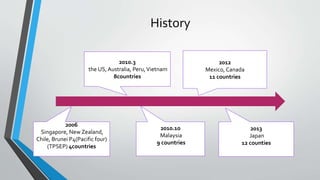
History
2006
Singapore, New Zealand,
Chile, Brunei P4(Pacific four)
(TPSEP) 4countries
2010.3
the US, Australia, Peru,Vietnam
8countries
2010.10
Malaysia
9 countries
2012
Mexico, Canada
11 countries
2013
Japan
12 counties
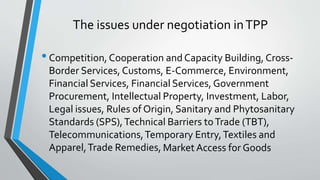
The issues under negotiation inTPP
•Competition, Cooperation and Capacity Building, Cross-
Border Services, Customs, E-Commerce, Environment,
Financial Services, Financial Services, Government
Procurement, Intellectual Property, Investment, Labor,
Legal issues, Rules of Origin, Sanitary and Phytosanitary
Standards (SPS),Technical Barriers toTrade (TBT),
Telecommunications,Temporary Entry,Textiles and
Apparel,Trade Remedies, Market Access for Goods
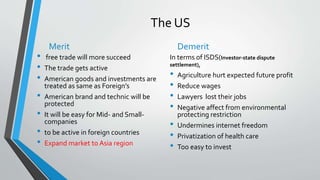
The US
Merit
• free trade will more succeed
• The trade gets active
• American goods and investments are
treated as same as Foreign’s
• American brand and technic will be
protected
• It will be easy for Mid- and Small-
companies
• to be active in foreign countries
• Expand market to Asia region
Demerit
In terms of ISDS(Investor-state dispute
settlement),
• Agriculture hurt expected future profit
• Reduce wages
• Lawyers lost their jobs
• Negative affect from environmental
protecting restriction
• Undermines internet freedom
• Privatization of health care
• Too easy to invest
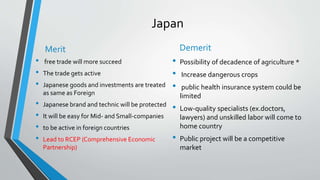
Japan
• free trade will more succeed
• The trade gets active
• Japanese goods and investments are treated
as same as Foreign
• Japanese brand and technic will be protected
• It will be easy for Mid- and Small-companies
• to be active in foreign countries
• Lead to RCEP (Comprehensive Economic
Partnership)
Demerit
• Possibility of decadence of agriculture *
• Increase dangerous crops
• public health insurance system could be
limited
• Low-quality specialists (ex.doctors,
lawyers) and unskilled labor will come to
home country
• Public project will be a competitive
market
Merit
reference
• http://www.ustr.gov/tpp
• http://www.doingbusiness.org/rankings
• http://www.meti.go.jp/policy/trade_policy/east_asia/activity/rcep.html
• http://www.occupy.com/article/trash-tpp-why-its-time-revolt-against-
worst-trade-agreement-history
• http://www.flushthetpp.org/
• http://www.fta.gov.sg/fta_tpfta.asp?hl=12
• http://www.mfat.govt.nz/downloads/trade-agreement/transpacific/main-
agreement.pdf
• http://www.huffingtonpost.jp/2013/10/06/tpp_n_4054726.html
Thank you for listening

Econ プレゼン

  • 1.
    Trans Pacific Partnership Meritand Demerit in the US and in Japan Minami Okamoto
  • 2.
    Contents •What isTPP •History •TPP Negotiations •Meritand Demerit in Japan and the US •reference
  • 3.
    What is Trans Pacific Partnership? willenhance trade and investment among theTPP partner countries, promote innovation, economic growth and development, and support the creation and retention of jobs.
  • 4.
    What isTPP ? •Comprehensive market access • Fully regional agreement • Cross-cutting trade issues ① Regulatory coherence ②Competitiveness and Business Facilitation ③ Small- and Medium-Sized Enterprises ④Development • New trade challenges • Living agreement FIVE KEY FEATURES
  • 5.
    History 2006 Singapore, New Zealand, Chile,Brunei P4(Pacific four) (TPSEP) 4countries 2010.3 the US, Australia, Peru,Vietnam 8countries 2010.10 Malaysia 9 countries 2012 Mexico, Canada 11 countries 2013 Japan 12 counties
  • 6.
    The issues undernegotiation inTPP •Competition, Cooperation and Capacity Building, Cross- Border Services, Customs, E-Commerce, Environment, Financial Services, Financial Services, Government Procurement, Intellectual Property, Investment, Labor, Legal issues, Rules of Origin, Sanitary and Phytosanitary Standards (SPS),Technical Barriers toTrade (TBT), Telecommunications,Temporary Entry,Textiles and Apparel,Trade Remedies, Market Access for Goods
  • 7.
    The US Merit • freetrade will more succeed • The trade gets active • American goods and investments are treated as same as Foreign’s • American brand and technic will be protected • It will be easy for Mid- and Small- companies • to be active in foreign countries • Expand market to Asia region Demerit In terms of ISDS(Investor-state dispute settlement), • Agriculture hurt expected future profit • Reduce wages • Lawyers lost their jobs • Negative affect from environmental protecting restriction • Undermines internet freedom • Privatization of health care • Too easy to invest
  • 8.
    Japan • free tradewill more succeed • The trade gets active • Japanese goods and investments are treated as same as Foreign • Japanese brand and technic will be protected • It will be easy for Mid- and Small-companies • to be active in foreign countries • Lead to RCEP (Comprehensive Economic Partnership) Demerit • Possibility of decadence of agriculture * • Increase dangerous crops • public health insurance system could be limited • Low-quality specialists (ex.doctors, lawyers) and unskilled labor will come to home country • Public project will be a competitive market Merit
  • 9.
    reference • http://www.ustr.gov/tpp • http://www.doingbusiness.org/rankings •http://www.meti.go.jp/policy/trade_policy/east_asia/activity/rcep.html • http://www.occupy.com/article/trash-tpp-why-its-time-revolt-against- worst-trade-agreement-history • http://www.flushthetpp.org/ • http://www.fta.gov.sg/fta_tpfta.asp?hl=12 • http://www.mfat.govt.nz/downloads/trade-agreement/transpacific/main- agreement.pdf • http://www.huffingtonpost.jp/2013/10/06/tpp_n_4054726.html
  • 10.
    Thank you forlistening