Arvindh.S
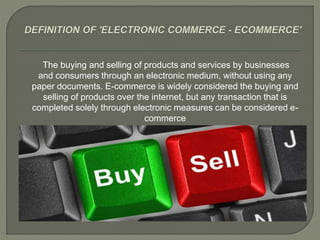
The buying and selling of products and services by businesses
and consumers through an electronic medium, without using any
paper documents. E-commerce is widely considered the buying and
selling of products over the internet, but any transaction that is
completed solely through electronic measures can be considered e-
commerce
 Similarities
• Both aim to deliver a valued product or service
• Both want to serve a large audience
• Both strive to quickly deliver products and services
 Differences
• E-commerce customers expect shorter fulfillment time
• E-commerce customers must understand Web-based
technologies
• E-commerce provides a global audience
• E-commerce orders are processed without human interaction or
travel to a store location
• E-commerce relies upon encryption for security
Provides paid Cloud storage online for
business purposes.
Apps/Hardware/Services
that provide secure authentication
and data transmission for
high-risk connections,
such as online banking.
 A Service that stores our website in its server
allowing the users to access it through the World
Wide Web.
Web Srevices that acts as a market where the customers can purchase
their desired products/services that arrives at their door steps.
SERVICES THAT INVOLVE
DESIGNING,DEVELOPMENT,SUPPORT AND
CONSULTATION FOR SITES.
 Merchant Services, or better known as credit card processing is the
handling of electronic payment transactions for merchants. Merchant
processing activities involve obtaining sales information from the
merchant, receiving authorization for the transaction, collecting funds
from the bank which issued the credit card, and sending payment to
the merchant.
Payment Techologies
Information-Formatting technologies
 Public-Key Cryptography Standards (PKCS)
• Used to store and transport certificates
 PKCS #7
• Used to secure e-mail certificates
 PKCS #10
• Used to generate a certificate request to a certificate
authority (CA)
 X.509
describes how to format digital certificates
Certificate Life Cycle
Exchange Rate
International
Shipping
Language
Barrier
International
Relations
0
10
20
30
40
50
60
70
80
90
100
0 50 100 150 200 250 300
Revenue & Market Cap
Market Capitalization
R
E
V
E
N
U
E
E-Commerce & its pratices

E-Commerce & its pratices

  • 1.
  • 2.
    The buying andselling of products and services by businesses and consumers through an electronic medium, without using any paper documents. E-commerce is widely considered the buying and selling of products over the internet, but any transaction that is completed solely through electronic measures can be considered e- commerce
  • 4.
     Similarities • Bothaim to deliver a valued product or service • Both want to serve a large audience • Both strive to quickly deliver products and services  Differences • E-commerce customers expect shorter fulfillment time • E-commerce customers must understand Web-based technologies • E-commerce provides a global audience • E-commerce orders are processed without human interaction or travel to a store location • E-commerce relies upon encryption for security
  • 6.
    Provides paid Cloudstorage online for business purposes.
  • 7.
    Apps/Hardware/Services that provide secureauthentication and data transmission for high-risk connections, such as online banking.
  • 8.
     A Servicethat stores our website in its server allowing the users to access it through the World Wide Web.
  • 9.
    Web Srevices thatacts as a market where the customers can purchase their desired products/services that arrives at their door steps.
  • 10.
  • 11.
     Merchant Services,or better known as credit card processing is the handling of electronic payment transactions for merchants. Merchant processing activities involve obtaining sales information from the merchant, receiving authorization for the transaction, collecting funds from the bank which issued the credit card, and sending payment to the merchant.
  • 13.
  • 14.
  • 15.
     Public-Key CryptographyStandards (PKCS) • Used to store and transport certificates  PKCS #7 • Used to secure e-mail certificates  PKCS #10 • Used to generate a certificate request to a certificate authority (CA)  X.509 describes how to format digital certificates Certificate Life Cycle
  • 16.
  • 17.
    0 10 20 30 40 50 60 70 80 90 100 0 50 100150 200 250 300 Revenue & Market Cap Market Capitalization R E V E N U E