E Commerce
Overview
13th May 2015
(v0.1)
PramodKumar
1
Table of Contents
1.1 E-commerce........................................................................................................................ 2
1.1.1 Advantages of Ecommerce: ........................................................................................... 2
1.1.2 Disadvantages of Ecommerce: ....................................................................................... 3
1.2 Types of e-commerce ..........................................................................................................4
1.2.1 Types of licensing models.............................................................................................. 4
1.2.2 Types of Sales scenario..................................................................................................5
1.2.3 Types of data exchange.................................................................................................6
1.3 E Commerce Process Flow ...................................................................................................8
1.3.1 Entry Point Sub Process Flow......................................................................................... 9
1.3.2 Home Page components.............................................................................................. 10
1.3.3 Product Listing/Search Results Page............................................................................. 11
1.3.4 Product Details Page ................................................................................................... 12
1.3.5 Product Details Page with Bundle products................................................................... 13
1.3.5 Cart Page.................................................................................................................... 14
1.3.6 Checkout Page............................................................................................................ 15
1.3.8 Billing details Page ...................................................................................................... 16
1.3.7 Shipping details Page................................................................................................... 17
1.3.9 Payment details Page.................................................................................................. 18
1.3.10 Order Review Page.................................................................................................... 19
1.3.11 Order Confirmation/Thank you Page.......................................................................... 20
2
1.1 E-commerce
Electroniccommerce,commonlyknownase-commerce oreCommerce,istradinginproductsor
servicesusingcomputernetworks,suchasthe Internet
E-commerce businessesmayemploysome orall of the following:
 Online shoppingwebsitesforretail salesdirecttoconsumers
 Providingorparticipatinginonlinemarketplaces,whichprocessthird-partybusiness-to-
consumeror consumer-to-consumersales
 Business-to-businessbuyingandselling
 Business-to-businesselectronicdatainterchange
 Marketingto prospective andestablishedcustomersbye-mail orfax (forexample,with
newsletters)
 Engaginginpretail forlaunchingnew productsandservices
1.1.1 AdvantagesofEcommerce:
1. AdvantagestoOrganizations
2. AdvantagestoConsumers
3. AdvantagestoSociety
1.1.1.1 Advantages toOrganizations
1. UsingE-Commerce,organizationcanexpandtheirmarkettonational andinternational
marketswithminimumcapital investment.Anorganizationcaneasilylocate more
customers,bestsuppliersandsuitablebusinesspartnersacrossthe globe.
2. E-Commerce helpsorganizationtoreduce the costto create process,distribute,retrieveand
manage the paperbasedinformationbydigitizingthe information.
3. E-commerce improvesthe brandimage of the company.
4. E-commerce helpsorganizationtoprovide bettercustomerservices.
5. E-Commerce helpstosimplifythe businessprocessesandmake themfasterandefficient.
6. E-Commerce reducespaperworkalot.
7. E-Commerce increasedthe productivityof the organization.Itsupports"pull"type supply
management.In"pull"type supplymanagement,abusinessprocessstartswhenarequest
comesfroma customerandit usesjust-in-timemanufacturingway.
1.1.1.2 Advantages toCustomers
1. 24x7 supports.Customercando transactionsforthe product or enquiryaboutany
product/servicesprovidedbyacompany anytime,anywherefromanylocation.Here 24x7
refersto24 hoursof each sevendaysof a week.
2. E-Commerce applicationprovidesusermore optionsandquickerdeliveryof products.
3. E-Commerce applicationprovidesusermore optionstocompare andselectthe cheaperand
betteroption.
4. A customercan putreviewcommentsaboutaproduct andcan see whatothersare buying
or see the reviewcommentsof othercustomersbefore makingafinal buy.
5. E-Commerce providesoptionof virtual auctions.
3
6. Readilyavailable information.A customercansee the relevantdetailedinformationwithin
secondsratherthan waitingfordaysor weeks.
7. E-Commerce increasescompetitionamongthe organizationsandasresultorganizations
providessubstantial discountstocustomers.
1.1.1.3 Advantages toSociety
1. Customersneednottotravel to shopa product thuslesstrafficonroad and low air
pollution.
2. E-Commerce helpsreducingcostof productsso lessaffluentpeople canalsoaffordthe
products.
3. E-Commerce hasenabledaccesstoservicesandproductstorural areasas well whichare
otherwise notavailable tothem.
4. E-Commerce helpsgovernmenttodeliverpublicserviceslike healthcare,education,social
servicesatreducedcostand inimprovedway.
1.1.2 DisadvantagesofEcommerce:
1. Initial cost: The cost of creating/ buildingE-Commerce applicationin-housemaybe very
high.There couldbe delayinlaunchingthe E-Commerce applicationdue tomistakes,lackof
experience.
2. User resistance:Usermaynot trust the site beingunknownfacelessseller.Suchmistrust
makesitdifficulttomake userswitchfromphysical storestoonline/virtual stores.
3. Security/Privacy:Difficulttoensure securityorprivacyononline transactions.
4. Lack of touch or feel of productsduring onlineshopping.
5. E-Commerce applicationsare still evolvingandchangingrapidly.
6. Internetaccessisstill notcheaperandis inconvenienttouse formany potential customers
like one livinginremote villages.
4
1.2 Types of e-commerce
Varioustypesof e-commerce platformsfall intoseveralindustryclassificationsbasedupontheir
licensingmodel,salesscenarioanddataexchange.
1.2.1 Typesoflicensingmodels
1.2.1.1 On-premisee-commerce
On-premisee-commerce software usuallyrequires initial one time purchase investmentintermsof
licensingfees.Also,itimpliesextracostsrelatedtohardware andinstallationservicesaswell asdata
migrationandon-goingmaintenance feesthatare usuallychargedona yearlybasisforsoftware
updatesandsupport.Some examplesof typical onpremise E-commerce platformsare Hybris
(company) andIBM WebSphere.
Advantages:
7. Easilycustomizable
8. Data security
9. Highperformance
Disadvantages:
10. Large initial investment
11. Self-maintenance
12. Technical knowledge
1.2.1.2 Softwareas a service(SaaS)E-commerce
Software as a Service (SaaS)- isacloudbaseddeliverymodel inwhichapplicationsare hostedand
managedina service provider'sdatacenter,paidforona subscriptionbasisandaccessedviaa
browseroveran internetconnection.Twoexamplesof typical SaaSE-commerce solutions
are Shopifyand Demandware.
Advantages:
1. Affordable low-costsolution
2. Hosted/upgradedbyE-commerce provider
3. Easilyscalable
Disadvantages:
1. Limitedintegrationwithback-endsystems
2. Lack of data security
3. Limitedcontrol overthe system
1.2.1.3 OpensourceE-commerce
Opensource e-Commerce isafree of charge platformthat doesn’timplylicensesfee.Furthermore,
opensource usersare alsoresponsible forinstalling,maintaining,securingandconfiguringthe
software ontheirownservers.Inorderto setup an opensource platform, basictechnical expertise
isrequiredinthe areasof webdesignanddevelopment.Software productsthatare distributedas
5
opensource are generallyfree,anduserscanaccessand modifythe source code.Three examplesof
typical opensource E-commerce platformsare Paycart, Magentoand Thelia.
Advantages:
1. Free of charge system
2. Wide varietyof available addons/plugins/extensions
3. Betterflexibility withacustomizablesource code
Disadvantages:
1. More technical knowledge required
2. Performance dependsonhostingcosts
3. No standardintegrationwithback-endsystem
1.2.2 TypesofSalesscenario
There are multiple types of sales scenario that eCommerce system can combine depending on a
company’s sales approach towards their customers.
Business
(organization)
Consumers
(individual)
Business
(organization)
B2B
(e.gAlibaba,Shopclues)
B2C
(e.gfilpkart,snapdeal,paytm)
Consumers
(individual)
C2B
(e.gbloggerdisplayingproducts
ads on itsblog)
C2C
(e.gOLX,Quickr)
1.2.2.1 Business-to-Consumer(B2C)
In a Business-to-ConsumerE-commerceenvironment,companiessell theironline goodsto
consumerswhoare the endusersof theirproductsor services.Usually, B2CE-commerce webshops
have an openaccessfor any visitor,meaningthatthere isnoneedfora persontologininorderto
make any productrelatedinquiry.
1.2.2.2 Business-to-Business (B2B)
In a Business-to-BusinessE-commerce environment,companiessell theironlinegoodstoother
companieswithoutbeingengagedinsalestoconsumers.InmostB2B E-commerce environments
enteringthe webshopwill require alogin.B2B webshopusuallycontainscustomer-specificpricing,
customer-specificcollections andcustomer-specificdiscounts.
1.2.2.3 Consumer-to-Business (C2B)
In a Consumer-to-BusinessE-commerceenvironment,consumersusuallyposttheirproductsor
servicesonlineonwhichcompaniescanposttheirbids.A consumerreviewsthe bidsandselectsthe
companythat meetshisprice expectations. Examplescouldbe abloggerdisplayingproductsadson
itsblog,or a photographerofferingstockimagesto businesses.Thiscouldalsobe someone
answeringapoll througha survey site, orofferingjobhiring service byreferringsomeone
throughreferral hiringsites.
6
1.2.2.4 Consumer-to-Consumer(C2C)
In a Consumer-to-ConsumerE-commerce environmentconsumerssell theironlinegoodstoother
consumers.A well-knownexample is Olx,Quickr.
1.2.3 Typesofdata exchange
Many E-commerce software retrieve the informationfromacertainback-endsystem, suchas
an Enterprise resource planning (ERP) or Customerrelationshipmanagement (CRM) system.This
informationisstoredinthe database of that system.The Businesslogic containsall of the business
rulesthatdefine the waydatais stored,created,displayed,calculatedandisbeingrecreatedinside
an ERP or CRM system.Forexample:differentproductdiscountsare appliedfordifferentcustomer
accounts.In orderto retrieve the information,twotypesof dataexchange are takenintoaccount.
1.2.3.1 Integrated E-commerce
In integratedE-commerce,apart of the software solutionisinstalledinside the back-endsystem.
Thismeansthat the connectionbetweenthe businesslogicanddatabase of a back-endsystemis
configured automatically.Informationthatisavailable inthe back-endsystemisbeing re-used and
displayedinthe front/backendof the E-commerce system.AnintegratedE-commerce software
productthus doesn’trequire toinvestinrecreatingaseparate database orbusinesslogic.Instead,it
re-usesthose of the back-endsystem.IntegratedE-commerce software ismostlyusedinaB2B and
B2C scenario.A typical exampleof anintegratedE-commerce software is SanaCommerce.
1.2.3.2 Interfaced E-commerce
In interfacedE-commerce,the softwaresolutionisinstalledontopof the back-endsystem.This
meansthat the connectionbetweenthe businesslogicanddatabase of a back-endsystemis
setup manually.Informationthatisavailable inthe back-endsystemisbeing duplicated intothe E-
commerce software.AninterfacedE-commerce software productthushastheir
own database and businesslogic thatare beingsynchronizedconstantlythroughaconnectiontoa
certainback-endsystem.InterfacedE-commerce ismostlyusedinaB2C scenario.Anexample of
interfacingE-commerce software is Magento.
7
8
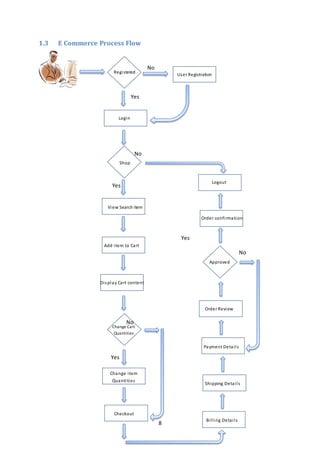
1.3 E Commerce Process Flow
Registered
?
Login
View Search item
Shop
User Registration
Add item to Cart
Display Cart content
Change Cart
Quantities
Change item
Quantities
Checkout
Shipping Details
Billing Details
Payment Details
Order Review
Approved
Order confirmation
Logout
No
Yes
No
No
No
Yes
Yes
Yes
9
1.3.1 EntryPoint SubProcessFlow
10
1.3.2 HomePage components
A. BrandingImage and topnavigation
B. QuickNavigations
C. Searchbar withinteractive Suggestions
D. Interactive Slidestopromote targetedsectionor product
E. Sidebarareato holdblocksof banner,badgesanddynamicsblockslike ,recentlyviewedand
mini cart
F. Featuredcategoryimage linkedtocategorypages
G. FeaturedProducts(configurablebyoptions)
H. Footerarea,navigationlinks,copyrightpolicy,newslettersign-upetc.
11
1.3.3 ProductListing/SearchResultsPage
A. Filterednavigationoncategoryandsearchresultspages.Usescontextspecificproduct
categoriesandattributestohelpshopperfindrelevantproducts
B. Mini-cart,interactswithuseractionsanddisplays,quantity,total amountandmini viewsof
productsin cart, usercan remove itemsfromcart or click
C. Productnavigation,withbreadcrumbs,pagination,sortingoptions,subscribe toRSSfeed.
D. Productsrenderedinmainareaand paginatedimagesandtitlesclickabletodetailspages.
E. Actionstopurchase,add to cart updatesmini cart,if configurable withoptionsuseristaken
to details page.
12
1.3.4 ProductDetailsPage
A. Recentlyviewedproductslistedinsidebar
B. Productdetails,main image,name,availability,short,description,linktoemail afriend
C. Productoptions(requiredforconfigurableproducts),basedonproductattributes
D. More views:alternate imagesof product,clickchangesmainimage,zoomingfeature toview
detail
E. Addto cart / quantityinput.Buttonclickupdatesmini cartanduseris notifiedattopof
page;or (as setin back-office) usercanbe directedtothe shoppingcartpage to begin
checkout
F. Recommended(productspecificmerchandising)
G. Long descriptionandproductspecs andreviews
13
1.3.5 ProductDetailsPagewith Bundleproducts
A. Recentlyviewedproductslistedinsidebar
B. Productdetails,mainimage,name,availability,short,description,linktoemail afriend
C. Bundle productsoffers/combooffers
D. More views:alternate imagesof product,clickchangesmainimage,zoomingfeature toview
detail
E. Addto cart / quantityinput.Buttonclickupdatesmini cartanduseris notifiedattopof
page;or (as setin back-office) usercanbe directedtothe shoppingcartpage to begin
checkout
F. Recommended(productspecificmerchandising)
G. Long descriptionandproductspecs
14
1.3.5 Cart Page
A. Shoppingcarttable,editable quantity,displaysanyproductoptionsselectedbyshopper;
line itemsinclude producticonname andunitprice.
B. Update shoppingcart, whenuserchangesquantity,the pricingcanbe updatedwiththis
button
C. Cross-sell offersonthe cartpage are basedonproductsthat the shopperhas addedtothe
cart
D. Discountcode formfor redemptionof couponcodes
E. Shippingestimateformtohelpshoppertogeta quote ontotal purchase cost
F. Proceedtocheckoutbeginsthe one-page checkoutprocess,asa bestpractice the buttonis
above and belowthe ‘fold’(alwaysvisiblewhenscrolling)
15
1.3.6 CheckoutPage
A. CheckoutMethod step.Create anaccount, loginorcheckoutas guest
B. Stepsincheckoutfloware reportedonscreento indicate progressandconfirmshopper
billing,shippingaddressandmethodaswell payment method
C. Optionsforfirsttime customerstopurchase as anonymousshopper(guest) orchoose to
save informationin‘MyAccount’to registerasa shopper
D. Continue initiatesthe secondstepinthe flow
E. Loginretrievesstoredshopperdetailstofacilitate completingof checkoutformsandauto-
populates the fields forease of use
16
1.3.8 BillingdetailsPage
A. Billinginformationisthe nextstepinthe flow
B. Stepsincheckoutfloware reportedonscreento indicate progressandconfirmshopper
billing,shippingaddressandmethodaswell payment method
C. Shopperchooseswhetherornot to use the same addressas billingtoshipthe purchase to
or create a newaddressentryforshipmentinthe thirdstep Whenshopperelectstoshipto
the same addressas billingthe next(3rd) stepisskippedasbilling addressisstoredforthe
shippingaddresstoo
D. Continue initiatesthe thirdorfourthstepinthe flow
17
1.3.7 ShippingdetailsPage
A. ShippingMethodisthe stepinthe flow
B. Stepsincheckoutfloware reportedonscreento indicate progressandconfirmshopper
billing, shippingaddressandmethodaswell payment method
C. Optionto‘gift’the purchase and notifythe recipientbyemail suingthe ‘giftmessage’
D. Continue initiatesthe nextstepinthe flow
18
1.3.9 Payment detailsPage
A. PaymentMethodisthe nextstepinthe flow
B. Stepsincheckoutfloware reportedonscreento indicate progressandconfirmshopper
billing, shippingaddressandmethodaswell payment method
C. In thisexample the methodchosenisCreditCard Paymentinformationiscollectedand
processedwith paymentgatewayselectedinthe back-office.
D. Continue initiatesthe final ‘review’stepinthe flow
19
1.3.10 OrderReviewPage
A. OrderReviewisthe final stepinthe flow
B. Stepsincheckoutfloware reportedonscreento indicate progressandconfirmshopper
billing,shippingaddressandmethodaswell payment method
C. Purchase summaryof itemsandtotal cost for shopperconfirmation
D. Optiontoeditthe itemsinthe cart, add,etc.
E. Place orderactioncompletesthe purchase.The shopperwillbe notifiedwitha successpage
inresponse tothe order postingorif there was any error on the transaction
20
1.3.11 OrderConfirmation/ThankyouPage
A. OrderCompleted,Linktoorderdetailsandbuttonto continue shopping
B. Mini-cartisnow emptyfollowingcompetedorder
C. My Ordersblockshowsrecentpurchasestoallow quickre-orderof products

Ecommerce

  • 1.
    E Commerce Overview 13th May2015 (v0.1) PramodKumar
  • 2.
    1 Table of Contents 1.1E-commerce........................................................................................................................ 2 1.1.1 Advantages of Ecommerce: ........................................................................................... 2 1.1.2 Disadvantages of Ecommerce: ....................................................................................... 3 1.2 Types of e-commerce ..........................................................................................................4 1.2.1 Types of licensing models.............................................................................................. 4 1.2.2 Types of Sales scenario..................................................................................................5 1.2.3 Types of data exchange.................................................................................................6 1.3 E Commerce Process Flow ...................................................................................................8 1.3.1 Entry Point Sub Process Flow......................................................................................... 9 1.3.2 Home Page components.............................................................................................. 10 1.3.3 Product Listing/Search Results Page............................................................................. 11 1.3.4 Product Details Page ................................................................................................... 12 1.3.5 Product Details Page with Bundle products................................................................... 13 1.3.5 Cart Page.................................................................................................................... 14 1.3.6 Checkout Page............................................................................................................ 15 1.3.8 Billing details Page ...................................................................................................... 16 1.3.7 Shipping details Page................................................................................................... 17 1.3.9 Payment details Page.................................................................................................. 18 1.3.10 Order Review Page.................................................................................................... 19 1.3.11 Order Confirmation/Thank you Page.......................................................................... 20
  • 3.
    2 1.1 E-commerce Electroniccommerce,commonlyknownase-commerce oreCommerce,istradinginproductsor servicesusingcomputernetworks,suchastheInternet E-commerce businessesmayemploysome orall of the following:  Online shoppingwebsitesforretail salesdirecttoconsumers  Providingorparticipatinginonlinemarketplaces,whichprocessthird-partybusiness-to- consumeror consumer-to-consumersales  Business-to-businessbuyingandselling  Business-to-businesselectronicdatainterchange  Marketingto prospective andestablishedcustomersbye-mail orfax (forexample,with newsletters)  Engaginginpretail forlaunchingnew productsandservices 1.1.1 AdvantagesofEcommerce: 1. AdvantagestoOrganizations 2. AdvantagestoConsumers 3. AdvantagestoSociety 1.1.1.1 Advantages toOrganizations 1. UsingE-Commerce,organizationcanexpandtheirmarkettonational andinternational marketswithminimumcapital investment.Anorganizationcaneasilylocate more customers,bestsuppliersandsuitablebusinesspartnersacrossthe globe. 2. E-Commerce helpsorganizationtoreduce the costto create process,distribute,retrieveand manage the paperbasedinformationbydigitizingthe information. 3. E-commerce improvesthe brandimage of the company. 4. E-commerce helpsorganizationtoprovide bettercustomerservices. 5. E-Commerce helpstosimplifythe businessprocessesandmake themfasterandefficient. 6. E-Commerce reducespaperworkalot. 7. E-Commerce increasedthe productivityof the organization.Itsupports"pull"type supply management.In"pull"type supplymanagement,abusinessprocessstartswhenarequest comesfroma customerandit usesjust-in-timemanufacturingway. 1.1.1.2 Advantages toCustomers 1. 24x7 supports.Customercando transactionsforthe product or enquiryaboutany product/servicesprovidedbyacompany anytime,anywherefromanylocation.Here 24x7 refersto24 hoursof each sevendaysof a week. 2. E-Commerce applicationprovidesusermore optionsandquickerdeliveryof products. 3. E-Commerce applicationprovidesusermore optionstocompare andselectthe cheaperand betteroption. 4. A customercan putreviewcommentsaboutaproduct andcan see whatothersare buying or see the reviewcommentsof othercustomersbefore makingafinal buy. 5. E-Commerce providesoptionof virtual auctions.
  • 4.
    3 6. Readilyavailable information.Acustomercansee the relevantdetailedinformationwithin secondsratherthan waitingfordaysor weeks. 7. E-Commerce increasescompetitionamongthe organizationsandasresultorganizations providessubstantial discountstocustomers. 1.1.1.3 Advantages toSociety 1. Customersneednottotravel to shopa product thuslesstrafficonroad and low air pollution. 2. E-Commerce helpsreducingcostof productsso lessaffluentpeople canalsoaffordthe products. 3. E-Commerce hasenabledaccesstoservicesandproductstorural areasas well whichare otherwise notavailable tothem. 4. E-Commerce helpsgovernmenttodeliverpublicserviceslike healthcare,education,social servicesatreducedcostand inimprovedway. 1.1.2 DisadvantagesofEcommerce: 1. Initial cost: The cost of creating/ buildingE-Commerce applicationin-housemaybe very high.There couldbe delayinlaunchingthe E-Commerce applicationdue tomistakes,lackof experience. 2. User resistance:Usermaynot trust the site beingunknownfacelessseller.Suchmistrust makesitdifficulttomake userswitchfromphysical storestoonline/virtual stores. 3. Security/Privacy:Difficulttoensure securityorprivacyononline transactions. 4. Lack of touch or feel of productsduring onlineshopping. 5. E-Commerce applicationsare still evolvingandchangingrapidly. 6. Internetaccessisstill notcheaperandis inconvenienttouse formany potential customers like one livinginremote villages.
  • 5.
    4 1.2 Types ofe-commerce Varioustypesof e-commerce platformsfall intoseveralindustryclassificationsbasedupontheir licensingmodel,salesscenarioanddataexchange. 1.2.1 Typesoflicensingmodels 1.2.1.1 On-premisee-commerce On-premisee-commerce software usuallyrequires initial one time purchase investmentintermsof licensingfees.Also,itimpliesextracostsrelatedtohardware andinstallationservicesaswell asdata migrationandon-goingmaintenance feesthatare usuallychargedona yearlybasisforsoftware updatesandsupport.Some examplesof typical onpremise E-commerce platformsare Hybris (company) andIBM WebSphere. Advantages: 7. Easilycustomizable 8. Data security 9. Highperformance Disadvantages: 10. Large initial investment 11. Self-maintenance 12. Technical knowledge 1.2.1.2 Softwareas a service(SaaS)E-commerce Software as a Service (SaaS)- isacloudbaseddeliverymodel inwhichapplicationsare hostedand managedina service provider'sdatacenter,paidforona subscriptionbasisandaccessedviaa browseroveran internetconnection.Twoexamplesof typical SaaSE-commerce solutions are Shopifyand Demandware. Advantages: 1. Affordable low-costsolution 2. Hosted/upgradedbyE-commerce provider 3. Easilyscalable Disadvantages: 1. Limitedintegrationwithback-endsystems 2. Lack of data security 3. Limitedcontrol overthe system 1.2.1.3 OpensourceE-commerce Opensource e-Commerce isafree of charge platformthat doesn’timplylicensesfee.Furthermore, opensource usersare alsoresponsible forinstalling,maintaining,securingandconfiguringthe software ontheirownservers.Inorderto setup an opensource platform, basictechnical expertise isrequiredinthe areasof webdesignanddevelopment.Software productsthatare distributedas
  • 6.
    5 opensource are generallyfree,anduserscanaccessandmodifythe source code.Three examplesof typical opensource E-commerce platformsare Paycart, Magentoand Thelia. Advantages: 1. Free of charge system 2. Wide varietyof available addons/plugins/extensions 3. Betterflexibility withacustomizablesource code Disadvantages: 1. More technical knowledge required 2. Performance dependsonhostingcosts 3. No standardintegrationwithback-endsystem 1.2.2 TypesofSalesscenario There are multiple types of sales scenario that eCommerce system can combine depending on a company’s sales approach towards their customers. Business (organization) Consumers (individual) Business (organization) B2B (e.gAlibaba,Shopclues) B2C (e.gfilpkart,snapdeal,paytm) Consumers (individual) C2B (e.gbloggerdisplayingproducts ads on itsblog) C2C (e.gOLX,Quickr) 1.2.2.1 Business-to-Consumer(B2C) In a Business-to-ConsumerE-commerceenvironment,companiessell theironline goodsto consumerswhoare the endusersof theirproductsor services.Usually, B2CE-commerce webshops have an openaccessfor any visitor,meaningthatthere isnoneedfora persontologininorderto make any productrelatedinquiry. 1.2.2.2 Business-to-Business (B2B) In a Business-to-BusinessE-commerce environment,companiessell theironlinegoodstoother companieswithoutbeingengagedinsalestoconsumers.InmostB2B E-commerce environments enteringthe webshopwill require alogin.B2B webshopusuallycontainscustomer-specificpricing, customer-specificcollections andcustomer-specificdiscounts. 1.2.2.3 Consumer-to-Business (C2B) In a Consumer-to-BusinessE-commerceenvironment,consumersusuallyposttheirproductsor servicesonlineonwhichcompaniescanposttheirbids.A consumerreviewsthe bidsandselectsthe companythat meetshisprice expectations. Examplescouldbe abloggerdisplayingproductsadson itsblog,or a photographerofferingstockimagesto businesses.Thiscouldalsobe someone answeringapoll througha survey site, orofferingjobhiring service byreferringsomeone throughreferral hiringsites.
  • 7.
    6 1.2.2.4 Consumer-to-Consumer(C2C) In aConsumer-to-ConsumerE-commerce environmentconsumerssell theironlinegoodstoother consumers.A well-knownexample is Olx,Quickr. 1.2.3 Typesofdata exchange Many E-commerce software retrieve the informationfromacertainback-endsystem, suchas an Enterprise resource planning (ERP) or Customerrelationshipmanagement (CRM) system.This informationisstoredinthe database of that system.The Businesslogic containsall of the business rulesthatdefine the waydatais stored,created,displayed,calculatedandisbeingrecreatedinside an ERP or CRM system.Forexample:differentproductdiscountsare appliedfordifferentcustomer accounts.In orderto retrieve the information,twotypesof dataexchange are takenintoaccount. 1.2.3.1 Integrated E-commerce In integratedE-commerce,apart of the software solutionisinstalledinside the back-endsystem. Thismeansthat the connectionbetweenthe businesslogicanddatabase of a back-endsystemis configured automatically.Informationthatisavailable inthe back-endsystemisbeing re-used and displayedinthe front/backendof the E-commerce system.AnintegratedE-commerce software productthus doesn’trequire toinvestinrecreatingaseparate database orbusinesslogic.Instead,it re-usesthose of the back-endsystem.IntegratedE-commerce software ismostlyusedinaB2B and B2C scenario.A typical exampleof anintegratedE-commerce software is SanaCommerce. 1.2.3.2 Interfaced E-commerce In interfacedE-commerce,the softwaresolutionisinstalledontopof the back-endsystem.This meansthat the connectionbetweenthe businesslogicanddatabase of a back-endsystemis setup manually.Informationthatisavailable inthe back-endsystemisbeing duplicated intothe E- commerce software.AninterfacedE-commerce software productthushastheir own database and businesslogic thatare beingsynchronizedconstantlythroughaconnectiontoa certainback-endsystem.InterfacedE-commerce ismostlyusedinaB2C scenario.Anexample of interfacingE-commerce software is Magento.
  • 8.
  • 9.
    8 1.3 E CommerceProcess Flow Registered ? Login View Search item Shop User Registration Add item to Cart Display Cart content Change Cart Quantities Change item Quantities Checkout Shipping Details Billing Details Payment Details Order Review Approved Order confirmation Logout No Yes No No No Yes Yes Yes
  • 10.
  • 11.
    10 1.3.2 HomePage components A.BrandingImage and topnavigation B. QuickNavigations C. Searchbar withinteractive Suggestions D. Interactive Slidestopromote targetedsectionor product E. Sidebarareato holdblocksof banner,badgesanddynamicsblockslike ,recentlyviewedand mini cart F. Featuredcategoryimage linkedtocategorypages G. FeaturedProducts(configurablebyoptions) H. Footerarea,navigationlinks,copyrightpolicy,newslettersign-upetc.
  • 12.
    11 1.3.3 ProductListing/SearchResultsPage A. Filterednavigationoncategoryandsearchresultspages.Usescontextspecificproduct categoriesandattributestohelpshopperfindrelevantproducts B.Mini-cart,interactswithuseractionsanddisplays,quantity,total amountandmini viewsof productsin cart, usercan remove itemsfromcart or click C. Productnavigation,withbreadcrumbs,pagination,sortingoptions,subscribe toRSSfeed. D. Productsrenderedinmainareaand paginatedimagesandtitlesclickabletodetailspages. E. Actionstopurchase,add to cart updatesmini cart,if configurable withoptionsuseristaken to details page.
  • 13.
    12 1.3.4 ProductDetailsPage A. Recentlyviewedproductslistedinsidebar B.Productdetails,main image,name,availability,short,description,linktoemail afriend C. Productoptions(requiredforconfigurableproducts),basedonproductattributes D. More views:alternate imagesof product,clickchangesmainimage,zoomingfeature toview detail E. Addto cart / quantityinput.Buttonclickupdatesmini cartanduseris notifiedattopof page;or (as setin back-office) usercanbe directedtothe shoppingcartpage to begin checkout F. Recommended(productspecificmerchandising) G. Long descriptionandproductspecs andreviews
  • 14.
    13 1.3.5 ProductDetailsPagewith Bundleproducts A.Recentlyviewedproductslistedinsidebar B. Productdetails,mainimage,name,availability,short,description,linktoemail afriend C. Bundle productsoffers/combooffers D. More views:alternate imagesof product,clickchangesmainimage,zoomingfeature toview detail E. Addto cart / quantityinput.Buttonclickupdatesmini cartanduseris notifiedattopof page;or (as setin back-office) usercanbe directedtothe shoppingcartpage to begin checkout F. Recommended(productspecificmerchandising) G. Long descriptionandproductspecs
  • 15.
    14 1.3.5 Cart Page A.Shoppingcarttable,editable quantity,displaysanyproductoptionsselectedbyshopper; line itemsinclude producticonname andunitprice. B. Update shoppingcart, whenuserchangesquantity,the pricingcanbe updatedwiththis button C. Cross-sell offersonthe cartpage are basedonproductsthat the shopperhas addedtothe cart D. Discountcode formfor redemptionof couponcodes E. Shippingestimateformtohelpshoppertogeta quote ontotal purchase cost F. Proceedtocheckoutbeginsthe one-page checkoutprocess,asa bestpractice the buttonis above and belowthe ‘fold’(alwaysvisiblewhenscrolling)
  • 16.
    15 1.3.6 CheckoutPage A. CheckoutMethodstep.Create anaccount, loginorcheckoutas guest B. Stepsincheckoutfloware reportedonscreento indicate progressandconfirmshopper billing,shippingaddressandmethodaswell payment method C. Optionsforfirsttime customerstopurchase as anonymousshopper(guest) orchoose to save informationin‘MyAccount’to registerasa shopper D. Continue initiatesthe secondstepinthe flow E. Loginretrievesstoredshopperdetailstofacilitate completingof checkoutformsandauto- populates the fields forease of use
  • 17.
    16 1.3.8 BillingdetailsPage A. Billinginformationisthenextstepinthe flow B. Stepsincheckoutfloware reportedonscreento indicate progressandconfirmshopper billing,shippingaddressandmethodaswell payment method C. Shopperchooseswhetherornot to use the same addressas billingtoshipthe purchase to or create a newaddressentryforshipmentinthe thirdstep Whenshopperelectstoshipto the same addressas billingthe next(3rd) stepisskippedasbilling addressisstoredforthe shippingaddresstoo D. Continue initiatesthe thirdorfourthstepinthe flow
  • 18.
    17 1.3.7 ShippingdetailsPage A. ShippingMethodisthestepinthe flow B. Stepsincheckoutfloware reportedonscreento indicate progressandconfirmshopper billing, shippingaddressandmethodaswell payment method C. Optionto‘gift’the purchase and notifythe recipientbyemail suingthe ‘giftmessage’ D. Continue initiatesthe nextstepinthe flow
  • 19.
    18 1.3.9 Payment detailsPage A.PaymentMethodisthe nextstepinthe flow B. Stepsincheckoutfloware reportedonscreento indicate progressandconfirmshopper billing, shippingaddressandmethodaswell payment method C. In thisexample the methodchosenisCreditCard Paymentinformationiscollectedand processedwith paymentgatewayselectedinthe back-office. D. Continue initiatesthe final ‘review’stepinthe flow
  • 20.
    19 1.3.10 OrderReviewPage A. OrderReviewisthefinal stepinthe flow B. Stepsincheckoutfloware reportedonscreento indicate progressandconfirmshopper billing,shippingaddressandmethodaswell payment method C. Purchase summaryof itemsandtotal cost for shopperconfirmation D. Optiontoeditthe itemsinthe cart, add,etc. E. Place orderactioncompletesthe purchase.The shopperwillbe notifiedwitha successpage inresponse tothe order postingorif there was any error on the transaction
  • 21.
    20 1.3.11 OrderConfirmation/ThankyouPage A. OrderCompleted,Linktoorderdetailsandbuttontocontinue shopping B. Mini-cartisnow emptyfollowingcompetedorder C. My Ordersblockshowsrecentpurchasestoallow quickre-orderof products