ECOLOGY
ORIGIN OF VARIATION
Origin of Variation
ORIGIN OF VARIATION
A. Genetics
1. Mutation
2. Gene Flow
3. Nonrandom
Mating
4. Genetics
Drift
5. Selection
B. Environment
C. Genetics and
Environment
Macroevolution
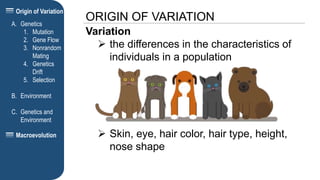
Variation
 the differences in the characteristics of
individuals in a population
 Skin, eye, hair color, hair type, height,
nose shape
Origin of Variation
ORIGIN OF VARIATION
A. Genetics
1. Mutation
2. Gene Flow
3. Nonrandom
Mating
4. Genetics
Drift
5. Selection
B. Environment
C. Genetics and
Environment
Macroevolution
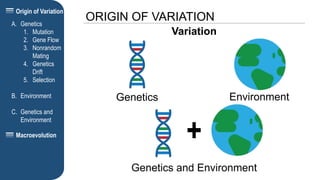
Variation
+
Genetics Environment
Genetics and Environment
Origin of Variation
GENETIC VARIATION
A. Genetics
1. Mutation
2. Gene Flow
3. Nonrandom
Mating
4. Genetics
Drift
5. Selection
B. Environment
C. Genetics and
Environment
Macroevolution
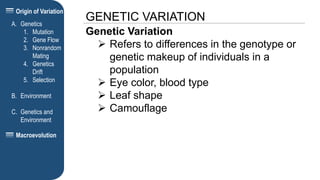
Genetic Variation
 Refers to differences in the genotype or
genetic makeup of individuals in a
population
 Eye color, blood type
 Leaf shape
 Camouflage
Origin of Variation
AGENTS OF GENETIC VARIATION
A. Genetics
1. Mutation
2. Gene Flow
3. Nonrandom
Mating
4. Genetics
Drift
5. Selection
B. Environment
C. Genetics and
Environment
Macroevolution
1.Mutation
2.Gene Flow
3.Nonrandom Mating
4.Genetics Drift
5.Selection
Origin of Variation
MUTATION
A. Genetics
1. Mutation
2. Gene Flow
3. Nonrandom
Mating
4. Genetics
Drift
5. Selection
B. Environment
C. Genetics and
Environment
Macroevolution
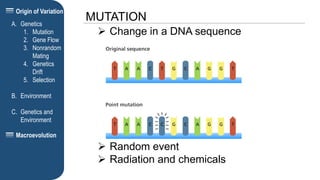
 Change in a DNA sequence
 Random event
 Radiation and chemicals
Origin of Variation
GENE FLOW
A. Genetics
1. Mutation
2. Gene Flow
3. Nonrandom
Mating
4. Genetics
Drift
5. Selection
B. Environment
C. Genetics and
Environment
Macroevolution
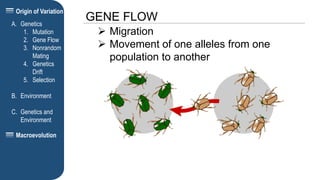
 Migration
 Movement of one alleles from one
population to another
Origin of Variation
NONRANDOM MATING
A. Genetics
1. Mutation
2. Gene Flow
3. Nonrandom
Mating
4. Genetics
Drift
5. Selection
B. Environment
C. Genetics and
Environment
Macroevolution
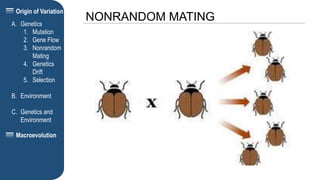
 Occurs when two individuals is a
population will mate
 a. inbreeding
-close relatives
-common form
-changes the genotype
frequencies, not the allele
frequencies
 b. outbreeding
-distant relatives
-less common
Origin of Variation
NONRANDOM MATING
A. Genetics
1. Mutation
2. Gene Flow
3. Nonrandom
Mating
4. Genetics
Drift
5. Selection
B. Environment
C. Genetics and
Environment
Macroevolution
Origin of Variation
GENETIC DRIFT
A. Genetics
1. Mutation
2. Gene Flow
3. Nonrandom
Mating
4. Genetics
Drift
5. Selection
B. Environment
C. Genetics and
Environment
Macroevolution
 change in allele frequencies in a
population from generation to generation
that occurs due to chance events
Origin of Variation
FOUNDER EFFECT
A. Genetics
1. Mutation
2. Gene Flow
3. Nonrandom
Mating
4. Genetics
Drift
5. Selection
B. Environment
C. Genetics and
Environment
Macroevolution
 Is a phenomena that occurs when a
small group of individuals becomes
isolated from a larger population.
Origin of Variation
BOTTLENECK EFFECT
A. Genetics
1. Mutation
2. Gene Flow
3. Nonrandom
Mating
4. Genetics
Drift
5. Selection
B. Environment
C. Genetics and
Environment
Macroevolution
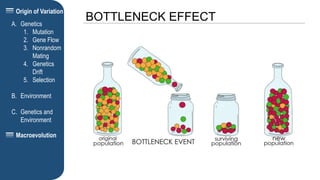
 the size of a population is severely
reduced
 natural disasters can decimate a
population, killing most individuals and
leaving behind a small, random
assortment of survivors.
Origin of Variation
BOTTLENECK EFFECT
A. Genetics
1. Mutation
2. Gene Flow
3. Nonrandom
Mating
4. Genetics
Drift
5. Selection
B. Environment
C. Genetics and
Environment
Macroevolution
Origin of Variation
SELECTION
A. Genetics
1. Mutation
2. Gene Flow
3. Nonrandom
Mating
4. Genetics
Drift
5. Selection
B. Environment
C. Genetics and
Environment
Macroevolution
 process by which individual organisms
with favorable traits are more likely to
survive and reproduce
 Natural selection acts on an organism’s
phenotype, or observable features
 When a phenotype produced by certain
alleles helps organisms survive and
reproduce better than their peers,
natural selection can increase the
frequency of the helpful alle
Origin of Variation
ENVIRONMENTAL VARIATION
A. Genetics
1. Mutation
2. Gene Flow
3. Nonrandom
Mating
4. Genetics
Drift
5. Selection
B. Environment
C. Genetics and
Environment
Macroevolution
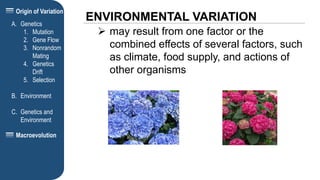
 may result from one factor or the
combined effects of several factors, such
as climate, food supply, and actions of
other organisms
Origin of Variation
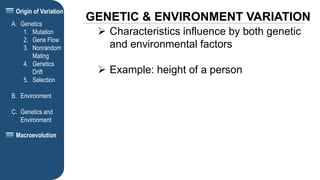
GENETIC & ENVIRONMENT VARIATION
A. Genetics
1. Mutation
2. Gene Flow
3. Nonrandom
Mating
4. Genetics
Drift
5. Selection
B. Environment
C. Genetics and
Environment
Macroevolution
 Characteristics influence by both genetic
and environmental factors
 Example: height of a person
Origin of Variation
ORIGIN OF VARIATION
A. Genetics
1. Mutation
2. Gene Flow
3. Nonrandom
Mating
4. Genetics
Drift
5. Selection
B. Environment
C. Genetics and
Environment
Macroevolution
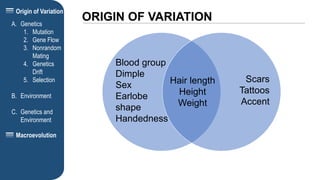
Blood group
Dimple
Sex
Earlobe
shape
Handedness
Scars
Tattoos
Accent
Hair length
Height
Weight

Ecology-Variation

  • 1.
  • 2.
    Origin of Variation ORIGINOF VARIATION A. Genetics 1. Mutation 2. Gene Flow 3. Nonrandom Mating 4. Genetics Drift 5. Selection B. Environment C. Genetics and Environment Macroevolution Variation  the differences in the characteristics of individuals in a population  Skin, eye, hair color, hair type, height, nose shape
  • 3.
    Origin of Variation ORIGINOF VARIATION A. Genetics 1. Mutation 2. Gene Flow 3. Nonrandom Mating 4. Genetics Drift 5. Selection B. Environment C. Genetics and Environment Macroevolution Variation + Genetics Environment Genetics and Environment
  • 4.
    Origin of Variation GENETICVARIATION A. Genetics 1. Mutation 2. Gene Flow 3. Nonrandom Mating 4. Genetics Drift 5. Selection B. Environment C. Genetics and Environment Macroevolution Genetic Variation  Refers to differences in the genotype or genetic makeup of individuals in a population  Eye color, blood type  Leaf shape  Camouflage
  • 5.
    Origin of Variation AGENTSOF GENETIC VARIATION A. Genetics 1. Mutation 2. Gene Flow 3. Nonrandom Mating 4. Genetics Drift 5. Selection B. Environment C. Genetics and Environment Macroevolution 1.Mutation 2.Gene Flow 3.Nonrandom Mating 4.Genetics Drift 5.Selection
  • 6.
    Origin of Variation MUTATION A.Genetics 1. Mutation 2. Gene Flow 3. Nonrandom Mating 4. Genetics Drift 5. Selection B. Environment C. Genetics and Environment Macroevolution  Change in a DNA sequence  Random event  Radiation and chemicals
  • 7.
    Origin of Variation GENEFLOW A. Genetics 1. Mutation 2. Gene Flow 3. Nonrandom Mating 4. Genetics Drift 5. Selection B. Environment C. Genetics and Environment Macroevolution  Migration  Movement of one alleles from one population to another
  • 8.
    Origin of Variation NONRANDOMMATING A. Genetics 1. Mutation 2. Gene Flow 3. Nonrandom Mating 4. Genetics Drift 5. Selection B. Environment C. Genetics and Environment Macroevolution  Occurs when two individuals is a population will mate  a. inbreeding -close relatives -common form -changes the genotype frequencies, not the allele frequencies  b. outbreeding -distant relatives -less common
  • 9.
    Origin of Variation NONRANDOMMATING A. Genetics 1. Mutation 2. Gene Flow 3. Nonrandom Mating 4. Genetics Drift 5. Selection B. Environment C. Genetics and Environment Macroevolution
  • 10.
    Origin of Variation GENETICDRIFT A. Genetics 1. Mutation 2. Gene Flow 3. Nonrandom Mating 4. Genetics Drift 5. Selection B. Environment C. Genetics and Environment Macroevolution  change in allele frequencies in a population from generation to generation that occurs due to chance events
  • 11.
    Origin of Variation FOUNDEREFFECT A. Genetics 1. Mutation 2. Gene Flow 3. Nonrandom Mating 4. Genetics Drift 5. Selection B. Environment C. Genetics and Environment Macroevolution  Is a phenomena that occurs when a small group of individuals becomes isolated from a larger population.
  • 12.
    Origin of Variation BOTTLENECKEFFECT A. Genetics 1. Mutation 2. Gene Flow 3. Nonrandom Mating 4. Genetics Drift 5. Selection B. Environment C. Genetics and Environment Macroevolution  the size of a population is severely reduced  natural disasters can decimate a population, killing most individuals and leaving behind a small, random assortment of survivors.
  • 13.
    Origin of Variation BOTTLENECKEFFECT A. Genetics 1. Mutation 2. Gene Flow 3. Nonrandom Mating 4. Genetics Drift 5. Selection B. Environment C. Genetics and Environment Macroevolution
  • 14.
    Origin of Variation SELECTION A.Genetics 1. Mutation 2. Gene Flow 3. Nonrandom Mating 4. Genetics Drift 5. Selection B. Environment C. Genetics and Environment Macroevolution  process by which individual organisms with favorable traits are more likely to survive and reproduce  Natural selection acts on an organism’s phenotype, or observable features  When a phenotype produced by certain alleles helps organisms survive and reproduce better than their peers, natural selection can increase the frequency of the helpful alle
  • 15.
    Origin of Variation ENVIRONMENTALVARIATION A. Genetics 1. Mutation 2. Gene Flow 3. Nonrandom Mating 4. Genetics Drift 5. Selection B. Environment C. Genetics and Environment Macroevolution  may result from one factor or the combined effects of several factors, such as climate, food supply, and actions of other organisms
  • 16.
    Origin of Variation GENETIC& ENVIRONMENT VARIATION A. Genetics 1. Mutation 2. Gene Flow 3. Nonrandom Mating 4. Genetics Drift 5. Selection B. Environment C. Genetics and Environment Macroevolution  Characteristics influence by both genetic and environmental factors  Example: height of a person
  • 17.
    Origin of Variation ORIGINOF VARIATION A. Genetics 1. Mutation 2. Gene Flow 3. Nonrandom Mating 4. Genetics Drift 5. Selection B. Environment C. Genetics and Environment Macroevolution Blood group Dimple Sex Earlobe shape Handedness Scars Tattoos Accent Hair length Height Weight

Editor's Notes

  • #2 Good morning, everyone! We have come to know the different individuals who contributed a lot to the understanding of evolution. So now, I will be talking more about evolution, specifically on the origin of variation and on macroevolution. I will now start with the origin of variation. Inside our house, all of us, human, appear to be human, but we can notice that no one of us are exactly the same, unless, if there are identical twins in our family. That is not only true with human, but also applicable to other species, like cats, dogs, and plants. In biology, we call those differences as variation.
  • #3 As what I have said a while ago, variation is the differences in the characteristics of individuals within a population. What does that mean? Let us look at the picture in the presentation, we can see a population of cats with 3 members and a population of dogs with 2 members. Although the cats are all cats, we can see a lot of differences. They do not have the same eye color, fur color, and even ear shape. Those are some examples of variation in the species of cats. In our case, human, some variations include skin complexion, eye shape and color, our hair type, our height, and nose shape.
  • #4 Variation in species can be caused by the differences of genes. It can also a result of environment. Variation in species can also be a result of both the gene differences and its environment. Let us first look on the variations caused by genetics.
  • #5 Genetic Variation Refers to the differences in the genotype or genetic makeup of individuals in a population. We learned last week that genotype determines phenotype. Examples of phenotype for human are eye color and blood type. For plants, leaf shape, and for animas, camouflage or their ability to change their color or form to blend with their environment.
  • #6 There are 5 agents for genetic variation. We have Mutation, Gene Flow, Nonrandom Mating, Genetics Drift, and Selection. We will know how these processes affects genetic variation in the succeeding slides
  • #7 First is mutation. Mutation happens when there is a change in the deoxyribonucleic acid or DNA sequence. DNA are made up of four chemical bases. We have adenine, guanine, cytosine, and thymine. Each are usually represented by their first letter. Let us look at the example in the presentation. The original sequence is T A A C T G and so on. Let us say that during cell division, there was a mistake in copying the original DNA. It became T A A C C G. There was mutation happend,. Mutation is a random event, but the occurrence can be increased by radiation like UV rays or x rays and chemicals like mutagens that we can get from cigarettes
  • #8 Next, we have gene flow. Gene flow is also called migration. It is any movement of individuals, and/or the genetic material they carry, from one population to another. Gene flow includes lots of different kinds of events, such as pollen being blown to a new destination or people moving to new cities or countries. If gene versions are carried to a population where those gene versions previously did not exist, gene flow can be a very important source of genetic variation. In the graphic below, the gene version for brown coloration moves from one population to another.
  • #9 Another agent of genetic variation is nonrandom mating. It occurs when two individuals will mate. There are 2 types of nonrandom mating. We have inbreeding and outbreeding. Inbreeding is usually the common. Example of inbreeding in human is when a male choose to marry a woman close to him in terms of geography. The result of this action is that there will be a change in genotype frequencies, and not the allele or the alternative frequencies.
  • #10 Let us look at the diagram. Let us say for instance, if a species with brown genotype mates with another brown genotypes, they will tend to produce offspring with brown genotypes. That is what I mean when I said that this will result to change genotype frequencies, and not allele frequencies.
  • #11 Let us now proceed to genetic drift as agent of variation. Genetic drift is referred to as a change in allele frequencies in a population from generation to generation that occurs due to chance events. These events may include natural disasters or man-made. Let us look at the illustration. Let us say that during the first generation ofpenguins, there were still a lot of them and as generations pass by, they became only few because of an event. That event may be the climate change that melts the ice in their habitat.
  • #12 There are 2 processes that causes genetic drift. We have the founder effect and the bottleneck effect. Let us talk first about founder effect. Founder effect is a phenomenon that refers to the migration of a small group of species from a larger population to go settle in another environment. Looking at the example, the larger population is made up of red and yellow genotype. Now, species of red allele separated from the original population and founded a new population. As a result, the new population formed will most probably have red alles. So a founder effect can sometimes impact a population in such a way that they may have less of a particular type of gene or more of a particular type of gene.
  • #13 Another process that explains genetic drift is the bottleneck effect. the size of a population is severely reduced. natural disasters can decimate a population, killing most individuals and leaving behind a small, random assortment of survivors. Let us look at the illustration to better visualize how this phenomena is done.
  • #14 Let's see how the bottleneck illustration can be applied here. In the original population above, there are green, orange, and red individuals living in a habitat. Orange makes up the majority of the population. The colors represent alleles for a color gene. When disaster strikes, only a few random individuals make it out alive. As you can see, by pure luck, most of the survivors are red, with a few green and just one orange. Over time, the population grows again, but now the majority of members are red, and there are just a few orange. This is very different from the original population before the disaster happened. This illustrates that when a bottleneck event happens, the variety in a population can decrease and the proportions of different alleles can change completely.
  • #15 Now, we are down to the most famous process that causes variation, the selection or natural selection. We have learned natural selection last week and I learned that those that have alleles that helps organism survive will have the greater chance to increase in frequency. Natural selection is defined as a process in nature through which living organisms adapt and change in response to an environmental condition. And organisms that are better suited to their environment tend to survive longer and produce more offspring. Those are variations caused by gentetics, now let us proceed to environmental variation.
  • #16 Environmental variation may result from one factor or the combined effects of several factors, such as climate, food supply, and actions of other organisms For example, humans. One will become heavier if he eat too much food, and one will become lighter if he eat too little. Food is the factor here Another example, A plant in the shade of big tree will grow taller as it tries to reach more light. Climate and food supplies are the two factors here. Another amazing example of this are Hydrangea. These species will have Pink flowers when planted in alkalinez soil and it will bear Blue flowers when planted in acidic soil
  • #17 Genetic and environment variation uccurs when characeristivs is influenced by both genetic and environmental factors. For example, us human. It is true tall parents tend to have tall children. That is because allele that corresponds tallness are present in both parents. Even though that child have the tall genes, it does not mean that he will also become taller. Food that he eats is also a factor in his height.
  • #18 This is to give examples of characteristics in human that can be affected by genetic, environment and both. For genetics, Blood group Dimple, Sex, Earlobe shape, and Handedness, for environment, Scars, Tattoos, and Accent. And for both, Hair length, Height, and Weight That ends my report on origin of variation and things included here actually falls under microevolution. Micro evolution happens in small-scale while macroevolution happens in large scale.