How can you help at home?
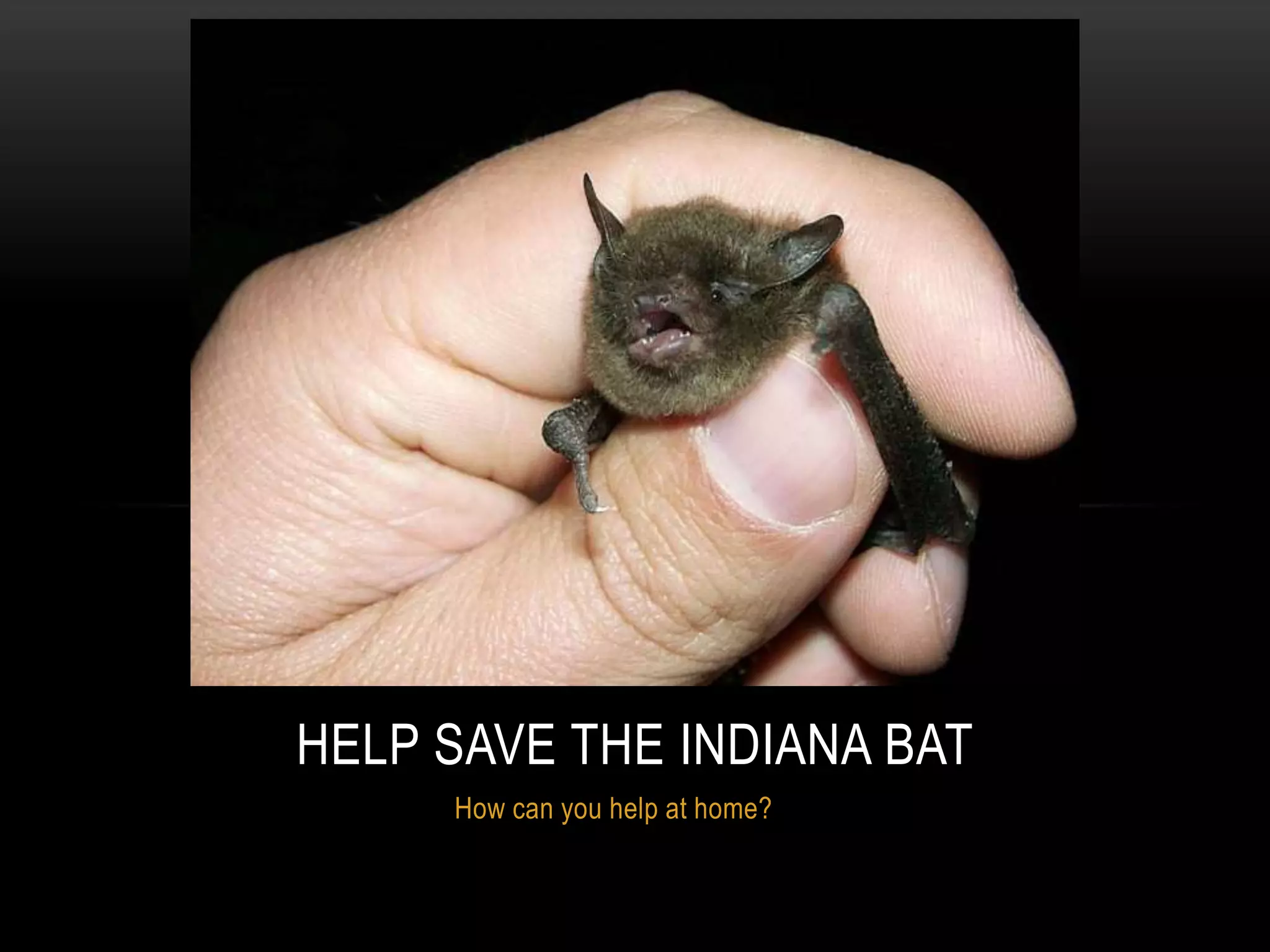
HELP SAVE THE INDIANA BAT
FIRST OF ALL, WHY BATS?
Bats help us out in many ways, such as:
• Pollinating flowers
• Advancing the medical field for humans
• Eating THOUSANDS of insects
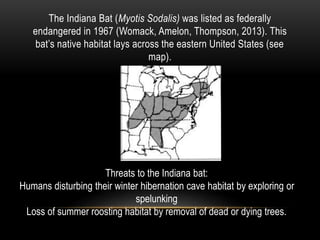
The Indiana Bat (Myotis Sodalis) was listed as federally
endangered in 1967 (Womack, Amelon, Thompson, 2013). This
bat’s native habitat lays across the eastern United States (see
map).
Threats to the Indiana bat:
Humans disturbing their winter hibernation cave habitat by exploring or
spelunking
Loss of summer roosting habitat by removal of dead or dying trees.
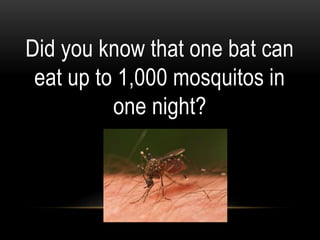
Did you know that one bat can
eat up to 1,000 mosquitos in
one night?
Imagine your next cookout or
bonfire with thousands of less
mosquitos and bugs, sounds
pretty appealing right?
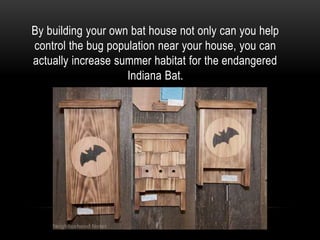
By building your own bat house not only can you help
control the bug population near your house, you can
actually increase summer habitat for the endangered
Indiana Bat.
ARTIFICIAL ROOSTING SITES
Creating an artificial roosting site, or bat box, is a great way to
create habitat for these endangered creatures. Indiana bats
generally prefer to roost inside the bark of dead or dying trees, but
a study in Indiana found that the Indiana bat does use a bat box for
roosting in some areas near the airport (Whitaker, Sparks, & Brack,
2006).
According to the National Wildlife Federation, it is important for
these bat boxes to mimic the area between the bark and the trunk
of a tree, prime roosting habitat. Bats like tight, small, warm
spaces. Unlike bird houses that tend to be large enough to hold a
nest, bat boxes need to be small and compact.
WANT TO MAKE YOUR OWN BAT BOX?
Here are some great resources to get you started:
http://www.nwf.org/How-to-Help/Garden-for-Wildlife/Gardening-Tips/Build-a-Bat-House.aspx
http://www.batconservation.org/bat-houses/build-your-own-bat-house
SHOW US YOUR BAT BOXES!
Now, after you are done building your bat box, be sure to
email us your photos so we can upload them to our page!
Email your photos to:
batboxesforconservation@gmail.com

Eco spot bat spring 2015

  • 1.
    How can youhelp at home? HELP SAVE THE INDIANA BAT
  • 2.
    FIRST OF ALL,WHY BATS? Bats help us out in many ways, such as: • Pollinating flowers • Advancing the medical field for humans • Eating THOUSANDS of insects
  • 3.
    The Indiana Bat(Myotis Sodalis) was listed as federally endangered in 1967 (Womack, Amelon, Thompson, 2013). This bat’s native habitat lays across the eastern United States (see map). Threats to the Indiana bat: Humans disturbing their winter hibernation cave habitat by exploring or spelunking Loss of summer roosting habitat by removal of dead or dying trees.
  • 4.
    Did you knowthat one bat can eat up to 1,000 mosquitos in one night?
  • 5.
    Imagine your nextcookout or bonfire with thousands of less mosquitos and bugs, sounds pretty appealing right?
  • 6.
    By building yourown bat house not only can you help control the bug population near your house, you can actually increase summer habitat for the endangered Indiana Bat.
  • 7.
    ARTIFICIAL ROOSTING SITES Creatingan artificial roosting site, or bat box, is a great way to create habitat for these endangered creatures. Indiana bats generally prefer to roost inside the bark of dead or dying trees, but a study in Indiana found that the Indiana bat does use a bat box for roosting in some areas near the airport (Whitaker, Sparks, & Brack, 2006). According to the National Wildlife Federation, it is important for these bat boxes to mimic the area between the bark and the trunk of a tree, prime roosting habitat. Bats like tight, small, warm spaces. Unlike bird houses that tend to be large enough to hold a nest, bat boxes need to be small and compact.
  • 8.
    WANT TO MAKEYOUR OWN BAT BOX? Here are some great resources to get you started: http://www.nwf.org/How-to-Help/Garden-for-Wildlife/Gardening-Tips/Build-a-Bat-House.aspx http://www.batconservation.org/bat-houses/build-your-own-bat-house
  • 9.
    SHOW US YOURBAT BOXES! Now, after you are done building your bat box, be sure to email us your photos so we can upload them to our page! Email your photos to: batboxesforconservation@gmail.com