Little Brown Bats By Clement
Introduction The little brown bat is sometimes called  little brown myotis. One if the most common bats in North America Species of the genus Myotis Found throughout the world
Description As it's name suggests, its fur is dark brown and glossy  Typical wingspan is 8.7-10.6 inches Ears are small and black All teeth are relatively sharp Adult bats are typically 4.6-5.6 ounces
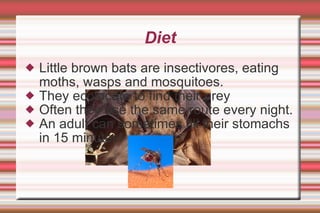
Diet Little brown bats are insectivores, eating moths, wasps and mosquitoes. They ecolocate to find their prey Often they use the same route every night. An adult can sometimes fill their stomachs in 15 minutes!
Distribution The little brown bat is found all over North America from northern Mexico to interior Alaska. It is  the  most abundant bat found in the United States.
Life cycle Mating season is in the fall, but fertilization doesn't happen until spring.  In the spring little brown bats form huge nursery colonies. The female little brown bat gives birth to only one baby. During birth, the female hangs right-side up!
Social Status The nursery colonies can get as big as 1000 bats in a cave /forest
Social system The little brown bat is colonial.  In the summer, females gather in nursery colonies,  While males roost alone or in small isolated colonies.
Endangered Status Little brown bats are not considered  endangered They also have no conservation status. Little Brown bat endangered
Significance to humans These voracious insectivores help control pest insect populations, and also serve as bio-indicators.
Hibernation Little brown bats hibernate in September and October, emerging in April - June.
Range and habitat The little brown bat's range is a large portion of North America from Alaska to Labrador, south into central Mexico.
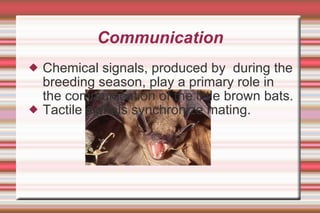
Communication Chemical signals, produced by  during the breeding season, play a primary role in the communication of the little brown bats.  Tactile signals synchronize mating.

Bats

  • 1.
  • 2.
    Introduction The littlebrown bat is sometimes called little brown myotis. One if the most common bats in North America Species of the genus Myotis Found throughout the world
  • 3.
    Description As it'sname suggests, its fur is dark brown and glossy Typical wingspan is 8.7-10.6 inches Ears are small and black All teeth are relatively sharp Adult bats are typically 4.6-5.6 ounces
  • 4.
    Diet Little brownbats are insectivores, eating moths, wasps and mosquitoes. They ecolocate to find their prey Often they use the same route every night. An adult can sometimes fill their stomachs in 15 minutes!
  • 5.
    Distribution The littlebrown bat is found all over North America from northern Mexico to interior Alaska. It is the most abundant bat found in the United States.
  • 6.
    Life cycle Matingseason is in the fall, but fertilization doesn't happen until spring. In the spring little brown bats form huge nursery colonies. The female little brown bat gives birth to only one baby. During birth, the female hangs right-side up!
  • 7.
    Social Status Thenursery colonies can get as big as 1000 bats in a cave /forest
  • 8.
    Social system Thelittle brown bat is colonial. In the summer, females gather in nursery colonies, While males roost alone or in small isolated colonies.
  • 9.
    Endangered Status Littlebrown bats are not considered endangered They also have no conservation status. Little Brown bat endangered
  • 10.
    Significance to humansThese voracious insectivores help control pest insect populations, and also serve as bio-indicators.
  • 11.
    Hibernation Little brownbats hibernate in September and October, emerging in April - June.
  • 12.
    Range and habitatThe little brown bat's range is a large portion of North America from Alaska to Labrador, south into central Mexico.
  • 13.
    Communication Chemical signals,produced by during the breeding season, play a primary role in the communication of the little brown bats. Tactile signals synchronize mating.