Mechanical and Electrical
Events of the Cardiac Cycle
PEP 3510: Exercise Physiology
PEP 4370: Exercise Management for
Special Populations
Cardiac Cycle
Cardiac Cycle: the electrical, pressure and
volume changes that occur in a functional
heart between successive heart beats.
• Phase of the cardiac cycle when
myocardium is relaxed is termed diastole.
• Phase of the cardiac cycle when the
myocardium contracts is termed systole.
– Atrial systole: when atria contract.
– Ventricular systole: when ventricles contract.
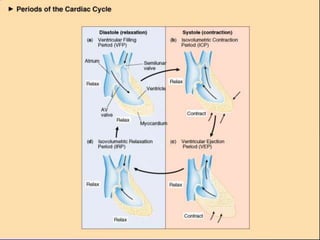
Mechanical Events of the
Cardiac Cycle
1. Ventricular Filling Period [ventricular
diastole, atrial systole]
2. Isovolumetric Contraction Period [ventricular
systole]
3. Ventricular Ejection Period [ventricular
systole]
4. Isovolumetric Relaxation Period [ventricular
diastole, atrial diastole]
Cardiac Cycle
 Electrical changes in heart tissue cause
mechanical changes, i.e. muscle
contraction.
 Thus, changes in electrical membrane
potential of specific parts of the heart tissue
represent mechanical events in specific
areas of the heart tissue.
Electrocardiography
 Two common abbreviations for
electrocardiogram: EKG and ECG.
 EKG comes from German language where
cardiogram is written as kardiogram.
 The ECG records the electrical activity of
the heart.
 Mechanical activity of the heart is sensed by
echocardiography.
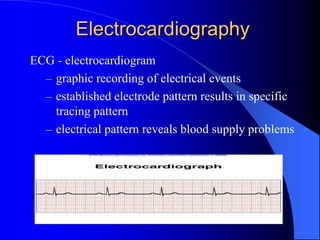
Electrocardiography
ECG - electrocardiogram
– graphic recording of electrical events
– established electrode pattern results in specific
tracing pattern
– electrical pattern reveals blood supply problems
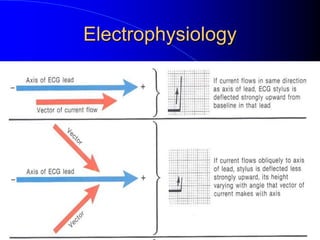
Electrophysiology
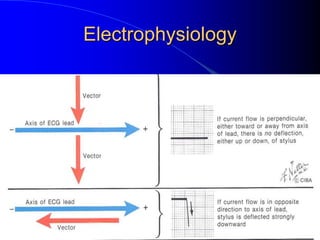
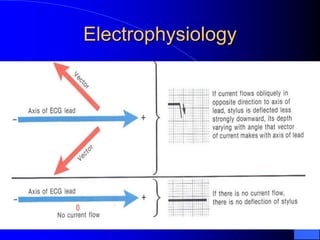
 If an electrode is placed so that wave of
depolarization spreads toward the recording
electrode, the ECG records a positive
(upward) deflection.
 If wave of depolarization spreads away
from recording electrode, a negative
(downward) deflection occurs.
Electrophysiology
Electrophysiology
Electrophysiology
Electrophysiology
 When myocardial muscle is completely
polarized or depolarized, the ECG will not
record any electrical potential but rather a
flat line, isoelectric line.
 After depolarization, myocardial cells
undergo repolarization to return to electrical
state at rest.
Electrical Events of the
Cardiac Cycle
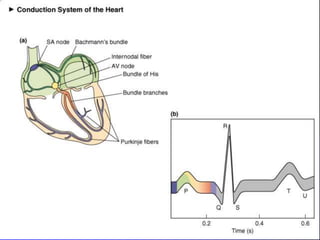
• Sinoatrial (SA) node is the normal pacemaker
of heart and is located in right atrium.
• Depolarization spreads from SA node across
atria and results in the P wave.
• Three tracts within atria conduct depolarization
to atrioventricular (AV) node.
• Conduction slows in AV node to allow atria to
empty blood into ventricles before vent. systole.
• Bundle of His connects AV to bundle branches.
• Purkinje fibers are terminal bundle branches.
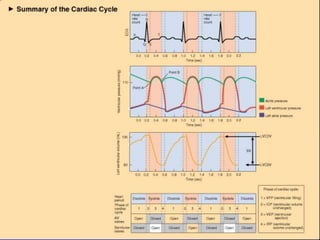
Cardiac Cycle
Coordination of :
 Electrical Changes
 Pressure Changes in Left Atria, Left
Ventricle and Aorta
 Ventricular Volume Changes
 Cardiac Valves
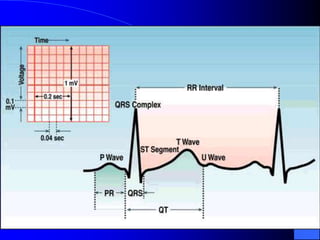
ECG Time & Voltage
• ECG machines can run at 50 or 25 mm/sec.
• Major grid lines are 5 mm apart; at standard
25 mm/s, 5 mm corresponds to .20 seconds.
• Minor lines are 1 mm apart; at standard 25
mm/s, 1 mm corresponds to .04 seconds.
• Voltage is measured on vertical axis.
• Standard calibration is 0.1 mV per mm of
deflection.
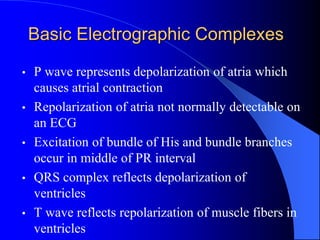
Basic Electrographic Complexes
• P wave represents depolarization of atria which
causes atrial contraction
• Repolarization of atria not normally detectable on
an ECG
• Excitation of bundle of His and bundle branches
occur in middle of PR interval
• QRS complex reflects depolarization of
ventricles
• T wave reflects repolarization of muscle fibers in
ventricles
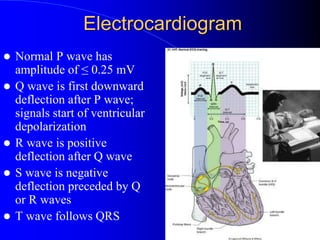
Electrocardiogram
 Normal P wave has
amplitude of ≤ 0.25 mV
 Q wave is first downward
deflection after P wave;
signals start of ventricular
depolarization
 R wave is positive
deflection after Q wave
 S wave is negative
deflection preceded by Q
or R waves
 T wave follows QRS
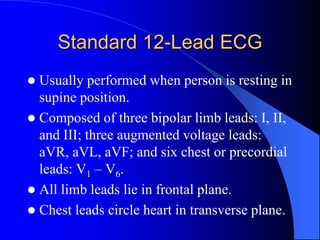
Standard 12-Lead ECG
 Usually performed when person is resting in
supine position.
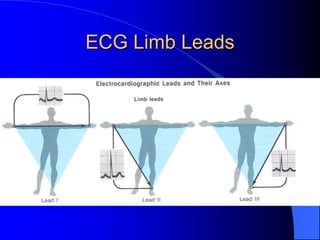
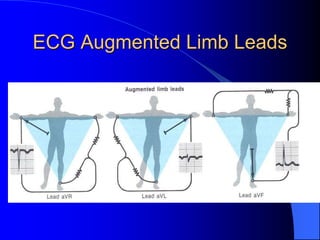
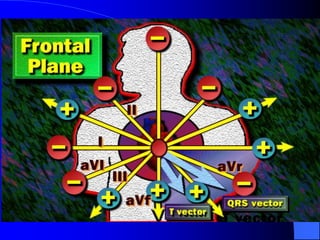
 Composed of three bipolar limb leads: I, II,
and III; three augmented voltage leads:
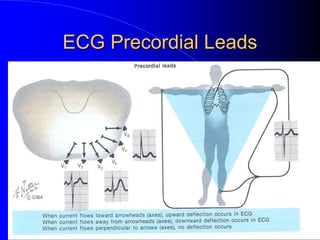
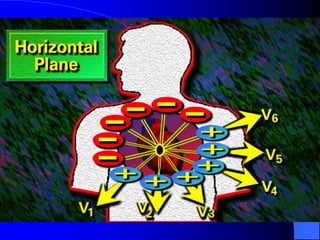
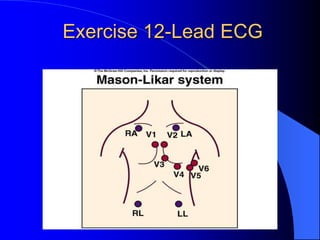
aVR, aVL, aVF; and six chest or precordial
leads: V1 – V6.
 All limb leads lie in frontal plane.
 Chest leads circle heart in transverse plane.
ECG Limb Leads
ECG Augmented Limb Leads
ECG Precordial Leads
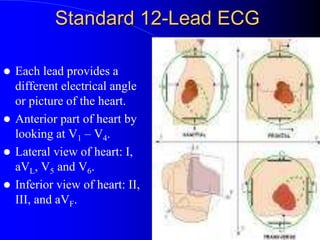
Standard 12-Lead ECG
 Each lead provides a
different electrical angle
or picture of the heart.
 Anterior part of heart by
looking at V1 – V4.
 Lateral view of heart: I,
aVL, V5 and V6.
 Inferior view of heart: II,
III, and aVF.
Exercise 12-Lead ECG
12-Lead ECG
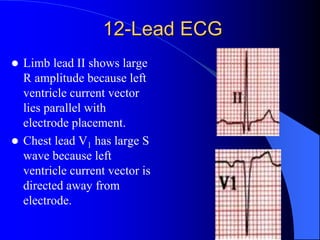
 Limb lead II shows large
R amplitude because left
ventricle current vector
lies parallel with
electrode placement.
 Chest lead V1 has large S
wave because left
ventricle current vector is
directed away from
electrode.
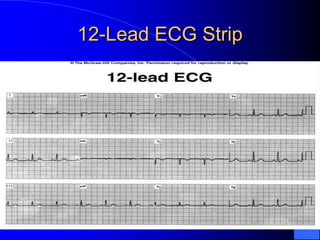
12-Lead ECG Strip
Interpretation of ECG:
Rate
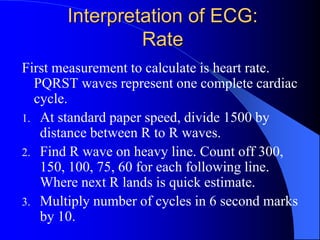
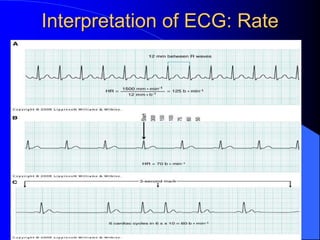
First measurement to calculate is heart rate.
PQRST waves represent one complete cardiac
cycle.
1. At standard paper speed, divide 1500 by
distance between R to R waves.
2. Find R wave on heavy line. Count off 300,
150, 100, 75, 60 for each following line.
Where next R lands is quick estimate.
3. Multiply number of cycles in 6 second marks
by 10.
Interpretation of ECG: Rate
Interpretation of ECG:
Rhythm
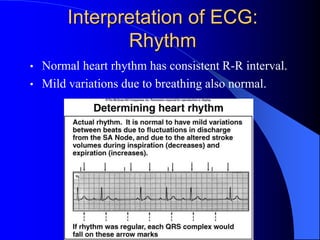
• Normal heart rhythm has consistent R-R interval.
• Mild variations due to breathing also normal.
Interpretation of ECG: Rhythm
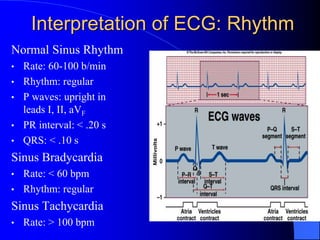
Normal Sinus Rhythm
• Rate: 60-100 b/min
• Rhythm: regular
• P waves: upright in
leads I, II, aVF
• PR interval: < .20 s
• QRS: < .10 s
Sinus Bradycardia
• Rate: < 60 bpm
• Rhythm: regular
Sinus Tachycardia
• Rate: > 100 bpm
AV Conduction Disturbances
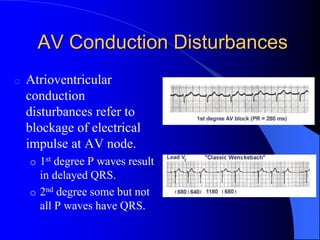
o Atrioventricular
conduction
disturbances refer to
blockage of electrical
impulse at AV node.
o 1st degree P waves result
in delayed QRS.
o 2nd degree some but not
all P waves have QRS.
Arrhythmias
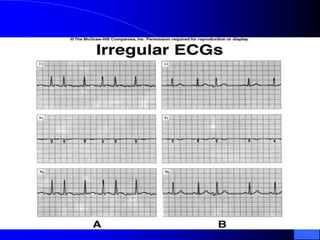
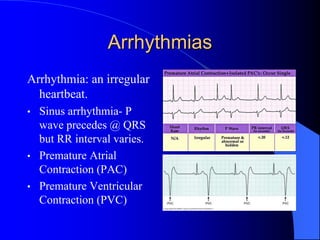
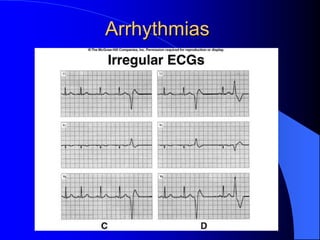
Arrhythmia: an irregular
heartbeat.
• Sinus arrhythmia- P
wave precedes @ QRS
but RR interval varies.
• Premature Atrial
Contraction (PAC)
• Premature Ventricular
Contraction (PVC)
Arrhythmias
Myocardial Ischemia
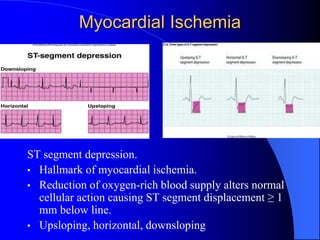
ST segment depression.
• Hallmark of myocardial ischemia.
• Reduction of oxygen-rich blood supply alters normal
cellular action causing ST segment displacement ≥ 1
mm below line.
• Upsloping, horizontal, downsloping
Illustration References
 McArdle, Katch, Katch. 2000. Essentials
of Exercise Physiology Image Collection,
2nd ed. Lippincott Williams & Wilkins
 Foss and Keteyian. 1998. Physiological
Basis for Exercise and Sport, 6th ed. WCB
McGraw-Hill.
 Robergs and Keteyian. 2003.
Fundamentals of Exercise Physiology, 2nd
ed. McGraw-Hill.

ECG.ppt

  • 1.
    Mechanical and Electrical Eventsof the Cardiac Cycle PEP 3510: Exercise Physiology PEP 4370: Exercise Management for Special Populations
  • 2.
    Cardiac Cycle Cardiac Cycle:the electrical, pressure and volume changes that occur in a functional heart between successive heart beats. • Phase of the cardiac cycle when myocardium is relaxed is termed diastole. • Phase of the cardiac cycle when the myocardium contracts is termed systole. – Atrial systole: when atria contract. – Ventricular systole: when ventricles contract.
  • 3.
    Mechanical Events ofthe Cardiac Cycle 1. Ventricular Filling Period [ventricular diastole, atrial systole] 2. Isovolumetric Contraction Period [ventricular systole] 3. Ventricular Ejection Period [ventricular systole] 4. Isovolumetric Relaxation Period [ventricular diastole, atrial diastole]
  • 5.
    Cardiac Cycle  Electricalchanges in heart tissue cause mechanical changes, i.e. muscle contraction.  Thus, changes in electrical membrane potential of specific parts of the heart tissue represent mechanical events in specific areas of the heart tissue.
  • 6.
    Electrocardiography  Two commonabbreviations for electrocardiogram: EKG and ECG.  EKG comes from German language where cardiogram is written as kardiogram.  The ECG records the electrical activity of the heart.  Mechanical activity of the heart is sensed by echocardiography.
  • 7.
    Electrocardiography ECG - electrocardiogram –graphic recording of electrical events – established electrode pattern results in specific tracing pattern – electrical pattern reveals blood supply problems
  • 8.
    Electrophysiology  If anelectrode is placed so that wave of depolarization spreads toward the recording electrode, the ECG records a positive (upward) deflection.  If wave of depolarization spreads away from recording electrode, a negative (downward) deflection occurs.
  • 9.
  • 10.
  • 11.
  • 12.
    Electrophysiology  When myocardialmuscle is completely polarized or depolarized, the ECG will not record any electrical potential but rather a flat line, isoelectric line.  After depolarization, myocardial cells undergo repolarization to return to electrical state at rest.
  • 13.
    Electrical Events ofthe Cardiac Cycle • Sinoatrial (SA) node is the normal pacemaker of heart and is located in right atrium. • Depolarization spreads from SA node across atria and results in the P wave. • Three tracts within atria conduct depolarization to atrioventricular (AV) node. • Conduction slows in AV node to allow atria to empty blood into ventricles before vent. systole. • Bundle of His connects AV to bundle branches. • Purkinje fibers are terminal bundle branches.
  • 15.
    Cardiac Cycle Coordination of:  Electrical Changes  Pressure Changes in Left Atria, Left Ventricle and Aorta  Ventricular Volume Changes  Cardiac Valves
  • 17.
    ECG Time &Voltage • ECG machines can run at 50 or 25 mm/sec. • Major grid lines are 5 mm apart; at standard 25 mm/s, 5 mm corresponds to .20 seconds. • Minor lines are 1 mm apart; at standard 25 mm/s, 1 mm corresponds to .04 seconds. • Voltage is measured on vertical axis. • Standard calibration is 0.1 mV per mm of deflection.
  • 19.
    Basic Electrographic Complexes •P wave represents depolarization of atria which causes atrial contraction • Repolarization of atria not normally detectable on an ECG • Excitation of bundle of His and bundle branches occur in middle of PR interval • QRS complex reflects depolarization of ventricles • T wave reflects repolarization of muscle fibers in ventricles
  • 20.
    Electrocardiogram  Normal Pwave has amplitude of ≤ 0.25 mV  Q wave is first downward deflection after P wave; signals start of ventricular depolarization  R wave is positive deflection after Q wave  S wave is negative deflection preceded by Q or R waves  T wave follows QRS
  • 22.
    Standard 12-Lead ECG Usually performed when person is resting in supine position.  Composed of three bipolar limb leads: I, II, and III; three augmented voltage leads: aVR, aVL, aVF; and six chest or precordial leads: V1 – V6.  All limb leads lie in frontal plane.  Chest leads circle heart in transverse plane.
  • 23.
  • 24.
  • 26.
  • 28.
    Standard 12-Lead ECG Each lead provides a different electrical angle or picture of the heart.  Anterior part of heart by looking at V1 – V4.  Lateral view of heart: I, aVL, V5 and V6.  Inferior view of heart: II, III, and aVF.
  • 29.
  • 30.
    12-Lead ECG  Limblead II shows large R amplitude because left ventricle current vector lies parallel with electrode placement.  Chest lead V1 has large S wave because left ventricle current vector is directed away from electrode.
  • 31.
  • 32.
    Interpretation of ECG: Rate Firstmeasurement to calculate is heart rate. PQRST waves represent one complete cardiac cycle. 1. At standard paper speed, divide 1500 by distance between R to R waves. 2. Find R wave on heavy line. Count off 300, 150, 100, 75, 60 for each following line. Where next R lands is quick estimate. 3. Multiply number of cycles in 6 second marks by 10.
  • 33.
  • 34.
    Interpretation of ECG: Rhythm •Normal heart rhythm has consistent R-R interval. • Mild variations due to breathing also normal.
  • 35.
    Interpretation of ECG:Rhythm Normal Sinus Rhythm • Rate: 60-100 b/min • Rhythm: regular • P waves: upright in leads I, II, aVF • PR interval: < .20 s • QRS: < .10 s Sinus Bradycardia • Rate: < 60 bpm • Rhythm: regular Sinus Tachycardia • Rate: > 100 bpm
  • 37.
    AV Conduction Disturbances oAtrioventricular conduction disturbances refer to blockage of electrical impulse at AV node. o 1st degree P waves result in delayed QRS. o 2nd degree some but not all P waves have QRS.
  • 38.
    Arrhythmias Arrhythmia: an irregular heartbeat. •Sinus arrhythmia- P wave precedes @ QRS but RR interval varies. • Premature Atrial Contraction (PAC) • Premature Ventricular Contraction (PVC)
  • 39.
  • 40.
    Myocardial Ischemia ST segmentdepression. • Hallmark of myocardial ischemia. • Reduction of oxygen-rich blood supply alters normal cellular action causing ST segment displacement ≥ 1 mm below line. • Upsloping, horizontal, downsloping
  • 41.
    Illustration References  McArdle,Katch, Katch. 2000. Essentials of Exercise Physiology Image Collection, 2nd ed. Lippincott Williams & Wilkins  Foss and Keteyian. 1998. Physiological Basis for Exercise and Sport, 6th ed. WCB McGraw-Hill.  Robergs and Keteyian. 2003. Fundamentals of Exercise Physiology, 2nd ed. McGraw-Hill.