Doon Ayurvedic medical college and hospital
[ Saharanpur ]
Guide by – Dr. Anu Bhardwaj
{ B. A. M. S. , M.D. Ayu. }
Perform by – Rajdeep Singh
{ Batch – 2023-24 }
Introduction –
– Electrocardiograph .
- Electrocardiograph is the instrument
(machine) by which electrical activities of
the heart are recorded .
- Discovered - Einthouen Leuwenhock .
- Function - Measure heart electric
activity .
- Principle- Galvenometer .
2. USE –
- Diagnosis of chest pain .
- Diagnosis the breathlessness .
- Dignosis of cardiac problems
.
3. Lead - Leads Total 12
- Two type of leads
- Chest lead -6
- Limb lead- Biplolar-3,
- Armented lead -3
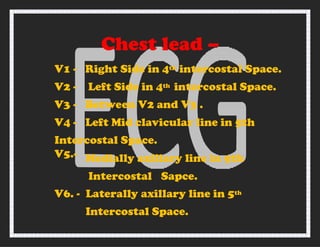
Chest lead –
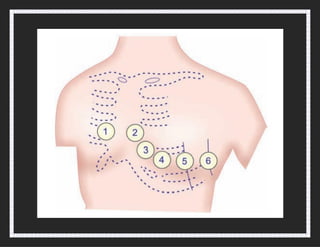
V1 - Right Side in 4th intercostal Space.
V2 - Left Side in 4th intercostal Space.
V3 - Between V2 and V3 .
V4 - Left Mid clavicular line in 5th
Intercostal Space.
V5.- Medially axillary line in 5th
Intercostal Sapce.
V6. - Laterally axillary line in 5th
Intercostal Space.
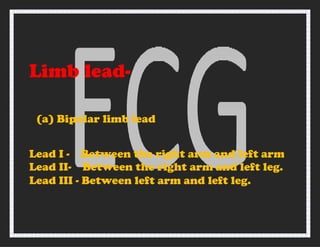
Limb lead-
(a) Bipolar limb lead
Lead I -
Lead II-
Between the right arm and left arm
Between the right arm and left leg.
Lead III - Between left arm and left leg.
(b) Unipolar limb lead-
Avr - Right arm avl -Left arm avf - Left foot
(av, -Armented voltage foot)
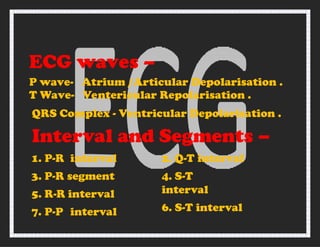
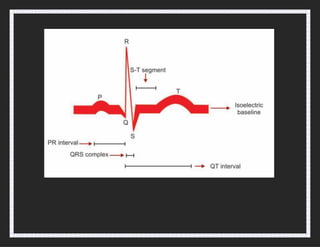
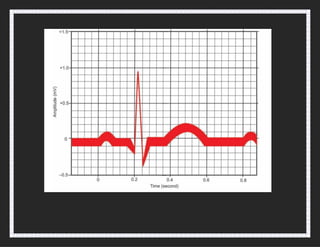
ECG waves –
P wave-
T Wave-
Atrium /Articular Depolarisation .
Ventericular Repolarisation .
QRS Complex - Ventricular Depolarisation .
Interval and Segments –
1. P-R interval
3. P-R segment
5. R-R interval
7. P-P interval
2. Q-T interval
4. S-T
interval
6. S-T interval
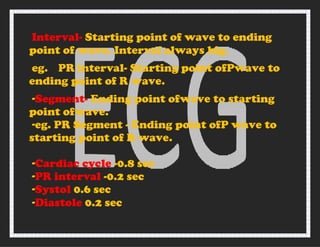
Interval- Starting point of wave to ending
point of wave. Interval always big.
eg. PR interval- Starting point ofPwave to
ending point of R wave.
-Segment- Ending point ofwave to starting
point ofwave.
-eg. PR Segment - Ending point ofP wave to
starting point of R wave.
-Cardiac cycle -0.8 sec
-PR interval -0.2 sec
-Systol 0.6 sec
-Diastole 0.2 sec
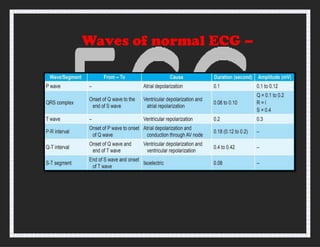
Waves of normal ECG –
P-R INTERVAL –
= P-R interval is the interval between
the onset of'P' wave and onset ofQ' wave.
= It's significes the aterial devpolarisation
and conduction impulses through the A-V
nodes.
= Normal duration ofP-R interval -0.18
second (0.12 to 0.20)
= Prolonged P-R interval scen in
bradycardia and first degree heart block.
= Shortend P-R interval seen in
tachycardia, WPW syndrome and LGL
syndrome.
Q-R interval-
= Q-T interval is the interval between
onset of'Q' wave and onset of T' wave. It
indicats the ventricular depolarisation
and repolarisation.
=It's significes the electrical activity in
venrticles.
=Normal duration ofQ-T interval is
between 0.4 to 0.42 seconds.
=In long, Q-T Syndrome, Q-T Interval is
prolonged ie. present in myocardial
infarction, myocardities, hypothyroidism
and hypocalcaemia.
= In shrot Q-T syndrome, Q-T interval is
shortend i. e. present in hypercalcaemia.
P-R Segment –
= It is an isoelectric period and the time
interval between end of"P' wave and
beginning of QRS Complex.
= P-R segment indicates the atrial
depolarisation and delay in the
AVjunction.
= Normal duration P-R segment - 0.12 - 0.20
seconds.
=Depression ofbareline up to 0.8 mm
accepted as normal.
= Pathological depression ofP-R segment
occurs in pericarditis and artial ischemia.
S-T Sgement –
= It is an isoelectric preiod, and the time
interval between end of's' wave and the
onset of't' wave.
= Normal duration of"S-T' segment is 0.05
second.
= Elevation of"S-T' segment occurs in
anterior or inferior myocardial infection
and left bundle branch block.
= In athelets 'S-T' segment is usually
elevated.
= Depression of"S-T' segment occurs
in posterior or mycoardial infarction
and hypokalemia.
="S-T Segment is prolonged in
hypocalcemia.
R-R interval –
= The time interval between two
consecutive 'R' waves is R-R interval.
= Normal duration of R-R interval is 0.8
second.
= Measurement of R-R interval helps in
calculation of heart rate and heart rate
Variability .
Heart rate -
Regular rhythm = 300/ Laege box between
R-R interval .
Rate = 300 / 4
= 75 bpm
Irregular rhythm =
[ No. of R waves in 6 sec ][ 10 ]
Animation

ECG ( ELECTRO CARDIO GRAPH) USE , INTRODUCTION, lead , ECG waves

  • 1.
    Doon Ayurvedic medicalcollege and hospital [ Saharanpur ] Guide by – Dr. Anu Bhardwaj { B. A. M. S. , M.D. Ayu. } Perform by – Rajdeep Singh { Batch – 2023-24 }
  • 2.
    Introduction – – Electrocardiograph. - Electrocardiograph is the instrument (machine) by which electrical activities of the heart are recorded . - Discovered - Einthouen Leuwenhock . - Function - Measure heart electric activity . - Principle- Galvenometer .
  • 3.
    2. USE – -Diagnosis of chest pain . - Diagnosis the breathlessness . - Dignosis of cardiac problems .
  • 4.
    3. Lead -Leads Total 12 - Two type of leads - Chest lead -6 - Limb lead- Biplolar-3, - Armented lead -3
  • 5.
    Chest lead – V1- Right Side in 4th intercostal Space. V2 - Left Side in 4th intercostal Space. V3 - Between V2 and V3 . V4 - Left Mid clavicular line in 5th Intercostal Space. V5.- Medially axillary line in 5th Intercostal Sapce. V6. - Laterally axillary line in 5th Intercostal Space.
  • 7.
    Limb lead- (a) Bipolarlimb lead Lead I - Lead II- Between the right arm and left arm Between the right arm and left leg. Lead III - Between left arm and left leg.
  • 8.
    (b) Unipolar limblead- Avr - Right arm avl -Left arm avf - Left foot (av, -Armented voltage foot)
  • 9.
    ECG waves – Pwave- T Wave- Atrium /Articular Depolarisation . Ventericular Repolarisation . QRS Complex - Ventricular Depolarisation . Interval and Segments – 1. P-R interval 3. P-R segment 5. R-R interval 7. P-P interval 2. Q-T interval 4. S-T interval 6. S-T interval
  • 10.
    Interval- Starting pointof wave to ending point of wave. Interval always big. eg. PR interval- Starting point ofPwave to ending point of R wave. -Segment- Ending point ofwave to starting point ofwave. -eg. PR Segment - Ending point ofP wave to starting point of R wave. -Cardiac cycle -0.8 sec -PR interval -0.2 sec -Systol 0.6 sec -Diastole 0.2 sec
  • 11.
  • 13.
    P-R INTERVAL – =P-R interval is the interval between the onset of'P' wave and onset ofQ' wave. = It's significes the aterial devpolarisation and conduction impulses through the A-V nodes. = Normal duration ofP-R interval -0.18 second (0.12 to 0.20)
  • 14.
    = Prolonged P-Rinterval scen in bradycardia and first degree heart block. = Shortend P-R interval seen in tachycardia, WPW syndrome and LGL syndrome.
  • 15.
    Q-R interval- = Q-Tinterval is the interval between onset of'Q' wave and onset of T' wave. It indicats the ventricular depolarisation and repolarisation. =It's significes the electrical activity in venrticles. =Normal duration ofQ-T interval is between 0.4 to 0.42 seconds.
  • 16.
    =In long, Q-TSyndrome, Q-T Interval is prolonged ie. present in myocardial infarction, myocardities, hypothyroidism and hypocalcaemia. = In shrot Q-T syndrome, Q-T interval is shortend i. e. present in hypercalcaemia.
  • 17.
    P-R Segment – =It is an isoelectric period and the time interval between end of"P' wave and beginning of QRS Complex. = P-R segment indicates the atrial depolarisation and delay in the AVjunction. = Normal duration P-R segment - 0.12 - 0.20 seconds.
  • 18.
    =Depression ofbareline upto 0.8 mm accepted as normal. = Pathological depression ofP-R segment occurs in pericarditis and artial ischemia.
  • 19.
    S-T Sgement – =It is an isoelectric preiod, and the time interval between end of's' wave and the onset of't' wave. = Normal duration of"S-T' segment is 0.05 second. = Elevation of"S-T' segment occurs in anterior or inferior myocardial infection and left bundle branch block.
  • 20.
    = In athelets'S-T' segment is usually elevated. = Depression of"S-T' segment occurs in posterior or mycoardial infarction and hypokalemia. ="S-T Segment is prolonged in hypocalcemia.
  • 21.
    R-R interval – =The time interval between two consecutive 'R' waves is R-R interval. = Normal duration of R-R interval is 0.8 second. = Measurement of R-R interval helps in calculation of heart rate and heart rate Variability .
  • 23.
    Heart rate - Regularrhythm = 300/ Laege box between R-R interval . Rate = 300 / 4 = 75 bpm Irregular rhythm = [ No. of R waves in 6 sec ][ 10 ]
  • 24.