25. Aug. 2017 | ECER 2017 Copenhagen | Network 06. Open Learning: Media, Environments and Cultures | Petra Grell & Sophie Schaper | 1
ECER 2017, Copenhagen
Prof. Dr. Petra Grell & Sophie Schaper M.A.
How Self-Tracking Experiences Affect
the Perception of Work-Life-Balance
of Academics
CC BY-Daniel Bichler2.0) https://flic.kr/p/Dc2VLf
CC BY-home thods 2.0) https://flic.kr/p/RyVjuq
25. Aug. 2017 | ECER 2017 Copenhagen | Network 06. Open Learning: Media, Environments and Cultures | Petra Grell & Sophie Schaper | 2
Introduction
Self-Tracking is easy and popular
Our Question: Does it have an influence on
people’s life, habits, attitudes?
Self-Experiment:
We are academics. A healthy lifestyle (work-life-balance,
physical activity, sports) is challenging
à How can the usage of an activity tracker device transform
the perception of oneself and one’s work-life-balance?
CC BY-home thods 2.0) https://flic.kr/p/RyVjuq
25. Aug. 2017 | ECER 2017 Copenhagen | Network 06. Open Learning: Media, Environments and Cultures | Petra Grell & Sophie Schaper | 3
1
2
3
The Device & Brief Literature Review
Research Design
Findings & Discussion
25. Aug. 2017 | ECER 2017 Copenhagen | Network 06. Open Learning: Media, Environments and Cultures | Petra Grell & Sophie Schaper | 4
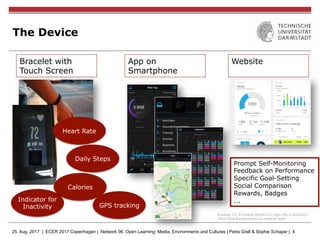
The Device
Bracelet with
Touch Screen
App on
Smartphone
Website
Daily Steps
Heart Rate
Indicator for
Inactivity
Calories
GPS tracking
Bracelet: CC BY-Daniel Bichler2.0) https://flic.kr/p/Dc2VLf
Other fotos &screenshots bx research team
Prompt Self-Monitoring
Feedback on Performance
Specific Goal-Setting
Social Comparison
Rewards, Badges
...
25. Aug. 2017 | ECER 2017 Copenhagen | Network 06. Open Learning: Media, Environments and Cultures | Petra Grell & Sophie Schaper | 5
Literature Review
(start of the project)
Very few articles
Rapp, A., & Cena, F. (2016) – Engaging in personal data
à  Participants considered the act of collecting personal
information burdensome and with no beneficial reward
Connolly, S., Fuchs, S., & Vinkenburg, C. (2011) - Gender-Specifics
à Differences between the work-life balances of men and women
working in academia
Rapp, A., & Cena, F. (2016). Personal informatics for everyday life: How users without prior self-tracking
experience engage with personal data. International Journal of Human-Computer Studies, 94, 1–17.
https://doi.org/10.1016/j.ijhcs.2016.05.006
Connolly, S., Fuchs, S., & Vinkenburg, C. (2011). Work-life balance in academia. Evidence from two
technical universities. In C. Leicht-Scholten, E. Breuer, N. Tulodetzki, & A. Wolffram (Eds.), Going diverse.
Innovative answers to future challenges. Gender and diversity perspectives in science, technology and
business (pp. 175–193). Opladen: Budrich UniPress.
25. Aug. 2017 | ECER 2017 Copenhagen | Network 06. Open Learning: Media, Environments and Cultures | Petra Grell & Sophie Schaper | 6
Literature Review (recent study)
Study on motivational impact of wearable device by Kerner & Goodyear,
published July 2017
„Data from this study demonstrated that though
clear potential exists, healthy lifestyle technologies
negatively impact young people’s motivation
for physical activity. Competition, peer comparison
and social comparison to normative predetermined
targets result in only short-term motivational
effects“ (Kerner & Goodyear 2017, p. 295.)
Charlotte Kerner & Victoria A. Goodyear (2017) The Motivational Impact of Wearable Healthy Lifestyle
Technologies: A Self-determination Perspective on Fitbits With Adolescents, American Journal of Health
Education, 48:5, 287-297, DOI: 10.1080/19325037.2017.1343161
25. Aug. 2017 | ECER 2017 Copenhagen | Network 06. Open Learning: Media, Environments and Cultures | Petra Grell & Sophie Schaper | 7
Research Design
Research Questions
(1)  How do academics perceive and cope with
continuous data feedback on their own behaviour?
(2)  How does the data feedback influence the
perception of oneself and one‘s work-life-balance?
(3)  In which way are actions initiated or deflated
through data feedback and interactions?
2
25. Aug. 2017 | ECER 2017 Copenhagen | Network 06. Open Learning: Media, Environments and Cultures | Petra Grell & Sophie Schaper | 8
Experiment
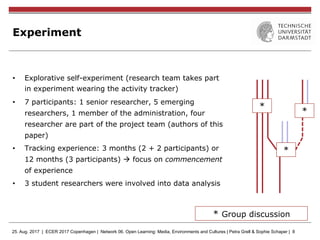
•  Explorative self-experiment (research team takes part
in experiment wearing the activity tracker)
•  7 participants: 1 senior researcher, 5 emerging
researchers, 1 member of the administration, four
researcher are part of the project team (authors of this
paper)
•  Tracking experience: 3 months (2 + 2 participants) or
12 months (3 participants) à focus on commencement
of experience
•  3 student researchers were involved into data analysis
* Group discussion
*
*
*
25. Aug. 2017 | ECER 2017 Copenhagen | Network 06. Open Learning: Media, Environments and Cultures | Petra Grell & Sophie Schaper | 9
Methods
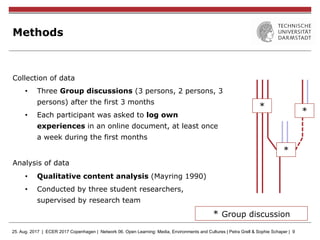
Collection of data
•  Three Group discussions (3 persons, 2 persons, 3
persons) after the first 3 months
•  Each participant was asked to log own
experiences in an online document, at least once
a week during the first months
Analysis of data
•  Qualitative content analysis (Mayring 1990)
•  Conducted by three student researchers,
supervised by research team
* Group discussion
*
*
*
25. Aug. 2017 | ECER 2017 Copenhagen | Network 06. Open Learning: Media, Environments and Cultures | Petra Grell & Sophie Schaper | 10
Findings & Discussion
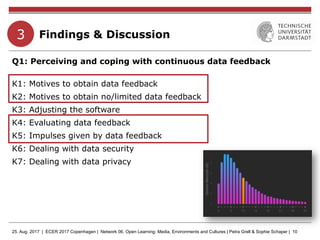
Q1: Perceiving and coping with continuous data feedback
K1: Motives to obtain data feedback
K2: Motives to obtain no/limited data feedback
K3: Adjusting the software
K4: Evaluating data feedback
K5: Impulses given by data feedback
K6: Dealing with data security
K7: Dealing with data privacy
3
25. Aug. 2017 | ECER 2017 Copenhagen | Network 06. Open Learning: Media, Environments and Cultures | Petra Grell & Sophie Schaper | 11
Examples K1/K2:
Data Feedback: Obtaining vs. Not Obtaining
K1-c Enjoyment of Comparison
„I think to compare, generally speaking, that‘s a nice thing. (...) So, you see,
okay. I walked that many steps, how many did you walk? That‘s something that
motivates or encourages me, right?“
"Also sich vergleichen, generell, das finde ich eine schöne Sache (...) So, du siehst, okay. Ich
bin so und so viele Schritte gelaufen, wie viele seid ihr gelaufen? Das ist dann irgendwas,
das motiviert oder das spornt an auch, nicht?" (Interview 3, Zeile 1324-1332)
K2-d No Interest in Comparison
„I really don‘t care who has walked how many steps or does whatever, that
doesn‘t interest me at all.“
„Es ist mir scheiß egal wer wie viele Schritte geht oder sonst was macht, das interessiert mich
einfach überhaupt nicht." (Interview 2, Zeile 100-106)
25. Aug. 2017 | ECER 2017 Copenhagen | Network 06. Open Learning: Media, Environments and Cultures | Petra Grell & Sophie Schaper | 12
Examples K4:
Data is Perceived as: Consistent vs. Non-
consistent
K4-c Data is perceived as non-consistent
„I was struggling with the data and myself at the very beginning, when my heart
frequency was measured and it told me, that my heart rate was 130 bpm when
I simply walk through the office [...] but that can‘t be true.“
“wo ich sozusagen nur mit den Daten und mit mir gerungen habe war ganz am Anfang, als
ich ... diesen Herzfrequenzmesser hatte und der mir gesagt habe, dass ich einen 130er Puls
habe, wenn ich einmal durch das Büro gehe [...] aber das kann doch nicht sein." (Interview
1, Zeile 470-477)
K4-d Data is perceived as consistent
„So when it showed me something, I just assumed, that it was right“
„Also wenn es mir etwas gezeigt hat, dann bin ich einfach davon ausgegangen, dass das
stimmt“ (Interview 3, Zeile 899-902)
25. Aug. 2017 | ECER 2017 Copenhagen | Network 06. Open Learning: Media, Environments and Cultures | Petra Grell & Sophie Schaper | 13
Examples K5:
Data Feedback: Leads to Actions vs. Has No
Effects
K5b – Data feedback leads to actions
„Because of the inactivity indicator and the missing steps [...] I changed my
evening routine. Because I realised how much I laze around in the evening.“
"Aufgrund des Inaktivitätsbalkens und der fehlenden Schritte. [...] Ich habe meine
Abendroutine geändert. Weil mir ist klar geworden wie viel ich einfach rumsitze abends.
(Interview 1, Zeile 889-893)
K5c – Data has no effects
„So with me, it has no effect at all. So when I see it and it tells me ‘Go!’ I just
think: [...] ‘Go yourself’ or something. (Laughter).”
"Also bei mir hat der überhaupt keinen Effekt. Also wenn ich die sehe und dann steht da: Los!
Und dann denke ich mir: [...] Los dich selber oder so. (Lachen).“ (Interview 1, Zeile
931-937)
25. Aug. 2017 | ECER 2017 Copenhagen | Network 06. Open Learning: Media, Environments and Cultures | Petra Grell & Sophie Schaper | 14
Results
Q2: Data feedback influences perception of self/work-life balance
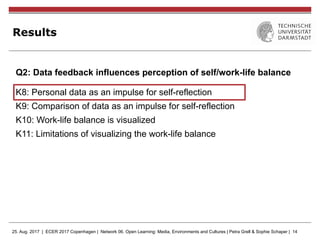
K8: Personal data as an impulse for self-reflection
K9: Comparison of data as an impulse for self-reflection
K10: Work-life balance is visualized
K11: Limitations of visualizing the work-life balance
25. Aug. 2017 | ECER 2017 Copenhagen | Network 06. Open Learning: Media, Environments and Cultures | Petra Grell & Sophie Schaper | 15
Examples K8:
Validation vs. Revision of Self-Image
K8-a Validation of self-image through data feedback
“I always knew that … but I think it’s cool to get the hard facts, to be confronted
with it in that way.”
"Also mir war immer klar, dass ..., aber da finde ich es dann noch einmal ganz cool so die
harten Fakten zu bekommen und das noch einmal so vor Augen geführt zu
bekommen." (Interview 2, Zeile 37-39)
K8-b Revision of self-image through data feedback
“[...] I was totally exhausted after training and thought: I’m so looking forward
to see my statistics tonight! But then it was 5000 steps less than I would have
expected. In either way, very frustrating.”
"[...] und ich war völlig ausgepumpt danach [Training] und dachte mir: Ich freue mich schon
heute Abend auf die Auswertung. Ja, also tatsächlich es war irgendwie 5000 Schritte
weniger als ich vermutet hätte. Auf jeden Fall sehr frustrierend." (Interview 1 Zeile
205-219)
25. Aug. 2017 | ECER 2017 Copenhagen | Network 06. Open Learning: Media, Environments and Cultures | Petra Grell & Sophie Schaper | 16
Results
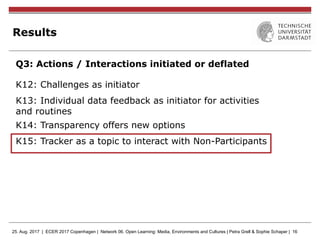
Q3: Actions / Interactions initiated or deflated
K12: Challenges as initiator
K13: Individual data feedback as initiator for activities
and routines
K14: Transparency offers new options
K15: Tracker as a topic to interact with Non-Participants
25. Aug. 2017 | ECER 2017 Copenhagen | Network 06. Open Learning: Media, Environments and Cultures | Petra Grell & Sophie Schaper | 17
Examples K15:
New Dimension – Interaction and
Conflicts with Non-Participants
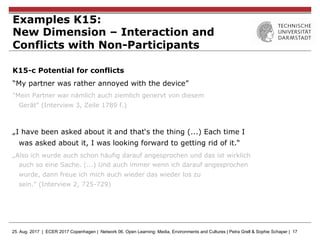
K15-c Potential for conflicts
“My partner was rather annoyed with the device”
"Mein Partner war nämlich auch ziemlich genervt von diesem
Gerät" (Interview 3, Zeile 1789 f.)
„I have been asked about it and that‘s the thing (...) Each time I
was asked about it, I was looking forward to getting rid of it.“
„Also ich wurde auch schon häufig darauf angesprochen und das ist wirklich
auch so eine Sache. (...) Und auch immer wenn ich darauf angesprochen
wurde, dann freue ich mich auch wieder das wieder los zu
sein." (Interview 2, 725-729)
25. Aug. 2017 | ECER 2017 Copenhagen | Network 06. Open Learning: Media, Environments and Cultures | Petra Grell & Sophie Schaper | 18
Conclusion
•  The on-going monitoring and data feedback triggers a
range of divergent impulses and emotions in
individuals: happiness, motivation, annoyance,
frustration, refusal
•  The visibility gives rise to reflect about oneself and
one’s behaviour, also about the technology framing
•  Different coping strategies to deal with social
comparison and (other-directed) goal setting
•  Realising the possibilities of tracking and data analysis
raises awareness for data mining, security, privacy
25. Aug. 2017 | ECER 2017 Copenhagen | Network 06. Open Learning: Media, Environments and Cultures | Petra Grell & Sophie Schaper | 19
Challenges for a Research Framework
Not only an object: Wearable, Smartphone App, further
possibilities of data-mining (and surveillance)
Not only an instrument for individual (and autonomous)
monitoring and data feedback, but a catalyst for social
comparison on different levels (friends, acquaintances,
user collective)
Main Challenge: The technology frames experiences. The
specific (other-directed) framework and goals offer only
limited customization and controllability.
25. Aug. 2017 | ECER 2017 Copenhagen | Network 06. Open Learning: Media, Environments and Cultures | Petra Grell & Sophie Schaper | 20
References (talk & slides)
Appelboom, G.; Yang, A: Christophe, B.A.; Bruce, E.M.; Slomian, J.; Bruyère, O.; Bruce, S.S.; Zacharia, B.E.; Reginster, J-Y.; Connoll, E.S.
(2014) ‘The Promise of Wearable Activity Sensors to Define Patient Recovery’. Journal of Clinical Neuroscience 21, no. 7 (July 2014): 1089–93.
doi:10.1016/j.jocn.2013.12.003.
Buchmayr, M. & Neissl, J. (eds.) Work-Life-Balance & Wissenschaft - Ein Widerspruch? Gender-Diskussion. 5. Wien: Lit Verl., 2006.
Blumer. H. (1976): Methodologische Prinzipien empirischer Wissenschaft. In: Gerdes, K. (Ed.) Explorative Sozialforschung. Stuttgart. p. 41-62
Connolly, S.; Fuchs, S. &je Vinkenburg. (2011) ‘Work-Life Balance in Academia. Evidence from Two Technical Universities.’ In Going Diverse.
Innovative Answers to Future Challenges. Gender and Diversity Perspectives in Science, Technology and Business, edited by Carmen Leicht-
Scholten, Elke Breuer, Nathalie Tulodetzki, and Andrea Wolffram, 175–93. Opladen: Budrich UniPress, 2011.
Dute, D.J., Bemelmans, W.J.E., Breda, J. (2016): Using Mobile Apps to Promote a Healthy Lifestyle Among Adolescents and Students: A Review of
the Theoretical Basis and Lessons Learned. JMIR Mhealth Uhealth 2016;4(2):e39, DOI: 10.2196/mhealth.3559
Ellis, C.; Adams, T. E. & Bochner, A.P. (2010). Autoethnography: An Overview. Forum Qualitative Sozialforschung / Forum: Qualitative Social
Research, 12(1), Art. 10.
Glaser, B. G.; Strauss, A.L. (1967): The Discovery of Grounded Theory. Strategies for Qualitative Research. Aldine, Chicago IL
Kleinschmidt, C. (2009). ‘Die Gesunde Hochschule.’ DUZ : Unabhängige Deutsche Universitätszeitung. Magazin 65, no. 10 (2009): 9–11.
Kerner, C. & Goodyear, V. A. (2017) The Motivational Impact of Wearable Healthy Lifestyle Technologies: A Self-determination Perspective on
Fitbits With Adolescents, American Journal of Health Education, 48:5, 287-297, DOI: 10.1080/19325037.2017.1343161
Loos, P.; Schäfer, B. (2001): Das Gruppendiskussionsverfahren. Opladen.
Mayring, P. (2000). Qualitative Content Analysis. Forum Qualitative Sozialforschung / Forum: Qualitative Social Research, 1(2). Retrieved from
http://www.qualitative-research.net/index.php/fqs/article/view/1089
Müller, K.; Krieger, C.; Suchert, V.; Johannsen, M.; Sauer, I.; Hanewinkel, R.; Isensee, B. (2015). ‘Mit Schrittzählern Und Parally Zu Mehr
Bewegung. Das Eigene Bewegungsverhalten Bewusst Machen Und Die Alltagsaktivität Steigern.’ Sportpädagogik 39, no. 1 (2015): 10–13.
Rapp, A., & Cena, F. (2016). Personal informatics for everyday life: How users without prior self-tracking experience engage with personal data.
International Journal of Human-Computer Studies, 94, 1–17. https://doi.org/10.1016/j.ijhcs.2016.05.006
25. Aug. 2017 | ECER 2017 Copenhagen | Network 06. Open Learning: Media, Environments and Cultures | Petra Grell & Sophie Schaper | 21
Thank you!
Petra Grell
@PGrell (Twitter)
http://de.slideshare.net/Pgrell
p.grell@apaed.tu-darmstadt.de
Sophie Schaper
@Tarzanlieberin (Twitter)
s.schaper@apaed.tu-darmstadt.de
25. Aug. 2017 | ECER 2017 Copenhagen | Network 06. Open Learning: Media, Environments and Cultures | Petra Grell & Sophie Schaper | 22
Annex
25. Aug. 2017 | ECER 2017 Copenhagen | Network 06. Open Learning: Media, Environments and Cultures | Petra Grell & Sophie Schaper | 23
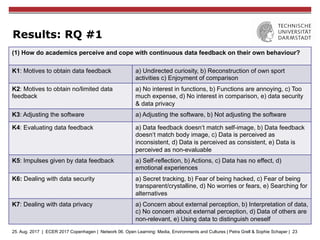
Results: RQ #1
(1) How do academics perceive and cope with continuous data feedback on their own behaviour?
K1: Motives to obtain data feedback a) Undirected curiosity, b) Reconstruction of own sport
activities c) Enjoyment of comparison
K2: Motives to obtain no/limited data
feedback
a) No interest in functions, b) Functions are annoying, c) Too
much expense, d) No interest in comparison, e) data security
& data privacy
K3: Adjusting the software a) Adjusting the software, b) Not adjusting the software
K4: Evaluating data feedback a) Data feedback doesn‘t match self-image, b) Data feedback
doesn‘t match body image, c) Data is perceived as
inconsistent, d) Data is perceived as consistent, e) Data is
perceived as non-evaluable
K5: Impulses given by data feedback a) Self-reflection, b) Actions, c) Data has no effect, d)
emotional experiences
K6: Dealing with data security a) Secret tracking, b) Fear of being hacked, c) Fear of being
transparent/crystalline, d) No worries or fears, e) Searching for
alternatives
K7: Dealing with data privacy a) Concern about external perception, b) Interpretation of data,
c) No concern about external perception, d) Data of others are
non-relevant, e) Using data to distinguish oneself
25. Aug. 2017 | ECER 2017 Copenhagen | Network 06. Open Learning: Media, Environments and Cultures | Petra Grell & Sophie Schaper | 24
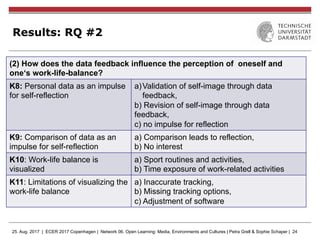
Results: RQ #2
(2) How does the data feedback influence the perception of oneself and
one‘s work-life-balance?
K8: Personal data as an impulse
for self-reflection
a) Validation of self-image through data
feedback,
b) Revision of self-image through data
feedback,
c) no impulse for reflection
K9: Comparison of data as an
impulse for self-reflection
a) Comparison leads to reflection,
b) No interest
K10: Work-life balance is
visualized
a) Sport routines and activities,
b) Time exposure of work-related activities
K11: Limitations of visualizing the
work-life balance
a) Inaccurate tracking,
b) Missing tracking options,
c) Adjustment of software
25. Aug. 2017 | ECER 2017 Copenhagen | Network 06. Open Learning: Media, Environments and Cultures | Petra Grell & Sophie Schaper | 25
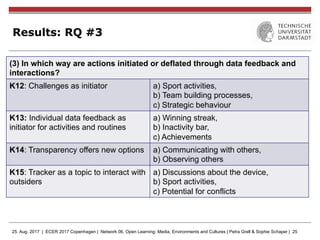
Results: RQ #3
(3) In which way are actions initiated or deflated through data feedback and
interactions?
K12: Challenges as initiator a) Sport activities,
b) Team building processes,
c) Strategic behaviour
K13: Individual data feedback as
initiator for activities and routines
a) Winning streak,
b) Inactivity bar,
c) Achievements
K14: Transparency offers new options a) Communicating with others,
b) Observing others
K15: Tracker as a topic to interact with
outsiders
a) Discussions about the device,
b) Sport activities,
c) Potential for conflicts

ECER 2017 Grell & Schaper TRY Self-Tracking Experiences Academics

  • 1.
    25. Aug. 2017| ECER 2017 Copenhagen | Network 06. Open Learning: Media, Environments and Cultures | Petra Grell & Sophie Schaper | 1 ECER 2017, Copenhagen Prof. Dr. Petra Grell & Sophie Schaper M.A. How Self-Tracking Experiences Affect the Perception of Work-Life-Balance of Academics CC BY-Daniel Bichler2.0) https://flic.kr/p/Dc2VLf CC BY-home thods 2.0) https://flic.kr/p/RyVjuq
  • 2.
    25. Aug. 2017| ECER 2017 Copenhagen | Network 06. Open Learning: Media, Environments and Cultures | Petra Grell & Sophie Schaper | 2 Introduction Self-Tracking is easy and popular Our Question: Does it have an influence on people’s life, habits, attitudes? Self-Experiment: We are academics. A healthy lifestyle (work-life-balance, physical activity, sports) is challenging à How can the usage of an activity tracker device transform the perception of oneself and one’s work-life-balance? CC BY-home thods 2.0) https://flic.kr/p/RyVjuq
  • 3.
    25. Aug. 2017| ECER 2017 Copenhagen | Network 06. Open Learning: Media, Environments and Cultures | Petra Grell & Sophie Schaper | 3 1 2 3 The Device & Brief Literature Review Research Design Findings & Discussion
  • 4.
    25. Aug. 2017| ECER 2017 Copenhagen | Network 06. Open Learning: Media, Environments and Cultures | Petra Grell & Sophie Schaper | 4 The Device Bracelet with Touch Screen App on Smartphone Website Daily Steps Heart Rate Indicator for Inactivity Calories GPS tracking Bracelet: CC BY-Daniel Bichler2.0) https://flic.kr/p/Dc2VLf Other fotos &screenshots bx research team Prompt Self-Monitoring Feedback on Performance Specific Goal-Setting Social Comparison Rewards, Badges ...
  • 5.
    25. Aug. 2017| ECER 2017 Copenhagen | Network 06. Open Learning: Media, Environments and Cultures | Petra Grell & Sophie Schaper | 5 Literature Review (start of the project) Very few articles Rapp, A., & Cena, F. (2016) – Engaging in personal data à  Participants considered the act of collecting personal information burdensome and with no beneficial reward Connolly, S., Fuchs, S., & Vinkenburg, C. (2011) - Gender-Specifics à Differences between the work-life balances of men and women working in academia Rapp, A., & Cena, F. (2016). Personal informatics for everyday life: How users without prior self-tracking experience engage with personal data. International Journal of Human-Computer Studies, 94, 1–17. https://doi.org/10.1016/j.ijhcs.2016.05.006 Connolly, S., Fuchs, S., & Vinkenburg, C. (2011). Work-life balance in academia. Evidence from two technical universities. In C. Leicht-Scholten, E. Breuer, N. Tulodetzki, & A. Wolffram (Eds.), Going diverse. Innovative answers to future challenges. Gender and diversity perspectives in science, technology and business (pp. 175–193). Opladen: Budrich UniPress.
  • 6.
    25. Aug. 2017| ECER 2017 Copenhagen | Network 06. Open Learning: Media, Environments and Cultures | Petra Grell & Sophie Schaper | 6 Literature Review (recent study) Study on motivational impact of wearable device by Kerner & Goodyear, published July 2017 „Data from this study demonstrated that though clear potential exists, healthy lifestyle technologies negatively impact young people’s motivation for physical activity. Competition, peer comparison and social comparison to normative predetermined targets result in only short-term motivational effects“ (Kerner & Goodyear 2017, p. 295.) Charlotte Kerner & Victoria A. Goodyear (2017) The Motivational Impact of Wearable Healthy Lifestyle Technologies: A Self-determination Perspective on Fitbits With Adolescents, American Journal of Health Education, 48:5, 287-297, DOI: 10.1080/19325037.2017.1343161
  • 7.
    25. Aug. 2017| ECER 2017 Copenhagen | Network 06. Open Learning: Media, Environments and Cultures | Petra Grell & Sophie Schaper | 7 Research Design Research Questions (1)  How do academics perceive and cope with continuous data feedback on their own behaviour? (2)  How does the data feedback influence the perception of oneself and one‘s work-life-balance? (3)  In which way are actions initiated or deflated through data feedback and interactions? 2
  • 8.
    25. Aug. 2017| ECER 2017 Copenhagen | Network 06. Open Learning: Media, Environments and Cultures | Petra Grell & Sophie Schaper | 8 Experiment •  Explorative self-experiment (research team takes part in experiment wearing the activity tracker) •  7 participants: 1 senior researcher, 5 emerging researchers, 1 member of the administration, four researcher are part of the project team (authors of this paper) •  Tracking experience: 3 months (2 + 2 participants) or 12 months (3 participants) à focus on commencement of experience •  3 student researchers were involved into data analysis * Group discussion * * *
  • 9.
    25. Aug. 2017| ECER 2017 Copenhagen | Network 06. Open Learning: Media, Environments and Cultures | Petra Grell & Sophie Schaper | 9 Methods Collection of data •  Three Group discussions (3 persons, 2 persons, 3 persons) after the first 3 months •  Each participant was asked to log own experiences in an online document, at least once a week during the first months Analysis of data •  Qualitative content analysis (Mayring 1990) •  Conducted by three student researchers, supervised by research team * Group discussion * * *
  • 10.
    25. Aug. 2017| ECER 2017 Copenhagen | Network 06. Open Learning: Media, Environments and Cultures | Petra Grell & Sophie Schaper | 10 Findings & Discussion Q1: Perceiving and coping with continuous data feedback K1: Motives to obtain data feedback K2: Motives to obtain no/limited data feedback K3: Adjusting the software K4: Evaluating data feedback K5: Impulses given by data feedback K6: Dealing with data security K7: Dealing with data privacy 3
  • 11.
    25. Aug. 2017| ECER 2017 Copenhagen | Network 06. Open Learning: Media, Environments and Cultures | Petra Grell & Sophie Schaper | 11 Examples K1/K2: Data Feedback: Obtaining vs. Not Obtaining K1-c Enjoyment of Comparison „I think to compare, generally speaking, that‘s a nice thing. (...) So, you see, okay. I walked that many steps, how many did you walk? That‘s something that motivates or encourages me, right?“ "Also sich vergleichen, generell, das finde ich eine schöne Sache (...) So, du siehst, okay. Ich bin so und so viele Schritte gelaufen, wie viele seid ihr gelaufen? Das ist dann irgendwas, das motiviert oder das spornt an auch, nicht?" (Interview 3, Zeile 1324-1332) K2-d No Interest in Comparison „I really don‘t care who has walked how many steps or does whatever, that doesn‘t interest me at all.“ „Es ist mir scheiß egal wer wie viele Schritte geht oder sonst was macht, das interessiert mich einfach überhaupt nicht." (Interview 2, Zeile 100-106)
  • 12.
    25. Aug. 2017| ECER 2017 Copenhagen | Network 06. Open Learning: Media, Environments and Cultures | Petra Grell & Sophie Schaper | 12 Examples K4: Data is Perceived as: Consistent vs. Non- consistent K4-c Data is perceived as non-consistent „I was struggling with the data and myself at the very beginning, when my heart frequency was measured and it told me, that my heart rate was 130 bpm when I simply walk through the office [...] but that can‘t be true.“ “wo ich sozusagen nur mit den Daten und mit mir gerungen habe war ganz am Anfang, als ich ... diesen Herzfrequenzmesser hatte und der mir gesagt habe, dass ich einen 130er Puls habe, wenn ich einmal durch das Büro gehe [...] aber das kann doch nicht sein." (Interview 1, Zeile 470-477) K4-d Data is perceived as consistent „So when it showed me something, I just assumed, that it was right“ „Also wenn es mir etwas gezeigt hat, dann bin ich einfach davon ausgegangen, dass das stimmt“ (Interview 3, Zeile 899-902)
  • 13.
    25. Aug. 2017| ECER 2017 Copenhagen | Network 06. Open Learning: Media, Environments and Cultures | Petra Grell & Sophie Schaper | 13 Examples K5: Data Feedback: Leads to Actions vs. Has No Effects K5b – Data feedback leads to actions „Because of the inactivity indicator and the missing steps [...] I changed my evening routine. Because I realised how much I laze around in the evening.“ "Aufgrund des Inaktivitätsbalkens und der fehlenden Schritte. [...] Ich habe meine Abendroutine geändert. Weil mir ist klar geworden wie viel ich einfach rumsitze abends. (Interview 1, Zeile 889-893) K5c – Data has no effects „So with me, it has no effect at all. So when I see it and it tells me ‘Go!’ I just think: [...] ‘Go yourself’ or something. (Laughter).” "Also bei mir hat der überhaupt keinen Effekt. Also wenn ich die sehe und dann steht da: Los! Und dann denke ich mir: [...] Los dich selber oder so. (Lachen).“ (Interview 1, Zeile 931-937)
  • 14.
    25. Aug. 2017| ECER 2017 Copenhagen | Network 06. Open Learning: Media, Environments and Cultures | Petra Grell & Sophie Schaper | 14 Results Q2: Data feedback influences perception of self/work-life balance K8: Personal data as an impulse for self-reflection K9: Comparison of data as an impulse for self-reflection K10: Work-life balance is visualized K11: Limitations of visualizing the work-life balance
  • 15.
    25. Aug. 2017| ECER 2017 Copenhagen | Network 06. Open Learning: Media, Environments and Cultures | Petra Grell & Sophie Schaper | 15 Examples K8: Validation vs. Revision of Self-Image K8-a Validation of self-image through data feedback “I always knew that … but I think it’s cool to get the hard facts, to be confronted with it in that way.” "Also mir war immer klar, dass ..., aber da finde ich es dann noch einmal ganz cool so die harten Fakten zu bekommen und das noch einmal so vor Augen geführt zu bekommen." (Interview 2, Zeile 37-39) K8-b Revision of self-image through data feedback “[...] I was totally exhausted after training and thought: I’m so looking forward to see my statistics tonight! But then it was 5000 steps less than I would have expected. In either way, very frustrating.” "[...] und ich war völlig ausgepumpt danach [Training] und dachte mir: Ich freue mich schon heute Abend auf die Auswertung. Ja, also tatsächlich es war irgendwie 5000 Schritte weniger als ich vermutet hätte. Auf jeden Fall sehr frustrierend." (Interview 1 Zeile 205-219)
  • 16.
    25. Aug. 2017| ECER 2017 Copenhagen | Network 06. Open Learning: Media, Environments and Cultures | Petra Grell & Sophie Schaper | 16 Results Q3: Actions / Interactions initiated or deflated K12: Challenges as initiator K13: Individual data feedback as initiator for activities and routines K14: Transparency offers new options K15: Tracker as a topic to interact with Non-Participants
  • 17.
    25. Aug. 2017| ECER 2017 Copenhagen | Network 06. Open Learning: Media, Environments and Cultures | Petra Grell & Sophie Schaper | 17 Examples K15: New Dimension – Interaction and Conflicts with Non-Participants K15-c Potential for conflicts “My partner was rather annoyed with the device” "Mein Partner war nämlich auch ziemlich genervt von diesem Gerät" (Interview 3, Zeile 1789 f.) „I have been asked about it and that‘s the thing (...) Each time I was asked about it, I was looking forward to getting rid of it.“ „Also ich wurde auch schon häufig darauf angesprochen und das ist wirklich auch so eine Sache. (...) Und auch immer wenn ich darauf angesprochen wurde, dann freue ich mich auch wieder das wieder los zu sein." (Interview 2, 725-729)
  • 18.
    25. Aug. 2017| ECER 2017 Copenhagen | Network 06. Open Learning: Media, Environments and Cultures | Petra Grell & Sophie Schaper | 18 Conclusion •  The on-going monitoring and data feedback triggers a range of divergent impulses and emotions in individuals: happiness, motivation, annoyance, frustration, refusal •  The visibility gives rise to reflect about oneself and one’s behaviour, also about the technology framing •  Different coping strategies to deal with social comparison and (other-directed) goal setting •  Realising the possibilities of tracking and data analysis raises awareness for data mining, security, privacy
  • 19.
    25. Aug. 2017| ECER 2017 Copenhagen | Network 06. Open Learning: Media, Environments and Cultures | Petra Grell & Sophie Schaper | 19 Challenges for a Research Framework Not only an object: Wearable, Smartphone App, further possibilities of data-mining (and surveillance) Not only an instrument for individual (and autonomous) monitoring and data feedback, but a catalyst for social comparison on different levels (friends, acquaintances, user collective) Main Challenge: The technology frames experiences. The specific (other-directed) framework and goals offer only limited customization and controllability.
  • 20.
    25. Aug. 2017| ECER 2017 Copenhagen | Network 06. Open Learning: Media, Environments and Cultures | Petra Grell & Sophie Schaper | 20 References (talk & slides) Appelboom, G.; Yang, A: Christophe, B.A.; Bruce, E.M.; Slomian, J.; Bruyère, O.; Bruce, S.S.; Zacharia, B.E.; Reginster, J-Y.; Connoll, E.S. (2014) ‘The Promise of Wearable Activity Sensors to Define Patient Recovery’. Journal of Clinical Neuroscience 21, no. 7 (July 2014): 1089–93. doi:10.1016/j.jocn.2013.12.003. Buchmayr, M. & Neissl, J. (eds.) Work-Life-Balance & Wissenschaft - Ein Widerspruch? Gender-Diskussion. 5. Wien: Lit Verl., 2006. Blumer. H. (1976): Methodologische Prinzipien empirischer Wissenschaft. In: Gerdes, K. (Ed.) Explorative Sozialforschung. Stuttgart. p. 41-62 Connolly, S.; Fuchs, S. &je Vinkenburg. (2011) ‘Work-Life Balance in Academia. Evidence from Two Technical Universities.’ In Going Diverse. Innovative Answers to Future Challenges. Gender and Diversity Perspectives in Science, Technology and Business, edited by Carmen Leicht- Scholten, Elke Breuer, Nathalie Tulodetzki, and Andrea Wolffram, 175–93. Opladen: Budrich UniPress, 2011. Dute, D.J., Bemelmans, W.J.E., Breda, J. (2016): Using Mobile Apps to Promote a Healthy Lifestyle Among Adolescents and Students: A Review of the Theoretical Basis and Lessons Learned. JMIR Mhealth Uhealth 2016;4(2):e39, DOI: 10.2196/mhealth.3559 Ellis, C.; Adams, T. E. & Bochner, A.P. (2010). Autoethnography: An Overview. Forum Qualitative Sozialforschung / Forum: Qualitative Social Research, 12(1), Art. 10. Glaser, B. G.; Strauss, A.L. (1967): The Discovery of Grounded Theory. Strategies for Qualitative Research. Aldine, Chicago IL Kleinschmidt, C. (2009). ‘Die Gesunde Hochschule.’ DUZ : Unabhängige Deutsche Universitätszeitung. Magazin 65, no. 10 (2009): 9–11. Kerner, C. & Goodyear, V. A. (2017) The Motivational Impact of Wearable Healthy Lifestyle Technologies: A Self-determination Perspective on Fitbits With Adolescents, American Journal of Health Education, 48:5, 287-297, DOI: 10.1080/19325037.2017.1343161 Loos, P.; Schäfer, B. (2001): Das Gruppendiskussionsverfahren. Opladen. Mayring, P. (2000). Qualitative Content Analysis. Forum Qualitative Sozialforschung / Forum: Qualitative Social Research, 1(2). Retrieved from http://www.qualitative-research.net/index.php/fqs/article/view/1089 Müller, K.; Krieger, C.; Suchert, V.; Johannsen, M.; Sauer, I.; Hanewinkel, R.; Isensee, B. (2015). ‘Mit Schrittzählern Und Parally Zu Mehr Bewegung. Das Eigene Bewegungsverhalten Bewusst Machen Und Die Alltagsaktivität Steigern.’ Sportpädagogik 39, no. 1 (2015): 10–13. Rapp, A., & Cena, F. (2016). Personal informatics for everyday life: How users without prior self-tracking experience engage with personal data. International Journal of Human-Computer Studies, 94, 1–17. https://doi.org/10.1016/j.ijhcs.2016.05.006
  • 21.
    25. Aug. 2017| ECER 2017 Copenhagen | Network 06. Open Learning: Media, Environments and Cultures | Petra Grell & Sophie Schaper | 21 Thank you! Petra Grell @PGrell (Twitter) http://de.slideshare.net/Pgrell p.grell@apaed.tu-darmstadt.de Sophie Schaper @Tarzanlieberin (Twitter) s.schaper@apaed.tu-darmstadt.de
  • 22.
    25. Aug. 2017| ECER 2017 Copenhagen | Network 06. Open Learning: Media, Environments and Cultures | Petra Grell & Sophie Schaper | 22 Annex
  • 23.
    25. Aug. 2017| ECER 2017 Copenhagen | Network 06. Open Learning: Media, Environments and Cultures | Petra Grell & Sophie Schaper | 23 Results: RQ #1 (1) How do academics perceive and cope with continuous data feedback on their own behaviour? K1: Motives to obtain data feedback a) Undirected curiosity, b) Reconstruction of own sport activities c) Enjoyment of comparison K2: Motives to obtain no/limited data feedback a) No interest in functions, b) Functions are annoying, c) Too much expense, d) No interest in comparison, e) data security & data privacy K3: Adjusting the software a) Adjusting the software, b) Not adjusting the software K4: Evaluating data feedback a) Data feedback doesn‘t match self-image, b) Data feedback doesn‘t match body image, c) Data is perceived as inconsistent, d) Data is perceived as consistent, e) Data is perceived as non-evaluable K5: Impulses given by data feedback a) Self-reflection, b) Actions, c) Data has no effect, d) emotional experiences K6: Dealing with data security a) Secret tracking, b) Fear of being hacked, c) Fear of being transparent/crystalline, d) No worries or fears, e) Searching for alternatives K7: Dealing with data privacy a) Concern about external perception, b) Interpretation of data, c) No concern about external perception, d) Data of others are non-relevant, e) Using data to distinguish oneself
  • 24.
    25. Aug. 2017| ECER 2017 Copenhagen | Network 06. Open Learning: Media, Environments and Cultures | Petra Grell & Sophie Schaper | 24 Results: RQ #2 (2) How does the data feedback influence the perception of oneself and one‘s work-life-balance? K8: Personal data as an impulse for self-reflection a) Validation of self-image through data feedback, b) Revision of self-image through data feedback, c) no impulse for reflection K9: Comparison of data as an impulse for self-reflection a) Comparison leads to reflection, b) No interest K10: Work-life balance is visualized a) Sport routines and activities, b) Time exposure of work-related activities K11: Limitations of visualizing the work-life balance a) Inaccurate tracking, b) Missing tracking options, c) Adjustment of software
  • 25.
    25. Aug. 2017| ECER 2017 Copenhagen | Network 06. Open Learning: Media, Environments and Cultures | Petra Grell & Sophie Schaper | 25 Results: RQ #3 (3) In which way are actions initiated or deflated through data feedback and interactions? K12: Challenges as initiator a) Sport activities, b) Team building processes, c) Strategic behaviour K13: Individual data feedback as initiator for activities and routines a) Winning streak, b) Inactivity bar, c) Achievements K14: Transparency offers new options a) Communicating with others, b) Observing others K15: Tracker as a topic to interact with outsiders a) Discussions about the device, b) Sport activities, c) Potential for conflicts