EN EN
EUROPEAN
COMMISSION
Brussels, 14.3.2014
SWD(2014) 106 final
COMMISSION STAFF WORKING DOCUMENT
Action Plan on HIV/AIDS in the EU and neighbouring countries:
2014-2016
1
COMMISSION STAFF WORKING DOCUMENT
Action Plan on HIV/AIDS in the EU and neighbouring countries:
2014-2016
Contents
1.) HIV/AIDS in the EU and neighbouring countries.........................................................................2
2.) Commission Communication combating HIV/AIDS and action plan ............................................2
3.) Achievements of the EU policy framework on HIV/AIDS and the need for an increased focus ....3
4.) Prolonging the Action Plan on HIV/AIDS....................................................................................4
2
1.) HIV/AIDS in the EU and neighbouring countries
HIV infection remains of major public health importance in the EU and neighbouring
countries. Contrary to the global trend, which shows an overall decline in new infections, the
number of newly reported HIV cases in Europe is increasing. In 2012, more than 131.000 new
HIV infections were reported in Europe and Central Asia, an 8% increase from 20111
. A total
of 29.000 cases were reported in the European Union and European Economic Area
(EU/EEA) a 1% increase from 2011 and 102.000 cases from countries in Eastern Europe and
Central Asia (a 9% increase from 2011).
The main HIV transmission mechanisms differ depending on the region. In the EU/EEA HIV
is predominantly transmitted among men who have sex with men (MSM). HIV transmission
through heterosexual contacts plays also an important role. In neighbouring countries the
main transmission modes are heterosexual contacts, followed by injecting drug use (IDU).
Besides MSM and IDUs other vulnerable groups at high risk of acquiring HIV infections
include migrants and mobile populations, sex workers and prisoners.
Early diagnosis followed by counselling and treatment as well as preventive strategies play a
crucial role in reducing the spread of the disease. Recent evidence suggests that early
treatment has significant effects in terms of reducing the risk of further transmission as well as
reducing the morbidity and mortality related to HIV/AIDS. However, in the EU/EEA 49% of
people living with HIV/AIDS are diagnosed late in the course of the infection and the
percentage is even higher in Eastern Europe and Central Asia. In addition, significant gaps in
coverage of prevention measures and access to antiretroviral therapy remain in some eastern
European countries. In several countries the high number of HIV/AIDS co-infections, such as
tuberculosis, viral hepatitis, and sexually transmitted diseases other than HIV/AIDS are
another serious concern.
2.) Commission Communication combating HIV/AIDS and action plan
The Commission Communication on combating HIV/AIDS in the European Union and
neighbouring countries, 2009-2013 2
provides a policy instrument to complement national
policies on HIV/AIDS on European level and has been the basis for EU action since 2009.
The overall objectives of the Communication are: (i) to contribute to reducing new HIV
infections across all European countries by 2013, (ii) to improve access to prevention,
treatment, care and support and (iii) improving the quality of life of people living with,
affected by or most vulnerable to HIV/AIDS in the European Union and neighbouring
countries.
The Communication is complemented by an operational action plan that contains 50 actions,
which are structured in the following six key issue areas: (1) Politics, policies and
involvement of civil society, wider society and stakeholders, (2) Prevention, (3) Priority
regions, (4) Priority groups, (5) Improving the knowledge, (6) Monitoring and evaluation.
The action plan presented an initial set of actions arising from consultation with Commission
services and external stakeholders, to be further developed along the lines of the political
1
European Centre for Disease Prevention and Control/WHO Regional Office for Europe. HIV/AIDS
surveillance in Europe 2012. Stockholm; 2013
2
COM(2009) 569 final
3
actions presented in the Communication in cooperation with the HIV/AIDS Think Tank, the
Civil Society Forum and external stakeholders.
Funding for the implementation of the Communication and action plan is provided through a
range of mechanisms and instruments. These include the EU Health Programme, the EU
Framework Programme for Research and Innovation, the Global Fund to Fight AIDS,
Tuberculosis and Malaria, to which the EU is a major contributor, as well as EU Structural
Funds, the Development Cooperation Instrument and the European Neighbourhood and
Partnership Instrument.
3.) Achievements of the EU policy framework on HIV/AIDS and the need for an
increased focus
Prime responsibility for protecting and improving the health of their citizens rests with the EU
Member States and the neighbouring countries. However, Article 168 of the Treaty on the
Functioning of the European Union explicitly acknowledges that Union action shall
complement national policies, and shall be directed towards improving public health,
preventing physical and mental illness and diseases, and obviating sources of danger to
physical and mental health. As HIV/AIDS is a communicable disease it needs to be addressed
by coordinating the efforts of national governments.
Upon request of the European Commission, the European Centre for Disease Prevention and
Control (ECDC) prepared a monitoring report on the implementation of the Commission
Communication and Action Plan for combating HIV/AIDS in 20133
. The report highlights
several achievements of the EU policy framework. For instance the Communication was
identified as an important tool for galvanizing political leadership, which was instrumental in
keeping HIV/AIDS on the agenda and has been used by civil society to frame debate at
regional and national levels. The Think Tank and Civil Society Forum proved to be valuable
platforms for policy dialogue and exchange of information and experience, and helped to
promote Europe-wide action and effective communication.
Financial inputs to support the objectives of the Communication and action plan are
considered to amount to approximately EUR 57.5 million annually. This funding contributed
to the development of new treatments and prevention technologies through the EU
Framework Programme for Research and Innovation, and supported the scaling up of HIV-
related services in the most affected Member States, neighbourhood countries and the Russian
Federation via Commission funding to the Global Fund. The EU Health Programme helped to
strengthen national HIV responses focusing on populations most at risk, such as targeted
prevention services and development of better approaches to service delivery for these
population groups. Substantial improvements were also achieved in relation to
epidemiological surveillance of HIV/AIDS and TB co-infection, and data reporting rates
could be significantly enhanced. In Eastern Europe and Russia capacity building of non-state
actors in the field of HIV has been supported through the Development Cooperation
Instrument.
Furthermore, the report identifies additional areas requiring continued attention and areas
where progress has been less pronounced. Amongst others these include: keeping HIV/AIDS
3
European Centre for Disease Prevention and Control. Monitoring implementation of the European Commission
Communication and Action Plan for combating HIV/AIDS in the EU and neighbouring countries, 2009-2013.
Final report Stockholm, 2013.
4
visibly high on the political agenda, tackling discrimination in relation to HIV/AIDS,
achieving universal access to voluntary testing, treatment and care, implementation of harm
reduction measures, and strengthening of behavioural surveillance. In May 2013 the high-
level meeting on HIV and Human Rights "Right to health, right to life”, which was jointly
organised by the European Commission and UNAIDS recognized the need for a continued
and renewed commitment by the European Commission to keep HIV/AIDS high on the
political agenda. The meeting also identified important areas addressed in the Communication
and the action plan, which require further attention, and pointed towards new developments,
which may warrant consideration in the future. Building on these findings, the HIV/AIDS
Civil Society Forum stressed the importance of continued attention to certain critical aspects
of HIV/AIDS policies and advocated the need for further action on HIV/AIDS.
This Staff Working Document prolongs the action plan thus providing continuity in EU
Action beyond 2013. An independent external evaluation of the Communication and action
plan is on-going, and due to be concluded in spring 2014. The results will contribute to the
consideration of options for a possible future EU policy framework on HIV/AIDS.
4.) Prolonging the Action Plan on HIV/AIDS
A consultation process was carried out from August to November 2013, involving
Commission services, the HIV/AIDS Think Tank, the Civil Society Forum, as well as WHO
and UNAIDS. The suggestions and comments of most respondents converged around several
key issues, which could be clustered into two groups.
Some issues and actions which are already addressed in the action plan require in particular
continued and/or increased focus and attention in order to reach the objectives of the
Communication. These include continued political leadership, addressing stigma and
discrimination, treatment as prevention, as well as continued and improved attention to co-
infections.
The Communication explicitly mentions political leadership as an important asset in the
fight against HIV/AIDS. Political leadership helps to keep HIV/AIDS high on the political
agenda, and has assisted civil society to frame debate at regional and national levels.
Particularly political support at national and regional level should be further encouraged, for
instance through existing policy dialogues between the EU (European Commission) and
neighbouring countries.
One issue requiring greater attention is the need to address stigma and discrimination,
including legal barriers that impede measures to fight HIV/AIDS. Given the limited EU
competence in this field the Commission will work closely with civil society and Member
States to achieve progress. In organising the high level meeting on HIV and Human Rights, as
well as the workshop on “Improving Access and Combating Discrimination in Healthcare
with a focus on vulnerable groups”4
, the Commission is already taking action. Building on
these events a high-level meeting on access and antidiscrimination in health entitled "Health
in Europe – making it fairer" is scheduled to take place in March 2014.
HIV/AIDS co-infections such as tuberculosis (TB) and viral hepatitis are amid the leading
causes of death for people living with HIV, particularly among drug users. For instance HIV
is a major risk factor for developing TB, and TB is responsible for more than a quarter of
4
Within the Framework of the European Health Forum Gastein 2013
5
deaths among people living with HIV.5
Particularly in Eastern European countries efforts
need to be continued to increase integrated prevention and treatment measures such as access
to harm reduction methods, and antiretroviral treatment, particularly in prisons.
An increasing body of evidence confirms that treatment is effective in preventing HIV
transmission, particularly in relation to heterosexual transmission6
. This underlines not only
the need for the strategic use of treatment, but also further increases the importance of early
and increased testing particularly amongst high risk groups. These changes are for instance
reflected in the consolidated WHO guidelines on the use of antiretroviral drugs for treating
and preventing HIV infection, which were released in June 2013, and should inform practice
in Member States and neighbouring countries.
Finally, there is the need to stay aligned with regional action frameworks to facilitate
synergies and maximise impact. For instance in 2011 WHO endorsed its European Action
Plan for HIV/AIDS, 2012-2015, and currently the Global Fund is developing a Strategy on
HIV/AIDS for Eastern Europe and Central Asia.
The consultation process also identified a number of other issues such as the need to provide
targeted support to additional populations at risk, the development of integrated strategies to
address HIV/AIDS and other sexually transmitted diseases, or the need to consider addressing
other co-morbidities, in addition to TB and Hepatitis. These issues require further reflection
and monitoring and will be further considered in discussions on a future EU policy framework
on HIV/AIDS.
Financing of specific actions contained in this action plan will be subject to final approval of
the Health Programme 2014-2020, and implementing decisions within the annual work plans.
As such, the prolongation will not have any budgetary impact. The research objectives of the
action plan will also be funded through the next EU programme for research and innovation,
Horizon 2020, which was formally adopted in November 2013.
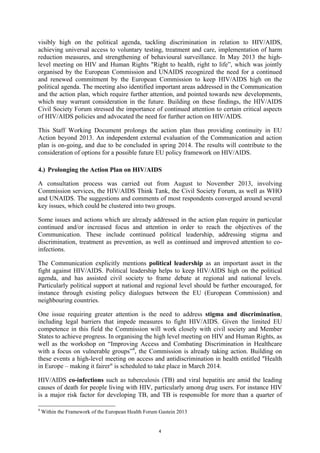
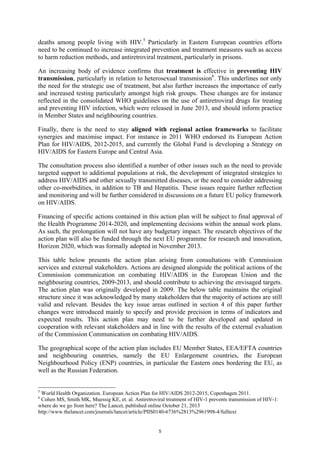
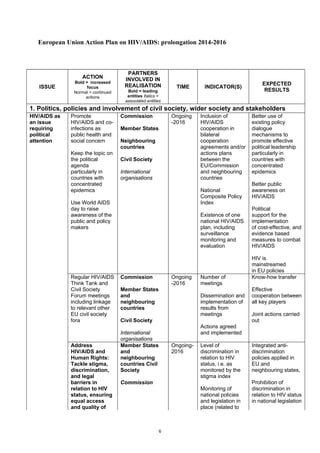
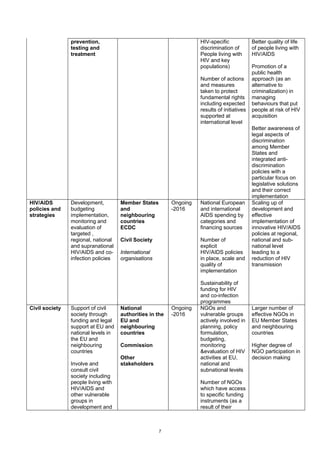
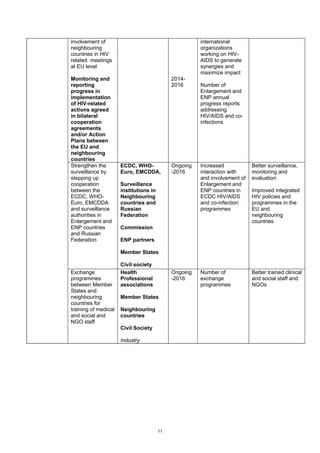
This table below presents the action plan arising from consultations with Commission
services and external stakeholders. Actions are designed alongside the political actions of the
Commission communication on combating HIV/AIDS in the European Union and the
neighbouring countries, 2009-2013, and should contribute to achieving the envisaged targets.
The action plan was originally developed in 2009. The below table maintains the original
structure since it was acknowledged by many stakeholders that the majority of actions are still
valid and relevant. Besides the key issue areas outlined in section 4 of this paper further
changes were introduced mainly to specify and provide precision in terms of indicators and
expected results. This action plan may need to be further developed and updated in
cooperation with relevant stakeholders and in line with the results of the external evaluation
of the Commission Communication on combating HIV/AIDS.
The geographical scope of the action plan includes EU Member States, EEA/EFTA countries
and neighbouring countries, namely the EU Enlargement countries, the European
Neighbourhood Policy (ENP) countries, in particular the Eastern ones bordering the EU, as
well as the Russian Federation.
5
World Health Organization. European Action Plan for HIV/AIDS 2012-2015, Copenhagen 2011.
6
Cohen MS, Smith MK, Muessig KE, et. al. Antiretroviral treatment of HIV-1 prevents transmission of HIV-1:
where do we go from here? The Lancet, published online October 21, 2013
http://www.thelancet.com/journals/lancet/article/PIIS0140-6736%2813%2961998-4/fulltext
6
European Union Action Plan on HIV/AIDS: prolongation 2014-2016
ISSUE
ACTION
Bold = increased
focus
Normal = continued
actions
PARTNERS
INVOLVED IN
REALISATION
Bold = leading
entities Italics =
associated entities
TIME INDICATOR(S)
EXPECTED
RESULTS
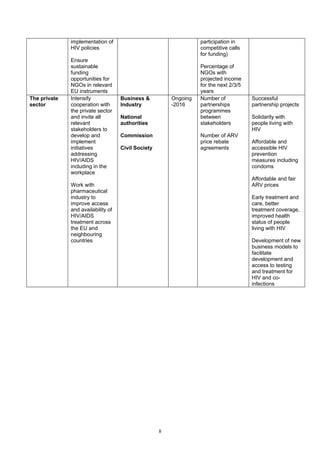
1. Politics, policies and involvement of civil society, wider society and stakeholders
Promote
HIV/AIDS and co-
infections as
public health and
social concern
Keep the topic on
the political
agenda
particularly in
countries with
concentrated
epidemics
Use World AIDS
day to raise
awareness of the
public and policy
makers
Commission
Member States
Neighbouring
countries
Civil Society
International
organisations
Ongoing
-2016
Inclusion of
HIV/AIDS
cooperation in
bilateral
cooperation
agreements and/or
actions plans
between the
EU/Commission
and neighbouring
countries
National
Composite Policy
Index
Existence of one
national HIV/AIDS
plan, including
surveillance
monitoring and
evaluation
Better use of
existing policy
dialogue
mechanisms to
promote effective
political leadership
particularly in
countries with
concentrated
epidemics
Better public
awareness on
HIV/AIDS
Political
support for the
implementation
of cost-effective, and
evidence based
measures to combat
HIV/AIDS
HIV is
mainstreamed
in EU policies
Regular HIV/AIDS
Think Tank and
Civil Society
Forum meetings
including linkage
to relevant other
EU civil society
fora
Commission
Member States
and
neighbouring
countries
Civil Society
International
organisations
Ongoing
-2016
Number of
meetings
Dissemination and
implementation of
results from
meetings
Actions agreed
and implemented
Know-how transfer
Effective
cooperation between
all key players
Joint actions carried
out
HIV/AIDS as
an issue
requiring
political
attention
Address
HIV/AIDS and
Human Rights:
Tackle stigma,
discrimination,
and legal
barriers in
relation to HIV
status, ensuring
equal access
and quality of
Member States
and
neighbouring
countries Civil
Society
Commission
Ongoing-
2016
Level of
discrimination in
relation to HIV
status, i.e. as
monitored by the
stigma index
Monitoring of
national policies
and legislation in
place (related to
Integrated anti-
discrimination
policies applied in
EU and
neighbouring states,
Prohibition of
discrimination in
relation to HIV status
in national legislation
7
prevention,
testing and
treatment
HIV-specific
discrimination of
People living with
HIV and key
populations)
Number of actions
and measures
taken to protect
fundamental rights
including expected
results of initiatives
supported at
international level
Better quality of life
of people living with
HIV/AIDS
Promotion of a
public health
approach (as an
alternative to
criminalization) in
managing
behaviours that put
people at risk of HIV
acquisition
Better awareness of
legal aspects of
discrimination
among Member
States and
integrated anti-
discrimination
policies with a
particular focus on
legislative solutions
and their correct
implementation
HIV/AIDS
policies and
strategies
Development,
budgeting
implementation,
monitoring and
evaluation of
targeted ,
regional, national
and supranational
HIV/AIDS and co-
infection policies
Member States
and
neighbouring
countries
ECDC
Civil Society
International
organisations
Ongoing
-2016
National European
and international
AIDS spending by
categories and
financing sources
Number of
explicit
HIV/AIDS policies
in place, scale and
quality of
implementation
Sustainability of
funding for HIV
and co-infection
programmes
Scaling up of
development and
effective
implementation of
innovative HIV/AIDS
policies at regional,
national and sub-
national level
leading to a
reduction of HIV
transmission
Civil society Support of civil
society through
funding and legal
support at EU and
national levels in
the EU and
neighbouring
countries
Involve and
consult civil
society including
people living with
HIV/AIDS and
other vulnerable
groups in
development and
National
authorities in the
EU and
neighbouring
countries
Commission
Other
stakeholders
Ongoing
-2016
NGOs and
vulnerable groups
actively involved in
planning, policy
formulation,
budgeting,
monitoring
&evaluation of HIV
activities at EU,
national and
subnational levels
Number of NGOs
which have access
to specific funding
instruments (as a
result of their
Larger number of
effective NGOs in
EU Member States
and neighbouring
countries
Higher degree of
NGO participation in
decision making
8
implementation of
HIV policies
Ensure
sustainable
funding
opportunities for
NGOs in relevant
EU instruments
participation in
competitive calls
for funding)
Percentage of
NGOs with
projected income
for the next 2/3/5
years
The private
sector
Intensify
cooperation with
the private sector
and invite all
relevant
stakeholders to
develop and
implement
initiatives
addressing
HIV/AIDS
including in the
workplace
Work with
pharmaceutical
industry to
improve access
and availability of
HIV/AIDS
treatment across
the EU and
neighbouring
countries
Business &
Industry
National
authorities
Commission
Civil Society
Ongoing
-2016
Number of
partnerships
programmes
between
stakeholders
Number of ARV
price rebate
agreements
Successful
partnership projects
Solidarity with
people living with
HIV
Affordable and
accessible HIV
prevention
measures including
condoms
Affordable and fair
ARV prices
Early treatment and
care, better
treatment coverage,
improved health
status of people
living with HIV
Development of new
business models to
facilitate
development and
access to testing
and treatment for
HIV and co-
infections
9
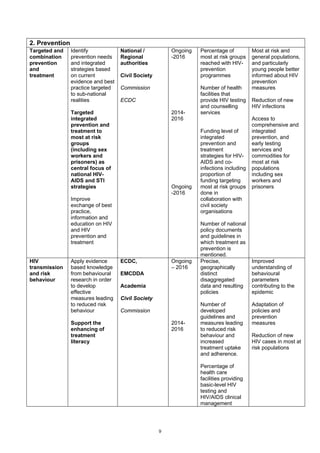
2. Prevention
Targeted and
combination
prevention
and
treatment
Identify
prevention needs
and integrated
strategies based
on current
evidence and best
practice targeted
to sub-national
realities
Targeted
integrated
prevention and
treatment to
most at risk
groups
(including sex
workers and
prisoners) as
central focus of
national HIV-
AIDS and STI
strategies
Improve
exchange of best
practice,
information and
education on HIV
and HIV
prevention and
treatment
National /
Regional
authorities
Civil Society
Commission
ECDC
Ongoing
-2016
2014-
2016
Ongoing
-2016
Percentage of
most at risk groups
reached with HIV-
prevention
programmes
Number of health
facilities that
provide HIV testing
and counselling
services
Funding level of
integrated
prevention and
treatment
strategies for HIV-
AIDS and co-
infections including
proportion of
funding targeting
most at risk groups
done in
collaboration with
civil society
organisations
Number of national
policy documents
and guidelines in
which treatment as
prevention is
mentioned.
Most at risk and
general populations,
and particularly
young people better
informed about HIV
prevention
measures
Reduction of new
HIV infections
Access to
comprehensive and
integrated
prevention, and
early testing
services and
commodities for
most at risk
populations
including sex
workers and
prisoners
HIV
transmission
and risk
behaviour
Apply evidence
based knowledge
from behavioural
research in order
to develop
effective
measures leading
to reduced risk
behaviour
Support the
enhancing of
treatment
literacy
ECDC,
EMCDDA
Academia
Civil Society
Commission
Ongoing
– 2016
2014-
2016
Precise,
geographically
distinct
disaggregated
data and resulting
policies
Number of
developed
guidelines and
measures leading
to reduced risk
behaviour and
increased
treatment uptake
and adherence.
Percentage of
health care
facilities providing
basic-level HIV
testing and
HIV/AIDS clinical
management
Improved
understanding of
behavioural
parameters
contributing to the
epidemic
Adaptation of
policies and
prevention
measures
Reduction of new
HIV cases in most at
risk populations
10
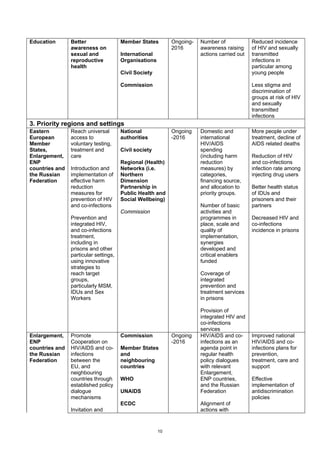
Education Better
awareness on
sexual and
reproductive
health
Member States
International
Organisations
Civil Society
Commission
Ongoing-
2016
Number of
awareness raising
actions carried out
Reduced incidence
of HIV and sexually
transmitted
infections in
particular among
young people
Less stigma and
discrimination of
groups at risk of HIV
and sexually
transmitted
infections
3. Priority regions and settings
Eastern
European
Member
States,
Enlargement,
ENP
countries and
the Russian
Federation
Reach universal
access to
voluntary testing,
treatment and
care
Introduction and
implementation of
effective harm
reduction
measures for
prevention of HIV
and co-infections
Prevention and
integrated HIV,
and co-infections
treatment,
including in
prisons and other
particular settings,
using innovative
strategies to
reach target
groups,
particularly MSM,
IDUs and Sex
Workers
National
authorities
Civil society
Regional (Health)
Networks (i.e.
Northern
Dimension
Partnership in
Public Health and
Social Wellbeing)
Commission
Ongoing
-2016
Domestic and
international
HIV/AIDS
spending
(including harm
reduction
measures) by
categories,
financing source,
and allocation to
priority groups.
Number of basic
activities and
programmes in
place, scale and
quality of
implementation,
synergies
developed and
critical enablers
funded
Coverage of
integrated
prevention and
treatment services
in prisons
Provision of
integrated HIV and
co-infections
services
More people under
treatment, decline of
AIDS related deaths
Reduction of HIV
and co-infections
infection rate among
injecting drug users
Better health status
of IDUs and
prisoners and their
partners
Decreased HIV and
co-infections
incidence in prisons
Enlargement,
ENP
countries and
the Russian
Federation
Promote
Cooperation on
HIV/AIDS and co-
infections
between the
EU, and
neighbouring
countries through
established policy
dialogue
mechanisms
Invitation and
Commission
Member States
and
neighbouring
countries
WHO
UNAIDS
ECDC
Ongoing
-2016
HIV/AIDS and co-
infections as an
agenda point in
regular health
policy dialogues
with relevant
Enlargement,
ENP countries,
and the Russian
Federation
Alignment of
actions with
Improved national
HIV/AIDS and co-
infections plans for
prevention,
treatment, care and
support
Effective
implementation of
antidiscrimination
policies
11
involvement of
neighbouring
countries in HIV
related meetings
at EU level
Monitoring and
reporting
progress in
implementation
of HIV-related
actions agreed
in bilateral
cooperation
agreements
and/or Action
Plans between
the EU and
neighbouring
countries
2014-
2016
international
organizations
working on HIV-
AIDS to generate
synergies and
maximize impact
Number of
Enlargement and
ENP annual
progress reports
addressing
HIV/AIDS and co-
infections
Strengthen the
surveillance by
stepping up
cooperation
between the
ECDC, WHO-
Euro, EMCDDA
and surveillance
authorities in
Enlargement and
ENP countries
and Russian
Federation
ECDC, WHO-
Euro, EMCDDA,
Surveillance
institutions in
Neighbouring
countries and
Russian
Federation
Commission
ENP partners
Member States
Civil society
Ongoing
-2016
Increased
interaction with
and involvement of
Enlargement and
ENP countries in
ECDC HIV/AIDS
and co-infection
programmes
Better surveillance,
monitoring and
evaluation
Improved integrated
HIV policies and
programmes in the
EU and
neighbouring
countries
Exchange
programmes
between Member
States and
neighbouring
countries for
training of medical
and social and
NGO staff
Health
Professional
associations
Member States
Neighbouring
countries
Civil Society
Industry
Ongoing
-2016
Number of
exchange
programmes
Better trained clinical
and social staff and
NGOs
12
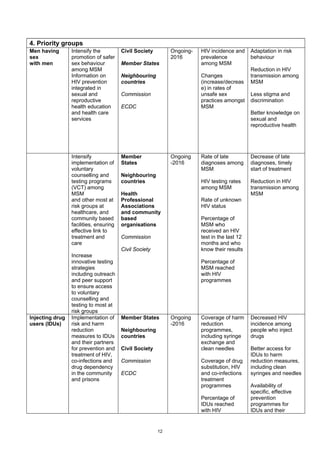
4. Priority groups
Men having
sex
with men
Intensify the
promotion of safer
sex behaviour
among MSM
Information on
HIV prevention
integrated in
sexual and
reproductive
health education
and health care
services
Civil Society
Member States
Neighbouring
countries
Commission
ECDC
Ongoing-
2016
HIV incidence and
prevalence
among MSM
Changes
(increase/decreas
e) in rates of
unsafe sex
practices amongst
MSM
Adaptation in risk
behaviour
Reduction in HIV
transmission among
MSM
Less stigma and
discrimination
Better knowledge on
sexual and
reproductive health
Intensify
implementation of
voluntary
counselling and
testing programs
(VCT) among
MSM
and other most at
risk groups at
healthcare, and
community based
facilities, ensuring
effective link to
treatment and
care
Increase
innovative testing
strategies
including outreach
and peer support
to ensure access
to voluntary
counselling and
testing to most at
risk groups
Member
States
Neighbouring
countries
Health
Professional
Associations
and community
based
organisations
Commission
Civil Society
Ongoing
-2016
Rate of late
diagnoses among
MSM
HIV testing rates
among MSM
Rate of unknown
HIV status
Percentage of
MSM who
received an HIV
test in the last 12
months and who
know their results
Percentage of
MSM reached
with HIV
programmes
Decrease of late
diagnoses, timely
start of treatment
Reduction in HIV
transmission among
MSM
Injecting drug
users (IDUs)
Implementation of
risk and harm
reduction
measures to IDUs
and their partners
for prevention and
treatment of HIV,
co-infections and
drug dependency
in the community
and prisons
Member States
Neighbouring
countries
Civil Society
Commission
ECDC
Ongoing
-2016
Coverage of harm
reduction
programmes,
including syringe
exchange and
clean needles
Coverage of drug
substitution, HIV
and co-infections
treatment
programmes
Percentage of
IDUs reached
with HIV
Decreased HIV
incidence among
people who inject
drugs
Better access for
IDUs to harm
reduction measures,
including clean
syringes and needles
Availability of
specific, effective
prevention
programmes for
IDUs and their
13
programmes partners
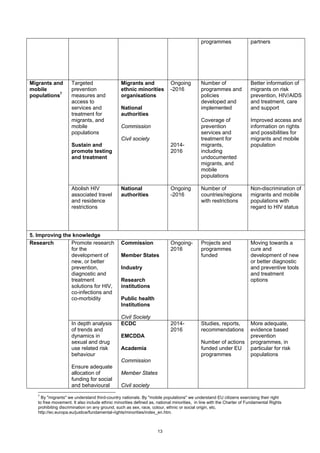
Targeted
prevention
measures and
access to
services and
treatment for
migrants, and
mobile
populations
Sustain and
promote testing
and treatment
Migrants and
ethnic minorities
organisations
National
authorities
Commission
Civil society
Ongoing
-2016
2014-
2016
Number of
programmes and
policies
developed and
implemented
Coverage of
prevention
services and
treatment for
migrants,
including
undocumented
migrants, and
mobile
populations
Better information of
migrants on risk
prevention, HIV/AIDS
and treatment, care
and support
Improved access and
information on rights
and possibilities for
migrants and mobile
population
Migrants and
mobile
populations7
Abolish HIV
associated travel
and residence
restrictions
National
authorities
Ongoing
-2016
Number of
countries/regions
with restrictions
Non-discrimination of
migrants and mobile
populations with
regard to HIV status
5. Improving the knowledge
Promote research
for the
development of
new, or better
prevention,
diagnostic and
treatment
solutions for HIV,
co-infections and
co-morbidity
Commission
Member States
Industry
Research
institutions
Public health
Institutions
Civil Society
Ongoing-
2016
Projects and
programmes
funded
Moving towards a
cure and
development of new
or better diagnostic
and preventive tools
and treatment
options
Research
In depth analysis
of trends and
dynamics in
sexual and drug
use related risk
behaviour
Ensure adequate
allocation of
funding for social
and behavioural
ECDC
EMCDDA
Academia
Commission
Member States
Civil society
2014-
2016
Studies, reports,
recommendations
Number of actions
funded under EU
programmes
More adequate,
evidence based
prevention
programmes, in
particular for risk
populations
7
By "migrants" we understand third-country nationals. By "mobile populations" we understand EU citizens exercising their right
to free movement. It also include ethnic minorities defined as, national minorities, in line with the Charter of Fundamental Rights
prohibiting discrimination on any ground, such as sex, race, colour, ethnic or social origin, etc.
http://ec.europa.eu/justice/fundamental-rights/minorities/index_en.htm.
14
research, socio-
economic
analysis
Health care Improve
capacities and
knowledge of
medical staff and
community based
organisations with
regards to
HIV/AIDS and co-
infections
prevention,
testing, treatment
and care including
larger
dissemination of
clinical best
practice
Health
professionals
associations and
community
based
organisations
Member States
WHO
Academia
Industry
Ongoing-
2016
Broad application
of international
testing and
treatment
guidelines
Timely diagnosis and
more effective
treatment solutions
Surveillance Enhanced and
integrated
surveillance of all
relevant aspects
on HIV/AIDS and
co- infections
(including
strengthened bio-
behavioural
surveillance)
ECDC
EMCDDA
WHO
Commission
Member States
and neighbouring
countries
Civil society
Ongoing-
2016
Comprehensive
overview of
HIV/AIDS and co-
infections in the
European region
disaggregated
data to identify
epidemiology
including those
linked to
behavioural
issues
Powerful
epidemiology
resulting in
comprehensive and
evidence based
policies
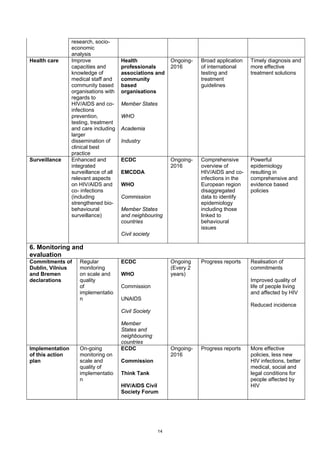
6. Monitoring and
evaluation
Commitments of
Dublin, Vilnius
and Bremen
declarations
Regular
monitoring
on scale and
quality
of
implementatio
n
ECDC
WHO
Commission
UNAIDS
Civil Society
Member
States and
neighbouring
countries
Ongoing
(Every 2
years)
Progress reports Realisation of
commitments
Improved quality of
life of people living
and affected by HIV
Reduced incidence
Implementation
of this action
plan
On-going
monitoring on
scale and
quality of
implementatio
n
ECDC
Commission
Think Tank
HIV/AIDS Civil
Society Forum
Ongoing-
2016
Progress reports More effective
policies, less new
HIV infections, better
medical, social and
legal conditions for
people affected by
HIV

Ec hiv actionplan_2014_en

  • 1.
    EN EN EUROPEAN COMMISSION Brussels, 14.3.2014 SWD(2014)106 final COMMISSION STAFF WORKING DOCUMENT Action Plan on HIV/AIDS in the EU and neighbouring countries: 2014-2016
  • 2.
    1 COMMISSION STAFF WORKINGDOCUMENT Action Plan on HIV/AIDS in the EU and neighbouring countries: 2014-2016 Contents 1.) HIV/AIDS in the EU and neighbouring countries.........................................................................2 2.) Commission Communication combating HIV/AIDS and action plan ............................................2 3.) Achievements of the EU policy framework on HIV/AIDS and the need for an increased focus ....3 4.) Prolonging the Action Plan on HIV/AIDS....................................................................................4
  • 3.
    2 1.) HIV/AIDS inthe EU and neighbouring countries HIV infection remains of major public health importance in the EU and neighbouring countries. Contrary to the global trend, which shows an overall decline in new infections, the number of newly reported HIV cases in Europe is increasing. In 2012, more than 131.000 new HIV infections were reported in Europe and Central Asia, an 8% increase from 20111 . A total of 29.000 cases were reported in the European Union and European Economic Area (EU/EEA) a 1% increase from 2011 and 102.000 cases from countries in Eastern Europe and Central Asia (a 9% increase from 2011). The main HIV transmission mechanisms differ depending on the region. In the EU/EEA HIV is predominantly transmitted among men who have sex with men (MSM). HIV transmission through heterosexual contacts plays also an important role. In neighbouring countries the main transmission modes are heterosexual contacts, followed by injecting drug use (IDU). Besides MSM and IDUs other vulnerable groups at high risk of acquiring HIV infections include migrants and mobile populations, sex workers and prisoners. Early diagnosis followed by counselling and treatment as well as preventive strategies play a crucial role in reducing the spread of the disease. Recent evidence suggests that early treatment has significant effects in terms of reducing the risk of further transmission as well as reducing the morbidity and mortality related to HIV/AIDS. However, in the EU/EEA 49% of people living with HIV/AIDS are diagnosed late in the course of the infection and the percentage is even higher in Eastern Europe and Central Asia. In addition, significant gaps in coverage of prevention measures and access to antiretroviral therapy remain in some eastern European countries. In several countries the high number of HIV/AIDS co-infections, such as tuberculosis, viral hepatitis, and sexually transmitted diseases other than HIV/AIDS are another serious concern. 2.) Commission Communication combating HIV/AIDS and action plan The Commission Communication on combating HIV/AIDS in the European Union and neighbouring countries, 2009-2013 2 provides a policy instrument to complement national policies on HIV/AIDS on European level and has been the basis for EU action since 2009. The overall objectives of the Communication are: (i) to contribute to reducing new HIV infections across all European countries by 2013, (ii) to improve access to prevention, treatment, care and support and (iii) improving the quality of life of people living with, affected by or most vulnerable to HIV/AIDS in the European Union and neighbouring countries. The Communication is complemented by an operational action plan that contains 50 actions, which are structured in the following six key issue areas: (1) Politics, policies and involvement of civil society, wider society and stakeholders, (2) Prevention, (3) Priority regions, (4) Priority groups, (5) Improving the knowledge, (6) Monitoring and evaluation. The action plan presented an initial set of actions arising from consultation with Commission services and external stakeholders, to be further developed along the lines of the political 1 European Centre for Disease Prevention and Control/WHO Regional Office for Europe. HIV/AIDS surveillance in Europe 2012. Stockholm; 2013 2 COM(2009) 569 final
  • 4.
    3 actions presented inthe Communication in cooperation with the HIV/AIDS Think Tank, the Civil Society Forum and external stakeholders. Funding for the implementation of the Communication and action plan is provided through a range of mechanisms and instruments. These include the EU Health Programme, the EU Framework Programme for Research and Innovation, the Global Fund to Fight AIDS, Tuberculosis and Malaria, to which the EU is a major contributor, as well as EU Structural Funds, the Development Cooperation Instrument and the European Neighbourhood and Partnership Instrument. 3.) Achievements of the EU policy framework on HIV/AIDS and the need for an increased focus Prime responsibility for protecting and improving the health of their citizens rests with the EU Member States and the neighbouring countries. However, Article 168 of the Treaty on the Functioning of the European Union explicitly acknowledges that Union action shall complement national policies, and shall be directed towards improving public health, preventing physical and mental illness and diseases, and obviating sources of danger to physical and mental health. As HIV/AIDS is a communicable disease it needs to be addressed by coordinating the efforts of national governments. Upon request of the European Commission, the European Centre for Disease Prevention and Control (ECDC) prepared a monitoring report on the implementation of the Commission Communication and Action Plan for combating HIV/AIDS in 20133 . The report highlights several achievements of the EU policy framework. For instance the Communication was identified as an important tool for galvanizing political leadership, which was instrumental in keeping HIV/AIDS on the agenda and has been used by civil society to frame debate at regional and national levels. The Think Tank and Civil Society Forum proved to be valuable platforms for policy dialogue and exchange of information and experience, and helped to promote Europe-wide action and effective communication. Financial inputs to support the objectives of the Communication and action plan are considered to amount to approximately EUR 57.5 million annually. This funding contributed to the development of new treatments and prevention technologies through the EU Framework Programme for Research and Innovation, and supported the scaling up of HIV- related services in the most affected Member States, neighbourhood countries and the Russian Federation via Commission funding to the Global Fund. The EU Health Programme helped to strengthen national HIV responses focusing on populations most at risk, such as targeted prevention services and development of better approaches to service delivery for these population groups. Substantial improvements were also achieved in relation to epidemiological surveillance of HIV/AIDS and TB co-infection, and data reporting rates could be significantly enhanced. In Eastern Europe and Russia capacity building of non-state actors in the field of HIV has been supported through the Development Cooperation Instrument. Furthermore, the report identifies additional areas requiring continued attention and areas where progress has been less pronounced. Amongst others these include: keeping HIV/AIDS 3 European Centre for Disease Prevention and Control. Monitoring implementation of the European Commission Communication and Action Plan for combating HIV/AIDS in the EU and neighbouring countries, 2009-2013. Final report Stockholm, 2013.
  • 5.
    4 visibly high onthe political agenda, tackling discrimination in relation to HIV/AIDS, achieving universal access to voluntary testing, treatment and care, implementation of harm reduction measures, and strengthening of behavioural surveillance. In May 2013 the high- level meeting on HIV and Human Rights "Right to health, right to life”, which was jointly organised by the European Commission and UNAIDS recognized the need for a continued and renewed commitment by the European Commission to keep HIV/AIDS high on the political agenda. The meeting also identified important areas addressed in the Communication and the action plan, which require further attention, and pointed towards new developments, which may warrant consideration in the future. Building on these findings, the HIV/AIDS Civil Society Forum stressed the importance of continued attention to certain critical aspects of HIV/AIDS policies and advocated the need for further action on HIV/AIDS. This Staff Working Document prolongs the action plan thus providing continuity in EU Action beyond 2013. An independent external evaluation of the Communication and action plan is on-going, and due to be concluded in spring 2014. The results will contribute to the consideration of options for a possible future EU policy framework on HIV/AIDS. 4.) Prolonging the Action Plan on HIV/AIDS A consultation process was carried out from August to November 2013, involving Commission services, the HIV/AIDS Think Tank, the Civil Society Forum, as well as WHO and UNAIDS. The suggestions and comments of most respondents converged around several key issues, which could be clustered into two groups. Some issues and actions which are already addressed in the action plan require in particular continued and/or increased focus and attention in order to reach the objectives of the Communication. These include continued political leadership, addressing stigma and discrimination, treatment as prevention, as well as continued and improved attention to co- infections. The Communication explicitly mentions political leadership as an important asset in the fight against HIV/AIDS. Political leadership helps to keep HIV/AIDS high on the political agenda, and has assisted civil society to frame debate at regional and national levels. Particularly political support at national and regional level should be further encouraged, for instance through existing policy dialogues between the EU (European Commission) and neighbouring countries. One issue requiring greater attention is the need to address stigma and discrimination, including legal barriers that impede measures to fight HIV/AIDS. Given the limited EU competence in this field the Commission will work closely with civil society and Member States to achieve progress. In organising the high level meeting on HIV and Human Rights, as well as the workshop on “Improving Access and Combating Discrimination in Healthcare with a focus on vulnerable groups”4 , the Commission is already taking action. Building on these events a high-level meeting on access and antidiscrimination in health entitled "Health in Europe – making it fairer" is scheduled to take place in March 2014. HIV/AIDS co-infections such as tuberculosis (TB) and viral hepatitis are amid the leading causes of death for people living with HIV, particularly among drug users. For instance HIV is a major risk factor for developing TB, and TB is responsible for more than a quarter of 4 Within the Framework of the European Health Forum Gastein 2013
  • 6.
    5 deaths among peopleliving with HIV.5 Particularly in Eastern European countries efforts need to be continued to increase integrated prevention and treatment measures such as access to harm reduction methods, and antiretroviral treatment, particularly in prisons. An increasing body of evidence confirms that treatment is effective in preventing HIV transmission, particularly in relation to heterosexual transmission6 . This underlines not only the need for the strategic use of treatment, but also further increases the importance of early and increased testing particularly amongst high risk groups. These changes are for instance reflected in the consolidated WHO guidelines on the use of antiretroviral drugs for treating and preventing HIV infection, which were released in June 2013, and should inform practice in Member States and neighbouring countries. Finally, there is the need to stay aligned with regional action frameworks to facilitate synergies and maximise impact. For instance in 2011 WHO endorsed its European Action Plan for HIV/AIDS, 2012-2015, and currently the Global Fund is developing a Strategy on HIV/AIDS for Eastern Europe and Central Asia. The consultation process also identified a number of other issues such as the need to provide targeted support to additional populations at risk, the development of integrated strategies to address HIV/AIDS and other sexually transmitted diseases, or the need to consider addressing other co-morbidities, in addition to TB and Hepatitis. These issues require further reflection and monitoring and will be further considered in discussions on a future EU policy framework on HIV/AIDS. Financing of specific actions contained in this action plan will be subject to final approval of the Health Programme 2014-2020, and implementing decisions within the annual work plans. As such, the prolongation will not have any budgetary impact. The research objectives of the action plan will also be funded through the next EU programme for research and innovation, Horizon 2020, which was formally adopted in November 2013. This table below presents the action plan arising from consultations with Commission services and external stakeholders. Actions are designed alongside the political actions of the Commission communication on combating HIV/AIDS in the European Union and the neighbouring countries, 2009-2013, and should contribute to achieving the envisaged targets. The action plan was originally developed in 2009. The below table maintains the original structure since it was acknowledged by many stakeholders that the majority of actions are still valid and relevant. Besides the key issue areas outlined in section 4 of this paper further changes were introduced mainly to specify and provide precision in terms of indicators and expected results. This action plan may need to be further developed and updated in cooperation with relevant stakeholders and in line with the results of the external evaluation of the Commission Communication on combating HIV/AIDS. The geographical scope of the action plan includes EU Member States, EEA/EFTA countries and neighbouring countries, namely the EU Enlargement countries, the European Neighbourhood Policy (ENP) countries, in particular the Eastern ones bordering the EU, as well as the Russian Federation. 5 World Health Organization. European Action Plan for HIV/AIDS 2012-2015, Copenhagen 2011. 6 Cohen MS, Smith MK, Muessig KE, et. al. Antiretroviral treatment of HIV-1 prevents transmission of HIV-1: where do we go from here? The Lancet, published online October 21, 2013 http://www.thelancet.com/journals/lancet/article/PIIS0140-6736%2813%2961998-4/fulltext
  • 7.
    6 European Union ActionPlan on HIV/AIDS: prolongation 2014-2016 ISSUE ACTION Bold = increased focus Normal = continued actions PARTNERS INVOLVED IN REALISATION Bold = leading entities Italics = associated entities TIME INDICATOR(S) EXPECTED RESULTS 1. Politics, policies and involvement of civil society, wider society and stakeholders Promote HIV/AIDS and co- infections as public health and social concern Keep the topic on the political agenda particularly in countries with concentrated epidemics Use World AIDS day to raise awareness of the public and policy makers Commission Member States Neighbouring countries Civil Society International organisations Ongoing -2016 Inclusion of HIV/AIDS cooperation in bilateral cooperation agreements and/or actions plans between the EU/Commission and neighbouring countries National Composite Policy Index Existence of one national HIV/AIDS plan, including surveillance monitoring and evaluation Better use of existing policy dialogue mechanisms to promote effective political leadership particularly in countries with concentrated epidemics Better public awareness on HIV/AIDS Political support for the implementation of cost-effective, and evidence based measures to combat HIV/AIDS HIV is mainstreamed in EU policies Regular HIV/AIDS Think Tank and Civil Society Forum meetings including linkage to relevant other EU civil society fora Commission Member States and neighbouring countries Civil Society International organisations Ongoing -2016 Number of meetings Dissemination and implementation of results from meetings Actions agreed and implemented Know-how transfer Effective cooperation between all key players Joint actions carried out HIV/AIDS as an issue requiring political attention Address HIV/AIDS and Human Rights: Tackle stigma, discrimination, and legal barriers in relation to HIV status, ensuring equal access and quality of Member States and neighbouring countries Civil Society Commission Ongoing- 2016 Level of discrimination in relation to HIV status, i.e. as monitored by the stigma index Monitoring of national policies and legislation in place (related to Integrated anti- discrimination policies applied in EU and neighbouring states, Prohibition of discrimination in relation to HIV status in national legislation
  • 8.
    7 prevention, testing and treatment HIV-specific discrimination of Peopleliving with HIV and key populations) Number of actions and measures taken to protect fundamental rights including expected results of initiatives supported at international level Better quality of life of people living with HIV/AIDS Promotion of a public health approach (as an alternative to criminalization) in managing behaviours that put people at risk of HIV acquisition Better awareness of legal aspects of discrimination among Member States and integrated anti- discrimination policies with a particular focus on legislative solutions and their correct implementation HIV/AIDS policies and strategies Development, budgeting implementation, monitoring and evaluation of targeted , regional, national and supranational HIV/AIDS and co- infection policies Member States and neighbouring countries ECDC Civil Society International organisations Ongoing -2016 National European and international AIDS spending by categories and financing sources Number of explicit HIV/AIDS policies in place, scale and quality of implementation Sustainability of funding for HIV and co-infection programmes Scaling up of development and effective implementation of innovative HIV/AIDS policies at regional, national and sub- national level leading to a reduction of HIV transmission Civil society Support of civil society through funding and legal support at EU and national levels in the EU and neighbouring countries Involve and consult civil society including people living with HIV/AIDS and other vulnerable groups in development and National authorities in the EU and neighbouring countries Commission Other stakeholders Ongoing -2016 NGOs and vulnerable groups actively involved in planning, policy formulation, budgeting, monitoring &evaluation of HIV activities at EU, national and subnational levels Number of NGOs which have access to specific funding instruments (as a result of their Larger number of effective NGOs in EU Member States and neighbouring countries Higher degree of NGO participation in decision making
  • 9.
    8 implementation of HIV policies Ensure sustainable funding opportunitiesfor NGOs in relevant EU instruments participation in competitive calls for funding) Percentage of NGOs with projected income for the next 2/3/5 years The private sector Intensify cooperation with the private sector and invite all relevant stakeholders to develop and implement initiatives addressing HIV/AIDS including in the workplace Work with pharmaceutical industry to improve access and availability of HIV/AIDS treatment across the EU and neighbouring countries Business & Industry National authorities Commission Civil Society Ongoing -2016 Number of partnerships programmes between stakeholders Number of ARV price rebate agreements Successful partnership projects Solidarity with people living with HIV Affordable and accessible HIV prevention measures including condoms Affordable and fair ARV prices Early treatment and care, better treatment coverage, improved health status of people living with HIV Development of new business models to facilitate development and access to testing and treatment for HIV and co- infections
  • 10.
    9 2. Prevention Targeted and combination prevention and treatment Identify preventionneeds and integrated strategies based on current evidence and best practice targeted to sub-national realities Targeted integrated prevention and treatment to most at risk groups (including sex workers and prisoners) as central focus of national HIV- AIDS and STI strategies Improve exchange of best practice, information and education on HIV and HIV prevention and treatment National / Regional authorities Civil Society Commission ECDC Ongoing -2016 2014- 2016 Ongoing -2016 Percentage of most at risk groups reached with HIV- prevention programmes Number of health facilities that provide HIV testing and counselling services Funding level of integrated prevention and treatment strategies for HIV- AIDS and co- infections including proportion of funding targeting most at risk groups done in collaboration with civil society organisations Number of national policy documents and guidelines in which treatment as prevention is mentioned. Most at risk and general populations, and particularly young people better informed about HIV prevention measures Reduction of new HIV infections Access to comprehensive and integrated prevention, and early testing services and commodities for most at risk populations including sex workers and prisoners HIV transmission and risk behaviour Apply evidence based knowledge from behavioural research in order to develop effective measures leading to reduced risk behaviour Support the enhancing of treatment literacy ECDC, EMCDDA Academia Civil Society Commission Ongoing – 2016 2014- 2016 Precise, geographically distinct disaggregated data and resulting policies Number of developed guidelines and measures leading to reduced risk behaviour and increased treatment uptake and adherence. Percentage of health care facilities providing basic-level HIV testing and HIV/AIDS clinical management Improved understanding of behavioural parameters contributing to the epidemic Adaptation of policies and prevention measures Reduction of new HIV cases in most at risk populations
  • 11.
    10 Education Better awareness on sexualand reproductive health Member States International Organisations Civil Society Commission Ongoing- 2016 Number of awareness raising actions carried out Reduced incidence of HIV and sexually transmitted infections in particular among young people Less stigma and discrimination of groups at risk of HIV and sexually transmitted infections 3. Priority regions and settings Eastern European Member States, Enlargement, ENP countries and the Russian Federation Reach universal access to voluntary testing, treatment and care Introduction and implementation of effective harm reduction measures for prevention of HIV and co-infections Prevention and integrated HIV, and co-infections treatment, including in prisons and other particular settings, using innovative strategies to reach target groups, particularly MSM, IDUs and Sex Workers National authorities Civil society Regional (Health) Networks (i.e. Northern Dimension Partnership in Public Health and Social Wellbeing) Commission Ongoing -2016 Domestic and international HIV/AIDS spending (including harm reduction measures) by categories, financing source, and allocation to priority groups. Number of basic activities and programmes in place, scale and quality of implementation, synergies developed and critical enablers funded Coverage of integrated prevention and treatment services in prisons Provision of integrated HIV and co-infections services More people under treatment, decline of AIDS related deaths Reduction of HIV and co-infections infection rate among injecting drug users Better health status of IDUs and prisoners and their partners Decreased HIV and co-infections incidence in prisons Enlargement, ENP countries and the Russian Federation Promote Cooperation on HIV/AIDS and co- infections between the EU, and neighbouring countries through established policy dialogue mechanisms Invitation and Commission Member States and neighbouring countries WHO UNAIDS ECDC Ongoing -2016 HIV/AIDS and co- infections as an agenda point in regular health policy dialogues with relevant Enlargement, ENP countries, and the Russian Federation Alignment of actions with Improved national HIV/AIDS and co- infections plans for prevention, treatment, care and support Effective implementation of antidiscrimination policies
  • 12.
    11 involvement of neighbouring countries inHIV related meetings at EU level Monitoring and reporting progress in implementation of HIV-related actions agreed in bilateral cooperation agreements and/or Action Plans between the EU and neighbouring countries 2014- 2016 international organizations working on HIV- AIDS to generate synergies and maximize impact Number of Enlargement and ENP annual progress reports addressing HIV/AIDS and co- infections Strengthen the surveillance by stepping up cooperation between the ECDC, WHO- Euro, EMCDDA and surveillance authorities in Enlargement and ENP countries and Russian Federation ECDC, WHO- Euro, EMCDDA, Surveillance institutions in Neighbouring countries and Russian Federation Commission ENP partners Member States Civil society Ongoing -2016 Increased interaction with and involvement of Enlargement and ENP countries in ECDC HIV/AIDS and co-infection programmes Better surveillance, monitoring and evaluation Improved integrated HIV policies and programmes in the EU and neighbouring countries Exchange programmes between Member States and neighbouring countries for training of medical and social and NGO staff Health Professional associations Member States Neighbouring countries Civil Society Industry Ongoing -2016 Number of exchange programmes Better trained clinical and social staff and NGOs
  • 13.
    12 4. Priority groups Menhaving sex with men Intensify the promotion of safer sex behaviour among MSM Information on HIV prevention integrated in sexual and reproductive health education and health care services Civil Society Member States Neighbouring countries Commission ECDC Ongoing- 2016 HIV incidence and prevalence among MSM Changes (increase/decreas e) in rates of unsafe sex practices amongst MSM Adaptation in risk behaviour Reduction in HIV transmission among MSM Less stigma and discrimination Better knowledge on sexual and reproductive health Intensify implementation of voluntary counselling and testing programs (VCT) among MSM and other most at risk groups at healthcare, and community based facilities, ensuring effective link to treatment and care Increase innovative testing strategies including outreach and peer support to ensure access to voluntary counselling and testing to most at risk groups Member States Neighbouring countries Health Professional Associations and community based organisations Commission Civil Society Ongoing -2016 Rate of late diagnoses among MSM HIV testing rates among MSM Rate of unknown HIV status Percentage of MSM who received an HIV test in the last 12 months and who know their results Percentage of MSM reached with HIV programmes Decrease of late diagnoses, timely start of treatment Reduction in HIV transmission among MSM Injecting drug users (IDUs) Implementation of risk and harm reduction measures to IDUs and their partners for prevention and treatment of HIV, co-infections and drug dependency in the community and prisons Member States Neighbouring countries Civil Society Commission ECDC Ongoing -2016 Coverage of harm reduction programmes, including syringe exchange and clean needles Coverage of drug substitution, HIV and co-infections treatment programmes Percentage of IDUs reached with HIV Decreased HIV incidence among people who inject drugs Better access for IDUs to harm reduction measures, including clean syringes and needles Availability of specific, effective prevention programmes for IDUs and their
  • 14.
    13 programmes partners Targeted prevention measures and accessto services and treatment for migrants, and mobile populations Sustain and promote testing and treatment Migrants and ethnic minorities organisations National authorities Commission Civil society Ongoing -2016 2014- 2016 Number of programmes and policies developed and implemented Coverage of prevention services and treatment for migrants, including undocumented migrants, and mobile populations Better information of migrants on risk prevention, HIV/AIDS and treatment, care and support Improved access and information on rights and possibilities for migrants and mobile population Migrants and mobile populations7 Abolish HIV associated travel and residence restrictions National authorities Ongoing -2016 Number of countries/regions with restrictions Non-discrimination of migrants and mobile populations with regard to HIV status 5. Improving the knowledge Promote research for the development of new, or better prevention, diagnostic and treatment solutions for HIV, co-infections and co-morbidity Commission Member States Industry Research institutions Public health Institutions Civil Society Ongoing- 2016 Projects and programmes funded Moving towards a cure and development of new or better diagnostic and preventive tools and treatment options Research In depth analysis of trends and dynamics in sexual and drug use related risk behaviour Ensure adequate allocation of funding for social and behavioural ECDC EMCDDA Academia Commission Member States Civil society 2014- 2016 Studies, reports, recommendations Number of actions funded under EU programmes More adequate, evidence based prevention programmes, in particular for risk populations 7 By "migrants" we understand third-country nationals. By "mobile populations" we understand EU citizens exercising their right to free movement. It also include ethnic minorities defined as, national minorities, in line with the Charter of Fundamental Rights prohibiting discrimination on any ground, such as sex, race, colour, ethnic or social origin, etc. http://ec.europa.eu/justice/fundamental-rights/minorities/index_en.htm.
  • 15.
    14 research, socio- economic analysis Health careImprove capacities and knowledge of medical staff and community based organisations with regards to HIV/AIDS and co- infections prevention, testing, treatment and care including larger dissemination of clinical best practice Health professionals associations and community based organisations Member States WHO Academia Industry Ongoing- 2016 Broad application of international testing and treatment guidelines Timely diagnosis and more effective treatment solutions Surveillance Enhanced and integrated surveillance of all relevant aspects on HIV/AIDS and co- infections (including strengthened bio- behavioural surveillance) ECDC EMCDDA WHO Commission Member States and neighbouring countries Civil society Ongoing- 2016 Comprehensive overview of HIV/AIDS and co- infections in the European region disaggregated data to identify epidemiology including those linked to behavioural issues Powerful epidemiology resulting in comprehensive and evidence based policies 6. Monitoring and evaluation Commitments of Dublin, Vilnius and Bremen declarations Regular monitoring on scale and quality of implementatio n ECDC WHO Commission UNAIDS Civil Society Member States and neighbouring countries Ongoing (Every 2 years) Progress reports Realisation of commitments Improved quality of life of people living and affected by HIV Reduced incidence Implementation of this action plan On-going monitoring on scale and quality of implementatio n ECDC Commission Think Tank HIV/AIDS Civil Society Forum Ongoing- 2016 Progress reports More effective policies, less new HIV infections, better medical, social and legal conditions for people affected by HIV