Librarians in the Cloud
era – Evolving or
transforming roles?
CHOY FATT CHEONG
University Librarian
Nanyang Technological University
Singapore
fcchoy@ntu.edu.sg
2013 EBSCO User Seminar
The Value of E-resource in the Cloud Era
Hong Kong, 11 April 2013
Hotel Nikko Hong Kong
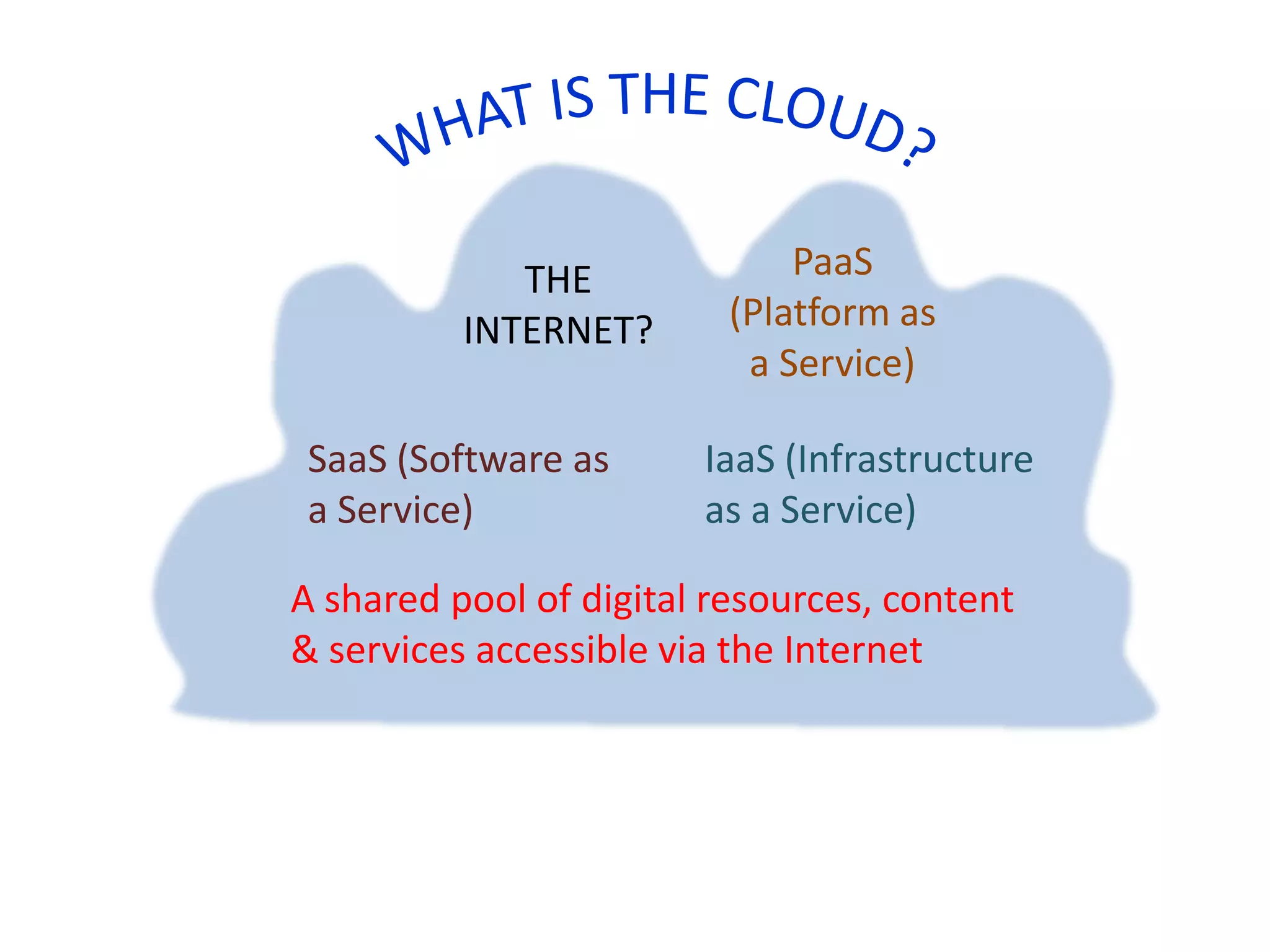
SaaS (Software as
a Service)
PaaS
(Platform as
a Service)
IaaS (Infrastructure
as a Service)
THE
INTERNET?
A shared pool of digital resources, content
& services accessible via the Internet
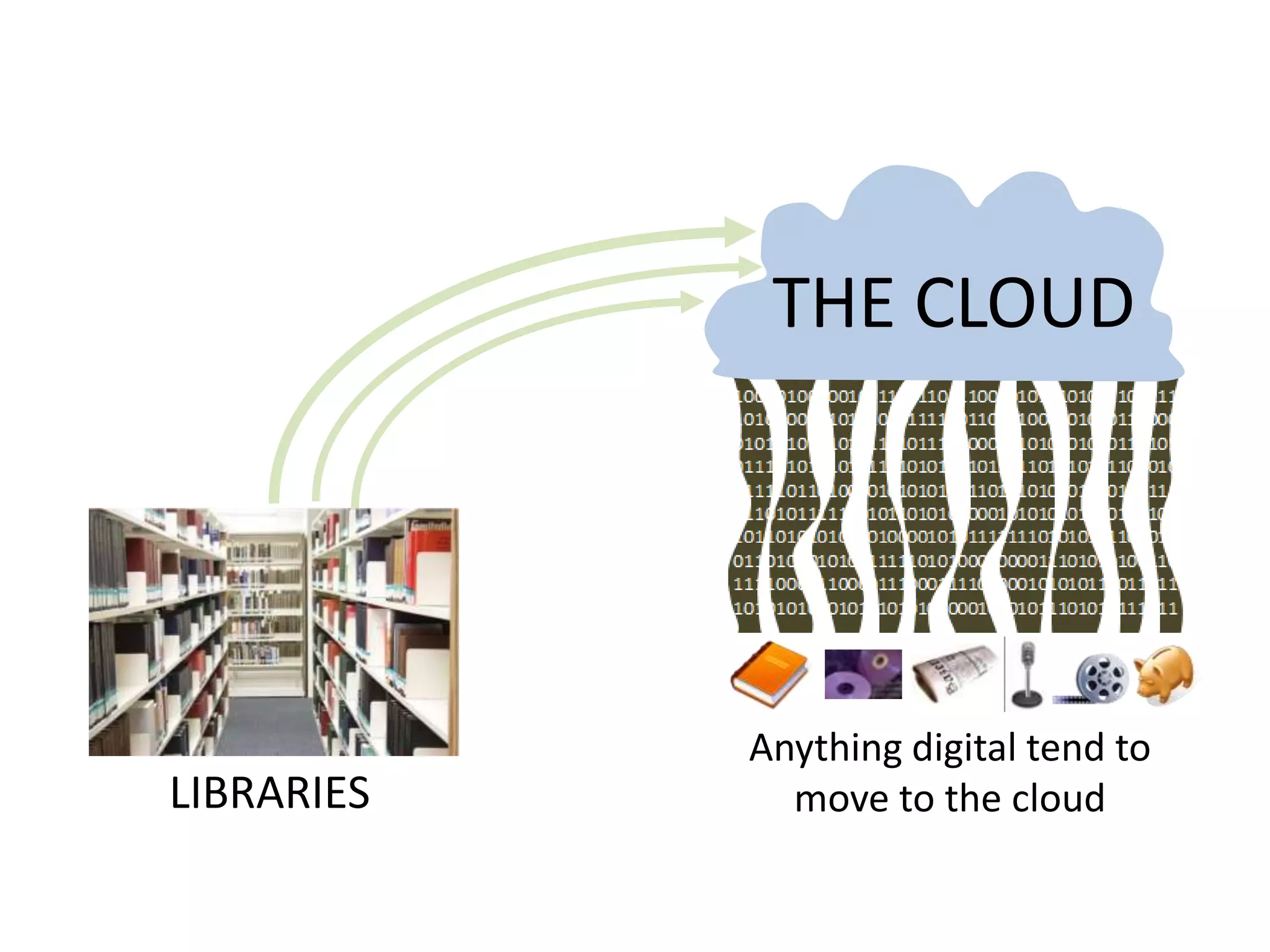
Anything digital tend to
move to the cloudLIBRARIES
THE CLOUD
THE CLOUD
FOCUS ON
How will it affect the work of
libraries & librarians?
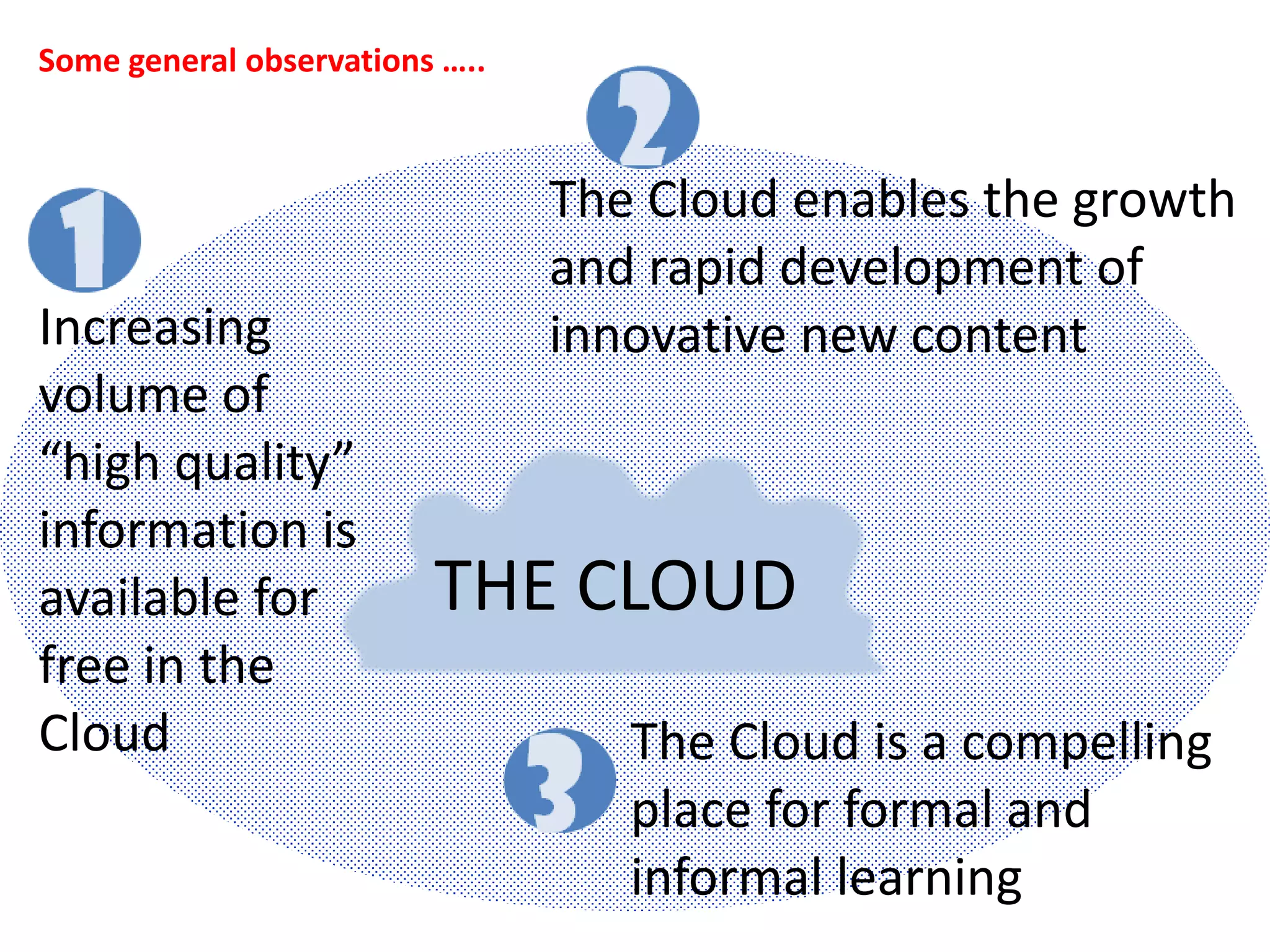
THE CLOUD
Increasing
volume of
“high quality”
information is
available for
free in the
Cloud
The Cloud enables the growth
and rapid development of
innovative new content
The Cloud is a compelling
place for formal and
informal learning
Some general observations …..
A key
selling
point
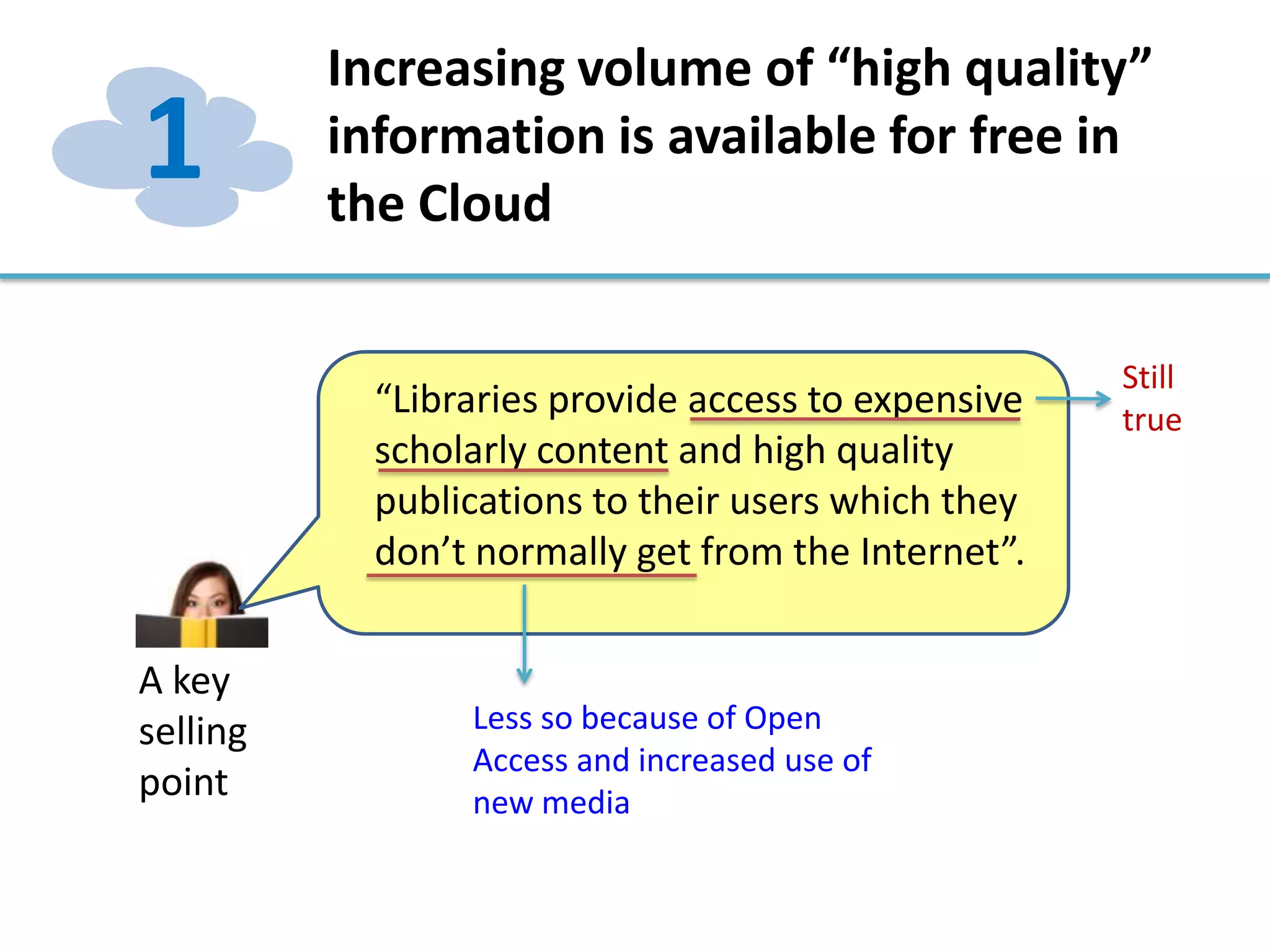
“Libraries provide access to expensive
scholarly content and high quality
publications to their users which they
don’t normally get from the Internet”.
Still
true
Less so because of Open
Access and increased use of
new media
Increasing volume of “high quality”
information is available for free in
the Cloud
1
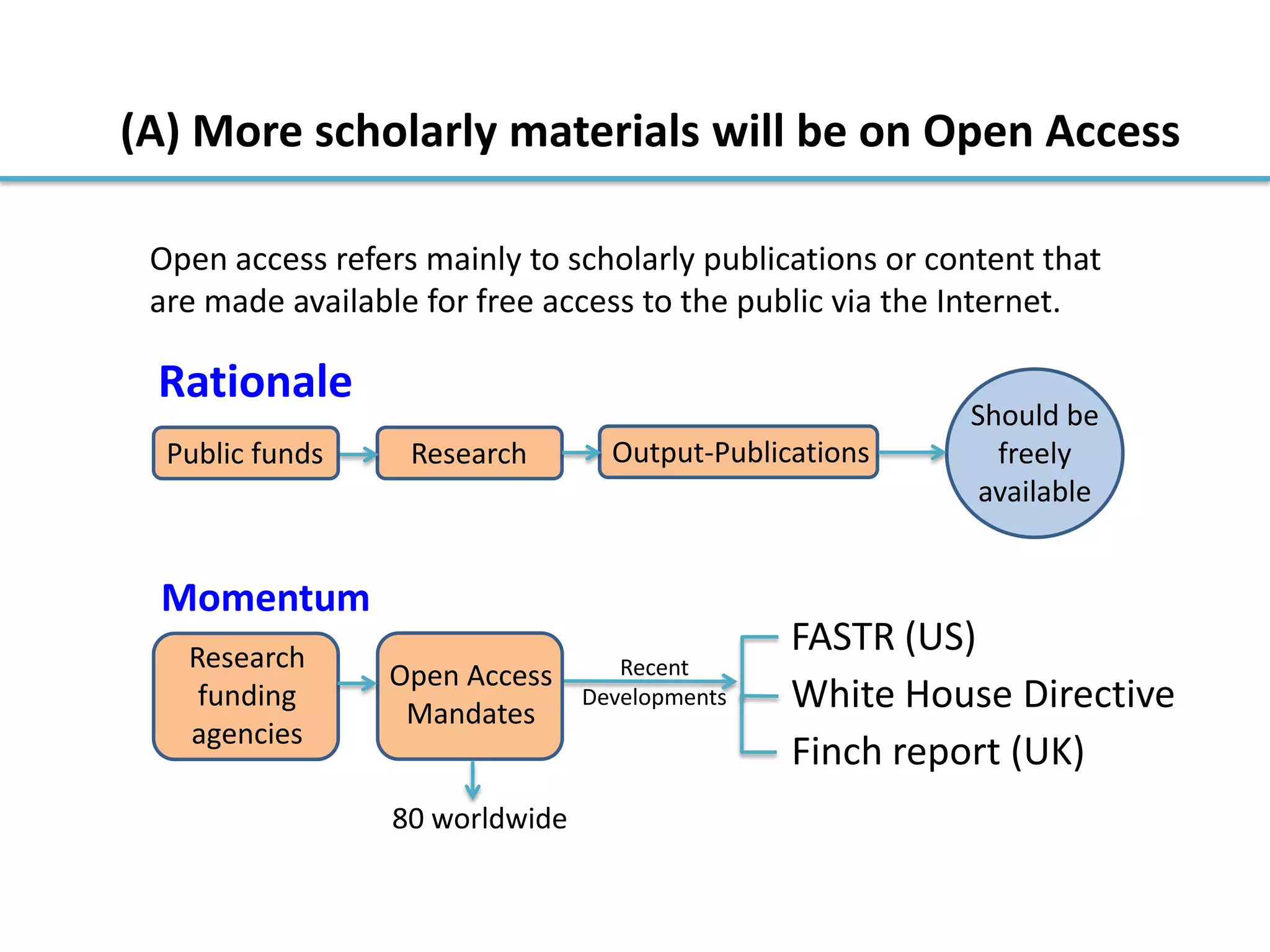
Recent
Developments
FASTR (US)
White House Directive
Finch report (UK)
Public funds Research Output-Publications
Should be
freely
available
Rationale
Momentum
Open Access
Mandates
Research
funding
agencies
80 worldwide
(A) More scholarly materials will be on Open Access
Open access refers mainly to scholarly publications or content that
are made available for free access to the public via the Internet.
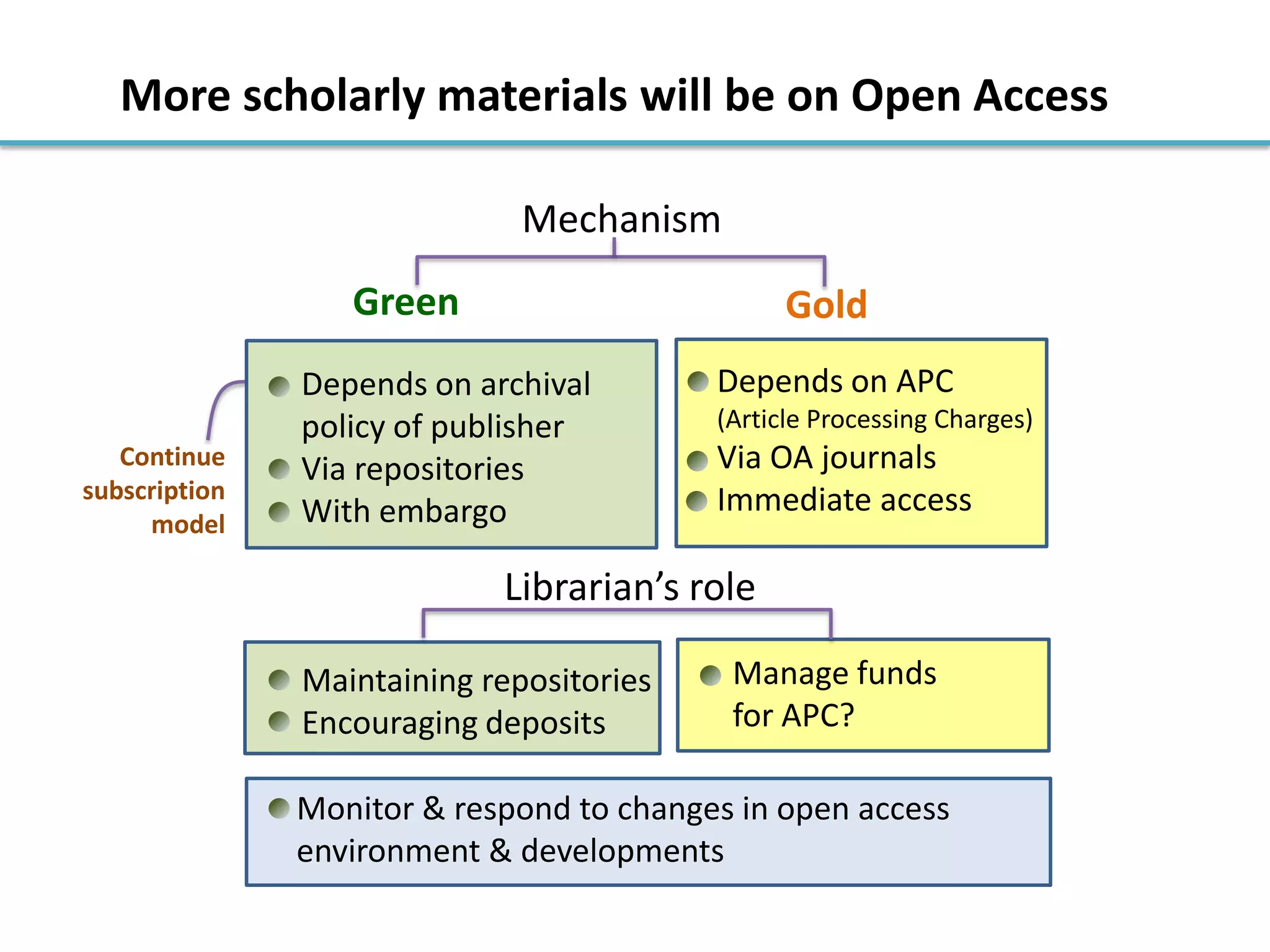
Green
Mechanism
Gold
Continue
subscription
model
More scholarly materials will be on Open Access
Depends on archival
policy of publisher
Via repositories
With embargo
Depends on APC
(Article Processing Charges)
Via OA journals
Immediate access
Maintaining repositories
Encouraging deposits
Manage funds
for APC?
Librarian’s role
Monitor & respond to changes in open access
environment & developments
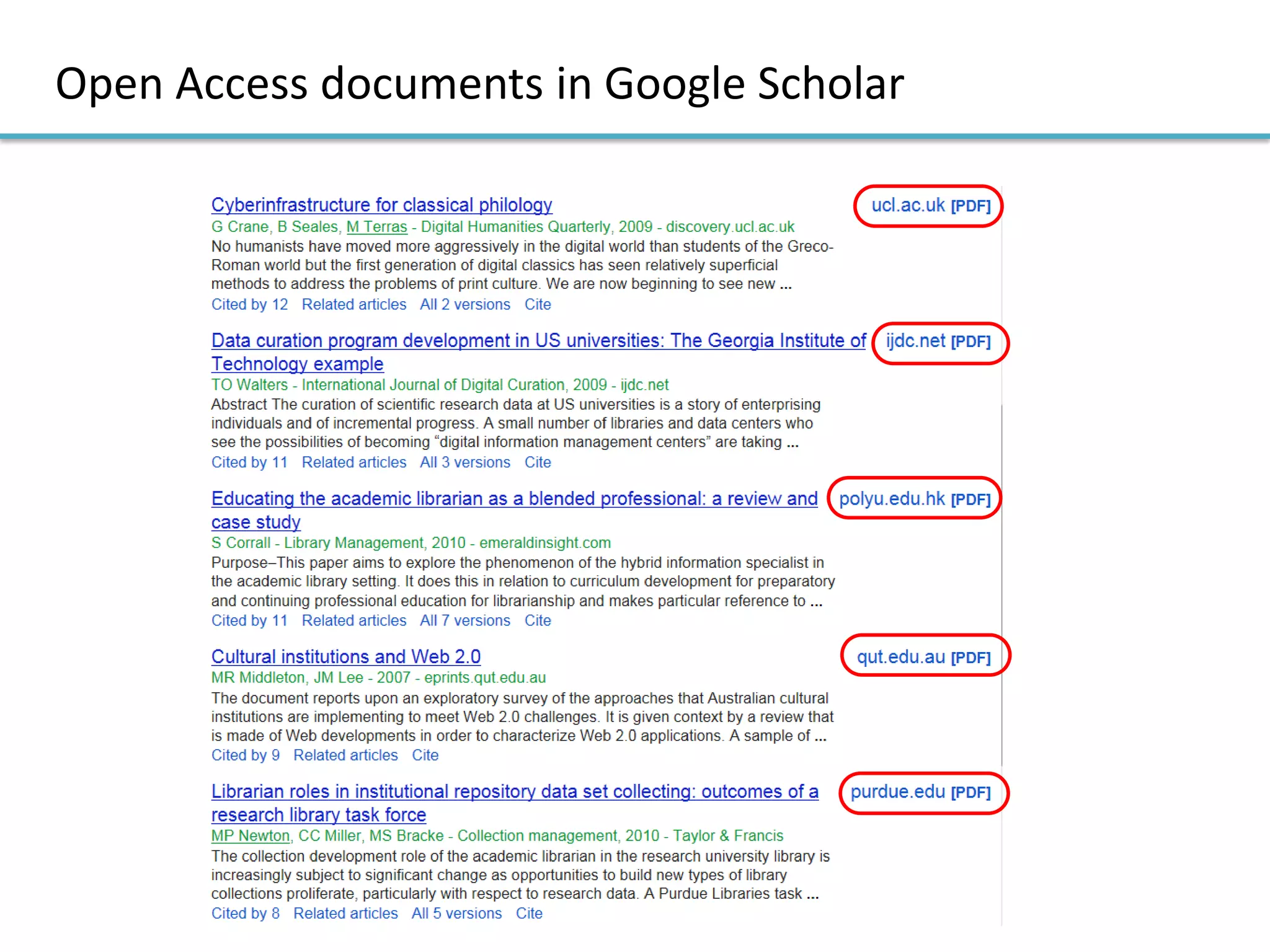
Open Access documents in Google Scholar
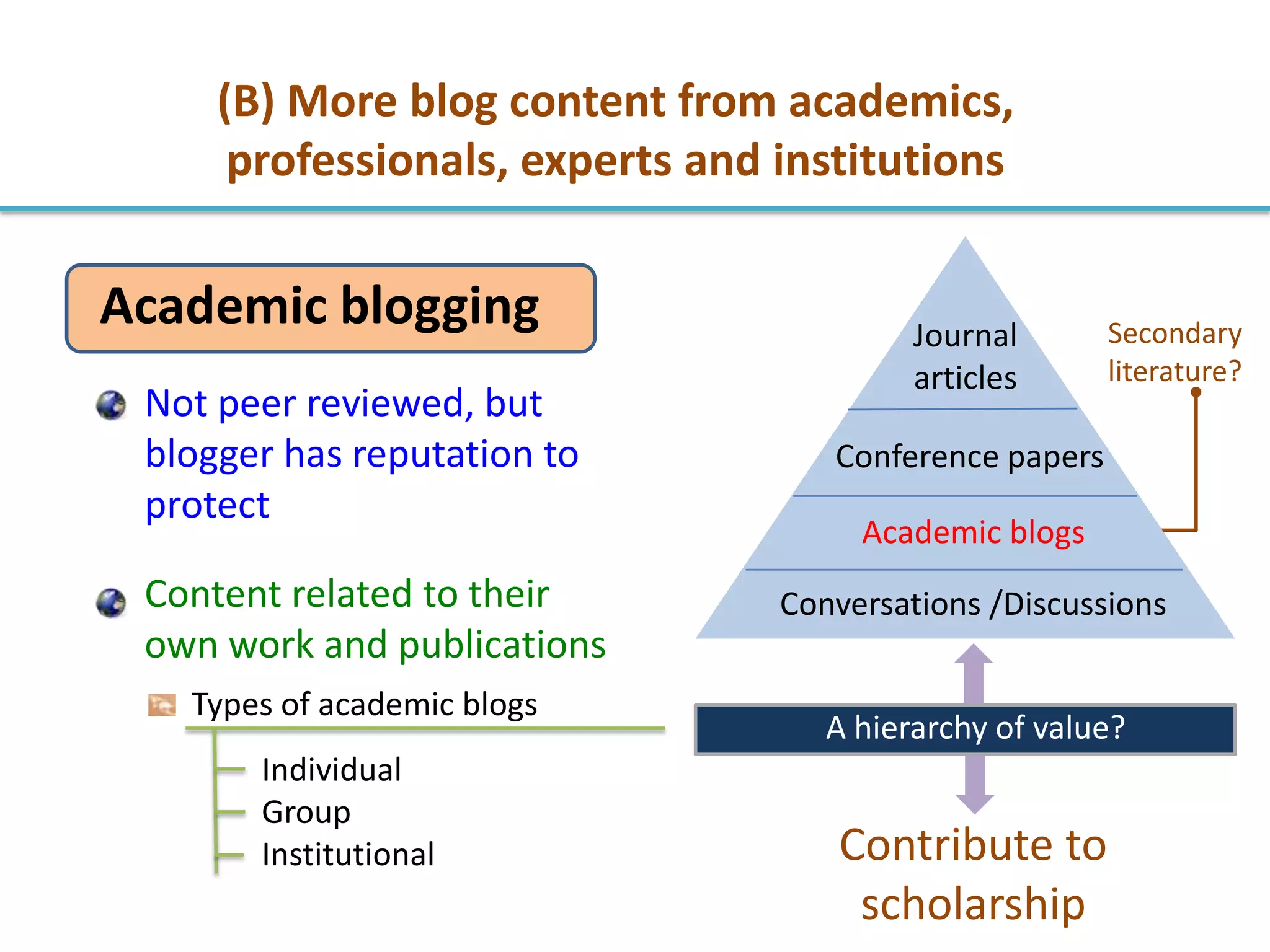
Academic blogging
(B) More blog content from academics,
professionals, experts and institutions
Contribute to
scholarship
Secondary
literature?
Not peer reviewed, but
blogger has reputation to
protect
Content related to their
own work and publications
Types of academic blogs
Individual
Group
Institutional
A hierarchy of value?
Journal
articles
Conference papers
Academic blogs
Conversations /Discussions
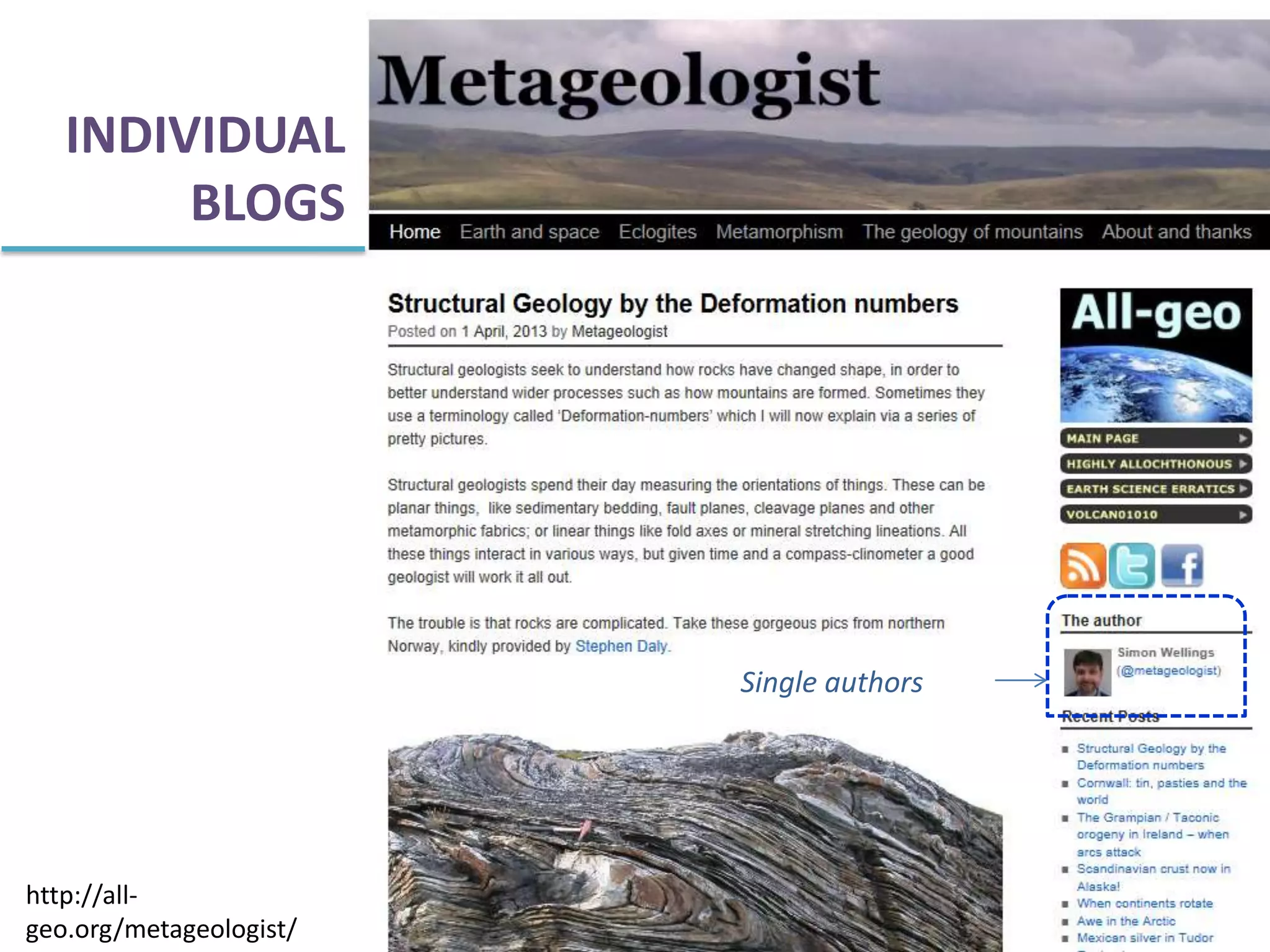
http://all-
geo.org/metageologist/
INDIVIDUAL
BLOGS
Single authors
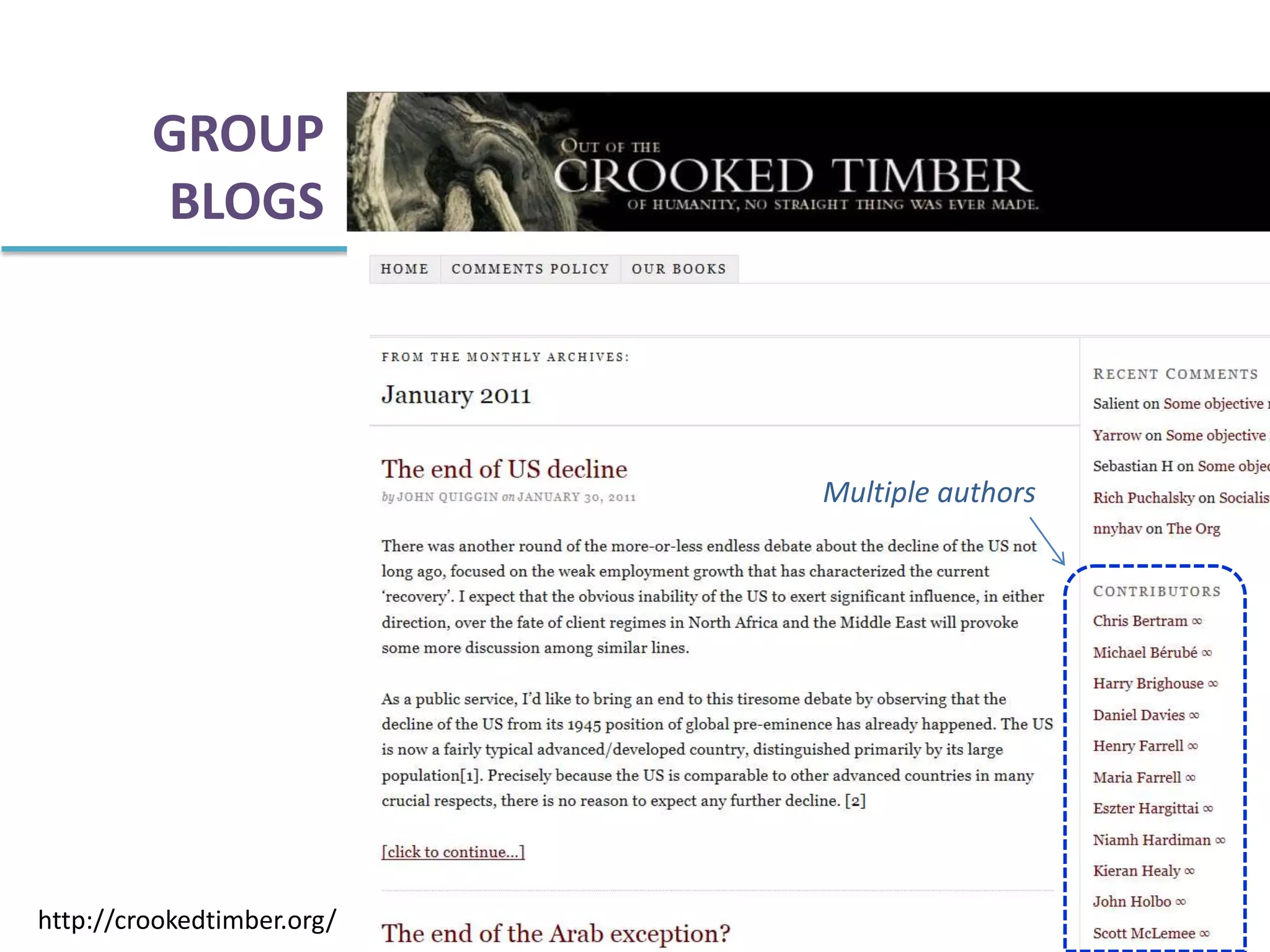
http://crookedtimber.org/
GROUP
BLOGS
Multiple authors
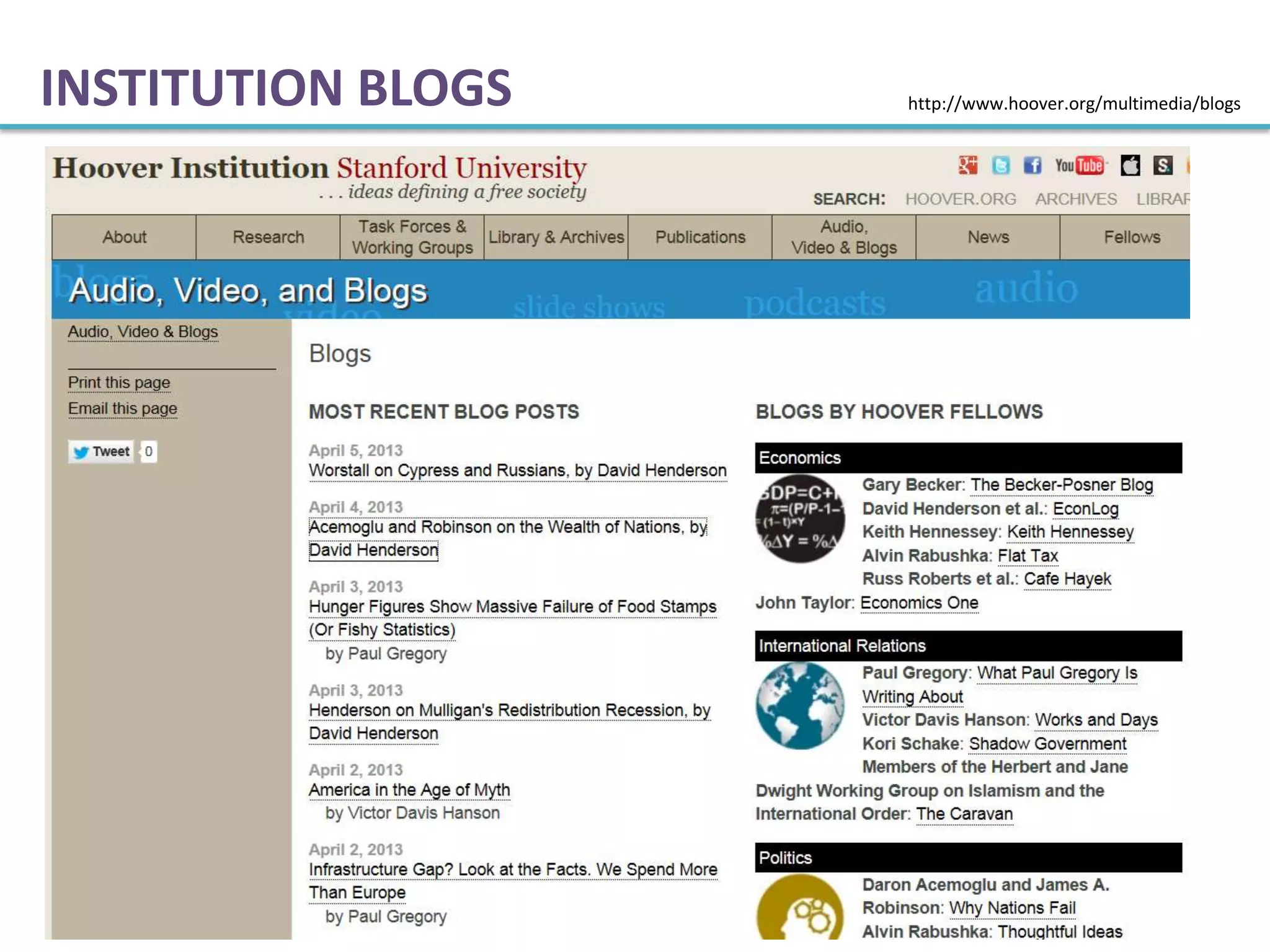
INSTITUTION BLOGS http://www.hoover.org/multimedia/blogs
Reasons for academic blogging
Fit in with current social
environment & norms
Alternative ways in
disseminating their work/ideas
Make quicker impact on the
community
Better engagement with public
Establish online identity &
reputation of author
ACADEMIC BLOGGERS
Fairly reliable content
Reveal thought/
scholarly process
Easier to understand
(lead-in to more
scholarly content)
More immediate
USERS
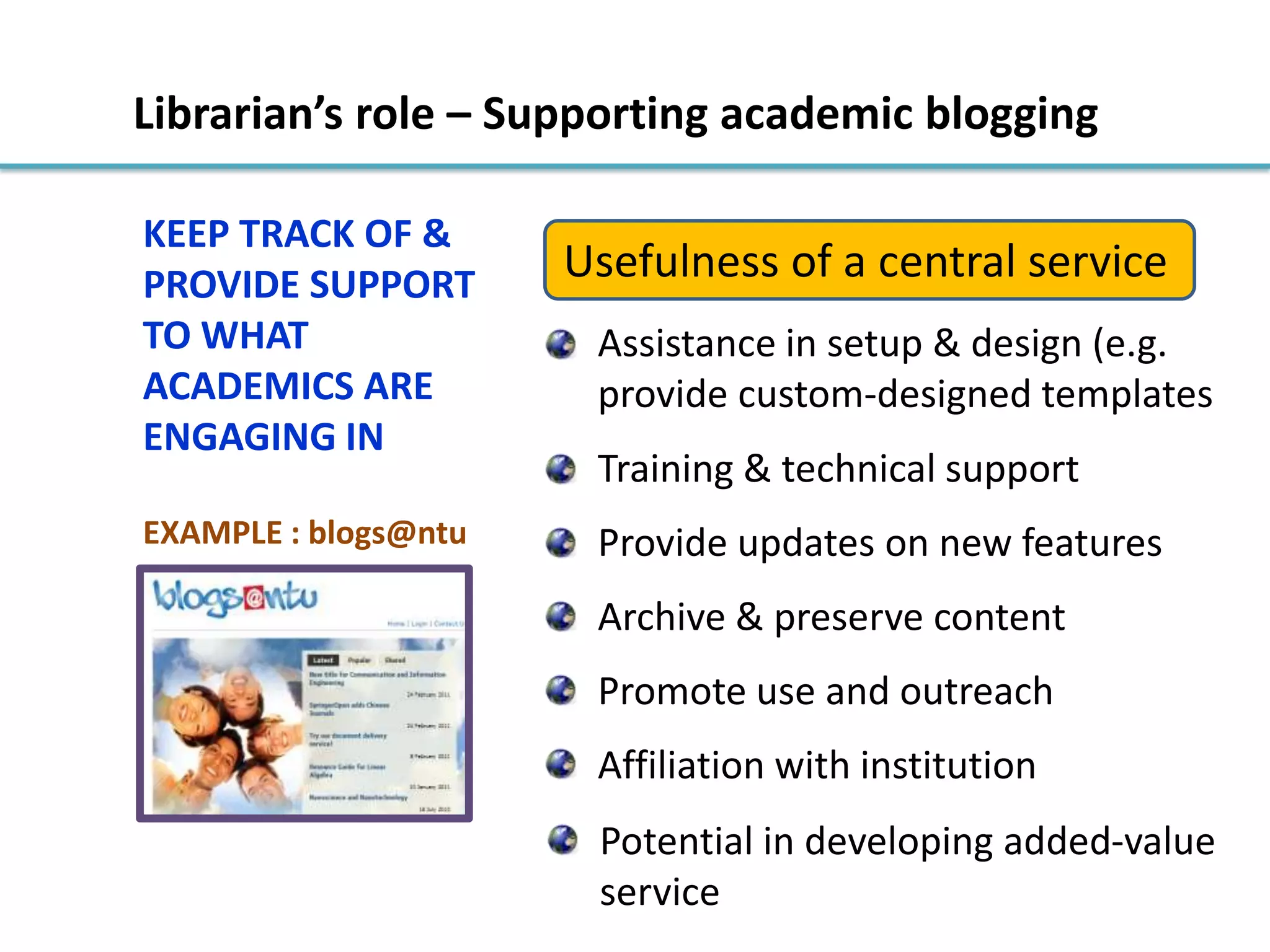
EXAMPLE : blogs@ntu
Librarian’s role – Supporting academic blogging
KEEP TRACK OF &
PROVIDE SUPPORT
TO WHAT
ACADEMICS ARE
ENGAGING IN
Usefulness of a central service
Assistance in setup & design (e.g.
provide custom-designed templates
Training & technical support
Provide updates on new features
Archive & preserve content
Promote use and outreach
Affiliation with institution
Potential in developing added-value
service
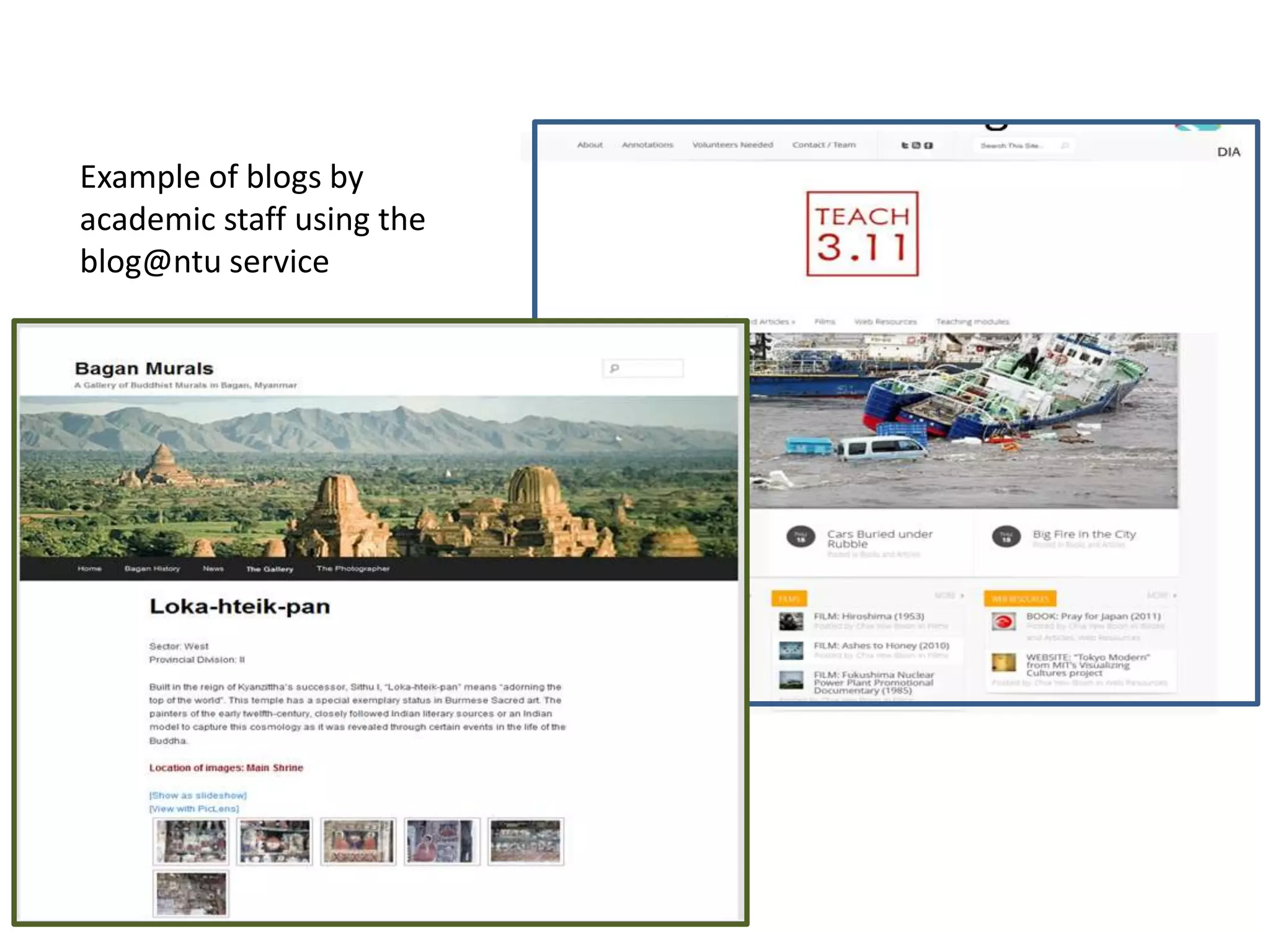
Example of blogs by
academic staff using the
blog@ntu service
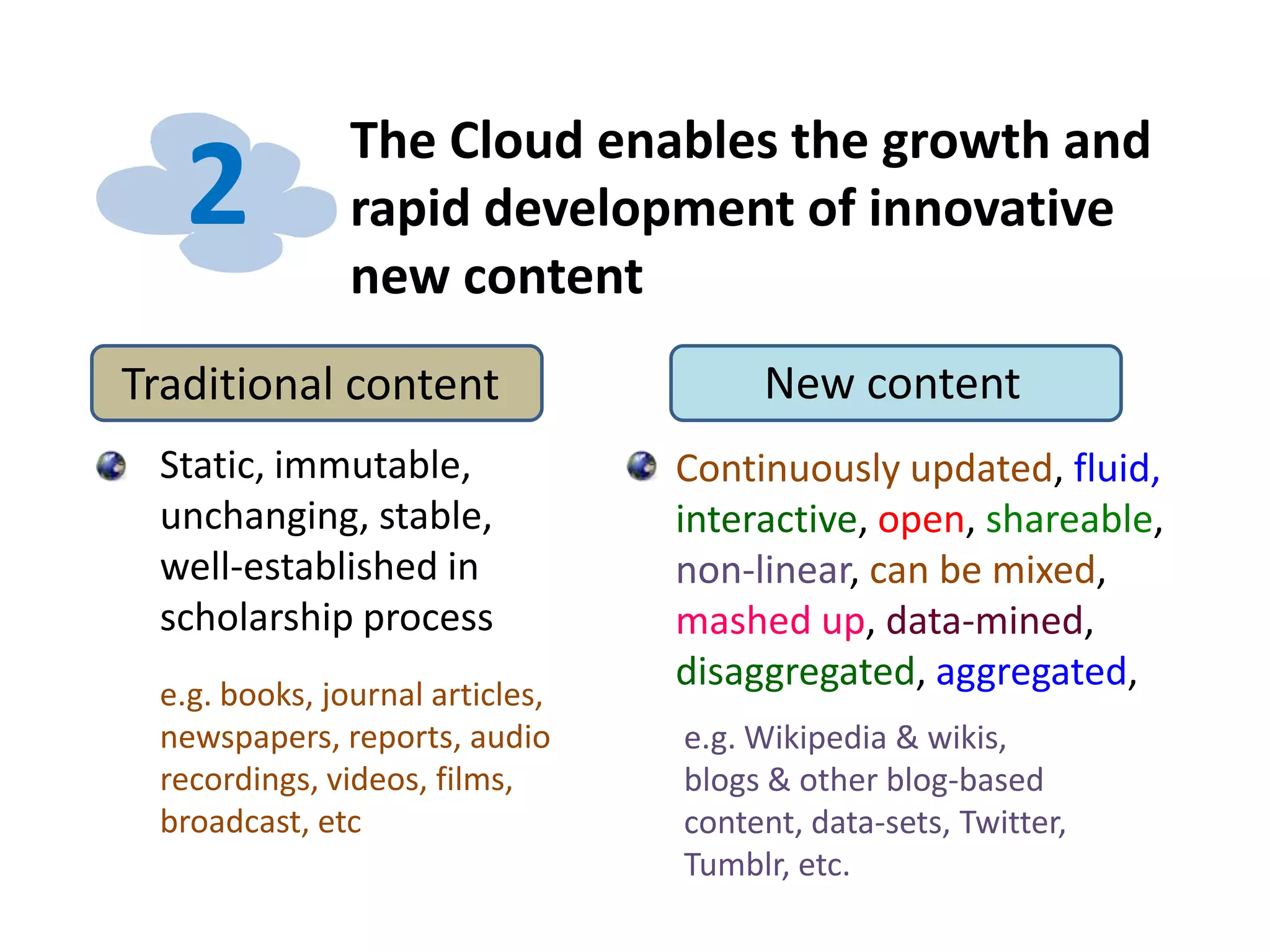
The Cloud enables the growth and
rapid development of innovative
new content
2
Traditional content New content
Static, immutable,
unchanging, stable,
well-established in
scholarship process
e.g. books, journal articles,
newspapers, reports, audio
recordings, videos, films,
broadcast, etc
Continuously updated, fluid,
interactive, open, shareable,
non-linear, can be mixed,
mashed up, data-mined,
disaggregated, aggregated,
e.g. Wikipedia & wikis,
blogs & other blog-based
content, data-sets, Twitter,
Tumblr, etc.
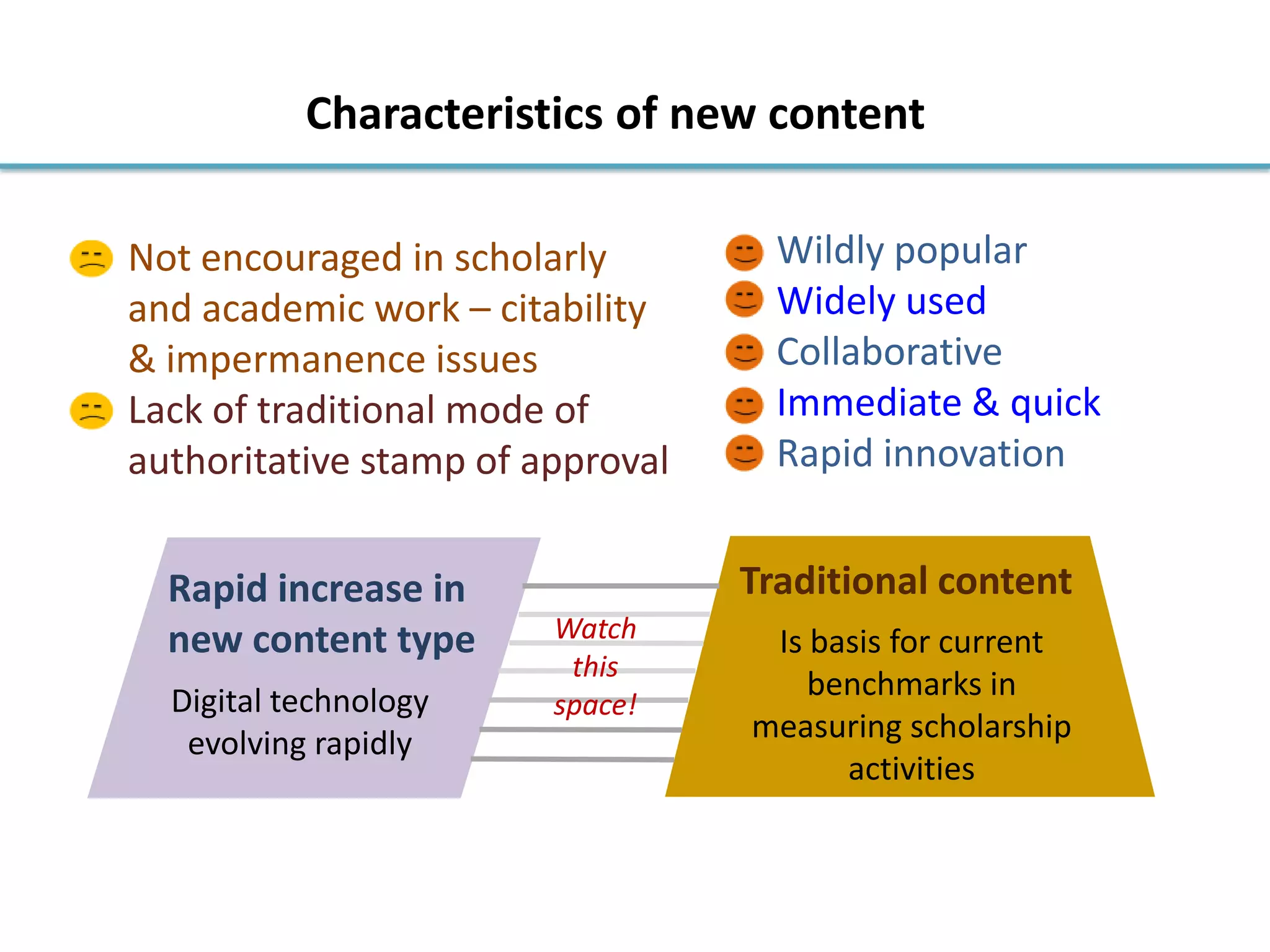
Characteristics of new content
Digital technology
evolving rapidly
Rapid increase in
new content type Is basis for current
benchmarks in
measuring scholarship
activities
Traditional content
Not encouraged in scholarly
and academic work – citability
& impermanence issues
Lack of traditional mode of
authoritative stamp of approval
Wildly popular
Widely used
Collaborative
Immediate & quick
Rapid innovation
Watch
this
space!
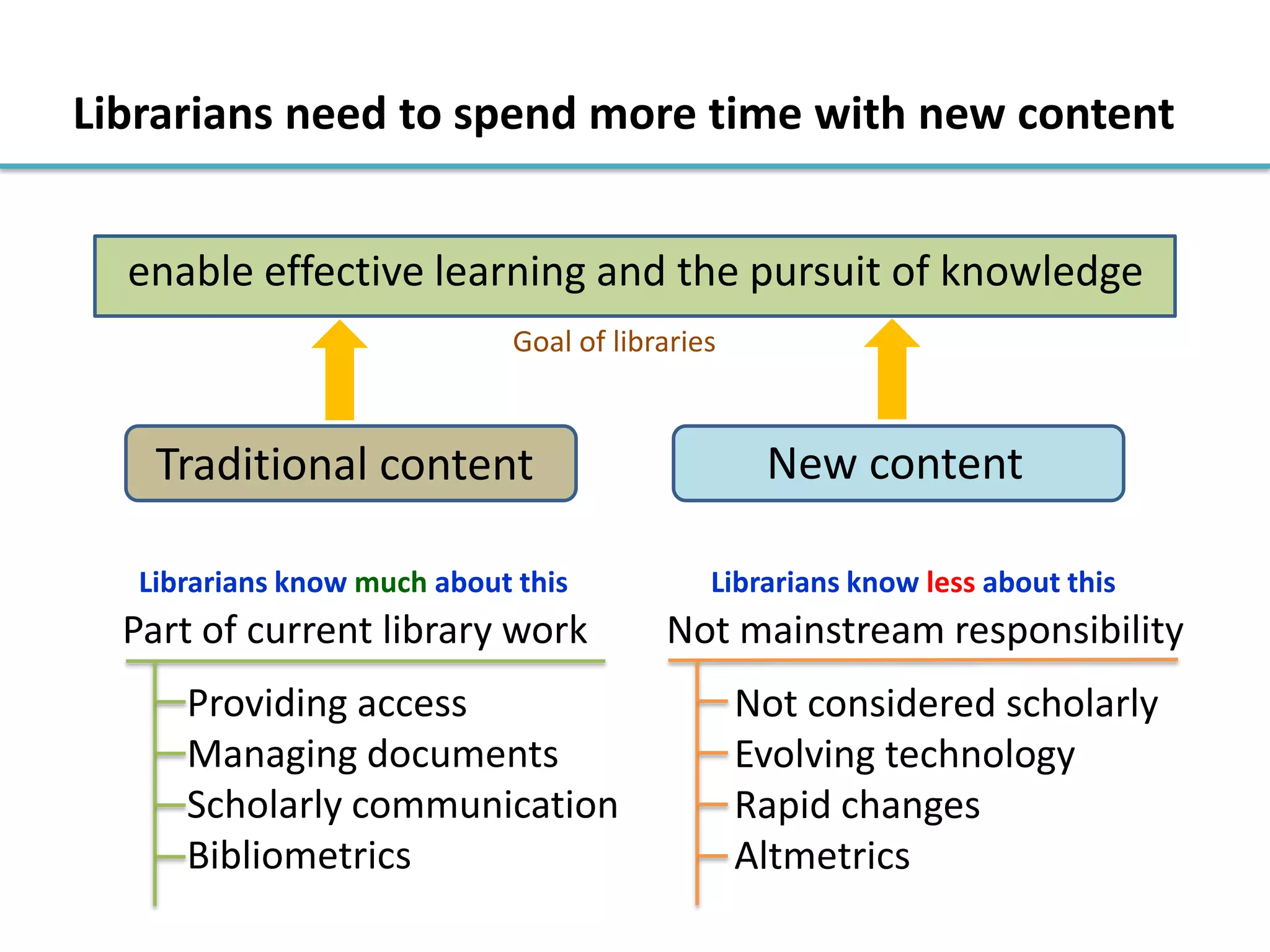
Librarians need to spend more time with new content
Traditional content New content
enable effective learning and the pursuit of knowledge
Goal of libraries
Librarians know much about this
Part of current library work
Providing access
Managing documents
Scholarly communication
Bibliometrics
Librarians know less about this
Not mainstream responsibility
Not considered scholarly
Evolving technology
Rapid changes
Altmetrics
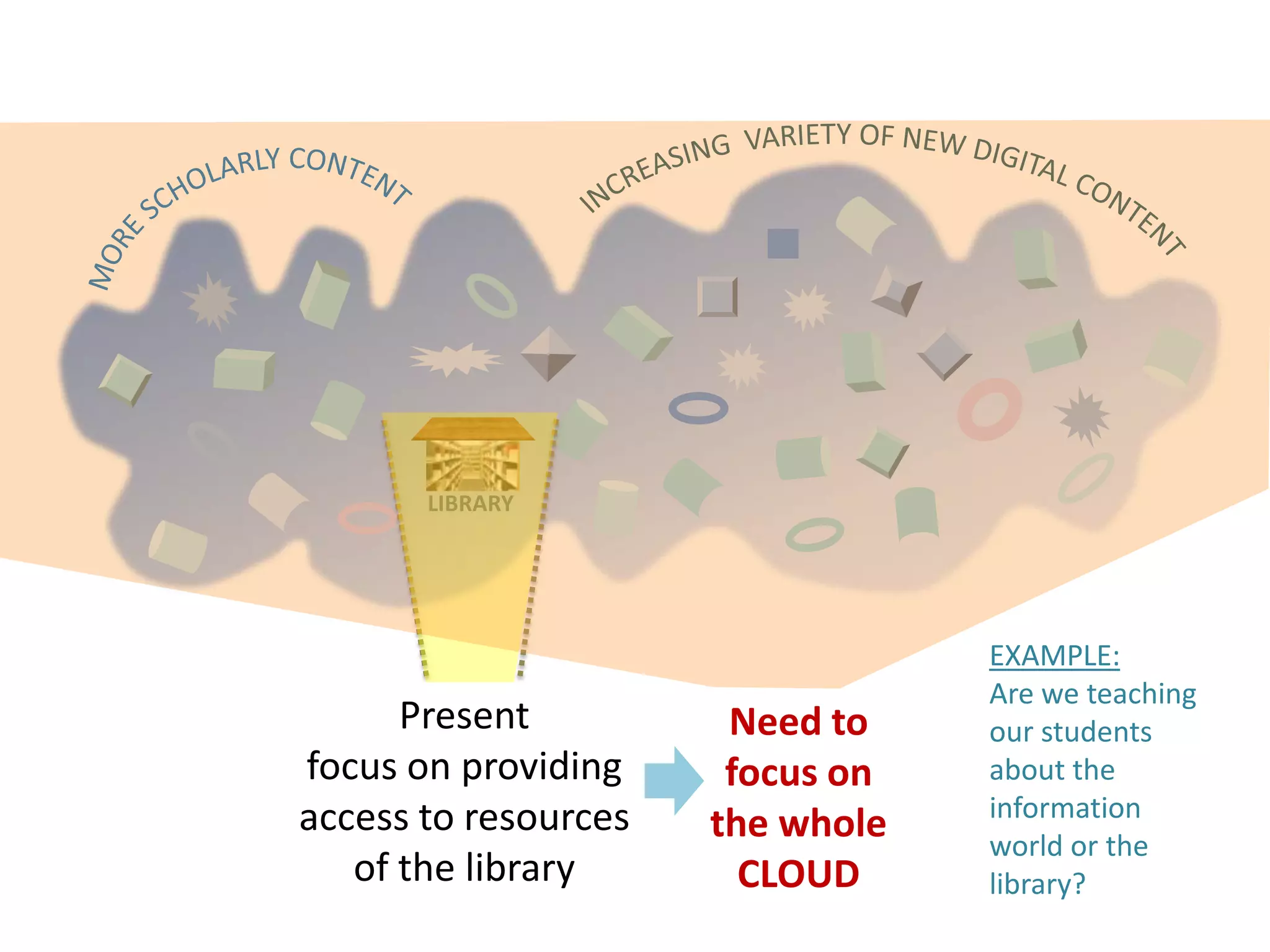
LIBRARY
Present
focus on providing
access to resources
of the library
Need to
focus on
the whole
CLOUD
EXAMPLE:
Are we teaching
our students
about the
information
world or the
library?
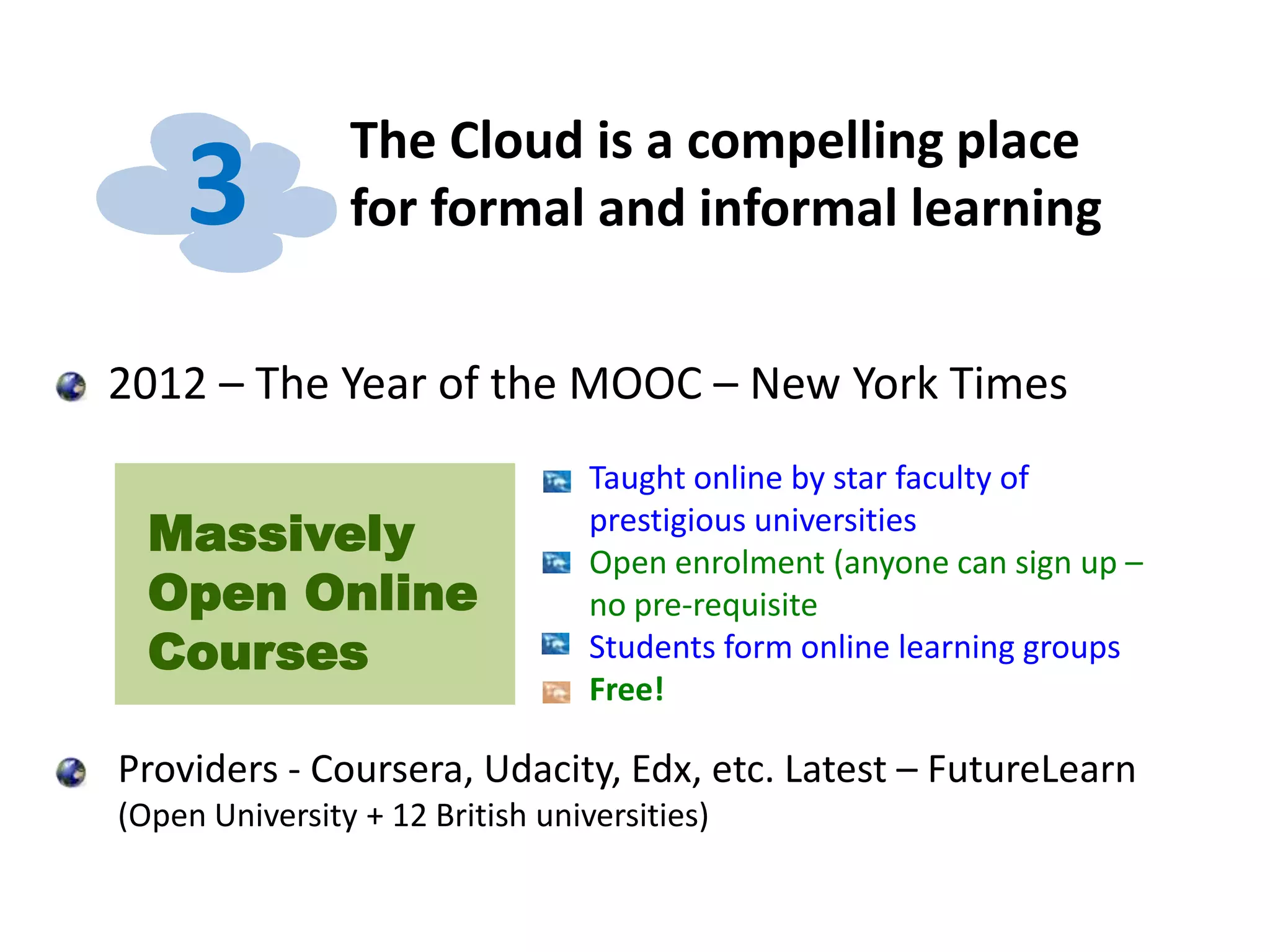
The Cloud is a compelling place
for formal and informal learning3
2012 – The Year of the MOOC – New York Times
Providers - Coursera, Udacity, Edx, etc. Latest – FutureLearn
(Open University + 12 British universities)
Massively
Open Online
Courses
Taught online by star faculty of
prestigious universities
Open enrolment (anyone can sign up –
no pre-requisite
Students form online learning groups
Free!
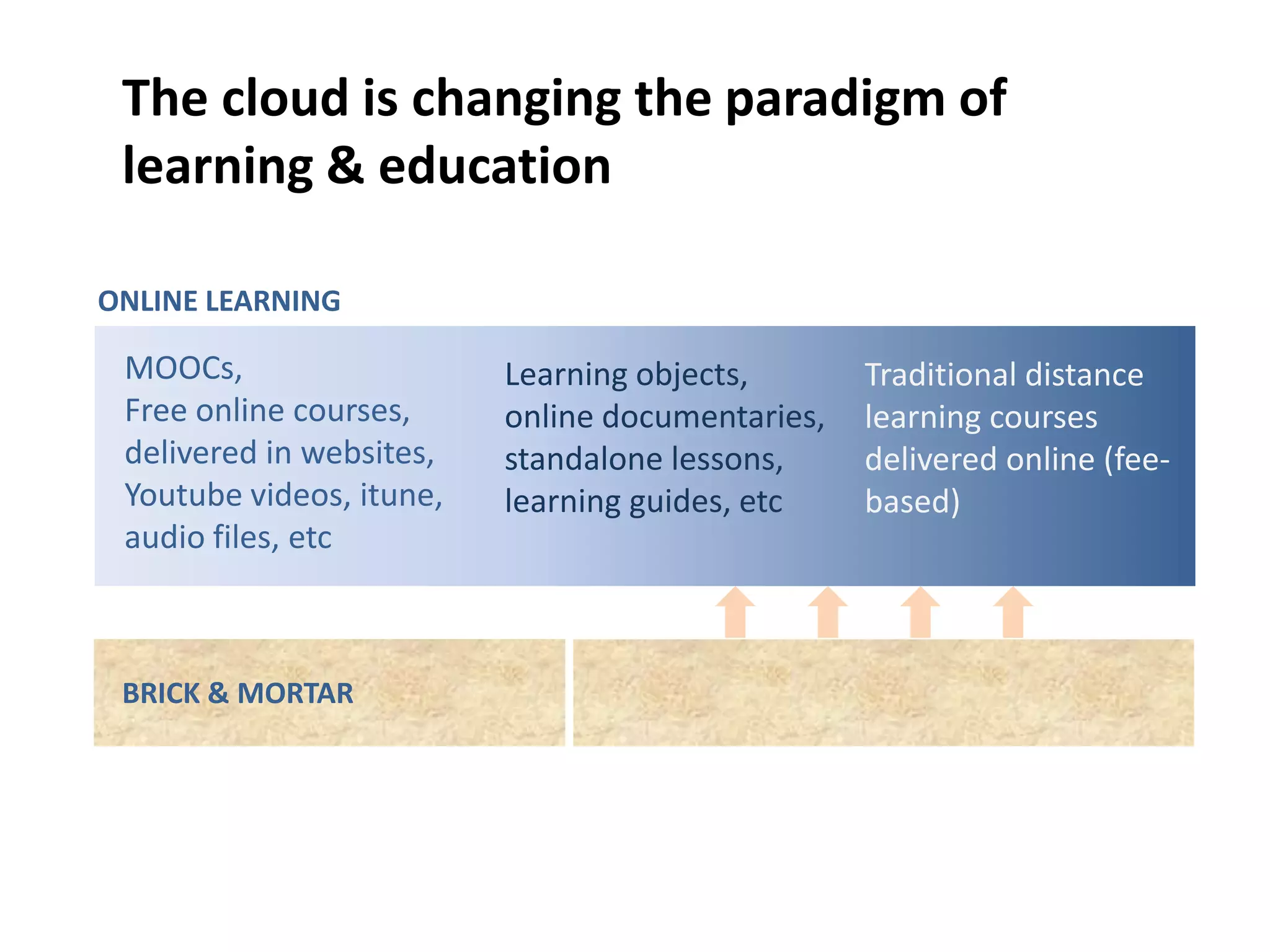
The cloud is changing the paradigm of
learning & education
MOOCs,
Free online courses,
delivered in websites,
Youtube videos, itune,
audio files, etc
Learning objects,
online documentaries,
standalone lessons,
learning guides, etc
Traditional distance
learning courses
delivered online (fee-
based)
ONLINE LEARNING
BRICK & MORTAR
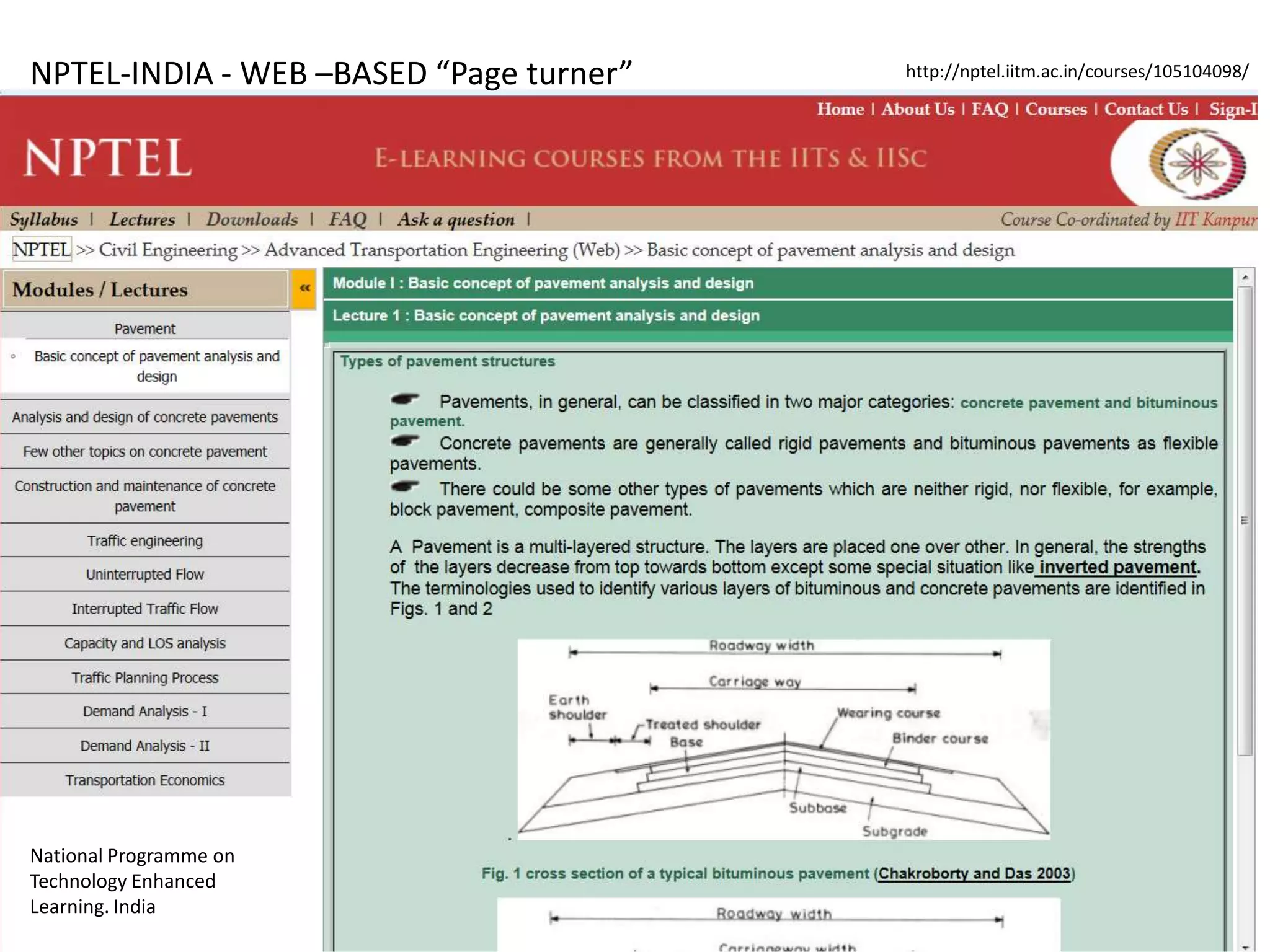
NPTEL-INDIA - WEB –BASED “Page turner” http://nptel.iitm.ac.in/courses/105104098/
National Programme on
Technology Enhanced
Learning. India
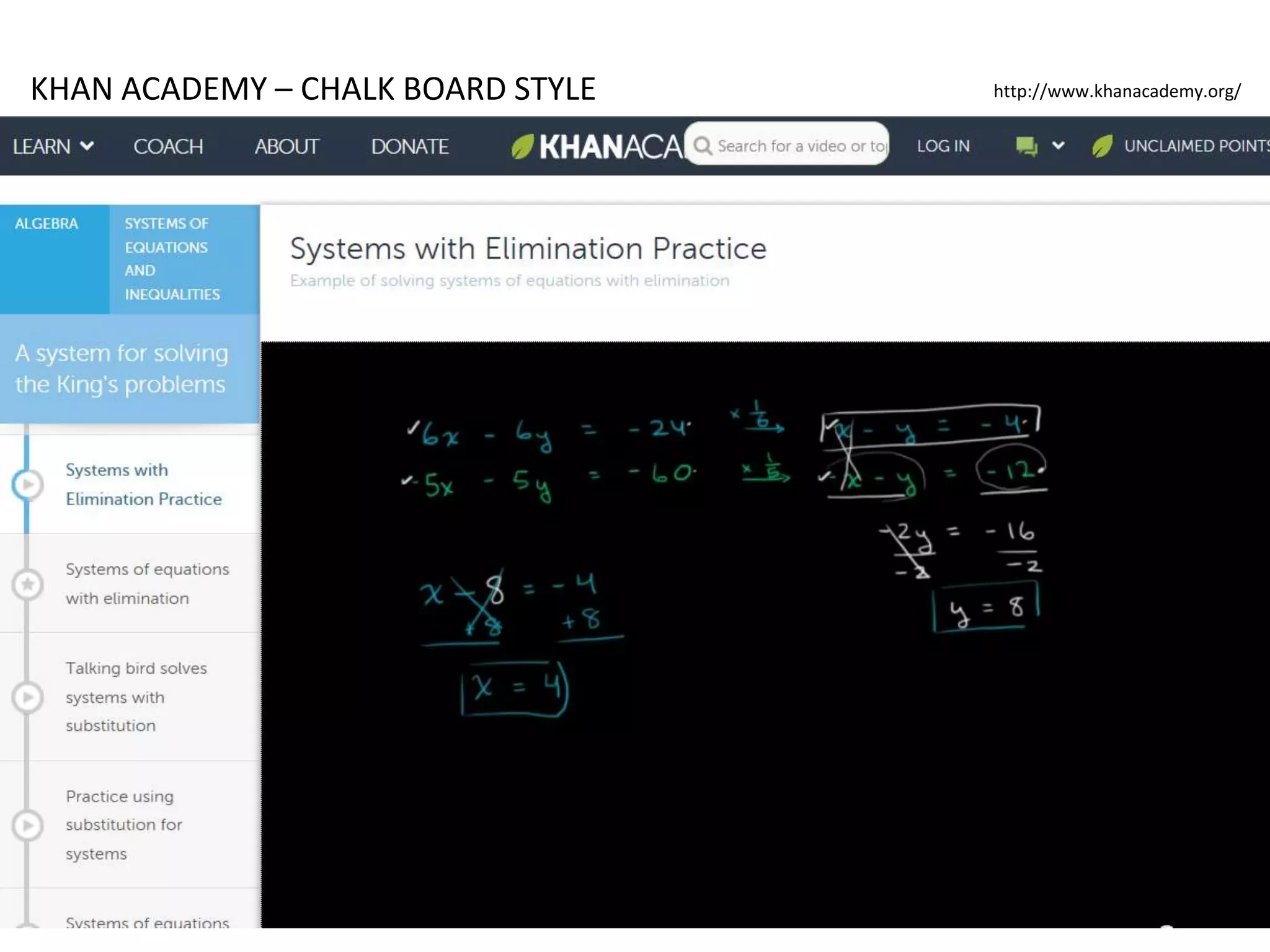
http://www.khanacademy.org/KHAN ACADEMY – CHALK BOARD STYLE
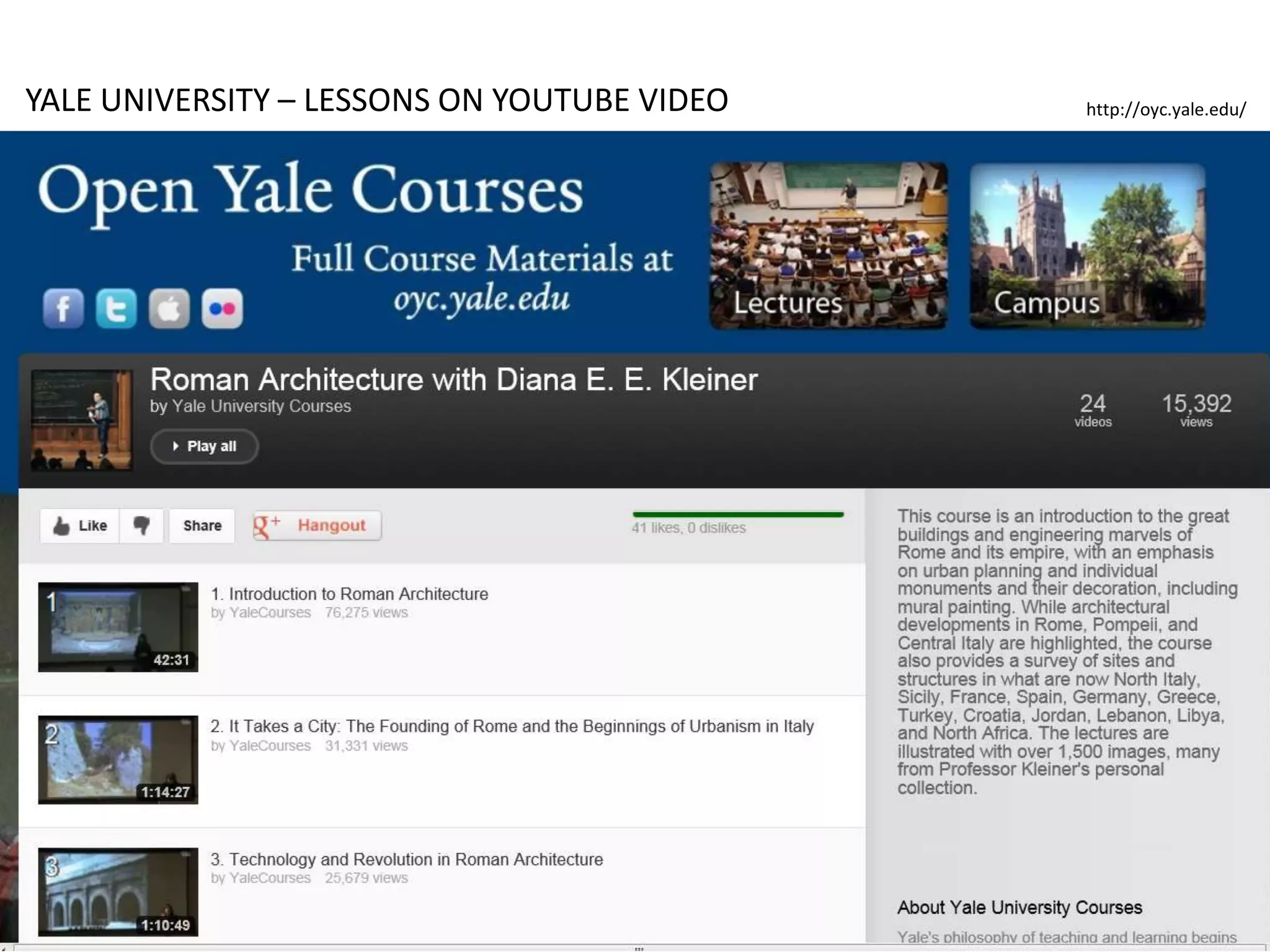
YALE UNIVERSITY – LESSONS ON YOUTUBE VIDEO http://oyc.yale.edu/
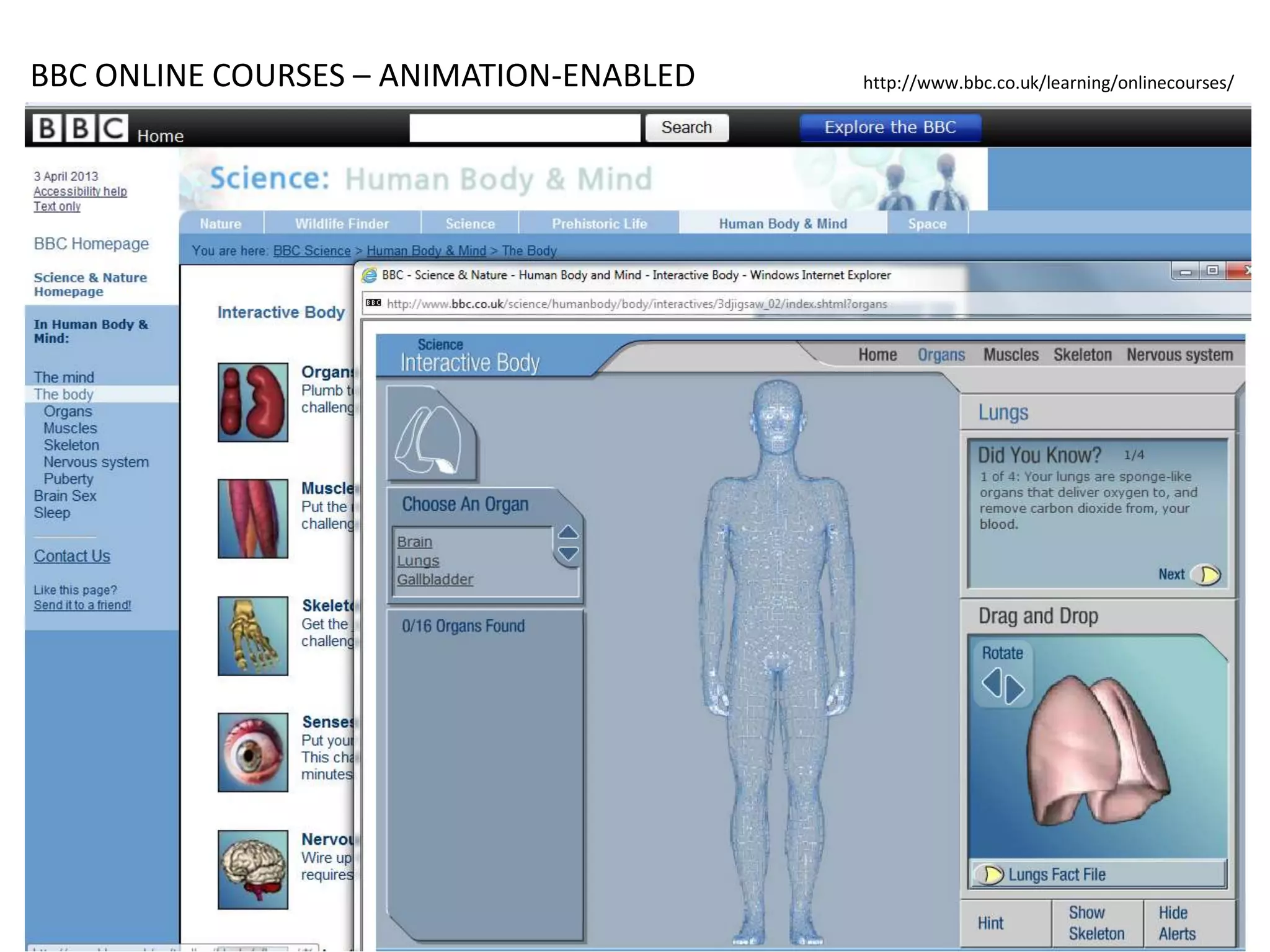
BBC ONLINE COURSES – ANIMATION-ENABLED http://www.bbc.co.uk/learning/onlinecourses/
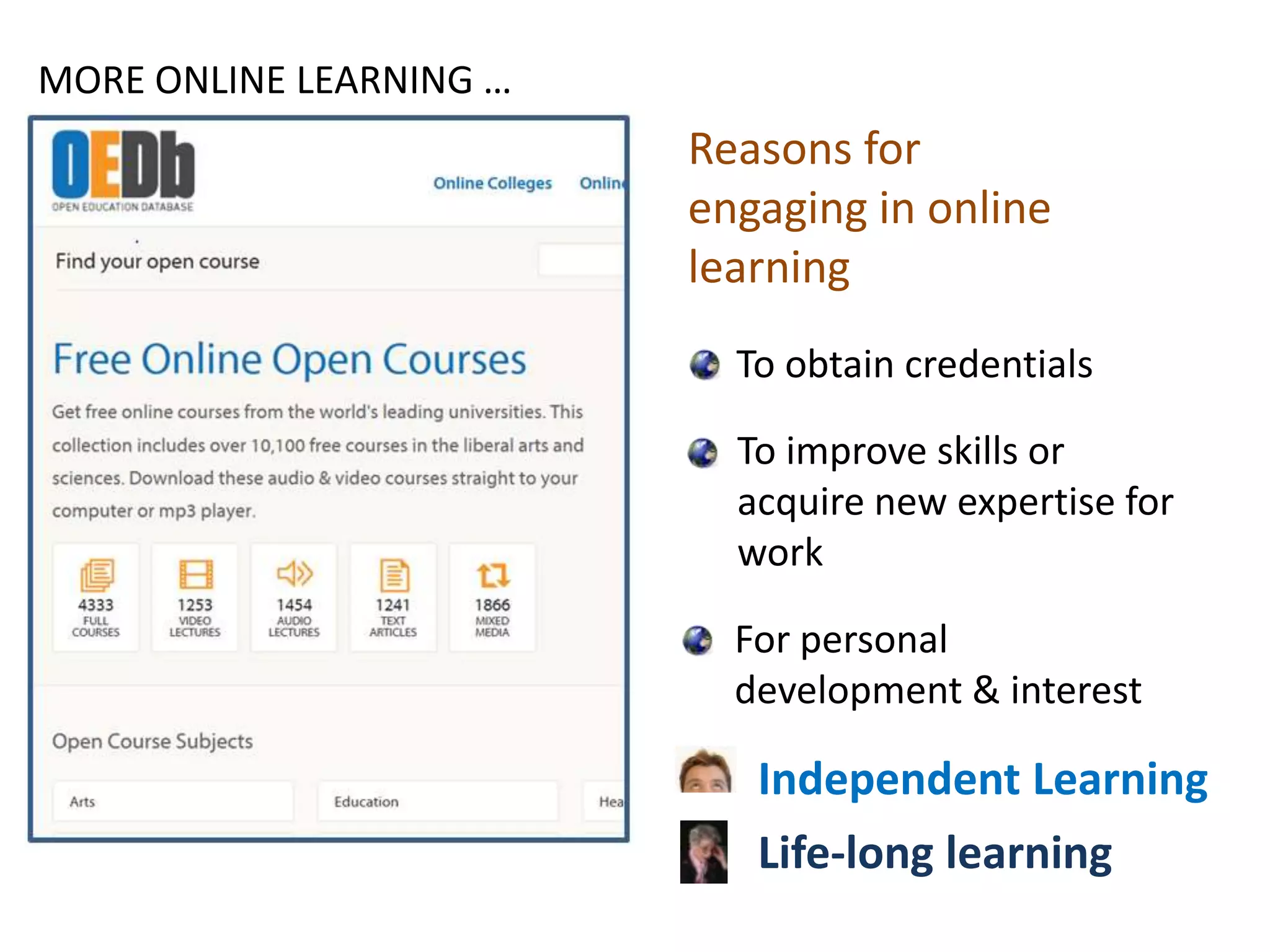
Reasons for
engaging in online
learning
To obtain credentials
To improve skills or
acquire new expertise for
work
For personal
development & interest
MORE ONLINE LEARNING …
Independent Learning
Life-long learning
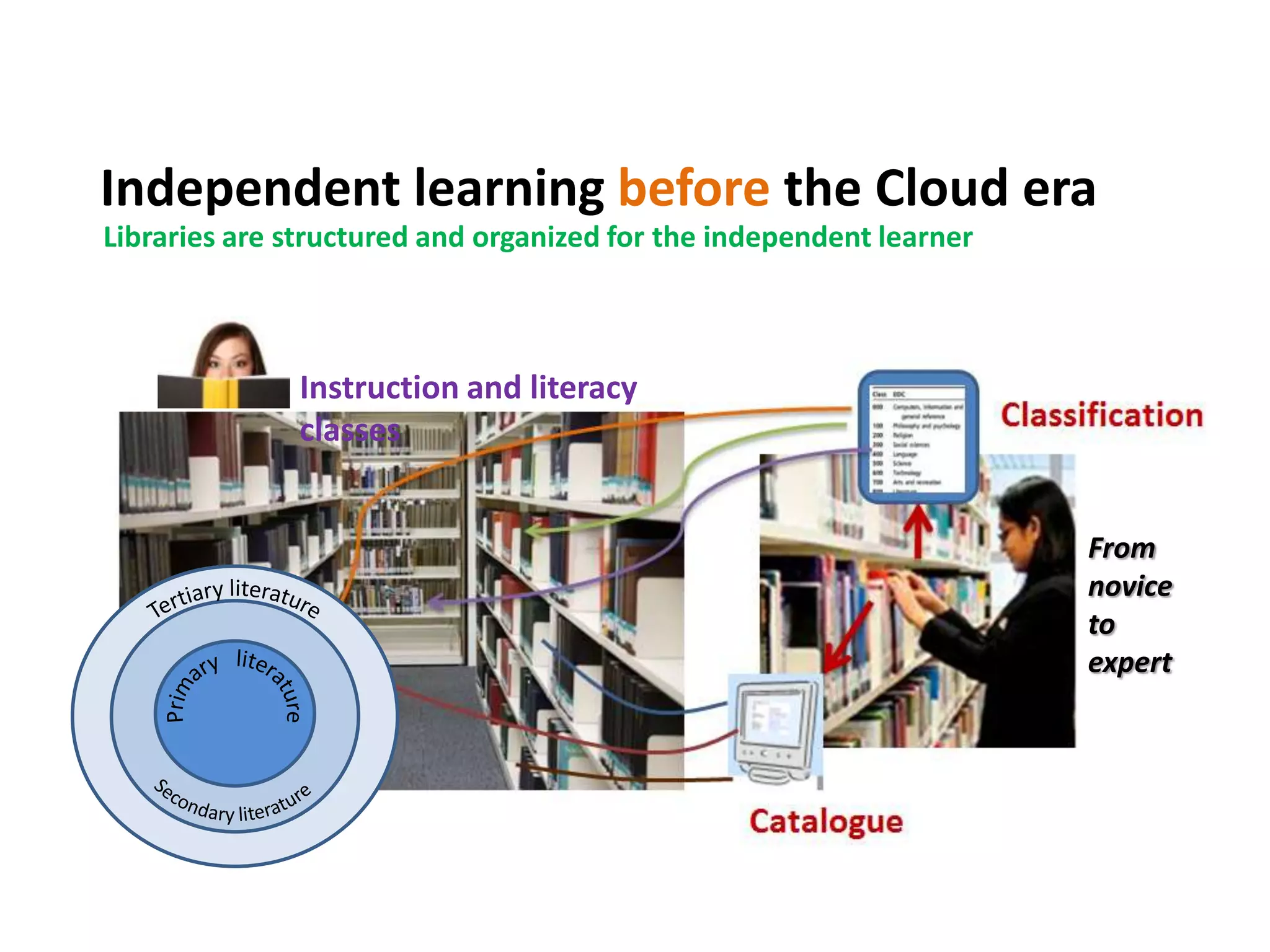
Independent learning before the Cloud era
Libraries are structured and organized for the independent learner
Instruction and literacy
classes
From
novice
to
expert
Independent learning in the Cloud era
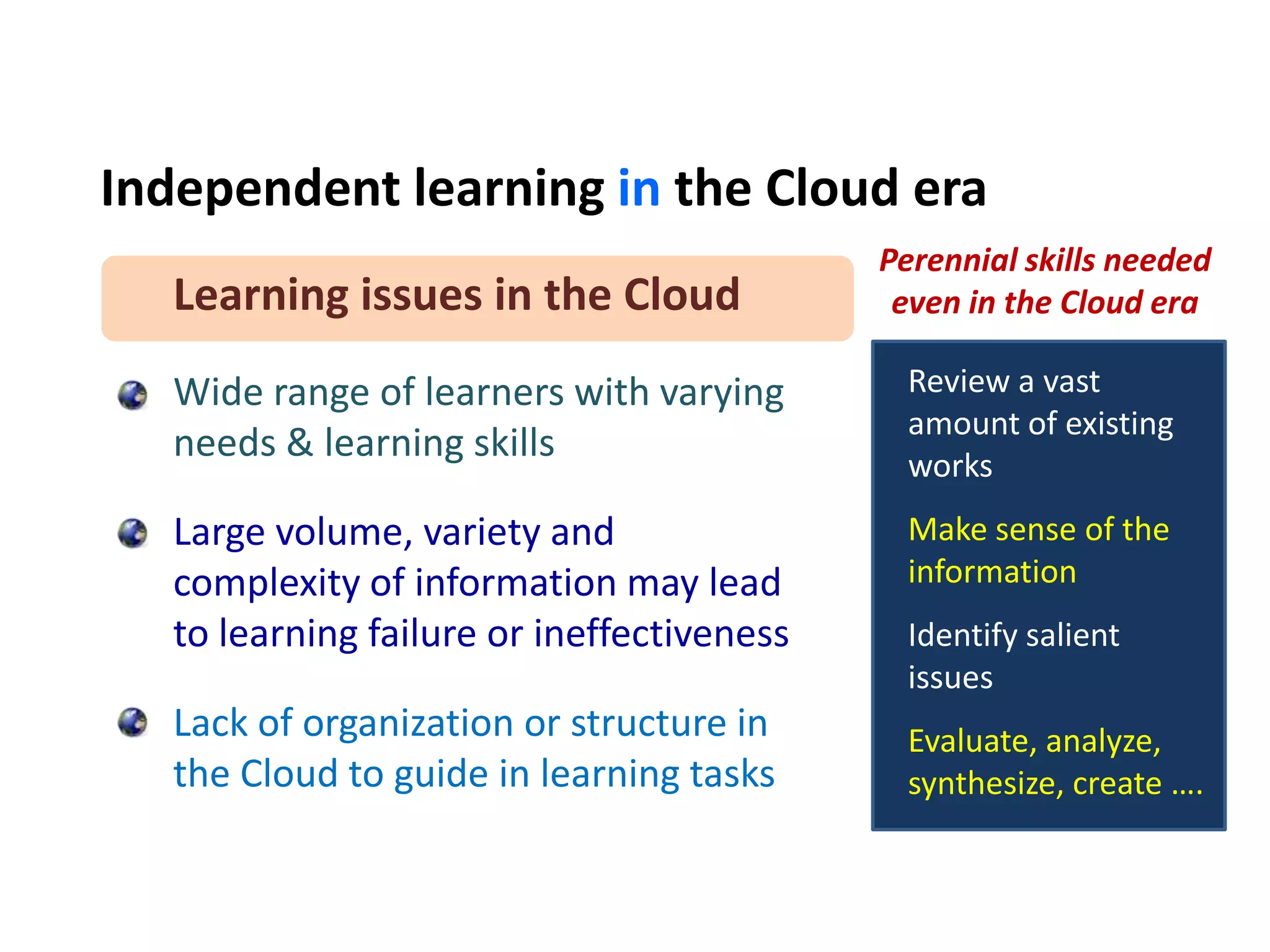
Learning issues in the Cloud
Wide range of learners with varying
needs & learning skills
Large volume, variety and
complexity of information may lead
to learning failure or ineffectiveness
Lack of organization or structure in
the Cloud to guide in learning tasks
Review a vast
amount of existing
works
Make sense of the
information
Identify salient
issues
Evaluate, analyze,
synthesize, create ….
Perennial skills needed
even in the Cloud era
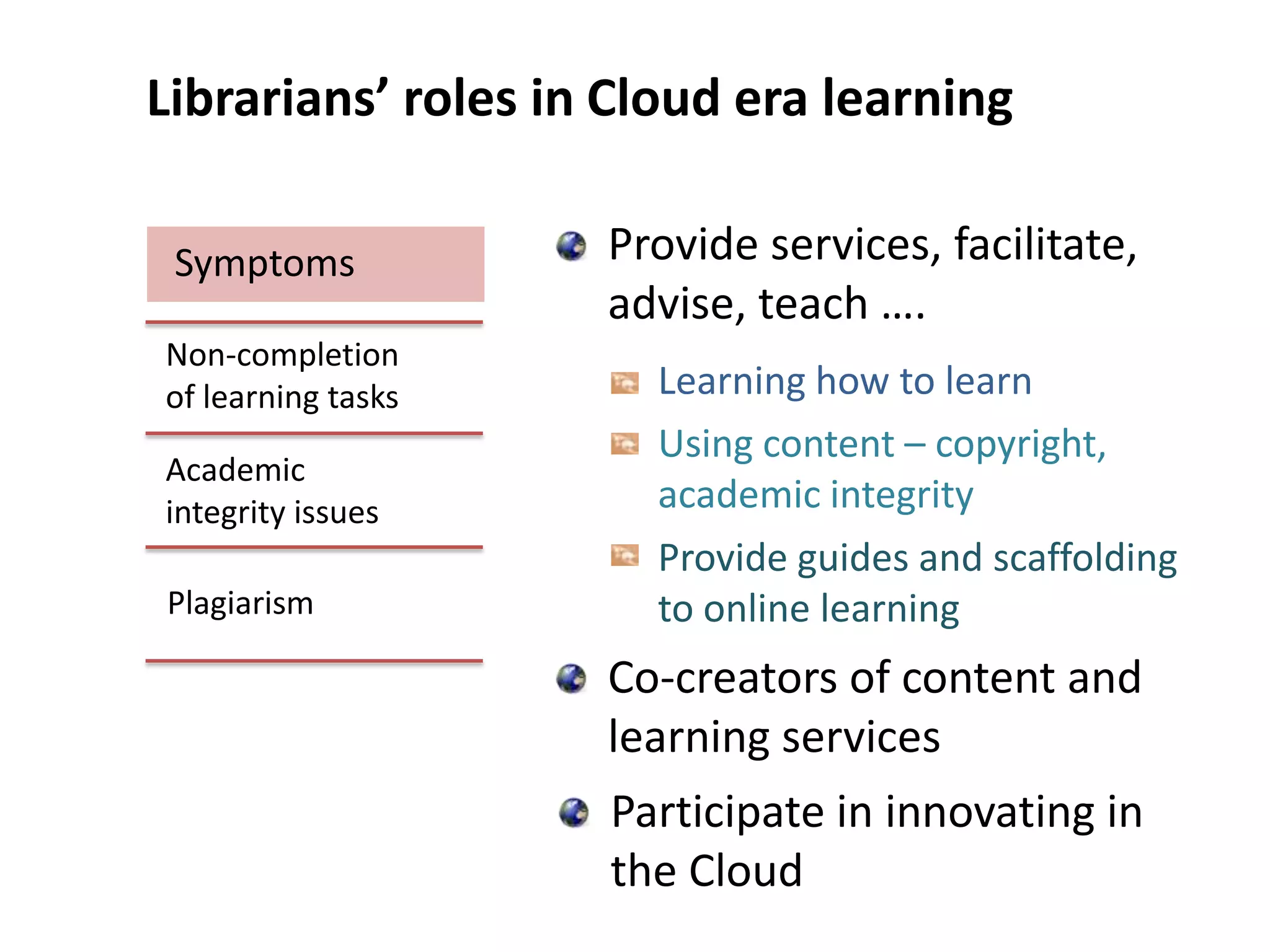
Librarians’ roles in Cloud era learning
Co-creators of content and
learning services
Symptoms
Academic
integrity issues
Plagiarism
Non-completion
of learning tasks Learning how to learn
Provide guides and scaffolding
to online learning
Using content – copyright,
academic integrity
Provide services, facilitate,
advise, teach ….
Participate in innovating in
the Cloud
CONCLUSION
The role of librarians is to facilitate the use of
information in learning and the pursuit of
knowledge and wisdom
LIBRARIANS - EVOLVING OR TRANSFORMING?

Ebsco hk-2013-choy fc

  • 1.
    Librarians in theCloud era – Evolving or transforming roles? CHOY FATT CHEONG University Librarian Nanyang Technological University Singapore fcchoy@ntu.edu.sg 2013 EBSCO User Seminar The Value of E-resource in the Cloud Era Hong Kong, 11 April 2013 Hotel Nikko Hong Kong
  • 2.
    SaaS (Software as aService) PaaS (Platform as a Service) IaaS (Infrastructure as a Service) THE INTERNET? A shared pool of digital resources, content & services accessible via the Internet
  • 3.
    Anything digital tendto move to the cloudLIBRARIES THE CLOUD
  • 4.
    THE CLOUD FOCUS ON Howwill it affect the work of libraries & librarians?
  • 5.
    THE CLOUD Increasing volume of “highquality” information is available for free in the Cloud The Cloud enables the growth and rapid development of innovative new content The Cloud is a compelling place for formal and informal learning Some general observations …..
  • 6.
    A key selling point “Libraries provideaccess to expensive scholarly content and high quality publications to their users which they don’t normally get from the Internet”. Still true Less so because of Open Access and increased use of new media Increasing volume of “high quality” information is available for free in the Cloud 1
  • 7.
    Recent Developments FASTR (US) White HouseDirective Finch report (UK) Public funds Research Output-Publications Should be freely available Rationale Momentum Open Access Mandates Research funding agencies 80 worldwide (A) More scholarly materials will be on Open Access Open access refers mainly to scholarly publications or content that are made available for free access to the public via the Internet.
  • 8.
    Green Mechanism Gold Continue subscription model More scholarly materialswill be on Open Access Depends on archival policy of publisher Via repositories With embargo Depends on APC (Article Processing Charges) Via OA journals Immediate access Maintaining repositories Encouraging deposits Manage funds for APC? Librarian’s role Monitor & respond to changes in open access environment & developments
  • 9.
    Open Access documentsin Google Scholar
  • 10.
    Academic blogging (B) Moreblog content from academics, professionals, experts and institutions Contribute to scholarship Secondary literature? Not peer reviewed, but blogger has reputation to protect Content related to their own work and publications Types of academic blogs Individual Group Institutional A hierarchy of value? Journal articles Conference papers Academic blogs Conversations /Discussions
  • 11.
  • 12.
  • 13.
  • 14.
    Reasons for academicblogging Fit in with current social environment & norms Alternative ways in disseminating their work/ideas Make quicker impact on the community Better engagement with public Establish online identity & reputation of author ACADEMIC BLOGGERS Fairly reliable content Reveal thought/ scholarly process Easier to understand (lead-in to more scholarly content) More immediate USERS
  • 15.
    EXAMPLE : blogs@ntu Librarian’srole – Supporting academic blogging KEEP TRACK OF & PROVIDE SUPPORT TO WHAT ACADEMICS ARE ENGAGING IN Usefulness of a central service Assistance in setup & design (e.g. provide custom-designed templates Training & technical support Provide updates on new features Archive & preserve content Promote use and outreach Affiliation with institution Potential in developing added-value service
  • 16.
    Example of blogsby academic staff using the blog@ntu service
  • 17.
    The Cloud enablesthe growth and rapid development of innovative new content 2 Traditional content New content Static, immutable, unchanging, stable, well-established in scholarship process e.g. books, journal articles, newspapers, reports, audio recordings, videos, films, broadcast, etc Continuously updated, fluid, interactive, open, shareable, non-linear, can be mixed, mashed up, data-mined, disaggregated, aggregated, e.g. Wikipedia & wikis, blogs & other blog-based content, data-sets, Twitter, Tumblr, etc.
  • 18.
    Characteristics of newcontent Digital technology evolving rapidly Rapid increase in new content type Is basis for current benchmarks in measuring scholarship activities Traditional content Not encouraged in scholarly and academic work – citability & impermanence issues Lack of traditional mode of authoritative stamp of approval Wildly popular Widely used Collaborative Immediate & quick Rapid innovation Watch this space!
  • 19.
    Librarians need tospend more time with new content Traditional content New content enable effective learning and the pursuit of knowledge Goal of libraries Librarians know much about this Part of current library work Providing access Managing documents Scholarly communication Bibliometrics Librarians know less about this Not mainstream responsibility Not considered scholarly Evolving technology Rapid changes Altmetrics
  • 20.
    LIBRARY Present focus on providing accessto resources of the library Need to focus on the whole CLOUD EXAMPLE: Are we teaching our students about the information world or the library?
  • 21.
    The Cloud isa compelling place for formal and informal learning3 2012 – The Year of the MOOC – New York Times Providers - Coursera, Udacity, Edx, etc. Latest – FutureLearn (Open University + 12 British universities) Massively Open Online Courses Taught online by star faculty of prestigious universities Open enrolment (anyone can sign up – no pre-requisite Students form online learning groups Free!
  • 22.
    The cloud ischanging the paradigm of learning & education MOOCs, Free online courses, delivered in websites, Youtube videos, itune, audio files, etc Learning objects, online documentaries, standalone lessons, learning guides, etc Traditional distance learning courses delivered online (fee- based) ONLINE LEARNING BRICK & MORTAR
  • 23.
    NPTEL-INDIA - WEB–BASED “Page turner” http://nptel.iitm.ac.in/courses/105104098/ National Programme on Technology Enhanced Learning. India
  • 24.
  • 25.
    YALE UNIVERSITY –LESSONS ON YOUTUBE VIDEO http://oyc.yale.edu/
  • 26.
    BBC ONLINE COURSES– ANIMATION-ENABLED http://www.bbc.co.uk/learning/onlinecourses/
  • 27.
    Reasons for engaging inonline learning To obtain credentials To improve skills or acquire new expertise for work For personal development & interest MORE ONLINE LEARNING … Independent Learning Life-long learning
  • 28.
    Independent learning beforethe Cloud era Libraries are structured and organized for the independent learner Instruction and literacy classes From novice to expert
  • 29.
    Independent learning inthe Cloud era Learning issues in the Cloud Wide range of learners with varying needs & learning skills Large volume, variety and complexity of information may lead to learning failure or ineffectiveness Lack of organization or structure in the Cloud to guide in learning tasks Review a vast amount of existing works Make sense of the information Identify salient issues Evaluate, analyze, synthesize, create …. Perennial skills needed even in the Cloud era
  • 30.
    Librarians’ roles inCloud era learning Co-creators of content and learning services Symptoms Academic integrity issues Plagiarism Non-completion of learning tasks Learning how to learn Provide guides and scaffolding to online learning Using content – copyright, academic integrity Provide services, facilitate, advise, teach …. Participate in innovating in the Cloud
  • 31.
    CONCLUSION The role oflibrarians is to facilitate the use of information in learning and the pursuit of knowledge and wisdom LIBRARIANS - EVOLVING OR TRANSFORMING?