Farewell Oracle EBS
A Smooth Exit
2 ©2018 eprentise. All rights reserved.
Learning Objectives
After completion of this presentation you will be able to:
Objective 1: Explore reasons why companies may choose to
move away from EBS now or in the future.
Objective 2: Explore why restructuring an existing EBS
environment beforehand is the best approach for migrating.
Objective 3: Learn steps to streamline your EBS environment
for a more efficient, cleaner and faster transition.
3 ©2018 eprentise. All rights reserved.
Companies Need to Change Their Oracle®
E-Business Suite Without Reimplementing
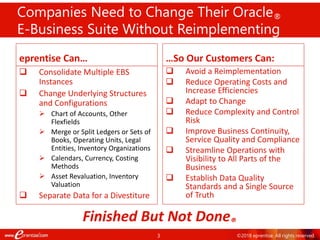
eprentise Can…
 Consolidate Multiple EBS
Instances
 Change Underlying Structures
and Configurations
 Chart of Accounts, Other
Flexfields
 Merge or Split Ledgers or Sets of
Books, Operating Units, Legal
Entities, Inventory Organizations
 Calendars, Currency, Costing
Methods
 Asset Revaluation, Inventory
Valuation
 Separate Data for a Divestiture
…So Our Customers Can:
 Avoid a Reimplementation
 Reduce Operating Costs and
Increase Efficiencies
 Adapt to Change
 Reduce Complexity and Control
Risk
 Improve Business Continuity,
Service Quality and Compliance
 Streamline Operations with
Visibility to All Parts of the
Business
 Establish Data Quality
Standards and a Single Source
of Truth
Finished But Not Done®
5 ©2018 eprentise. All rights reserved.
 Introduction
 Business Scenarios and Challenges for…
 Multiple Instances, Different Charts of Accounts, Divestures,
Multiple Calendars, Unused Data
 Why eprentise?
 Out-of-the-box Software
 Proven Methodology and Approach
 Benefits
 Roles and Responsibilities and Project Post-Steps
 Getting Started
Outline
6 ©2018 eprentise. All rights reserved.
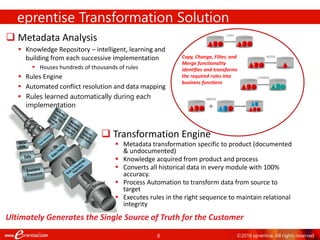
Copy, Change, Filter, and
Merge functionality
identifies and transforms
the required rules into
business functions
eprentise Transformation Solution
Ultimately Generates the Single Source of Truth for the Customer
 Transformation Engine
 Metadata transformation specific to product (documented
& undocumented)
 Knowledge acquired from product and process
 Converts all historical data in every module with 100%
accuracy.
 Process Automation to transform data from source to
target
 Executes rules in the right sequence to maintain relational
integrity
 Metadata Analysis
 Knowledge Repository – intelligent, learning and
building from each successive implementation
 Houses hundreds of thousands of rules
 Rules Engine
 Automated conflict resolution and data mapping
 Rules learned automatically during each
implementation
7 ©2018 eprentise. All rights reserved.
 You are moving to Oracle Cloud (Fusion/SAAS)
 There is no direct migration path to Oracle Cloud from EBS
 You are moving to the Cloud (IAAS, PAAS)
 You’ve been acquired
 The acquiring company does not use Oracle E-Business Suite
(EBS)
 The plan is to move to SAP or Dynamic or Netsuite or another
ERP system within the next two years
 You have been divested from a parent company who
used Oracle EBS, and you need a smaller, stand-alone
footprint that you can manage with fewer resources
The Business Scenarios
8 ©2018 eprentise. All rights reserved.
 Data needs to be extracted from multiple systems
 Different formats in each system
 Different configurations in each system
 Ledgers, Operating Units, Inventory Orgs
 Charts of Accounts
 Calendars
 Inconsistent business processes
 Duplicate data
 Master data
 IDs (document sequence numbers, invoice numbers, etc.)
 Multiple interfacing systems and customizations
 Coordination and synchronization of extracts
 Multiple teams – possibly of hundreds of technical consultants for
each team
 Different extract scripts, error handling, unit testing of code
Challenge: Multiple Instances
9 ©2018 eprentise. All rights reserved.
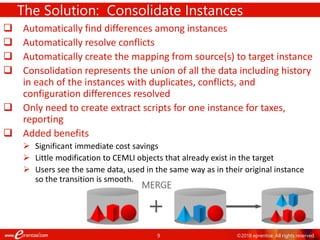
 Automatically find differences among instances
 Automatically resolve conflicts
 Automatically create the mapping from source(s) to target instance
 Consolidation represents the union of all the data including history
in each of the instances with duplicates, conflicts, and
configuration differences resolved
 Only need to create extract scripts for one instance for taxes,
reporting
 Added benefits
 Significant immediate cost savings
 Little modification to CEMLI objects that already exist in the target
 Users see the same data, used in the same way as in their original instance
so the transition is smooth.
The Solution: Consolidate Instances
10 ©2018 eprentise. All rights reserved.
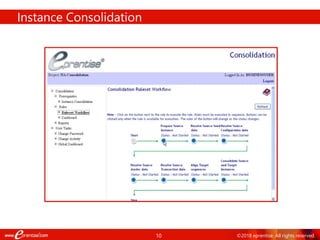
Instance Consolidation
11 ©2018 eprentise. All rights reserved.
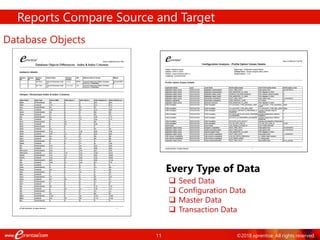
Reports Compare Source and Target
Database Objects
 Seed Data
 Configuration Data
 Master Data
 Transaction Data
Every Type of Data
12 ©2018 eprentise. All rights reserved.
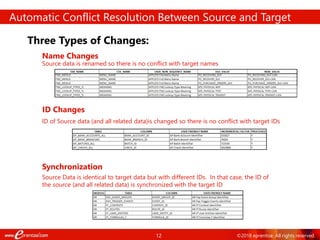
Automatic Conflict Resolution Between Source and Target
Three Types of Changes:
ID of Source data (and all related data)is changed so there is no conflict with target IDs
Source Data is identical to target data but with different IDs. In that case, the ID of
the source (and all related data) is synchronized with the target ID
Source data is renamed so there is no conflict with target names
Synchronization
Name Changes
ID Changes
13 ©2018 eprentise. All rights reserved.
 You have many different charts of accounts
 Many systems do not accommodate multiple charts of
accounts
 You need many external products/modules/features (HFM,
custom reports, GL Consolidation, secondary ledgers, etc.) to
close each month
 Each of those charts of accounts will need to be transformed
before migrating into the new system
 Your chart of accounts does not match the acquired
company’s chart of accounts
Challenge: Different Charts of Accounts
14 ©2018 eprentise. All rights reserved.
 There is no software product like eprentise’s FlexField
product for EBS for any other ERP system
 Add additional segments
 Eliminate redundant information across segments
 Eliminate unused values
 Restructure to align with the new ERP and new business
requirements
 Allow for growth in existing segments
 Simplify for financial management, shortening the close
cycle, reporting, compliance with statutory and
regulatory requirements, and integration with 3rd party
applications
The Solution: Change Charts of Accounts with
FlexField Software
15 ©2018 eprentise. All rights reserved.
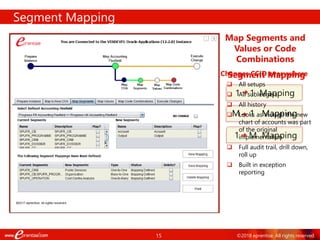
Segment Mapping
Map Segments and
Values or Code
Combinations
Segment Mapping
1 1 Mapping
M 1 Mapping
1 M Mapping
Changes CCID everywhere
 All setups
 All subledgers
 All history
 Looks as though the new
chart of accounts was part
of the original
implementation
 Full audit trail, drill down,
roll up
 Built in exception
reporting
16 ©2018 eprentise. All rights reserved.
 You have been divested from a parent company who
used Oracle EBS, and you need a smaller, stand-alone
footprint that you can manage with fewer resources
 Acquiring company doesn’t want all divisions
 Acquiring entity is planning on doing a flip of selected
lines of business
 Only a few divisions are going to be integrated into the
new ERP
Challenge: Carve-out is Sold to Different
Company
17 ©2018 eprentise. All rights reserved.
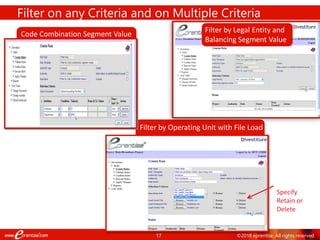
Filter on any Criteria and on Multiple Criteria
Specify
Retain or
Delete
Code Combination Segment Value
Filter by Operating Unit with File Load
Filter by Legal Entity and
Balancing Segment Value
18 ©2018 eprentise. All rights reserved.
 There may be a statutory or regulatory requirement to have
a different year-end, change the number of periods, or to
change the period dates to align with an acquiring
company’s systems.
 In the case of an acquisition, preparing consolidated
financial reports and revaluing assets must be completed
shortly after the acquisition date.
 It is useful to have year-over-year reports and projections
with the same periods to obtain an accurate financial picture
of an acquired company.
 Multiple calendars require additional custom extract,
transform, and load scripts and make the migration to a new
system more difficult.
Challenge: Different Calendars
19 ©2018 eprentise. All rights reserved.
 Over time, as companies grow by acquisition and sell parts of their
business, EBS accumulates data that the current business does not need
 Historical data from an acquired system that does not belong to the current
company
 Data from divisions that have been divested
 Modules that are no-longer in use or have been replaced by another system
 Localizations that are not needed for the new company
 Ledgers, operating units, inventory orgs are redundant and make EBS
more complex
 Data that exists after a “start-over” when a new ledger or legal entity or
operating unit was created and the old, historical data is beyond the required
retention period
 Migration is more complex when there are duplicate business processes
 The “garbage-in”, “garbage-out” means that reporting and operations in the
new system will inherit the same issues that you had within your EBS
environment that made your close cycle longer, reconciliation more complex,
and required extensive use of spreadsheets and third-party systems
 Data in the new system will not be complete, consistent, and correct
Challenge: Too Much “Unused” Data
Challenge: Streamline and Simplify
20 ©2018 eprentise. All rights reserved.
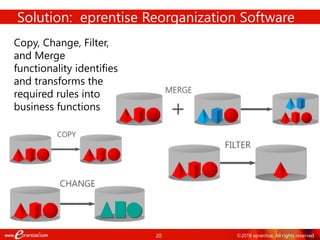
Solution: eprentise Reorganization Software
Copy, Change, Filter,
and Merge
functionality identifies
and transforms the
required rules into
business functions
21 ©2018 eprentise. All rights reserved.
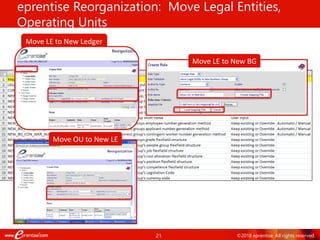
Move LE to New Ledger
eprentise Reorganization: Move Legal Entities,
Operating Units
Move OU to New LE
Move LE to New BG
22 ©2018 eprentise. All rights reserved.
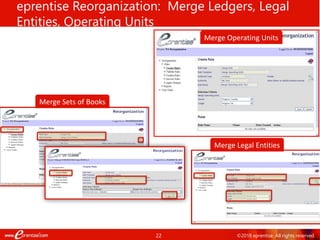
eprentise Reorganization: Merge Ledgers, Legal
Entities, Operating Units
Merge Operating Units
Merge Sets of Books
Merge Legal Entities
23 ©2018 eprentise. All rights reserved.
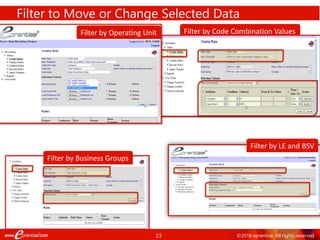
Filter to Move or Change Selected Data
Filter by Code Combination Values
Filter by LE and BSV
Filter by Business Groups
Filter by Operating Unit
24 ©2018 eprentise. All rights reserved.
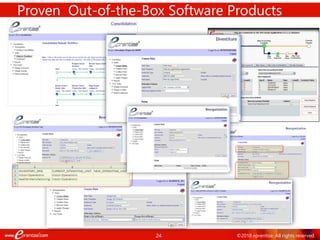
Proven Out-of-the-Box Software Products
25 ©2018 eprentise. All rights reserved.
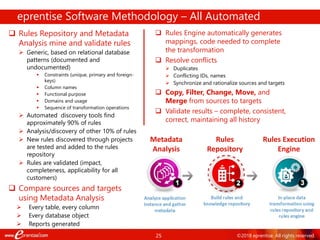
eprentise Software Methodology – All Automated
 Rules Repository and Metadata
Analysis mine and validate rules
 Generic, based on relational database
patterns (documented and
undocumented)
 Constraints (unique, primary and foreign-
keys)
 Column names
 Functional purpose
 Domains and usage
 Sequence of transformation operations
 Automated discovery tools find
approximately 90% of rules
 Analysis/discovery of other 10% of rules
 New rules discovered through projects
are tested and added to the rules
repository
 Rules are validated (impact,
completeness, applicability for all
customers)
 Compare sources and targets
using Metadata Analysis
 Every table, every column
 Every database object
 Reports generated
 Rules Engine automatically generates
mappings, code needed to complete
the transformation
 Resolve conflicts
 Duplicates
 Conflicting IDs, names
 Synchronize and rationalize sources and targets
 Copy, Filter, Change, Move, and
Merge from sources to targets
 Validate results – complete, consistent,
correct, maintaining all history
Metadata
Analysis
Rules
Repository
Rules Execution
Engine
26 ©2018 eprentise. All rights reserved.
 Complex Business Challenges can not be met with Typical Conversion Approach:
 Data between disparate systems doesn’t lend itself to simple mapping
 Effect of change on underlying database structure complicates the process
 Users and engineers are often unaware of these intricate, complex issues
 Changes can impact thousands of tables and columns
 What transformation offers over conversion:
 Maintaining database integrity
 Ultimate delivery of consistent data
 Complete, 100% accurate set of historical financial (and other) transactions
 Ability to support various situations (mergers and acquisitions, divestitures etc.)
 Increased data quality
 Repeatable process reduces risk
 Consistency and completeness:
 Code is dynamically generated to implement require changes which eliminates coding errors
 Rules execution engine saves the time and cost of custom coding and error handling, and reduces the
risk of compromising the data integrity
 Definition, design and re-use of rules
 Permits modeling scenarios as requirements change
 Enables fastest and safest time-to-value:
 Reduces project timelines and costs, allowing IT executives to more efficiently manage the project
 Improves accuracy and predictability
Why is the eprentise Transformation Solution Different
Than Traditional Consulting Migration, Integration, or
Conversion Projects?
27 ©2018 eprentise. All rights reserved.
 Easier migration to the Cloud
 Clean data to go into a new ERP or to Fusion
 Simplified structures that reflect the current business
environment
 Easier and faster migration path to new ERP
 Alignment of the business
 Easier for users to recognize their data in a new environment
 Clean audit trail before the move
 Less expensive than trying to transform the data once you
are in the new environment
 Ability to purge data that is no longer needed for the new
ERP
The Benefits
Planning for the Transition with eprentise
28 ©2018 eprentise. All rights reserved.
 No other software products in market for any transformation
 Many system integrators have scripts that they run
 Equivalent to custom code for each customer
 Has not gone through extensive testing, code review, or impact assessment
 Requires very qualified technical consultants or there is a significant risk of data
corruption or violating the relational integrity
 Qualified consultants are not readily available and are only assigned to one
project at a time.
 Most often for eprentise customers the competitive solution considered
was a reimplementation (setting up a new environment, or a new
organization unit from scratch). The alternatives:
 Typically migrate only a year’s data and beginning balances
 Data is extracted, transformed and loaded into new environment
 Requires maintaining a sunset environment for audits, compliance, and historical
data
 Often takes more than a year, and can cost millions of dollars
 Neither migration scripts or a reimplementation can accommodate
changing requirements either during the duration of the project, or
afterwards without a significant amount of recoding
eprentise Offers a Competitive Solution
29 ©2018 eprentise. All rights reserved.
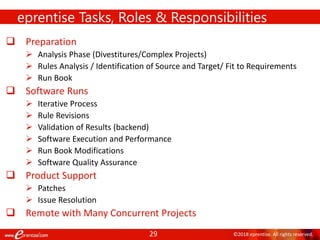
 Preparation
 Analysis Phase (Divestitures/Complex Projects)
 Rules Analysis / Identification of Source and Target/ Fit to Requirements
 Run Book
 Software Runs
 Iterative Process
 Rule Revisions
 Validation of Results (backend)
 Software Execution and Performance
 Run Book Modifications
 Software Quality Assurance
 Product Support
 Patches
 Issue Resolution
 Remote with Many Concurrent Projects
eprentise Tasks, Roles & Responsibilities
30 ©2018 eprentise. All rights reserved.
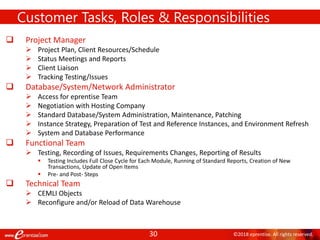
 Project Manager
 Project Plan, Client Resources/Schedule
 Status Meetings and Reports
 Client Liaison
 Tracking Testing/Issues
 Database/System/Network Administrator
 Access for eprentise Team
 Negotiation with Hosting Company
 Standard Database/System Administration, Maintenance, Patching
 Instance Strategy, Preparation of Test and Reference Instances, and Environment Refresh
 System and Database Performance
 Functional Team
 Testing, Recording of Issues, Requirements Changes, Reporting of Results
 Testing Includes Full Close Cycle for Each Module, Running of Standard Reports, Creation of New
Transactions, Update of Open Items
 Pre- and Post- Steps
 Technical Team
 CEMLI Objects
 Reconfigure and/or Reload of Data Warehouse
Customer Tasks, Roles & Responsibilities
31 ©2018 eprentise. All rights reserved.
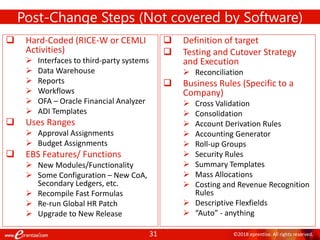
Post-Change Steps (Not covered by Software)
 Hard-Coded (RICE-W or CEMLI
Activities)
 Interfaces to third-party systems
 Data Warehouse
 Reports
 Workflows
 OFA – Oracle Financial Analyzer
 ADI Templates
 Uses Ranges
 Approval Assignments
 Budget Assignments
 EBS Features/ Functions
 New Modules/Functionality
 Some Configuration – New CoA,
Secondary Ledgers, etc.
 Recompile Fast Formulas
 Re-run Global HR Patch
 Upgrade to New Release
 Definition of target
 Testing and Cutover Strategy
and Execution
 Reconciliation
 Business Rules (Specific to a
Company)
 Cross Validation
 Consolidation
 Account Derivation Rules
 Accounting Generator
 Roll-up Groups
 Security Rules
 Summary Templates
 Mass Allocations
 Costing and Revenue Recognition
Rules
 Descriptive Flexfields
 “Auto” - anything
32 ©2018 eprentise. All rights reserved.
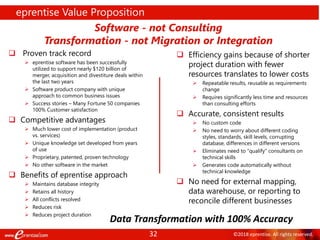
eprentise Value Proposition
 Proven track record
 eprentise software has been successfully
utilized to support nearly $120 billion of
merger, acquisition and divestiture deals within
the last two years
 Software product company with unique
approach to common business issues
 Success stories – Many Fortune 50 companies
100% Customer satisfaction
 Competitive advantages
 Much lower cost of implementation (product
vs. services)
 Unique knowledge set developed from years
of use
 Proprietary, patented, proven technology
 No other software in the market
 Benefits of eprentise approach
 Maintains database integrity
 Retains all history
 All conflicts resolved
 Reduces risk
 Reduces project duration
 Efficiency gains because of shorter
project duration with fewer
resources translates to lower costs
 Repeatable results, reusable as requirements
change
 Requires significantly less time and resources
than consulting efforts
 Accurate, consistent results
 No custom code
 No need to worry about different coding
styles, standards, skill levels, corrupting
database, differences in different versions
 Eliminates need to “qualify” consultants on
technical skills
 Generates code automatically without
technical knowledge
 No need for external mapping,
data warehouse, or reporting to
reconcile different businesses
Software - not Consulting
Transformation - not Migration or Integration
Data Transformation with 100% Accuracy
33 ©2018 eprentise. All rights reserved.
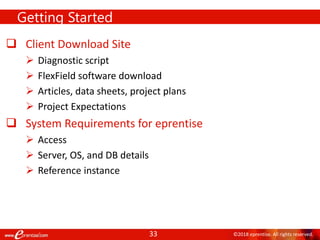
 Client Download Site
 Diagnostic script
 FlexField software download
 Articles, data sheets, project plans
 Project Expectations
 System Requirements for eprentise
 Access
 Server, OS, and DB details
 Reference instance
Getting Started
34 ©2018 eprentise. All rights reserved.
Questions?
35 ©2018 eprentise. All rights reserved.
Thank You!
- One World, One System, A Single Source of Truth -
Helene Abrams
CEO, eprentise
habrams@eprentise.com
407.591.4950
Hosted by eprentise | www.eprentise.com | www.AgilityByDesign.com
Questions and Responses will be posted on EBS Answers:
http://www.linkedin.com/groups/EBS-Answers-4683349/about
39 ©2018 eprentise. All rights reserved.
Thank You!
Contacts
- One World, One System, A Single Source of Truth -
Helene Abrams
407.591.4952
habrams@eprentise.com
www.eprentise.com
www.AgilityByDesign.com

Farewell Oracle EBS: A Smooth Exit

  • 1.
  • 2.
    2 ©2018 eprentise.All rights reserved. Learning Objectives After completion of this presentation you will be able to: Objective 1: Explore reasons why companies may choose to move away from EBS now or in the future. Objective 2: Explore why restructuring an existing EBS environment beforehand is the best approach for migrating. Objective 3: Learn steps to streamline your EBS environment for a more efficient, cleaner and faster transition.
  • 3.
    3 ©2018 eprentise.All rights reserved. Companies Need to Change Their Oracle® E-Business Suite Without Reimplementing eprentise Can…  Consolidate Multiple EBS Instances  Change Underlying Structures and Configurations  Chart of Accounts, Other Flexfields  Merge or Split Ledgers or Sets of Books, Operating Units, Legal Entities, Inventory Organizations  Calendars, Currency, Costing Methods  Asset Revaluation, Inventory Valuation  Separate Data for a Divestiture …So Our Customers Can:  Avoid a Reimplementation  Reduce Operating Costs and Increase Efficiencies  Adapt to Change  Reduce Complexity and Control Risk  Improve Business Continuity, Service Quality and Compliance  Streamline Operations with Visibility to All Parts of the Business  Establish Data Quality Standards and a Single Source of Truth Finished But Not Done®
  • 4.
    5 ©2018 eprentise.All rights reserved.  Introduction  Business Scenarios and Challenges for…  Multiple Instances, Different Charts of Accounts, Divestures, Multiple Calendars, Unused Data  Why eprentise?  Out-of-the-box Software  Proven Methodology and Approach  Benefits  Roles and Responsibilities and Project Post-Steps  Getting Started Outline
  • 5.
    6 ©2018 eprentise.All rights reserved. Copy, Change, Filter, and Merge functionality identifies and transforms the required rules into business functions eprentise Transformation Solution Ultimately Generates the Single Source of Truth for the Customer  Transformation Engine  Metadata transformation specific to product (documented & undocumented)  Knowledge acquired from product and process  Converts all historical data in every module with 100% accuracy.  Process Automation to transform data from source to target  Executes rules in the right sequence to maintain relational integrity  Metadata Analysis  Knowledge Repository – intelligent, learning and building from each successive implementation  Houses hundreds of thousands of rules  Rules Engine  Automated conflict resolution and data mapping  Rules learned automatically during each implementation
  • 6.
    7 ©2018 eprentise.All rights reserved.  You are moving to Oracle Cloud (Fusion/SAAS)  There is no direct migration path to Oracle Cloud from EBS  You are moving to the Cloud (IAAS, PAAS)  You’ve been acquired  The acquiring company does not use Oracle E-Business Suite (EBS)  The plan is to move to SAP or Dynamic or Netsuite or another ERP system within the next two years  You have been divested from a parent company who used Oracle EBS, and you need a smaller, stand-alone footprint that you can manage with fewer resources The Business Scenarios
  • 7.
    8 ©2018 eprentise.All rights reserved.  Data needs to be extracted from multiple systems  Different formats in each system  Different configurations in each system  Ledgers, Operating Units, Inventory Orgs  Charts of Accounts  Calendars  Inconsistent business processes  Duplicate data  Master data  IDs (document sequence numbers, invoice numbers, etc.)  Multiple interfacing systems and customizations  Coordination and synchronization of extracts  Multiple teams – possibly of hundreds of technical consultants for each team  Different extract scripts, error handling, unit testing of code Challenge: Multiple Instances
  • 8.
    9 ©2018 eprentise.All rights reserved.  Automatically find differences among instances  Automatically resolve conflicts  Automatically create the mapping from source(s) to target instance  Consolidation represents the union of all the data including history in each of the instances with duplicates, conflicts, and configuration differences resolved  Only need to create extract scripts for one instance for taxes, reporting  Added benefits  Significant immediate cost savings  Little modification to CEMLI objects that already exist in the target  Users see the same data, used in the same way as in their original instance so the transition is smooth. The Solution: Consolidate Instances
  • 9.
    10 ©2018 eprentise.All rights reserved. Instance Consolidation
  • 10.
    11 ©2018 eprentise.All rights reserved. Reports Compare Source and Target Database Objects  Seed Data  Configuration Data  Master Data  Transaction Data Every Type of Data
  • 11.
    12 ©2018 eprentise.All rights reserved. Automatic Conflict Resolution Between Source and Target Three Types of Changes: ID of Source data (and all related data)is changed so there is no conflict with target IDs Source Data is identical to target data but with different IDs. In that case, the ID of the source (and all related data) is synchronized with the target ID Source data is renamed so there is no conflict with target names Synchronization Name Changes ID Changes
  • 12.
    13 ©2018 eprentise.All rights reserved.  You have many different charts of accounts  Many systems do not accommodate multiple charts of accounts  You need many external products/modules/features (HFM, custom reports, GL Consolidation, secondary ledgers, etc.) to close each month  Each of those charts of accounts will need to be transformed before migrating into the new system  Your chart of accounts does not match the acquired company’s chart of accounts Challenge: Different Charts of Accounts
  • 13.
    14 ©2018 eprentise.All rights reserved.  There is no software product like eprentise’s FlexField product for EBS for any other ERP system  Add additional segments  Eliminate redundant information across segments  Eliminate unused values  Restructure to align with the new ERP and new business requirements  Allow for growth in existing segments  Simplify for financial management, shortening the close cycle, reporting, compliance with statutory and regulatory requirements, and integration with 3rd party applications The Solution: Change Charts of Accounts with FlexField Software
  • 14.
    15 ©2018 eprentise.All rights reserved. Segment Mapping Map Segments and Values or Code Combinations Segment Mapping 1 1 Mapping M 1 Mapping 1 M Mapping Changes CCID everywhere  All setups  All subledgers  All history  Looks as though the new chart of accounts was part of the original implementation  Full audit trail, drill down, roll up  Built in exception reporting
  • 15.
    16 ©2018 eprentise.All rights reserved.  You have been divested from a parent company who used Oracle EBS, and you need a smaller, stand-alone footprint that you can manage with fewer resources  Acquiring company doesn’t want all divisions  Acquiring entity is planning on doing a flip of selected lines of business  Only a few divisions are going to be integrated into the new ERP Challenge: Carve-out is Sold to Different Company
  • 16.
    17 ©2018 eprentise.All rights reserved. Filter on any Criteria and on Multiple Criteria Specify Retain or Delete Code Combination Segment Value Filter by Operating Unit with File Load Filter by Legal Entity and Balancing Segment Value
  • 17.
    18 ©2018 eprentise.All rights reserved.  There may be a statutory or regulatory requirement to have a different year-end, change the number of periods, or to change the period dates to align with an acquiring company’s systems.  In the case of an acquisition, preparing consolidated financial reports and revaluing assets must be completed shortly after the acquisition date.  It is useful to have year-over-year reports and projections with the same periods to obtain an accurate financial picture of an acquired company.  Multiple calendars require additional custom extract, transform, and load scripts and make the migration to a new system more difficult. Challenge: Different Calendars
  • 18.
    19 ©2018 eprentise.All rights reserved.  Over time, as companies grow by acquisition and sell parts of their business, EBS accumulates data that the current business does not need  Historical data from an acquired system that does not belong to the current company  Data from divisions that have been divested  Modules that are no-longer in use or have been replaced by another system  Localizations that are not needed for the new company  Ledgers, operating units, inventory orgs are redundant and make EBS more complex  Data that exists after a “start-over” when a new ledger or legal entity or operating unit was created and the old, historical data is beyond the required retention period  Migration is more complex when there are duplicate business processes  The “garbage-in”, “garbage-out” means that reporting and operations in the new system will inherit the same issues that you had within your EBS environment that made your close cycle longer, reconciliation more complex, and required extensive use of spreadsheets and third-party systems  Data in the new system will not be complete, consistent, and correct Challenge: Too Much “Unused” Data Challenge: Streamline and Simplify
  • 19.
    20 ©2018 eprentise.All rights reserved. Solution: eprentise Reorganization Software Copy, Change, Filter, and Merge functionality identifies and transforms the required rules into business functions
  • 20.
    21 ©2018 eprentise.All rights reserved. Move LE to New Ledger eprentise Reorganization: Move Legal Entities, Operating Units Move OU to New LE Move LE to New BG
  • 21.
    22 ©2018 eprentise.All rights reserved. eprentise Reorganization: Merge Ledgers, Legal Entities, Operating Units Merge Operating Units Merge Sets of Books Merge Legal Entities
  • 22.
    23 ©2018 eprentise.All rights reserved. Filter to Move or Change Selected Data Filter by Code Combination Values Filter by LE and BSV Filter by Business Groups Filter by Operating Unit
  • 23.
    24 ©2018 eprentise.All rights reserved. Proven Out-of-the-Box Software Products
  • 24.
    25 ©2018 eprentise.All rights reserved. eprentise Software Methodology – All Automated  Rules Repository and Metadata Analysis mine and validate rules  Generic, based on relational database patterns (documented and undocumented)  Constraints (unique, primary and foreign- keys)  Column names  Functional purpose  Domains and usage  Sequence of transformation operations  Automated discovery tools find approximately 90% of rules  Analysis/discovery of other 10% of rules  New rules discovered through projects are tested and added to the rules repository  Rules are validated (impact, completeness, applicability for all customers)  Compare sources and targets using Metadata Analysis  Every table, every column  Every database object  Reports generated  Rules Engine automatically generates mappings, code needed to complete the transformation  Resolve conflicts  Duplicates  Conflicting IDs, names  Synchronize and rationalize sources and targets  Copy, Filter, Change, Move, and Merge from sources to targets  Validate results – complete, consistent, correct, maintaining all history Metadata Analysis Rules Repository Rules Execution Engine
  • 25.
    26 ©2018 eprentise.All rights reserved.  Complex Business Challenges can not be met with Typical Conversion Approach:  Data between disparate systems doesn’t lend itself to simple mapping  Effect of change on underlying database structure complicates the process  Users and engineers are often unaware of these intricate, complex issues  Changes can impact thousands of tables and columns  What transformation offers over conversion:  Maintaining database integrity  Ultimate delivery of consistent data  Complete, 100% accurate set of historical financial (and other) transactions  Ability to support various situations (mergers and acquisitions, divestitures etc.)  Increased data quality  Repeatable process reduces risk  Consistency and completeness:  Code is dynamically generated to implement require changes which eliminates coding errors  Rules execution engine saves the time and cost of custom coding and error handling, and reduces the risk of compromising the data integrity  Definition, design and re-use of rules  Permits modeling scenarios as requirements change  Enables fastest and safest time-to-value:  Reduces project timelines and costs, allowing IT executives to more efficiently manage the project  Improves accuracy and predictability Why is the eprentise Transformation Solution Different Than Traditional Consulting Migration, Integration, or Conversion Projects?
  • 26.
    27 ©2018 eprentise.All rights reserved.  Easier migration to the Cloud  Clean data to go into a new ERP or to Fusion  Simplified structures that reflect the current business environment  Easier and faster migration path to new ERP  Alignment of the business  Easier for users to recognize their data in a new environment  Clean audit trail before the move  Less expensive than trying to transform the data once you are in the new environment  Ability to purge data that is no longer needed for the new ERP The Benefits Planning for the Transition with eprentise
  • 27.
    28 ©2018 eprentise.All rights reserved.  No other software products in market for any transformation  Many system integrators have scripts that they run  Equivalent to custom code for each customer  Has not gone through extensive testing, code review, or impact assessment  Requires very qualified technical consultants or there is a significant risk of data corruption or violating the relational integrity  Qualified consultants are not readily available and are only assigned to one project at a time.  Most often for eprentise customers the competitive solution considered was a reimplementation (setting up a new environment, or a new organization unit from scratch). The alternatives:  Typically migrate only a year’s data and beginning balances  Data is extracted, transformed and loaded into new environment  Requires maintaining a sunset environment for audits, compliance, and historical data  Often takes more than a year, and can cost millions of dollars  Neither migration scripts or a reimplementation can accommodate changing requirements either during the duration of the project, or afterwards without a significant amount of recoding eprentise Offers a Competitive Solution
  • 28.
    29 ©2018 eprentise.All rights reserved.  Preparation  Analysis Phase (Divestitures/Complex Projects)  Rules Analysis / Identification of Source and Target/ Fit to Requirements  Run Book  Software Runs  Iterative Process  Rule Revisions  Validation of Results (backend)  Software Execution and Performance  Run Book Modifications  Software Quality Assurance  Product Support  Patches  Issue Resolution  Remote with Many Concurrent Projects eprentise Tasks, Roles & Responsibilities
  • 29.
    30 ©2018 eprentise.All rights reserved.  Project Manager  Project Plan, Client Resources/Schedule  Status Meetings and Reports  Client Liaison  Tracking Testing/Issues  Database/System/Network Administrator  Access for eprentise Team  Negotiation with Hosting Company  Standard Database/System Administration, Maintenance, Patching  Instance Strategy, Preparation of Test and Reference Instances, and Environment Refresh  System and Database Performance  Functional Team  Testing, Recording of Issues, Requirements Changes, Reporting of Results  Testing Includes Full Close Cycle for Each Module, Running of Standard Reports, Creation of New Transactions, Update of Open Items  Pre- and Post- Steps  Technical Team  CEMLI Objects  Reconfigure and/or Reload of Data Warehouse Customer Tasks, Roles & Responsibilities
  • 30.
    31 ©2018 eprentise.All rights reserved. Post-Change Steps (Not covered by Software)  Hard-Coded (RICE-W or CEMLI Activities)  Interfaces to third-party systems  Data Warehouse  Reports  Workflows  OFA – Oracle Financial Analyzer  ADI Templates  Uses Ranges  Approval Assignments  Budget Assignments  EBS Features/ Functions  New Modules/Functionality  Some Configuration – New CoA, Secondary Ledgers, etc.  Recompile Fast Formulas  Re-run Global HR Patch  Upgrade to New Release  Definition of target  Testing and Cutover Strategy and Execution  Reconciliation  Business Rules (Specific to a Company)  Cross Validation  Consolidation  Account Derivation Rules  Accounting Generator  Roll-up Groups  Security Rules  Summary Templates  Mass Allocations  Costing and Revenue Recognition Rules  Descriptive Flexfields  “Auto” - anything
  • 31.
    32 ©2018 eprentise.All rights reserved. eprentise Value Proposition  Proven track record  eprentise software has been successfully utilized to support nearly $120 billion of merger, acquisition and divestiture deals within the last two years  Software product company with unique approach to common business issues  Success stories – Many Fortune 50 companies 100% Customer satisfaction  Competitive advantages  Much lower cost of implementation (product vs. services)  Unique knowledge set developed from years of use  Proprietary, patented, proven technology  No other software in the market  Benefits of eprentise approach  Maintains database integrity  Retains all history  All conflicts resolved  Reduces risk  Reduces project duration  Efficiency gains because of shorter project duration with fewer resources translates to lower costs  Repeatable results, reusable as requirements change  Requires significantly less time and resources than consulting efforts  Accurate, consistent results  No custom code  No need to worry about different coding styles, standards, skill levels, corrupting database, differences in different versions  Eliminates need to “qualify” consultants on technical skills  Generates code automatically without technical knowledge  No need for external mapping, data warehouse, or reporting to reconcile different businesses Software - not Consulting Transformation - not Migration or Integration Data Transformation with 100% Accuracy
  • 32.
    33 ©2018 eprentise.All rights reserved.  Client Download Site  Diagnostic script  FlexField software download  Articles, data sheets, project plans  Project Expectations  System Requirements for eprentise  Access  Server, OS, and DB details  Reference instance Getting Started
  • 33.
    34 ©2018 eprentise.All rights reserved. Questions?
  • 34.
    35 ©2018 eprentise.All rights reserved. Thank You! - One World, One System, A Single Source of Truth - Helene Abrams CEO, eprentise habrams@eprentise.com 407.591.4950 Hosted by eprentise | www.eprentise.com | www.AgilityByDesign.com Questions and Responses will be posted on EBS Answers: http://www.linkedin.com/groups/EBS-Answers-4683349/about
  • 35.
    39 ©2018 eprentise.All rights reserved. Thank You! Contacts - One World, One System, A Single Source of Truth - Helene Abrams 407.591.4952 habrams@eprentise.com www.eprentise.com www.AgilityByDesign.com