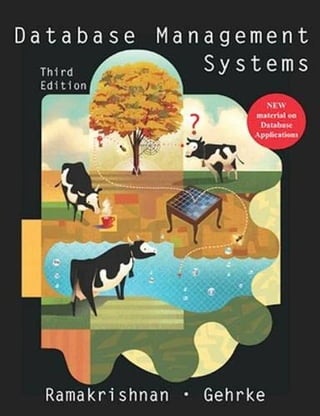
Database Management Systems 3rd Edition Raghu
Ramakrishnan install download
https://ebookmeta.com/product/database-management-systems-3rd-
edition-raghu-ramakrishnan/
Download more ebook from https://ebookmeta.com
We believe these products will be a great fit for you. Click
the link to download now, or visit ebookmeta.com
to discover even more!
Database Management Systems 1st Edition V. Vidhya
https://ebookmeta.com/product/database-management-systems-1st-
edition-v-vidhya/
Database Systems Third Edition Elvis C. Foster
https://ebookmeta.com/product/database-systems-third-edition-
elvis-c-foster/
Database Systems A Practical Approach to Design
Implementation and Management 6E 6th Edition Thomas
Connolly & Carolyn Begg
https://ebookmeta.com/product/database-systems-a-practical-
approach-to-design-implementation-and-management-6e-6th-edition-
thomas-connolly-carolyn-begg/
Second Helpings A MFM Menage Romance Sweet Treats Book
4 1st Edition S.E. Law [Law
https://ebookmeta.com/product/second-helpings-a-mfm-menage-
romance-sweet-treats-book-4-1st-edition-s-e-law-law/
Swift by Tutorials A Hands On Approach Eberhardt Colin
Galloway Matt
https://ebookmeta.com/product/swift-by-tutorials-a-hands-on-
approach-eberhardt-colin-galloway-matt/
The Violence Pendulum: Tactical Change in Islamist
Groups in Egypt and Indonesia 1st Edition Ioana Emy
Matesan
https://ebookmeta.com/product/the-violence-pendulum-tactical-
change-in-islamist-groups-in-egypt-and-indonesia-1st-edition-
ioana-emy-matesan/
Re Monster Volume 04 1st Edition Kanekiru Kogitsune
https://ebookmeta.com/product/re-monster-volume-04-1st-edition-
kanekiru-kogitsune/
Cybersecurity Ops with bash Attack defend and analyze
from the command line 1st Edition Paul Troncone Carl
Albing
https://ebookmeta.com/product/cybersecurity-ops-with-bash-attack-
defend-and-analyze-from-the-command-line-1st-edition-paul-
troncone-carl-albing/
Data Science for Public Policy (Springer Series in the
Data Sciences) Jeffrey C. Chen
https://ebookmeta.com/product/data-science-for-public-policy-
springer-series-in-the-data-sciences-jeffrey-c-chen/
Blackstone Ranger Scrooge Blackstone Rangers 6 1st
Edition Alicia Montgomery Montgomery Alicia
https://ebookmeta.com/product/blackstone-ranger-scrooge-
blackstone-rangers-6-1st-edition-alicia-montgomery-montgomery-
alicia/
DATABASE MANAGEMENT
SYSTEMS
DATABASE MANAGEMENT
SYSTEMS
Raghu Ramakrishnan
University of Wisconsin
Madison, Wisconsin, USA
Johannes Gehrke
Cornell University
Ithaca, New York, USA
Third Edition
Boston Burr Ridge, IL Dubuque, IA Madison, WI New York San Francisco St. Louis
Bangkok Bogotá Caracas Kuala Lumpur Lisbon London Madrid Mexico City
Milan Montreal New Delhi Santiago Seoul Singapore Sydney Taipei Toronto
abc
To Apu, Ketan, and Vivek with love
To Keiko and Elisa
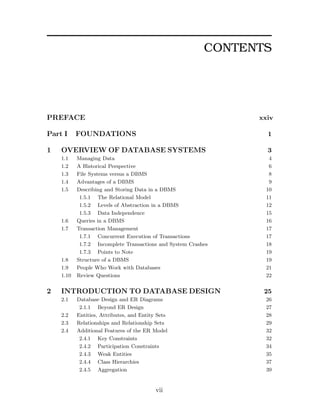
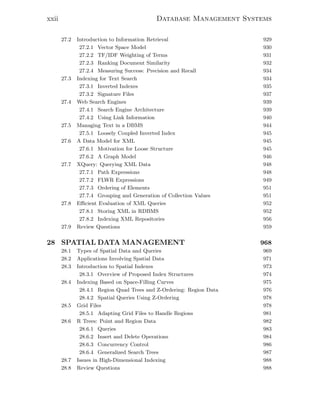
CONTENTS
PREFACE xxiv
Part I FOUNDATIONS 1
1 OVERVIEW OF DATABASE SYSTEMS 3
1.1 Managing Data 4
1.2 A Historical Perspective 6
1.3 File Systems versus a DBMS 8
1.4 Advantages of a DBMS 9
1.5 Describing and Storing Data in a DBMS 10
1.5.1 The Relational Model 11
1.5.2 Levels of Abstraction in a DBMS 12
1.5.3 Data Independence 15
1.6 Queries in a DBMS 16
1.7 Transaction Management 17
1.7.1 Concurrent Execution of Transactions 17
1.7.2 Incomplete Transactions and System Crashes 18
1.7.3 Points to Note 19
1.8 Structure of a DBMS 19
1.9 People Who Work with Databases 21
1.10 Review Questions 22
2 INTRODUCTION TO DATABASE DESIGN 25
2.1 Database Design and ER Diagrams 26
2.1.1 Beyond ER Design 27
2.2 Entities, Attributes, and Entity Sets 28
2.3 Relationships and Relationship Sets 29
2.4 Additional Features of the ER Model 32
2.4.1 Key Constraints 32
2.4.2 Participation Constraints 34
2.4.3 Weak Entities 35
2.4.4 Class Hierarchies 37
2.4.5 Aggregation 39
vii
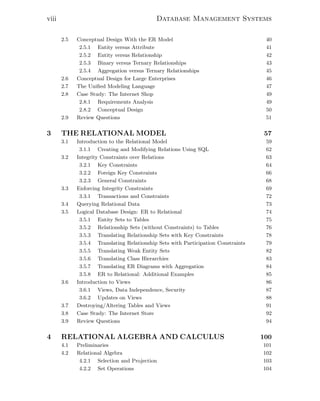
viii Database Management Systems
2.5 Conceptual Design With the ER Model 40
2.5.1 Entity versus Attribute 41
2.5.2 Entity versus Relationship 42
2.5.3 Binary versus Ternary Relationships 43
2.5.4 Aggregation versus Ternary Relationships 45
2.6 Conceptual Design for Large Enterprises 46
2.7 The Unified Modeling Language 47
2.8 Case Study: The Internet Shop 49
2.8.1 Requirements Analysis 49
2.8.2 Conceptual Design 50
2.9 Review Questions 51
3 THE RELATIONAL MODEL 57
3.1 Introduction to the Relational Model 59
3.1.1 Creating and Modifying Relations Using SQL 62
3.2 Integrity Constraints over Relations 63
3.2.1 Key Constraints 64
3.2.2 Foreign Key Constraints 66
3.2.3 General Constraints 68
3.3 Enforcing Integrity Constraints 69
3.3.1 Transactions and Constraints 72
3.4 Querying Relational Data 73
3.5 Logical Database Design: ER to Relational 74
3.5.1 Entity Sets to Tables 75
3.5.2 Relationship Sets (without Constraints) to Tables 76
3.5.3 Translating Relationship Sets with Key Constraints 78
3.5.4 Translating Relationship Sets with Participation Constraints 79
3.5.5 Translating Weak Entity Sets 82
3.5.6 Translating Class Hierarchies 83
3.5.7 Translating ER Diagrams with Aggregation 84
3.5.8 ER to Relational: Additional Examples 85
3.6 Introduction to Views 86
3.6.1 Views, Data Independence, Security 87
3.6.2 Updates on Views 88
3.7 Destroying/Altering Tables and Views 91
3.8 Case Study: The Internet Store 92
3.9 Review Questions 94
4 RELATIONAL ALGEBRA AND CALCULUS 100
4.1 Preliminaries 101
4.2 Relational Algebra 102
4.2.1 Selection and Projection 103
4.2.2 Set Operations 104
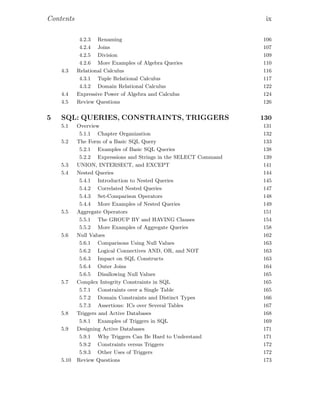
Contents ix
4.2.3 Renaming 106
4.2.4 Joins 107
4.2.5 Division 109
4.2.6 More Examples of Algebra Queries 110
4.3 Relational Calculus 116
4.3.1 Tuple Relational Calculus 117
4.3.2 Domain Relational Calculus 122
4.4 Expressive Power of Algebra and Calculus 124
4.5 Review Questions 126
5 SQL: QUERIES, CONSTRAINTS, TRIGGERS 130
5.1 Overview 131
5.1.1 Chapter Organization 132
5.2 The Form of a Basic SQL Query 133
5.2.1 Examples of Basic SQL Queries 138
5.2.2 Expressions and Strings in the SELECT Command 139
5.3 UNION, INTERSECT, and EXCEPT 141
5.4 Nested Queries 144
5.4.1 Introduction to Nested Queries 145
5.4.2 Correlated Nested Queries 147
5.4.3 Set-Comparison Operators 148
5.4.4 More Examples of Nested Queries 149
5.5 Aggregate Operators 151
5.5.1 The GROUP BY and HAVING Clauses 154
5.5.2 More Examples of Aggregate Queries 158
5.6 Null Values 162
5.6.1 Comparisons Using Null Values 163
5.6.2 Logical Connectives AND, OR, and NOT 163
5.6.3 Impact on SQL Constructs 163
5.6.4 Outer Joins 164
5.6.5 Disallowing Null Values 165
5.7 Complex Integrity Constraints in SQL 165
5.7.1 Constraints over a Single Table 165
5.7.2 Domain Constraints and Distinct Types 166
5.7.3 Assertions: ICs over Several Tables 167
5.8 Triggers and Active Databases 168
5.8.1 Examples of Triggers in SQL 169
5.9 Designing Active Databases 171
5.9.1 Why Triggers Can Be Hard to Understand 171
5.9.2 Constraints versus Triggers 172
5.9.3 Other Uses of Triggers 172
5.10 Review Questions 173
x Database Management Systems
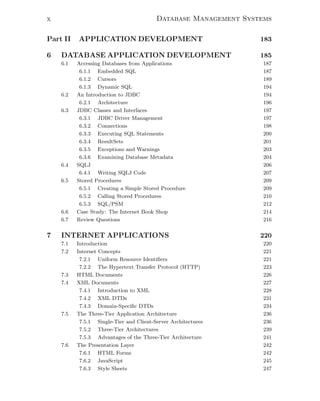
Part II APPLICATION DEVELOPMENT 183
6 DATABASE APPLICATION DEVELOPMENT 185
6.1 Accessing Databases from Applications 187
6.1.1 Embedded SQL 187
6.1.2 Cursors 189
6.1.3 Dynamic SQL 194
6.2 An Introduction to JDBC 194
6.2.1 Architecture 196
6.3 JDBC Classes and Interfaces 197
6.3.1 JDBC Driver Management 197
6.3.2 Connections 198
6.3.3 Executing SQL Statements 200
6.3.4 ResultSets 201
6.3.5 Exceptions and Warnings 203
6.3.6 Examining Database Metadata 204
6.4 SQLJ 206
6.4.1 Writing SQLJ Code 207
6.5 Stored Procedures 209
6.5.1 Creating a Simple Stored Procedure 209
6.5.2 Calling Stored Procedures 210
6.5.3 SQL/PSM 212
6.6 Case Study: The Internet Book Shop 214
6.7 Review Questions 216
7 INTERNET APPLICATIONS 220
7.1 Introduction 220
7.2 Internet Concepts 221
7.2.1 Uniform Resource Identifiers 221
7.2.2 The Hypertext Transfer Protocol (HTTP) 223
7.3 HTML Documents 226
7.4 XML Documents 227
7.4.1 Introduction to XML 228
7.4.2 XML DTDs 231
7.4.3 Domain-Specific DTDs 234
7.5 The Three-Tier Application Architecture 236
7.5.1 Single-Tier and Client-Server Architectures 236
7.5.2 Three-Tier Architectures 239
7.5.3 Advantages of the Three-Tier Architecture 241
7.6 The Presentation Layer 242
7.6.1 HTML Forms 242
7.6.2 JavaScript 245
7.6.3 Style Sheets 247
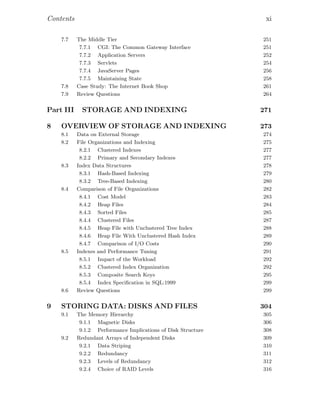
Contents xi
7.7 The Middle Tier 251
7.7.1 CGI: The Common Gateway Interface 251
7.7.2 Application Servers 252
7.7.3 Servlets 254
7.7.4 JavaServer Pages 256
7.7.5 Maintaining State 258
7.8 Case Study: The Internet Book Shop 261
7.9 Review Questions 264
Part III STORAGE AND INDEXING 271
8 OVERVIEW OF STORAGE AND INDEXING 273
8.1 Data on External Storage 274
8.2 File Organizations and Indexing 275
8.2.1 Clustered Indexes 277
8.2.2 Primary and Secondary Indexes 277
8.3 Index Data Structures 278
8.3.1 Hash-Based Indexing 279
8.3.2 Tree-Based Indexing 280
8.4 Comparison of File Organizations 282
8.4.1 Cost Model 283
8.4.2 Heap Files 284
8.4.3 Sorted Files 285
8.4.4 Clustered Files 287
8.4.5 Heap File with Unclustered Tree Index 288
8.4.6 Heap File With Unclustered Hash Index 289
8.4.7 Comparison of I/O Costs 290
8.5 Indexes and Performance Tuning 291
8.5.1 Impact of the Workload 292
8.5.2 Clustered Index Organization 292
8.5.3 Composite Search Keys 295
8.5.4 Index Specification in SQL:1999 299
8.6 Review Questions 299
9 STORING DATA: DISKS AND FILES 304
9.1 The Memory Hierarchy 305
9.1.1 Magnetic Disks 306
9.1.2 Performance Implications of Disk Structure 308
9.2 Redundant Arrays of Independent Disks 309
9.2.1 Data Striping 310
9.2.2 Redundancy 311
9.2.3 Levels of Redundancy 312
9.2.4 Choice of RAID Levels 316
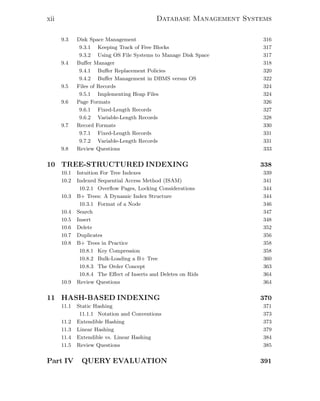
xii Database Management Systems
9.3 Disk Space Management 316
9.3.1 Keeping Track of Free Blocks 317
9.3.2 Using OS File Systems to Manage Disk Space 317
9.4 Buffer Manager 318
9.4.1 Buffer Replacement Policies 320
9.4.2 Buffer Management in DBMS versus OS 322
9.5 Files of Records 324
9.5.1 Implementing Heap Files 324
9.6 Page Formats 326
9.6.1 Fixed-Length Records 327
9.6.2 Variable-Length Records 328
9.7 Record Formats 330
9.7.1 Fixed-Length Records 331
9.7.2 Variable-Length Records 331
9.8 Review Questions 333
10 TREE-STRUCTURED INDEXING 338
10.1 Intuition For Tree Indexes 339
10.2 Indexed Sequential Access Method (ISAM) 341
10.2.1 Overflow Pages, Locking Considerations 344
10.3 B+ Trees: A Dynamic Index Structure 344
10.3.1 Format of a Node 346
10.4 Search 347
10.5 Insert 348
10.6 Delete 352
10.7 Duplicates 356
10.8 B+ Trees in Practice 358
10.8.1 Key Compression 358
10.8.2 Bulk-Loading a B+ Tree 360
10.8.3 The Order Concept 363
10.8.4 The Effect of Inserts and Deletes on Rids 364
10.9 Review Questions 364
11 HASH-BASED INDEXING 370
11.1 Static Hashing 371
11.1.1 Notation and Conventions 373
11.2 Extendible Hashing 373
11.3 Linear Hashing 379
11.4 Extendible vs. Linear Hashing 384
11.5 Review Questions 385
Part IV QUERY EVALUATION 391
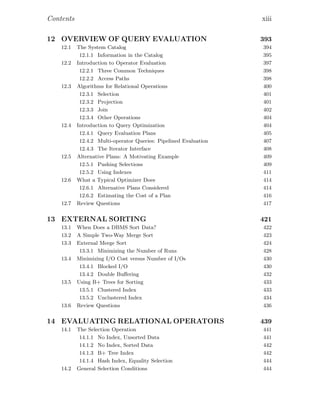
Contents xiii
12 OVERVIEW OF QUERY EVALUATION 393
12.1 The System Catalog 394
12.1.1 Information in the Catalog 395
12.2 Introduction to Operator Evaluation 397
12.2.1 Three Common Techniques 398
12.2.2 Access Paths 398
12.3 Algorithms for Relational Operations 400
12.3.1 Selection 401
12.3.2 Projection 401
12.3.3 Join 402
12.3.4 Other Operations 404
12.4 Introduction to Query Optimization 404
12.4.1 Query Evaluation Plans 405
12.4.2 Multi-operator Queries: Pipelined Evaluation 407
12.4.3 The Iterator Interface 408
12.5 Alternative Plans: A Motivating Example 409
12.5.1 Pushing Selections 409
12.5.2 Using Indexes 411
12.6 What a Typical Optimizer Does 414
12.6.1 Alternative Plans Considered 414
12.6.2 Estimating the Cost of a Plan 416
12.7 Review Questions 417
13 EXTERNAL SORTING 421
13.1 When Does a DBMS Sort Data? 422
13.2 A Simple Two-Way Merge Sort 423
13.3 External Merge Sort 424
13.3.1 Minimizing the Number of Runs 428
13.4 Minimizing I/O Cost versus Number of I/Os 430
13.4.1 Blocked I/O 430
13.4.2 Double Buffering 432
13.5 Using B+ Trees for Sorting 433
13.5.1 Clustered Index 433
13.5.2 Unclustered Index 434
13.6 Review Questions 436
14 EVALUATING RELATIONAL OPERATORS 439
14.1 The Selection Operation 441
14.1.1 No Index, Unsorted Data 441
14.1.2 No Index, Sorted Data 442
14.1.3 B+ Tree Index 442
14.1.4 Hash Index, Equality Selection 444
14.2 General Selection Conditions 444
xiv Database Management Systems
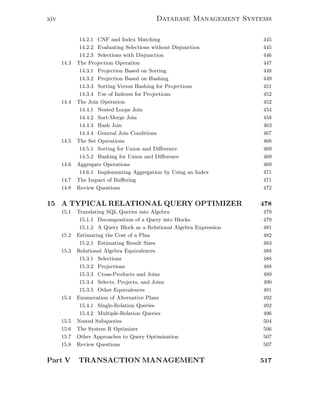
14.2.1 CNF and Index Matching 445
14.2.2 Evaluating Selections without Disjunction 445
14.2.3 Selections with Disjunction 446
14.3 The Projection Operation 447
14.3.1 Projection Based on Sorting 448
14.3.2 Projection Based on Hashing 449
14.3.3 Sorting Versus Hashing for Projections 451
14.3.4 Use of Indexes for Projections 452
14.4 The Join Operation 452
14.4.1 Nested Loops Join 454
14.4.2 Sort-Merge Join 458
14.4.3 Hash Join 463
14.4.4 General Join Conditions 467
14.5 The Set Operations 468
14.5.1 Sorting for Union and Difference 469
14.5.2 Hashing for Union and Difference 469
14.6 Aggregate Operations 469
14.6.1 Implementing Aggregation by Using an Index 471
14.7 The Impact of Buffering 471
14.8 Review Questions 472
15 A TYPICAL RELATIONAL QUERY OPTIMIZER 478
15.1 Translating SQL Queries into Algebra 479
15.1.1 Decomposition of a Query into Blocks 479
15.1.2 A Query Block as a Relational Algebra Expression 481
15.2 Estimating the Cost of a Plan 482
15.2.1 Estimating Result Sizes 483
15.3 Relational Algebra Equivalences 488
15.3.1 Selections 488
15.3.2 Projections 488
15.3.3 Cross-Products and Joins 489
15.3.4 Selects, Projects, and Joins 490
15.3.5 Other Equivalences 491
15.4 Enumeration of Alternative Plans 492
15.4.1 Single-Relation Queries 492
15.4.2 Multiple-Relation Queries 496
15.5 Nested Subqueries 504
15.6 The System R Optimizer 506
15.7 Other Approaches to Query Optimization 507
15.8 Review Questions 507
Part V TRANSACTION MANAGEMENT 517
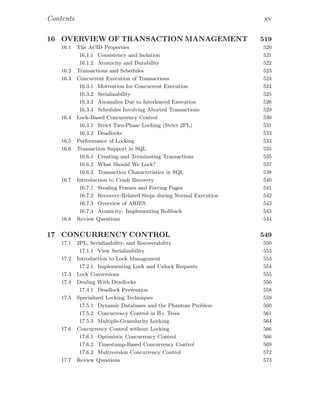
Contents xv
16 OVERVIEW OF TRANSACTION MANAGEMENT 519
16.1 The ACID Properties 520
16.1.1 Consistency and Isolation 521
16.1.2 Atomicity and Durability 522
16.2 Transactions and Schedules 523
16.3 Concurrent Execution of Transactions 524
16.3.1 Motivation for Concurrent Execution 524
16.3.2 Serializability 525
16.3.3 Anomalies Due to Interleaved Execution 526
16.3.4 Schedules Involving Aborted Transactions 529
16.4 Lock-Based Concurrency Control 530
16.4.1 Strict Two-Phase Locking (Strict 2PL) 531
16.4.2 Deadlocks 533
16.5 Performance of Locking 533
16.6 Transaction Support in SQL 535
16.6.1 Creating and Terminating Transactions 535
16.6.2 What Should We Lock? 537
16.6.3 Transaction Characteristics in SQL 538
16.7 Introduction to Crash Recovery 540
16.7.1 Stealing Frames and Forcing Pages 541
16.7.2 Recovery-Related Steps during Normal Execution 542
16.7.3 Overview of ARIES 543
16.7.4 Atomicity: Implementing Rollback 543
16.8 Review Questions 544
17 CONCURRENCY CONTROL 549
17.1 2PL, Serializability, and Recoverability 550
17.1.1 View Serializability 553
17.2 Introduction to Lock Management 553
17.2.1 Implementing Lock and Unlock Requests 554
17.3 Lock Conversions 555
17.4 Dealing With Deadlocks 556
17.4.1 Deadlock Prevention 558
17.5 Specialized Locking Techniques 559
17.5.1 Dynamic Databases and the Phantom Problem 560
17.5.2 Concurrency Control in B+ Trees 561
17.5.3 Multiple-Granularity Locking 564
17.6 Concurrency Control without Locking 566
17.6.1 Optimistic Concurrency Control 566
17.6.2 Timestamp-Based Concurrency Control 569
17.6.3 Multiversion Concurrency Control 572
17.7 Review Questions 573
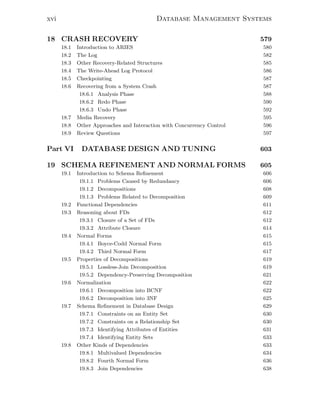
xvi Database Management Systems
18 CRASH RECOVERY 579
18.1 Introduction to ARIES 580
18.2 The Log 582
18.3 Other Recovery-Related Structures 585
18.4 The Write-Ahead Log Protocol 586
18.5 Checkpointing 587
18.6 Recovering from a System Crash 587
18.6.1 Analysis Phase 588
18.6.2 Redo Phase 590
18.6.3 Undo Phase 592
18.7 Media Recovery 595
18.8 Other Approaches and Interaction with Concurrency Control 596
18.9 Review Questions 597
Part VI DATABASE DESIGN AND TUNING 603
19 SCHEMA REFINEMENT AND NORMAL FORMS 605
19.1 Introduction to Schema Refinement 606
19.1.1 Problems Caused by Redundancy 606
19.1.2 Decompositions 608
19.1.3 Problems Related to Decomposition 609
19.2 Functional Dependencies 611
19.3 Reasoning about FDs 612
19.3.1 Closure of a Set of FDs 612
19.3.2 Attribute Closure 614
19.4 Normal Forms 615
19.4.1 Boyce-Codd Normal Form 615
19.4.2 Third Normal Form 617
19.5 Properties of Decompositions 619
19.5.1 Lossless-Join Decomposition 619
19.5.2 Dependency-Preserving Decomposition 621
19.6 Normalization 622
19.6.1 Decomposition into BCNF 622
19.6.2 Decomposition into 3NF 625
19.7 Schema Refinement in Database Design 629
19.7.1 Constraints on an Entity Set 630
19.7.2 Constraints on a Relationship Set 630
19.7.3 Identifying Attributes of Entities 631
19.7.4 Identifying Entity Sets 633
19.8 Other Kinds of Dependencies 633
19.8.1 Multivalued Dependencies 634
19.8.2 Fourth Normal Form 636
19.8.3 Join Dependencies 638
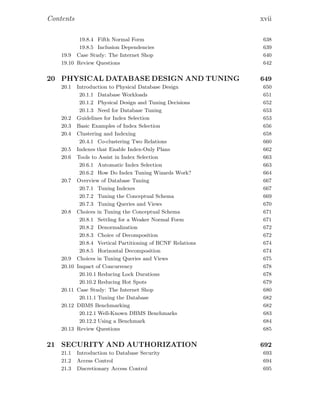
Contents xvii
19.8.4 Fifth Normal Form 638
19.8.5 Inclusion Dependencies 639
19.9 Case Study: The Internet Shop 640
19.10 Review Questions 642
20 PHYSICAL DATABASE DESIGN AND TUNING 649
20.1 Introduction to Physical Database Design 650
20.1.1 Database Workloads 651
20.1.2 Physical Design and Tuning Decisions 652
20.1.3 Need for Database Tuning 653
20.2 Guidelines for Index Selection 653
20.3 Basic Examples of Index Selection 656
20.4 Clustering and Indexing 658
20.4.1 Co-clustering Two Relations 660
20.5 Indexes that Enable Index-Only Plans 662
20.6 Tools to Assist in Index Selection 663
20.6.1 Automatic Index Selection 663
20.6.2 How Do Index Tuning Wizards Work? 664
20.7 Overview of Database Tuning 667
20.7.1 Tuning Indexes 667
20.7.2 Tuning the Conceptual Schema 669
20.7.3 Tuning Queries and Views 670
20.8 Choices in Tuning the Conceptual Schema 671
20.8.1 Settling for a Weaker Normal Form 671
20.8.2 Denormalization 672
20.8.3 Choice of Decomposition 672
20.8.4 Vertical Partitioning of BCNF Relations 674
20.8.5 Horizontal Decomposition 674
20.9 Choices in Tuning Queries and Views 675
20.10 Impact of Concurrency 678
20.10.1 Reducing Lock Durations 678
20.10.2 Reducing Hot Spots 679
20.11 Case Study: The Internet Shop 680
20.11.1 Tuning the Database 682
20.12 DBMS Benchmarking 682
20.12.1 Well-Known DBMS Benchmarks 683
20.12.2 Using a Benchmark 684
20.13 Review Questions 685
21 SECURITY AND AUTHORIZATION 692
21.1 Introduction to Database Security 693
21.2 Access Control 694
21.3 Discretionary Access Control 695
xviii Database Management Systems
21.3.1 Grant and Revoke on Views and Integrity Constraints 704
21.4 Mandatory Access Control 705
21.4.1 Multilevel Relations and Polyinstantiation 707
21.4.2 Covert Channels, DoD Security Levels 708
21.5 Security for Internet Applications 709
21.5.1 Encryption 709
21.5.2 Certifying Servers: The SSL Protocol 712
21.5.3 Digital Signatures 713
21.6 Additional Issues Related to Security 714
21.6.1 Role of the Database Administrator 714
21.6.2 Security in Statistical Databases 715
21.7 Design Case Study: The Internet Store 716
21.8 Review Questions 718
Part VII ADDITIONAL TOPICS 723
22 PARALLEL AND DISTRIBUTED DATABASES 725
22.1 Introduction 726
22.2 Architectures for Parallel Databases 727
22.3 Parallel Query Evaluation 728
22.3.1 Data Partitioning 730
22.3.2 Parallelizing Sequential Operator Evaluation Code 730
22.4 Parallelizing Individual Operations 731
22.4.1 Bulk Loading and Scanning 731
22.4.2 Sorting 732
22.4.3 Joins 732
22.5 Parallel Query Optimization 735
22.6 Introduction to Distributed Databases 736
22.6.1 Types of Distributed Databases 737
22.7 Distributed DBMS Architectures 737
22.7.1 Client-Server Systems 738
22.7.2 Collaborating Server Systems 738
22.7.3 Middleware Systems 739
22.8 Storing Data in a Distributed DBMS 739
22.8.1 Fragmentation 739
22.8.2 Replication 741
22.9 Distributed Catalog Management 741
22.9.1 Naming Objects 741
22.9.2 Catalog Structure 742
22.9.3 Distributed Data Independence 743
22.10 Distributed Query Processing 743
22.10.1 Nonjoin Queries in a Distributed DBMS 744
22.10.2 Joins in a Distributed DBMS 745
Contents xix
22.10.3 Cost-Based Query Optimization 749
22.11 Updating Distributed Data 750
22.11.1 Synchronous Replication 750
22.11.2 Asynchronous Replication 751
22.12 Distributed Transactions 755
22.13 Distributed Concurrency Control 755
22.13.1 Distributed Deadlock 756
22.14 Distributed Recovery 758
22.14.1 Normal Execution and Commit Protocols 758
22.14.2 Restart after a Failure 760
22.14.3 Two-Phase Commit Revisited 761
22.14.4 Three-Phase Commit 762
22.15 Review Questions 763
23 OBJECT-DATABASE SYSTEMS 772
23.1 Motivating Example 774
23.1.1 New Data Types 775
23.1.2 Manipulating the New Data 777
23.2 Structured Data Types 779
23.2.1 Collection Types 780
23.3 Operations on Structured Data 781
23.3.1 Operations on Rows 781
23.3.2 Operations on Arrays 781
23.3.3 Operations on Other Collection Types 782
23.3.4 Queries Over Nested Collections 783
23.4 Encapsulation and ADTs 784
23.4.1 Defining Methods 785
23.5 Inheritance 787
23.5.1 Defining Types with Inheritance 787
23.5.2 Binding Methods 788
23.5.3 Collection Hierarchies 789
23.6 Objects, OIDs, and Reference Types 789
23.6.1 Notions of Equality 790
23.6.2 Dereferencing Reference Types 791
23.6.3 URLs and OIDs in SQL:1999 791
23.7 Database Design for an ORDBMS 792
23.7.1 Collection Types and ADTs 792
23.7.2 Object Identity 795
23.7.3 Extending the ER Model 796
23.7.4 Using Nested Collections 798
23.8 ORDBMS Implementation Challenges 799
23.8.1 Storage and Access Methods 799
23.8.2 Query Processing 801
xx Database Management Systems
23.8.3 Query Optimization 803
23.9 OODBMS 805
23.9.1 The ODMG Data Model and ODL 805
23.9.2 OQL 807
23.10 Comparing RDBMS, OODBMS, and ORDBMS 809
23.10.1 RDBMS versus ORDBMS 809
23.10.2 OODBMS versus ORDBMS: Similarities 809
23.10.3 OODBMS versus ORDBMS: Differences 810
23.11 Review Questions 811
24 DEDUCTIVE DATABASES 817
24.1 Introduction to Recursive Queries 818
24.1.1 Datalog 819
24.2 Theoretical Foundations 822
24.2.1 Least Model Semantics 823
24.2.2 The Fixpoint Operator 824
24.2.3 Safe Datalog Programs 825
24.2.4 Least Model = Least Fixpoint 826
24.3 Recursive Queries with Negation 827
24.3.1 Stratification 828
24.4 From Datalog to SQL 831
24.5 Evaluating Recursive Queries 834
24.5.1 Fixpoint Evaluation without Repeated Inferences 835
24.5.2 Pushing Selections to Avoid Irrelevant Inferences 837
24.5.3 The Magic Sets Algorithm 838
24.6 Review Questions 841
25 DATA WAREHOUSING AND DECISION SUPPORT 846
25.1 Introduction to Decision Support 848
25.2 OLAP: Multidimensional Data Model 849
25.2.1 Multidimensional Database Design 853
25.3 Multidimensional Aggregation Queries 854
25.3.1 ROLLUP and CUBE in SQL:1999 856
25.4 Window Queries in SQL:1999 859
25.4.1 Framing a Window 861
25.4.2 New Aggregate Functions 862
25.5 Finding Answers Quickly 862
25.5.1 Top N Queries 863
25.5.2 Online Aggregation 864
25.6 Implementation Techniques for OLAP 865
25.6.1 Bitmap Indexes 866
25.6.2 Join Indexes 868
25.6.3 File Organizations 869
Contents xxi
25.7 Data Warehousing 870
25.7.1 Creating and Maintaining a Warehouse 871
25.8 Views and Decision Support 872
25.8.1 Views, OLAP, and Warehousing 872
25.8.2 Queries over Views 873
25.9 View Materialization 873
25.9.1 Issues in View Materialization 874
25.10 Maintaining Materialized Views 876
25.10.1 Incremental View Maintenance 876
25.10.2 Maintaining Warehouse Views 879
25.10.3 When Should We Synchronize Views? 881
25.11 Review Questions 882
26 DATA MINING 889
26.1 Introduction to Data Mining 890
26.1.1 The Knowledge Discovery Process 891
26.2 Counting Co-occurrences 892
26.2.1 Frequent Itemsets 892
26.2.2 Iceberg Queries 895
26.3 Mining for Rules 897
26.3.1 Association Rules 897
26.3.2 An Algorithm for Finding Association Rules 898
26.3.3 Association Rules and ISA Hierarchies 899
26.3.4 Generalized Association Rules 900
26.3.5 Sequential Patterns 901
26.3.6 The Use of Association Rules for Prediction 902
26.3.7 Bayesian Networks 903
26.3.8 Classification and Regression Rules 904
26.4 Tree-Structured Rules 906
26.4.1 Decision Trees 907
26.4.2 An Algorithm to Build Decision Trees 908
26.5 Clustering 911
26.5.1 A Clustering Algorithm 912
26.6 Similarity Search over Sequences 913
26.6.1 An Algorithm to Find Similar Sequences 915
26.7 Incremental Mining and Data Streams 916
26.7.1 Incremental Maintenance of Frequent Itemsets 918
26.8 Additional Data Mining Tasks 920
26.9 Review Questions 920
27 INFORMATION RETRIEVAL AND XML DATA 926
27.1 Colliding Worlds: Databases, IR, and XML 927
27.1.1 DBMS versus IR Systems 928
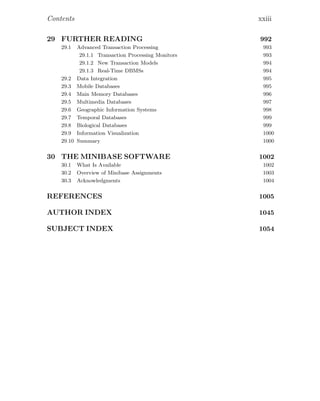
xxii Database Management Systems
27.2 Introduction to Information Retrieval 929
27.2.1 Vector Space Model 930
27.2.2 TF/IDF Weighting of Terms 931
27.2.3 Ranking Document Similarity 932
27.2.4 Measuring Success: Precision and Recall 934
27.3 Indexing for Text Search 934
27.3.1 Inverted Indexes 935
27.3.2 Signature Files 937
27.4 Web Search Engines 939
27.4.1 Search Engine Architecture 939
27.4.2 Using Link Information 940
27.5 Managing Text in a DBMS 944
27.5.1 Loosely Coupled Inverted Index 945
27.6 A Data Model for XML 945
27.6.1 Motivation for Loose Structure 945
27.6.2 A Graph Model 946
27.7 XQuery: Querying XML Data 948
27.7.1 Path Expressions 948
27.7.2 FLWR Expressions 949
27.7.3 Ordering of Elements 951
27.7.4 Grouping and Generation of Collection Values 951
27.8 Efficient Evaluation of XML Queries 952
27.8.1 Storing XML in RDBMS 952
27.8.2 Indexing XML Repositories 956
27.9 Review Questions 959
28 SPATIAL DATA MANAGEMENT 968
28.1 Types of Spatial Data and Queries 969
28.2 Applications Involving Spatial Data 971
28.3 Introduction to Spatial Indexes 973
28.3.1 Overview of Proposed Index Structures 974
28.4 Indexing Based on Space-Filling Curves 975
28.4.1 Region Quad Trees and Z-Ordering: Region Data 976
28.4.2 Spatial Queries Using Z-Ordering 978
28.5 Grid Files 978
28.5.1 Adapting Grid Files to Handle Regions 981
28.6 R Trees: Point and Region Data 982
28.6.1 Queries 983
28.6.2 Insert and Delete Operations 984
28.6.3 Concurrency Control 986
28.6.4 Generalized Search Trees 987
28.7 Issues in High-Dimensional Indexing 988
28.8 Review Questions 988
Contents xxiii
29 FURTHER READING 992
29.1 Advanced Transaction Processing 993
29.1.1 Transaction Processing Monitors 993
29.1.2 New Transaction Models 994
29.1.3 Real-Time DBMSs 994
29.2 Data Integration 995
29.3 Mobile Databases 995
29.4 Main Memory Databases 996
29.5 Multimedia Databases 997
29.6 Geographic Information Systems 998
29.7 Temporal Databases 999
29.8 Biological Databases 999
29.9 Information Visualization 1000
29.10 Summary 1000
30 THE MINIBASE SOFTWARE 1002
30.1 What Is Available 1002
30.2 Overview of Minibase Assignments 1003
30.3 Acknowledgments 1004
REFERENCES 1005
AUTHOR INDEX 1045
SUBJECT INDEX 1054
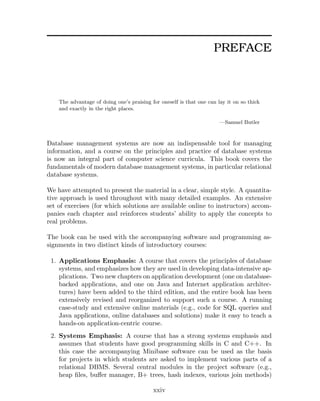
PREFACE
The advantage of doing one’s praising for oneself is that one can lay it on so thick
and exactly in the right places.
—Samuel Butler
Database management systems are now an indispensable tool for managing
information, and a course on the principles and practice of database systems
is now an integral part of computer science curricula. This book covers the
fundamentals of modern database management systems, in particular relational
database systems.
We have attempted to present the material in a clear, simple style. A quantita-
tive approach is used throughout with many detailed examples. An extensive
set of exercises (for which solutions are available online to instructors) accom-
panies each chapter and reinforces students’ ability to apply the concepts to
real problems.
The book can be used with the accompanying software and programming as-
signments in two distinct kinds of introductory courses:
1. Applications Emphasis: A course that covers the principles of database
systems, and emphasizes how they are used in developing data-intensive ap-
plications. Two new chapters on application development (one on database-
backed applications, and one on Java and Internet application architec-
tures) have been added to the third edition, and the entire book has been
extensively revised and reorganized to support such a course. A running
case-study and extensive online materials (e.g., code for SQL queries and
Java applications, online databases and solutions) make it easy to teach a
hands-on application-centric course.
2. Systems Emphasis: A course that has a strong systems emphasis and
assumes that students have good programming skills in C and C++. In
this case the accompanying Minibase software can be used as the basis
for projects in which students are asked to implement various parts of a
relational DBMS. Several central modules in the project software (e.g.,
heap files, buffer manager, B+ trees, hash indexes, various join methods)
xxiv
Preface xxv
are described in sufficient detail in the text to enable students to implement
them, given the (C++) class interfaces.
Many instructors will no doubt teach a course that falls between these two
extremes. The restructuring in the third edition offers a very modular orga-
nization that facilitates such hybrid courses. The also book contains enough
material to support advanced courses in a two-course sequence.
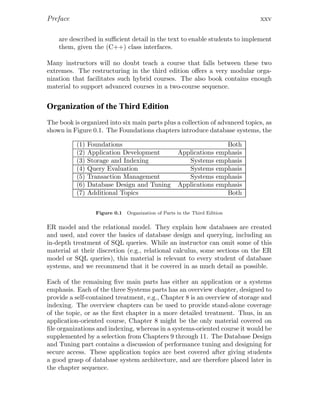
Organization of the Third Edition
The book is organized into six main parts plus a collection of advanced topics, as
shown in Figure 0.1. The Foundations chapters introduce database systems, the
(1) Foundations Both
(2) Application Development Applications emphasis
(3) Storage and Indexing Systems emphasis
(4) Query Evaluation Systems emphasis
(5) Transaction Management Systems emphasis
(6) Database Design and Tuning Applications emphasis
(7) Additional Topics Both
Figure 0.1 Organization of Parts in the Third Edition
ER model and the relational model. They explain how databases are created
and used, and cover the basics of database design and querying, including an
in-depth treatment of SQL queries. While an instructor can omit some of this
material at their discretion (e.g., relational calculus, some sections on the ER
model or SQL queries), this material is relevant to every student of database
systems, and we recommend that it be covered in as much detail as possible.
Each of the remaining five main parts has either an application or a systems
emphasis. Each of the three Systems parts has an overview chapter, designed to
provide a self-contained treatment, e.g., Chapter 8 is an overview of storage and
indexing. The overview chapters can be used to provide stand-alone coverage
of the topic, or as the first chapter in a more detailed treatment. Thus, in an
application-oriented course, Chapter 8 might be the only material covered on
file organizations and indexing, whereas in a systems-oriented course it would be
supplemented by a selection from Chapters 9 through 11. The Database Design
and Tuning part contains a discussion of performance tuning and designing for
secure access. These application topics are best covered after giving students
a good grasp of database system architecture, and are therefore placed later in
the chapter sequence.
xxvi Database Management Systems
Suggested Course Outlines
The book can be used in two kinds of introductory database courses, one with
an applications emphasis and one with a systems emphasis.
The introductory applications-oriented course could cover the Foundations chap-
ters, then the Application Development chapters, followed by the overview sys-
tems chapters, and conclude with the Database Design and Tuning material.
Chapter dependencies have been kept to a minimum, enabling instructors to
easily fine tune what material to include. The Foundations material, Part I,
should be covered first, and within Parts III, IV, and V, the overview chapters
should be covered first. The only remaining dependencies between chapters
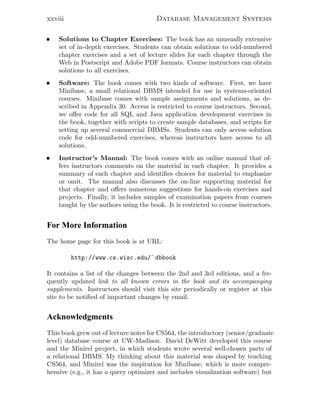
in Parts I to VI are shown as arrows in Figure 0.2. The chapters in Part I
should be covered in sequence. However, the coverage of algebra and calculus
can be skipped in order to get to SQL queries sooner (although we believe this
material is important and recommend that it should be covered before SQL).
The introductory systems-oriented course would cover the Foundations chap-
ters and a selection of Applications and Systems chapters. An important point
for systems-oriented courses is that the timing of programming projects (e.g.,
using Minibase) makes it desirable to cover some systems topics early. Chap-
ter dependencies have been carefully limited to allow the Systems chapters to
be covered as soon as Chapters 1 and 3 have been covered. The remaining
Foundations chapters and Applications chapters can be covered subsequently.
The book also has ample material to support a multi-course sequence. Obvi-
ously, choosing an applications or systems emphasis in the introductory course
results in dropping certain material from the course; the material in the book
supports a comprehensive two-course sequence that covers both applications
and systems aspects. The Additional Topics range over a broad set of issues,
and can be used as the core material for an advanced course, supplemented
with further readings.
Supplementary Material
This book comes with extensive online supplements:
Online Chapter: To make space for new material such as application
development, information retrieval, and XML, we’ve moved the coverage
of QBE to an online chapter. Students can freely download the chapter
from the book’s web site, and solutions to exercises from this chapter are
included in solutions manual.
Preface xxvii
2
ER Model
Conceptual Design
3
Relational Model
SQL DDL
Evaluation of
Relational Operators
14 15
Relational Optimizer
A Typical
17 18
Concurrency
Control
Crash
Recovery
Parallel and
Distributed DBs
Introduction,
1
Relational Algebra
and Calculus
4
SQL DML
5
Hash Indexes
11
I
II
III
IV
V
VI
VII
6 7
16
Transaction Management
Overview of
External Sorting
13
Overview of
Storage and Indexing
8
12
Query Evaluation
Overview of
9
Data Storage Tree Indexes
10
Schema Refinement,
19
FDs, Normalization
20
Physical DB
Design, Tuning
Development
Database Application
Internet Applications
Database−Backed
Authorization
Security and
21
Mining
Data
27
Databases
Spatial
Object−Database
Systems
Deductive
Databases and Decision Support
Data Warehousing
and XML Data
Information Retrieval
28
25
24
23
22
26 29
Reading
Further
Figure 0.2 Chapter Organization and Dependencies
Lecture Slides: Lecture slides are freely available for all chapters in
Postscript, and PDF formats. Course instructors can also obtain these
slides in Microsoft Powerpoint format, and can adapt them to their teach-
ing needs. Instructors also have access to all figures used in the book (in
xfig format), and can use them to modify the slides.
xxviii Database Management Systems
Solutions to Chapter Exercises: The book has an unusually extensive
set of in-depth exercises. Students can obtain solutions to odd-numbered
chapter exercises and a set of lecture slides for each chapter through the
Web in Postscript and Adobe PDF formats. Course instructors can obtain
solutions to all exercises.
Software: The book comes with two kinds of software. First, we have
Minibase, a small relational DBMS intended for use in systems-oriented
courses. Minibase comes with sample assignments and solutions, as de-
scribed in Appendix 30. Access is restricted to course instructors. Second,
we offer code for all SQL and Java application development exercises in
the book, together with scripts to create sample databases, and scripts for
setting up several commercial DBMSs. Students can only access solution
code for odd-numbered exercises, whereas instructors have access to all
solutions.
Instructor’s Manual: The book comes with an online manual that of-
fers instructors comments on the material in each chapter. It provides a
summary of each chapter and identifies choices for material to emphasize
or omit. The manual also discusses the on-line supporting material for
that chapter and offers numerous suggestions for hands-on exercises and
projects. Finally, it includes samples of examination papers from courses
taught by the authors using the book. It is restricted to course instructors.
For More Information
The home page for this book is at URL:
http://www.cs.wisc.edu/˜ dbbook
It contains a list of the changes between the 2nd and 3rd editions, and a fre-
quently updated link to all known errors in the book and its accompanying
supplements. Instructors should visit this site periodically or register at this
site to be notified of important changes by email.
Acknowledgments
This book grew out of lecture notes for CS564, the introductory (senior/graduate
level) database course at UW-Madison. David DeWitt developed this course
and the Minirel project, in which students wrote several well-chosen parts of
a relational DBMS. My thinking about this material was shaped by teaching
CS564, and Minirel was the inspiration for Minibase, which is more compre-
hensive (e.g., it has a query optimizer and includes visualization software) but
Preface xxix
tries to retain the spirit of Minirel. Mike Carey and I jointly designed much of
Minibase. My lecture notes (and in turn this book) were influenced by Mike’s
lecture notes and by Yannis Ioannidis’s lecture slides.
Joe Hellerstein used the beta edition of the book at Berkeley and provided
invaluable feedback, assistance on slides, and hilarious quotes. Writing the
chapter on object-database systems with Joe was a lot of fun.
C. Mohan provided invaluable assistance, patiently answering a number of ques-
tions about implementation techniques used in various commercial systems, in
particular indexing, concurrency control, and recovery algorithms. Moshe Zloof
answered numerous questions about QBE semantics and commercial systems
based on QBE. Ron Fagin, Krishna Kulkarni, Len Shapiro, Jim Melton, Dennis
Shasha, and Dirk Van Gucht reviewed the book and provided detailed feedback,
greatly improving the content and presentation. Michael Goldweber at Beloit
College, Matthew Haines at Wyoming, Michael Kifer at SUNY StonyBrook,
Jeff Naughton at Wisconsin, Praveen Seshadri at Cornell, and Stan Zdonik at
Brown also used the beta edition in their database courses and offered feedback
and bug reports. In particular, Michael Kifer pointed out an error in the (old)
algorithm for computing a minimal cover and suggested covering some SQL
features in Chapter 2 to improve modularity. Gio Wiederhold’s bibliography,
converted to Latex format by S. Sudarshan, and Michael Ley’s online bibliogra-
phy on databases and logic programming were a great help while compiling the
chapter bibliographies. Shaun Flisakowski and Uri Shaft helped me frequently
in my never-ending battles with Latex.
I owe a special thanks to the many, many students who have contributed to
the Minibase software. Emmanuel Ackaouy, Jim Pruyne, Lee Schumacher, and
Michael Lee worked with me when I developed the first version of Minibase
(much of which was subsequently discarded, but which influenced the next
version). Emmanuel Ackaouy and Bryan So were my TAs when I taught CS564
using this version and went well beyond the limits of a TAship in their efforts
to refine the project. Paul Aoki struggled with a version of Minibase and
offered lots of useful comments as a TA at Berkeley. An entire class of CS764
students (our graduate database course) developed much of the current version
of Minibase in a large class project that was led and coordinated by Mike Carey
and me. Amit Shukla and Michael Lee were my TAs when I first taught CS564
using this version of Minibase and developed the software further.
Several students worked with me on independent projects, over a long period
of time, to develop Minibase components. These include visualization packages
for the buffer manager and B+ trees (Huseyin Bektas, Harry Stavropoulos, and
Weiqing Huang); a query optimizer and visualizer (Stephen Harris, Michael Lee,
and Donko Donjerkovic); an ER diagram tool based on the Opossum schema
xxx Database Management Systems
editor (Eben Haber); and a GUI-based tool for normalization (Andrew Prock
and Andy Therber). In addition, Bill Kimmel worked to integrate and fix a
large body of code (storage manager, buffer manager, files and access methods,
relational operators, and the query plan executor) produced by the CS764 class
project. Ranjani Ramamurty considerably extended Bill’s work on cleaning up
and integrating the various modules. Luke Blanshard, Uri Shaft, and Shaun
Flisakowski worked on putting together the release version of the code and
developed test suites and exercises based on the Minibase software. Krishna
Kunchithapadam tested the optimizer and developed part of the Minibase GUI.
Clearly, the Minibase software would not exist without the contributions of a
great many talented people. With this software available freely in the public
domain, I hope that more instructors will be able to teach a systems-oriented
database course with a blend of implementation and experimentation to com-
plement the lecture material.
I’d like to thank the many students who helped in developing and checking
the solutions to the exercises and provided useful feedback on draft versions of
the book. In alphabetical order: X. Bao, S. Biao, M. Chakrabarti, C. Chan,
W. Chen, N. Cheung, D. Colwell, C. Fritz, V. Ganti, J. Gehrke, G. Glass, V.
Gopalakrishnan, M. Higgins, T. Jasmin, M. Krishnaprasad, Y. Lin, C. Liu, M.
Lusignan, H. Modi, S. Narayanan, D. Randolph, A. Ranganathan, J. Reminga,
A. Therber, M. Thomas, Q. Wang, R. Wang, Z. Wang, and J. Yuan. Arcady
Grenader, James Harrington, and Martin Reames at Wisconsin and Nina Tang
at Berkeley provided especially detailed feedback.
Charlie Fischer, Avi Silberschatz, and Jeff Ullman gave me invaluable advice
on working with a publisher. My editors at McGraw-Hill, Betsy Jones and Eric
Munson, obtained extensive reviews and guided this book in its early stages.
Emily Gray and Brad Kosirog were there whenever problems cropped up. At
Wisconsin, Ginny Werner really helped me to stay on top of things.
Finally, this book was a thief of time, and in many ways it was harder on my
family than on me. My sons expressed themselves forthrightly. From my (then)
five-year-old, Ketan: “Dad, stop working on that silly book. You don’t have
any time for me.” Two-year-old Vivek: “You working boook? No no no come
play basketball me!” All the seasons of their discontent were visited upon my
wife, and Apu nonetheless cheerfully kept the family going in its usual chaotic,
happy way all the many evenings and weekends I was wrapped up in this book.
(Not to mention the days when I was wrapped up in being a faculty member!)
As in all things, I can trace my parents’ hand in much of this; my father,
with his love of learning, and my mother, with her love of us, shaped me. My
brother Kartik’s contributions to this book consisted chiefly of phone calls in
which he kept me from working, but if I don’t acknowledge him, he’s liable to
Preface xxxi
be annoyed. I’d like to thank my family for being there and giving meaning to
everything I do. (There! I knew I’d find a legitimate reason to thank Kartik.)
Acknowledgments for the Second Edition
Emily Gray and Betsy Jones at McGraw-Hill obtained extensive reviews and
provided guidance and support as we prepared the second edition. Jonathan
Goldstein helped with the bibliography for spatial databases. The following
reviewers provided valuable feedback on content and organization: Liming Cai
at Ohio University, Costas Tsatsoulis at University of Kansas, Kwok-Bun Yue
at University of Houston, Clear Lake, William Grosky at Wayne State Univer-
sity, Sang H. Son at University of Virginia, James M. Slack at Minnesota State
University, Mankato, Herman Balsters at University of Twente, Netherlands,
Karen C. Davis at University of Cincinnati, Joachim Hammer at University of
Florida, Fred Petry at Tulane University, Gregory Speegle at Baylor Univer-
sity, Salih Yurttas at Texas A&M University, and David Chao at San Francisco
State University.
A number of people reported bugs in the first edition. In particular, we wish
to thank the following: Joseph Albert at Portland State University, Han-yin
Chen at University of Wisconsin, Lois Delcambre at Oregon Graduate Institute,
Maggie Eich at Southern Methodist University, Raj Gopalan at Curtin Univer-
sity of Technology, Davood Rafiei at University of Toronto, Michael Schrefl at
University of South Australia, Alex Thomasian at University of Connecticut,
and Scott Vandenberg at Siena College.
A special thanks to the many people who answered a detailed survey about how
commercial systems support various features: At IBM, Mike Carey, Bruce Lind-
say, C. Mohan, and James Teng; at Informix, M. Muralikrishna and Michael
Ubell; at Microsoft, David Campbell, Goetz Graefe, and Peter Spiro; at Oracle,
Hakan Jacobsson, Jonathan D. Klein, Muralidhar Krishnaprasad, and M. Zi-
auddin; and at Sybase, Marc Chanliau, Lucien Dimino, Sangeeta Doraiswamy,
Hanuma Kodavalla, Roger MacNicol, and Tirumanjanam Rengarajan.
After reading about himself in the acknowledgment to the first edition, Ketan
(now 8) had a simple question: “How come you didn’t dedicate the book to us?
Why mom?” Ketan, I took care of this inexplicable oversight. Vivek (now 5)
was more concerned about the extent of his fame: “Daddy, is my name in evvy
copy of your book? Do they have it in evvy compooter science department in
the world?” Vivek, I hope so. Finally, this revision would not have made it
without Apu’s and Keiko’s support.
xxxii Database Management Systems
Acknowledgments for the Third Edition
We thank Raghav Kaushik for his contribution to the discussion of XML, and
Alex Thomasian for his contribution to the coverage of concurrency control. A
special thanks to Jim Melton for giving us a pre-publication copy of his book
on object-oriented extensions in the SQL:1999 standard, and catching several
bugs in a draft of this edition. Marti Hearst at Berkeley generously permitted
us to adapt some of her slides on Information Retrieval, and Alon Levy and
Dan Suciu were kind enough to let us adapt some of their lectures on XML.
Mike Carey offered input on Web services.
Emily Lupash at McGraw-Hill has been a source of constant support and en-
couragement. She coordinated extensive reviews from Ming Wang at Embry-
Riddle Aeronautical University, Cheng Hsu at RPI, Paul Bergstein at Univ. of
Massachusetts, Archana Sathaye at SJSU, Bharat Bhargava at Purdue, John
Fendrich at Bradley, Ahmet Ugur at Central Michigan, Richard Osborne at
Univ. of Colorado, Akira Kawaguchi at CCNY, Mark Last at Ben Gurion,
Vassilis Tsotras at Univ. of California, and Ronald Eaglin at Univ. of Central
Florida. It is a pleasure to acknowledge the thoughtful input we received from
the reviewers, which greatly improved the design and content of this edition.
Gloria Schiesl and Jade Moran dealt cheerfully and efficiently with last-minute
snafus, and, with Sherry Kane, made a very tight schedule possible. Michelle
Whitaker iterated many times on the cover and end-sheet design.
On a personal note for Raghu, Ketan, following the canny example of the
camel that shared a tent, observed that “it is only fair” that Raghu dedicate
this edition solely to him and Vivek, since “mommy already had it dedicated
only to her.” Despite this blatant attempt to hog the limelight, enthusiastically
supported by Vivek and viewed with the indulgent affection of a doting father,
this book is also dedicated to Apu, for being there through it all.
For Johannes, this revision would not have made it without Keiko’s support
and inspiration and the motivation from looking at Elisa’s peacefully sleeping
face.
PART I
FOUNDATIONS
1
OVERVIEW OF
DATABASE SYSTEMS
☛ What is a DBMS, in particular, a relational DBMS?
☛ Why should we consider a DBMS to manage data?
☛ How is application data represented in a DBMS?
☛ How is data in a DBMS retrieved and manipulated?
☛ How does a DBMS support concurrent access and protect data during
system failures?
☛ What are the main components of a DBMS?
☛ Who is involved with databases in real life?
➽ Key concepts: database management, data independence, database
design, data model; relational databases and queries; schemas, levels
of abstraction; transactions, concurrency and locking, recovery and
logging; DBMS architecture; database administrator, application pro-
grammer, end user
Has everyone noticed that all the letters of the word database are typed with
the left hand? Now the layout of the QWERTY typewriter keyboard was designed,
among other things, to facilitate the even use of both hands. It follows, therefore,
that writing about databases is not only unnatural, but a lot harder than it appears.
—Anonymous
The amount of information available to us is literally exploding, and the value
of data as an organizational asset is widely recognized. To get the most out of
their large and complex datasets, users require tools that simplify the tasks of
3
4 Chapter 1
The area of database management systems is a microcosm of computer sci-
ence in general. The issues addressed and the techniques used span a wide
spectrum, including languages, object-orientation and other programming
paradigms, compilation, operating systems, concurrent programming, data
structures, algorithms, theory, parallel and distributed systems, user inter-
faces, expert systems and artificial intelligence, statistical techniques, and
dynamic programming. We cannot go into all these aspects of database
management in one book, but we hope to give the reader a sense of the
excitement in this rich and vibrant discipline.
managing the data and extracting useful information in a timely fashion. Oth-
erwise, data can become a liability, with the cost of acquiring it and managing
it far exceeding the value derived from it.
A database is a collection of data, typically describing the activities of one or
more related organizations. For example, a university database might contain
information about the following:
Entities such as students, faculty, courses, and classrooms.
Relationships between entities, such as students’ enrollment in courses,
faculty teaching courses, and the use of rooms for courses.
A database management system, or DBMS, is software designed to assist
in maintaining and utilizing large collections of data. The need for such systems,
as well as their use, is growing rapidly. The alternative to using a DBMS is
to store the data in files and write application-specific code to manage it. The
use of a DBMS has several important advantages, as we will see in Section 1.4.
1.1 MANAGING DATA
The goal of this book is to present an in-depth introduction to database man-
agement systems, with an emphasis on how to design a database and use a
DBMS effectively. Not surprisingly, many decisions about how to use a DBMS
for a given application depend on what capabilities the DBMS supports effi-
ciently. Therefore, to use a DBMS well, it is necessary to also understand how
a DBMS works.
Many kinds of database management systems are in use, but this book concen-
trates on relational database systems (RDBMSs), which are by far the
dominant type of DBMS today. The following questions are addressed in the
core chapters of this book:
Overview of Database Systems 5
1. Database Design and Application Development: How can a user
describe a real-world enterprise (e.g., a university) in terms of the data
stored in a DBMS? What factors must be considered in deciding how to
organize the stored data? How can we develop applications that rely upon
a DBMS? (Chapters 2, 3, 6, 7, 19, 20, and 21.)
2. Data Analysis: How can a user answer questions about the enterprise by
posing queries over the data in the DBMS? (Chapters 4 and 5.)1
3. Concurrency and Robustness: How does a DBMS allow many users to
access data concurrently, and how does it protect the data in the event of
system failures? (Chapters 16, 17, and 18.)
4. Efficiency and Scalability: How does a DBMS store large datasets and
answer questions against this data efficiently? (Chapters 8, 9, 10, 11, 12,
13, 14, and 15.)
Later chapters cover important and rapidly evolving topics, such as parallel and
distributed database management, data warehousing and complex queries for
decision support, data mining, databases and information retrieval, XML repos-
itories, object databases, spatial data management, and rule-oriented DBMS
extensions.
In the rest of this chapter, we introduce these issues. In Section 1.2, we be-
gin with a brief history of the field and a discussion of the role of database
management in modern information systems. We then identify the benefits of
storing data in a DBMS instead of a file system in Section 1.3, and discuss
the advantages of using a DBMS to manage data in Section 1.4. In Section
1.5, we consider how information about an enterprise should be organized and
stored in a DBMS. A user probably thinks about this information in high-level
terms that correspond to the entities in the organization and their relation-
ships, whereas the DBMS ultimately stores data in the form of (many, many)
bits. The gap between how users think of their data and how the data is ul-
timately stored is bridged through several levels of abstraction supported by
the DBMS. Intuitively, a user can begin by describing the data in fairly high-
level terms, then refine this description by considering additional storage and
representation details as needed.
In Section 1.6, we consider how users can retrieve data stored in a DBMS and
the need for techniques to efficiently compute answers to questions involving
such data. In Section 1.7, we provide an overview of how a DBMS supports
concurrent access to data by several users and how it protects the data in the
event of system failures.
1An online chapter on Query-by-Example (QBE) is also available.
6 Chapter 1
We then briefly describe the internal structure of a DBMS in Section 1.8, and
mention various groups of people associated with the development and use of
a DBMS in Section 1.9.
1.2 A HISTORICAL PERSPECTIVE
From the earliest days of computers, storing and manipulating data have been a
major application focus. The first general-purpose DBMS, designed by Charles
Bachman at General Electric in the early 1960s, was called the Integrated Data
Store. It formed the basis for the network data model, which was standardized
by the Conference on Data Systems Languages (CODASYL) and strongly in-
fluenced database systems through the 1960s. Bachman was the first recipient
of ACM’s Turing Award (the computer science equivalent of a Nobel Prize) for
work in the database area; he received the award in 1973.
In the late 1960s, IBM developed the Information Management System (IMS)
DBMS, used even today in many major installations. IMS formed the basis for
an alternative data representation framework called the hierarchical data model.
The SABRE system for making airline reservations was jointly developed by
American Airlines and IBM around the same time, and it allowed several people
to access the same data through a computer network. Interestingly, today the
same SABRE system is used to power popular Web-based travel services such
as Travelocity.
In 1970, Edgar Codd, at IBM’s San Jose Research Laboratory, proposed a new
data representation framework called the relational data model. This proved to
be a watershed in the development of database systems: It sparked the rapid
development of several DBMSs based on the relational model, along with a rich
body of theoretical results that placed the field on a firm foundation. Codd
won the 1981 Turing Award for his seminal work. Database systems matured
as an academic discipline, and the popularity of relational DBMSs changed the
commercial landscape. Their benefits were widely recognized, and the use of
DBMSs for managing corporate data became standard practice.
In the 1980s, the relational model consolidated its position as the dominant
DBMS paradigm, and database systems continued to gain widespread use. The
SQL query language for relational databases, developed as part of IBM’s Sys-
tem R project, is now the standard query language. SQL was standardized
in the late 1980s, and the current standard, SQL:1999, was adopted by the
American National Standards Institute (ANSI) and International Organization
for Standardization (ISO). Arguably, the most widely used form of concurrent
programming is the concurrent execution of database programs (called trans-
actions). Users write programs as if they are to be run by themselves, and
Overview of Database Systems 7
the responsibility for running them concurrently is given to the DBMS. James
Gray won the 1999 Turing award for his contributions to database transaction
management.
In the late 1980s and the 1990s, advances were made in many areas of database
systems. Considerable research was carried out into more powerful query lan-
guages and richer data models, with emphasis placed on supporting complex
analysis of data from all parts of an enterprise. Several vendors (e.g., IBM’s
DB2, Oracle 8, Informix2 UDS) extended their systems with the ability to store
new data types such as images and text, and to ask more complex queries. Spe-
cialized systems have been developed by numerous vendors for creating data
warehouses, consolidating data from several databases, and for carrying out
specialized analysis.
An interesting phenomenon is the emergence of several enterprise resource
planning (ERP) and management resource planning (MRP) packages,
which add a substantial layer of application-oriented features on top of a DBMS.
Widely used packages include systems from Baan, Oracle, PeopleSoft, SAP,
and Siebel. These packages identify a set of common tasks (e.g., inventory
management, human resources planning, financial analysis) encountered by a
large number of organizations and provide a general application layer to carry
out these tasks. The data is stored in a relational DBMS and the application
layer can be customized to different companies, leading to lower overall costs
for the companies, compared to the cost of building the application layer from
scratch.
Most significant, perhaps, DBMSs have entered the Internet Age. While the
first generation of websites stored their data exclusively in operating systems
files, the use of a DBMS to store data accessed through a Web browser is
becoming widespread. Queries are generated through Web-accessible forms
and answers are formatted using a markup language such as HTML to be
easily displayed in a browser. All the database vendors are adding features to
their DBMS aimed at making it more suitable for deployment over the Internet.
Database management continues to gain importance as more and more data is
brought online and made ever more accessible through computer networking.
Today the field is being driven by exciting visions such as multimedia databases,
interactive video, streaming data, digital libraries, a host of scientific projects
such as the human genome mapping effort and NASA’s Earth Observation Sys-
tem project, and the desire of companies to consolidate their decision-making
processes and mine their data repositories for useful information about their
businesses. Commercially, database management systems represent one of the
2Informix was recently acquired by IBM.
8 Chapter 1
largest and most vigorous market segments. Thus the study of database sys-
tems could prove to be richly rewarding in more ways than one!
1.3 FILE SYSTEMS VERSUS A DBMS
To understand the need for a DBMS, let us consider a motivating scenario: A
company has a large collection (say, 500 GB3) of data on employees, depart-
ments, products, sales, and so on. This data is accessed concurrently by several
employees. Questions about the data must be answered quickly, changes made
to the data by different users must be applied consistently, and access to certain
parts of the data (e.g., salaries) must be restricted.
We can try to manage the data by storing it in operating system files. This
approach has many drawbacks, including the following:
We probably do not have 500 GB of main memory to hold all the data.
We must therefore store data in a storage device such as a disk or tape and
bring relevant parts into main memory for processing as needed.
Even if we have 500 GB of main memory, on computer systems with 32-bit
addressing, we cannot refer directly to more than about 4 GB of data. We
have to program some method of identifying all data items.
We have to write special programs to answer each question a user may want
to ask about the data. These programs are likely to be complex because
of the large volume of data to be searched.
We must protect the data from inconsistent changes made by different users
accessing the data concurrently. If applications must address the details of
such concurrent access, this adds greatly to their complexity.
We must ensure that data is restored to a consistent state if the system
crashes while changes are being made.
Operating systems provide only a password mechanism for security. This is
not sufficiently flexible to enforce security policies in which different users
have permission to access different subsets of the data.
A DBMS is a piece of software designed to make the preceding tasks easier. By
storing data in a DBMS rather than as a collection of operating system files,
we can use the DBMS’s features to manage the data in a robust and efficient
manner. As the volume of data and the number of users grow—hundreds of
gigabytes of data and thousands of users are common in current corporate
databases—DBMS support becomes indispensable.
3A kilobyte (KB) is 1024 bytes, a megabyte (MB) is 1024 KBs, a gigabyte (GB) is 1024 MBs, a
terabyte (TB) is 1024 GBs, and a petabyte (PB) is 1024 terabytes.
Overview of Database Systems 9
1.4 ADVANTAGES OF A DBMS
Using a DBMS to manage data has many advantages:
Data Independence: Application programs should not, ideally, be ex-
posed to details of data representation and storage. The DBMS provides
an abstract view of the data that hides such details.
Efficient Data Access: A DBMS utilizes a variety of sophisticated tech-
niques to store and retrieve data efficiently. This feature is especially im-
portant if the data is stored on external storage devices.
Data Integrity and Security: If data is always accessed through the
DBMS, the DBMS can enforce integrity constraints. For example, before
inserting salary information for an employee, the DBMS can check that
the department budget is not exceeded. Also, it can enforce access controls
that govern what data is visible to different classes of users.
Data Administration: When several users share the data, centralizing
the administration of data can offer significant improvements. Experienced
professionals who understand the nature of the data being managed, and
how different groups of users use it, can be responsible for organizing the
data representation to minimize redundancy and for fine-tuning the storage
of the data to make retrieval efficient.
Concurrent Access and Crash Recovery: A DBMS schedules concur-
rent accesses to the data in such a manner that users can think of the data
as being accessed by only one user at a time. Further, the DBMS protects
users from the effects of system failures.
Reduced Application Development Time: Clearly, the DBMS sup-
ports important functions that are common to many applications accessing
data in the DBMS. This, in conjunction with the high-level interface to the
data, facilitates quick application development. DBMS applications are
also likely to be more robust than similar stand-alone applications because
many important tasks are handled by the DBMS (and do not have to be
debugged and tested in the application).
Given all these advantages, is there ever a reason not to use a DBMS? Some-
times, yes. A DBMS is a complex piece of software, optimized for certain kinds
of workloads (e.g., answering complex queries or handling many concurrent
requests), and its performance may not be adequate for certain specialized ap-
plications. Examples include applications with tight real-time constraints or
just a few well-defined critical operations for which efficient custom code must
be written. Another reason for not using a DBMS is that an application may
need to manipulate the data in ways not supported by the query language. In
10 Chapter 1
such a situation, the abstract view of the data presented by the DBMS does
not match the application’s needs and actually gets in the way. As an exam-
ple, relational databases do not support flexible analysis of text data (although
vendors are now extending their products in this direction).
If specialized performance or data manipulation requirements are central to an
application, the application may choose not to use a DBMS, especially if the
added benefits of a DBMS (e.g., flexible querying, security, concurrent access,
and crash recovery) are not required. In most situations calling for large-scale
data management, however, DBMSs have become an indispensable tool.
1.5 DESCRIBING AND STORING DATA IN A DBMS
The user of a DBMS is ultimately concerned with some real-world enterprise,
and the data to be stored describes various aspects of this enterprise. For
example, there are students, faculty, and courses in a university, and the data
in a university database describes these entities and their relationships.
A data model is a collection of high-level data description constructs that hide
many low-level storage details. A DBMS allows a user to define the data to be
stored in terms of a data model. Most database management systems today
are based on the relational data model, which we focus on in this book.
While the data model of the DBMS hides many details, it is nonetheless closer
to how the DBMS stores data than to how a user thinks about the underlying
enterprise. A semantic data model is a more abstract, high-level data model
that makes it easier for a user to come up with a good initial description of
the data in an enterprise. These models contain a wide variety of constructs
that help describe a real application scenario. A DBMS is not intended to
support all these constructs directly; it is typically built around a data model
with just a few basic constructs, such as the relational model. A database
design in terms of a semantic model serves as a useful starting point and is
subsequently translated into a database design in terms of the data model the
DBMS actually supports.
A widely used semantic data model called the entity-relationship (ER) model
allows us to pictorially denote entities and the relationships among them. We
cover the ER model in Chapter 2.
Overview of Database Systems 11
An Example of Poor Design: The relational schema for Students il-
lustrates a poor design choice; you should never create a field such as age,
whose value is constantly changing. A better choice would be DOB (for
date of birth); age can be computed from this. We continue to use age in
our examples, however, because it makes them easier to read.
1.5.1 The Relational Model
In this section we provide a brief introduction to the relational model. The
central data description construct in this model is a relation, which can be
thought of as a set of records.
A description of data in terms of a data model is called a schema. In the
relational model, the schema for a relation specifies its name, the name of each
field (or attribute or column), and the type of each field. As an example,
student information in a university database may be stored in a relation with
the following schema:
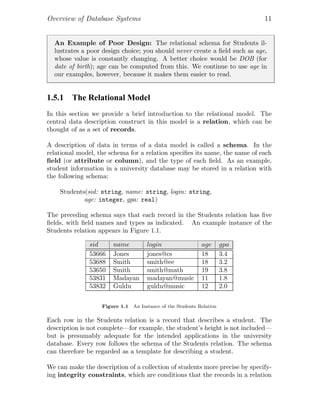
Students(sid: string, name: string, login: string,
age: integer, gpa: real)
The preceding schema says that each record in the Students relation has five
fields, with field names and types as indicated. An example instance of the
Students relation appears in Figure 1.1.
sid name login age gpa
53666 Jones jones@cs 18 3.4
53688 Smith smith@ee 18 3.2
53650 Smith smith@math 19 3.8
53831 Madayan madayan@music 11 1.8
53832 Guldu guldu@music 12 2.0
Figure 1.1 An Instance of the Students Relation
Each row in the Students relation is a record that describes a student. The
description is not complete—for example, the student’s height is not included—
but is presumably adequate for the intended applications in the university
database. Every row follows the schema of the Students relation. The schema
can therefore be regarded as a template for describing a student.
We can make the description of a collection of students more precise by specify-
ing integrity constraints, which are conditions that the records in a relation
12 Chapter 1
must satisfy. For example, we could specify that every student has a unique
sid value. Observe that we cannot capture this information by simply adding
another field to the Students schema. Thus, the ability to specify uniqueness
of the values in a field increases the accuracy with which we can describe our
data. The expressiveness of the constructs available for specifying integrity
constraints is an important aspect of a data model.
Other Data Models
In addition to the relational data model (which is used in numerous systems,
including IBM’s DB2, Informix, Oracle, Sybase, Microsoft’s Access, FoxBase,
Paradox, Tandem, and Teradata), other important data models include the
hierarchical model (e.g., used in IBM’s IMS DBMS), the network model (e.g.,
used in IDS and IDMS), the object-oriented model (e.g., used in Objectstore
and Versant), and the object-relational model (e.g., used in DBMS products
from IBM, Informix, ObjectStore, Oracle, Versant, and others). While many
databases use the hierarchical and network models and systems based on the
object-oriented and object-relational models are gaining acceptance in the mar-
ketplace, the dominant model today is the relational model.
In this book, we focus on the relational model because of its wide use and im-
portance. Indeed, the object-relational model, which is gaining in popularity, is
an effort to combine the best features of the relational and object-oriented mod-
els, and a good grasp of the relational model is necessary to understand object-
relational concepts. (We discuss the object-oriented and object-relational mod-
els in Chapter 23.)
1.5.2 Levels of Abstraction in a DBMS
The data in a DBMS is described at three levels of abstraction, as illustrated
in Figure 1.2. The database description consists of a schema at each of these
three levels of abstraction: the conceptual, physical, and external.
A data definition language (DDL) is used to define the external and concep-
tual schemas. We discuss the DDL facilities of the most widely used database
language, SQL, in Chapter 3. All DBMS vendors also support SQL commands
to describe aspects of the physical schema, but these commands are not part of
the SQL language standard. Information about the conceptual, external, and
physical schemas is stored in the system catalogs (Section 12.1). We discuss
the three levels of abstraction in the rest of this section.
Random documents with unrelated
content Scribd suggests to you:
CHRISTMAS IN PARADISE ALLEY. © The Vitagraph Co. of
America; 2Dec1908; H119040.
CHRISTMAS MORNING. © American Mutoscope & Biograph Co.;
15Dec1902; H25018.
THE CHRISTMAS PARTY. © American Mutoscope & Biograph
Co.; 15Dec1902; H25019.
CHRISTY MATHEWSON, N. Y. NATIONAL LEAGUE BASEBALL
TEAM. © The Winthrop Moving Picture Co.; 24May1907;
H94486.
CHUMS. © American Mutoscope & Biograph Co.; 9Jan1903;
H26844.
THE CHUNCHO INDIANS OF THE AMAZON RIVER, PERU,
scenes 1–4. © Edison Mfg. Co.; 14Oct1910; J146842–45.
CHURCH AND COUNTRY, scenes 1–4. © Thomas A. Edison, Inc.;
12Apr1912; J168272–75.
CHURCH, “OUR LADY OF GRACE,” HOBOKEN. © American
Mutoscope & Biograph Co.; 8July1903; H33289.
THE CIGARETTE MAKER OF SEVILLE, scenes 1–5. © Edison
Mfg. Co.; 3May1910; J141208–12.
CIGARETTE MAKING: FROM PLANTATION TO CONSUMER. ©
The Vitagraph Co. of America; 29Apr1909; H126311.
CINDERELLA UP-TO-DATE. © Geo. Méliès; 27Oct1909; J133255.
CIRCLE DANCE. © Thomas A. Edison; 24Feb1898; 13566.
CIRCULAR PANORAMA OF ELECTRIC TOWER [Pan American
Exposition, Buffalo]. © Thomas A. Edison; 14Aug1901; H7633.
CIRCULAR PANORAMA OF HOUSING THE ICE [Groton Ice
Fields]. © Thomas A. Edison; 24Feb1902; H14440.
CIRCULAR PANORAMA OF SUSPENSION BRIDGE AND
AMERICAN FALLS [Niagara Falls]. © Thomas A. Edison;
13Aug1901; H7627.
CIRCULAR PANORAMA OF THE HORSE SHOE FALLS IN
WINTER [Niagara Falls]. © Thomas A. Edison; 15Jan1904;
H40909.
CIRCULAR PANORAMIC VIEW OF JONES & LAUGHLIN’S
STEEL WORKS YARD. © Thomas A. Edison; 7Apr1902; H16118.
CIRCULAR PANORAMIC VIEW OF WHIRLPOOL RAPIDS
[Niagara Falls]. © Thomas A. Edison; 13Aug1901; H7626.
CIRCUMSTANTIAL EVIDENCE; or, AN INNOCENT VICTIM. ©
The Vitagraph Co. of America; 8June1908; H111509.
THE CIRCUS BOY. © S. Lubin; 6May1908; H110240.
CITY HALL TO HARLEM IN 15 SECONDS, VIA THE SUBWAY
ROUTE. © Thomas A. Edison; 22Oct1904; H51950.
THE CITY OF DENVER, THE QUEEN OF THE PLAINS, scenes 1–
4. © Thomas A. Edison, Inc.; 10Feb1912; J166393–96.
THE CITY OF WASHINGTON, scenes 1–4. © Thomas A. Edison,
Inc.; 10Aug1912; J172449–52.
CLARENCE THE COP. © American Mutoscope & Biograph Co.;
23Dec1903; H39905.
CLARENCE, THE COP, ON THE FEED STORE BEAT. ©
American Mutoscope & Biograph Co.; 5Feb1904; H41858.
CLARK’S THREAD MILL. © Thomas A. Edison; 31Oct1896;
60144.
CLASSICAL DANCES BY COUNTESS DE SWIRSKY. © Imp Films
Co.; 23Mar1912; J167456.
On same reel with Tankville Constable 1.
CLASSICAL DANCES BY COUNTESS DE SWIRSKY. © Imp Films
Co.; 23Mar1912; J167457.
On same reel with Tankville Constable 2.
CLASSMATES. © American Mutoscope & Biograph Co.;
27Jan1908; H105590.
CLEOPATRA’S LOVER; or, A NIGHT OF ENCHANTMENT. ©
The Vitagraph Co. of America; 22Jan1909; H121846.
THE CLEPTOMANIAC [i.e. KLEPTOMANIAC]. © S. Lubin;
23Oct1907; H101546.
CLERKS CASING MAIL FOR BAGS, U.S.P.O. © American
Mutoscope & Biograph Co.; 22Aug1903; H34972.
CLERKS TYING BAGS, U.S.P.O. © American Mutoscope &
Biograph Co.; 22Aug1903; H34975.
CLERKS TYING UP FOR BAGS, U.S.P.O. © American Mutoscope
& Biograph Co.; 22Aug1903; H34977.
CLEVELAND FIRE DEPARTMENT. © American Mutoscope &
Biograph Co.; 17June1903; H32791.
CLEVER HORSEMANSHIP. © American Mutoscope & Biograph
Co.; 4Apr1903; H30178.
A CLEVER TRICK. © The Vitagraph Co. of America; 29Jan1909;
H122210.
A CLEVER UNDERTAKING. SEE The Mourners.
CLIMBING THE AMERICAN ALPS. © American Mutoscope &
Biograph Co.; 6Dec1905; H69545.
THE CLOCK MAKER’S DREAM. © George Méliès; 23Feb1904;
H42528.
THE CLOISTER’S TOUCH. © Biograph Co.; 1c 2Feb1910; J137957.
A CLOSE CALL. © Biograph Co.; 1c 22May1912; J169460.
THE CLOSE OF THE AMERICAN REVOLUTION, scenes 1–3. ©
Thomas A. Edison, Inc.; 2July1912; J170934–36.
A CLOSE SHAVE. © American Mutoscope & Biograph Co.;
9Dec1902; H24892.
CLOSE VIEW OF THE “BROOKLYN,” NAVAL PARADE [Spanish-
American War; New York City Welcome to Admiral Sampson’s
Fleet after Battle of Santiago Bay]. © Thomas A. Edison;
3Sept1898; 52054.
CLOSED SUNDAY, scenes 1–4. © Edison Mfg. Co.; 16June1909;
H128434–37.
THE CLOWN. © S. Lubin; 15June1908; H111857.
THE CLOWN AND THE ALCHEMIST. © Thomas A. Edison;
16Nov1900; D21657.
CLOWN JUGGLER. © Winthrop Press; 6Sept1906; H82617.
CLOWNLAND. © Universal Film Mfg. Co.; 22June1912; J170428.
THE CLOWN’S ADVENTURES. © S. Lubin; 31Mar1906; H75203.
THE CLOWN’S CHRISTMAS EVE. © The Vitagraph Co. of
America; 28Aug1908; H115153.
A CLOWN’S LOVE STORY. © The Vitagraph Co. of America;
9Dec1907; H103456.
CLOWN’S TRIUMPHS. © Imp Films Co.; 23May1912; J169923.
CLUB SWINGING, CARLISLE INDIAN SCHOOL. © American
Mutoscope & Biograph Co.; 14June1902; H19019.
THE CLUBMAN AND TRAMP. © American Mutoscope &
Biograph Co.; 21Nov1908; H118716.
COACH AT RURAL POST OFFICE, U.S.P.O. © American
Mutoscope & Biograph Co.; 22Aug1903; H34991.
COACHES ARRIVING AT MAMMOTH HOT SPRINGS
[Yellowstone Park]. © Thomas A. Edison; 4Jan1899; 2468.
COACHES GOING TO CINNABAR FROM YELLOWSTONE PARK.
© Thomas A. Edison; 4Jan1899; 2466.
COACHING FOR A RECORD. © American Mutoscope & Biograph
Co.; 10May1902; H17626.
COACHING PARTY. © American Mutoscope & Biograph Co.;
8July1903; H33288.
COACHING PARTY, YOSEMITE VALLEY. © American
Mutoscope & Biograph Co.; 24Apr1903; H30734.
COAL HEAVERS. © American Mutoscope & Biograph Co.;
28Oct1904; H52230.
THE COAL STRIKE. © American Mutoscope & Biograph Co.;
12Dec1905; H69963.
COALING A STEAMER, NAGASKI [i.e. NAGASAKI] BAY, JAPAN.
© American Mutoscope & Biograph Co.; 16Apr1902; H16648.
COASTING. © Thomas A. Edison; 17Feb1898; 12175.
COASTING SCENE AT MONTMORENCY FALLS, CANADA. ©
Thomas A. Edison; 17Feb1902; H14292.
THE COBBLER AND THE CALIPH. © The Vitagraph Co. of
America; 13July1909; J129601.
COCK FIGHT. © Thomas A. Edison; 24Dec1896; 70082.
COCOA INDUSTRY, TRINIDAD, BRITISH WEST INDIES, scenes
1–5. © Edison Mfg. Co.; 17Dec1908; H120046–50.
CODFISH INDUSTRY, NEWFOUNDLAND, scenes 1–4. ©
Thomas A. Edison, Inc.; 5Jan1912; J165015–18.
THE CO-ED PROFESSOR. © Independent Moving Picture Co.;
25Sept1911; J160310.
On same reel with Through the Dells of Wisconsin.
THE COFFIN SHIP. SEE The Wreck of the Aurora.
COFFYN HYDROAEROPLANE ALIGHTING IN EAST RIVER, N.
Y. © Vitagraph Co. of America; 20Mar1912; J167411.
COHEN AT CONEY ISLAND. © The Vitagraph Co. of America;
17Mar1909; H124227.
COHEN’S ADVERTISING SCHEME. © Thomas A. Edison;
16Feb1904; H42210.
COHEN’S DREAM OF CONEY ISLAND. © The Vitagraph Co. of
America; 13Mar1909; H123952.
COHEN’S FIRE SALE, scenes 1–12. © Thomas A. Edison;
14June1907; H95238–49.
COIL WINDING MACHINES, WESTINGHOUSE WORKS. ©
American Mutoscope & Biograph Co.; 6May1904; H45401.
COIL WINDING SECTION E, WESTINGHOUSE WORKS. ©
American Mutoscope & Biograph Co.; 6May1904; H45402.
A COLD SUPPER WITH A HOT FINISH. © American Mutoscope
& Biograph Co.; 20June1903; H33024.
COLLECTING MAIL, U.S.P.O. © American Mutoscope & Biograph
Co.; 22Aug1903; H34968.
COLLEGE CHUMS, scenes 1–8. © Edison Mfg. Co.; 25Nov1907;
H102945–52.
A COLLEGE GIRL’S AFFAIR OF HONOR. © American Mutoscope
& Biograph Co.; 19June1906; H79737.
THE COLLINWOOD [OHIO] SCHOOL FIRE. © William Bullock;
23Mar1908; H107814.
THE COLLINWOOD [OHIO] SCHOOL FIRE FUNERAL. ©
William Bullock; 23Mar1908; H107815.
COLONEL FUNSTAN [i.e. FUNSTON] SWIMMING THE BAGLAG
RIVER. © Thos. A. Edison; 23Sept1899; 61838.
THE COLONEL’S FRIEND. © Frank Graham; 12July1905;
H63157.
A COLONIAL ROMANCE. © The Vitagraph Co. of America;
11Jan1909; H121461.
COLONIAL VIRGINIA, scenes 1–5. © Edison Mfg. Co.;
19Nov1908; H118492–96.
THE COLORED STENOGRAPHER, scenes 1–5. © Edison Mfg.
Co.; 9Mar1909; H123788–92.
COLORED TROOPS DISEMBARKING [Spanish-American War].
© Thomas A. Edison; 20May1898; 31436.
“COLUMBIA” AND “DEFENDER” ROUNDING STAKE-BOAT. ©
American Mutoscope & Biograph Co.; 8May1902; H17487.
“COLUMBIA” AND “SHAMROCK II” [America’s Cup Races]. ©
Thomas A. Edison.
Jockeying and starting. © 7Oct1901; H9408.
Finishing second race. © 7Oct1901; H9409.
Start of second race. © 7Oct1901; H9410.
Turning the outer stake boat. © 9Oct1901; H9496.
Starting in the third race. © 9Oct1901; H9497.
“COLUMBIA” CLOSE TO THE WIND. © American Mutoscope &
Biograph Co.; 14Jan1903; H26955.
“COLUMBIA” vs. “DEFENDER.” © American Mutoscope &
Biograph Co.; 24Apr1903; H30746.
“COLUMBIA” WINNING THE CUP [America’s Cup Races:
Columbia and Shamrock I]. © Thomas A. Edison; 24Oct1899;
69350.
“COLUMBIA” WINNING THE CUP [America’s Cup Races:
Columbia and Shamrock II]. © Thomas A. Edison; 9Oct1901;
H9495.
COMATA, THE SIOUX. © Biograph Co.; 1c 13Sept1909; J131568.
COMEDY AND TRAGEDY, scenes 1–5. © Edison Mfg. Co.;
2Nov1909; J134484–88.
COMEDY CAKE WALK. © American Mutoscope & Biograph Co.;
11May1903; H31675.
A COMEDY IN BLACK AND WHITE, scenes 1–2. © Edison Mfg.
Co.; 4Sept1908; H115348–49.
A COMEDY OF ERRORS. © The Vitagraph Co. of America;
1Feb1908; H105775.
A COMEDY OF UNDERSTANDING, scenes 1–4. © Thomas A.
Edison, Inc.; 21June1911; J156880–83.
COMEDY SET-TO. © Thomas A. Edison; 20May1898; 31430.
COMING OF COLUMBUS. © Selig Polyscope Co.
Scenes 1–10. © 1c 8Apr1912; J167883–92.
Scenes 11–26. © 1c 13Apr1912; J168122–37.
COMMITTEE ON ART. © American Mutoscope & Biograph Co.;
27Feb1904; H42804.
THE COMMUTER’S WIFE, scenes 1–4. © Thomas A. Edison, Inc.;
7Feb1912; J166381–84.
COMPANY DRILL, ST. JOHN’S MILITARY ACADEMY. ©
American Mutoscope & Biograph Co.; 17Mar1904; H43410.
COMRADES. © Biograph Co.; 1c 14Mar1911; J153151.
CONCEALING A BURGLAR. © American Mutoscope & Biograph
Co.; 22Oct1908; H117340.
THE CONDEMNATION OF FAUST. © S. Lubin; 15Jan1904;
H40888.
CONDENSED MILK. © American Mutoscope & Biograph Co.;
20June1903; H32872.
CONEY ISLAND AT NIGHT. © Thomas A. Edison; 29June1905;
H62761.
THE CONEY ISLAND BEACH PATROL. © American Mutoscope &
Biograph Co.; 13Aug1904; H49071.
THE CONEY ISLAND BIKERS. © American Mutoscope &
Biograph Co.; 24Feb1903; H28550.
CONEY ISLAND POLICE COURT. © American Mutoscope &
Biograph Co.; 25Aug1908; H115087.
CONFIDENCE. © American Mutoscope & Biograph Co.;
8Apr1909; H125501.
CONGRESS OF NATIONS. © Thomas A. Edison; 16Nov1900;
D21659.
THE CONJUROR’S OUTING. © Lubin Mfg. Co.; 3May1909;
H126441.
THE CONQUERING HERO. © Lubin Mfg. Co.; 20Mar1909;
H124441.
CONSCIENCE. © Biograph Co.; 1c 10Mar1911; J153060.
A CONSPIRACY AGAINST THE KING, scenes 1–4. © Thomas A.
Edison, Inc.; 20Oct1911; J161706–09.
CONTRARY WIND. © American Mutoscope & Biograph Co.;
24Feb1903; H28559.
A CONVENIENT BURGLAR. © Biograph Co.; 1c 25Sept1911;
J160416.
CONVERTED BY A BILLIKEN. SEE Grin and Win.
THE CONVERTS. © Biograph Co.; 1c 16Mar1910; J139195.
CONVICT LIFE IN THE OHIO PENITENTIARY. © America’s
Feature Film Co.; 1c 18May1912; J169358.
CONVICTED BY HYPNOTISM; or, A DOUBLE LIFE, 2 pts. ©
Société Francaise des Films & Cinematographes Eclair; 1c
5Aug1912; J171903.
THE CONVICT’S BRIDE. © American Mutoscope & Biograph Co.;
9Aug1906; H81754.
THE CONVICT’S ESCAPE. © American Mutoscope & Biograph
Co.; 10Sept1904; H50327.
CONVICTS NO. 10 AND NO. 13, parts 1–3. © Ingvald C. Oes; 1c
1Mar1912; J166791–93.
THE CONVICT’S PAROLE, scenes 1–4. © Thomas A. Edison, Inc.;
17May1912; J169450–53.
A CONVICT’S PUNISHMENT. © American Mutoscope & Biograph
Co.; 7Feb1903; H27980.
THE COOK IN THE PARLOR. © American Mutoscope & Biograph
Co.; 23June1903; H32908.
THE COOK IN TROUBLE. © Geo. Méliès; 9May1904; H45466.
THE COOK’S REVENGE. © S. Lubin; 7Mar1901; H1774.
COON TOWN PARADE. © Lubin Mfg. Co.; 5Feb1909; H122572.
THE COP AND THE NURSE GIRL. © Thomas A. Edison;
12Dec1898; 72467.
THE COP FOOLS THE SERGEANT. © Thomas A. Edison;
29Apr1904; H45037.
THE COQUETTE, scenes 1–4. © Edison Mfg. Co.; 21Jan1910;
J137658–61.
CORBETT AND COURTNEY BEFORE THE KINETOGRAPH. ©
Wm. K. L. Dickson; 17Nov1894; 53707.
CORBETT AND JEFFRIES FIGHT. SEE Reproduction of the
Corbett and Jeffries Fight.
CORBETT AND MCCOY FIGHT. SEE Reproduction of the Corbett
and McCoy Fight.
CORBETT-MCGOVERN FIGHT. SEE Reproduction of Corbett-
McGovern Fight.
CORCORAN CADETS, WASHINGTON [McKinley Inaugural
Parade]. © Thomas A. Edison; 8May1897; 28515.
THE CORD OF LIFE. © American Mutoscope & Biograph Co.;
22Jan1909; H121877.
CORK LEG LEGACY. © Lubin Mfg. Co.; 3May1909; H126442.
CORNELL-COLUMBIA-UNIVERSITY OF PENNSYLVANIA BOAT
RACE AT ITHACA, N. Y., SHOWING LEHIGH VALLEY
OBSERVATION TRAIN. © Thomas A. Edison; 6June1901;
H4935.
A CORNER IN THE PLAY ROOM. © American Mutoscope &
Biograph Co.; 8July1903; H33291.
A CORNER IN WHEAT. © Biograph Co.; 1c 15Dec1909; J135969.
CORNER MADISON AND STATE STREETS, CHICAGO. ©
Thomas A. Edison; 31July1897; 43410.
CORPUS CHRISTI PROCESSION, ORVIETO. © American
Mutoscope & Biograph Co.; 12Sept1903; H35635.
“CORSAIR” IN WAKE OF TUGBOAT. © American Mutoscope &
Biograph Co.; 14Jan1903; H26952.
THE CORSET MODEL. © American Mutoscope & Biograph Co.;
20June1903; H32866.
THE CORSICAN BROTHERS, scenes 1–4. © Thomas A. Edison,
Inc.; 9Feb1912; J166377–80.
COSSACK CAVALRY. © American Mutoscope & Biograph Co.;
3Aug1903; H34102.
COSY CORNER DANCE. © American Mutoscope & Biograph Co.;
25June1903; H32943.
COTTON INDUSTRY. © Imp Films Co.; 15Jan1912; J164477.
On same reel with How She Married.
THE COTTON INDUSTRY OF THE SOUTH. © S. Lubin;
3Oct1908; H116478.
COTTON SPINNING. © American Mutoscope & Biograph Co.;
6Mar1903; H29001.
COUNCIL BLUFFS BRIDGE STATION. © American Mutoscope &
Biograph Co.; 11Mar1903; H29152.
THE COUNT OF NO ACCOUNT. © S. Lubin; 28Jan1908;
H105595.
THE COUNTERFEITERS. © S. Lubin; 24Jan1905; H56167.
A COUNTRY COURTSHIP. © American Mutoscope & Biograph
Co.; 25Oct1905; H67887.
A COUNTRY CUPID. © Biograph Co.; 1c 29July1911; J158240.
THE COUNTRY DOCTOR. © Biograph Co.; 1c 9July1909;
J129513.
A COUNTRY GIRL IN PHILADELPHIA. © S. Lubin; 16Mar1908;
H107537.
A COUNTRY GIRL’S SEMINARY LIFE AND EXPERIENCES,
scenes 1–6. © Edison Mfg. Co.; 25Mar1908; H107917–22.
THE COUNTRY SCHOOLMASTER. © American Mutoscope &
Biograph Co.; 6Oct1906; H83541.
THE COUNT’S WOOING. © Geo. Méliès; 17Nov1909; J134442.
A COUPLE OF LIGHTWEIGHTS AT CONEY ISLAND. ©
American Mutoscope & Biograph Co.; 28July1904; H48620.
THE COURSE OF TRUE LOVE. © American Mutoscope &
Biograph Co.; 26Sept1905; H66191.
THE COURSE OF TRUE LOVE. © Biograph Co.; 1c 8Feb1910;
J138088.
A COWARD, scenes 1–4. © Edison Mfg. Co.; 10Aug1909;
J130719–22.
THE COWBOY AND THE LADY. © American Mutoscope &
Biograph Co.; 1Oct1903; H36402.
THE COWBOY AND THE SCHOOLMARM, scenes 1–6. © Edison
Mfg. Co.; 1Apr1908; H108151–56.
A COWBOY ELOPEMENT. © The Vitagraph Co. of America;
17Jan1908; H105166.
COWBOY JUSTICE. © American Mutoscope & Biograph Co.;
11Jan1904; H40754.
COWBOYS AND INDIANS FORDING RIVER IN A WAGON. ©
Thomas A. Edison; 18May1904; H46141.
A COWBOY’S ROMANCE. © Centaur Film Co.; 26June1909;
H128972.
A COWBOY’S STRATAGEM, scenes 1–4. © Thomas A. Edison,
Inc.; 2Mar1912; J167023–26.
A COWBOY’S SWEETHEART. © Centaur Film Co., Inc.;
23Apr1909; H126067.
THE COWPUNCHER’S GLOVE, scenes 1–4. © Edison Mfg. Co.;
2Dec1910; J148712–15.
A CRAZY COMPOSER. © George Méliès; 3June1905; H61532.
A CRAZY QUILT. © The Vitagraph Co. of America; 12Nov1907;
H102390.
THE CREATORS OF FOXY GRANDPA. © American Mutoscope &
Biograph Co.; 23May1902; H18032.
THE CRICKET ON THE HEARTH. © Biograph Co.; 26May1909;
H127599.
THE CRIMINAL HYPNOTIST. © American Mutoscope &
Biograph Co.; 12Jan1909; H121531.
THE CRIMINAL’S DAUGHTER. © S. Lubin; 25Aug1908;
H115089.
CRIPPLE CREEK BAR-ROOM SCENE. © Thomas A. Edison;
10May1899; 31770.
CRIPPLE CREEK FLOATS. © Thomas A. Edison; 24Feb1898;
13539.
THE CRISIS. © New York Motion Picture Co., Inc.; 15May1912;
J169703.
CRISSIE SHERIDAN. © Thomas A. Edison; 25Oct1897; 60590.
THE CRITIC. © American Mutoscope & Biograph Co.; 22Jan1906;
H72184.
THE CROOKED ROAD. © Biograph Co.; 1c 25May1911; J155829.
CROSS COUNTRY RUNNING ON SNOW SHOES. © Thomas A.
Edison; 17Feb1902; H14293.
THE CROSS ROAD. © S. Lubin; 25Sept1908; H116150.
CROSSING ICE BRIDGE AT NIAGARA FALLS. © Thomas A.
Edison; 15Jan1904; H40910.
CROSSING THE ATLANTIC. © Thomas A. Edison; 17June1903;
H32796.
CROSSROADS OF LIFE. © American Mutoscope & Biograph Co.;
20June1908; H112128.
CROWD ENTERING, FUTURITY DAY. © American Mutoscope &
Biograph Co.; 17Sept1902; H21775.
CROWDS RETURNING FROM THE GAMES, WAIKIKI, H. I. ©
Thomas A. Edison; 13Nov1906; H85056.
THE CRUCIAL TEST, scenes 1–4. © Thomas A. Edison, Inc.;
7July1911; J157537–40.
CRUELTY TO HORSES. © American Mutoscope & Biograph Co.;
1Oct1904; H51117.
THE CRUISE OF THE “GLADYS.” © American Mutoscope &
Biograph Co.; 25Aug1906; H82299.
CRUISER “CINCINNATI” [Spanish-American War]. © Thomas A.
Edison; 21Apr1898; 25327.
CRUISER “DETROIT” [Spanish-American War]. © Thomas A.
Edison; 21Apr1898; 25326.
CRUISER “MARBLEHEAD” [Spanish-American War]. © Thomas
A. Edison; 22Apr1898; 25564.
THE CRUSADER, scenes 1–4. © Thomas A. Edison, Inc.;
30June1911; J157084–87.
THE CRUSADERS; or, JERUSALEM DELIVERED. © World’s
Best Film Co.; 4July1911; J157263.
THE CRUSHED HAT. © American Mutoscope & Biograph Co.;
29Mar1904; H44030.
THE CRUSHED TRAGEDIAN. © S. Lubin; 21July1908; H113740.
A CRY FROM THE WILDERNESS, scenes 1–4. © Edison Mfg. Co.;
22Mar1909; H124583–86.
THE CRYSTAL CASKET. © Geo. Méliès; 21Mar1905; H58074.
THE CRYSTAL CASKET. SEE Glass Coffin.
THE CUB REPORTER, scenes 1–4. © Thomas A. Edison, Inc.;
23Aug1912; J176455–58.
CUBAN AMBUSH [Spanish-American War]. © Thomas A. Edison;
5Aug1898; 46695.
CUBAN REFUGEES WAITING FOR RATIONS [Spanish-American
War]. © Thomas A. Edison; 20May1898; 31439.
CUBAN VOLUNTEERS EMBARKING [Spanish-American War].
© Thomas A. Edison; 22June1898; 38246.
CUBAN VOLUNTEERS MARCHING FOR RATIONS [Spanish-
American War]. © Thomas A. Edison; 20May1898; 31434.
A CUP OF TEA AND SHE, scenes 1–4. © Edison Mfg. Co.;
8Apr1909; H125513–16.
CUPID AND PSYCHE. © Thomas A. Edison; 25Oct1897; 60560.
CUPID’S JOKE. © Biograph Co.; 1c 8May1911; J155076.
CUPID’S PRANKS, scenes 1–7. © Edison Mfg. Co.; 19Feb1908;
H106508–14.
CUPID’S REALM; or, A GAME OF HEARTS. © The Vitagraph Co.
of America; 19Feb1908; H106452.
CURE FOR BASHFULNESS. © The Vitagraph Co. of America;
19Dec1908; H120077.
A CURE FOR CRIME, scenes 1–4. © Thomas A. Edison, Inc.;
27Sept1911; J160329–32.
A CURE FOR DYSPEPSIA, scenes 1–4. © Thomas A. Edison, Inc.;
21June1911; J156910–13.
A CURE FOR RHEUMATISM. © The Vitagraph Co. of America;
11Mar1909; H123858.
THE CURE THAT FAILED. © Universal Film Mfg. Co.; 3Aug1912;
J171838.
CURED. © Biograph Co.; 1c 28Mar1911; J153534.
THE CURFEW BELL, scenes 1–4. © Edison Mfg. Co.; 3June1909;
H127992–95.
CURING A JEALOUS HUSBAND. © Lubin Mfg. Co.; 5June1909;
H128024.
CURING THE OFFICE BOY, scenes 1–4. © Thomas A. Edison,
Inc.; 17Feb1912; J166531–34.
CURIOSITY. © Biograph Co.; 1c 3June1911; J156203.
CURIOSITY PUNISHED. © Geo. Méliès; 20Apr1908; H109548.
A CURIOUS DREAM. © The Vitagraph Co. of America;
18Mar1907; H91549.
CURIOUS MR. CURIO, scenes 1–5. © Edison Mfg. Co.;
21May1908; H110844–48.
THE CURSE OF GOLD. © Lubin Mfg. Co.; 13Mar1909; H123955.
THE CURSE OF GOLD. © S. Lubin; 6Apr1908; H108430.
THE CURTAIN POLE. © American Mutoscope & Biograph Co.;
2Jan1909; H120977.
A CUSTOMER DROPS IN. © American Mutoscope & Biograph
Co.; 24Apr1903; H30749.
CUTTING AND CANALING ICE [Groton Ice Fields]. © Thomas A.
Edison; 24Feb1902; H14436.
CUTTING SUGAR CANE. © American Mutoscope & Biograph Co.;
23May1902; H18040.
CYNTHIA’S AGREEMENT, scenes 1–4. © Thomas A. Edison, Inc.;
25Sept1912; J176558–61.
D
DAD’S A GENTLEMAN TOO. © Frank Graham; 12July1905;
H63156.
THE DAIRY MAID’S REVENGE. © American Mutoscope &
Biograph Co.; 25Aug1902; H21311.
THE DAISY COWBOYS, scenes 1–4. © Thomas A. Edison, Inc.;
9Dec1911; J164286–89.
DALY OF WEST POINT WINNING HURDLE RACE. © American
Mutoscope & Biograph Co.; 9Dec1902; H24881.
THE DAM BUILDER, scenes 1–4. © Thomas A. Edison, Inc.;
13Sept1912; J176503–06.
LA DAME AUX CAMELIAS. With Mme. Sarah Bernhardt. ©
French-American Film Co.; 1c 24Feb1912; J166636.
THE DAMNATION OF FAUST. © George Méliès; 11Dec1903;
H39290.
DAN, THE DANDY. © Biograph Co.; 1c 20Sept1911; J160241.
DANCE, FRANCHONETTI SISTERS. © American Mutoscope &
Biograph Co.; 24Apr1903; H30723.
A DANCE IN PAJAMAS. © American Mutoscope & Biograph Co.;
7Dec1903; H39142.
THE DANCE OF THE SEVEN VEILS. SEE Salome.
A DANCE ON THE PIKE. © American Mutoscope & Biograph Co.;
22Mar1904; H43560.
THE DANCER AND THE KING; a romantic story of Spain. © The
Vitagraph Co. of America; 8Dec1908; H119406.
DANCING BOXING MATCH, MONTGOMERY AND STONE. ©
The Winthrop Moving Picture Co.; 7May1907; H93358.
DANCING CHINAMAN, MARIONETTES. © Thomas A. Edison;
7Oct1898; 59208.
DANCING DARKEY BOY. © Thomas A. Edison; 25Oct1897;
60568.
DANCING DARKIES. © American Mutoscope Co.; 7Jan1897;
3540.
THE DANCING FIEND. © S. Lubin; 5Aug1908; H114298.
THE DANCING GIRL OF BUTTE. © Biograph Co.; 1c 8Jan1910;
J136851.
THE DANCING LEGS. © The Vitagraph Co. of America;
1Apr1908; H108127.
A DANCING LESSON: A LITTLE PRACTICE. © American
Mutoscope & Biograph Co.; 23Dec1904; H54690.
THE DANDY FIFTH. © American Mutoscope & Biograph Co.;
5Sept1902; H21512.
DANGER OF DINING IN PRIVATE DINING ROOMS. ©
American Mutoscope & Biograph Co.; 5June1903; H32408.
A DANGEROUS LESSON, scenes 1–4. © Thomas A. Edison, Inc.;
13Aug1912; J172453–56.
A DANGEROUS PAIR, scenes 1–4. © Edison Mfg. Co.; 7Sept1909;
J131476–79.
A DANGEROUS PLAY, parts 1–2. © Ingvald C. Oes; 1c 19Apr1912;
J168439–40.
DANIEL BOONE, scenes 1–13. © Thomas A. Edison; 3Jan1907;
H88545–57.
DANTE’S INFERNO. © Monopol Film Co.
Pt. 1. © 1c 27June1911; J157014.
Pt. 2. © 1c 12July1911; J157495.
Pt. 3. © 1c 12July1911; J157496.
Pt. 4. © 1c 12July1911; J157497.
DANTE’S PROGRESS AND EXPERIENCES THROUGH
PARADISE. © National Film Distributing Co.; 1c 29Apr1912;
J168785.
DANTE’S PROGRESS AND EXPERIENCES THROUGH
PURGATORY. © National Film Distributing Co.; 1c 29Apr1912;
J168784.
THE DARLING OF THE GALLERY GODS. © American
Mutoscope & Biograph Co.; 15July1905; H63379.
A DASH THROUGH THE CLOUDS. © Biograph Co.; 1c
28June1912; J170666.
A DASH TO DEATH, scenes 1–4. © Edison Mfg. Co.; 27Aug1909;
J131252–55.
A DAUGHTER OF THE MINES, scenes 1–4. © Edison Mfg. Co.;
25Nov1910; J148424–27.
A DAUGHTER OF THE SUN, scenes 1–6. © Edison Mfg. Co.;
17Feb1909; H123010–15.
DAVE’S LOVE AFFAIR. © Biograph Co.; 1c 10June1911; J156469.
DAVEY JONES’ LOCKER. © American Mutoscope & Biograph
Co.; 24Apr1903; H30728.
THE DAY AFTER. © Biograph Co.; 1c 3Jan1909; J136612.
A DAY AT THE CIRCUS. © Thomas A. Edison; 17May1901;
H4418.
A DAY AT WEST POINT MILITARY ACADEMY, NEW YORK,
scenes 1–4. © Thomas A. Edison, Inc.; 24Oct1911; J161698–701.
A DAY IN WASHINGTON; the Capital of the United States,
showing many points of interest. © The Vitagraph Co. of
America; 26Feb1909; H123375.
THE DAY OF THE DOG. © S. Lubin; 1Feb1909; H122288.
A DAY ON A BUFFALO RANCH. © Imp Films Co.; 27Jan1912;
J165053.
On same reel with All A Mistake.
A DAY ON A BUFFALO RANCH. © Imp Films Co.; 27Jan1912;
J165409.
THE DAYS OF ’61. SEE The Blue and the Gray.
THE DEACON’S LOVE LETTER. © The Vitagraph Co. of America;
22Jan1909; H121845.
A DEAD MAN’S CHILD, no. 1–2. © Ingvald C. Oes; 1c 7Dec1911;
J163442–43.
THE DEADWOOD SLEEPER. © American Mutoscope & Biograph
Co.; 26May1905; H61361.
DEAF MUTE GIRL RECITING “STAR SPANGLED BANNER.” ©
American Mutoscope & Biograph Co.; 7June1902; H18743.
DEAR OLD STARS AND STRIPES, GOODBYE. © S. Lubin;
2Oct1903; H36488.
A DEARLY PAID FOR KISS. © The Vitagraph Co. of America;
17Oct1908; H117107.
THE DEATH DISC. © Biograph Co.; 1c 3Dec1909; J135518.
THE DEATH OF NATHAN HALE, scenes 1–4. © Thomas A.
Edison, Inc.; 29Sept1911. J160333–36.
THE DECEIVED SLUMMING PARTY. © American Mutoscope &
Biograph Co.; 28July1908; H113968.
THE DECEIVER. © The Vitagraph Co. of America; 23Dec1907;
H104010.
THE DECEPTION. © American Mutoscope & Biograph Co.;
13Mar1909; H123959.
THE DECLARATION OF INDEPENDENCE, scenes 1–4. ©
Thomas A. Edison, Inc.; 1Sept1911; J159414–17.
DECORATED CARRIAGES, no. 11. © Thomas A. Edison;
24Feb1898; 13535.
DECOYED. © American Mutoscope & Biograph Co.; 28Oct1904;
H52231.
A DECREE OF DESTINY. © Biograph Co.; 1c 7Mar1911; J152949.
DEEP BREATHING AND CHEST EXPANSION. © Winthrop
Press; 18Apr1906; H75806.
DEER STALKING WITH CAMERA. © American Mutoscope &
Biograph Co.; 3Jan1906; H71527.
THE DELAYED PROPOSAL. © Biograph Co.; 1c 21June1911;
J156842.
DELIRIUM IN A STUDIO. © Geo. Méliès; 7Dec1907; H103393.
DELIVERING MAIL FROM SUB-STATION [U.S.P.O.]. ©
American Mutoscope & Biograph Co.; 1Oct1903; H36398.
DELIVERING NEWSPAPERS. © American Mutoscope &
Biograph Co.; 24Apr1903; H30745.
A DELUSION. © American Mutoscope & Biograph Co.;
27Sept1902; H22088.
DEMOCRATIC NATIONAL COMMITTEE AT ESOPUS [N. Y.]. ©
American Mutoscope & Biograph Co.; 4Aug1904; H48851.
DENVER FIRE BRIGADE. © Thomas A. Edison; 24Feb1898;
13532.
THE DEPARTMENT STORE, scenes 1–4. © Thomas A. Edison,
Inc.; 15Mar1911; J153383–86.
DEPARTURE OF PEARY [AND] ROOSEVELT FROM NEW
YORK. © American Mutoscope & Biograph Co.; 28July1905;
H63906.
DESDEMONA, part 1–2. © Ingvald C. Oes; 1c 16Apr1912;
J168207–08.
THE DESERTED SHAFT. © Imp Films Co.; 15Jan1912; J164478.
THE DESERTER, parts 1–2. © New York Motion Picture Co.;
15Mar1912; J167154.
THE DESPATCH BEARER. © The Vitagraph Co. of America;
6Aug1907; H97722.
A DESPERATE CRIME. © George Méliès; 27Apr1906; H76259.
THE DETERMINED LOVER; or, WHERE THERE’S A WILL,
THERE’S A WAY. © The Vitagraph Co. of America; 12June1908;
H111706.
“DEUTSCHLAND” LEAVING NEW YORK AT FULL SPEED [With
Prince Henry of Prussia]. © Thomas A. Edison; 15Mar1902;
H15199.
DEVELOPING MUSCLES OF BACK AND CHEST. © Winthrop
Press; 18 Apr 1906; H75812.
DEVELOPING MUSCLES OF CHEST AND ABDOMEN. ©
Winthrop Press; 18Apr1906; H75808.
THE DEVIL. © American Mutoscope & Biograph Co.; 25Sept1908;
H116154.
THE DEVIL, scenes 1–12. © Edison Mfg. Co.; 10Sept1908;
H115507–18.
THE DEVIL AND THE GAMBLER. © The Vitagraph Co. of
America; 23Sept1908; H116064.
DEVIL’S SLIDE. © American Mutoscope & Biograph Co.;
23May1902; H18046.
THE DEWEY ARCH [Spanish-American War; Dewey
Homecoming, New York City]. © American Mutoscope &
Biograph Co.; 18June1903; H32835.
DEWEY ARCH—TROOPS PASSING UNDER ARCH [Spanish-
American War; Dewey Homecoming, New York City]. © Thomas
A. Edison; 5Oct1899; 64682.
DEWEY PARADE, 10TH PENNSYLVANIA VOLUNTEERS
[Spanish-American War; Dewey Homecoming, New York City].
© Thomas A. Edison; 7Oct1899; 65373.
DEYO. © American Mutoscope & Biograph Co.; 22Apr1907;
H92889.
DIAL’S GIRLS’ BAND, LUNA PARK. © Eugene Dial; 25Oct1905;
H67888.
THE DIAMOND MAKER; or, FORTUNE AND MISFORTUNE. ©
The Vitagraph Co. of America; 12June1909; H128245.
THE DIAMOND SMUGGLERS. SEE Secret Service.
THE DIAMOND STAR. © Biograph Co.; 1c 21Feb1911; J152473.
DICK CROKER LEAVING TAMMANY HALL. © Thomas A
Edison; 9Feb1900; D3543.
DICK’S SISTER. © S. Lubin; 18June1908; H112074.
DID MOTHER GET HER WISH? © Biograph Co.; 1c 15Jan1912;
J164603.
DID NOT FINISH THE STORY. © American Mutoscope &
Biograph Co.; 18July1903; H33546.
DIME NOVEL DAN. © The Vitagraph Co. of America; 29Apr1909;
H126310.
A DIME NOVEL DETECTIVE. © S. Lubin; 5Feb1909; H122569.
DINAH’S DEFEAT. © American Mutoscope & Biograph Co.;
10Feb1904; H42000.
A DIP IN THE MEDITERRANEAN. © American Mutoscope &
Biograph Co.; 16Apr1902, H16642.
THE DISAPPOINTED OLD MAID. © American Mutoscope &
Biograph Co.; 13June1903; H32632.
DISCHARGING A WHITEHEAD TORPEDO. © Thomas A.
Edison; 12May1900; D10160.
A DISCORDANT NOTE. © American Mutoscope & Biograph Co.;
6July1903; H33397.
THE DISCOVERERS; a grand historical pageant picturing the
discovery and founding of New France, Canada. © The Vitagraph
Co. of America; 15Aug1908; H114573.
DISCOVERY OF BODIES. © American Mutoscope & Biograph
Co.; 21Sept1903; H35879.
THE DISINTEGRATED CONVICT. © The Vitagraph Co. of
America; 4Sept1907; H99034.
THE DISREPUTABLE MR. RAEGEN, scenes 1–4. © Thomas A.
Edison, Inc.; 24Mar1911; J153739–42.
THE DIVIDING LINE. © Universal Film Mfg. Co.; 24June1912;
J170425.
THE DIVING GIRL. © Biograph Co.; 1c 23Aug1911; J159204.
THE DIVING HORSE. © Thomas A. Edison; 23Sept1899; 61839.
DIVING THROUGH HOOPS. © American Mutoscope & Biograph
Co.; 12Apr1902; H16383.
THE DIVORCE. © American Mutoscope & Biograph Co.;
13June1903.
Detected. H33410.
On the trail. H33411.
The evidence secured. H33412.
10 FEMMES DANS UN PARAPLUIE. © George Méliès;
26Oct1903; H37511.
DIXON-CHESTER LEON CONTEST. © American Mutoscope &
Biograph Co.; 6Mar1906; H74312.
DO IT NOW. © S. Lubin; 16Mar1908; H107538.
DO YOU SPEAK FRENCH. SEE Parlez Vous Francais?
THE DOCTOR, scenes 1–3. © Edison Mfg. Co.; 7Feb1911;
J152135–37.
DR. BROMPTON-WATTS’ ADJUSTER, scenes 1–4. © Thomas A.
Edison, Inc.; 6Apr1912; J168020–23.
DR. BUNION AND THE MISCHIEVOUS BOYS. © American
Mutoscope & Biograph Co.; 18Apr1902; H16736.
DR. CUREM’S PATIENTS. © S. Lubin; 28Apr1908; H109925.
DR. DIPPY’S SANITARIUM. © American Mutoscope & Biograph
Co.; 27Oct1906; H84235.
DOCTOR PHANTOM, THE SCIENTIFIC SLEUTH, no. 1–6. ©
Walter Lannoy Brind; 1c 5Aug1912; J171902.
THE DOCTORED DINNER PAIL, scene 1. © Edison Mfg. Co.;
5May1909; H126608.
THE DOCTOR’S BRIDE. © Lubin Mfg. Co.; 30Aug1909; J132442.
THE DOCTOR’S FAVORITE PATIENT. © American Mutoscope &
Biograph Co.; 12June1903; H32560.
DOG FACTORY. © Thomas A. Edison; 21Apr1904; H44668.
A DOG FIGHT. © American Mutoscope & Biograph Co.;
24Feb1903; H28562.
A DOG LOST, STRAYED OR STOLEN, $25.00 REWARD. APPLY
TO MRS. BROWN, 711 PARK AVE. © S. Lubin; 23May1905;
H61274.
DOGS PLAYING IN THE SURF. © Thomas A. Edison; 17Feb1898;
12172.
A DOMESTIC REUNION. SEE Two Affinities.
A DONKEY PARTY. © American Mutoscope & Biograph Co.;
17June1903; H32788.
THE DONKEY PARTY. © Thomas A. Edison; 16Mar1901; H2342.
DOOLEY’S SCHEME. © Biograph Co.; 1c 15Nov1911; J162974.
THE DOOMED SHIP, scenes 1–4. © Thos. A. Edison, Inc.;
28July1911; J158321–24.
DORA: A RUSTIC IDYLL. © The Vitagraph Co. of America;
1Apr1908; H108128.
DOROTHY’S FAMILY. © Independent Moving Picture Co.;
10Aug1911; J158554.
A DOUBLE-BARRELED SUICIDE. © The Vitagraph Co. of
America; 31July1907; H97473.
A DOUBLE LIFE. © New York Motion Picture Co.; 20July1912;
J171458.
A DOUBLE LIFE. SEE Convicted by Hypnotism.
DOUBLE RING ACT, LUNA PARK [Coney Island]. © American
Mutoscope & Biograph Co.; 6Oct1903; H36555.
THE DOVE AND THE SERPENT. © Imp Films Co.; 4Apr1912;
J167839.
DOWN ON THE FARM, scenes 1–6. © Thomas A. Edison;
26Oct1905; H67910–67915.
DOWN THE HOTEL CORRIDOR. © American Mutoscope &
Biograph Co.; 28July1903; H33887.
DOWN THE HUDSON. © American Mutoscope & Biograph Co.;
6Oct1903; H36559.
DOWN WESTERN SLOPE. © American Mutoscope & Biograph
Co.; 14Jan1903; H26946.
DOWN WHERE THE WURZBURGER FLOWS. © Thomas A.
Edison; 26Aug1903; H35062.
THE DOWNWARD PATH. © American Mutoscope & Biograph
Co.; 11Nov1902.
The new soubrette. H23806.
The fresh book agent. H23807.
The girl who went astray. H23808.
The suicide. H23809.
She ran away. H23810.
THE DRAMATIST’S DREAM. © The Vitagraph Co. of America;
6July1909; J129521.
THE DRAPED MODEL. © American Mutoscope & Biograph Co.;
27Sept1902; H22089.
DRAWING A LOBSTER POT. © American Mutoscope & Biograph
Co.; 31Dec1902; H25970.
THE DRAWING LESSON; or, THE LIVING STATUE. © George
Méliès; 6July1903; H33237.
DRAWING THE COLOR LINE, scenes 1–3. © Edison Mfg. Co.;
13Jan1909; H121564–66.
DREAM DANCES, scenes 1–4. © Thomas A. Edison, Inc.;
20Apr1912; J168489–92.
DREAM OF A RAREBIT FIEND, scenes 1–9. © Thomas A. Edison;
24Feb1906; H73985–93.
THE DREAM OF AN OPIUM FIEND. © Geo. Méliès; 14Mar1908;
H107381.
A DREAM OF ROSES. © American Mutoscope & Biograph Co.;
9June1904; H46939.
DREAM OF THE RACE TRACK FIEND. © American Mutoscope &
Biograph Co.; 6Oct1905; H67066.
A DREAM OF WEALTH; a tale of the gold seekers of ’49. © The
Vitagraph Co. of America; 9Dec1908; H119443.
DREAMS OF A POLICEMAN. © The Vitagraph Co. of America;
20July1908; H113633.
DRESS PARADE OF SCOUTS. ST. LOUIS EXPOSITION
[Louisiana Purchase Exposition]. © American Mutoscope &
Biograph Co.; 17June1904; H47293.
DRESS PARADE, ST. JOHN’S ACADEMY. © American Mutoscope
& Biograph Co.; 23Mar1904; H43621.
DRESS SUITS IN PAWN, scenes 1–4. © Thomas A. Edison, Inc.;
20Mar1912; J167598–601.
THE DRESSMAKER’S ACCIDENT. © American Mutoscope &
Biograph Co.; 7Dec1903; H39141.
THE DRESSMAKER’S LOYAL SON. SEE The Little Father.
DRILL, AMBULANCE CORPS. © American Mutoscope &
Biograph Co.; 17June1903; H32790.
DRILL BY NAVAL MILITIA. © American Mutoscope & Biograph
Co.; 26Apr1902; H17044.
DRILL BY PROVIDENCE POLICE. © American Mutoscope &
Biograph Co.; 5Dec1903; H38866.
DRILL, YE TARRIERS, DRILL. © American Mutoscope &
Biograph Co.; 5Apr1902; H16091.
DRILLING AN AWKWARD SQUAD. © American Mutoscope &
Biograph Co.; 3Jan1905; H55398.
DRILLS AND EXERCISES, SCHOOLSHIP “ST. MARY’S.” ©
Thomas A. Edison; 17June1905; H62108.
A DRINK! A great temperance story. © Geo. Méliès; 6Aug1907;
H97724.
THE DRINK CURE. © S. Lubin; 28Apr1908; H109926.
DRIVE FOR A LIFE. © American Mutoscope & Biograph Co.;
14Apr1909; H125726.
DRIVEN FROM HOME. © Lubin Mfg. Co.; 17June1909; H128495.
DRIVEN FROM HOME. © S. Lubin; 29July1908; H113994.
DRIVING CATTLE TO PASTURE. © Thomas A. Edison;
18May1904; H46137.
A DROP OF INK. © American Mutoscope & Biograph Co.;
12Jan1904; H40815.
DROWSY DICK, OFFICER NO. 73, scenes 1–2. © Edison Mfg. Co.;
29Apr1910; J141049–50.
DRUM CORPS AND MILITIA [McKinley Inaugural Parade]. ©
Thomas A. Edison; 15Mar1897; 17406.
THE DRUMMER’S DAY OFF. © The Vitagraph Co. of America;
7Apr1908; H108472.
DRUNKARD’S CHILD. © Lubin Mfg. Co.; 9Aug1909; J132443.
THE DRUNKARD’S REFORMATION. © American Mutoscope &
Biograph Co.; 31Mar1909; H125114.
THE DRUNKEN ACROBAT—O’BRIEN AND HAVEL. © American
Mutoscope Co.; 7Jan1897; 3559.
THE DUDE AND THE BATHING GIRLS. © American Mutoscope
& Biograph Co.; 13July1903; H33417.
THE DUDE AND THE BURGLARS. © American Mutoscope &
Biograph Co.; 13Aug1903; H34510.
A DUEL IN MID-AIR, scenes 1–4. © Edison Mfg. Co.; 5Nov1909;
J134480–83.
DUEL SCENE, “BY RIGHT OF SWORD.” © American Mutoscope
& Biograph Co.; 16Jan1904; H40943.
DUEL SCENE FROM “MACBETH.” © American Mutoscope &
Biograph Co.; 24July1905; H63805.
DUET FROM “MARTHA” (FLOTOW). © Lubin Mfg. Co.;
5Feb1909; H122573.
DUKE AND DUCHESS OF CORNWALL AND YORK LANDING
AT QUEENSTOWN, ONTARIO. © Thomas A. Edison;
22Oct1901; H9962.
DUKE OF YORK AT MONTREAL AND QUEBEC. © Thomas A.
Edison; 4Oct1901; H9310.
THE DUKE’S JESTER; or, A FOOL’S REVENGE. © The Vitagraph
Co. of America; 12June1909; H128250.
THE DUKE’S PLAN. © Biograph Co.; 1c 12Feb1910; J138229.
A DULL RAZOR. © Thomas A. Edison; 28Feb1900; D4732.
A DUMB HERO, scenes 1–5. © Edison Mfg. Co.; 24July1908;
H113885–89.
THE DUMB MESSENGER. © Independent Moving Picture Co.;
4Dec1911; J163273.
THE DUMB WITNESS. © The Vitagraph Co. of America;
28Aug1908; H115156.
THE DUMB WOOING, scenes 1–4. © Thomas A. Edison, Inc.;
17Apr1912; J168501–04.
DUMPING IRON ORE. © American Mutoscope & Biograph Co.;
5Dec1903; H38859.
A DUTCH GOLD MINE. © Biograph Co.; 1c 3June1911; J156204.
THE DUTCH KIDDIES: MONTGOMERY AND STONE. © The
Winthrop Moving Picture Co.; 24May1907; H94485.
DUTY. © Independent Moving Picture Co.; 7Sept1911; J159748.
DUTY VERSUS REVENGE. © The Vitagraph Co. of America;
19Sept1908; H115857.
THE DYNAMITE WAISTCOAT. © The Vitagraph Co. of America;
10Apr1909; H125539.
THE DYNAMITER. © The World Film Mfg. Co.; 10Mar1908;
H107213.
DYNAMITING RUINS AND PULLING DOWN WALLS IN SAN
FRANCISCO [San Francisco Earthquake]. © The Vitagraph Co.
of America; 14May1906; H77297.
E
EAGLE DANCE, PUEBLO INDIANS. © Thomas A. Edison;
24Feb1898; 13541.
THE EARLY MORNING ATTACK [Spanish-American War]. ©
Thomas A. Edison; 22Sept1899; 61216.
EAST LYNNE; or, LED ASTRAY. © The Vitagraph Co. of America;
1June1908; H111203.
AN EAST RIVER NOVELTY. © Thomas A. Edison; 22Oct1903;
H37247.
EAST SIDE DRIVE, no. 1–2. © Thomas A. Edison; 31Oct1896;
60140–41.
EAST SIDE URCHINS BATHING IN A FOUNTAIN. © Thomas A.
Edison; 3Oct1903; H36495.
THE EASTERNER; a tale of the West. © The Vitagraph Co. of
America; 31July1907; H97474.
THE EASY CHAIR. © American Mutoscope & Biograph Co.;
8Jan1904; H40723.
EASY MONEY. © S. Lubin; 3Aug1907; H97638.
EATING FORCE. © American Mutoscope & Biograph Co.;
22May1903; H32107.
EATING MACARONI IN THE STREETS OF NAPLES. © Thomas
A. Edison; 8June1903; H32452.
THE EAVESDROPPER. © American Mutoscope & Biograph Co.;
28Apr1909; H126278.
ECCENTRICITIES OF AN ADIRONDACK CANOE. © American
Mutoscope & Biograph Co.; 10Apr1902; H16337.
THE ECLIPSE. © Geo. Méliès; 23Aug1907; H98713.
ECLIPSE CAR FENDER TEST, no. 1–2. © American Mutoscope &
Biograph Co.; 12Sept1903; H35652.
EDDIE’S EXPLOIT, scenes 1–4. © Thomas A. Edison, Inc.;
1June1912; J170191–94.
EDGAR ALLEN [i.e. ALLAN] POE. © American Mutoscope &
Biograph Co.; 3Feb1909; H122509.
EDISON KINETOSCOPIC RECORD OF A SNEEZE, JANUARY 7,
1894. © W. K. L. Dickson; 9Jan1894; 2887.
EDISON KINETOSCOPIC RECORDS. © W. K. L. Dickson;
9Apr1894; 10776.
EDNA’S IMPRISONMENT. © Thomas A. Edison, Inc.
Scene 1. © 9May1911; J155327.
Scene 2. © 19May1911; J155328.
Scene 3. © 9May1911; J155329.
Scene 4. © 9May1911; J155330.
THE EDUCATED CHIMPANZEE. © Thomas A. Edison;
31July1901; H7331.
EELING THROUGH ICE. © American Mutoscope & Biograph Co.;
18Apr1902; H16724.
EFFECTING A CURE. © Biograph Co.; 1c 2Dec1910; J148460.
EGGS HATCHING. © American Mutoscope & Biograph Co.;
22Apr1902; H16922.
EGYPTIAN BOYS IN SWIMMING RACE. © Thomas A. Edison;
10June1903; H32486.
EGYPTIAN FAKIR WITH DANCING MONKEY. © Thomas A.
Edison; 8June1903; H32453.
EGYPTIAN MARKET SCENE. © Thomas A. Edison; 17June1903;
H32804.
THE EGYPTIAN MYSTERY, scenes 1–2. © Edison Mfg. Co.;
16July1909; J129727–28.

Database Management Systems 3rd Edition Raghu Ramakrishnan

  • 1.
    Database Management Systems3rd Edition Raghu Ramakrishnan install download https://ebookmeta.com/product/database-management-systems-3rd- edition-raghu-ramakrishnan/ Download more ebook from https://ebookmeta.com
  • 2.
    We believe theseproducts will be a great fit for you. Click the link to download now, or visit ebookmeta.com to discover even more! Database Management Systems 1st Edition V. Vidhya https://ebookmeta.com/product/database-management-systems-1st- edition-v-vidhya/ Database Systems Third Edition Elvis C. Foster https://ebookmeta.com/product/database-systems-third-edition- elvis-c-foster/ Database Systems A Practical Approach to Design Implementation and Management 6E 6th Edition Thomas Connolly & Carolyn Begg https://ebookmeta.com/product/database-systems-a-practical- approach-to-design-implementation-and-management-6e-6th-edition- thomas-connolly-carolyn-begg/ Second Helpings A MFM Menage Romance Sweet Treats Book 4 1st Edition S.E. Law [Law https://ebookmeta.com/product/second-helpings-a-mfm-menage- romance-sweet-treats-book-4-1st-edition-s-e-law-law/
  • 3.
    Swift by TutorialsA Hands On Approach Eberhardt Colin Galloway Matt https://ebookmeta.com/product/swift-by-tutorials-a-hands-on- approach-eberhardt-colin-galloway-matt/ The Violence Pendulum: Tactical Change in Islamist Groups in Egypt and Indonesia 1st Edition Ioana Emy Matesan https://ebookmeta.com/product/the-violence-pendulum-tactical- change-in-islamist-groups-in-egypt-and-indonesia-1st-edition- ioana-emy-matesan/ Re Monster Volume 04 1st Edition Kanekiru Kogitsune https://ebookmeta.com/product/re-monster-volume-04-1st-edition- kanekiru-kogitsune/ Cybersecurity Ops with bash Attack defend and analyze from the command line 1st Edition Paul Troncone Carl Albing https://ebookmeta.com/product/cybersecurity-ops-with-bash-attack- defend-and-analyze-from-the-command-line-1st-edition-paul- troncone-carl-albing/ Data Science for Public Policy (Springer Series in the Data Sciences) Jeffrey C. Chen https://ebookmeta.com/product/data-science-for-public-policy- springer-series-in-the-data-sciences-jeffrey-c-chen/
  • 4.
    Blackstone Ranger ScroogeBlackstone Rangers 6 1st Edition Alicia Montgomery Montgomery Alicia https://ebookmeta.com/product/blackstone-ranger-scrooge- blackstone-rangers-6-1st-edition-alicia-montgomery-montgomery- alicia/
  • 6.
  • 8.
    DATABASE MANAGEMENT SYSTEMS Raghu Ramakrishnan Universityof Wisconsin Madison, Wisconsin, USA Johannes Gehrke Cornell University Ithaca, New York, USA Third Edition Boston Burr Ridge, IL Dubuque, IA Madison, WI New York San Francisco St. Louis Bangkok Bogotá Caracas Kuala Lumpur Lisbon London Madrid Mexico City Milan Montreal New Delhi Santiago Seoul Singapore Sydney Taipei Toronto
  • 9.
  • 10.
    To Apu, Ketan,and Vivek with love To Keiko and Elisa
  • 12.
    CONTENTS PREFACE xxiv Part IFOUNDATIONS 1 1 OVERVIEW OF DATABASE SYSTEMS 3 1.1 Managing Data 4 1.2 A Historical Perspective 6 1.3 File Systems versus a DBMS 8 1.4 Advantages of a DBMS 9 1.5 Describing and Storing Data in a DBMS 10 1.5.1 The Relational Model 11 1.5.2 Levels of Abstraction in a DBMS 12 1.5.3 Data Independence 15 1.6 Queries in a DBMS 16 1.7 Transaction Management 17 1.7.1 Concurrent Execution of Transactions 17 1.7.2 Incomplete Transactions and System Crashes 18 1.7.3 Points to Note 19 1.8 Structure of a DBMS 19 1.9 People Who Work with Databases 21 1.10 Review Questions 22 2 INTRODUCTION TO DATABASE DESIGN 25 2.1 Database Design and ER Diagrams 26 2.1.1 Beyond ER Design 27 2.2 Entities, Attributes, and Entity Sets 28 2.3 Relationships and Relationship Sets 29 2.4 Additional Features of the ER Model 32 2.4.1 Key Constraints 32 2.4.2 Participation Constraints 34 2.4.3 Weak Entities 35 2.4.4 Class Hierarchies 37 2.4.5 Aggregation 39 vii
  • 13.
    viii Database ManagementSystems 2.5 Conceptual Design With the ER Model 40 2.5.1 Entity versus Attribute 41 2.5.2 Entity versus Relationship 42 2.5.3 Binary versus Ternary Relationships 43 2.5.4 Aggregation versus Ternary Relationships 45 2.6 Conceptual Design for Large Enterprises 46 2.7 The Unified Modeling Language 47 2.8 Case Study: The Internet Shop 49 2.8.1 Requirements Analysis 49 2.8.2 Conceptual Design 50 2.9 Review Questions 51 3 THE RELATIONAL MODEL 57 3.1 Introduction to the Relational Model 59 3.1.1 Creating and Modifying Relations Using SQL 62 3.2 Integrity Constraints over Relations 63 3.2.1 Key Constraints 64 3.2.2 Foreign Key Constraints 66 3.2.3 General Constraints 68 3.3 Enforcing Integrity Constraints 69 3.3.1 Transactions and Constraints 72 3.4 Querying Relational Data 73 3.5 Logical Database Design: ER to Relational 74 3.5.1 Entity Sets to Tables 75 3.5.2 Relationship Sets (without Constraints) to Tables 76 3.5.3 Translating Relationship Sets with Key Constraints 78 3.5.4 Translating Relationship Sets with Participation Constraints 79 3.5.5 Translating Weak Entity Sets 82 3.5.6 Translating Class Hierarchies 83 3.5.7 Translating ER Diagrams with Aggregation 84 3.5.8 ER to Relational: Additional Examples 85 3.6 Introduction to Views 86 3.6.1 Views, Data Independence, Security 87 3.6.2 Updates on Views 88 3.7 Destroying/Altering Tables and Views 91 3.8 Case Study: The Internet Store 92 3.9 Review Questions 94 4 RELATIONAL ALGEBRA AND CALCULUS 100 4.1 Preliminaries 101 4.2 Relational Algebra 102 4.2.1 Selection and Projection 103 4.2.2 Set Operations 104
  • 14.
    Contents ix 4.2.3 Renaming106 4.2.4 Joins 107 4.2.5 Division 109 4.2.6 More Examples of Algebra Queries 110 4.3 Relational Calculus 116 4.3.1 Tuple Relational Calculus 117 4.3.2 Domain Relational Calculus 122 4.4 Expressive Power of Algebra and Calculus 124 4.5 Review Questions 126 5 SQL: QUERIES, CONSTRAINTS, TRIGGERS 130 5.1 Overview 131 5.1.1 Chapter Organization 132 5.2 The Form of a Basic SQL Query 133 5.2.1 Examples of Basic SQL Queries 138 5.2.2 Expressions and Strings in the SELECT Command 139 5.3 UNION, INTERSECT, and EXCEPT 141 5.4 Nested Queries 144 5.4.1 Introduction to Nested Queries 145 5.4.2 Correlated Nested Queries 147 5.4.3 Set-Comparison Operators 148 5.4.4 More Examples of Nested Queries 149 5.5 Aggregate Operators 151 5.5.1 The GROUP BY and HAVING Clauses 154 5.5.2 More Examples of Aggregate Queries 158 5.6 Null Values 162 5.6.1 Comparisons Using Null Values 163 5.6.2 Logical Connectives AND, OR, and NOT 163 5.6.3 Impact on SQL Constructs 163 5.6.4 Outer Joins 164 5.6.5 Disallowing Null Values 165 5.7 Complex Integrity Constraints in SQL 165 5.7.1 Constraints over a Single Table 165 5.7.2 Domain Constraints and Distinct Types 166 5.7.3 Assertions: ICs over Several Tables 167 5.8 Triggers and Active Databases 168 5.8.1 Examples of Triggers in SQL 169 5.9 Designing Active Databases 171 5.9.1 Why Triggers Can Be Hard to Understand 171 5.9.2 Constraints versus Triggers 172 5.9.3 Other Uses of Triggers 172 5.10 Review Questions 173
  • 15.
    x Database ManagementSystems Part II APPLICATION DEVELOPMENT 183 6 DATABASE APPLICATION DEVELOPMENT 185 6.1 Accessing Databases from Applications 187 6.1.1 Embedded SQL 187 6.1.2 Cursors 189 6.1.3 Dynamic SQL 194 6.2 An Introduction to JDBC 194 6.2.1 Architecture 196 6.3 JDBC Classes and Interfaces 197 6.3.1 JDBC Driver Management 197 6.3.2 Connections 198 6.3.3 Executing SQL Statements 200 6.3.4 ResultSets 201 6.3.5 Exceptions and Warnings 203 6.3.6 Examining Database Metadata 204 6.4 SQLJ 206 6.4.1 Writing SQLJ Code 207 6.5 Stored Procedures 209 6.5.1 Creating a Simple Stored Procedure 209 6.5.2 Calling Stored Procedures 210 6.5.3 SQL/PSM 212 6.6 Case Study: The Internet Book Shop 214 6.7 Review Questions 216 7 INTERNET APPLICATIONS 220 7.1 Introduction 220 7.2 Internet Concepts 221 7.2.1 Uniform Resource Identifiers 221 7.2.2 The Hypertext Transfer Protocol (HTTP) 223 7.3 HTML Documents 226 7.4 XML Documents 227 7.4.1 Introduction to XML 228 7.4.2 XML DTDs 231 7.4.3 Domain-Specific DTDs 234 7.5 The Three-Tier Application Architecture 236 7.5.1 Single-Tier and Client-Server Architectures 236 7.5.2 Three-Tier Architectures 239 7.5.3 Advantages of the Three-Tier Architecture 241 7.6 The Presentation Layer 242 7.6.1 HTML Forms 242 7.6.2 JavaScript 245 7.6.3 Style Sheets 247
  • 16.
    Contents xi 7.7 TheMiddle Tier 251 7.7.1 CGI: The Common Gateway Interface 251 7.7.2 Application Servers 252 7.7.3 Servlets 254 7.7.4 JavaServer Pages 256 7.7.5 Maintaining State 258 7.8 Case Study: The Internet Book Shop 261 7.9 Review Questions 264 Part III STORAGE AND INDEXING 271 8 OVERVIEW OF STORAGE AND INDEXING 273 8.1 Data on External Storage 274 8.2 File Organizations and Indexing 275 8.2.1 Clustered Indexes 277 8.2.2 Primary and Secondary Indexes 277 8.3 Index Data Structures 278 8.3.1 Hash-Based Indexing 279 8.3.2 Tree-Based Indexing 280 8.4 Comparison of File Organizations 282 8.4.1 Cost Model 283 8.4.2 Heap Files 284 8.4.3 Sorted Files 285 8.4.4 Clustered Files 287 8.4.5 Heap File with Unclustered Tree Index 288 8.4.6 Heap File With Unclustered Hash Index 289 8.4.7 Comparison of I/O Costs 290 8.5 Indexes and Performance Tuning 291 8.5.1 Impact of the Workload 292 8.5.2 Clustered Index Organization 292 8.5.3 Composite Search Keys 295 8.5.4 Index Specification in SQL:1999 299 8.6 Review Questions 299 9 STORING DATA: DISKS AND FILES 304 9.1 The Memory Hierarchy 305 9.1.1 Magnetic Disks 306 9.1.2 Performance Implications of Disk Structure 308 9.2 Redundant Arrays of Independent Disks 309 9.2.1 Data Striping 310 9.2.2 Redundancy 311 9.2.3 Levels of Redundancy 312 9.2.4 Choice of RAID Levels 316
  • 17.
    xii Database ManagementSystems 9.3 Disk Space Management 316 9.3.1 Keeping Track of Free Blocks 317 9.3.2 Using OS File Systems to Manage Disk Space 317 9.4 Buffer Manager 318 9.4.1 Buffer Replacement Policies 320 9.4.2 Buffer Management in DBMS versus OS 322 9.5 Files of Records 324 9.5.1 Implementing Heap Files 324 9.6 Page Formats 326 9.6.1 Fixed-Length Records 327 9.6.2 Variable-Length Records 328 9.7 Record Formats 330 9.7.1 Fixed-Length Records 331 9.7.2 Variable-Length Records 331 9.8 Review Questions 333 10 TREE-STRUCTURED INDEXING 338 10.1 Intuition For Tree Indexes 339 10.2 Indexed Sequential Access Method (ISAM) 341 10.2.1 Overflow Pages, Locking Considerations 344 10.3 B+ Trees: A Dynamic Index Structure 344 10.3.1 Format of a Node 346 10.4 Search 347 10.5 Insert 348 10.6 Delete 352 10.7 Duplicates 356 10.8 B+ Trees in Practice 358 10.8.1 Key Compression 358 10.8.2 Bulk-Loading a B+ Tree 360 10.8.3 The Order Concept 363 10.8.4 The Effect of Inserts and Deletes on Rids 364 10.9 Review Questions 364 11 HASH-BASED INDEXING 370 11.1 Static Hashing 371 11.1.1 Notation and Conventions 373 11.2 Extendible Hashing 373 11.3 Linear Hashing 379 11.4 Extendible vs. Linear Hashing 384 11.5 Review Questions 385 Part IV QUERY EVALUATION 391
  • 18.
    Contents xiii 12 OVERVIEWOF QUERY EVALUATION 393 12.1 The System Catalog 394 12.1.1 Information in the Catalog 395 12.2 Introduction to Operator Evaluation 397 12.2.1 Three Common Techniques 398 12.2.2 Access Paths 398 12.3 Algorithms for Relational Operations 400 12.3.1 Selection 401 12.3.2 Projection 401 12.3.3 Join 402 12.3.4 Other Operations 404 12.4 Introduction to Query Optimization 404 12.4.1 Query Evaluation Plans 405 12.4.2 Multi-operator Queries: Pipelined Evaluation 407 12.4.3 The Iterator Interface 408 12.5 Alternative Plans: A Motivating Example 409 12.5.1 Pushing Selections 409 12.5.2 Using Indexes 411 12.6 What a Typical Optimizer Does 414 12.6.1 Alternative Plans Considered 414 12.6.2 Estimating the Cost of a Plan 416 12.7 Review Questions 417 13 EXTERNAL SORTING 421 13.1 When Does a DBMS Sort Data? 422 13.2 A Simple Two-Way Merge Sort 423 13.3 External Merge Sort 424 13.3.1 Minimizing the Number of Runs 428 13.4 Minimizing I/O Cost versus Number of I/Os 430 13.4.1 Blocked I/O 430 13.4.2 Double Buffering 432 13.5 Using B+ Trees for Sorting 433 13.5.1 Clustered Index 433 13.5.2 Unclustered Index 434 13.6 Review Questions 436 14 EVALUATING RELATIONAL OPERATORS 439 14.1 The Selection Operation 441 14.1.1 No Index, Unsorted Data 441 14.1.2 No Index, Sorted Data 442 14.1.3 B+ Tree Index 442 14.1.4 Hash Index, Equality Selection 444 14.2 General Selection Conditions 444
  • 19.
    xiv Database ManagementSystems 14.2.1 CNF and Index Matching 445 14.2.2 Evaluating Selections without Disjunction 445 14.2.3 Selections with Disjunction 446 14.3 The Projection Operation 447 14.3.1 Projection Based on Sorting 448 14.3.2 Projection Based on Hashing 449 14.3.3 Sorting Versus Hashing for Projections 451 14.3.4 Use of Indexes for Projections 452 14.4 The Join Operation 452 14.4.1 Nested Loops Join 454 14.4.2 Sort-Merge Join 458 14.4.3 Hash Join 463 14.4.4 General Join Conditions 467 14.5 The Set Operations 468 14.5.1 Sorting for Union and Difference 469 14.5.2 Hashing for Union and Difference 469 14.6 Aggregate Operations 469 14.6.1 Implementing Aggregation by Using an Index 471 14.7 The Impact of Buffering 471 14.8 Review Questions 472 15 A TYPICAL RELATIONAL QUERY OPTIMIZER 478 15.1 Translating SQL Queries into Algebra 479 15.1.1 Decomposition of a Query into Blocks 479 15.1.2 A Query Block as a Relational Algebra Expression 481 15.2 Estimating the Cost of a Plan 482 15.2.1 Estimating Result Sizes 483 15.3 Relational Algebra Equivalences 488 15.3.1 Selections 488 15.3.2 Projections 488 15.3.3 Cross-Products and Joins 489 15.3.4 Selects, Projects, and Joins 490 15.3.5 Other Equivalences 491 15.4 Enumeration of Alternative Plans 492 15.4.1 Single-Relation Queries 492 15.4.2 Multiple-Relation Queries 496 15.5 Nested Subqueries 504 15.6 The System R Optimizer 506 15.7 Other Approaches to Query Optimization 507 15.8 Review Questions 507 Part V TRANSACTION MANAGEMENT 517
  • 20.
    Contents xv 16 OVERVIEWOF TRANSACTION MANAGEMENT 519 16.1 The ACID Properties 520 16.1.1 Consistency and Isolation 521 16.1.2 Atomicity and Durability 522 16.2 Transactions and Schedules 523 16.3 Concurrent Execution of Transactions 524 16.3.1 Motivation for Concurrent Execution 524 16.3.2 Serializability 525 16.3.3 Anomalies Due to Interleaved Execution 526 16.3.4 Schedules Involving Aborted Transactions 529 16.4 Lock-Based Concurrency Control 530 16.4.1 Strict Two-Phase Locking (Strict 2PL) 531 16.4.2 Deadlocks 533 16.5 Performance of Locking 533 16.6 Transaction Support in SQL 535 16.6.1 Creating and Terminating Transactions 535 16.6.2 What Should We Lock? 537 16.6.3 Transaction Characteristics in SQL 538 16.7 Introduction to Crash Recovery 540 16.7.1 Stealing Frames and Forcing Pages 541 16.7.2 Recovery-Related Steps during Normal Execution 542 16.7.3 Overview of ARIES 543 16.7.4 Atomicity: Implementing Rollback 543 16.8 Review Questions 544 17 CONCURRENCY CONTROL 549 17.1 2PL, Serializability, and Recoverability 550 17.1.1 View Serializability 553 17.2 Introduction to Lock Management 553 17.2.1 Implementing Lock and Unlock Requests 554 17.3 Lock Conversions 555 17.4 Dealing With Deadlocks 556 17.4.1 Deadlock Prevention 558 17.5 Specialized Locking Techniques 559 17.5.1 Dynamic Databases and the Phantom Problem 560 17.5.2 Concurrency Control in B+ Trees 561 17.5.3 Multiple-Granularity Locking 564 17.6 Concurrency Control without Locking 566 17.6.1 Optimistic Concurrency Control 566 17.6.2 Timestamp-Based Concurrency Control 569 17.6.3 Multiversion Concurrency Control 572 17.7 Review Questions 573
  • 21.
    xvi Database ManagementSystems 18 CRASH RECOVERY 579 18.1 Introduction to ARIES 580 18.2 The Log 582 18.3 Other Recovery-Related Structures 585 18.4 The Write-Ahead Log Protocol 586 18.5 Checkpointing 587 18.6 Recovering from a System Crash 587 18.6.1 Analysis Phase 588 18.6.2 Redo Phase 590 18.6.3 Undo Phase 592 18.7 Media Recovery 595 18.8 Other Approaches and Interaction with Concurrency Control 596 18.9 Review Questions 597 Part VI DATABASE DESIGN AND TUNING 603 19 SCHEMA REFINEMENT AND NORMAL FORMS 605 19.1 Introduction to Schema Refinement 606 19.1.1 Problems Caused by Redundancy 606 19.1.2 Decompositions 608 19.1.3 Problems Related to Decomposition 609 19.2 Functional Dependencies 611 19.3 Reasoning about FDs 612 19.3.1 Closure of a Set of FDs 612 19.3.2 Attribute Closure 614 19.4 Normal Forms 615 19.4.1 Boyce-Codd Normal Form 615 19.4.2 Third Normal Form 617 19.5 Properties of Decompositions 619 19.5.1 Lossless-Join Decomposition 619 19.5.2 Dependency-Preserving Decomposition 621 19.6 Normalization 622 19.6.1 Decomposition into BCNF 622 19.6.2 Decomposition into 3NF 625 19.7 Schema Refinement in Database Design 629 19.7.1 Constraints on an Entity Set 630 19.7.2 Constraints on a Relationship Set 630 19.7.3 Identifying Attributes of Entities 631 19.7.4 Identifying Entity Sets 633 19.8 Other Kinds of Dependencies 633 19.8.1 Multivalued Dependencies 634 19.8.2 Fourth Normal Form 636 19.8.3 Join Dependencies 638
  • 22.
    Contents xvii 19.8.4 FifthNormal Form 638 19.8.5 Inclusion Dependencies 639 19.9 Case Study: The Internet Shop 640 19.10 Review Questions 642 20 PHYSICAL DATABASE DESIGN AND TUNING 649 20.1 Introduction to Physical Database Design 650 20.1.1 Database Workloads 651 20.1.2 Physical Design and Tuning Decisions 652 20.1.3 Need for Database Tuning 653 20.2 Guidelines for Index Selection 653 20.3 Basic Examples of Index Selection 656 20.4 Clustering and Indexing 658 20.4.1 Co-clustering Two Relations 660 20.5 Indexes that Enable Index-Only Plans 662 20.6 Tools to Assist in Index Selection 663 20.6.1 Automatic Index Selection 663 20.6.2 How Do Index Tuning Wizards Work? 664 20.7 Overview of Database Tuning 667 20.7.1 Tuning Indexes 667 20.7.2 Tuning the Conceptual Schema 669 20.7.3 Tuning Queries and Views 670 20.8 Choices in Tuning the Conceptual Schema 671 20.8.1 Settling for a Weaker Normal Form 671 20.8.2 Denormalization 672 20.8.3 Choice of Decomposition 672 20.8.4 Vertical Partitioning of BCNF Relations 674 20.8.5 Horizontal Decomposition 674 20.9 Choices in Tuning Queries and Views 675 20.10 Impact of Concurrency 678 20.10.1 Reducing Lock Durations 678 20.10.2 Reducing Hot Spots 679 20.11 Case Study: The Internet Shop 680 20.11.1 Tuning the Database 682 20.12 DBMS Benchmarking 682 20.12.1 Well-Known DBMS Benchmarks 683 20.12.2 Using a Benchmark 684 20.13 Review Questions 685 21 SECURITY AND AUTHORIZATION 692 21.1 Introduction to Database Security 693 21.2 Access Control 694 21.3 Discretionary Access Control 695
  • 23.
    xviii Database ManagementSystems 21.3.1 Grant and Revoke on Views and Integrity Constraints 704 21.4 Mandatory Access Control 705 21.4.1 Multilevel Relations and Polyinstantiation 707 21.4.2 Covert Channels, DoD Security Levels 708 21.5 Security for Internet Applications 709 21.5.1 Encryption 709 21.5.2 Certifying Servers: The SSL Protocol 712 21.5.3 Digital Signatures 713 21.6 Additional Issues Related to Security 714 21.6.1 Role of the Database Administrator 714 21.6.2 Security in Statistical Databases 715 21.7 Design Case Study: The Internet Store 716 21.8 Review Questions 718 Part VII ADDITIONAL TOPICS 723 22 PARALLEL AND DISTRIBUTED DATABASES 725 22.1 Introduction 726 22.2 Architectures for Parallel Databases 727 22.3 Parallel Query Evaluation 728 22.3.1 Data Partitioning 730 22.3.2 Parallelizing Sequential Operator Evaluation Code 730 22.4 Parallelizing Individual Operations 731 22.4.1 Bulk Loading and Scanning 731 22.4.2 Sorting 732 22.4.3 Joins 732 22.5 Parallel Query Optimization 735 22.6 Introduction to Distributed Databases 736 22.6.1 Types of Distributed Databases 737 22.7 Distributed DBMS Architectures 737 22.7.1 Client-Server Systems 738 22.7.2 Collaborating Server Systems 738 22.7.3 Middleware Systems 739 22.8 Storing Data in a Distributed DBMS 739 22.8.1 Fragmentation 739 22.8.2 Replication 741 22.9 Distributed Catalog Management 741 22.9.1 Naming Objects 741 22.9.2 Catalog Structure 742 22.9.3 Distributed Data Independence 743 22.10 Distributed Query Processing 743 22.10.1 Nonjoin Queries in a Distributed DBMS 744 22.10.2 Joins in a Distributed DBMS 745
  • 24.
    Contents xix 22.10.3 Cost-BasedQuery Optimization 749 22.11 Updating Distributed Data 750 22.11.1 Synchronous Replication 750 22.11.2 Asynchronous Replication 751 22.12 Distributed Transactions 755 22.13 Distributed Concurrency Control 755 22.13.1 Distributed Deadlock 756 22.14 Distributed Recovery 758 22.14.1 Normal Execution and Commit Protocols 758 22.14.2 Restart after a Failure 760 22.14.3 Two-Phase Commit Revisited 761 22.14.4 Three-Phase Commit 762 22.15 Review Questions 763 23 OBJECT-DATABASE SYSTEMS 772 23.1 Motivating Example 774 23.1.1 New Data Types 775 23.1.2 Manipulating the New Data 777 23.2 Structured Data Types 779 23.2.1 Collection Types 780 23.3 Operations on Structured Data 781 23.3.1 Operations on Rows 781 23.3.2 Operations on Arrays 781 23.3.3 Operations on Other Collection Types 782 23.3.4 Queries Over Nested Collections 783 23.4 Encapsulation and ADTs 784 23.4.1 Defining Methods 785 23.5 Inheritance 787 23.5.1 Defining Types with Inheritance 787 23.5.2 Binding Methods 788 23.5.3 Collection Hierarchies 789 23.6 Objects, OIDs, and Reference Types 789 23.6.1 Notions of Equality 790 23.6.2 Dereferencing Reference Types 791 23.6.3 URLs and OIDs in SQL:1999 791 23.7 Database Design for an ORDBMS 792 23.7.1 Collection Types and ADTs 792 23.7.2 Object Identity 795 23.7.3 Extending the ER Model 796 23.7.4 Using Nested Collections 798 23.8 ORDBMS Implementation Challenges 799 23.8.1 Storage and Access Methods 799 23.8.2 Query Processing 801
  • 25.
    xx Database ManagementSystems 23.8.3 Query Optimization 803 23.9 OODBMS 805 23.9.1 The ODMG Data Model and ODL 805 23.9.2 OQL 807 23.10 Comparing RDBMS, OODBMS, and ORDBMS 809 23.10.1 RDBMS versus ORDBMS 809 23.10.2 OODBMS versus ORDBMS: Similarities 809 23.10.3 OODBMS versus ORDBMS: Differences 810 23.11 Review Questions 811 24 DEDUCTIVE DATABASES 817 24.1 Introduction to Recursive Queries 818 24.1.1 Datalog 819 24.2 Theoretical Foundations 822 24.2.1 Least Model Semantics 823 24.2.2 The Fixpoint Operator 824 24.2.3 Safe Datalog Programs 825 24.2.4 Least Model = Least Fixpoint 826 24.3 Recursive Queries with Negation 827 24.3.1 Stratification 828 24.4 From Datalog to SQL 831 24.5 Evaluating Recursive Queries 834 24.5.1 Fixpoint Evaluation without Repeated Inferences 835 24.5.2 Pushing Selections to Avoid Irrelevant Inferences 837 24.5.3 The Magic Sets Algorithm 838 24.6 Review Questions 841 25 DATA WAREHOUSING AND DECISION SUPPORT 846 25.1 Introduction to Decision Support 848 25.2 OLAP: Multidimensional Data Model 849 25.2.1 Multidimensional Database Design 853 25.3 Multidimensional Aggregation Queries 854 25.3.1 ROLLUP and CUBE in SQL:1999 856 25.4 Window Queries in SQL:1999 859 25.4.1 Framing a Window 861 25.4.2 New Aggregate Functions 862 25.5 Finding Answers Quickly 862 25.5.1 Top N Queries 863 25.5.2 Online Aggregation 864 25.6 Implementation Techniques for OLAP 865 25.6.1 Bitmap Indexes 866 25.6.2 Join Indexes 868 25.6.3 File Organizations 869
  • 26.
    Contents xxi 25.7 DataWarehousing 870 25.7.1 Creating and Maintaining a Warehouse 871 25.8 Views and Decision Support 872 25.8.1 Views, OLAP, and Warehousing 872 25.8.2 Queries over Views 873 25.9 View Materialization 873 25.9.1 Issues in View Materialization 874 25.10 Maintaining Materialized Views 876 25.10.1 Incremental View Maintenance 876 25.10.2 Maintaining Warehouse Views 879 25.10.3 When Should We Synchronize Views? 881 25.11 Review Questions 882 26 DATA MINING 889 26.1 Introduction to Data Mining 890 26.1.1 The Knowledge Discovery Process 891 26.2 Counting Co-occurrences 892 26.2.1 Frequent Itemsets 892 26.2.2 Iceberg Queries 895 26.3 Mining for Rules 897 26.3.1 Association Rules 897 26.3.2 An Algorithm for Finding Association Rules 898 26.3.3 Association Rules and ISA Hierarchies 899 26.3.4 Generalized Association Rules 900 26.3.5 Sequential Patterns 901 26.3.6 The Use of Association Rules for Prediction 902 26.3.7 Bayesian Networks 903 26.3.8 Classification and Regression Rules 904 26.4 Tree-Structured Rules 906 26.4.1 Decision Trees 907 26.4.2 An Algorithm to Build Decision Trees 908 26.5 Clustering 911 26.5.1 A Clustering Algorithm 912 26.6 Similarity Search over Sequences 913 26.6.1 An Algorithm to Find Similar Sequences 915 26.7 Incremental Mining and Data Streams 916 26.7.1 Incremental Maintenance of Frequent Itemsets 918 26.8 Additional Data Mining Tasks 920 26.9 Review Questions 920 27 INFORMATION RETRIEVAL AND XML DATA 926 27.1 Colliding Worlds: Databases, IR, and XML 927 27.1.1 DBMS versus IR Systems 928
  • 27.
    xxii Database ManagementSystems 27.2 Introduction to Information Retrieval 929 27.2.1 Vector Space Model 930 27.2.2 TF/IDF Weighting of Terms 931 27.2.3 Ranking Document Similarity 932 27.2.4 Measuring Success: Precision and Recall 934 27.3 Indexing for Text Search 934 27.3.1 Inverted Indexes 935 27.3.2 Signature Files 937 27.4 Web Search Engines 939 27.4.1 Search Engine Architecture 939 27.4.2 Using Link Information 940 27.5 Managing Text in a DBMS 944 27.5.1 Loosely Coupled Inverted Index 945 27.6 A Data Model for XML 945 27.6.1 Motivation for Loose Structure 945 27.6.2 A Graph Model 946 27.7 XQuery: Querying XML Data 948 27.7.1 Path Expressions 948 27.7.2 FLWR Expressions 949 27.7.3 Ordering of Elements 951 27.7.4 Grouping and Generation of Collection Values 951 27.8 Efficient Evaluation of XML Queries 952 27.8.1 Storing XML in RDBMS 952 27.8.2 Indexing XML Repositories 956 27.9 Review Questions 959 28 SPATIAL DATA MANAGEMENT 968 28.1 Types of Spatial Data and Queries 969 28.2 Applications Involving Spatial Data 971 28.3 Introduction to Spatial Indexes 973 28.3.1 Overview of Proposed Index Structures 974 28.4 Indexing Based on Space-Filling Curves 975 28.4.1 Region Quad Trees and Z-Ordering: Region Data 976 28.4.2 Spatial Queries Using Z-Ordering 978 28.5 Grid Files 978 28.5.1 Adapting Grid Files to Handle Regions 981 28.6 R Trees: Point and Region Data 982 28.6.1 Queries 983 28.6.2 Insert and Delete Operations 984 28.6.3 Concurrency Control 986 28.6.4 Generalized Search Trees 987 28.7 Issues in High-Dimensional Indexing 988 28.8 Review Questions 988
  • 28.
    Contents xxiii 29 FURTHERREADING 992 29.1 Advanced Transaction Processing 993 29.1.1 Transaction Processing Monitors 993 29.1.2 New Transaction Models 994 29.1.3 Real-Time DBMSs 994 29.2 Data Integration 995 29.3 Mobile Databases 995 29.4 Main Memory Databases 996 29.5 Multimedia Databases 997 29.6 Geographic Information Systems 998 29.7 Temporal Databases 999 29.8 Biological Databases 999 29.9 Information Visualization 1000 29.10 Summary 1000 30 THE MINIBASE SOFTWARE 1002 30.1 What Is Available 1002 30.2 Overview of Minibase Assignments 1003 30.3 Acknowledgments 1004 REFERENCES 1005 AUTHOR INDEX 1045 SUBJECT INDEX 1054
  • 29.
    PREFACE The advantage ofdoing one’s praising for oneself is that one can lay it on so thick and exactly in the right places. —Samuel Butler Database management systems are now an indispensable tool for managing information, and a course on the principles and practice of database systems is now an integral part of computer science curricula. This book covers the fundamentals of modern database management systems, in particular relational database systems. We have attempted to present the material in a clear, simple style. A quantita- tive approach is used throughout with many detailed examples. An extensive set of exercises (for which solutions are available online to instructors) accom- panies each chapter and reinforces students’ ability to apply the concepts to real problems. The book can be used with the accompanying software and programming as- signments in two distinct kinds of introductory courses: 1. Applications Emphasis: A course that covers the principles of database systems, and emphasizes how they are used in developing data-intensive ap- plications. Two new chapters on application development (one on database- backed applications, and one on Java and Internet application architec- tures) have been added to the third edition, and the entire book has been extensively revised and reorganized to support such a course. A running case-study and extensive online materials (e.g., code for SQL queries and Java applications, online databases and solutions) make it easy to teach a hands-on application-centric course. 2. Systems Emphasis: A course that has a strong systems emphasis and assumes that students have good programming skills in C and C++. In this case the accompanying Minibase software can be used as the basis for projects in which students are asked to implement various parts of a relational DBMS. Several central modules in the project software (e.g., heap files, buffer manager, B+ trees, hash indexes, various join methods) xxiv
  • 30.
    Preface xxv are describedin sufficient detail in the text to enable students to implement them, given the (C++) class interfaces. Many instructors will no doubt teach a course that falls between these two extremes. The restructuring in the third edition offers a very modular orga- nization that facilitates such hybrid courses. The also book contains enough material to support advanced courses in a two-course sequence. Organization of the Third Edition The book is organized into six main parts plus a collection of advanced topics, as shown in Figure 0.1. The Foundations chapters introduce database systems, the (1) Foundations Both (2) Application Development Applications emphasis (3) Storage and Indexing Systems emphasis (4) Query Evaluation Systems emphasis (5) Transaction Management Systems emphasis (6) Database Design and Tuning Applications emphasis (7) Additional Topics Both Figure 0.1 Organization of Parts in the Third Edition ER model and the relational model. They explain how databases are created and used, and cover the basics of database design and querying, including an in-depth treatment of SQL queries. While an instructor can omit some of this material at their discretion (e.g., relational calculus, some sections on the ER model or SQL queries), this material is relevant to every student of database systems, and we recommend that it be covered in as much detail as possible. Each of the remaining five main parts has either an application or a systems emphasis. Each of the three Systems parts has an overview chapter, designed to provide a self-contained treatment, e.g., Chapter 8 is an overview of storage and indexing. The overview chapters can be used to provide stand-alone coverage of the topic, or as the first chapter in a more detailed treatment. Thus, in an application-oriented course, Chapter 8 might be the only material covered on file organizations and indexing, whereas in a systems-oriented course it would be supplemented by a selection from Chapters 9 through 11. The Database Design and Tuning part contains a discussion of performance tuning and designing for secure access. These application topics are best covered after giving students a good grasp of database system architecture, and are therefore placed later in the chapter sequence.
  • 31.
    xxvi Database ManagementSystems Suggested Course Outlines The book can be used in two kinds of introductory database courses, one with an applications emphasis and one with a systems emphasis. The introductory applications-oriented course could cover the Foundations chap- ters, then the Application Development chapters, followed by the overview sys- tems chapters, and conclude with the Database Design and Tuning material. Chapter dependencies have been kept to a minimum, enabling instructors to easily fine tune what material to include. The Foundations material, Part I, should be covered first, and within Parts III, IV, and V, the overview chapters should be covered first. The only remaining dependencies between chapters in Parts I to VI are shown as arrows in Figure 0.2. The chapters in Part I should be covered in sequence. However, the coverage of algebra and calculus can be skipped in order to get to SQL queries sooner (although we believe this material is important and recommend that it should be covered before SQL). The introductory systems-oriented course would cover the Foundations chap- ters and a selection of Applications and Systems chapters. An important point for systems-oriented courses is that the timing of programming projects (e.g., using Minibase) makes it desirable to cover some systems topics early. Chap- ter dependencies have been carefully limited to allow the Systems chapters to be covered as soon as Chapters 1 and 3 have been covered. The remaining Foundations chapters and Applications chapters can be covered subsequently. The book also has ample material to support a multi-course sequence. Obvi- ously, choosing an applications or systems emphasis in the introductory course results in dropping certain material from the course; the material in the book supports a comprehensive two-course sequence that covers both applications and systems aspects. The Additional Topics range over a broad set of issues, and can be used as the core material for an advanced course, supplemented with further readings. Supplementary Material This book comes with extensive online supplements: Online Chapter: To make space for new material such as application development, information retrieval, and XML, we’ve moved the coverage of QBE to an online chapter. Students can freely download the chapter from the book’s web site, and solutions to exercises from this chapter are included in solutions manual.
  • 32.
    Preface xxvii 2 ER Model ConceptualDesign 3 Relational Model SQL DDL Evaluation of Relational Operators 14 15 Relational Optimizer A Typical 17 18 Concurrency Control Crash Recovery Parallel and Distributed DBs Introduction, 1 Relational Algebra and Calculus 4 SQL DML 5 Hash Indexes 11 I II III IV V VI VII 6 7 16 Transaction Management Overview of External Sorting 13 Overview of Storage and Indexing 8 12 Query Evaluation Overview of 9 Data Storage Tree Indexes 10 Schema Refinement, 19 FDs, Normalization 20 Physical DB Design, Tuning Development Database Application Internet Applications Database−Backed Authorization Security and 21 Mining Data 27 Databases Spatial Object−Database Systems Deductive Databases and Decision Support Data Warehousing and XML Data Information Retrieval 28 25 24 23 22 26 29 Reading Further Figure 0.2 Chapter Organization and Dependencies Lecture Slides: Lecture slides are freely available for all chapters in Postscript, and PDF formats. Course instructors can also obtain these slides in Microsoft Powerpoint format, and can adapt them to their teach- ing needs. Instructors also have access to all figures used in the book (in xfig format), and can use them to modify the slides.
  • 33.
    xxviii Database ManagementSystems Solutions to Chapter Exercises: The book has an unusually extensive set of in-depth exercises. Students can obtain solutions to odd-numbered chapter exercises and a set of lecture slides for each chapter through the Web in Postscript and Adobe PDF formats. Course instructors can obtain solutions to all exercises. Software: The book comes with two kinds of software. First, we have Minibase, a small relational DBMS intended for use in systems-oriented courses. Minibase comes with sample assignments and solutions, as de- scribed in Appendix 30. Access is restricted to course instructors. Second, we offer code for all SQL and Java application development exercises in the book, together with scripts to create sample databases, and scripts for setting up several commercial DBMSs. Students can only access solution code for odd-numbered exercises, whereas instructors have access to all solutions. Instructor’s Manual: The book comes with an online manual that of- fers instructors comments on the material in each chapter. It provides a summary of each chapter and identifies choices for material to emphasize or omit. The manual also discusses the on-line supporting material for that chapter and offers numerous suggestions for hands-on exercises and projects. Finally, it includes samples of examination papers from courses taught by the authors using the book. It is restricted to course instructors. For More Information The home page for this book is at URL: http://www.cs.wisc.edu/˜ dbbook It contains a list of the changes between the 2nd and 3rd editions, and a fre- quently updated link to all known errors in the book and its accompanying supplements. Instructors should visit this site periodically or register at this site to be notified of important changes by email. Acknowledgments This book grew out of lecture notes for CS564, the introductory (senior/graduate level) database course at UW-Madison. David DeWitt developed this course and the Minirel project, in which students wrote several well-chosen parts of a relational DBMS. My thinking about this material was shaped by teaching CS564, and Minirel was the inspiration for Minibase, which is more compre- hensive (e.g., it has a query optimizer and includes visualization software) but
  • 34.
    Preface xxix tries toretain the spirit of Minirel. Mike Carey and I jointly designed much of Minibase. My lecture notes (and in turn this book) were influenced by Mike’s lecture notes and by Yannis Ioannidis’s lecture slides. Joe Hellerstein used the beta edition of the book at Berkeley and provided invaluable feedback, assistance on slides, and hilarious quotes. Writing the chapter on object-database systems with Joe was a lot of fun. C. Mohan provided invaluable assistance, patiently answering a number of ques- tions about implementation techniques used in various commercial systems, in particular indexing, concurrency control, and recovery algorithms. Moshe Zloof answered numerous questions about QBE semantics and commercial systems based on QBE. Ron Fagin, Krishna Kulkarni, Len Shapiro, Jim Melton, Dennis Shasha, and Dirk Van Gucht reviewed the book and provided detailed feedback, greatly improving the content and presentation. Michael Goldweber at Beloit College, Matthew Haines at Wyoming, Michael Kifer at SUNY StonyBrook, Jeff Naughton at Wisconsin, Praveen Seshadri at Cornell, and Stan Zdonik at Brown also used the beta edition in their database courses and offered feedback and bug reports. In particular, Michael Kifer pointed out an error in the (old) algorithm for computing a minimal cover and suggested covering some SQL features in Chapter 2 to improve modularity. Gio Wiederhold’s bibliography, converted to Latex format by S. Sudarshan, and Michael Ley’s online bibliogra- phy on databases and logic programming were a great help while compiling the chapter bibliographies. Shaun Flisakowski and Uri Shaft helped me frequently in my never-ending battles with Latex. I owe a special thanks to the many, many students who have contributed to the Minibase software. Emmanuel Ackaouy, Jim Pruyne, Lee Schumacher, and Michael Lee worked with me when I developed the first version of Minibase (much of which was subsequently discarded, but which influenced the next version). Emmanuel Ackaouy and Bryan So were my TAs when I taught CS564 using this version and went well beyond the limits of a TAship in their efforts to refine the project. Paul Aoki struggled with a version of Minibase and offered lots of useful comments as a TA at Berkeley. An entire class of CS764 students (our graduate database course) developed much of the current version of Minibase in a large class project that was led and coordinated by Mike Carey and me. Amit Shukla and Michael Lee were my TAs when I first taught CS564 using this version of Minibase and developed the software further. Several students worked with me on independent projects, over a long period of time, to develop Minibase components. These include visualization packages for the buffer manager and B+ trees (Huseyin Bektas, Harry Stavropoulos, and Weiqing Huang); a query optimizer and visualizer (Stephen Harris, Michael Lee, and Donko Donjerkovic); an ER diagram tool based on the Opossum schema
  • 35.
    xxx Database ManagementSystems editor (Eben Haber); and a GUI-based tool for normalization (Andrew Prock and Andy Therber). In addition, Bill Kimmel worked to integrate and fix a large body of code (storage manager, buffer manager, files and access methods, relational operators, and the query plan executor) produced by the CS764 class project. Ranjani Ramamurty considerably extended Bill’s work on cleaning up and integrating the various modules. Luke Blanshard, Uri Shaft, and Shaun Flisakowski worked on putting together the release version of the code and developed test suites and exercises based on the Minibase software. Krishna Kunchithapadam tested the optimizer and developed part of the Minibase GUI. Clearly, the Minibase software would not exist without the contributions of a great many talented people. With this software available freely in the public domain, I hope that more instructors will be able to teach a systems-oriented database course with a blend of implementation and experimentation to com- plement the lecture material. I’d like to thank the many students who helped in developing and checking the solutions to the exercises and provided useful feedback on draft versions of the book. In alphabetical order: X. Bao, S. Biao, M. Chakrabarti, C. Chan, W. Chen, N. Cheung, D. Colwell, C. Fritz, V. Ganti, J. Gehrke, G. Glass, V. Gopalakrishnan, M. Higgins, T. Jasmin, M. Krishnaprasad, Y. Lin, C. Liu, M. Lusignan, H. Modi, S. Narayanan, D. Randolph, A. Ranganathan, J. Reminga, A. Therber, M. Thomas, Q. Wang, R. Wang, Z. Wang, and J. Yuan. Arcady Grenader, James Harrington, and Martin Reames at Wisconsin and Nina Tang at Berkeley provided especially detailed feedback. Charlie Fischer, Avi Silberschatz, and Jeff Ullman gave me invaluable advice on working with a publisher. My editors at McGraw-Hill, Betsy Jones and Eric Munson, obtained extensive reviews and guided this book in its early stages. Emily Gray and Brad Kosirog were there whenever problems cropped up. At Wisconsin, Ginny Werner really helped me to stay on top of things. Finally, this book was a thief of time, and in many ways it was harder on my family than on me. My sons expressed themselves forthrightly. From my (then) five-year-old, Ketan: “Dad, stop working on that silly book. You don’t have any time for me.” Two-year-old Vivek: “You working boook? No no no come play basketball me!” All the seasons of their discontent were visited upon my wife, and Apu nonetheless cheerfully kept the family going in its usual chaotic, happy way all the many evenings and weekends I was wrapped up in this book. (Not to mention the days when I was wrapped up in being a faculty member!) As in all things, I can trace my parents’ hand in much of this; my father, with his love of learning, and my mother, with her love of us, shaped me. My brother Kartik’s contributions to this book consisted chiefly of phone calls in which he kept me from working, but if I don’t acknowledge him, he’s liable to
  • 36.
    Preface xxxi be annoyed.I’d like to thank my family for being there and giving meaning to everything I do. (There! I knew I’d find a legitimate reason to thank Kartik.) Acknowledgments for the Second Edition Emily Gray and Betsy Jones at McGraw-Hill obtained extensive reviews and provided guidance and support as we prepared the second edition. Jonathan Goldstein helped with the bibliography for spatial databases. The following reviewers provided valuable feedback on content and organization: Liming Cai at Ohio University, Costas Tsatsoulis at University of Kansas, Kwok-Bun Yue at University of Houston, Clear Lake, William Grosky at Wayne State Univer- sity, Sang H. Son at University of Virginia, James M. Slack at Minnesota State University, Mankato, Herman Balsters at University of Twente, Netherlands, Karen C. Davis at University of Cincinnati, Joachim Hammer at University of Florida, Fred Petry at Tulane University, Gregory Speegle at Baylor Univer- sity, Salih Yurttas at Texas A&M University, and David Chao at San Francisco State University. A number of people reported bugs in the first edition. In particular, we wish to thank the following: Joseph Albert at Portland State University, Han-yin Chen at University of Wisconsin, Lois Delcambre at Oregon Graduate Institute, Maggie Eich at Southern Methodist University, Raj Gopalan at Curtin Univer- sity of Technology, Davood Rafiei at University of Toronto, Michael Schrefl at University of South Australia, Alex Thomasian at University of Connecticut, and Scott Vandenberg at Siena College. A special thanks to the many people who answered a detailed survey about how commercial systems support various features: At IBM, Mike Carey, Bruce Lind- say, C. Mohan, and James Teng; at Informix, M. Muralikrishna and Michael Ubell; at Microsoft, David Campbell, Goetz Graefe, and Peter Spiro; at Oracle, Hakan Jacobsson, Jonathan D. Klein, Muralidhar Krishnaprasad, and M. Zi- auddin; and at Sybase, Marc Chanliau, Lucien Dimino, Sangeeta Doraiswamy, Hanuma Kodavalla, Roger MacNicol, and Tirumanjanam Rengarajan. After reading about himself in the acknowledgment to the first edition, Ketan (now 8) had a simple question: “How come you didn’t dedicate the book to us? Why mom?” Ketan, I took care of this inexplicable oversight. Vivek (now 5) was more concerned about the extent of his fame: “Daddy, is my name in evvy copy of your book? Do they have it in evvy compooter science department in the world?” Vivek, I hope so. Finally, this revision would not have made it without Apu’s and Keiko’s support.
  • 37.
    xxxii Database ManagementSystems Acknowledgments for the Third Edition We thank Raghav Kaushik for his contribution to the discussion of XML, and Alex Thomasian for his contribution to the coverage of concurrency control. A special thanks to Jim Melton for giving us a pre-publication copy of his book on object-oriented extensions in the SQL:1999 standard, and catching several bugs in a draft of this edition. Marti Hearst at Berkeley generously permitted us to adapt some of her slides on Information Retrieval, and Alon Levy and Dan Suciu were kind enough to let us adapt some of their lectures on XML. Mike Carey offered input on Web services. Emily Lupash at McGraw-Hill has been a source of constant support and en- couragement. She coordinated extensive reviews from Ming Wang at Embry- Riddle Aeronautical University, Cheng Hsu at RPI, Paul Bergstein at Univ. of Massachusetts, Archana Sathaye at SJSU, Bharat Bhargava at Purdue, John Fendrich at Bradley, Ahmet Ugur at Central Michigan, Richard Osborne at Univ. of Colorado, Akira Kawaguchi at CCNY, Mark Last at Ben Gurion, Vassilis Tsotras at Univ. of California, and Ronald Eaglin at Univ. of Central Florida. It is a pleasure to acknowledge the thoughtful input we received from the reviewers, which greatly improved the design and content of this edition. Gloria Schiesl and Jade Moran dealt cheerfully and efficiently with last-minute snafus, and, with Sherry Kane, made a very tight schedule possible. Michelle Whitaker iterated many times on the cover and end-sheet design. On a personal note for Raghu, Ketan, following the canny example of the camel that shared a tent, observed that “it is only fair” that Raghu dedicate this edition solely to him and Vivek, since “mommy already had it dedicated only to her.” Despite this blatant attempt to hog the limelight, enthusiastically supported by Vivek and viewed with the indulgent affection of a doting father, this book is also dedicated to Apu, for being there through it all. For Johannes, this revision would not have made it without Keiko’s support and inspiration and the motivation from looking at Elisa’s peacefully sleeping face.
  • 38.
  • 40.
    1 OVERVIEW OF DATABASE SYSTEMS ☛What is a DBMS, in particular, a relational DBMS? ☛ Why should we consider a DBMS to manage data? ☛ How is application data represented in a DBMS? ☛ How is data in a DBMS retrieved and manipulated? ☛ How does a DBMS support concurrent access and protect data during system failures? ☛ What are the main components of a DBMS? ☛ Who is involved with databases in real life? ➽ Key concepts: database management, data independence, database design, data model; relational databases and queries; schemas, levels of abstraction; transactions, concurrency and locking, recovery and logging; DBMS architecture; database administrator, application pro- grammer, end user Has everyone noticed that all the letters of the word database are typed with the left hand? Now the layout of the QWERTY typewriter keyboard was designed, among other things, to facilitate the even use of both hands. It follows, therefore, that writing about databases is not only unnatural, but a lot harder than it appears. —Anonymous The amount of information available to us is literally exploding, and the value of data as an organizational asset is widely recognized. To get the most out of their large and complex datasets, users require tools that simplify the tasks of 3
  • 41.
    4 Chapter 1 Thearea of database management systems is a microcosm of computer sci- ence in general. The issues addressed and the techniques used span a wide spectrum, including languages, object-orientation and other programming paradigms, compilation, operating systems, concurrent programming, data structures, algorithms, theory, parallel and distributed systems, user inter- faces, expert systems and artificial intelligence, statistical techniques, and dynamic programming. We cannot go into all these aspects of database management in one book, but we hope to give the reader a sense of the excitement in this rich and vibrant discipline. managing the data and extracting useful information in a timely fashion. Oth- erwise, data can become a liability, with the cost of acquiring it and managing it far exceeding the value derived from it. A database is a collection of data, typically describing the activities of one or more related organizations. For example, a university database might contain information about the following: Entities such as students, faculty, courses, and classrooms. Relationships between entities, such as students’ enrollment in courses, faculty teaching courses, and the use of rooms for courses. A database management system, or DBMS, is software designed to assist in maintaining and utilizing large collections of data. The need for such systems, as well as their use, is growing rapidly. The alternative to using a DBMS is to store the data in files and write application-specific code to manage it. The use of a DBMS has several important advantages, as we will see in Section 1.4. 1.1 MANAGING DATA The goal of this book is to present an in-depth introduction to database man- agement systems, with an emphasis on how to design a database and use a DBMS effectively. Not surprisingly, many decisions about how to use a DBMS for a given application depend on what capabilities the DBMS supports effi- ciently. Therefore, to use a DBMS well, it is necessary to also understand how a DBMS works. Many kinds of database management systems are in use, but this book concen- trates on relational database systems (RDBMSs), which are by far the dominant type of DBMS today. The following questions are addressed in the core chapters of this book:
  • 42.
    Overview of DatabaseSystems 5 1. Database Design and Application Development: How can a user describe a real-world enterprise (e.g., a university) in terms of the data stored in a DBMS? What factors must be considered in deciding how to organize the stored data? How can we develop applications that rely upon a DBMS? (Chapters 2, 3, 6, 7, 19, 20, and 21.) 2. Data Analysis: How can a user answer questions about the enterprise by posing queries over the data in the DBMS? (Chapters 4 and 5.)1 3. Concurrency and Robustness: How does a DBMS allow many users to access data concurrently, and how does it protect the data in the event of system failures? (Chapters 16, 17, and 18.) 4. Efficiency and Scalability: How does a DBMS store large datasets and answer questions against this data efficiently? (Chapters 8, 9, 10, 11, 12, 13, 14, and 15.) Later chapters cover important and rapidly evolving topics, such as parallel and distributed database management, data warehousing and complex queries for decision support, data mining, databases and information retrieval, XML repos- itories, object databases, spatial data management, and rule-oriented DBMS extensions. In the rest of this chapter, we introduce these issues. In Section 1.2, we be- gin with a brief history of the field and a discussion of the role of database management in modern information systems. We then identify the benefits of storing data in a DBMS instead of a file system in Section 1.3, and discuss the advantages of using a DBMS to manage data in Section 1.4. In Section 1.5, we consider how information about an enterprise should be organized and stored in a DBMS. A user probably thinks about this information in high-level terms that correspond to the entities in the organization and their relation- ships, whereas the DBMS ultimately stores data in the form of (many, many) bits. The gap between how users think of their data and how the data is ul- timately stored is bridged through several levels of abstraction supported by the DBMS. Intuitively, a user can begin by describing the data in fairly high- level terms, then refine this description by considering additional storage and representation details as needed. In Section 1.6, we consider how users can retrieve data stored in a DBMS and the need for techniques to efficiently compute answers to questions involving such data. In Section 1.7, we provide an overview of how a DBMS supports concurrent access to data by several users and how it protects the data in the event of system failures. 1An online chapter on Query-by-Example (QBE) is also available.
  • 43.
    6 Chapter 1 Wethen briefly describe the internal structure of a DBMS in Section 1.8, and mention various groups of people associated with the development and use of a DBMS in Section 1.9. 1.2 A HISTORICAL PERSPECTIVE From the earliest days of computers, storing and manipulating data have been a major application focus. The first general-purpose DBMS, designed by Charles Bachman at General Electric in the early 1960s, was called the Integrated Data Store. It formed the basis for the network data model, which was standardized by the Conference on Data Systems Languages (CODASYL) and strongly in- fluenced database systems through the 1960s. Bachman was the first recipient of ACM’s Turing Award (the computer science equivalent of a Nobel Prize) for work in the database area; he received the award in 1973. In the late 1960s, IBM developed the Information Management System (IMS) DBMS, used even today in many major installations. IMS formed the basis for an alternative data representation framework called the hierarchical data model. The SABRE system for making airline reservations was jointly developed by American Airlines and IBM around the same time, and it allowed several people to access the same data through a computer network. Interestingly, today the same SABRE system is used to power popular Web-based travel services such as Travelocity. In 1970, Edgar Codd, at IBM’s San Jose Research Laboratory, proposed a new data representation framework called the relational data model. This proved to be a watershed in the development of database systems: It sparked the rapid development of several DBMSs based on the relational model, along with a rich body of theoretical results that placed the field on a firm foundation. Codd won the 1981 Turing Award for his seminal work. Database systems matured as an academic discipline, and the popularity of relational DBMSs changed the commercial landscape. Their benefits were widely recognized, and the use of DBMSs for managing corporate data became standard practice. In the 1980s, the relational model consolidated its position as the dominant DBMS paradigm, and database systems continued to gain widespread use. The SQL query language for relational databases, developed as part of IBM’s Sys- tem R project, is now the standard query language. SQL was standardized in the late 1980s, and the current standard, SQL:1999, was adopted by the American National Standards Institute (ANSI) and International Organization for Standardization (ISO). Arguably, the most widely used form of concurrent programming is the concurrent execution of database programs (called trans- actions). Users write programs as if they are to be run by themselves, and
  • 44.
    Overview of DatabaseSystems 7 the responsibility for running them concurrently is given to the DBMS. James Gray won the 1999 Turing award for his contributions to database transaction management. In the late 1980s and the 1990s, advances were made in many areas of database systems. Considerable research was carried out into more powerful query lan- guages and richer data models, with emphasis placed on supporting complex analysis of data from all parts of an enterprise. Several vendors (e.g., IBM’s DB2, Oracle 8, Informix2 UDS) extended their systems with the ability to store new data types such as images and text, and to ask more complex queries. Spe- cialized systems have been developed by numerous vendors for creating data warehouses, consolidating data from several databases, and for carrying out specialized analysis. An interesting phenomenon is the emergence of several enterprise resource planning (ERP) and management resource planning (MRP) packages, which add a substantial layer of application-oriented features on top of a DBMS. Widely used packages include systems from Baan, Oracle, PeopleSoft, SAP, and Siebel. These packages identify a set of common tasks (e.g., inventory management, human resources planning, financial analysis) encountered by a large number of organizations and provide a general application layer to carry out these tasks. The data is stored in a relational DBMS and the application layer can be customized to different companies, leading to lower overall costs for the companies, compared to the cost of building the application layer from scratch. Most significant, perhaps, DBMSs have entered the Internet Age. While the first generation of websites stored their data exclusively in operating systems files, the use of a DBMS to store data accessed through a Web browser is becoming widespread. Queries are generated through Web-accessible forms and answers are formatted using a markup language such as HTML to be easily displayed in a browser. All the database vendors are adding features to their DBMS aimed at making it more suitable for deployment over the Internet. Database management continues to gain importance as more and more data is brought online and made ever more accessible through computer networking. Today the field is being driven by exciting visions such as multimedia databases, interactive video, streaming data, digital libraries, a host of scientific projects such as the human genome mapping effort and NASA’s Earth Observation Sys- tem project, and the desire of companies to consolidate their decision-making processes and mine their data repositories for useful information about their businesses. Commercially, database management systems represent one of the 2Informix was recently acquired by IBM.
  • 45.
    8 Chapter 1 largestand most vigorous market segments. Thus the study of database sys- tems could prove to be richly rewarding in more ways than one! 1.3 FILE SYSTEMS VERSUS A DBMS To understand the need for a DBMS, let us consider a motivating scenario: A company has a large collection (say, 500 GB3) of data on employees, depart- ments, products, sales, and so on. This data is accessed concurrently by several employees. Questions about the data must be answered quickly, changes made to the data by different users must be applied consistently, and access to certain parts of the data (e.g., salaries) must be restricted. We can try to manage the data by storing it in operating system files. This approach has many drawbacks, including the following: We probably do not have 500 GB of main memory to hold all the data. We must therefore store data in a storage device such as a disk or tape and bring relevant parts into main memory for processing as needed. Even if we have 500 GB of main memory, on computer systems with 32-bit addressing, we cannot refer directly to more than about 4 GB of data. We have to program some method of identifying all data items. We have to write special programs to answer each question a user may want to ask about the data. These programs are likely to be complex because of the large volume of data to be searched. We must protect the data from inconsistent changes made by different users accessing the data concurrently. If applications must address the details of such concurrent access, this adds greatly to their complexity. We must ensure that data is restored to a consistent state if the system crashes while changes are being made. Operating systems provide only a password mechanism for security. This is not sufficiently flexible to enforce security policies in which different users have permission to access different subsets of the data. A DBMS is a piece of software designed to make the preceding tasks easier. By storing data in a DBMS rather than as a collection of operating system files, we can use the DBMS’s features to manage the data in a robust and efficient manner. As the volume of data and the number of users grow—hundreds of gigabytes of data and thousands of users are common in current corporate databases—DBMS support becomes indispensable. 3A kilobyte (KB) is 1024 bytes, a megabyte (MB) is 1024 KBs, a gigabyte (GB) is 1024 MBs, a terabyte (TB) is 1024 GBs, and a petabyte (PB) is 1024 terabytes.
  • 46.
    Overview of DatabaseSystems 9 1.4 ADVANTAGES OF A DBMS Using a DBMS to manage data has many advantages: Data Independence: Application programs should not, ideally, be ex- posed to details of data representation and storage. The DBMS provides an abstract view of the data that hides such details. Efficient Data Access: A DBMS utilizes a variety of sophisticated tech- niques to store and retrieve data efficiently. This feature is especially im- portant if the data is stored on external storage devices. Data Integrity and Security: If data is always accessed through the DBMS, the DBMS can enforce integrity constraints. For example, before inserting salary information for an employee, the DBMS can check that the department budget is not exceeded. Also, it can enforce access controls that govern what data is visible to different classes of users. Data Administration: When several users share the data, centralizing the administration of data can offer significant improvements. Experienced professionals who understand the nature of the data being managed, and how different groups of users use it, can be responsible for organizing the data representation to minimize redundancy and for fine-tuning the storage of the data to make retrieval efficient. Concurrent Access and Crash Recovery: A DBMS schedules concur- rent accesses to the data in such a manner that users can think of the data as being accessed by only one user at a time. Further, the DBMS protects users from the effects of system failures. Reduced Application Development Time: Clearly, the DBMS sup- ports important functions that are common to many applications accessing data in the DBMS. This, in conjunction with the high-level interface to the data, facilitates quick application development. DBMS applications are also likely to be more robust than similar stand-alone applications because many important tasks are handled by the DBMS (and do not have to be debugged and tested in the application). Given all these advantages, is there ever a reason not to use a DBMS? Some- times, yes. A DBMS is a complex piece of software, optimized for certain kinds of workloads (e.g., answering complex queries or handling many concurrent requests), and its performance may not be adequate for certain specialized ap- plications. Examples include applications with tight real-time constraints or just a few well-defined critical operations for which efficient custom code must be written. Another reason for not using a DBMS is that an application may need to manipulate the data in ways not supported by the query language. In
  • 47.
    10 Chapter 1 sucha situation, the abstract view of the data presented by the DBMS does not match the application’s needs and actually gets in the way. As an exam- ple, relational databases do not support flexible analysis of text data (although vendors are now extending their products in this direction). If specialized performance or data manipulation requirements are central to an application, the application may choose not to use a DBMS, especially if the added benefits of a DBMS (e.g., flexible querying, security, concurrent access, and crash recovery) are not required. In most situations calling for large-scale data management, however, DBMSs have become an indispensable tool. 1.5 DESCRIBING AND STORING DATA IN A DBMS The user of a DBMS is ultimately concerned with some real-world enterprise, and the data to be stored describes various aspects of this enterprise. For example, there are students, faculty, and courses in a university, and the data in a university database describes these entities and their relationships. A data model is a collection of high-level data description constructs that hide many low-level storage details. A DBMS allows a user to define the data to be stored in terms of a data model. Most database management systems today are based on the relational data model, which we focus on in this book. While the data model of the DBMS hides many details, it is nonetheless closer to how the DBMS stores data than to how a user thinks about the underlying enterprise. A semantic data model is a more abstract, high-level data model that makes it easier for a user to come up with a good initial description of the data in an enterprise. These models contain a wide variety of constructs that help describe a real application scenario. A DBMS is not intended to support all these constructs directly; it is typically built around a data model with just a few basic constructs, such as the relational model. A database design in terms of a semantic model serves as a useful starting point and is subsequently translated into a database design in terms of the data model the DBMS actually supports. A widely used semantic data model called the entity-relationship (ER) model allows us to pictorially denote entities and the relationships among them. We cover the ER model in Chapter 2.
  • 48.
    Overview of DatabaseSystems 11 An Example of Poor Design: The relational schema for Students il- lustrates a poor design choice; you should never create a field such as age, whose value is constantly changing. A better choice would be DOB (for date of birth); age can be computed from this. We continue to use age in our examples, however, because it makes them easier to read. 1.5.1 The Relational Model In this section we provide a brief introduction to the relational model. The central data description construct in this model is a relation, which can be thought of as a set of records. A description of data in terms of a data model is called a schema. In the relational model, the schema for a relation specifies its name, the name of each field (or attribute or column), and the type of each field. As an example, student information in a university database may be stored in a relation with the following schema: Students(sid: string, name: string, login: string, age: integer, gpa: real) The preceding schema says that each record in the Students relation has five fields, with field names and types as indicated. An example instance of the Students relation appears in Figure 1.1. sid name login age gpa 53666 Jones jones@cs 18 3.4 53688 Smith smith@ee 18 3.2 53650 Smith smith@math 19 3.8 53831 Madayan madayan@music 11 1.8 53832 Guldu guldu@music 12 2.0 Figure 1.1 An Instance of the Students Relation Each row in the Students relation is a record that describes a student. The description is not complete—for example, the student’s height is not included— but is presumably adequate for the intended applications in the university database. Every row follows the schema of the Students relation. The schema can therefore be regarded as a template for describing a student. We can make the description of a collection of students more precise by specify- ing integrity constraints, which are conditions that the records in a relation
  • 49.
    12 Chapter 1 mustsatisfy. For example, we could specify that every student has a unique sid value. Observe that we cannot capture this information by simply adding another field to the Students schema. Thus, the ability to specify uniqueness of the values in a field increases the accuracy with which we can describe our data. The expressiveness of the constructs available for specifying integrity constraints is an important aspect of a data model. Other Data Models In addition to the relational data model (which is used in numerous systems, including IBM’s DB2, Informix, Oracle, Sybase, Microsoft’s Access, FoxBase, Paradox, Tandem, and Teradata), other important data models include the hierarchical model (e.g., used in IBM’s IMS DBMS), the network model (e.g., used in IDS and IDMS), the object-oriented model (e.g., used in Objectstore and Versant), and the object-relational model (e.g., used in DBMS products from IBM, Informix, ObjectStore, Oracle, Versant, and others). While many databases use the hierarchical and network models and systems based on the object-oriented and object-relational models are gaining acceptance in the mar- ketplace, the dominant model today is the relational model. In this book, we focus on the relational model because of its wide use and im- portance. Indeed, the object-relational model, which is gaining in popularity, is an effort to combine the best features of the relational and object-oriented mod- els, and a good grasp of the relational model is necessary to understand object- relational concepts. (We discuss the object-oriented and object-relational mod- els in Chapter 23.) 1.5.2 Levels of Abstraction in a DBMS The data in a DBMS is described at three levels of abstraction, as illustrated in Figure 1.2. The database description consists of a schema at each of these three levels of abstraction: the conceptual, physical, and external. A data definition language (DDL) is used to define the external and concep- tual schemas. We discuss the DDL facilities of the most widely used database language, SQL, in Chapter 3. All DBMS vendors also support SQL commands to describe aspects of the physical schema, but these commands are not part of the SQL language standard. Information about the conceptual, external, and physical schemas is stored in the system catalogs (Section 12.1). We discuss the three levels of abstraction in the rest of this section.
  • 50.
    Random documents withunrelated content Scribd suggests to you:
  • 51.
    CHRISTMAS IN PARADISEALLEY. © The Vitagraph Co. of America; 2Dec1908; H119040. CHRISTMAS MORNING. © American Mutoscope & Biograph Co.; 15Dec1902; H25018. THE CHRISTMAS PARTY. © American Mutoscope & Biograph Co.; 15Dec1902; H25019. CHRISTY MATHEWSON, N. Y. NATIONAL LEAGUE BASEBALL TEAM. © The Winthrop Moving Picture Co.; 24May1907; H94486. CHUMS. © American Mutoscope & Biograph Co.; 9Jan1903; H26844. THE CHUNCHO INDIANS OF THE AMAZON RIVER, PERU, scenes 1–4. © Edison Mfg. Co.; 14Oct1910; J146842–45. CHURCH AND COUNTRY, scenes 1–4. © Thomas A. Edison, Inc.; 12Apr1912; J168272–75. CHURCH, “OUR LADY OF GRACE,” HOBOKEN. © American Mutoscope & Biograph Co.; 8July1903; H33289. THE CIGARETTE MAKER OF SEVILLE, scenes 1–5. © Edison Mfg. Co.; 3May1910; J141208–12. CIGARETTE MAKING: FROM PLANTATION TO CONSUMER. © The Vitagraph Co. of America; 29Apr1909; H126311. CINDERELLA UP-TO-DATE. © Geo. Méliès; 27Oct1909; J133255. CIRCLE DANCE. © Thomas A. Edison; 24Feb1898; 13566. CIRCULAR PANORAMA OF ELECTRIC TOWER [Pan American Exposition, Buffalo]. © Thomas A. Edison; 14Aug1901; H7633. CIRCULAR PANORAMA OF HOUSING THE ICE [Groton Ice Fields]. © Thomas A. Edison; 24Feb1902; H14440. CIRCULAR PANORAMA OF SUSPENSION BRIDGE AND AMERICAN FALLS [Niagara Falls]. © Thomas A. Edison; 13Aug1901; H7627. CIRCULAR PANORAMA OF THE HORSE SHOE FALLS IN WINTER [Niagara Falls]. © Thomas A. Edison; 15Jan1904;
  • 52.
    H40909. CIRCULAR PANORAMIC VIEWOF JONES & LAUGHLIN’S STEEL WORKS YARD. © Thomas A. Edison; 7Apr1902; H16118. CIRCULAR PANORAMIC VIEW OF WHIRLPOOL RAPIDS [Niagara Falls]. © Thomas A. Edison; 13Aug1901; H7626. CIRCUMSTANTIAL EVIDENCE; or, AN INNOCENT VICTIM. © The Vitagraph Co. of America; 8June1908; H111509. THE CIRCUS BOY. © S. Lubin; 6May1908; H110240. CITY HALL TO HARLEM IN 15 SECONDS, VIA THE SUBWAY ROUTE. © Thomas A. Edison; 22Oct1904; H51950. THE CITY OF DENVER, THE QUEEN OF THE PLAINS, scenes 1– 4. © Thomas A. Edison, Inc.; 10Feb1912; J166393–96. THE CITY OF WASHINGTON, scenes 1–4. © Thomas A. Edison, Inc.; 10Aug1912; J172449–52. CLARENCE THE COP. © American Mutoscope & Biograph Co.; 23Dec1903; H39905. CLARENCE, THE COP, ON THE FEED STORE BEAT. © American Mutoscope & Biograph Co.; 5Feb1904; H41858. CLARK’S THREAD MILL. © Thomas A. Edison; 31Oct1896; 60144. CLASSICAL DANCES BY COUNTESS DE SWIRSKY. © Imp Films Co.; 23Mar1912; J167456. On same reel with Tankville Constable 1. CLASSICAL DANCES BY COUNTESS DE SWIRSKY. © Imp Films Co.; 23Mar1912; J167457. On same reel with Tankville Constable 2. CLASSMATES. © American Mutoscope & Biograph Co.; 27Jan1908; H105590. CLEOPATRA’S LOVER; or, A NIGHT OF ENCHANTMENT. © The Vitagraph Co. of America; 22Jan1909; H121846.
  • 53.
    THE CLEPTOMANIAC [i.e.KLEPTOMANIAC]. © S. Lubin; 23Oct1907; H101546. CLERKS CASING MAIL FOR BAGS, U.S.P.O. © American Mutoscope & Biograph Co.; 22Aug1903; H34972. CLERKS TYING BAGS, U.S.P.O. © American Mutoscope & Biograph Co.; 22Aug1903; H34975. CLERKS TYING UP FOR BAGS, U.S.P.O. © American Mutoscope & Biograph Co.; 22Aug1903; H34977. CLEVELAND FIRE DEPARTMENT. © American Mutoscope & Biograph Co.; 17June1903; H32791. CLEVER HORSEMANSHIP. © American Mutoscope & Biograph Co.; 4Apr1903; H30178. A CLEVER TRICK. © The Vitagraph Co. of America; 29Jan1909; H122210. A CLEVER UNDERTAKING. SEE The Mourners. CLIMBING THE AMERICAN ALPS. © American Mutoscope & Biograph Co.; 6Dec1905; H69545. THE CLOCK MAKER’S DREAM. © George Méliès; 23Feb1904; H42528. THE CLOISTER’S TOUCH. © Biograph Co.; 1c 2Feb1910; J137957. A CLOSE CALL. © Biograph Co.; 1c 22May1912; J169460. THE CLOSE OF THE AMERICAN REVOLUTION, scenes 1–3. © Thomas A. Edison, Inc.; 2July1912; J170934–36. A CLOSE SHAVE. © American Mutoscope & Biograph Co.; 9Dec1902; H24892. CLOSE VIEW OF THE “BROOKLYN,” NAVAL PARADE [Spanish- American War; New York City Welcome to Admiral Sampson’s Fleet after Battle of Santiago Bay]. © Thomas A. Edison; 3Sept1898; 52054. CLOSED SUNDAY, scenes 1–4. © Edison Mfg. Co.; 16June1909; H128434–37. THE CLOWN. © S. Lubin; 15June1908; H111857.
  • 54.
    THE CLOWN ANDTHE ALCHEMIST. © Thomas A. Edison; 16Nov1900; D21657. CLOWN JUGGLER. © Winthrop Press; 6Sept1906; H82617. CLOWNLAND. © Universal Film Mfg. Co.; 22June1912; J170428. THE CLOWN’S ADVENTURES. © S. Lubin; 31Mar1906; H75203. THE CLOWN’S CHRISTMAS EVE. © The Vitagraph Co. of America; 28Aug1908; H115153. A CLOWN’S LOVE STORY. © The Vitagraph Co. of America; 9Dec1907; H103456. CLOWN’S TRIUMPHS. © Imp Films Co.; 23May1912; J169923. CLUB SWINGING, CARLISLE INDIAN SCHOOL. © American Mutoscope & Biograph Co.; 14June1902; H19019. THE CLUBMAN AND TRAMP. © American Mutoscope & Biograph Co.; 21Nov1908; H118716. COACH AT RURAL POST OFFICE, U.S.P.O. © American Mutoscope & Biograph Co.; 22Aug1903; H34991. COACHES ARRIVING AT MAMMOTH HOT SPRINGS [Yellowstone Park]. © Thomas A. Edison; 4Jan1899; 2468. COACHES GOING TO CINNABAR FROM YELLOWSTONE PARK. © Thomas A. Edison; 4Jan1899; 2466. COACHING FOR A RECORD. © American Mutoscope & Biograph Co.; 10May1902; H17626. COACHING PARTY. © American Mutoscope & Biograph Co.; 8July1903; H33288. COACHING PARTY, YOSEMITE VALLEY. © American Mutoscope & Biograph Co.; 24Apr1903; H30734. COAL HEAVERS. © American Mutoscope & Biograph Co.; 28Oct1904; H52230. THE COAL STRIKE. © American Mutoscope & Biograph Co.; 12Dec1905; H69963.
  • 55.
    COALING A STEAMER,NAGASKI [i.e. NAGASAKI] BAY, JAPAN. © American Mutoscope & Biograph Co.; 16Apr1902; H16648. COASTING. © Thomas A. Edison; 17Feb1898; 12175. COASTING SCENE AT MONTMORENCY FALLS, CANADA. © Thomas A. Edison; 17Feb1902; H14292. THE COBBLER AND THE CALIPH. © The Vitagraph Co. of America; 13July1909; J129601. COCK FIGHT. © Thomas A. Edison; 24Dec1896; 70082. COCOA INDUSTRY, TRINIDAD, BRITISH WEST INDIES, scenes 1–5. © Edison Mfg. Co.; 17Dec1908; H120046–50. CODFISH INDUSTRY, NEWFOUNDLAND, scenes 1–4. © Thomas A. Edison, Inc.; 5Jan1912; J165015–18. THE CO-ED PROFESSOR. © Independent Moving Picture Co.; 25Sept1911; J160310. On same reel with Through the Dells of Wisconsin. THE COFFIN SHIP. SEE The Wreck of the Aurora. COFFYN HYDROAEROPLANE ALIGHTING IN EAST RIVER, N. Y. © Vitagraph Co. of America; 20Mar1912; J167411. COHEN AT CONEY ISLAND. © The Vitagraph Co. of America; 17Mar1909; H124227. COHEN’S ADVERTISING SCHEME. © Thomas A. Edison; 16Feb1904; H42210. COHEN’S DREAM OF CONEY ISLAND. © The Vitagraph Co. of America; 13Mar1909; H123952. COHEN’S FIRE SALE, scenes 1–12. © Thomas A. Edison; 14June1907; H95238–49. COIL WINDING MACHINES, WESTINGHOUSE WORKS. © American Mutoscope & Biograph Co.; 6May1904; H45401. COIL WINDING SECTION E, WESTINGHOUSE WORKS. © American Mutoscope & Biograph Co.; 6May1904; H45402.
  • 56.
    A COLD SUPPERWITH A HOT FINISH. © American Mutoscope & Biograph Co.; 20June1903; H33024. COLLECTING MAIL, U.S.P.O. © American Mutoscope & Biograph Co.; 22Aug1903; H34968. COLLEGE CHUMS, scenes 1–8. © Edison Mfg. Co.; 25Nov1907; H102945–52. A COLLEGE GIRL’S AFFAIR OF HONOR. © American Mutoscope & Biograph Co.; 19June1906; H79737. THE COLLINWOOD [OHIO] SCHOOL FIRE. © William Bullock; 23Mar1908; H107814. THE COLLINWOOD [OHIO] SCHOOL FIRE FUNERAL. © William Bullock; 23Mar1908; H107815. COLONEL FUNSTAN [i.e. FUNSTON] SWIMMING THE BAGLAG RIVER. © Thos. A. Edison; 23Sept1899; 61838. THE COLONEL’S FRIEND. © Frank Graham; 12July1905; H63157. A COLONIAL ROMANCE. © The Vitagraph Co. of America; 11Jan1909; H121461. COLONIAL VIRGINIA, scenes 1–5. © Edison Mfg. Co.; 19Nov1908; H118492–96. THE COLORED STENOGRAPHER, scenes 1–5. © Edison Mfg. Co.; 9Mar1909; H123788–92. COLORED TROOPS DISEMBARKING [Spanish-American War]. © Thomas A. Edison; 20May1898; 31436. “COLUMBIA” AND “DEFENDER” ROUNDING STAKE-BOAT. © American Mutoscope & Biograph Co.; 8May1902; H17487. “COLUMBIA” AND “SHAMROCK II” [America’s Cup Races]. © Thomas A. Edison. Jockeying and starting. © 7Oct1901; H9408. Finishing second race. © 7Oct1901; H9409. Start of second race. © 7Oct1901; H9410.
  • 57.
    Turning the outerstake boat. © 9Oct1901; H9496. Starting in the third race. © 9Oct1901; H9497. “COLUMBIA” CLOSE TO THE WIND. © American Mutoscope & Biograph Co.; 14Jan1903; H26955. “COLUMBIA” vs. “DEFENDER.” © American Mutoscope & Biograph Co.; 24Apr1903; H30746. “COLUMBIA” WINNING THE CUP [America’s Cup Races: Columbia and Shamrock I]. © Thomas A. Edison; 24Oct1899; 69350. “COLUMBIA” WINNING THE CUP [America’s Cup Races: Columbia and Shamrock II]. © Thomas A. Edison; 9Oct1901; H9495. COMATA, THE SIOUX. © Biograph Co.; 1c 13Sept1909; J131568. COMEDY AND TRAGEDY, scenes 1–5. © Edison Mfg. Co.; 2Nov1909; J134484–88. COMEDY CAKE WALK. © American Mutoscope & Biograph Co.; 11May1903; H31675. A COMEDY IN BLACK AND WHITE, scenes 1–2. © Edison Mfg. Co.; 4Sept1908; H115348–49. A COMEDY OF ERRORS. © The Vitagraph Co. of America; 1Feb1908; H105775. A COMEDY OF UNDERSTANDING, scenes 1–4. © Thomas A. Edison, Inc.; 21June1911; J156880–83. COMEDY SET-TO. © Thomas A. Edison; 20May1898; 31430. COMING OF COLUMBUS. © Selig Polyscope Co. Scenes 1–10. © 1c 8Apr1912; J167883–92. Scenes 11–26. © 1c 13Apr1912; J168122–37. COMMITTEE ON ART. © American Mutoscope & Biograph Co.; 27Feb1904; H42804. THE COMMUTER’S WIFE, scenes 1–4. © Thomas A. Edison, Inc.; 7Feb1912; J166381–84.
  • 58.
    COMPANY DRILL, ST.JOHN’S MILITARY ACADEMY. © American Mutoscope & Biograph Co.; 17Mar1904; H43410. COMRADES. © Biograph Co.; 1c 14Mar1911; J153151. CONCEALING A BURGLAR. © American Mutoscope & Biograph Co.; 22Oct1908; H117340. THE CONDEMNATION OF FAUST. © S. Lubin; 15Jan1904; H40888. CONDENSED MILK. © American Mutoscope & Biograph Co.; 20June1903; H32872. CONEY ISLAND AT NIGHT. © Thomas A. Edison; 29June1905; H62761. THE CONEY ISLAND BEACH PATROL. © American Mutoscope & Biograph Co.; 13Aug1904; H49071. THE CONEY ISLAND BIKERS. © American Mutoscope & Biograph Co.; 24Feb1903; H28550. CONEY ISLAND POLICE COURT. © American Mutoscope & Biograph Co.; 25Aug1908; H115087. CONFIDENCE. © American Mutoscope & Biograph Co.; 8Apr1909; H125501. CONGRESS OF NATIONS. © Thomas A. Edison; 16Nov1900; D21659. THE CONJUROR’S OUTING. © Lubin Mfg. Co.; 3May1909; H126441. THE CONQUERING HERO. © Lubin Mfg. Co.; 20Mar1909; H124441. CONSCIENCE. © Biograph Co.; 1c 10Mar1911; J153060. A CONSPIRACY AGAINST THE KING, scenes 1–4. © Thomas A. Edison, Inc.; 20Oct1911; J161706–09. CONTRARY WIND. © American Mutoscope & Biograph Co.; 24Feb1903; H28559. A CONVENIENT BURGLAR. © Biograph Co.; 1c 25Sept1911; J160416.
  • 59.
    CONVERTED BY ABILLIKEN. SEE Grin and Win. THE CONVERTS. © Biograph Co.; 1c 16Mar1910; J139195. CONVICT LIFE IN THE OHIO PENITENTIARY. © America’s Feature Film Co.; 1c 18May1912; J169358. CONVICTED BY HYPNOTISM; or, A DOUBLE LIFE, 2 pts. © Société Francaise des Films & Cinematographes Eclair; 1c 5Aug1912; J171903. THE CONVICT’S BRIDE. © American Mutoscope & Biograph Co.; 9Aug1906; H81754. THE CONVICT’S ESCAPE. © American Mutoscope & Biograph Co.; 10Sept1904; H50327. CONVICTS NO. 10 AND NO. 13, parts 1–3. © Ingvald C. Oes; 1c 1Mar1912; J166791–93. THE CONVICT’S PAROLE, scenes 1–4. © Thomas A. Edison, Inc.; 17May1912; J169450–53. A CONVICT’S PUNISHMENT. © American Mutoscope & Biograph Co.; 7Feb1903; H27980. THE COOK IN THE PARLOR. © American Mutoscope & Biograph Co.; 23June1903; H32908. THE COOK IN TROUBLE. © Geo. Méliès; 9May1904; H45466. THE COOK’S REVENGE. © S. Lubin; 7Mar1901; H1774. COON TOWN PARADE. © Lubin Mfg. Co.; 5Feb1909; H122572. THE COP AND THE NURSE GIRL. © Thomas A. Edison; 12Dec1898; 72467. THE COP FOOLS THE SERGEANT. © Thomas A. Edison; 29Apr1904; H45037. THE COQUETTE, scenes 1–4. © Edison Mfg. Co.; 21Jan1910; J137658–61. CORBETT AND COURTNEY BEFORE THE KINETOGRAPH. © Wm. K. L. Dickson; 17Nov1894; 53707.

  • 60.
    CORBETT AND JEFFRIESFIGHT. SEE Reproduction of the Corbett and Jeffries Fight. CORBETT AND MCCOY FIGHT. SEE Reproduction of the Corbett and McCoy Fight. CORBETT-MCGOVERN FIGHT. SEE Reproduction of Corbett- McGovern Fight. CORCORAN CADETS, WASHINGTON [McKinley Inaugural Parade]. © Thomas A. Edison; 8May1897; 28515. THE CORD OF LIFE. © American Mutoscope & Biograph Co.; 22Jan1909; H121877. CORK LEG LEGACY. © Lubin Mfg. Co.; 3May1909; H126442. CORNELL-COLUMBIA-UNIVERSITY OF PENNSYLVANIA BOAT RACE AT ITHACA, N. Y., SHOWING LEHIGH VALLEY OBSERVATION TRAIN. © Thomas A. Edison; 6June1901; H4935. A CORNER IN THE PLAY ROOM. © American Mutoscope & Biograph Co.; 8July1903; H33291. A CORNER IN WHEAT. © Biograph Co.; 1c 15Dec1909; J135969. CORNER MADISON AND STATE STREETS, CHICAGO. © Thomas A. Edison; 31July1897; 43410. CORPUS CHRISTI PROCESSION, ORVIETO. © American Mutoscope & Biograph Co.; 12Sept1903; H35635. “CORSAIR” IN WAKE OF TUGBOAT. © American Mutoscope & Biograph Co.; 14Jan1903; H26952. THE CORSET MODEL. © American Mutoscope & Biograph Co.; 20June1903; H32866. THE CORSICAN BROTHERS, scenes 1–4. © Thomas A. Edison, Inc.; 9Feb1912; J166377–80. COSSACK CAVALRY. © American Mutoscope & Biograph Co.; 3Aug1903; H34102. COSY CORNER DANCE. © American Mutoscope & Biograph Co.; 25June1903; H32943.
  • 61.
    COTTON INDUSTRY. ©Imp Films Co.; 15Jan1912; J164477. On same reel with How She Married. THE COTTON INDUSTRY OF THE SOUTH. © S. Lubin; 3Oct1908; H116478. COTTON SPINNING. © American Mutoscope & Biograph Co.; 6Mar1903; H29001. COUNCIL BLUFFS BRIDGE STATION. © American Mutoscope & Biograph Co.; 11Mar1903; H29152. THE COUNT OF NO ACCOUNT. © S. Lubin; 28Jan1908; H105595. THE COUNTERFEITERS. © S. Lubin; 24Jan1905; H56167. A COUNTRY COURTSHIP. © American Mutoscope & Biograph Co.; 25Oct1905; H67887. A COUNTRY CUPID. © Biograph Co.; 1c 29July1911; J158240. THE COUNTRY DOCTOR. © Biograph Co.; 1c 9July1909; J129513. A COUNTRY GIRL IN PHILADELPHIA. © S. Lubin; 16Mar1908; H107537. A COUNTRY GIRL’S SEMINARY LIFE AND EXPERIENCES, scenes 1–6. © Edison Mfg. Co.; 25Mar1908; H107917–22. THE COUNTRY SCHOOLMASTER. © American Mutoscope & Biograph Co.; 6Oct1906; H83541. THE COUNT’S WOOING. © Geo. Méliès; 17Nov1909; J134442. A COUPLE OF LIGHTWEIGHTS AT CONEY ISLAND. © American Mutoscope & Biograph Co.; 28July1904; H48620. THE COURSE OF TRUE LOVE. © American Mutoscope & Biograph Co.; 26Sept1905; H66191. THE COURSE OF TRUE LOVE. © Biograph Co.; 1c 8Feb1910; J138088. A COWARD, scenes 1–4. © Edison Mfg. Co.; 10Aug1909; J130719–22.
  • 62.
    THE COWBOY ANDTHE LADY. © American Mutoscope & Biograph Co.; 1Oct1903; H36402. THE COWBOY AND THE SCHOOLMARM, scenes 1–6. © Edison Mfg. Co.; 1Apr1908; H108151–56. A COWBOY ELOPEMENT. © The Vitagraph Co. of America; 17Jan1908; H105166. COWBOY JUSTICE. © American Mutoscope & Biograph Co.; 11Jan1904; H40754. COWBOYS AND INDIANS FORDING RIVER IN A WAGON. © Thomas A. Edison; 18May1904; H46141. A COWBOY’S ROMANCE. © Centaur Film Co.; 26June1909; H128972. A COWBOY’S STRATAGEM, scenes 1–4. © Thomas A. Edison, Inc.; 2Mar1912; J167023–26. A COWBOY’S SWEETHEART. © Centaur Film Co., Inc.; 23Apr1909; H126067. THE COWPUNCHER’S GLOVE, scenes 1–4. © Edison Mfg. Co.; 2Dec1910; J148712–15. A CRAZY COMPOSER. © George Méliès; 3June1905; H61532. A CRAZY QUILT. © The Vitagraph Co. of America; 12Nov1907; H102390. THE CREATORS OF FOXY GRANDPA. © American Mutoscope & Biograph Co.; 23May1902; H18032. THE CRICKET ON THE HEARTH. © Biograph Co.; 26May1909; H127599. THE CRIMINAL HYPNOTIST. © American Mutoscope & Biograph Co.; 12Jan1909; H121531. THE CRIMINAL’S DAUGHTER. © S. Lubin; 25Aug1908; H115089. CRIPPLE CREEK BAR-ROOM SCENE. © Thomas A. Edison; 10May1899; 31770.
  • 63.
    CRIPPLE CREEK FLOATS.© Thomas A. Edison; 24Feb1898; 13539. THE CRISIS. © New York Motion Picture Co., Inc.; 15May1912; J169703. CRISSIE SHERIDAN. © Thomas A. Edison; 25Oct1897; 60590. THE CRITIC. © American Mutoscope & Biograph Co.; 22Jan1906; H72184. THE CROOKED ROAD. © Biograph Co.; 1c 25May1911; J155829. CROSS COUNTRY RUNNING ON SNOW SHOES. © Thomas A. Edison; 17Feb1902; H14293. THE CROSS ROAD. © S. Lubin; 25Sept1908; H116150. CROSSING ICE BRIDGE AT NIAGARA FALLS. © Thomas A. Edison; 15Jan1904; H40910. CROSSING THE ATLANTIC. © Thomas A. Edison; 17June1903; H32796. CROSSROADS OF LIFE. © American Mutoscope & Biograph Co.; 20June1908; H112128. CROWD ENTERING, FUTURITY DAY. © American Mutoscope & Biograph Co.; 17Sept1902; H21775. CROWDS RETURNING FROM THE GAMES, WAIKIKI, H. I. © Thomas A. Edison; 13Nov1906; H85056. THE CRUCIAL TEST, scenes 1–4. © Thomas A. Edison, Inc.; 7July1911; J157537–40. CRUELTY TO HORSES. © American Mutoscope & Biograph Co.; 1Oct1904; H51117. THE CRUISE OF THE “GLADYS.” © American Mutoscope & Biograph Co.; 25Aug1906; H82299. CRUISER “CINCINNATI” [Spanish-American War]. © Thomas A. Edison; 21Apr1898; 25327. CRUISER “DETROIT” [Spanish-American War]. © Thomas A. Edison; 21Apr1898; 25326.
  • 64.
    CRUISER “MARBLEHEAD” [Spanish-AmericanWar]. © Thomas A. Edison; 22Apr1898; 25564. THE CRUSADER, scenes 1–4. © Thomas A. Edison, Inc.; 30June1911; J157084–87. THE CRUSADERS; or, JERUSALEM DELIVERED. © World’s Best Film Co.; 4July1911; J157263. THE CRUSHED HAT. © American Mutoscope & Biograph Co.; 29Mar1904; H44030. THE CRUSHED TRAGEDIAN. © S. Lubin; 21July1908; H113740. A CRY FROM THE WILDERNESS, scenes 1–4. © Edison Mfg. Co.; 22Mar1909; H124583–86. THE CRYSTAL CASKET. © Geo. Méliès; 21Mar1905; H58074. THE CRYSTAL CASKET. SEE Glass Coffin. THE CUB REPORTER, scenes 1–4. © Thomas A. Edison, Inc.; 23Aug1912; J176455–58. CUBAN AMBUSH [Spanish-American War]. © Thomas A. Edison; 5Aug1898; 46695. CUBAN REFUGEES WAITING FOR RATIONS [Spanish-American War]. © Thomas A. Edison; 20May1898; 31439. CUBAN VOLUNTEERS EMBARKING [Spanish-American War]. © Thomas A. Edison; 22June1898; 38246. CUBAN VOLUNTEERS MARCHING FOR RATIONS [Spanish- American War]. © Thomas A. Edison; 20May1898; 31434. A CUP OF TEA AND SHE, scenes 1–4. © Edison Mfg. Co.; 8Apr1909; H125513–16. CUPID AND PSYCHE. © Thomas A. Edison; 25Oct1897; 60560. CUPID’S JOKE. © Biograph Co.; 1c 8May1911; J155076. CUPID’S PRANKS, scenes 1–7. © Edison Mfg. Co.; 19Feb1908; H106508–14. CUPID’S REALM; or, A GAME OF HEARTS. © The Vitagraph Co. of America; 19Feb1908; H106452.
  • 65.
    CURE FOR BASHFULNESS.© The Vitagraph Co. of America; 19Dec1908; H120077. A CURE FOR CRIME, scenes 1–4. © Thomas A. Edison, Inc.; 27Sept1911; J160329–32. A CURE FOR DYSPEPSIA, scenes 1–4. © Thomas A. Edison, Inc.; 21June1911; J156910–13. A CURE FOR RHEUMATISM. © The Vitagraph Co. of America; 11Mar1909; H123858. THE CURE THAT FAILED. © Universal Film Mfg. Co.; 3Aug1912; J171838. CURED. © Biograph Co.; 1c 28Mar1911; J153534. THE CURFEW BELL, scenes 1–4. © Edison Mfg. Co.; 3June1909; H127992–95. CURING A JEALOUS HUSBAND. © Lubin Mfg. Co.; 5June1909; H128024. CURING THE OFFICE BOY, scenes 1–4. © Thomas A. Edison, Inc.; 17Feb1912; J166531–34. CURIOSITY. © Biograph Co.; 1c 3June1911; J156203. CURIOSITY PUNISHED. © Geo. Méliès; 20Apr1908; H109548. A CURIOUS DREAM. © The Vitagraph Co. of America; 18Mar1907; H91549. CURIOUS MR. CURIO, scenes 1–5. © Edison Mfg. Co.; 21May1908; H110844–48. THE CURSE OF GOLD. © Lubin Mfg. Co.; 13Mar1909; H123955. THE CURSE OF GOLD. © S. Lubin; 6Apr1908; H108430. THE CURTAIN POLE. © American Mutoscope & Biograph Co.; 2Jan1909; H120977. A CUSTOMER DROPS IN. © American Mutoscope & Biograph Co.; 24Apr1903; H30749. CUTTING AND CANALING ICE [Groton Ice Fields]. © Thomas A. Edison; 24Feb1902; H14436.
  • 66.
    CUTTING SUGAR CANE.© American Mutoscope & Biograph Co.; 23May1902; H18040. CYNTHIA’S AGREEMENT, scenes 1–4. © Thomas A. Edison, Inc.; 25Sept1912; J176558–61.
  • 67.
    D DAD’S A GENTLEMANTOO. © Frank Graham; 12July1905; H63156. THE DAIRY MAID’S REVENGE. © American Mutoscope & Biograph Co.; 25Aug1902; H21311. THE DAISY COWBOYS, scenes 1–4. © Thomas A. Edison, Inc.; 9Dec1911; J164286–89. DALY OF WEST POINT WINNING HURDLE RACE. © American Mutoscope & Biograph Co.; 9Dec1902; H24881. THE DAM BUILDER, scenes 1–4. © Thomas A. Edison, Inc.; 13Sept1912; J176503–06. LA DAME AUX CAMELIAS. With Mme. Sarah Bernhardt. © French-American Film Co.; 1c 24Feb1912; J166636. THE DAMNATION OF FAUST. © George Méliès; 11Dec1903; H39290. DAN, THE DANDY. © Biograph Co.; 1c 20Sept1911; J160241. DANCE, FRANCHONETTI SISTERS. © American Mutoscope & Biograph Co.; 24Apr1903; H30723. A DANCE IN PAJAMAS. © American Mutoscope & Biograph Co.; 7Dec1903; H39142. THE DANCE OF THE SEVEN VEILS. SEE Salome. A DANCE ON THE PIKE. © American Mutoscope & Biograph Co.; 22Mar1904; H43560. THE DANCER AND THE KING; a romantic story of Spain. © The Vitagraph Co. of America; 8Dec1908; H119406. DANCING BOXING MATCH, MONTGOMERY AND STONE. © The Winthrop Moving Picture Co.; 7May1907; H93358.
  • 68.
    DANCING CHINAMAN, MARIONETTES.© Thomas A. Edison; 7Oct1898; 59208. DANCING DARKEY BOY. © Thomas A. Edison; 25Oct1897; 60568. DANCING DARKIES. © American Mutoscope Co.; 7Jan1897; 3540. THE DANCING FIEND. © S. Lubin; 5Aug1908; H114298. THE DANCING GIRL OF BUTTE. © Biograph Co.; 1c 8Jan1910; J136851. THE DANCING LEGS. © The Vitagraph Co. of America; 1Apr1908; H108127. A DANCING LESSON: A LITTLE PRACTICE. © American Mutoscope & Biograph Co.; 23Dec1904; H54690. THE DANDY FIFTH. © American Mutoscope & Biograph Co.; 5Sept1902; H21512. DANGER OF DINING IN PRIVATE DINING ROOMS. © American Mutoscope & Biograph Co.; 5June1903; H32408. A DANGEROUS LESSON, scenes 1–4. © Thomas A. Edison, Inc.; 13Aug1912; J172453–56. A DANGEROUS PAIR, scenes 1–4. © Edison Mfg. Co.; 7Sept1909; J131476–79. A DANGEROUS PLAY, parts 1–2. © Ingvald C. Oes; 1c 19Apr1912; J168439–40. DANIEL BOONE, scenes 1–13. © Thomas A. Edison; 3Jan1907; H88545–57. DANTE’S INFERNO. © Monopol Film Co. Pt. 1. © 1c 27June1911; J157014. Pt. 2. © 1c 12July1911; J157495. Pt. 3. © 1c 12July1911; J157496. Pt. 4. © 1c 12July1911; J157497.
  • 69.
    DANTE’S PROGRESS ANDEXPERIENCES THROUGH PARADISE. © National Film Distributing Co.; 1c 29Apr1912; J168785. DANTE’S PROGRESS AND EXPERIENCES THROUGH PURGATORY. © National Film Distributing Co.; 1c 29Apr1912; J168784. THE DARLING OF THE GALLERY GODS. © American Mutoscope & Biograph Co.; 15July1905; H63379. A DASH THROUGH THE CLOUDS. © Biograph Co.; 1c 28June1912; J170666. A DASH TO DEATH, scenes 1–4. © Edison Mfg. Co.; 27Aug1909; J131252–55. A DAUGHTER OF THE MINES, scenes 1–4. © Edison Mfg. Co.; 25Nov1910; J148424–27. A DAUGHTER OF THE SUN, scenes 1–6. © Edison Mfg. Co.; 17Feb1909; H123010–15. DAVE’S LOVE AFFAIR. © Biograph Co.; 1c 10June1911; J156469. DAVEY JONES’ LOCKER. © American Mutoscope & Biograph Co.; 24Apr1903; H30728. THE DAY AFTER. © Biograph Co.; 1c 3Jan1909; J136612. A DAY AT THE CIRCUS. © Thomas A. Edison; 17May1901; H4418. A DAY AT WEST POINT MILITARY ACADEMY, NEW YORK, scenes 1–4. © Thomas A. Edison, Inc.; 24Oct1911; J161698–701. A DAY IN WASHINGTON; the Capital of the United States, showing many points of interest. © The Vitagraph Co. of America; 26Feb1909; H123375. THE DAY OF THE DOG. © S. Lubin; 1Feb1909; H122288. A DAY ON A BUFFALO RANCH. © Imp Films Co.; 27Jan1912; J165053. On same reel with All A Mistake.
  • 70.
    A DAY ONA BUFFALO RANCH. © Imp Films Co.; 27Jan1912; J165409. THE DAYS OF ’61. SEE The Blue and the Gray. THE DEACON’S LOVE LETTER. © The Vitagraph Co. of America; 22Jan1909; H121845. A DEAD MAN’S CHILD, no. 1–2. © Ingvald C. Oes; 1c 7Dec1911; J163442–43. THE DEADWOOD SLEEPER. © American Mutoscope & Biograph Co.; 26May1905; H61361. DEAF MUTE GIRL RECITING “STAR SPANGLED BANNER.” © American Mutoscope & Biograph Co.; 7June1902; H18743. DEAR OLD STARS AND STRIPES, GOODBYE. © S. Lubin; 2Oct1903; H36488. A DEARLY PAID FOR KISS. © The Vitagraph Co. of America; 17Oct1908; H117107. THE DEATH DISC. © Biograph Co.; 1c 3Dec1909; J135518. THE DEATH OF NATHAN HALE, scenes 1–4. © Thomas A. Edison, Inc.; 29Sept1911. J160333–36. THE DECEIVED SLUMMING PARTY. © American Mutoscope & Biograph Co.; 28July1908; H113968. THE DECEIVER. © The Vitagraph Co. of America; 23Dec1907; H104010. THE DECEPTION. © American Mutoscope & Biograph Co.; 13Mar1909; H123959. THE DECLARATION OF INDEPENDENCE, scenes 1–4. © Thomas A. Edison, Inc.; 1Sept1911; J159414–17. DECORATED CARRIAGES, no. 11. © Thomas A. Edison; 24Feb1898; 13535. DECOYED. © American Mutoscope & Biograph Co.; 28Oct1904; H52231. A DECREE OF DESTINY. © Biograph Co.; 1c 7Mar1911; J152949.
  • 71.
    DEEP BREATHING ANDCHEST EXPANSION. © Winthrop Press; 18Apr1906; H75806. DEER STALKING WITH CAMERA. © American Mutoscope & Biograph Co.; 3Jan1906; H71527. THE DELAYED PROPOSAL. © Biograph Co.; 1c 21June1911; J156842. DELIRIUM IN A STUDIO. © Geo. Méliès; 7Dec1907; H103393. DELIVERING MAIL FROM SUB-STATION [U.S.P.O.]. © American Mutoscope & Biograph Co.; 1Oct1903; H36398. DELIVERING NEWSPAPERS. © American Mutoscope & Biograph Co.; 24Apr1903; H30745. A DELUSION. © American Mutoscope & Biograph Co.; 27Sept1902; H22088. DEMOCRATIC NATIONAL COMMITTEE AT ESOPUS [N. Y.]. © American Mutoscope & Biograph Co.; 4Aug1904; H48851. DENVER FIRE BRIGADE. © Thomas A. Edison; 24Feb1898; 13532. THE DEPARTMENT STORE, scenes 1–4. © Thomas A. Edison, Inc.; 15Mar1911; J153383–86. DEPARTURE OF PEARY [AND] ROOSEVELT FROM NEW YORK. © American Mutoscope & Biograph Co.; 28July1905; H63906. DESDEMONA, part 1–2. © Ingvald C. Oes; 1c 16Apr1912; J168207–08. THE DESERTED SHAFT. © Imp Films Co.; 15Jan1912; J164478. THE DESERTER, parts 1–2. © New York Motion Picture Co.; 15Mar1912; J167154. THE DESPATCH BEARER. © The Vitagraph Co. of America; 6Aug1907; H97722. A DESPERATE CRIME. © George Méliès; 27Apr1906; H76259. THE DETERMINED LOVER; or, WHERE THERE’S A WILL, THERE’S A WAY. © The Vitagraph Co. of America; 12June1908;
  • 72.
    H111706. “DEUTSCHLAND” LEAVING NEWYORK AT FULL SPEED [With Prince Henry of Prussia]. © Thomas A. Edison; 15Mar1902; H15199. DEVELOPING MUSCLES OF BACK AND CHEST. © Winthrop Press; 18 Apr 1906; H75812. DEVELOPING MUSCLES OF CHEST AND ABDOMEN. © Winthrop Press; 18Apr1906; H75808. THE DEVIL. © American Mutoscope & Biograph Co.; 25Sept1908; H116154. THE DEVIL, scenes 1–12. © Edison Mfg. Co.; 10Sept1908; H115507–18. THE DEVIL AND THE GAMBLER. © The Vitagraph Co. of America; 23Sept1908; H116064. DEVIL’S SLIDE. © American Mutoscope & Biograph Co.; 23May1902; H18046. THE DEWEY ARCH [Spanish-American War; Dewey Homecoming, New York City]. © American Mutoscope & Biograph Co.; 18June1903; H32835. DEWEY ARCH—TROOPS PASSING UNDER ARCH [Spanish- American War; Dewey Homecoming, New York City]. © Thomas A. Edison; 5Oct1899; 64682. DEWEY PARADE, 10TH PENNSYLVANIA VOLUNTEERS [Spanish-American War; Dewey Homecoming, New York City]. © Thomas A. Edison; 7Oct1899; 65373. DEYO. © American Mutoscope & Biograph Co.; 22Apr1907; H92889. DIAL’S GIRLS’ BAND, LUNA PARK. © Eugene Dial; 25Oct1905; H67888. THE DIAMOND MAKER; or, FORTUNE AND MISFORTUNE. © The Vitagraph Co. of America; 12June1909; H128245. THE DIAMOND SMUGGLERS. SEE Secret Service.
  • 73.
    THE DIAMOND STAR.© Biograph Co.; 1c 21Feb1911; J152473. DICK CROKER LEAVING TAMMANY HALL. © Thomas A Edison; 9Feb1900; D3543. DICK’S SISTER. © S. Lubin; 18June1908; H112074. DID MOTHER GET HER WISH? © Biograph Co.; 1c 15Jan1912; J164603. DID NOT FINISH THE STORY. © American Mutoscope & Biograph Co.; 18July1903; H33546. DIME NOVEL DAN. © The Vitagraph Co. of America; 29Apr1909; H126310. A DIME NOVEL DETECTIVE. © S. Lubin; 5Feb1909; H122569. DINAH’S DEFEAT. © American Mutoscope & Biograph Co.; 10Feb1904; H42000. A DIP IN THE MEDITERRANEAN. © American Mutoscope & Biograph Co.; 16Apr1902, H16642. THE DISAPPOINTED OLD MAID. © American Mutoscope & Biograph Co.; 13June1903; H32632. DISCHARGING A WHITEHEAD TORPEDO. © Thomas A. Edison; 12May1900; D10160. A DISCORDANT NOTE. © American Mutoscope & Biograph Co.; 6July1903; H33397. THE DISCOVERERS; a grand historical pageant picturing the discovery and founding of New France, Canada. © The Vitagraph Co. of America; 15Aug1908; H114573. DISCOVERY OF BODIES. © American Mutoscope & Biograph Co.; 21Sept1903; H35879. THE DISINTEGRATED CONVICT. © The Vitagraph Co. of America; 4Sept1907; H99034. THE DISREPUTABLE MR. RAEGEN, scenes 1–4. © Thomas A. Edison, Inc.; 24Mar1911; J153739–42. THE DIVIDING LINE. © Universal Film Mfg. Co.; 24June1912; J170425.
  • 74.
    THE DIVING GIRL.© Biograph Co.; 1c 23Aug1911; J159204. THE DIVING HORSE. © Thomas A. Edison; 23Sept1899; 61839. DIVING THROUGH HOOPS. © American Mutoscope & Biograph Co.; 12Apr1902; H16383. THE DIVORCE. © American Mutoscope & Biograph Co.; 13June1903. Detected. H33410. On the trail. H33411. The evidence secured. H33412. 10 FEMMES DANS UN PARAPLUIE. © George Méliès; 26Oct1903; H37511. DIXON-CHESTER LEON CONTEST. © American Mutoscope & Biograph Co.; 6Mar1906; H74312. DO IT NOW. © S. Lubin; 16Mar1908; H107538. DO YOU SPEAK FRENCH. SEE Parlez Vous Francais? THE DOCTOR, scenes 1–3. © Edison Mfg. Co.; 7Feb1911; J152135–37. DR. BROMPTON-WATTS’ ADJUSTER, scenes 1–4. © Thomas A. Edison, Inc.; 6Apr1912; J168020–23. DR. BUNION AND THE MISCHIEVOUS BOYS. © American Mutoscope & Biograph Co.; 18Apr1902; H16736. DR. CUREM’S PATIENTS. © S. Lubin; 28Apr1908; H109925. DR. DIPPY’S SANITARIUM. © American Mutoscope & Biograph Co.; 27Oct1906; H84235. DOCTOR PHANTOM, THE SCIENTIFIC SLEUTH, no. 1–6. © Walter Lannoy Brind; 1c 5Aug1912; J171902. THE DOCTORED DINNER PAIL, scene 1. © Edison Mfg. Co.; 5May1909; H126608. THE DOCTOR’S BRIDE. © Lubin Mfg. Co.; 30Aug1909; J132442.
  • 75.
    THE DOCTOR’S FAVORITEPATIENT. © American Mutoscope & Biograph Co.; 12June1903; H32560. DOG FACTORY. © Thomas A. Edison; 21Apr1904; H44668. A DOG FIGHT. © American Mutoscope & Biograph Co.; 24Feb1903; H28562. A DOG LOST, STRAYED OR STOLEN, $25.00 REWARD. APPLY TO MRS. BROWN, 711 PARK AVE. © S. Lubin; 23May1905; H61274. DOGS PLAYING IN THE SURF. © Thomas A. Edison; 17Feb1898; 12172. A DOMESTIC REUNION. SEE Two Affinities. A DONKEY PARTY. © American Mutoscope & Biograph Co.; 17June1903; H32788. THE DONKEY PARTY. © Thomas A. Edison; 16Mar1901; H2342. DOOLEY’S SCHEME. © Biograph Co.; 1c 15Nov1911; J162974. THE DOOMED SHIP, scenes 1–4. © Thos. A. Edison, Inc.; 28July1911; J158321–24. DORA: A RUSTIC IDYLL. © The Vitagraph Co. of America; 1Apr1908; H108128. DOROTHY’S FAMILY. © Independent Moving Picture Co.; 10Aug1911; J158554. A DOUBLE-BARRELED SUICIDE. © The Vitagraph Co. of America; 31July1907; H97473. A DOUBLE LIFE. © New York Motion Picture Co.; 20July1912; J171458. A DOUBLE LIFE. SEE Convicted by Hypnotism. DOUBLE RING ACT, LUNA PARK [Coney Island]. © American Mutoscope & Biograph Co.; 6Oct1903; H36555. THE DOVE AND THE SERPENT. © Imp Films Co.; 4Apr1912; J167839.
  • 76.
    DOWN ON THEFARM, scenes 1–6. © Thomas A. Edison; 26Oct1905; H67910–67915. DOWN THE HOTEL CORRIDOR. © American Mutoscope & Biograph Co.; 28July1903; H33887. DOWN THE HUDSON. © American Mutoscope & Biograph Co.; 6Oct1903; H36559. DOWN WESTERN SLOPE. © American Mutoscope & Biograph Co.; 14Jan1903; H26946. DOWN WHERE THE WURZBURGER FLOWS. © Thomas A. Edison; 26Aug1903; H35062. THE DOWNWARD PATH. © American Mutoscope & Biograph Co.; 11Nov1902. The new soubrette. H23806. The fresh book agent. H23807. The girl who went astray. H23808. The suicide. H23809. She ran away. H23810. THE DRAMATIST’S DREAM. © The Vitagraph Co. of America; 6July1909; J129521. THE DRAPED MODEL. © American Mutoscope & Biograph Co.; 27Sept1902; H22089. DRAWING A LOBSTER POT. © American Mutoscope & Biograph Co.; 31Dec1902; H25970. THE DRAWING LESSON; or, THE LIVING STATUE. © George Méliès; 6July1903; H33237. DRAWING THE COLOR LINE, scenes 1–3. © Edison Mfg. Co.; 13Jan1909; H121564–66. DREAM DANCES, scenes 1–4. © Thomas A. Edison, Inc.; 20Apr1912; J168489–92. DREAM OF A RAREBIT FIEND, scenes 1–9. © Thomas A. Edison; 24Feb1906; H73985–93.
  • 77.
    THE DREAM OFAN OPIUM FIEND. © Geo. Méliès; 14Mar1908; H107381. A DREAM OF ROSES. © American Mutoscope & Biograph Co.; 9June1904; H46939. DREAM OF THE RACE TRACK FIEND. © American Mutoscope & Biograph Co.; 6Oct1905; H67066. A DREAM OF WEALTH; a tale of the gold seekers of ’49. © The Vitagraph Co. of America; 9Dec1908; H119443. DREAMS OF A POLICEMAN. © The Vitagraph Co. of America; 20July1908; H113633. DRESS PARADE OF SCOUTS. ST. LOUIS EXPOSITION [Louisiana Purchase Exposition]. © American Mutoscope & Biograph Co.; 17June1904; H47293. DRESS PARADE, ST. JOHN’S ACADEMY. © American Mutoscope & Biograph Co.; 23Mar1904; H43621. DRESS SUITS IN PAWN, scenes 1–4. © Thomas A. Edison, Inc.; 20Mar1912; J167598–601. THE DRESSMAKER’S ACCIDENT. © American Mutoscope & Biograph Co.; 7Dec1903; H39141. THE DRESSMAKER’S LOYAL SON. SEE The Little Father. DRILL, AMBULANCE CORPS. © American Mutoscope & Biograph Co.; 17June1903; H32790. DRILL BY NAVAL MILITIA. © American Mutoscope & Biograph Co.; 26Apr1902; H17044. DRILL BY PROVIDENCE POLICE. © American Mutoscope & Biograph Co.; 5Dec1903; H38866. DRILL, YE TARRIERS, DRILL. © American Mutoscope & Biograph Co.; 5Apr1902; H16091. DRILLING AN AWKWARD SQUAD. © American Mutoscope & Biograph Co.; 3Jan1905; H55398. DRILLS AND EXERCISES, SCHOOLSHIP “ST. MARY’S.” © Thomas A. Edison; 17June1905; H62108.
  • 78.
    A DRINK! Agreat temperance story. © Geo. Méliès; 6Aug1907; H97724. THE DRINK CURE. © S. Lubin; 28Apr1908; H109926. DRIVE FOR A LIFE. © American Mutoscope & Biograph Co.; 14Apr1909; H125726. DRIVEN FROM HOME. © Lubin Mfg. Co.; 17June1909; H128495. DRIVEN FROM HOME. © S. Lubin; 29July1908; H113994. DRIVING CATTLE TO PASTURE. © Thomas A. Edison; 18May1904; H46137. A DROP OF INK. © American Mutoscope & Biograph Co.; 12Jan1904; H40815. DROWSY DICK, OFFICER NO. 73, scenes 1–2. © Edison Mfg. Co.; 29Apr1910; J141049–50. DRUM CORPS AND MILITIA [McKinley Inaugural Parade]. © Thomas A. Edison; 15Mar1897; 17406. THE DRUMMER’S DAY OFF. © The Vitagraph Co. of America; 7Apr1908; H108472. DRUNKARD’S CHILD. © Lubin Mfg. Co.; 9Aug1909; J132443. THE DRUNKARD’S REFORMATION. © American Mutoscope & Biograph Co.; 31Mar1909; H125114. THE DRUNKEN ACROBAT—O’BRIEN AND HAVEL. © American Mutoscope Co.; 7Jan1897; 3559. THE DUDE AND THE BATHING GIRLS. © American Mutoscope & Biograph Co.; 13July1903; H33417. THE DUDE AND THE BURGLARS. © American Mutoscope & Biograph Co.; 13Aug1903; H34510. A DUEL IN MID-AIR, scenes 1–4. © Edison Mfg. Co.; 5Nov1909; J134480–83. DUEL SCENE, “BY RIGHT OF SWORD.” © American Mutoscope & Biograph Co.; 16Jan1904; H40943.
  • 79.
    DUEL SCENE FROM“MACBETH.” © American Mutoscope & Biograph Co.; 24July1905; H63805. DUET FROM “MARTHA” (FLOTOW). © Lubin Mfg. Co.; 5Feb1909; H122573. DUKE AND DUCHESS OF CORNWALL AND YORK LANDING AT QUEENSTOWN, ONTARIO. © Thomas A. Edison; 22Oct1901; H9962. DUKE OF YORK AT MONTREAL AND QUEBEC. © Thomas A. Edison; 4Oct1901; H9310. THE DUKE’S JESTER; or, A FOOL’S REVENGE. © The Vitagraph Co. of America; 12June1909; H128250. THE DUKE’S PLAN. © Biograph Co.; 1c 12Feb1910; J138229. A DULL RAZOR. © Thomas A. Edison; 28Feb1900; D4732. A DUMB HERO, scenes 1–5. © Edison Mfg. Co.; 24July1908; H113885–89. THE DUMB MESSENGER. © Independent Moving Picture Co.; 4Dec1911; J163273. THE DUMB WITNESS. © The Vitagraph Co. of America; 28Aug1908; H115156. THE DUMB WOOING, scenes 1–4. © Thomas A. Edison, Inc.; 17Apr1912; J168501–04. DUMPING IRON ORE. © American Mutoscope & Biograph Co.; 5Dec1903; H38859. A DUTCH GOLD MINE. © Biograph Co.; 1c 3June1911; J156204. THE DUTCH KIDDIES: MONTGOMERY AND STONE. © The Winthrop Moving Picture Co.; 24May1907; H94485. DUTY. © Independent Moving Picture Co.; 7Sept1911; J159748. DUTY VERSUS REVENGE. © The Vitagraph Co. of America; 19Sept1908; H115857. THE DYNAMITE WAISTCOAT. © The Vitagraph Co. of America; 10Apr1909; H125539.
  • 80.
    THE DYNAMITER. ©The World Film Mfg. Co.; 10Mar1908; H107213. DYNAMITING RUINS AND PULLING DOWN WALLS IN SAN FRANCISCO [San Francisco Earthquake]. © The Vitagraph Co. of America; 14May1906; H77297.
  • 81.
    E EAGLE DANCE, PUEBLOINDIANS. © Thomas A. Edison; 24Feb1898; 13541. THE EARLY MORNING ATTACK [Spanish-American War]. © Thomas A. Edison; 22Sept1899; 61216. EAST LYNNE; or, LED ASTRAY. © The Vitagraph Co. of America; 1June1908; H111203. AN EAST RIVER NOVELTY. © Thomas A. Edison; 22Oct1903; H37247. EAST SIDE DRIVE, no. 1–2. © Thomas A. Edison; 31Oct1896; 60140–41. EAST SIDE URCHINS BATHING IN A FOUNTAIN. © Thomas A. Edison; 3Oct1903; H36495. THE EASTERNER; a tale of the West. © The Vitagraph Co. of America; 31July1907; H97474. THE EASY CHAIR. © American Mutoscope & Biograph Co.; 8Jan1904; H40723. EASY MONEY. © S. Lubin; 3Aug1907; H97638. EATING FORCE. © American Mutoscope & Biograph Co.; 22May1903; H32107. EATING MACARONI IN THE STREETS OF NAPLES. © Thomas A. Edison; 8June1903; H32452. THE EAVESDROPPER. © American Mutoscope & Biograph Co.; 28Apr1909; H126278. ECCENTRICITIES OF AN ADIRONDACK CANOE. © American Mutoscope & Biograph Co.; 10Apr1902; H16337. THE ECLIPSE. © Geo. Méliès; 23Aug1907; H98713.
  • 82.
    ECLIPSE CAR FENDERTEST, no. 1–2. © American Mutoscope & Biograph Co.; 12Sept1903; H35652. EDDIE’S EXPLOIT, scenes 1–4. © Thomas A. Edison, Inc.; 1June1912; J170191–94. EDGAR ALLEN [i.e. ALLAN] POE. © American Mutoscope & Biograph Co.; 3Feb1909; H122509. EDISON KINETOSCOPIC RECORD OF A SNEEZE, JANUARY 7, 1894. © W. K. L. Dickson; 9Jan1894; 2887. EDISON KINETOSCOPIC RECORDS. © W. K. L. Dickson; 9Apr1894; 10776. EDNA’S IMPRISONMENT. © Thomas A. Edison, Inc. Scene 1. © 9May1911; J155327. Scene 2. © 19May1911; J155328. Scene 3. © 9May1911; J155329. Scene 4. © 9May1911; J155330. THE EDUCATED CHIMPANZEE. © Thomas A. Edison; 31July1901; H7331. EELING THROUGH ICE. © American Mutoscope & Biograph Co.; 18Apr1902; H16724. EFFECTING A CURE. © Biograph Co.; 1c 2Dec1910; J148460. EGGS HATCHING. © American Mutoscope & Biograph Co.; 22Apr1902; H16922. EGYPTIAN BOYS IN SWIMMING RACE. © Thomas A. Edison; 10June1903; H32486. EGYPTIAN FAKIR WITH DANCING MONKEY. © Thomas A. Edison; 8June1903; H32453. EGYPTIAN MARKET SCENE. © Thomas A. Edison; 17June1903; H32804. THE EGYPTIAN MYSTERY, scenes 1–2. © Edison Mfg. Co.; 16July1909; J129727–28.