Visit ebookmass.com todownload the full version and
explore more ebook or textbook
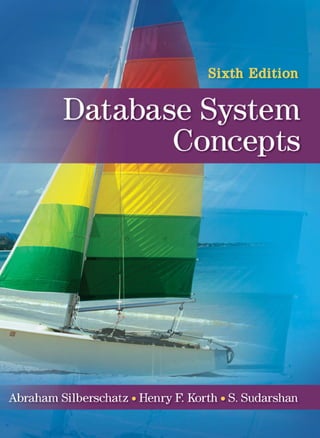
Database System Concepts 6th Edition, (Ebook PDF)
_____ Click the link below to download _____
https://ebookmass.com/product/database-system-concepts-6th-
edition-ebook-pdf/
Explore and download more ebook or textbook at ebookmass.com
2.
Here are somerecommended products that we believe you will be
interested in. You can click the link to download.
Database System Concepts 7th Edition Avi Silberschatz
https://ebookmass.com/product/database-system-concepts-7th-edition-
avi-silberschatz/
Database System Concepts 7th Edition Abraham Silberschatz
https://ebookmass.com/product/database-system-concepts-7th-edition-
abraham-silberschatz/
(eBook PDF) Operating System Concepts, 10th Edition
https://ebookmass.com/product/ebook-pdf-operating-system-
concepts-10th-edition/
(eTextbook PDF) for Database Concepts 8th Edition by David
M. Kroenke
https://ebookmass.com/product/etextbook-pdf-for-database-concepts-8th-
edition-by-david-m-kroenke/
3.
(eBook PDF) Conceptsof Database Management , 9th Edition
Joy L. Starks
https://ebookmass.com/product/ebook-pdf-concepts-of-database-
management-9th-edition-joy-l-starks/
Concepts of database management 10th Edition Lisa
Friedrichsen
https://ebookmass.com/product/concepts-of-database-management-10th-
edition-lisa-friedrichsen/
Policy Analysis: Concepts and Practice 6th Edition, (Ebook
PDF)
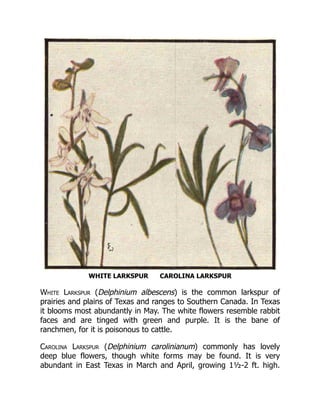
https://ebookmass.com/product/policy-analysis-concepts-and-
practice-6th-edition-ebook-pdf/
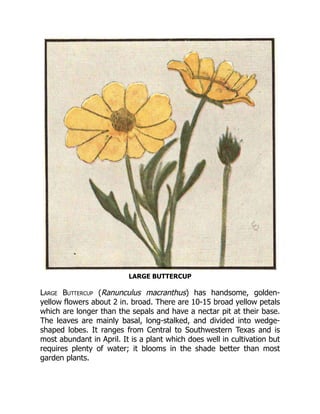
Theories of Development: Concepts and Applications 6th
Edition, (Ebook PDF)
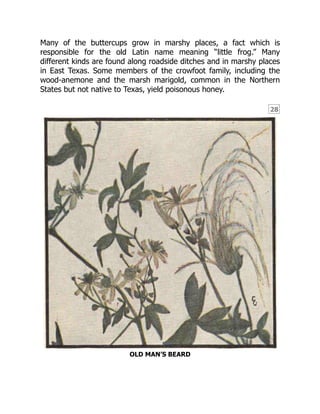
https://ebookmass.com/product/theories-of-development-concepts-and-
applications-6th-edition-ebook-pdf/
Graph Database and Graph Computing for Power System
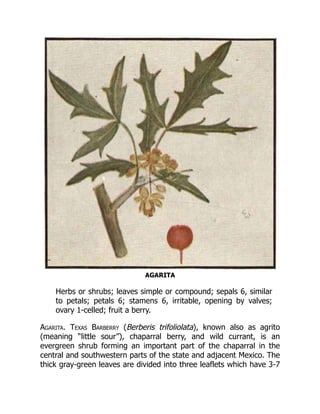
Analysis Renchang Dai
https://ebookmass.com/product/graph-database-and-graph-computing-for-
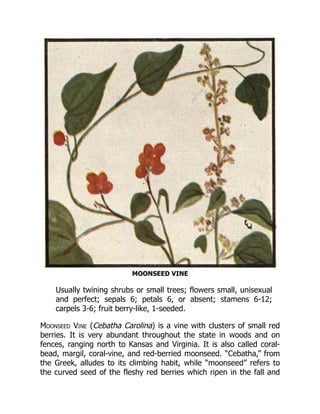
power-system-analysis-renchang-dai/
6.
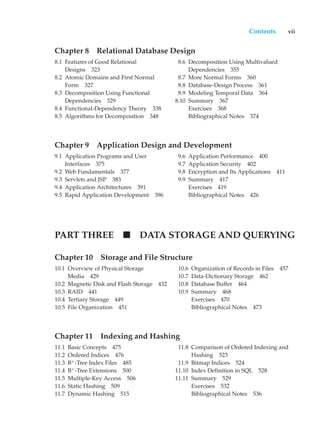
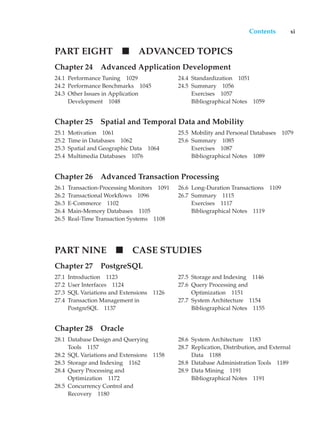
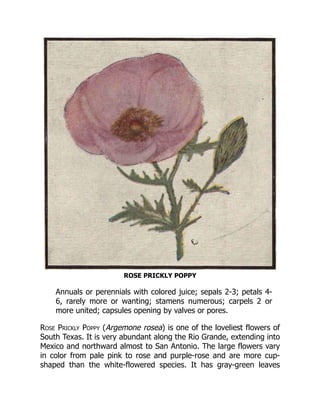
Contents vii
Chapter 8Relational Database Design
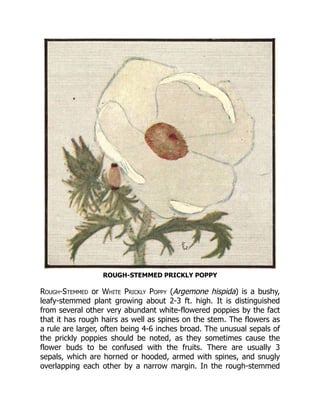
8.1 Features of Good Relational
Designs 323
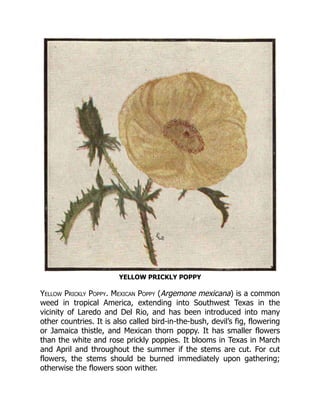
8.2 Atomic Domains and First Normal
Form 327
8.3 Decomposition Using Functional
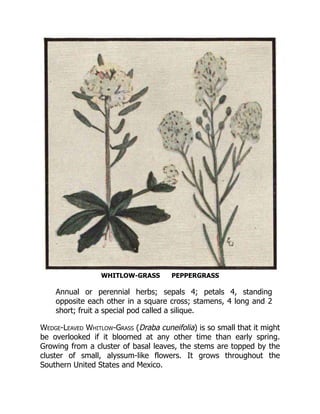
Dependencies 329
8.4 Functional-Dependency Theory 338
8.5 Algorithms for Decomposition 348
8.6 Decomposition Using Multivalued
Dependencies 355
8.7 More Normal Forms 360
8.8 Database-Design Process 361
8.9 Modeling Temporal Data 364
8.10 Summary 367
Exercises 368
Bibliographical Notes 374
Chapter 9 Application Design and Development
9.1 Application Programs and User
Interfaces 375
9.2 Web Fundamentals 377
9.3 Servlets and JSP 383
9.4 Application Architectures 391
9.5 Rapid Application Development 396
9.6 Application Performance 400
9.7 Application Security 402
9.8 Encryption and Its Applications 411
9.9 Summary 417
Exercises 419
Bibliographical Notes 426
PART THREE DATA STORAGE AND QUERYING
Chapter 10 Storage and File Structure
10.1 Overview of Physical Storage
Media 429
10.2 Magnetic Disk and Flash Storage 432
10.3 RAID 441
10.4 Tertiary Storage 449
10.5 File Organization 451
10.6 Organization of Records in Files 457
10.7 Data-Dictionary Storage 462
10.8 Database Buffer 464
10.9 Summary 468
Exercises 470
Bibliographical Notes 473
Chapter 11 Indexing and Hashing
11.1 Basic Concepts 475
11.2 Ordered Indices 476
11.3 B+
-Tree Index Files 485
11.4 B+
-Tree Extensions 500
11.5 Multiple-Key Access 506
11.6 Static Hashing 509
11.7 Dynamic Hashing 515
11.8 Comparison of Ordered Indexing and
Hashing 523
11.9 Bitmap Indices 524
11.10 Index Definition in SQL 528
11.11 Summary 529
Exercises 532
Bibliographical Notes 536
7.
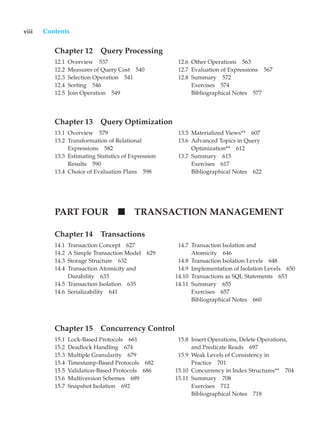
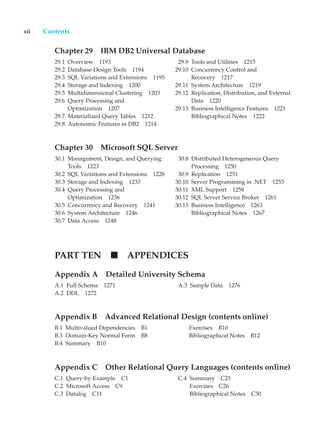
viii Contents
Chapter 12Query Processing
12.1 Overview 537
12.2 Measures of Query Cost 540
12.3 Selection Operation 541
12.4 Sorting 546
12.5 Join Operation 549
12.6 Other Operations 563
12.7 Evaluation of Expressions 567
12.8 Summary 572
Exercises 574
Bibliographical Notes 577
Chapter 13 Query Optimization
13.1 Overview 579
13.2 Transformation of Relational
Expressions 582
13.3 Estimating Statistics of Expression
Results 590
13.4 Choice of Evaluation Plans 598
13.5 Materialized Views** 607
13.6 Advanced Topics in Query
Optimization** 612
13.7 Summary 615
Exercises 617
Bibliographical Notes 622
PART FOUR TRANSACTION MANAGEMENT
Chapter 14 Transactions
14.1 Transaction Concept 627
14.2 A Simple Transaction Model 629
14.3 Storage Structure 632
14.4 Transaction Atomicity and
Durability 633
14.5 Transaction Isolation 635
14.6 Serializability 641
14.7 Transaction Isolation and
Atomicity 646
14.8 Transaction Isolation Levels 648
14.9 Implementation of Isolation Levels 650
14.10 Transactions as SQL Statements 653
14.11 Summary 655
Exercises 657
Bibliographical Notes 660
Chapter 15 Concurrency Control
15.1 Lock-Based Protocols 661
15.2 Deadlock Handling 674
15.3 Multiple Granularity 679
15.4 Timestamp-Based Protocols 682
15.5 Validation-Based Protocols 686
15.6 Multiversion Schemes 689
15.7 Snapshot Isolation 692
15.8 Insert Operations, Delete Operations,
and Predicate Reads 697
15.9 Weak Levels of Consistency in
Practice 701
15.10 Concurrency in Index Structures** 704
15.11 Summary 708
Exercises 712
Bibliographical Notes 718
8.
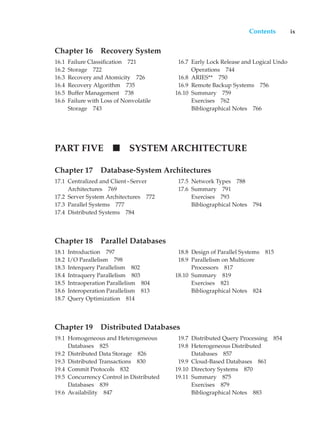
Contents ix
Chapter 16Recovery System
16.1 Failure Classification 721
16.2 Storage 722
16.3 Recovery and Atomicity 726
16.4 Recovery Algorithm 735
16.5 Buffer Management 738
16.6 Failure with Loss of Nonvolatile
Storage 743
16.7 Early Lock Release and Logical Undo
Operations 744
16.8 ARIES** 750
16.9 Remote Backup Systems 756
16.10 Summary 759
Exercises 762
Bibliographical Notes 766
PART FIVE SYSTEM ARCHITECTURE
Chapter 17 Database-System Architectures
17.1 Centralized and Client–Server
Architectures 769
17.2 Server System Architectures 772
17.3 Parallel Systems 777
17.4 Distributed Systems 784
17.5 Network Types 788
17.6 Summary 791
Exercises 793
Bibliographical Notes 794
Chapter 18 Parallel Databases
18.1 Introduction 797
18.2 I/O Parallelism 798
18.3 Interquery Parallelism 802
18.4 Intraquery Parallelism 803
18.5 Intraoperation Parallelism 804
18.6 Interoperation Parallelism 813
18.7 Query Optimization 814
18.8 Design of Parallel Systems 815
18.9 Parallelism on Multicore
Processors 817
18.10 Summary 819
Exercises 821
Bibliographical Notes 824
Chapter 19 Distributed Databases
19.1 Homogeneous and Heterogeneous
Databases 825
19.2 Distributed Data Storage 826
19.3 Distributed Transactions 830
19.4 Commit Protocols 832
19.5 Concurrency Control in Distributed
Databases 839
19.6 Availability 847
19.7 Distributed Query Processing 854
19.8 Heterogeneous Distributed
Databases 857
19.9 Cloud-Based Databases 861
19.10 Directory Systems 870
19.11 Summary 875
Exercises 879
Bibliographical Notes 883
9.
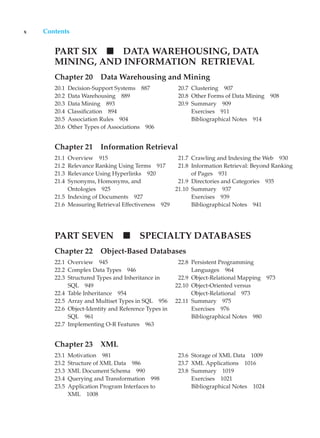
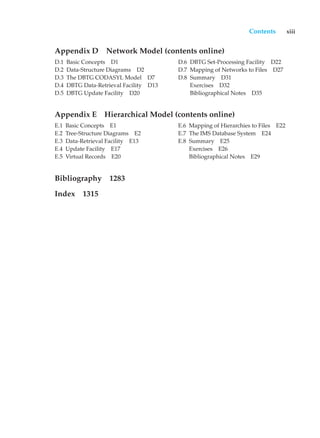
x Contents
PART SIXDATA WAREHOUSING, DATA
MINING, AND INFORMATION RETRIEVAL
Chapter 20 Data Warehousing and Mining
20.1 Decision-Support Systems 887
20.2 Data Warehousing 889
20.3 Data Mining 893
20.4 Classification 894
20.5 Association Rules 904
20.6 Other Types of Associations 906
20.7 Clustering 907
20.8 Other Forms of Data Mining 908
20.9 Summary 909
Exercises 911
Bibliographical Notes 914
Chapter 21 Information Retrieval
21.1 Overview 915
21.2 Relevance Ranking Using Terms 917
21.3 Relevance Using Hyperlinks 920
21.4 Synonyms, Homonyms, and
Ontologies 925
21.5 Indexing of Documents 927
21.6 Measuring Retrieval Effectiveness 929
21.7 Crawling and Indexing the Web 930
21.8 Information Retrieval: Beyond Ranking
of Pages 931
21.9 Directories and Categories 935
21.10 Summary 937
Exercises 939
Bibliographical Notes 941
PART SEVEN SPECIALTY DATABASES
Chapter 22 Object-Based Databases
22.1 Overview 945
22.2 Complex Data Types 946
22.3 Structured Types and Inheritance in
SQL 949
22.4 Table Inheritance 954
22.5 Array and Multiset Types in SQL 956
22.6 Object-Identity and Reference Types in
SQL 961
22.7 Implementing O-R Features 963
22.8 Persistent Programming
Languages 964
22.9 Object-Relational Mapping 973
22.10 Object-Oriented versus
Object-Relational 973
22.11 Summary 975
Exercises 976
Bibliographical Notes 980
Chapter 23 XML
23.1 Motivation 981
23.2 Structure of XML Data 986
23.3 XML Document Schema 990
23.4 Querying and Transformation 998
23.5 Application Program Interfaces to
XML 1008
23.6 Storage of XML Data 1009
23.7 XML Applications 1016
23.8 Summary 1019
Exercises 1021
Bibliographical Notes 1024
10.
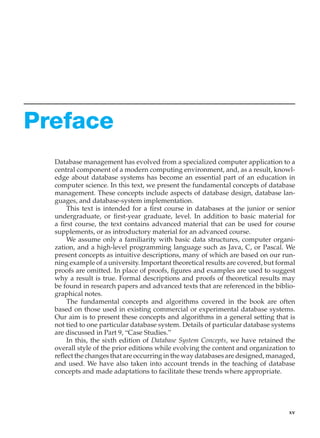
Contents xi
PART EIGHTADVANCED TOPICS
Chapter 24 Advanced Application Development
24.1 Performance Tuning 1029
24.2 Performance Benchmarks 1045
24.3 Other Issues in Application
Development 1048
24.4 Standardization 1051
24.5 Summary 1056
Exercises 1057
Bibliographical Notes 1059
Chapter 25 Spatial and Temporal Data and Mobility
25.1 Motivation 1061
25.2 Time in Databases 1062
25.3 Spatial and Geographic Data 1064
25.4 Multimedia Databases 1076
25.5 Mobility and Personal Databases 1079
25.6 Summary 1085
Exercises 1087
Bibliographical Notes 1089
Chapter 26 Advanced Transaction Processing
26.1 Transaction-Processing Monitors 1091
26.2 Transactional Workflows 1096
26.3 E-Commerce 1102
26.4 Main-Memory Databases 1105
26.5 Real-Time Transaction Systems 1108
26.6 Long-Duration Transactions 1109
26.7 Summary 1115
Exercises 1117
Bibliographical Notes 1119
PART NINE CASE STUDIES
Chapter 27 PostgreSQL
27.1 Introduction 1123
27.2 User Interfaces 1124
27.3 SQL Variations and Extensions 1126
27.4 Transaction Management in
PostgreSQL 1137
27.5 Storage and Indexing 1146
27.6 Query Processing and
Optimization 1151
27.7 System Architecture 1154
Bibliographical Notes 1155
Chapter 28 Oracle
28.1 Database Design and Querying
Tools 1157
28.2 SQL Variations and Extensions 1158
28.3 Storage and Indexing 1162
28.4 Query Processing and
Optimization 1172
28.5 Concurrency Control and
Recovery 1180
28.6 System Architecture 1183
28.7 Replication, Distribution, and External
Data 1188
28.8 Database Administration Tools 1189
28.9 Data Mining 1191
Bibliographical Notes 1191
11.
xii Contents
Chapter 29IBM DB2 Universal Database
29.1 Overview 1193
29.2 Database-Design Tools 1194
29.3 SQL Variations and Extensions 1195
29.4 Storage and Indexing 1200
29.5 Multidimensional Clustering 1203
29.6 Query Processing and
Optimization 1207
29.7 Materialized Query Tables 1212
29.8 Autonomic Features in DB2 1214
29.9 Tools and Utilities 1215
29.10 Concurrency Control and
Recovery 1217
29.11 System Architecture 1219
29.12 Replication, Distribution, and External
Data 1220
29.13 Business Intelligence Features 1221
Bibliographical Notes 1222
Chapter 30 Microsoft SQL Server
30.1 Management, Design, and Querying
Tools 1223
30.2 SQL Variations and Extensions 1228
30.3 Storage and Indexing 1233
30.4 Query Processing and
Optimization 1236
30.5 Concurrency and Recovery 1241
30.6 System Architecture 1246
30.7 Data Access 1248
30.8 Distributed Heterogeneous Query
Processing 1250
30.9 Replication 1251
30.10 Server Programming in .NET 1253
30.11 XML Support 1258
30.12 SQL Server Service Broker 1261
30.13 Business Intelligence 1263
Bibliographical Notes 1267
PART TEN APPENDICES
Appendix A Detailed University Schema
A.1 Full Schema 1271
A.2 DDL 1272
A.3 Sample Data 1276
Appendix B Advanced Relational Design (contents online)
B.1 Multivalued Dependencies B1
B.3 Domain-Key Normal Form B8
B.4 Summary B10
Exercises B10
Bibliographical Notes B12
Appendix C Other Relational Query Languages (contents online)
C.1 Query-by-Example C1
C.2 Microsoft Access C9
C.3 Datalog C11
C.4 Summary C25
Exercises C26
Bibliographical Notes C30
12.
Contents xiii
Appendix DNetwork Model (contents online)
D.1 Basic Concepts D1
D.2 Data-Structure Diagrams D2
D.3 The DBTG CODASYL Model D7
D.4 DBTG Data-Retrieval Facility D13
D.5 DBTG Update Facility D20
D.6 DBTG Set-Processing Facility D22
D.7 Mapping of Networks to Files D27
D.8 Summary D31
Exercises D32
Bibliographical Notes D35
Appendix E Hierarchical Model (contents online)
E.1 Basic Concepts E1
E.2 Tree-Structure Diagrams E2
E.3 Data-Retrieval Facility E13
E.4 Update Facility E17
E.5 Virtual Records E20
E.6 Mapping of Hierarchies to Files E22
E.7 The IMS Database System E24
E.8 Summary E25
Exercises E26
Bibliographical Notes E29
Bibliography 1283
Index 1315
Preface
Database management hasevolved from a specialized computer application to a
central component of a modern computing environment, and, as a result, knowl-
edge about database systems has become an essential part of an education in
computer science. In this text, we present the fundamental concepts of database
management. These concepts include aspects of database design, database lan-
guages, and database-system implementation.
This text is intended for a first course in databases at the junior or senior
undergraduate, or first-year graduate, level. In addition to basic material for
a first course, the text contains advanced material that can be used for course
supplements, or as introductory material for an advanced course.
We assume only a familiarity with basic data structures, computer organi-
zation, and a high-level programming language such as Java, C, or Pascal. We
present concepts as intuitive descriptions, many of which are based on our run-
ning example of a university. Important theoretical results are covered, but formal
proofs are omitted. In place of proofs, figures and examples are used to suggest
why a result is true. Formal descriptions and proofs of theoretical results may
be found in research papers and advanced texts that are referenced in the biblio-
graphical notes.
The fundamental concepts and algorithms covered in the book are often
based on those used in existing commercial or experimental database systems.
Our aim is to present these concepts and algorithms in a general setting that is
not tied to one particular database system. Details of particular database systems
are discussed in Part 9, “Case Studies.”
In this, the sixth edition of Database System Concepts, we have retained the
overall style of the prior editions while evolving the content and organization to
reflect the changes that are occurring in the way databases are designed, managed,
and used. We have also taken into account trends in the teaching of database
concepts and made adaptations to facilitate these trends where appropriate.
xv
15.
Visit https://ebookmass.com todayto explore
a vast collection of ebooks across various
genres, available in popular formats like
PDF, EPUB, and MOBI, fully compatible with
all devices. Enjoy a seamless reading
experience and effortlessly download high-
quality materials in just a few simple steps.
Plus, don’t miss out on exciting offers that
let you access a wealth of knowledge at the
best prices!
16.
xvi Preface
Organization
The textis organized in nine major parts, plus five appendices.
• Overview (Chapter 1). Chapter 1 provides a general overview of the nature
and purpose of database systems. We explain how the concept of a database
system has developed, what the common features of database systems are,
what a database system does for the user, and how a database system in-
terfaces with operating systems. We also introduce an example database
application: a university organization consisting of multiple departments,
instructors, students, and courses. This application is used as a running ex-
ample throughout the book. This chapter is motivational, historical, and ex-
planatory in nature.
• Part 1: Relational Databases (Chapters 2 through 6). Chapter 2 introduces
the relational model of data, covering basic concepts such as the structure
of relational databases, database schemas, keys, schema diagrams, relational
query languages, and relational operations. Chapters 3, 4, and 5 focus on the
most influential of the user-oriented relational languages: SQL. Chapter 6 cov-
ers the formal relational query languages: relational algebra, tuple relational
calculus, and domain relational calculus.
The chapters in this part describe data manipulation: queries, updates, in-
sertions, and deletions, assuming a schema design has been provided. Schema
design issues are deferred to Part 2.
• Part 2: Database Design (Chapters 7 through 9). Chapter 7 provides an
overview of the database-design process, with major emphasis on database
design using the entity-relationship data model. The entity-relationship data
model provides a high-level view of the issues in database design, and of the
problems that we encounter in capturing the semantics of realistic applica-
tions within the constraints of a data model. UML class-diagram notation is
also covered in this chapter.
Chapter 8 introduces the theory of relational database design. The the-
ory of functional dependencies and normalization is covered, with emphasis
on the motivation and intuitive understanding of each normal form. This
chapter begins with an overview of relational design and relies on an intu-
itive understanding of logical implication of functional dependencies. This
allows the concept of normalization to be introduced prior to full coverage
of functional-dependency theory, which is presented later in the chapter. In-
structors may choose to use only this initial coverage in Sections 8.1 through
8.3 without loss of continuity. Instructors covering the entire chapter will ben-
efit from students having a good understanding of normalization concepts to
motivate some of the challenging concepts of functional-dependency theory.
Chapter 9 covers application design and development. This chapter empha-
sizes the construction of database applications with Web-based interfaces. In
addition, the chapter covers application security.
17.
Preface xvii
• Part3: Data Storage and Querying (Chapters 10 through 13). Chapter 10
deals with storage devices, files, and data-storage structures. A variety of
data-access techniques are presented in Chapter 11, including B+
-tree indices
and hashing. Chapters 12 and 13 address query-evaluation algorithms and
query optimization. These chapters provide an understanding of the internals
of the storage and retrieval components of a database.
• Part 4: Transaction Management (Chapters 14 through 16). Chapter 14 fo-
cuses on the fundamentals of a transaction-processing system: atomicity,
consistency, isolation, and durability. It provides an overview of the methods
used to ensure these properties, including locking and snapshot isolation.
Chapter 15 focuses on concurrency control and presents several techniques
for ensuring serializability, including locking, timestamping, and optimistic
(validation) techniques. The chapter also covers deadlock issues. Alterna-
tives to serializability are covered, most notably the widely-used snapshot
isolation, which is discussed in detail.
Chapter 16 covers the primary techniques for ensuring correct transac-
tion execution despite system crashes and storage failures. These techniques
include logs, checkpoints, and database dumps. The widely-used ARIES al-
gorithm is presented.
• Part 5: System Architecture (Chapters 17 through 19). Chapter 17 covers
computer-system architecture, and describes the influence of the underly-
ing computer system on the database system. We discuss centralized sys-
tems, client–server systems, and parallel and distributed architectures in this
chapter.
Chapter 18, on parallel databases, explores a variety of parallelization
techniques, including I/O parallelism, interquery and intraquery parallelism,
and interoperation and intraoperation parallelism. The chapter also describes
parallel-system design.
Chapter 19 covers distributed database systems, revisiting the issues
of database design, transaction management, and query evaluation and op-
timization, in the context of distributed databases. The chapter also cov-
ers issues of system availability during failures, heterogeneous distributed
databases, cloud-based databases, and distributed directory systems.
• Part 6: Data Warehousing, Data Mining, and Information Retrieval (Chap-
ters 20 and 21). Chapter 20 introduces the concepts of data warehousing
and data mining. Chapter 21 describes information-retrieval techniques for
querying textual data, including hyperlink-based techniques used in Web
search engines.
Part 6 uses the modeling and language concepts from Parts 1 and 2, but
does not depend on Parts 3, 4, or 5. It can therefore be incorporated easily
into a course that focuses on SQL and on database design.
18.
xviii Preface
• Part7: Specialty Databases (Chapters 22 and 23). Chapter 22 covers object-
based databases. The chapter describes the object-relational data model,
which extends the relational data model to support complex data types, type
inheritance, and object identity. The chapter also describes database access
from object-oriented programming languages.
Chapter 23 covers the XML standard for data representation, which is seeing
increasing use in the exchange and storage of complex data. The chapter also
describes query languages for XML.
• Part 8: Advanced Topics (Chapters 24 through 26). Chapter 24 covers ad-
vanced issues in application development, including performance tuning,
performance benchmarks, database-application testing, and standardization.
Chapter 25 covers spatial and geographic data, temporal data, multimedia
data, and issues in the management of mobile and personal databases.
Finally, Chapter 26 deals with advanced transaction processing. Top-
ics covered in the chapter include transaction-processing monitors, transac-
tional workflows, electronic commerce, high-performance transaction sys-
tems, real-time transaction systems, and long-duration transactions.
• Part 9: Case Studies (Chapters 27 through 30). In this part, we present case
studies of four of the leading database systems, PostgreSQL, Oracle, IBM DB2,
and Microsoft SQL Server. These chapters outline unique features of each of
these systems, and describe their internal structure. They provide a wealth of
interesting information about the respective products, and help you see how
the various implementation techniques described in earlier parts are used
in real systems. They also cover several interesting practical aspects in the
design of real systems.
• Appendices. We provide five appendices that cover material that is of histor-
ical nature or is advanced; these appendices are available only online on the
Web site of the book (http://www.db-book.com). An exception is Appendix A,
which presents details of our university schema including the full schema,
DDL, and all the tables. This appendix appears in the actual text.
Appendix B describes other relational query languages, including QBE
Microsoft Access, and Datalog.
Appendix C describes advanced relational database design, including the
theory of multivalued dependencies, join dependencies, and the project-join
and domain-key normal forms. This appendix is for the benefit of individuals
who wish to study the theory of relational database design in more detail,
and instructors who wish to do so in their courses. This appendix, too, is
available only online, on the Web site of the book.
Although most new database applications use either the relational model
or the object-relational model, the network and hierarchical data models are
still in use in some legacy applications. For the benefit of readers who wish to
learn about these data models, we provide appendices describing the network
and hierarchical data models, in Appendices D and E respectively.
19.
Preface xix
The SixthEdition
The production of this sixth edition has been guided by the many comments and
suggestions we received concerning the earlier editions, by our own observations
while teaching at Yale University, Lehigh University, and IIT Bombay, and by our
analysis of the directions in which database technology is evolving.
We have replaced the earlier running example of bank enterprise with a uni-
versity example. This example has an immediate intuitive connection to students
that assists not only in remembering the example, but, more importantly, in gain-
ing deeper insight into the various design decisions that need to be made.
We have reorganized the book so as to collect all of our SQL coverage together
and place it early in the book. Chapters 3, 4, and 5 present complete SQL coverage.
Chapter 3 presents the basics of the language, with more advanced features in
Chapter 4. In Chapter 5, we present JDBC along with other means of accessing
SQL from a general-purpose programming language. We present triggers and re-
cursion, and then conclude with coverage of online analytic processing (OLAP).
Introductory courses may choose to cover only certain sections of Chapter 5 or
defer sections until after the coverage of database design without loss of continu-
ity.
Beyond these two major changes, we revised the material in each chapter,
bringing the older material up-to-date, adding discussions on recent develop-
ments in database technology, and improving descriptions of topics that students
found difficult to understand. We have also added new exercises and updated
references. The list of specific changes includes the following:
• Earlier coverage of SQL. Many instructors use SQL as a key component of term
projects (see our Web site, www.db-book.com, for sample projects). In order to
give students ample time for the projects, particularly for universities and
colleges on the quarter system, it is essential to teach SQL as early as possible.
With this in mind, we have undertaken several changes in organization:
◦ A new chapter on the relational model (Chapter 2) precedes SQL, laying
the conceptual foundation, without getting lost in details of relational
algebra.
◦ Chapters 3, 4, and 5 provide detailed coverage of SQL. These chapters also
discuss variants supported by different database systems, to minimize
problems that students face when they execute queries on actual database
systems. These chapters cover all aspects of SQL, including queries, data
definition, constraint specification, OLAP, and the use of SQL from within
a variety of languages, including Java/JDBC.
◦ Formal languages (Chapter 6) have been postponed to after SQL, and can
be omitted without affecting the sequencing of other chapters. Only our
discussion of query optimization in Chapter 13 depends on the relational
algebra coverage of Chapter 6.
20.
xx Preface
• Newdatabase schema. We adopted a new schema, which is based on uni-
versity data, as a running example throughout the book. This schema is
more intuitive and motivating for students than the earlier bank schema, and
illustrates more complex design trade-offs in the database-design chapters.
• More support for a hands-on student experience. To facilitate following
our running example, we list the database schema and the sample relation
instances for our university database together in Appendix A as well as
where they are used in the various regular chapters. In addition, we provide,
on our Web site http://www.db-book.com, SQL data-definition statements for the
entire example, along with SQL statements to create our example relation
instances. This encourages students to run example queries directly on a
database system and to experiment with modifying those queries.
• Revised coverage of E-R model. The E-R diagram notation in Chapter 7 has
been modified to make it more compatible with UML. The chapter also makes
good use of the new university database schema to illustrate more complex
design trade-offs.
• Revised coverage of relational design. Chapter 8 now has a more readable
style, providing an intuitive understanding of functional dependencies and
normalization, before covering functional dependency theory; the theory is
motivated much better as a result.
• Expanded material on application development and security. Chapter 9 has
new material on application development, mirroring rapid changes in the
field. In particular, coverage of security has been expanded, considering its
criticality in today’s interconnected world, with an emphasis on practical
issues over abstract concepts.
• Revised and updated coverage of data storage, indexing and query op-
timization. Chapter 10 has been updated with new technology, including
expanded coverage of flash memory.
Coverage of B+
-trees in Chapter 11 has been revised to reflect practical
implementations, including coverage of bulk loading, and the presentation
has been improved. The B+
-tree examples in Chapter 11 have now been
revised with n = 4, to avoid the special case of empty nodes that arises with
the (unrealistic) value of n = 3.
Chapter 13 has new material on advanced query-optimization techniques.
• Revised coverage of transaction management. Chapter 14 provides full cov-
erage of the basics for an introductory course, with advanced details follow-
ing in Chapters 15 and 16. Chapter 14 has been expanded to cover the practical
issues in transaction management faced by database users and database-
application developers. The chapter also includes an expanded overview of
topics covered in Chapters 15 and 16, ensuring that even if Chapters 15 and 16
are omitted, students have a basic knowledge of the concepts of concurrency
control and recovery.
21.
Preface xxi
Chapters 14and 15 now include detailed coverage of snapshot isolation,
which is widely supported and used today, including coverage of potential
hazards when using it.
Chapter 16 now has a simplified description of basic log-based recovery
leading up to coverage of the ARIES algorithm.
• Revised and expanded coverage of distributed databases. We now cover
cloud data storage, which is gaining significant interest for business appli-
cations. Cloud storage offers enterprises opportunities for improved cost-
management and increased storage scalability, particularly for Web-based
applications. We examine those advantages along with the potential draw-
backs and risks.
Multidatabases, which were earlier in the advanced transaction processing
chapter, are now covered earlier as part of the distributed database chapter.
• Postponed coverage of object databases and XML. Although object-oriented
languages and XML are widely used outside of databases, their use in data-
bases is still limited, making them appropriate for more advanced courses,
or as supplementary material for an introductory course. These topics have
therefore been moved to later in the book, in Chapters 22 and 23.
• QBE, Microsoft Access, and Datalog in an online appendix. These topics,
which were earlier part of a chapter on “other relational languages,” are now
covered in online Appendix C.
All topics not listed above are updated from the fifth edition, though their overall
organization is relatively unchanged.
Review Material and Exercises
Each chapter has a list of review terms, in addition to a summary, which can help
readers review key topics covered in the chapter.
The exercises are divided into two sets: practice exercises and exercises. The
solutions for the practice exercises are publicly available on the Web site of the
book. Students are encouraged to solve the practice exercises on their own, and
later use the solutions on the Web site to check their own solutions. Solutions
to the other exercises are available only to instructors (see “Instructor’s Note,”
below, for information on how to get the solutions).
Many chapters have a tools section at the end of the chapter that provides
information on software tools related to the topic of the chapter; some of these
tools can be used for laboratory exercises. SQL DDL and sample data for the
university database and other relations used in the exercises are available on the
Web site of the book, and can be used for laboratory exercises.
22.
xxii Preface
Instructor’s Note
Thebook contains both basic and advanced material, which might not be cov-
ered in a single semester. We have marked several sections as advanced, using
the symbol “**”. These sections may be omitted if so desired, without a loss of
continuity. Exercises that are difficult (and can be omitted) are also marked using
the symbol “**”.
It is possible to design courses by using various subsets of the chapters. Some
of the chapters can also be covered in an order different from their order in the
book. We outline some of the possibilities here:
• Chapter 5 (Advanced SQL) can be skipped or deferred to later without loss of
continuity. We expect most courses will cover at least Section 5.1.1 early, as
JDBC is likely to be a useful tool in student projects.
• Chapter 6 (Formal Relational Query Languages) can be covered immediately
after Chapter 2, ahead of SQL. Alternatively, this chapter may be omitted from
an introductory course.
We recommend covering Section 6.1 (relational algebra) if the course also
covers query processing. However, Sections 6.2 and 6.3 can be omitted if
students will not be using relational calculus as part of the course.
• Chapter 7 (E-R Model) can be covered ahead of Chapters 3, 4 and 5 if you so
desire, since Chapter 7 does not have any dependency on SQL.
• Chapter 13 (Query Optimization) can be omitted from an introductory course
without affecting coverage of any other chapter.
• Both our coverage of transaction processing (Chapters 14 through 16) and
our coverage of system architecture (Chapters 17 through 19) consist of an
overview chapter (Chapters 14 and 17, respectively), followed by chapters
with details. You might choose to use Chapters 14 and 17, while omitting
Chapters 15, 16, 18 and 19, if you defer these latter chapters to an advanced
course.
• Chapters 20 and 21, covering data warehousing, data mining, and informa-
tion retrieval, can be used as self-study material or omitted from an introduc-
tory course.
• Chapters 22 (Object-Based Databases), and 23 (XML) can be omitted from an
introductory course.
• Chapters 24 through 26, covering advanced application development, spatial,
temporal and mobile data, and advanced transaction processing, are suitable
for an advanced course or for self-study by students.
• The case-study Chapters 27 through 30 are suitable for self-study by students.
Alternatively, they can be used as an illustration of concepts when the earlier
chapters are presented in class.
Model course syllabi, based on the text, can be found on the Web site of the book.
23.
Preface xxiii
Web Siteand Teaching Supplements
A Web site for the book is available at the URL: http://www.db-book.com. The Web
site contains:
• Slides covering all the chapters of the book.
• Answers to the practice exercises.
• The five appendices.
• An up-to-date errata list.
• Laboratory material, including SQL DDL and sample data for the university
schema and other relations used in exercises, and instructions for setting up
and using various database systems and tools.
The following additional material is available only to faculty:
• An instructor manual containing solutions to all exercises in the book.
• A question bank containing extra exercises.
For more information about how to get a copy of the instructor manual and the
question bank, please send electronic mail to customer.service@mcgraw-hill.com.
In the United States, you may call 800-338-3987. The McGraw-Hill Web site for
this book is http://www.mhhe.com/silberschatz.
Contacting Us
We have endeavored to eliminate typos, bugs, and the like from the text. But, as
in new releases of software, bugs almost surely remain; an up-to-date errata list
is accessible from the book’s Web site. We would appreciate it if you would notify
us of any errors or omissions in the book that are not on the current list of errata.
We would be glad to receive suggestions on improvements to the book. We
also welcome any contributions to the book Web site that could be of use to
other readers, such as programming exercises, project suggestions, online labs
and tutorials, and teaching tips.
Email should be addressed to db-book-authors@cs.yale.edu. Any other corre-
spondence should be sent to Avi Silberschatz, Department of Computer Science,
Yale University, 51 Prospect Street, P.O. Box 208285, New Haven, CT 06520-8285
USA.
Acknowledgments
Many people have helped us with this sixth edition, as well as with the previous
five editions from which it is derived.
24.
xxiv Preface
Sixth Edition
•Anastassia Ailamaki, Sailesh Krishnamurthy, Spiros Papadimitriou, and
Bianca Schroeder (Carnegie Mellon University) for writing Chapter 27 de-
scribing the PostgreSQL database system.
• Hakan Jakobsson (Oracle), for writing Chapter 28 on the Oracle database
system.
• Sriram Padmanabhan (IBM), for writing Chapter 29 describing the IBM DB2
database system.
• Sameet Agarwal, José A. Blakeley, Thierry D’Hers, Gerald Hinson, Dirk My-
ers, Vaqar Pirzada, Bill Ramos, Balaji Rathakrishnan, Michael Rys, Florian
Waas, and Michael Zwilling (all of Microsoft) for writing Chapter 30 de-
scribing the Microsoft SQL Server database system, and in particular José
Blakeley for coordinating and editing the chapter; César Galindo-Legaria,
Goetz Graefe, Kalen Delaney, and Thomas Casey (all of Microsoft) for their
contributions to the previous edition of the Microsoft SQL Server chapter.
• Daniel Abadi for reviewing the table of contents of the fifth edition and
helping with the new organization.
• Steve Dolins, University of Florida; Rolando Fernanez, George Washington
University; Frantisek Franek, McMaster University; Latifur Khan, University
of Texas - Dallas; Sanjay Madria, University of Missouri - Rolla; Aris Ouksel,
University of Illinois; and Richard Snodgrass, University of Waterloo; who
served as reviewers of the book and whose comments helped us greatly in
formulating this sixth edition.
• Judi Paige for her help in generating figures and presentation slides.
• Mark Wogahn for making sure that the software to produce the book, includ-
ing LaTeX macros and fonts, worked properly.
• N. L. Sarda for feedback that helped us improve several chapters, in particular
Chapter 11; Vikram Pudi for motivating us to replace the earlier bank schema;
and Shetal Shah for feedback on several chapters.
• Students at Yale, Lehigh, and IIT Bombay, for their comments on the fifth
edition, as well as on preprints of the sixth edition.
Previous Editions
• Chen Li and Sharad Mehrotra for providing material on JDBC and security
for the fifth edition.
• Marilyn Turnamian and Nandprasad Joshi provided secretarial assistance for
the fifth edition, and Marilyn also prepared an early draft of the cover design
for the fifth edition.
25.
Preface xxv
• LynDupré copyedited the third edition and Sara Strandtman edited the text
of the third edition.
• Nilesh Dalvi, Sumit Sanghai, Gaurav Bhalotia, Arvind Hulgeri K. V. Ragha-
van, Prateek Kapadia, Sara Strandtman, Greg Speegle, and Dawn Bezviner
helped to prepare the instructor’s manual for earlier editions.
• The idea of using ships as part of the cover concept was originally suggested
to us by Bruce Stephan.
• The following people pointed out errors in the fifth edition: Alex Coman,
Ravindra Guravannavar, Arvind Hulgeri, Rohit Kulshreshtha, Sang-Won
Lee, Joe H. C. Lu, Alex N. Napitupulu, H. K. Park, Jian Pei, Fernando Saenz
Perez, Donnie Pinkston, Yma Pinto, Rajarshi Rakshit, Sandeep Satpal, Amon
Seagull, Barry Soroka, Praveen Ranjan Srivastava, Hans Svensson, Moritz
Wiese, and Eyob Delele Yirdaw.
• The following people offered suggestions and comments for the fifth and ear-
lier editions of the book. R. B. Abhyankar, Hani Abu-Salem, Jamel R. Alsab-
bagh, Raj Ashar, Don Batory, Phil Bernhard, Christian Breimann, Gavin M.
Bierman, Janek Bogucki, Haran Boral, Paul Bourgeois, Phil Bohannon, Robert
Brazile, Yuri Breitbart, Ramzi Bualuan, Michael Carey, Soumen Chakrabarti,
Tom Chappell, Zhengxin Chen, Y. C. Chin, Jan Chomicki, Laurens Damen,
Prasanna Dhandapani, Qin Ding, Valentin Dinu, J. Edwards, Christos Falout-
sos, Homma Farian, Alan Fekete, Frantisek Franek, Shashi Gadia, Hector
Garcia-Molina, Goetz Graefe, Jim Gray, Le Gruenwald, Eitan M. Gurari,
William Hankley, Bruce Hillyer, Ron Hitchens, Chad Hogg, Arvind Hulgeri,
Yannis Ioannidis, Zheng Jiaping, Randy M. Kaplan, Graham J. L. Kemp, Rami
Khouri, Hyoung-Joo Kim, Won Kim, Henry Korth (father of Henry F.), Carol
Kroll, Hae Choon Lee, Sang-Won Lee, Irwin Levinstein, Mark Llewellyn,
Gary Lindstrom, Ling Liu, Dave Maier, Keith Marzullo, Marty Maskarinec,
Fletcher Mattox, Sharad Mehrotra, Jim Melton, Alberto Mendelzon, Ami
Motro, Bhagirath Narahari, Yiu-Kai Dennis Ng, Thanh-Duy Nguyen, Anil
Nigam, Cyril Orji, Meral Ozsoyoglu, D. B. Phatak, Juan Altmayer Pizzorno,
Bruce Porter, Sunil Prabhakar, Jim Peterson, K. V. Raghavan, Nahid Rahman,
Rajarshi Rakshit, Krithi Ramamritham, Mike Reiter, Greg Riccardi, Odinaldo
Rodriguez, Mark Roth, Marek Rusinkiewicz, Michael Rys, Sunita Sarawagi,
N. L. Sarda, Patrick Schmid, Nikhil Sethi, S. Seshadri, Stewart Shen, Shashi
Shekhar, Amit Sheth, Max Smolens, Nandit Soparkar, Greg Speegle, Jeff
Storey, Dilys Thomas, Prem Thomas, Tim Wahls, Anita Whitehall, Christo-
pher Wilson, Marianne Winslett, Weining Zhang, and Liu Zhenming.
Book Production
The publisher was Raghu Srinivasan. The developmental editor was Melinda
D. Bilecki. The project manager was Melissa Leick. The marketing manager was
26.
Visit https://ebookmass.com todayto explore
a vast collection of ebooks across various
genres, available in popular formats like
PDF, EPUB, and MOBI, fully compatible with
all devices. Enjoy a seamless reading
experience and effortlessly download high-
quality materials in just a few simple steps.
Plus, don’t miss out on exciting offers that
let you access a wealth of knowledge at the
best prices!
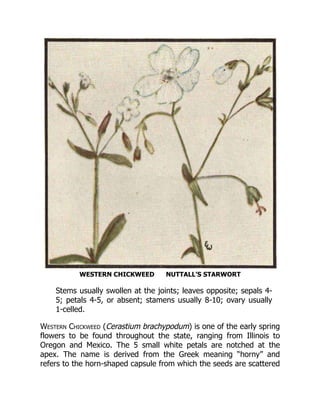
WESTERN CHICKWEED NUTTALL’SSTARWORT
Stems usually swollen at the joints; leaves opposite; sepals 4-
5; petals 4-5, or absent; stamens usually 8-10; ovary usually
1-celled.
Western Chickweed (Cerastium brachypodum) is one of the early spring
flowers to be found throughout the state, ranging from Illinois to
Oregon and Mexico. The 5 small white petals are notched at the
apex. The name is derived from the Greek meaning “horny” and
refers to the horn-shaped capsule from which the seeds are scattered
29.
24
through the openingat the top. Several other chickweeds are found
in the state in early spring.
Nuttall’s Starwort or Chickweed (Stellaria nuttallii) is a lovely white-
flowered chickweed found on moist sandy prairies or in open woods
in Texas, Arkansas, and Louisiana in March and April. The flowers are
about 1 in. broad, and the 5 broad petals are deeply notched at the
apex.
The pink family is well represented in cultivation, including the
carnation, sweet William, garden pink, baby’s breath, and others. The
red-flowered catch-fly (Silene laciniata), found in the mountains of
West Texas to Mexico and California, is known in cultivation.
WATER-LILY FAMILY (Nymphaeaceae)
30.
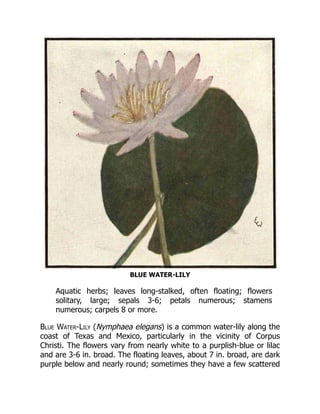
BLUE WATER-LILY
Aquatic herbs;leaves long-stalked, often floating; flowers
solitary, large; sepals 3-6; petals numerous; stamens
numerous; carpels 8 or more.
Blue Water-Lily (Nymphaea elegans) is a common water-lily along the
coast of Texas and Mexico, particularly in the vicinity of Corpus
Christi. The flowers vary from nearly white to a purplish-blue or lilac
and are 3-6 in. broad. The floating leaves, about 7 in. broad, are dark
purple below and nearly round; sometimes they have a few scattered
31.
25
teeth on themargins. The blooms last 3 days, opening about 8
o’clock in the morning and closing shortly after noon.
Yellow Water-Lily (Nymphaea flava) is a yellow-flowered water-lily
found on the Texas and Florida coasts. The sweet-scented white
water-lily is abundant in the southeastern part of the state.
Spatter Dock. Yellow Pond Lily (Nuphar advena), with yellow cup-
shaped flowers 2-3 in. broad, is the common water-lily of slow
streams and ponds throughout the state and ranges to Labrador,
Florida, and Utah.
The water-lilies form an important food and cover for fish; ducks and
muskrats feed upon the many seeds produced.
CROWFOOT FAMILY (Ranunculaceae)
32.
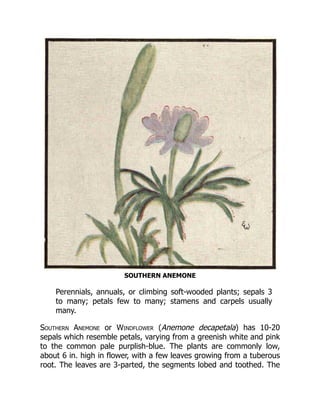
SOUTHERN ANEMONE
Perennials, annuals,or climbing soft-wooded plants; sepals 3
to many; petals few to many; stamens and carpels usually
many.
Southern Anemone or Windflower (Anemone decapetala) has 10-20
sepals which resemble petals, varying from a greenish white and pink
to the common pale purplish-blue. The plants are commonly low,
about 6 in. high in flower, with a few leaves growing from a tuberous
root. The leaves are 3-parted, the segments lobed and toothed. The
33.
26
anemone is theTexas harbinger of spring, appearing in late January,
February, or March on plains and prairies, and in the chaparral. It
ranges from the Southern United States to South America. The
Carolina anemone, with bluer flowers and more finely-divided leaves,
is abundant in the woods of East Texas.
The crowfoot or real buttercup family (the yellow evening primrose is
also called buttercup) is considered by most botanists as the plant
family from which other plants have been derived. In many the fruits
look very much like the fruit head of the arrowleaf. The columbine is
a member of this family frequently cultivated in the gardens of the
state, but the few native ones are not very abundant.
34.
WHITE LARKSPUR CAROLINALARKSPUR
White Larkspur (Delphinium albescens) is the common larkspur of
prairies and plains of Texas and ranges to Southern Canada. In Texas
it blooms most abundantly in May. The white flowers resemble rabbit
faces and are tinged with green and purple. It is the bane of
ranchmen, for it is poisonous to cattle.
Carolina Larkspur (Delphinium carolinianum) commonly has lovely
deep blue flowers, though white forms may be found. It is very
abundant in East Texas in March and April, growing 1½-2 ft. high.
35.
27
The plants havefew leaves, and these are 3-5 parted, each part
being divided into narrow linear lobes. It is very much like the Texas
larkspur (Delphinium vimineum), which has blue or white flowers,
grows taller, and is more leafy than the Carolina larkspur.
“Delphinium” is derived from the Latin meaning “dolphin,” so-called
because of the resemblance of the spurred flowers to a dolphin. The
common garden larkspur is native to Southern Europe. Some of the
larkspurs furnish drugs.
36.
LARGE BUTTERCUP
Large Buttercup(Ranunculus macranthus) has handsome, golden-
yellow flowers about 2 in. broad. There are 10-15 broad yellow petals
which are longer than the sepals and have a nectar pit at their base.
The leaves are mainly basal, long-stalked, and divided into wedge-
shaped lobes. It ranges from Central to Southwestern Texas and is
most abundant in April. It is a plant which does well in cultivation but
requires plenty of water; it blooms in the shade better than most
garden plants.
37.
28
Many of thebuttercups grow in marshy places, a fact which is
responsible for the old Latin name meaning “little frog.” Many
different kinds are found along roadside ditches and in marshy places
in East Texas. Some members of the crowfoot family, including the
wood-anemone and the marsh marigold, common in the Northern
States but not native to Texas, yield poisonous honey.
OLD MAN’S BEARD
38.
29
Drummond’s Virgin’s Bower.Old Man’s Beard (Clematis drummondii) is a
vine growing in great profusion, covering shrubs and fences from
Central Texas to Arizona and Mexico. The 4 petal-like sepals are pale
greenish-yellow, almost white, narrow and thin with margins
somewhat crinkled, about ½ in. long. The flowers bloom in the
summer, being inconspicuous among the branching leafy stems. The
stamen-bearing flowers are on a separate vine from the seed-
producing flowers. The seeds mature in a few weeks, and soon the
vine is covered with iridescent masses of silky, feathery plumes, 2-4
in. long, which grow out from the seed cover. These plumes are
elongated, persistent styles and are responsible for many common
names given to the vine, including grandfather’s beard, gray beard,
goat’s beard, and love-in-the-mist.
Western Virgin’s Bower (Clematis ligusticifolia), with white flowers and
leaves with 5-7 leaflets, has been reported from the mountains of
West Texas.
39.
SCARLET CLEMATIS PURPLELEATHER FLOWER
Texas Leather Flower. Scarlet Clematis (Clematis texensis) has maroon
or scarlet bell-shaped flowers about 1 in. long. It is a climbing vine
found along streams in Central Texas, growing 6-10 or more feet
high. The leaves are thickened, entire or lobed, ovate to rounded.
This clematis is a hardy climber, well known in cultivation, giving rise
to many hybrids when crossed with the marsh leather flower
(Clematis crispa), which is a low climber, 3-4 ft. high, with lavender
bell-shaped flowers. The leather flowers have no petals, the showy
bells being made up of 4 thickened sepals. The flattened fruits grow
40.
30
in head-like clustersabout an inch thick and have plumose tails 1-2
in. long.
Purple Leather Flower (Clematis pitcheri), together with the marsh
leather flower, is often called blue bell. Except in color, the flower is
very much like the scarlet clematis. The leaflets are more frequently
3-lobed, and the tails on the fruits are silky but not plumose. It grows
in damp woods from Indiana to Mexico, beginning to bloom in Texas
in April and continuing into the summer.
BARBERRY FAMILY (Berberidaceae)
41.
AGARITA
Herbs or shrubs;leaves simple or compound; sepals 6, similar
to petals; petals 6; stamens 6, irritable, opening by valves;
ovary 1-celled; fruit a berry.
Agarita. Texas Barberry (Berberis trifoliolata), known also as agrito
(meaning “little sour”), chaparral berry, and wild currant, is an
evergreen shrub forming an important part of the chaparral in the
central and southwestern parts of the state and adjacent Mexico. The
thick gray-green leaves are divided into three leaflets which have 3-7
42.
31
lobes ending insharp spines. The stiff spreading branches form a
compact shrub 4-5 feet high.
The clusters of fragrant flowers are among the first spring blossoms
to appear in late February and March. With 6 spreading yellow sepals
and 6 yellow petals forming a cup around the stamens and pistil, the
small flowers are somewhat like those of the narcissus. The acid
berries ripen in May and June, being used for jellies and wines; the
flowers are an important source of nectar; and the wood and roots
furnish a yellow dye which was used by Indians and pioneers.
May Apple. Mandrake (Podophyllum peltatum) is abundant in moist
woods in East Texas. The white flower growing in the fork of the
stem is overtopped by the two umbrella-shaped leaves.
MOONSEED FAMILY (Menispermaceae)
43.
MOONSEED VINE
Usually twiningshrubs or small trees; flowers small, unisexual
and perfect; sepals 6; petals 6, or absent; stamens 6-12;
carpels 3-6; fruit berry-like, 1-seeded.
Moonseed Vine (Cebatha Carolina) is a vine with clusters of small red
berries. It is very abundant throughout the state in woods and on
fences, ranging north to Kansas and Virginia. It is also called coral-
bead, margil, coral-vine, and red-berried moonseed. “Cebatha,” from
the Greek, alludes to its climbing habit, while “moonseed” refers to
the curved seed of the fleshy red berries which ripen in the fall and
44.
32
remain on thevines long after the leaves have fallen. The small white
flowers bloom during the summer and fall. The leaves are quite
variable, sometimes entire and sometimes distinctly 3-lobed and
rarely 5-lobed, being smooth above and downy beneath.
The berries of the Indian moonseed contain an acrid poison which is
used by the Chinese in catching fish, as it will temporarily stun or
intoxicate the fish.
POPPY FAMILY (Papaveraceae)
45.
ROSE PRICKLY POPPY
Annualsor perennials with colored juice; sepals 2-3; petals 4-
6, rarely more or wanting; stamens numerous; carpels 2 or
more united; capsules opening by valves or pores.
Rose Prickly Poppy (Argemone rosea) is one of the loveliest flowers of
South Texas. It is very abundant along the Rio Grande, extending into
Mexico and northward almost to San Antonio. The large flowers vary
in color from pale pink to rose and purple-rose and are more cup-
shaped than the white-flowered species. It has gray-green leaves
46.
33
conspicuously blotched withwhite along the midribs, the slightly
wavy margins being armed with sharp spines. Like other prickly
poppies, the flowers have 6 petals, the 3 outer a little different in
shape from the 3 inner, and an orange-colored sap. Long considered
a variety of the western prickly poppy (Argemone platyceras), which
has very spiny leaves and stems and white flowers, it may readily be
separated because of its seed-pods, which are about 2 in. long and
decidedly broader above the middle.
Argemone is from the Greek meaning an eye disease, supposedly
cured by the plant. The opium poppy (Papaver somniferum) has been
widely planted in gardens, and has escaped in places in the state.
47.
ROUGH-STEMMED PRICKLY POPPY
Rough-Stemmedor White Prickly Poppy (Argemone hispida) is a bushy,
leafy-stemmed plant growing about 2-3 ft. high. It is distinguished
from several other very abundant white-flowered poppies by the fact
that it has rough hairs as well as spines on the stem. The flowers as
a rule are larger, often being 4-6 inches broad. The unusual sepals of
the prickly poppies should be noted, as they sometimes cause the
flower buds to be confused with the fruits. There are usually 3
sepals, which are horned or hooded, armed with spines, and snugly
overlapping each other by a narrow margin. In the rough-stemmed
48.
34
prickly poppy thehorns are large and triangular in shape. It ranges
from Texas to Kansas and California.
Texas Prickly Poppy (Argemone delicatula) is not so branched or leafy
and has flowers somewhat smaller, 2½-3 in. broad. The stigmas are
purple instead of red, and the capsules are less than an inch long.
This poppy grows in dry soil in Central Texas. The prickly poppies
bloom most profusely in April, but scattered blooms appear
throughout the summer and fall.
49.
YELLOW PRICKLY POPPY
YellowPrickly Poppy. Mexican Poppy (Argemone mexicana) is a common
weed in tropical America, extending into Southwest Texas in the
vicinity of Laredo and Del Rio, and has been introduced into many
other countries. It is also called bird-in-the-bush, devil’s fig, flowering
or Jamaica thistle, and Mexican thorn poppy. It has smaller flowers
than the white and rose prickly poppies. It blooms in Texas in March
and April and throughout the summer if the stems are cut. For cut
flowers, the stems should be burned immediately upon gathering;
otherwise the flowers soon wither.
50.
35
The seeds ofthe Mexican poppy are valued for the painter’s oil
obtained from them. The oil from the seeds is also said to act as a
mild cathartic, the plant otherwise possessing emetic, anodyne, and
narcotic properties.
FUMITORY FAMILY (Fumariaceae)
GOLDEN CORYDALIS TEXAS CORYDALIS
51.
36
Leaves usually muchdivided; sepals 2; petals 4 in 2 series,
outer usually spurred, the 2 inner usually crested and united;
stamens 4 or 6; seeds shining.
Golden Corydalis. Plains Scrambled-Eggs (Capnoides montanum) is a
common plant throughout the central and western parts of the state,
ranging to Arizona and Montana, and blooming in Texas with the
earlier spring flowers in March and April. By some botanists it is
placed in the Corydalis group, which was named because of the
resemblance of the flower spur to that of a lark. The pods are about
an inch long, and the seeds are black, smooth, and shining. The
short-podded scrambled-eggs (Capnoides crystallinum) comes into
the northern part of the state from Kansas and Missouri. The pods
are over half an inch long, about ¼ in. broad, and covered with
blisters.
Texas Corydalis or Scrambled-Eggs (Capnoides curvisiliquum) grows in
the sandy regions of the state. It is usually a more bushy plant than
the preceding ones, with longer 4-angled pods.
Dutchman’s breeches (Dicentra cucullaria), so called because of the
shape of the flower, does not come into the state. The plant in Texas
which is called Dutchman’s breeches from the shape of the seed case
is Thamnosma texana, a member of the rue family.
MUSTARD FAMILY (Cruciferae)
52.
WHITLOW-GRASS PEPPERGRASS
Annual orperennial herbs; sepals 4; petals 4, standing
opposite each other in a square cross; stamens, 4 long and 2
short; fruit a special pod called a silique.
Wedge-Leaved Whitlow-Grass (Draba cuneifolia) is so small that it might
be overlooked if it bloomed at any other time than early spring.
Growing from a cluster of basal leaves, the stems are topped by the
cluster of small, alyssum-like flowers. It grows throughout the
Southern United States and Mexico.
53.
37
Alyssum-Flowered Peppergrass (Lepidiumalyssoides) is a low bushy
perennial plant with numerous clusters of small white flowers. It
grows in the western part of the state, ranging to Arizona and
Colorado. Many other peppergrasses are found in the state, some
with inconspicuous flowers, but all having the small, flat, roundish
seed-pod which is usually notched above. The foliage and pods have
an aromatic-peppery flavor. In some species the leaves are used for
salad and the seeds for bird food, but the seeds from some native
species have been fed to canaries with fatal results.
The mustard family is a large group well represented in Texas among
the early spring flowers and includes many of our vegetables, such as
mustard, cabbage, cauliflower, radish, and water-cress.
54.
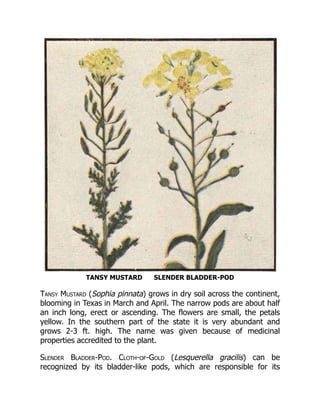
TANSY MUSTARD SLENDERBLADDER-POD
Tansy Mustard (Sophia pinnata) grows in dry soil across the continent,
blooming in Texas in March and April. The narrow pods are about half
an inch long, erect or ascending. The flowers are small, the petals
yellow. In the southern part of the state it is very abundant and
grows 2-3 ft. high. The name was given because of medicinal
properties accredited to the plant.
Slender Bladder-Pod. Cloth-of-Gold (Lesquerella gracilis) can be
recognized by its bladder-like pods, which are responsible for its
55.
38
common name ofpop-weed. The yellow petals are narrowed at the
base and streaked with orange. The first flush of yellow on plains and
prairies is usually due to the bladder-pods. There are more than 20
species in the state, most of them being very abundant. The scientific
name is in honor of Leo Lesquereux, a Swiss and American botanist.
The western wall-flower (Erysimum asperum), which grows in sandy
areas in West Texas, is one of the showiest yellow mustards in the
state. Several large-flowered purple mustards are common, including
Streptanthus bracteatus.
56.
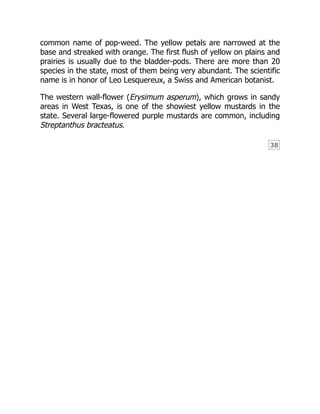
GREGGIA SPECTACLE-POD
Greggia (Greggiacamporum) is a white-flowered mustard which looks
like the yellow western wall-flower. The flowers are about half an inch
broad and sometimes tinged with purple. The stems are about a foot
high and almost concealed by the broad gray-green leaves. The
woolly pods are narrow, flattened, and about half an inch long. It is
one of the commonest flowers in Southwestern Texas, blooming in
April, May, and June.
57.
Welcome to ourwebsite – the ideal destination for book lovers and
knowledge seekers. With a mission to inspire endlessly, we offer a
vast collection of books, ranging from classic literary works to
specialized publications, self-development books, and children's
literature. Each book is a new journey of discovery, expanding
knowledge and enriching the soul of the reade
Our website is not just a platform for buying books, but a bridge
connecting readers to the timeless values of culture and wisdom. With
an elegant, user-friendly interface and an intelligent search system,
we are committed to providing a quick and convenient shopping
experience. Additionally, our special promotions and home delivery
services ensure that you save time and fully enjoy the joy of reading.
Let us accompany you on the journey of exploring knowledge and
personal growth!
ebookmass.com