(eBook PDF) Accounting Information Systems 9th Edition
(eBook PDF) Accounting Information Systems 9th Edition
(eBook PDF) Accounting Information Systems 9th Edition
(eBook PDF) Accounting Information Systems 9th Edition
(eBook PDF) Accounting Information Systems 9th Edition
1.
(eBook PDF) AccountingInformation Systems 9th
Edition download
https://ebookluna.com/product/ebook-pdf-accounting-information-
systems-9th-edition/
Download more ebook from https://ebookluna.com
3.
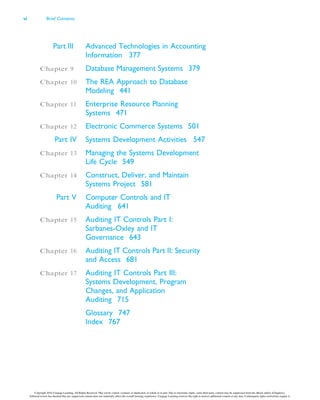
Part III AdvancedTechnologies in Accounting
Information 377
Chapter 9 Database Management Systems 379
Chapter 10 The REA Approach to Database
Modeling 441
Chapter 11 Enterprise Resource Planning
Systems 471
Chapter 12 Electronic Commerce Systems 501
Part IV Systems Development Activities 547
Chapter 13 Managing the Systems Development
Life Cycle 549
Chapter 14 Construct, Deliver, and Maintain
Systems Project 581
Part V Computer Controls and IT
Auditing 641
Chapter 15 Auditing IT Controls Part I:
Sarbanes-Oxley and IT
Governance 643
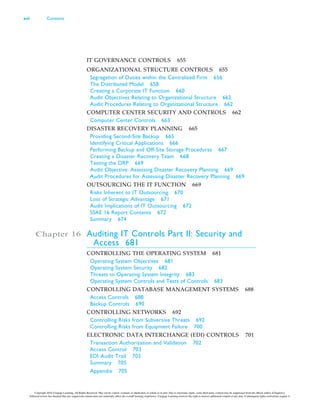
Chapter 16 Auditing IT Controls Part II: Security
and Access 681
Chapter 17 Auditing IT Controls Part III:
Systems Development, Program
Changes, and Application
Auditing 715
Glossary 747
Index 767
vi Brief Contents
Copyright 2016 Cengage Learning. All Rights Reserved. May not be copied, scanned, or duplicated, in whole or in part. Due to electronic rights, some third party content may be suppressed from the eBook and/or eChapter(s).
Editorial review has deemed that any suppressed content does not materially affect the overall learning experience. Cengage Learning reserves the right to remove additional content at any time if subsequent rights restrictions require it.
4.
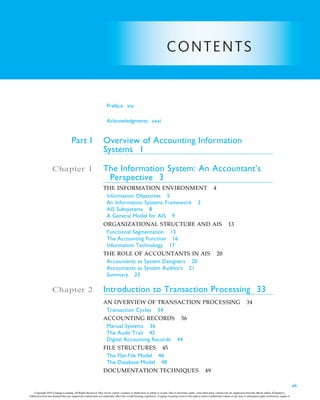
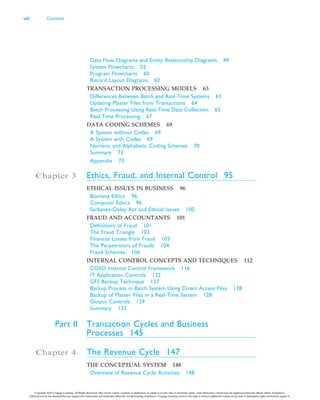
CONTENTS
Preface xix
Acknowledgments xxxi
PartI Overview of Accounting Information
Systems 1
Chapter 1 The Information System: An Accountant’s
Perspective 3
THE INFORMATION ENVIRONMENT 4
Information Objectives 5
An Information Systems Framework 5
AIS Subsystems 8
A General Model for AIS 9
ORGANIZATIONAL STRUCTURE AND AIS 13
Functional Segmentation 13
The Accounting Function 16
Information Technology 17
THE ROLE OF ACCOUNTANTS IN AIS 20
Accountants as System Designers 20
Accountants as System Auditors 21
Summary 23
Chapter 2 Introduction to Transaction Processing 33
AN OVERVIEW OF TRANSACTION PROCESSING 34
Transaction Cycles 34
ACCOUNTING RECORDS 36
Manual Systems 36
The Audit Trail 42
Digital Accounting Records 44
FILE STRUCTURES 45
The Flat-File Model 46
The Database Model 48
DOCUMENTATION TECHNIQUES 49
vii
Copyright 2016 Cengage Learning. All Rights Reserved. May not be copied, scanned, or duplicated, in whole or in part. Due to electronic rights, some third party content may be suppressed from the eBook and/or eChapter(s).
Editorial review has deemed that any suppressed content does not materially affect the overall learning experience. Cengage Learning reserves the right to remove additional content at any time if subsequent rights restrictions require it.
5.
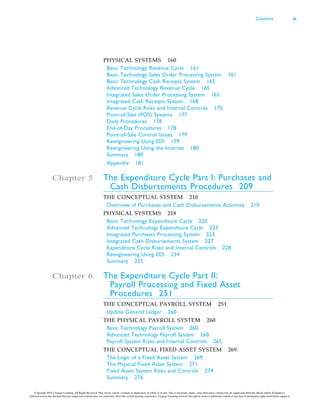
Data Flow Diagramsand Entity Relationship Diagrams 49
System Flowcharts 52
Program Flowcharts 60
Record Layout Diagrams 62
TRANSACTION PROCESSING MODELS 63
Differences Between Batch and Real-Time Systems 63
Updating Master Files from Transactions 64
Batch Processing Using Real-Time Data Collection 65
Real-Time Processing 67
DATA CODING SCHEMES 69
A System without Codes 69
A System with Codes 69
Numeric and Alphabetic Coding Schemes 70
Summary 73
Appendix 73
Chapter 3 Ethics, Fraud, and Internal Control 95
ETHICAL ISSUES IN BUSINESS 96
Business Ethics 96
Computer Ethics 96
Sarbanes-Oxley Act and Ethical Issues 100
FRAUD AND ACCOUNTANTS 101
Definitions of Fraud 101
The Fraud Triangle 102
Financial Losses from Fraud 103
The Perpetrators of Frauds 104
Fraud Schemes 106
INTERNAL CONTROL CONCEPTS AND TECHNIQUES 112
COSO Internal Control Framework 116
IT Application Controls 122
GFS Backup Technique 127
Backup Process in Batch System Using Direct Access Files 128
Backup of Master Files in a Real-Time System 128
Output Controls 129
Summary 132
Part II Transaction Cycles and Business
Processes 145
Chapter 4 The Revenue Cycle 147
THE CONCEPTUAL SYSTEM 148
Overview of Revenue Cycle Activities 148
viii Contents
Copyright 2016 Cengage Learning. All Rights Reserved. May not be copied, scanned, or duplicated, in whole or in part. Due to electronic rights, some third party content may be suppressed from the eBook and/or eChapter(s).
Editorial review has deemed that any suppressed content does not materially affect the overall learning experience. Cengage Learning reserves the right to remove additional content at any time if subsequent rights restrictions require it.
6.
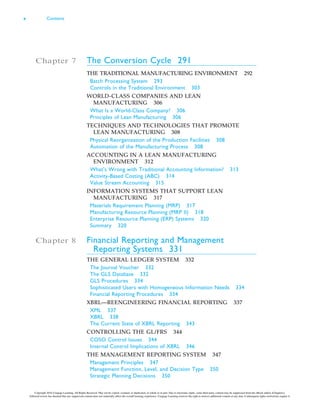
PHYSICAL SYSTEMS 160
BasicTechnology Revenue Cycle 161
Basic Technology Sales Order Processing System 161
Basic Technology Cash Receipts System 165
Advanced Technology Revenue Cycle 165
Integrated Sales Order Processing System 165
Integrated Cash Receipts System 168
Revenue Cycle Risks and Internal Controls 170
Point-of-Sale (POS) Systems 177
Daily Procedures 178
End-of-Day Procedures 178
Point-of-Sale Control Issues 179
Reengineering Using EDI 179
Reengineering Using the Internet 180
Summary 180
Appendix 181
Chapter 5 The Expenditure Cycle Part I: Purchases and
Cash Disbursements Procedures 209
THE CONCEPTUAL SYSTEM 210
Overview of Purchases and Cash Disbursements Activities 210
PHYSICAL SYSTEMS 218
Basic Technology Expenditure Cycle 220
Advanced Technology Expenditure Cycle 223
Integrated Purchases Processing System 223
Integrated Cash Disbursements System 227
Expenditure Cycle Risks and Internal Controls 228
Reengineering Using EDI 234
Summary 235
Chapter 6 The Expenditure Cycle Part II:
Payroll Processing and Fixed Asset
Procedures 251
THE CONCEPTUAL PAYROLL SYSTEM 251
Update General Ledger 260
THE PHYSICAL PAYROLL SYSTEM 260
Basic Technology Payroll System 260
Advanced Technology Payroll System 260
Payroll System Risks and Internal Controls 265
THE CONCEPTUAL FIXED ASSET SYSTEM 269
The Logic of a Fixed Asset System 269
The Physical Fixed Asset System 271
Fixed Asset System Risks and Controls 274
Summary 276
Contents ix
Copyright 2016 Cengage Learning. All Rights Reserved. May not be copied, scanned, or duplicated, in whole or in part. Due to electronic rights, some third party content may be suppressed from the eBook and/or eChapter(s).
Editorial review has deemed that any suppressed content does not materially affect the overall learning experience. Cengage Learning reserves the right to remove additional content at any time if subsequent rights restrictions require it.
7.
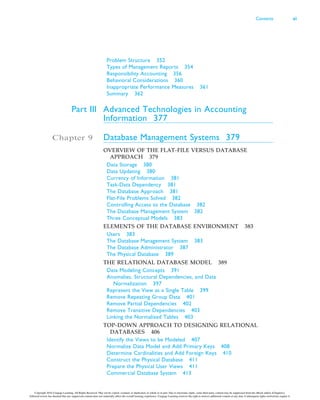
Chapter 7 TheConversion Cycle 291
THE TRADITIONAL MANUFACTURING ENVIRONMENT 292
Batch Processing System 293
Controls in the Traditional Environment 303
WORLD-CLASS COMPANIES AND LEAN
MANUFACTURING 306
What Is a World-Class Company? 306
Principles of Lean Manufacturing 306
TECHNIQUES AND TECHNOLOGIES THAT PROMOTE
LEAN MANUFACTURING 308
Physical Reorganization of the Production Facilities 308
Automation of the Manufacturing Process 308
ACCOUNTING IN A LEAN MANUFACTURING
ENVIRONMENT 312
What’s Wrong with Traditional Accounting Information? 313
Activity-Based Costing (ABC) 314
Value Stream Accounting 315
INFORMATION SYSTEMS THAT SUPPORT LEAN
MANUFACTURING 317
Materials Requirement Planning (MRP) 317
Manufacturing Resource Planning (MRP II) 318
Enterprise Resource Planning (ERP) Systems 320
Summary 320
Chapter 8 Financial Reporting and Management
Reporting Systems 331
THE GENERAL LEDGER SYSTEM 332
The Journal Voucher 332
The GLS Database 332
GLS Procedures 334
Sophisticated Users with Homogeneous Information Needs 334
Financial Reporting Procedures 334
XBRL—REENGINEERING FINANCIAL REPORTING 337
XML 337
XBRL 338
The Current State of XBRL Reporting 343
CONTROLLING THE GL/FRS 344
COSO Control Issues 344
Internal Control Implications of XBRL 346
THE MANAGEMENT REPORTING SYSTEM 347
Management Principles 347
Management Function, Level, and Decision Type 350
Strategic Planning Decisions 350
x Contents
Copyright 2016 Cengage Learning. All Rights Reserved. May not be copied, scanned, or duplicated, in whole or in part. Due to electronic rights, some third party content may be suppressed from the eBook and/or eChapter(s).
Editorial review has deemed that any suppressed content does not materially affect the overall learning experience. Cengage Learning reserves the right to remove additional content at any time if subsequent rights restrictions require it.
8.
Problem Structure 352
Typesof Management Reports 354
Responsibility Accounting 356
Behavioral Considerations 360
Inappropriate Performance Measures 361
Summary 362
Part III Advanced Technologies in Accounting
Information 377
Chapter 9 Database Management Systems 379
OVERVIEW OF THE FLAT-FILE VERSUS DATABASE
APPROACH 379
Data Storage 380
Data Updating 380
Currency of Information 381
Task-Data Dependency 381
The Database Approach 381
Flat-File Problems Solved 382
Controlling Access to the Database 382
The Database Management System 382
Three Conceptual Models 383
ELEMENTS OF THE DATABASE ENVIRONMENT 383
Users 383
The Database Management System 383
The Database Administrator 387
The Physical Database 389
THE RELATIONAL DATABASE MODEL 389
Data Modeling Concepts 391
Anomalies, Structural Dependencies, and Data
Normalization 397
Represent the View as a Single Table 399
Remove Repeating Group Data 401
Remove Partial Dependencies 402
Remove Transitive Dependencies 403
Linking the Normalized Tables 403
TOP-DOWN APPROACH TO DESIGNING RELATIONAL
DATABASES 406
Identify the Views to be Modeled 407
Normalize Data Model and Add Primary Keys 408
Determine Cardinalities and Add Foreign Keys 410
Construct the Physical Database 411
Prepare the Physical User Views 411
Commercial Database System 413
Contents xi
Copyright 2016 Cengage Learning. All Rights Reserved. May not be copied, scanned, or duplicated, in whole or in part. Due to electronic rights, some third party content may be suppressed from the eBook and/or eChapter(s).
Editorial review has deemed that any suppressed content does not materially affect the overall learning experience. Cengage Learning reserves the right to remove additional content at any time if subsequent rights restrictions require it.
9.
DATABASES IN ADISTRIBUTED ENVIRONMENT 413
Centralized Databases 413
Distributed Databases 415
Summary 419
Appendix 419
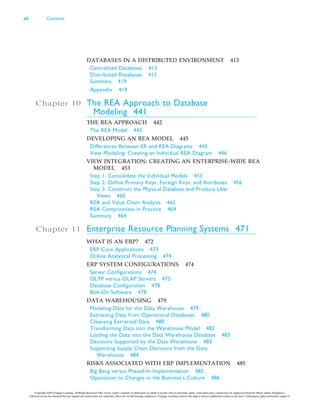
Chapter 10 The REA Approach to Database
Modeling 441
THE REA APPROACH 442
The REA Model 442
DEVELOPING AN REA MODEL 445
Differences Between ER and REA Diagrams 445
View Modeling: Creating an Individual REA Diagram 446
VIEW INTEGRATION: CREATING AN ENTERPRISE-WIDE REA
MODEL 453
Step 1. Consolidate the Individual Models 453
Step 2. Define Primary Keys, Foreign Keys, and Attributes 456
Step 3. Construct the Physical Database and Produce User
Views 460
REA and Value Chain Analysis 462
REA Compromises in Practice 464
Summary 464
Chapter 11 Enterprise Resource Planning Systems 471
WHAT IS AN ERP? 472
ERP Core Applications 473
Online Analytical Processing 474
ERP SYSTEM CONFIGURATIONS 474
Server Configurations 474
OLTP versus OLAP Servers 475
Database Configuration 478
Bolt-On Software 478
DATA WAREHOUSING 479
Modeling Data for the Data Warehouse 479
Extracting Data from Operational Databases 480
Cleansing Extracted Data 480
Transforming Data into the Warehouse Model 482
Loading the Data into the Data Warehouse Database 483
Decisions Supported by the Data Warehouse 483
Supporting Supply Chain Decisions from the Data
Warehouse 484
RISKS ASSOCIATED WITH ERP IMPLEMENTATION 485
Big Bang versus Phased-In Implementation 485
Opposition to Changes in the Business’s Culture 486
xii Contents
Copyright 2016 Cengage Learning. All Rights Reserved. May not be copied, scanned, or duplicated, in whole or in part. Due to electronic rights, some third party content may be suppressed from the eBook and/or eChapter(s).
Editorial review has deemed that any suppressed content does not materially affect the overall learning experience. Cengage Learning reserves the right to remove additional content at any time if subsequent rights restrictions require it.
10.
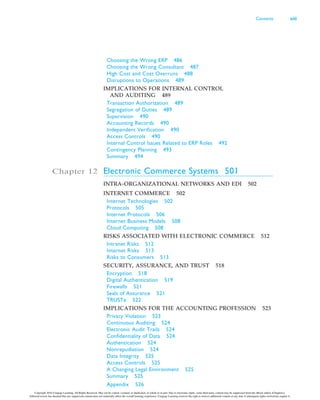
Choosing the WrongERP 486
Choosing the Wrong Consultant 487
High Cost and Cost Overruns 488
Disruptions to Operations 489
IMPLICATIONS FOR INTERNAL CONTROL
AND AUDITING 489
Transaction Authorization 489
Segregation of Duties 489
Supervision 490
Accounting Records 490
Independent Verification 490
Access Controls 490
Internal Control Issues Related to ERP Roles 492
Contingency Planning 493
Summary 494
Chapter 12 Electronic Commerce Systems 501
INTRA-ORGANIZATIONAL NETWORKS AND EDI 502
INTERNET COMMERCE 502
Internet Technologies 502
Protocols 505
Internet Protocols 506
Internet Business Models 508
Cloud Computing 508
RISKS ASSOCIATED WITH ELECTRONIC COMMERCE 512
Intranet Risks 512
Internet Risks 513
Risks to Consumers 513
SECURITY, ASSURANCE, AND TRUST 518
Encryption 518
Digital Authentication 519
Firewalls 521
Seals of Assurance 521
TRUSTe 522
IMPLICATIONS FOR THE ACCOUNTING PROFESSION 523
Privacy Violation 523
Continuous Auditing 524
Electronic Audit Trails 524
Confidentiality of Data 524
Authentication 524
Nonrepudiation 524
Data Integrity 525
Access Controls 525
A Changing Legal Environment 525
Summary 525
Appendix 526
Contents xiii
Copyright 2016 Cengage Learning. All Rights Reserved. May not be copied, scanned, or duplicated, in whole or in part. Due to electronic rights, some third party content may be suppressed from the eBook and/or eChapter(s).
Editorial review has deemed that any suppressed content does not materially affect the overall learning experience. Cengage Learning reserves the right to remove additional content at any time if subsequent rights restrictions require it.
11.
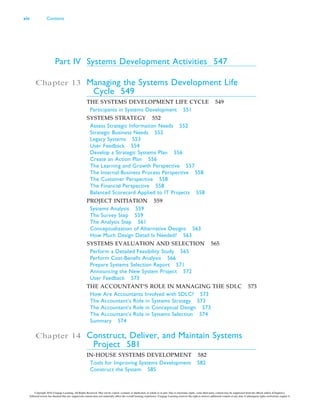
Part IV SystemsDevelopment Activities 547
Chapter 13 Managing the Systems Development Life
Cycle 549
THE SYSTEMS DEVELOPMENT LIFE CYCLE 549
Participants in Systems Development 551
SYSTEMS STRATEGY 552
Assess Strategic Information Needs 552
Strategic Business Needs 552
Legacy Systems 553
User Feedback 554
Develop a Strategic Systems Plan 556
Create an Action Plan 556
The Learning and Growth Perspective 557
The Internal Business Process Perspective 558
The Customer Perspective 558
The Financial Perspective 558
Balanced Scorecard Applied to IT Projects 558
PROJECT INITIATION 559
Systems Analysis 559
The Survey Step 559
The Analysis Step 561
Conceptualization of Alternative Designs 563
How Much Design Detail Is Needed? 563
SYSTEMS EVALUATION AND SELECTION 565
Perform a Detailed Feasibility Study 565
Perform Cost-Benefit Analysis 566
Prepare Systems Selection Report 571
Announcing the New System Project 572
User Feedback 573
THE ACCOUNTANT’S ROLE IN MANAGING THE SDLC 573
How Are Accountants Involved with SDLC? 573
The Accountant’s Role in Systems Strategy 573
The Accountant’s Role in Conceptual Design 573
The Accountant’s Role in Systems Selection 574
Summary 574
Chapter 14 Construct, Deliver, and Maintain Systems
Project 581
IN-HOUSE SYSTEMS DEVELOPMENT 582
Tools for Improving Systems Development 582
Construct the System 585
xiv Contents
Copyright 2016 Cengage Learning. All Rights Reserved. May not be copied, scanned, or duplicated, in whole or in part. Due to electronic rights, some third party content may be suppressed from the eBook and/or eChapter(s).
Editorial review has deemed that any suppressed content does not materially affect the overall learning experience. Cengage Learning reserves the right to remove additional content at any time if subsequent rights restrictions require it.
12.
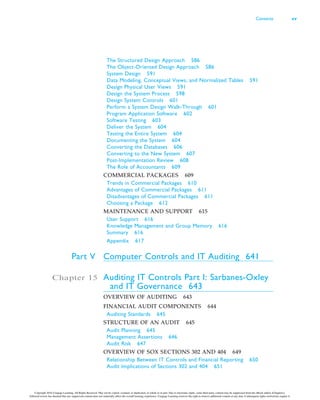
The Structured DesignApproach 586
The Object-Oriented Design Approach 586
System Design 591
Data Modeling, Conceptual Views, and Normalized Tables 591
Design Physical User Views 591
Design the System Process 598
Design System Controls 601
Perform a System Design Walk-Through 601
Program Application Software 602
Software Testing 603
Deliver the System 604
Testing the Entire System 604
Documenting the System 604
Converting the Databases 606
Converting to the New System 607
Post-Implementation Review 608
The Role of Accountants 609
COMMERCIAL PACKAGES 609
Trends in Commercial Packages 610
Advantages of Commercial Packages 611
Disadvantages of Commercial Packages 611
Choosing a Package 612
MAINTENANCE AND SUPPORT 615
User Support 616
Knowledge Management and Group Memory 616
Summary 616
Appendix 617
Part V Computer Controls and IT Auditing 641
Chapter 15 Auditing IT Controls Part I: Sarbanes-Oxley
and IT Governance 643
OVERVIEW OF AUDITING 643
FINANCIAL AUDIT COMPONENTS 644
Auditing Standards 645
STRUCTURE OF AN AUDIT 645
Audit Planning 645
Management Assertions 646
Audit Risk 647
OVERVIEW OF SOX SECTIONS 302 AND 404 649
Relationship Between IT Controls and Financial Reporting 650
Audit Implications of Sections 302 and 404 651
Contents xv
Copyright 2016 Cengage Learning. All Rights Reserved. May not be copied, scanned, or duplicated, in whole or in part. Due to electronic rights, some third party content may be suppressed from the eBook and/or eChapter(s).
Editorial review has deemed that any suppressed content does not materially affect the overall learning experience. Cengage Learning reserves the right to remove additional content at any time if subsequent rights restrictions require it.
13.
IT GOVERNANCE CONTROLS655
ORGANIZATIONAL STRUCTURE CONTROLS 655
Segregation of Duties within the Centralized Firm 656
The Distributed Model 658
Creating a Corporate IT Function 660
Audit Objectives Relating to Organizational Structure 662
Audit Procedures Relating to Organizational Structure 662
COMPUTER CENTER SECURITY AND CONTROLS 662
Computer Center Controls 663
DISASTER RECOVERY PLANNING 665
Providing Second-Site Backup 665
Identifying Critical Applications 666
Performing Backup and Off-Site Storage Procedures 667
Creating a Disaster Recovery Team 668
Testing the DRP 669
Audit Objective: Assessing Disaster Recovery Planning 669
Audit Procedures for Assessing Disaster Recovery Planning 669
OUTSOURCING THE IT FUNCTION 669
Risks Inherent to IT Outsourcing 670
Loss of Strategic Advantage 671
Audit Implications of IT Outsourcing 672
SSAE 16 Report Contents 672
Summary 674
Chapter 16 Auditing IT Controls Part II: Security and
Access 681
CONTROLLING THE OPERATING SYSTEM 681
Operating System Objectives 681
Operating System Security 682
Threats to Operating System Integrity 683
Operating System Controls and Tests of Controls 683
CONTROLLING DATABASE MANAGEMENT SYSTEMS 688
Access Controls 688
Backup Controls 690
CONTROLLING NETWORKS 692
Controlling Risks from Subversive Threats 692
Controlling Risks from Equipment Failure 700
ELECTRONIC DATA INTERCHANGE (EDI) CONTROLS 701
Transaction Authorization and Validation 702
Access Control 703
EDI Audit Trail 703
Summary 705
Appendix 705
xvi Contents
Copyright 2016 Cengage Learning. All Rights Reserved. May not be copied, scanned, or duplicated, in whole or in part. Due to electronic rights, some third party content may be suppressed from the eBook and/or eChapter(s).
Editorial review has deemed that any suppressed content does not materially affect the overall learning experience. Cengage Learning reserves the right to remove additional content at any time if subsequent rights restrictions require it.
14.
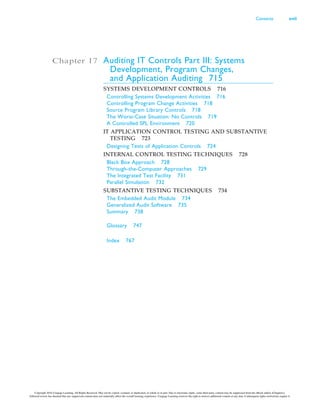
Chapter 17 AuditingIT Controls Part III: Systems
Development, Program Changes,
and Application Auditing 715
SYSTEMS DEVELOPMENT CONTROLS 716
Controlling Systems Development Activities 716
Controlling Program Change Activities 718
Source Program Library Controls 718
The Worst-Case Situation: No Controls 719
A Controlled SPL Environment 720
IT APPLICATION CONTROL TESTING AND SUBSTANTIVE
TESTING 723
Designing Tests of Application Controls 724
INTERNAL CONTROL TESTING TECHNIQUES 728
Black Box Approach 728
Through-the-Computer Approaches 729
The Integrated Test Facility 731
Parallel Simulation 732
SUBSTANTIVE TESTING TECHNIQUES 734
The Embedded Audit Module 734
Generalized Audit Software 735
Summary 738
Glossary 747
Index 767
Contents xvii
Copyright 2016 Cengage Learning. All Rights Reserved. May not be copied, scanned, or duplicated, in whole or in part. Due to electronic rights, some third party content may be suppressed from the eBook and/or eChapter(s).
Editorial review has deemed that any suppressed content does not materially affect the overall learning experience. Cengage Learning reserves the right to remove additional content at any time if subsequent rights restrictions require it.
15.
Copyright 2016 CengageLearning. All Rights Reserved. May not be copied, scanned, or duplicated, in whole or in part. Due to electronic rights, some third party content may be suppressed from the eBook and/or eChapter(s).
Editorial review has deemed that any suppressed content does not materially affect the overall learning experience. Cengage Learning reserves the right to remove additional content at any time if subsequent rights restrictions require it.
16.
PREFACE
Welcome to theNinth Edition
The ninth edition of Accounting Information Systems includes a range of new
and revised homework assignments and up-to-date content changes, as well as sev-
eral reorganized chapters. All of these changes add up to more student and
instructor enhancements than ever before. As this preface makes clear, we have
made these changes to keep students and instructors as current as possible on issues
such as business processes, systems development methods, IT governance and strat-
egy, security, internal controls, and relevant aspects of Sarbanes-Oxley legislation.
Focus and Flexibility in Designing
Your AIS Course
Among accounting courses, accounting information systems (AIS) courses tend to be
the least standardized. Often, the objectives, background, and orientation of the in-
structor, rather than adherence to a standard body of knowledge, determine the di-
rection the AIS course takes. Therefore, we have designed this text for maximum
flexibility:
• This textbook covers a full range of AIS topics to provide instructors with flexi-
bility in setting the direction and intensity of their courses.
• At the same time, for those who desire a structured model, the first nine chapters of
the text, along with the chapters on electronic commerce and general IT controls,
provide what has proven to be a successful template for developing an AIS course.
• Previous editions of this book have been used successfully in introductory-,
advanced-, and graduate-level AIS courses.
• The topics in this book are presented from the perspective of the managers’ and
accountants’ AIS-related responsibilities under the Sarbanes-Oxley Act.
• Although this book was written primarily to meet the needs of accounting majors
about to enter the modern business world, we have also developed it to be an
effective text for general business, industrial engineering, and computer science
students who seek a thorough understanding of AIS and internal control issues
as part of their professional education.
Key Features
CONCEPTUAL FRAMEWORK
This book employs a conceptual framework to emphasize the professional and legal
responsibility of accountants, auditors, and management for the design, operation,
xix
Copyright 2016 Cengage Learning. All Rights Reserved. May not be copied, scanned, or duplicated, in whole or in part. Due to electronic rights, some third party content may be suppressed from the eBook and/or eChapter(s).
Editorial review has deemed that any suppressed content does not materially affect the overall learning experience. Cengage Learning reserves the right to remove additional content at any time if subsequent rights restrictions require it.
foremost. So shethrust forth her head from the venerable porch,
and at the top of her voice exclaimed—"Turmots, turmots, turmots!"
At that loud cry, Leviticus Cripps turned pale—for his conscience
smote him. "She meaneth me, she meaneth me, she meaneth my
turmot-field;" he whispered, with his long legs bent for departure;
"'tis a thousand pound they have offered, Zak. Come away, come
away, down Ship Street; there is a pump, and I want some water."
"But tell me what thou wast agoing to say," cried his brother, laying
hold of him.
"Dash it! I will tell thee the truth, then, Zak. I just went and cut up a
maisly sow—as fine a bit of pork as you ever clapped eyes on, but
for they little beauty spots. And the clerk of the market bought some
for his dinner; and he have got a bad cook, a cantankerous woman,
and now I be in a pretty mess!"
"Not a word of all that do I believe," said Cripps.
19.
CHAPTER XVII.
INSTALLED ATBRASENOSE.
Master Cripps was accustomed mainly to daylight roads and open
ways. It was true that he had a good many corners to turn between
Beckley and Oxford, whether his course were through Elsfield and
Marston, or the broader track from Headington. But for all sharp
turns he had two great maxims—keep on the proper side, and go
slowly. By virtue of these, he had never been damaged himself, or
forced to pay damages; and when he was in a pleasant vein, at the
Dusty Anvil, or anywhere else, it was useless to tell him that any
mischance need happen to a man who heeded this—that is to say, if
he drove a good horse, and saw to the shoeing of the nag himself.
Of course there was also the will of the Lord. But that was quite sure
to go right, if you watched it.
If he has any good substance in him, a man who spends most of his
daylight time in the company of an honest horse, is sure to improve
so much that none of his bad companions know him—supposing that
he ever had any. The simplicity and the good will of the horse, his
faith in mankind, and his earnest desire to earn his oats, and have
plenty of them; also the knowledge that his time is short, and his
longest worn shoes will outlast him; and that when he is dead, quite
another must be bought, who will cost twice as much as he did—
these things (if any sense can be made of them) operate on the
human mind, in a measure, for the most part, favourable.
Allowance, therefore, must be made for Master Leviticus Cripps and
his character, as often as it is borne in mind that he, from society of
good horses, was (by mere mischance of birth) fetched down to
communion with low hogs. Not that hogs are in any way low, from a
properly elevated gazing-point; and taking, perhaps, the loftiest of
20.
human considerations, theyare, as yet, fondly believed to be much
better on a dish than horses.
But that—as Cripps would plainly put it—is neither here nor there
just now; and it is ever so much better to let a man make his own
excuses, which he can generally do pretty well.
"Cripps, well met!" cried Russel Overshute, seizing him by the apron,
as Zacchary stood at the corner of Ship Street, to shake his head
after his brother, who had made off down the Corn Market; "you are
the very man I want to see!"
"Lor' a mercy now, be I, your Worship? Well, there are not many
gentlemen as it does me more good to look at."
Without any flattery he might say that. It was good, after dealing
with a crooked man, to set eyes upon young Overshute. In his face
there was no possibility of lie, hidden thought, or subterfuge.
Whatever he meant was there expressed, in quick bold features, and
frank bright eyes. His tall straight figure, firm neck, and broad
shoulders helped to make people respect what he meant; moreover,
he walked as if he had always something in view before him. He
never turned round to look after a pretty girl, as weak young fellows
do. He admired a pretty girl very much; but had too much respect
for her to show it. He had made his choice, once for all in life; and
his choice was sweet Grace Oglander.
"I made sure of meeting you, Master Cripps; if not in the market, at
any rate where you put up your fine old horse. I like a man who
likes his horse. I want to speak to you quietly, Cripps."
"I am your man, sir. Goo where you plaiseth. Without no beckoning,
I be after you."
"There is nothing to make any fuss about, Cripps. And the whole
world is welcome to what I say, whenever there is no one else
21.
concerned. At present,there are other people concerned;—and get
out of the way, you jackanapes!"
In symmetry with his advanced ideas, he should not have spoken
thus—but he spake it; and the eavesdropper touched his hat, and
made off very hastily.
Russel was not at all certain of having quite acted up to his better
lights, and longed to square up all the wrong with a shilling; but,
with higher philosophy, suppressed that foolish yearning. "Now,
Cripps, just follow me," he said.
The Carrier grumbled to himself a little, because of all his parcels,
and the change he was to call for somewhere, and a woman who
could not make up her mind about a bullock's liver—not to think of
more important things in every other direction. No one thought
nothing of the value of his time; every bit the same as if he was a
lean old horse turned out to grass! In spite of all that, Master Cripps
did his best to keep time with the long legs before him. Thus was he
led through well-known ways to the modest gate of Brasenose,
which being passed, he went up a staircase near the unpretentious
hall of that very good society. "Why am I here?" thought Cripps, but,
with his usual resignation, added, "I have aseed finer places nor
this." This, in the range of his great experience, doubtless was an
established truth. But even his view of the breadth of the world
received a little twist of wonder, when over a narrow dark doorway,
which Mr. Overshute passed in silence, he read—for read he could—
these words, "Rev. Thomas Hardenow." "May I be danged," said
Cripps, "if I ever come across such a queer thing as this here be!"
However, he quelled his emotions and followed the lengthy-striding
Overshute into a long low room containing uncommonly little
furniture. There was no one there, except Overshute, and a scout,
who flitted away in ripe haste, with an order upon the buttery.
22.
"Now, Cripps, didstthou ever taste college ale?" Mr. Overshute
asked, as he took a chair like the dead bones of Ezekiel. "Master
Carrier, here thou hast the tokens of a new and important
movement. In my time, chairs were comfortable. But they make
them now, only to mortify the flesh."
"Did your Worship mean me to sit down?" asked Cripps, touching
the forelock which he kept combed for that purpose.
"Certainly, Cripps. Be not critical; but sit."
"I thank your Worship kindly," he answered with little cause for
gratitude. "I have a-druv many thousand mile on a seat no worse
nor this, perhaps."
"Your reservation is wise, my friend. Your driving-board must have
been velvet to this. But the new lights are not in our Brewery yet. If
they get there, they will have the worst of it. Here comes the
tankard! Well done, old Hooper. Score a gallon to me for my family."
"With pleasure, sir," answered Hooper, truly, while he set on the
table a tray filled with solid luncheon. "Ah, I see you remember the
good old times, when there was those in this college, sir, that never
thought twice about keeping down the flesh; and better flesh, sir,
they had ever so much than these as are always a-doctoring of it.
Ah, when I comes to recall to my mind what my father said to me,
when fust he led me in under King Solomon's nose—'Bob, my boy,'
he says to me——"
"Now, Hooper, I know that his advice was good. The fruit thereof is
in yourself. You shall tell me all about it the very next time I come to
see you."
"Ah, they never cares now to hearken," said Hooper to himself, as,
with the resignation of an ancient scout, he coughed, and bowed,
and stroked the cloth, and contemplated Cripps with mild surprise,
and then made a quiet exit. As for listening at the door, a good scout
23.
scorns such benefit.He likes to help himself to something more solid
than the words behind him.
"If I may make so bold," said the Carrier, after waiting as long as he
could, with Overshute clearly forgetting him; "what was it your
Worship was going to tell me? Time is going by, sir, and our horse
will miss his feeding."
"Attend to your own, Cripps, attend to your own. I beg your pardon
for not helping you. But that you can do for yourself, I dare say. I
am trying to think out something. I used to be quick; I am very slow
now."
Cripps made a little face at this, to show that the ways of his betters
had good right to be beyond him; and then he stood upon his sturdy
bowed legs, and turned a quick corner of eye at the door, in fear of
any fasting influence, and seeing nothing of the kind, with pleasure
laid hold of a large knife and fork.
"Lay about you, Cripps, my friend; lay about you to your utmost." So
said Mr. Overshute, himself refusing everything.
"Railly now, I dunno, your Worship, how to get on, all a-ating by
myself. Some folk can, and some breaks down at it. I must have
somebody to ate with me—so be it was only now a babby, or a dog."
"I thank you for the frank comparison, Cripps. Well, help me, if you
must—ah, I see you can carve."
"I am better at the raw mate, sir; but I can make shift when
roasted. Butcher Numbers my brother, your Worship—but perhaps
you never heered on him?"
"Oh yes, I know, Cripps. A highly respectable thriving man he is too.
All your family thrive, and everybody speaks so well of them. Why,
look at Leviticus! They tell me he has three hundred pigs!"
24.
Like most menwho have the great gift of gaining good will and
popularity, Russel Overshute loved a bit of gossip about his
neighbours.
"Your Worship," said Cripps, disappointing him of any new
information, "pigs is out of my way altogether. When I was a young
man of tender years, counteracted I was for to carry a pig. Three
pounds twelve shillings and four pence he cost me, in less than
three-quarters of a mile of road; and squeak, squeak, all the way, as
if I was a-killing of him, and not he me. Seemeth he smelled some
apples somewhere, and he went through a chaney clock, and a
violin, and a set of first-born babby-linen for Squire Corser's
daughter; grown up now she is, your Worship must a met her riding.
And that was not the worst of it nother——"
"Well, Cripps, you must tell me another time. It was terribly hard
upon you. But, my friend, the gentleman who lives here will be back
for his hat, when the clock strikes two. Cap and gown off, when the
clock strikes two. From two until five he walks fifteen miles,
whatever the state of the weather is."
"Lord bless me, your Worship, I could not travel that, with an empty
cart, and all downhill!"
"Never mind, Cripps. Will you try to listen, and offer no
observation?"
"To say nort,—does your Worship mean? Well, all our family be
esteemed for that."
"Then prove the justice of that esteem; for I have a long story to tell
you, Cripps, and no long time to do it in."
25.
CHAPTER XVIII.
A FLASHOF LIGHT.
The Carrier, with a decisive gesture, ceased from both solid and
liquid food, and settled his face, and whole body, and members into
a grim and yet flexible aspect, as if he were driving a half-broken
horse, and must be prepared for any sort of start. And yet with all
this he reconciled a duly receptive deference, and a pleasant
readiness, as if he were his own Dobbin, just fresh from stable.
"I need not tell you, Master Cripps," said Russel, "how I have picked
up the many little things, which have been coming to my knowledge
lately. And I will not be too positive about any of them; because I
made such a mistake in the beginning of this inquiry. All my
suspicions at first were set on a man who was purely innocent—a
legal gentleman of fair repute, to whom I have now made all
honourable amends. In the most candid manner he has forgiven me,
and desires no better than to act in the best faith with us."
"Asking your pardon for interrupting—did the gentleman happen to
have a sharp name?"
"Yes, Cripps, he did. But no more of that. I was over sharp myself,
no doubt; he is thoroughly blameless, and more than that, his
behaviour has been most generous, most unwearying, most—— I
never can do justice to him."
"Well, your Worship, no—perhaps not. A would take a rare sharp un
to do so."
"You hold by the vulgar prejudice—well, I should be the last to
blame you. That, however, has nothing to do with what I want to
ask you. But first, I must tell you my reason, Cripps. You know I
26.
have no faithwhatever in that man John Smith. At first I thought
him a tool of Mr.—never mind who—since I was so wrong. I am now
convinced that John Smith is 'art and part' in the whole affair
himself. He has thrown dust in our eyes throughout. He has stopped
us from taking the proper track. Do you remember what discredit he
threw on your sister's story?"
"He didn't believe a word of un. Had a good mind, I had, to a'
knocked un down."
"To be sure, Cripps, I wonder that you forbore. Though violent
measures must not be encouraged. And I myself thought that your
sister might have made some mistakes through her scare in the
dark. Poor thing! Her hair can have wanted no bandoline ever since,
I should fancy. What a brave girl too not to shriek or faint!"
"Well, her did goo zummut queer, sir, and lie down in the quarry-pit.
Perhaps 'twas the wisest thing the poor young wench could do."
"No doubt it was—the very wisest. However, before she lost her wits
she noticed, as I understand her to say—or rather she was
particularly struck with the harsh cackling voice of the taller man,
who also had a pointed hat, she thinks. It was not exactly a cackling
voice, nor a clacking voice, nor a guttural voice, but something
compounded of all three. Your sister, of course, could not quite so
describe it; but she imitated it; which was better."
"Her hath had great advantages. Her can imitate a'most anything.
Her waited for months on a College-chap, the very same in whose
house we be sitting now."
"Cripps, that is strange. But to come back again. Your sister, who is a
very nice girl, indeed, and a good member of a good family——"
"Ay, your Worship, that her be. Wish a could come across the man
as would dare to say the contrairy!"
27.
"Now, Cripps, wenever shall get on, while you are so horribly
warlike. Are you ready to listen to me, or not?"
"Every blessed word, your Worship, every blessed word goeth down;
unto such time as you begins to spake of things at home to me."
"Such dangerous topics I will avoid. And now for the man with this
villainous voice. You knew, or at any rate now you know, that I
never was satisfied with that wretched affair that was called an
'Inquest.' Inquest a non inquirendo—but I beg your pardon, my
good Cripps. Enough that the whole was pompous child's play,
guided by crafty hands beneath; as happens with most inquests. I
only doubted the more, friend Cripps; I only doubted the more, from
having a wrong way taken to extinguish doubts."
"To be sure, your Worship; a lie on the back of another lie makes un
go heavier."
"Well, never mind; only this I did. For a few days perhaps I was
overcome; and the illness of my dear old friend, the Squire, and the
trouble of managing so that he should not hear anything to kill him;
and my own slowness at the back of it all; for I never, as you know,
am hasty—these things, one and another, kept me from going on
horseback anywhere."
"To be sure, your Worship, to be sure. You ought to be always a-
horseback. I've a-seed you many times on the Bench; but you looks
a very poor stick there compared to what 'ee be a-horseback."
"Now, Cripps, where is your reverence? You call me 'your Worship,'
and in the same breath contemn my judicial functions. I must
commit you for a week's hard labour at getting in and out of your
own cart, if you will not allow me to speak, Cripps. At last I have
frightened you, have I? Then let me secure the result in silence.
Well, after the weather began to change from that tremendous frost
and snow, and the poor Squire fell into the quiet state that he has
28.
been in eversince, I found that nothing would do for me, my health
not being quite as usual——"
"Oh, your Worship was wonderfully kind; they told me you was as
good as any old woman in the room almost!"
"Except to take long rides, Cripps, nothing at all would do for me.
And, not to speak of myself too much, I believe that saved me from
falling into a weak, and spooney, and godless state. I assure you
there were times—however, never mind that, I am all right now, and
——"
"Thank the Lord! you ought to say, sir; but you great Squires upon
the bench——"
"Thank the Lord! I do say, Cripps; I thank Him every day for it. But if
I may edge in a word, in your unusually eloquent state, I will tell you
just what happened to me. I never believed, and never will, that
poor Miss Oglander is dead. The coroner and the jury believed that
they had her remains before them, although for the Squire's sake
they forbore to identify her in the verdict. Your sister, no doubt,
believed the same; and so did almost every one. I could not go, I
could not go—no doubt I was a fool; but I could not face the chance
of what I might see, after what I had heard of it. Well, I began to
ride about, saying nothing of course to any one. And the more I
rode, the more my spirit and faith in good things came back to me.
And I think I have been rewarded, Cripps; at last I have been
rewarded. It is not very much; but still it is like a flash of light to me.
I have found out the man with the horrible voice."
"Lord have mercy upon me! your Worship—the man as laid hold of
the pick-axe!"
"I have found him, Cripps, I do believe. But rather by pure luck than
skill."
29.
"There be nosuch thing as luck, your Worship; if you will excoose
me. The Lord in heaven is the master of us!"
"Upon my word, it looks almost like it, though I never took that view
of things. However, this was the way of it. To-day is Saturday. Well,
it was last Wednesday night, I was coming home from a long, and
wet, and muddy ride to Maidenhead. That little town always pleases
me; and I like the landlord and the hostler, and I am sure that my
horse is fed——"
"Your Worship must never think such a thing, without you see it
mixed, and feel it, and watch him a-munching, until he hath done."
"More than that, I have always fancied, ever since that story was
about the bag of potatoes you brought, without knowing any more
of it—ever since I heard of that, it has seemed to me that more
inquiries ought to be made at Maidenhead. I need not say why; but
I know that the Squire's opinion had been the same, as long as—I
mean while—his health permitted. On Wednesday I went to the
foreman of the nursery whence the potatoes came. It was raining
hard, and he was in a shed, with a green baize apron on, seeing to
some potting work. I got him away from the other men, and I found
him a very sharp fellow indeed. He remembered all about those
potatoes, especially as Squire Oglander had ridden from Oxford, in
the snowy weather, to ask many questions about them. But the
Squire could not put the questions I did. The poor old gentleman
could not bear, of course, to expose his trouble. But I threw away all
little scruples (as truly I should have done long ago), and I told the
good foreman every word, so far as we know it yet, at least. He was
shocked beyond expression—people take things in such different
ways—not at the poor Squire's loss and anguish, but that anybody
should have dared to meddle with his own pet 'oakleafs,' and, above
all, his new pet seal.
"'I sealed them myself,' he said, 'sealed them myself, sir, with the
new coat of arms that we paid for that month, because of the tricks
30.
of the trade,sir! Has anybody dared to imitate——' 'No, Mr.
Foreman,' I said, 'they simply cut away your seal altogether, and tied
it again, without any seal.' 'Oh, then,' he replied, 'that quite alters
the case. If they had only meddled with our new arms, while the
money was hot that we paid for them, what a case we might have
had! But to knock them off—no action lies.'
"Cripps, it took me a very long time to warm him up to the matter
again, after that great disappointment. He was burning for some
great suit at law against some rival nursery, which always pays the
upstart one; but I led him round, and by patient words and simple
truth brought him back to reason. The packing of the bag he
remembered well, and the pouring of a lot of buck-wheat husks
around and among the potato sets, to keep them from bruising, and
to keep out frost, which seemed even then to be in the air. And he
sent his best man to the Oxford coach, the first down coach from
London, which passed by their gate about ten o'clock, and would be
in Oxford about two, with the weather and the roads as usual. In
that case, the bag could scarcely have been at the Black Horse more
than half an hour before you came and laid hold of it; and being put
into the bar, as the Squire's parcels always are, it was very unlikely
to be tampered with."
"Lord a' mercy! your Worship, it was witchcraft then! The same as I
said all along; it were witches' craft, and nothing else."
"Stop, Cripps, don't you be in such a hurry. But wait till you hear
what I have next to tell. But oh, here comes my friend Hardenow, as
punctual as the clock strikes two! Well, old fellow, how are you
getting on?"
31.
CHAPTER XIX.
A STORMYNIGHT.
The Rev. Thomas Hardenow, fellow and tutor of Brasenose, strode
into his own room at full speed, and stopped abruptly at sight of the
Carrier. "Of all men, most I have avoided thee," was in his mind; but
he spoke it not, though being a strongly outspoken man. Not that he
ever had done any wrong to make him be shy of the Cripps race;
but that he felt in his heart a desire for commune, which must be
dangerous. He knew that in him lurked a foolish tendency towards
Esther; and (which was worse) he knew that she had done her best
to overcome a still more foolish turn towards him.
Cripps, however (who would have fed the doves of Venus on black
peas), looked upon any little bygone "coorting" as a social and
congenial topic, enabling a quiet man to get on (if he only had a
good memory) with almost any woman. Like a sensible man, he had
always acquitted Hardenow of any blame in the matter, knowing that
young girls' fancies may be caught without any angling. "If her
chose to be a fool, how were he to blame for it?" And the Carrier
never forgot the stages of social distinction. "Servant, sir," he
therefore said, with his usual salaam; "hope I see you well, sir."
"Thank you, Zacchary," said Mr. Hardenow, taking the Carrier's horny
palm (which always smelled of straps and buckles), and trying to
squeeze it, with a passive result, "I am pretty well, Zacchary, thank
you."
"Then you don't look it, sir, that you doesn't. We heerd you was
getting on wonderful well. But the proof of the puddin' ain't in you,
sir."
32.
"That's right, Cripps,"cried Overshute; "give it to him, Cripps! Why,
he starves himself! Ever since he took his first and second, and got
his fellowship and took orders, he hasn't known what a good dinner
is. He keeps all the fasts in the calendar, and the vigils of the
festivals, and he ought to have an appetite for the feasts; but he
overstays his time, and can't keep anything on his stomach!"
"Now, Russel, as usual!" Hardenow answered, with a true and
pleasant smile; "what a fine fellow you would be, if you only had
moderation! But I see that you want to talk to Cripps; and I have
several men waiting in the quad. Where is my beaver? Oh! here, to
be sure! Will you come with us? No, of course you can't. Will you
dine in hall with me?"
"Of course, I won't. But come you and dine with me on Sunday—the
only day you dare eat a bit—and my mother will do her best to
strengthen you, build you up, establish you, for a fortnight of
macaroni. Will you come?"
"Yes, yes, to-morrow—to be sure—I have many things I want to say
to you. Good-bye for the present; good-bye, Master Cripps."
"There goes one of the finest fellows, of all the fine fellows yet
ruined by rubbish!" With these words Russel Overshute ran to the
window and looked out. A dozen or more of young men were
waiting, the best undergraduates of the college, for Mr. Hardenow to
lead them for fifteen miles, without a word.
"Well, every man to his liking," said Russel; "but that would be about
the last of mine. Now, Cripps, most patient of carriers, are you ready
for me to go on or not?"
"I hath a been thinking about my horse. How greedy o' me to be
ating like this"—for the thought of so much fasting had made him
set to again, while he got the chance—"drinking likewise of college
ale—better I have tasted, but not often—and all this time, as you
33.
might say, oldDobbin easing of his dainty foot, with no more nor a
wisp of hay to drag through his water—if he hath any."
"An excruciating picture, Cripps, drawn by too vivid a conscience.
Dobbin is as happy as he can be, with twenty-five horses to talk to
him. At this very moment I behold him munching choicest of white
oats and chaff."
"Your Worship can see through a stone-wall, they say; but they only
keeps black oats at the Cross just now, along of a contract the
landlord have made—and a blind sort of bargain, to my thinking——"
"Never mind that—let him have black oats then, or Irish oats, or no
oats at all. But do you wish to hear my story out, or will you leave it
till next Saturday?"
"Sir, you might a' seen as I was waiting, until such time as you plaze
to go on wi' un."
"Very well, Cripps, that satisfies the most exacting historian. I will go
on where I left off, if that point can be established. Well, I left the
foreman of the nursery telling me about the man he sent with the
bag of potatoes to the Oxford coach. He told me he was one of his
sharpest hands, who had been off work for a week or two then, and
had only returned that morning. 'Joe Smith' was his name; and
when they could get him to work, he would do as much work as any
two other men on the place. He might be trusted with anything, if
he only undertook it; but the worst of him was that he never could
be got to stick long to anything. Here to-day and gone to-morrow
had always been his character; and they thought that he must be of
gipsy race, and perhaps had a wandering family.
"This made me a little curious about the man; and I asked to see
him. But the foreman said that for some days now he had not been
near the nursery, and they thought that he was on the Oxford road,
in the neighbourhood of Nettlebed; and another thing—if I did see
34.
him, I couldnot make out more than half he said, for the man had
such a defect in his voice, that only those who were used to him
could be certain of his meaning. Suddenly I thought of your sister's
tale, and I said to the foreman, 'Does he speak like this?' imitating
as well as I could your sister's imitation of him. 'You know the man,
sir,' the foreman answered; 'you have got him so exactly, that you
must have heard him many times.' I told him no more, but asked
him to describe Joe Smith's appearance. He answered that he was a
tall, dark man, loosely built, but powerful, with a stoop in his neck,
and a long sharp nose; and he generally wore a brown pointed hat.
"Cripps, you may well suppose that my suspicions were strong by
this time. Here was your sister's description—so far as the poor girl
could see in the dusk and the fright—confirmed to the very letter;
and here was the clear opportunity offered for slipping the wreath of
hair into the bag."
"Your Worship, now, your Worship! you be a bit too sharp! If that
there man were at Headington quarry at nightfall of the Tuesday,
how could he possible a' been to Maidenhead next morning? No, no,
your Worship are too sharp."
"Too thick, you mean, Cripps; and not sharp enough. But listen to
me for a moment. Those long-legged gipsies think very little of going
thirty miles in a night; though they never travel by day so. And then
there is the up mail-coach. Of course he would not pay his fare, but
he might hang on beneath the guard's bugle, with or without his
knowledge, and slip away at the changing-houses. Of that objection
I think nothing. It serves to my mind as a confirmation."
"Very well, sir," said Cripps discreetly; "who be I for to argify?"
"No, Cripps, of course not. But still I wish to allow you to think of
everything. You may not be right; but still I like you to speak when
you think of anything. That is what I have always said, and
contended for continually—let every man speak—when sensible."
35.
"Your Worship hathhit the mark again. The old Squire saith, 'let no
man speak,' as St. Paul sayeth of the women. But your Worship saith
'let all men speak, all women likewise, as hath a tongue'—and then
you stoppeth us both the more, by restirrecting all on us, women or
men, whichever a may happen, till such time as all turns up sensible.
Now, there never could ever be such a time!"
"Carrier, you are satirical. Keep from the Dusty Anvil, Cripps. Marry a
wife, and you will have a surfeit of argument at home. But still you
have been very good on the whole, and you never will get home to-
night. At any rate, I was so convinced, in spite of all smaller
difficulties, that I bound the foreman to let me know, by a man on
horseback, at any expense, the moment he saw Joe Smith again.
And his parting words to me were these—'Well, sir, don't you think
harm of Joe without sure proof against him. He is a random chap, I
know; but I never saw a better man to earn his wages.'
"Well, I went back to the inn at once, and rode leisurely to Henley. It
was raining hard, and the river in flood with all the melted snow and
so on, when I crossed that pretty bridge. I had been trying in vain to
think what was the best thing I could do; not liking to go home, and
leave my new discovery so vague. But being soaked and chilly now,
I resolved to have a glass of something hot, for fear of taking a
violent cold, and losing perhaps a week by it. So I went into the
entrance of that good inn by the waterside, and called for some
brandy and water hot. The landlord was good enough to come out;
and knowing me from old boating days, he got into a talk with me. I
had helped him at the sessions about a house of his at Dorchester;
and nothing could exceed his good will. Remembering how the
gipsies hang about the boats and the waterside, I asked him (quite
as a random shot) whether any of them happened to be in the
neighbourhood just now. He thought perhaps that I was timid about
my dark ride homeward, and he told me all he knew of them. There
was one lot, as usual, in the open ground about Nuneham, and
36.
another large campnear Chalgrove, and another, quite a small pitch
that, on the edge of the firs above Nettlebed.
"This last was the lot for me; and I pressed him so about them, that
he looked at me with a peculiar grin. 'What do you mean by that?' I
asked. 'Now, Squire Overshute, as if you did not know!' he
answered. 'Doth your Worship happen to remember Cinnaminta's
name?'
"Cripps, I assure you I was astonished. Of course you knew
Cinnaminta—well, I don't want to be interrupted. No one could say
any harm of her; and a lovelier girl was never seen. The landlord
had heard some bygone gossip about Cinnaminta and myself. I did
admire her. I am not ashamed to say that I greatly admired her. And
so did every young fellow here, who had got a bit of pluck in him. I
will not go into that question; but you know what Cinnaminta was."
Cripps nodded, with a thick mixture of feelings. His poetical self had
been smitten more with Cinnaminta than he cared to tell; and his
practical self was getting into a terrible hubbub about his horse. "To
be sure, your Worship," was all he said.
"Very well, now you understand me. To hear of Cinnaminta being in
that camp at Nettlebed made me so determined that I laid hold of
the landlord by the collar without thinking. He begged me not to ride
off with him, or his business would be ruined; and feeling that he
weighed about eighteen stone, I left him on his threshold.
"I could not bear to ask him now another word of anything. Knowing
looks, and winks, and reeking jokes so irritate me, when I know that
a woman is pure and good. You remember how we all lost
Cinnaminta. Three or four score of undergraduates, reckless of
parental will, had offered her matrimony; and three or four newly-
elected fellows were asking whether they would vacate, if they
happened to jump the broomstick."
37.
"All that weretoo fine to last," muttered Cripps, most sensibly. "But
her ought to a' had a sound man on the road—a man with a horse
well seasoned, and a substantial cart—her ought."
"Oh, then, Cripps, you were smitten too! A nice connection for light
parcels! Well, never mind. The whole thing is over. We all are sadder
and wiser men; but we like to know who the chief sufferer is—what
man has won the beauty. And with this in my mind, I rode up the
hill, and resolved to go through with my seeking.
"When I got to the end of 'the fair-mile,' the night came down in
earnest. You know my young horse 'Cantelupe,' freckled like a
melon. He knows me as well as my old dog; and a child can ride
him. But in the dark he gets often nervous, and jumps across the
road, if he sees what he does not consider sociable. So that one
must watch his ears, whatever the weather may be. And now the
weather was as bad as man or horse could be out in.
"All day, there had been spits of rain, with sudden puffs of wind, and
streaks of green upon the sky, and racing clouds with ragged edges.
You remember the weather of course; Wednesday is one of your
Oxford days. Well, I hope you were home before it began to pelt as
it did that evening. For myself I did not care one fig. I would rather
be drenched than slowly sodden. But I did care for my horse;
because he had whistled a little in the afternoon, and his throat is
slightly delicate. And the whirr of the wind in the hedge, and the
way it struck the naked branches back, like the clashing of clubs
against the sky, were enough to make even a steady old horse
uneasy at the things before him. Moreover, the road began to flash
with that peculiar light which comes upward or downward—who can
tell?—in reckless tumults of the air and earth. The road was running
like a river; come here and go there, like glass it shone with the
furious blows of the wind striking a pale gleam out of it. I stooped
upon Cantelupe's neck, or the wind would have dashed me back
over his crupper.
38.
"Suddenly in thisswirl and roar, my horse stood steadfast. He spread
his fore legs and stooped his head to throw his balance forward; and
his mane (which had been lashing my beard) swished down in a
waterfall of hair. I was startled as much as he was, and in the
strange light stared about. 'You have better eyes than I have,' I said,
'or else you are a fool, Canty.'
"I thought that he was a fool, until I followed the turn of his head,
and there I saw a white thing in the ditch. Something white or rather
of a whity-brown colour was in the trough, with something dark
leaning over it. 'Who are you there?' I shouted, and the wind blew
my voice back between my teeth.
"'Nort to you, master. Nort to you. Go on, and look to your own
consarns.'
"This rough reply was in a harsh high cackle, rather than a human
voice; but it came through the roar of the tempest clearly, as no
common voice could come. For a moment, I had a great mind to do
exactly as I was ordered. But curiosity, and perhaps some pity for
the fellow, stopped me. 'I will not leave you, my friend,' I said, 'until
I am sure that I can do no good.' The man was in such trouble, that
he made no answer which I could hear, so I jumped from my horse,
who would come no nearer; and holding the bridle, I went up to
see.
"In as sheltered a spot as could be found, but still in a dripping and
weltering place, lay, or rather rolled and kicked, a poor child in a
most violent fit. 'Don't 'ee now, my little Tom; don't 'ee, that's a
deary, don't!' The man kept coaxing, and moaning, and trying to
smooth down little legs and arms. 'Let it have its way,' I said; 'only
keep the head well up; and try to put something between the teeth.'
Without any answer, he did as I bade; and what he put betwixt the
teeth must have been his own great thumb. Of course he mistook
me for a doctor. None but a doctor was likely to be out riding on so
rough a night."
39.
"Ah, how Ido pity they poor chaps!" cried Carrier Cripps, who really
could not wait one minute longer. "Many a naight I mates 'em a
starting for ten or twenty maile of it, just when I be in the smell o'
my supper, and nort but nightcap arterward. Leastways, I mean,
arter pipe and hot summat. Your Worship'll 'scoose me a-breakin' in.
But there's half my arrands to do yet, and the sun gone flat on the
Radcliffe! The Lord knows if I shall get home to-night. But if I doos—
might I make so bold—your Worship be coming to see poor Squire?
Your Worship is not like some worships be—and I has got a rare
drop of fine old stuff! Your Worship is not the man to take me
crooked. I means no liberty, mind you."
"Of that I am certain," Mr. Overshute answered. "Cripps, your
suggestion just hits the mark. I particularly want to see your sister.
That was my object in seeking you. And I did not like to see her,
until you should have had time to prepare her. I have several things
to see to here, and then I will ride to Beckley. Mrs. Hookham will
give me a bit of dinner, when I have seen my dear friend the Squire.
At night, I will come down, and smoke a pipe, and finish my story
with you, as soon as I am sure you have had your supper."
"Never you pay no heed at all," said Master Cripps, with solemnity,
"to no thought of my zupper, sir. That be entire what you worships
call a zecondary consideration. However, I will have un, if so be I
can. And you mustn't goo for to think, sir, that goo I would now, if
stay I could. I goes with that there story, the same as the jog of a
cart to the trot of the nag. My wits kapes on agoin' up and down.
But business is a piece of the body, sir. But no slape for me; nor no
church to-morrow; wi'out I hears the last of that there tale!"
40.
CHAPTER XX.
CRIPPS DRAWSTHE CORK.
Any kind good-natured person, loving bright simplicity, would have
thought it a little treat to look round the Carrier's dwelling-room,
upon that Saturday evening, when he expected Mr. Overshute. Not
that Cripps himself was over-tidy, or too particular. He was so kindly
familiar now with hay, and straw, and bits of string, and chaff, and
chips, and promiscuous parcels, that on the whole he preferred a
litter to any exertions of broom or brush. But Esther, who ruled the
house at home, was the essence of quick neatness, and scorned all
comfort, unless it looked—as well as was—right comfortable. And
now, expecting so grand a guest, she had tucked up her sleeves,
and stirred her pretty arms to no small purpose.
The room was still a kitchen, and she had made no attempt to
disguise that much. But what can look better than a kitchen, clean,
and bright, and well supplied with the cheery tools of appetite. It
was a good-sized room, and very picturesque with snugness. Little
corners, in and out, gave play for light and shadow; the fireplace
retired far enough to well express itself; and the dresser had brass-
handled drawers, that seemed quietly nursing table-cloths. Well,
above these, upon lofty hooks, the chronicles of the present
generation might be read on cups. Zacchary headed the line, of
course; and then—as Genesis is ignored by grander generations—
Exodus, and Leviticus (the fount of much fine movement), and
Numbers, and a great many more, showed that the Carrier's father
and mother had gladly baptized every one.
In front of the fire sat the Carrier, with nearly all of his best clothes
on, and gazing at a warming-pan. He had been forbidden to eat his
supper, for fear of making a smell of it; and he had a great mind to
41.
go to bed,and have some hot coals under him. For nearly five miles
of uphill work and laying his shoulder against the spokes, he had
been promising himself a rare good supper, and a pipe to follow; and
now where were they? In the far background. He had no idea of
rebellion; still that saucepan on the simmer made the most
provoking movements. Therefore he put up his feet upon a stump of
oak (which had for generations cooled down pots), and he turned
with a shake of his head toward the fire, and sniffed the sniff of
Tantalus, and muttered—"Ah, well! the Lord knoweth best!" and
thought to himself that if ever again he invited the quality to his
house, he would wait till he had his own quantity first.
Esther was quite in a flutter; although she was ready to deny it
stoutly, and to blush a bright red in doing so. To her, of course,
Justice Overshute was simply a great man, who must have the chair
of state, and the talk of restraint, and a clean dry hearth, and the
curtsy, and the best white apron of deference. To her it could make
not one jot of difference, that Mr. Overshute happened to be the
most intimate friend of some other gentleman, who never came near
her, except in dreams. Tush, she had the very greatest mind, when
the house was clean and tidy, to go and spend the evening with her
dear friend Mealy at the Anvil. But Zacchary would not hear of this;
and how could she go against Zacchary?
So she brought the grand chair, the arm-chair of yew-tree—the tree
that used to shade the graves of unrecorded Crippses—a chair of
deepest red complexion, countenanced with a cushion. The cushion
was but a little pad in the dark capacious hollow; suggesting to an
innocent mind, that a lean man had left his hat there, and a fat man
had sat down on it. But the mind of every Cripps yet known was
strictly reverential; and this was the curule chair, and even the
Olympian throne of Crippses.
Russel Overshute knocked at the door, in his usual quick and
impetuous way. In the main he was a gentleman; and he would
42.
have knocked ata nobleman's door exactly as he did at the Carrier's.
But all radical theories, fine as they are, detract from gentle practice;
and the too-large-minded man, while young, takes a flying leap over
small niceties. He does not remember that poor men need more
deference than rich men, because they are not used to it. To put it
more plainly—Overshute knocked hard, and meant no harm by it.
"Come in, sir, and kindly welcome!" Cripps began, as he showed him
in; "plaize to take this chair, your Worship. Never mind your boots;
Lor' bless us! the mud of three counties cometh here."
"Then it goes away again very quickly! Miss Cripps, how are you?
May I shake hands?"
Esther, who had been shrinking into the shade of the clock and the
dresser, came forward with a brave bright blush, and offered her
hand, as a lady might. Russel Overshute took it kindly, and bowed to
her curtsy, and smiled at her. In an honest manly way, he admired
pretty Esther.
"Master Cripps, you are too bad; and your sister in the conspiracy
too! I do believe that your mind is set to make me as tipsy as a king
to-night!"
"They little things!" said the Carrier, pointing to the old oak table,
where a bottle of grand old whiskey shone with the reflected gleam
of lemons, and glasses danced in the firelight—"they little things, sir,
was never set for so good a gentleman afore, nor a one to do such
honour to un. But they might be worse, sir, they might be worse, to
spake their simple due of un. And how is poor Squire to-night, your
Worship?"
"Well, he is about as usual. Nothing seems to move him much. He
sits in his old chair, and listens for a step that never comes. But his
patience is wonderful. It ought to be a lesson to us; and I hope it
has been one to me. He trusts in the Lord, Cripps, as strongly as
43.
ever. I fearI should have given up that long ago, if I were laid on
my back as he is."
"Young folk," answered Cripps, as he drew the cork—"meaning no
disrespect to you, sir—when they encounters trouble, is like a young
horse a-coming to the foot of a hill for the fust time wi' a heavy load.
He feeleth the collar beginning to press, and he tosseth his head,
and that maketh un worse. He beginneth to get into fret and fume,
and he shaketh his legs with anger, and he turneth his head and
foameth a bit, and champeth, to ax the maning o' it. And then you
can judge what the stuff of him is. If he be bad stuff, he throweth
them back, and tilteth up his loins, and spraddleth. But if he hath
good stuff, he throweth out his chest, and putteth the fire into his
eyes, and closeth his nostrils, and gathereth his legs, and straineth
his muscles like a bowstring. But be he as good as a wool, he
longeth to see over the top of that there hill, afore he be half-way up
it."
"Well, Cripps, I have done that, I confess. I have longed to see over
the top of the hill; and Heaven only knows where that top is! But as
sure as we sit here and drink this glass of punch to your sister's
health, and to yours, good Carrier, so surely shall our dear old friend
receive the reward of his faith and courage; whether in this world or
the next!"
"Thank 'ee kindly, sir. Etty, is that the best sort of curtsy they
teaches now? Now, don't blush, child, but make a betterer. But as to
what your Worship was a-saying of, I virtually hopes a may come to
pass in this world we be living in. Otherwise, maybe, us never may
know on it, the kingdom of Heaven being such a size."
"Cripps, I believe it will be in this world. And I hope that I am on the
straight road now towards making out some part of it. You have told
your sister all I told you at Brasenose this morning according to my
directions? Very well, then; I may begin again at the point where I
left off with you. Where did I break it? I almost forget."
44.
Welcome to ourwebsite – the ideal destination for book lovers and
knowledge seekers. With a mission to inspire endlessly, we offer a
vast collection of books, ranging from classic literary works to
specialized publications, self-development books, and children's
literature. Each book is a new journey of discovery, expanding
knowledge and enriching the soul of the reade
Our website is not just a platform for buying books, but a bridge
connecting readers to the timeless values of culture and wisdom. With
an elegant, user-friendly interface and an intelligent search system,
we are committed to providing a quick and convenient shopping
experience. Additionally, our special promotions and home delivery
services ensure that you save time and fully enjoy the joy of reading.
Let us accompany you on the journey of exploring knowledge and
personal growth!
ebookluna.com